General Mathematics – Grade 11
Alternative Delivery Mode
Quarter 4 – Module 5: Test of Hypothesis
First Edition, 2019
Republic Act 8293, section 176 states that: No copyright shall subsist in any
work of the Governm
...
General Mathematics – Grade 11
Alternative Delivery Mode
Quarter 4 – Module 5: Test of Hypothesis
First Edition, 2019
Republic Act 8293, section 176 states that: No copyright shall subsist in any
work of the Government of the Philippines. However, prior approval of the government
agency or office wherein the work is created shall be necessary for exploitation of such
work for profit. Such agency or office may, among other things, impose as a condition
the payment of royalties.
Borrowed materials (i.e., songs, poems, pictures, photos, brand names,
trademarks, etc.) included in this book are owned by their respective copyright holders.
Every effort has been exerted to locate and seek permission to use these materials
from their respective copyright owners. The publisher and authors do not represent
nor claim ownership over them.
Published by the Department of Education – Region X – Northern Mindanao
Regional Director: Dr. Arturo B. Bayocot, CESO III
Development Team of the Module
Author: Alfred G. Barrientos
Mae Flor P. Cardeño
Reviewers: Evangeline M. Pailmao Emily A. Tabamo
Rufe A. Felicilda
Management Team
Chairperson: Dr. Arturo B. Bayocot, CESO III
Regional Director
Co-Chairperson: Dr. Victor G. De Gracia Jr. CESO V
Asst. Regional Director
Members
Mala Epra B. Magnaong, Chief ES, CLMD
Bienvenido U. Tagolimot, Jr., EPS-ADM
Neil A. Improgo, EPS-LRMS
Joel D. Potane, SEPS- LRMS Manager
Himaya B. Sinatao, EPS-LRMS
Printed in the Philippines by
Department of Education – Bureau of Learning Resources (DepEd-BLR)
Office Address: Zone 1, Upper Balulang Cagayan de Oro City 9000
Telefax: (088) 880-7071, (088) 880-7072
E-mail Address:
[email protected]
Development Team of the Module:
Authors: Alfred G. Barrientos
Mae Flor P. Cardeño
Reviewers: Evangeline M. Pailmao
Emily A. Tabamo
Rufe A. Felicilda
Illustrator: Jay Michael A. Calipusan
Management Team:
Chairperson: Dr. Arturo B. Bayocot, CESO III
Regional Director
Co-Chairpersons: Dr. Victor G. De Gracia Jr., CESO V
Asst. Regional Director
Mala Epra B. Magnaong
CES, CLMD
Members: Dr. Bienvenido U. Tagolimot, Jr.
Regional ADM Coordinator
Marino O. Dal
EPS, Math
Printed in the Philippines by: Department of Education – Regional Office 10
Office Address: Zone 1, Upper Balulang Cagayan de Oro City 9000
Telefax: (088) 880-7071, (088) 880-7072
E-mail Address:
[email protected]
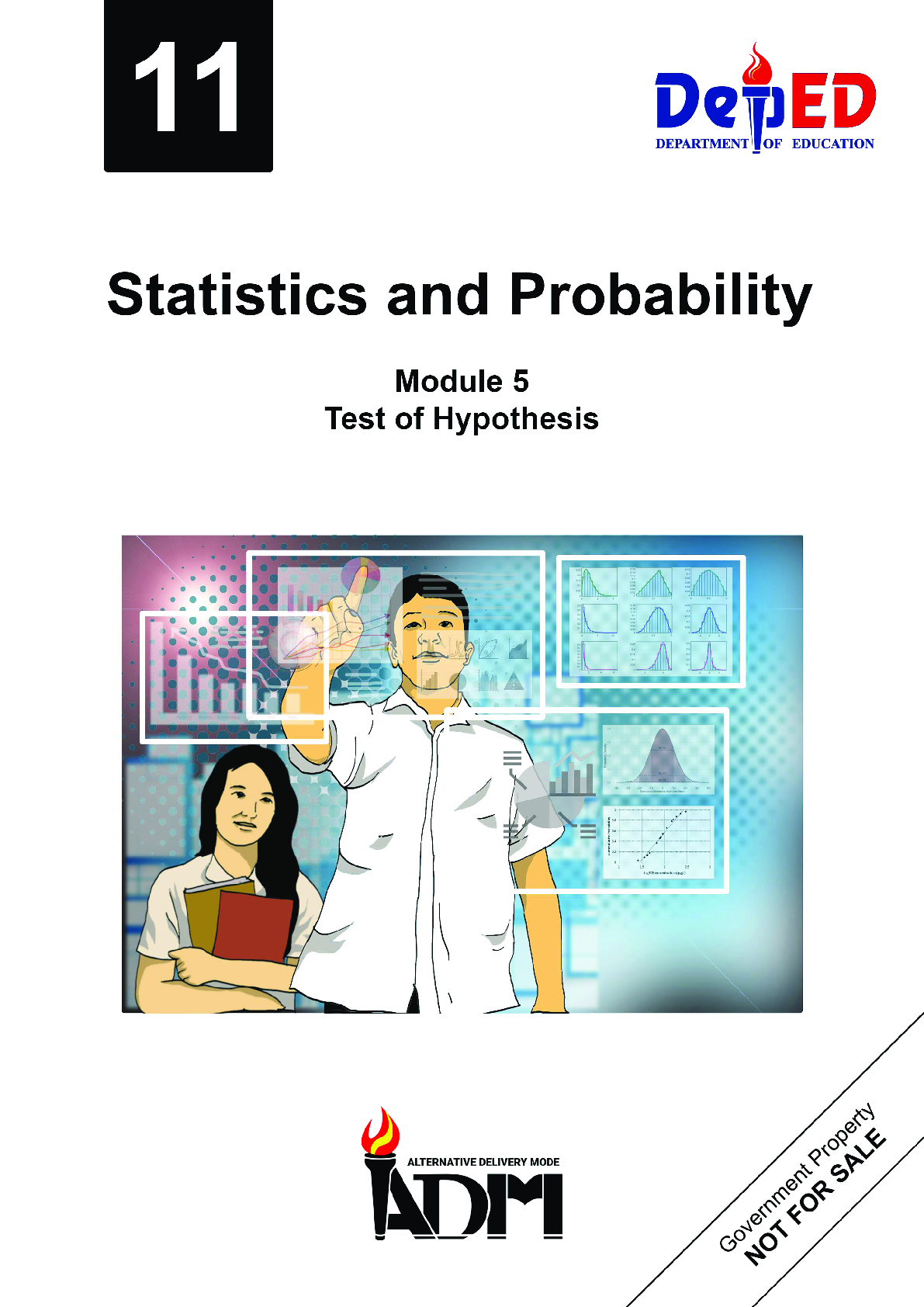
11
Statistics and
Probability
Module 5
Test of Hypothesis
Department of Education • Republic of the Philippines
This instructional material was collaboratively developed and reviewed
by educators from public and private schools, colleges, and/or universities. We
encourage teachers and other education stakeholders to email their feedback,
comments, and recommendations to the Department of Education at
[email protected].
We value your feedback and recommendations.v
Table of Contents
Overview ……………………………………..……..…… 1
Module Content ………………………………………………… 1
What I Need to Know ………………………………………………… 2
General Instructions ………………………………………………… 3
What I Know ………………………………………………… 4
Lessons/Concept
Lesson 1 – Basic Concepts in Hypothesis Testing……………… 6
Activity 1 ………………………………………………… 6
Activity 2 …………….………………………………..… 7
Activity 3 ……………………………………………..…. 11
Activity 4 ………………………………………………… 15
Lesson 2 – Rejection Region and Level of Significance ……… 16
Activity 1 …………….………………………………… 21
Lesson 3 – Test on Population Mean…………………………….. 23
Activity 1 ………………………………………………… 23
Activity 2 ………………………………………………… 29
Lesson 4 – Test on Population Proportion .……………………… 30
Activity 1 ………………………………………………… 32
Activity 2 ………………………………………………… 35
Assessment ………………………………………………… 36
References ………………………………………………… 471
Module 5
Test of Hypothesis
Overview
Hypothesis testing is a statistical method that is used in making
statistical decisions using experimental data. Basically, it is a process of gathering
evidences to either accept or reject a claim, a guess, or an assumption, known as
hypothesis.
In real life, we are doing hypothesis testing every time we need to make
decisions on something that affect our lives. As students you need to make decisions
by looking both the positive and negative sides of the problem that confronted you
before making any decision. Unknowingly, your decision to enroll in the Open Senior
High School went to a series of hypothesis testing. You were confronted with a lot of
“what ifs” until finally you decided to be here, one of the pioneers of the Open Senior
High School Program.
In the previous module, you learned that statistical inference is concerned with
either estimation or evaluation of a statement or claim about a parameter or a
distribution. The focus of this module is on evaluation of a claim about a parameter or
a distribution which is done through a statistical test of hypothesis.
This module will equip you with the basic knowledge in testing hypothesis
concerning population mean and population proportion which in turn will prepare you
to your future journey to the world of practical research. The lessons are arranged and
presented in an easier way and are supplemented with activities and exercises that
would concretize your learning. So, sit back, relax and enjoy doing the module.
Module Contents
The lessons that we will be dealing with are the following:
Lesson 1 – Basic Concepts in Hypothesis Testing
Lesson 2 – Rejection Region and Level of Significance
Lesson 3 – Test on Population Mean
Lesson 4 – Test on Population Proportion2
What I need to know?
Once you are done with this module, you should be able to:
1. illustrate (a) null hypothesis, (b) alternative hypothesis, (c) level of significance, (d)
rejection region, and (e) types of errors in hypothesis testing (M11/12SP-IVa-1).
2. calculates the probabilities of committing a Type I and Type II error (M11/12SPIVa-2).
3. identifies the parameter to be tested given a real-life problem (M11/12SP-IVa-3)
4. formulate the appropriate null and alternative hypothesis on a population mean
(M11/12SP-IVb-1)
5. identify the appropriate form of the test-statistic when:
(a) the population variance is assumed to be known
(b) the population variance is assumed to be unknown; and
(c) the Central Limit Theorem is to be used (M11/12SP-IVb-2)
6. identify the appropriate rejection region for a given level of significance when:
(a) the population variance is assumed to be known
(b) the population variance is assumed to be unknown
(c) the Central Limit Theorem is to be used (M11/12SP-IVc-1)
7. compute for the test-statistic value of population mean (M11/12SP-IVd-1).
8. draw conclusion about the population mean based on the test-statistic value and
the rejection region (M11/12SP-IVd-2).
9. solve problems involving test of hypothesis on the population mean (M11/12SPIVe-1).
10.formulate appropriate null and alternative hypotheses on a population proportion
(M11/12SP-IVe-2),
11.identify the appropriate form of test statistic when the Central Limit Theorem is to
be used (M11/12SP-IVe-3),
12.identify the appropriate rejection region for a given level of significance when the
Central Limit Theorem is to be used (M11/12SP-IVe-4),
13.compute for the test statistic value of population proportion (M11/12SP-IVf-1),
14.draw conclusion about the population proportion based on the test-statistic value
and the rejection region (M11/12SP-IVf-2), and
15. Solve problems involving test of hypothesis on the population proportion
(M11/12SP-IVf-2)

.png)
 2e Peter Olver, Chehrzad Shakiban.png)