Lesson 1: Introduction, History,
and Internet Architecture
Lesson 1 Readings
A Brief History of the Internet
Notes
Internet Architecture
Internet Architecture Introduction Transcript
The OSI Model (Open Systems In
...
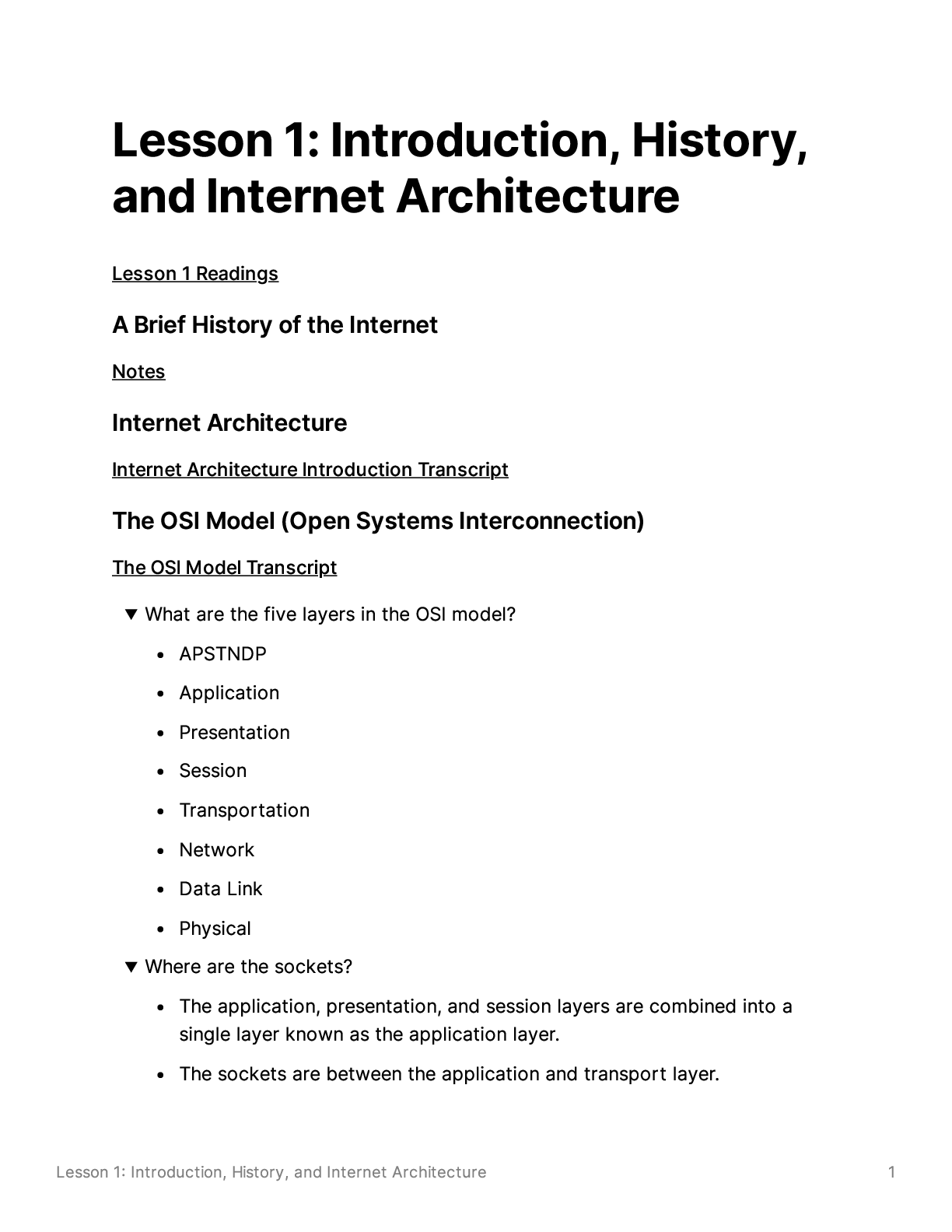
Lesson 1: Introduction, History,
and Internet Architecture
Lesson 1 Readings
A Brief History of the Internet
Notes
Internet Architecture
Internet Architecture Introduction Transcript
The OSI Model (Open Systems Interconnection)
The OSI Model Transcript
What are the five layers in the OSI model?
APSTNDP
Application
Presentation
Session
Transportation
Network
Data Link
Physical
Where are the sockets?
The application, presentation, and session layers are combined into a
single layer known as the application layer.
The sockets are between the application and transport layer.Lesson 1{ Introduction, History, and Internet Architecture 2
Application, Presentation, and Session Layers
Application, Presentation, and Session Layers Transcript
What does the application layer do?
It varies based on the application, but it is primarily to display information.
What does the presentation layer do?
It converts the data into a format that can be presented.
What does the session layer do?
It combines and synchronizes different streams of information.
Transport and Network Layer
Transport and Network Layer Transcript
What does the transport layer do?
Communication between end hosts
Congestion control
What does the network layer do?
It moves datagrams (packets) between internet hosts.
Data Link and Physical Layer
Data Link and Physical Layer Transcript
Layer Encapsulation
Layers Encapsulation Transcript
The End to End Principle
The End to End Principle Transcript
Violations of the End-to-End Principle and NAT BoxesLesson 1{ Introduction, History, and Internet Architecture 3
Violations of the End-to-End Principle and NAT Boxes Transcript
What are examples violations of the e2e principle?
firewalls
network address translation ANATB boxes
The Hourglass Shape of Internet Architecture
The Hourglass Shape of Internet Architecture Transcript
Evolutionary Architecture Model
Evolutionary Architecture Model
Which of the following are ramifications of the “hourglass shape of the
internet”?
A. Many technologies that were not originally designed for the internet have
been modified so that they have versions that can communicate over the
internet (such as Radio over IPB.
B. It has been a difficult and slow process to transition to IPv6, despite the
shortage of public IPv4 addresses.
C. Applications like BitTorrent leverage peer-to-peer networking instead of a
more traditional client-server model for better performance.
A is correct. Modifying a technology so that it is compatible with the rest
of the internet (i.e., by making it compatible with IPB greatly enhances
market penetration (from the vendor’s perspective), and/or decreases the
amount of extra development that would need to happen.
B is correct. A big part of the Internet infrastructure uses IPV4 while the
cost of transitioning is high. This reflects as a consequence of the narrow
waist.
C is not relevant here. The hourglass shape of the Internet refers to
Internet architecture in terms of protocols available at the different layers.
Optional Reading: Architecture Redesign
Architecture RedesignLesson 1{ Introduction, History, and Internet Architecture 4
Interconnecting Hosts and Networks
Interconnecting Hosts and Networks
Repeaters and hubs operate on which layer?
Physical AL1B
Bridges operate on which layer?
Data link based on MAC addresses AL2B
Routers operate on which layer?
Network AL3B
Learning Bridges
Learning Bridges
How does a bridge learn?
A forwarding table
Looping Problem in Bridges and the Spanning Tree Algorithm
Looping Problem in Bridges and the Spanning Tree Algorithm Transcript
Which of the following statements are correct?
A. The Spanning Tree Algorithm helps to prevent broadcast storms
B. The Spanning Tree Algorithm presented in this lecture always results in a
spanning tree that places the root in a topologically central location, so that all
the nodes are as “close” as possible to the root.
C. Network traffic cannot traverse an inactive link.
A is correct. That is the purpose of the Spanning Tree Algorithm.
Although it is still possible to have broadcast storms on the network
(such as from a bad network card), STP prevents broadcast storms that
result from having loops present in the network topology.
B is incorrect. The Spanning Tree Algorithm presented guarantees a
unique spanning tree that all the nodes will agree to, but sometimes this
[Show More]