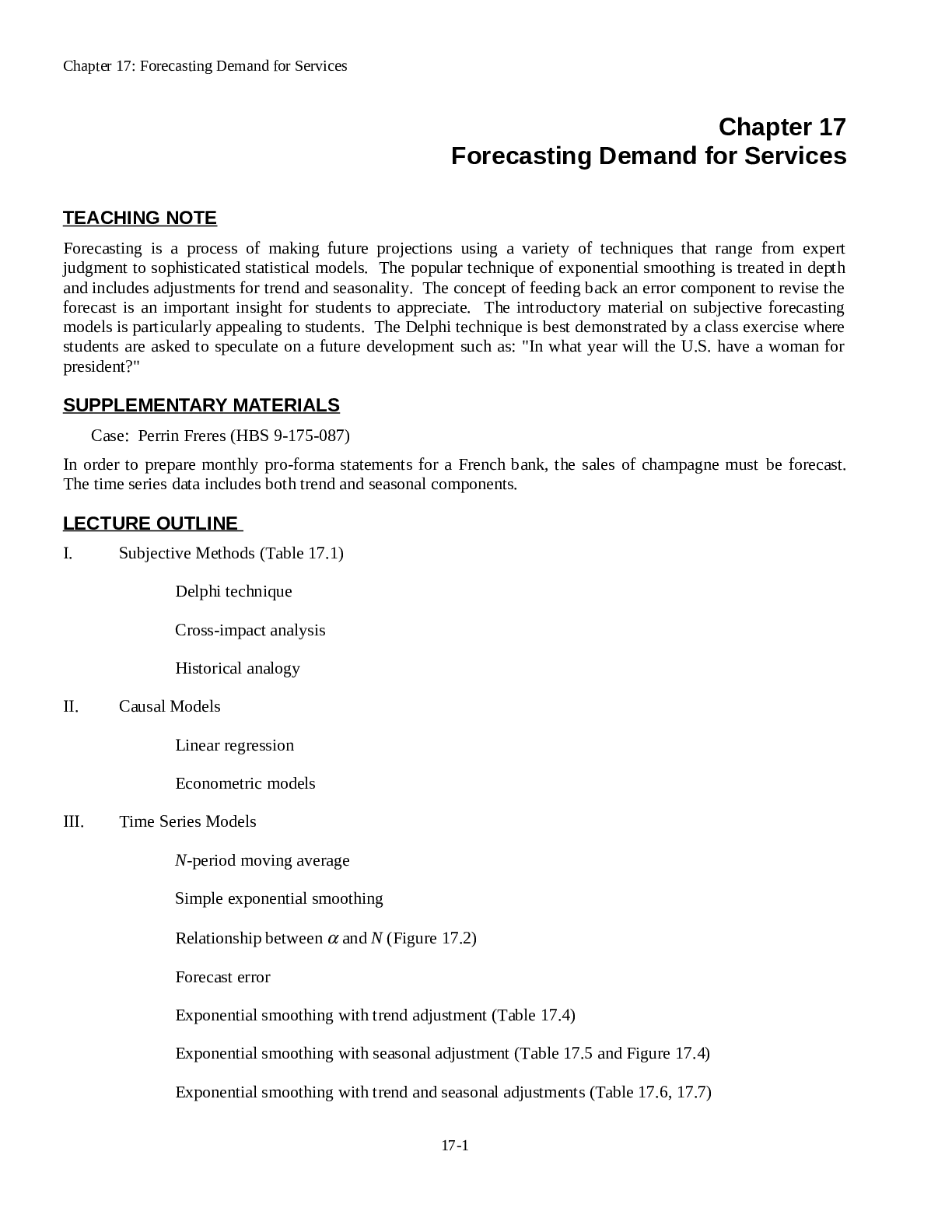
Chapter 17
Forecasting Demand for Services
TEACHING NOTE
Forecasting is a process of making future projections using a variety of techniques that range from expert
judgment to sophisticated statistical models. The po
...
Chapter 17
Forecasting Demand for Services
TEACHING NOTE
Forecasting is a process of making future projections using a variety of techniques that range from expert
judgment to sophisticated statistical models. The popular technique of exponential smoothing is treated in depth
and includes adjustments for trend and seasonality. The concept of feeding back an error component to revise the
forecast is an important insight for students to appreciate. The introductory material on subjective forecasting
models is particularly appealing to students. The Delphi technique is best demonstrated by a class exercise where
students are asked to speculate on a future development such as: "In what year will the U.S. have a woman for
president?"
SUPPLEMENTARY MATERIALS
Case: Perrin Freres (HBS 9-175-087)
In order to prepare monthly pro-forma statements for a French bank, the sales of champagne must be forecast.
The time series data includes both trend and seasonal components.
LECTURE OUTLINE
I. Subjective Methods (Table 17.1)
Delphi technique
Cross-impact analysis
Historical analogy
II. Causal Models
Linear regression
Econometric models
III. Time Series Models
N-period moving average
Simple exponential smoothing
Relationship between α and N (Figure 17.2)
Forecast error
Exponential smoothing with trend adjustment (Table 17.4)
Exponential smoothing with seasonal adjustment (Table 17.5 and Figure 17.4)
Exponential smoothing with trend and seasonal adjustments (Table 17.6, 17.7)
17-1
Summary of exponential smoothing
TOPICS FOR DISCUSSION
1. What characteristics of service organizations make forecast accuracy important?
Demand for services can vary by the season of the year, the month, day of the week, and hour of the day.
Planning for staff levels that can meet the expected demand must be done in advance in order to make full use of
perishable service capacity. Accurate forecasts of customer demand allow effective management of service
capacity that will avoid creating idle resources and excessive customer waiting.
2. For each of the three forecasting methods (i.e., time series, causal, and subjective), what costs are associated
with the development and use of the forecast model? What costs are associated with forecast error?
Developmental costs include data collection, model structuring, computer programming, and model validation.
Time series modeling is the least costly to develop and use because it tracks only one variable and uses a simple
computer model. Causal models such as multiple regression analysis are more costly because considerable data
collection time and analysis is needed to identify the appropriate dependent variables and validate the model.
Subjective models are labor intensive by nature.
After the models are developed and implemented, forecasting costs include collecting revised data on the
dependent variables which, in the case of time series models, can be done automatically and in real time using
point-of-sale computer terminals. Subjective forecasting models are the most expensive, because experts must be
reconvened each time a new forecast is required.
The costs associated with forecasting vary with the forecasting applications. For example, time series models are
often used to forecast demand over the short term (e.g., hourly demand at a fast food restaurant) and the costs of
error are measured in idle resources or waiting customers. Causal models are often used for long range planning
decisions such as site selections for motels. Errors can result in poor investment decisions or an inadequate
estimate of capacity needs. Subjective models are used for "crystal ball" projections of the future for which very
long-range planning is based. An error in this case can result in making business decisions based on anticipated
trends that never materialize.
3. The number of customers at a bank is likely to vary by the hour of the day and by the day of the month. What
are the implications of this for choosing a forecasting model?
A forecasting model such as exponential smoothing should be selected, because it is appropriate for a short-term
planning horizon. The exponential smoothing model with seasonal adjustment could be developed to account for
the hourly and daily variations. However, the forecast would probably be disaggregated by hour of the day and
day of the month (e.g., Fridays between 2 and 3 p.m.) and then each period would be subjected to simple
exponential smoothing.
4. Suggest a number of independent variables for a regression model to predict the potential sales volume of a
given location for a retail store (e.g., a video rental store).
• Number of VCR's per household
• Level of education
• Number of children per household
• Age of head of household
• Residential population density
5. Why is the N-period moving-average model still in common use if the simple exponential smoothing model has
superior qualities?
[Show More]