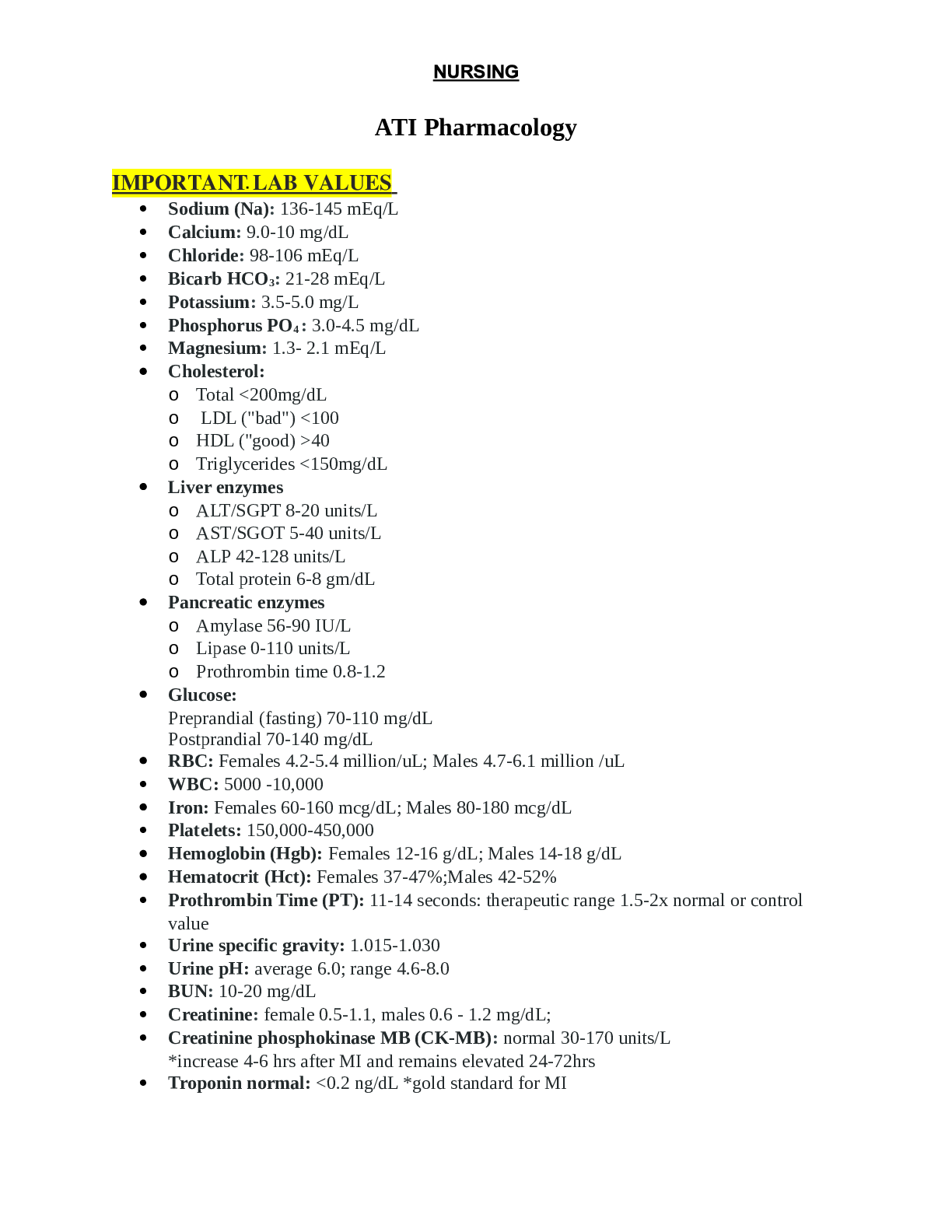
Medical-Surgical A
1. 1.ID: 310945742
Which milestone indicates to the nurse successful achievement of young adulthood?
o Demonstrates a conceptualization of death and dying.
o Completes education and becomes self-su
...
Medical-Surgical A
1. 1.ID: 310945742
Which milestone indicates to the nurse successful achievement of young adulthood?
o Demonstrates a conceptualization of death and dying.
o Completes education and becomes self-supporting. Correct
o Creates a new definition of self and roles with others. Incorrect
o Develops a strong need for parental support and approval.
Transitioning through young adulthood is characterized by establishing independence as
an adult, and includes developmental tasks such as completing education, beginning a
career, and becoming self-supporting (B). (A and C) are characteristic of adolescence.
Although strong bonds with parents are an expected finding for this age group, the need
for support and approval (D) indicates dependency, which is a developmental delay.
Awarded 0.0 points out of 1.0 possible points.
2. 2.ID: 310959831
The nurse working on a telemetry unit finds a client unconscious and in pulseless
ventricular tachycardia (VT). The client has an implanted automatic defibrillator. What
action should the nurse implement?
o Prepare the client for transcutaneous pacemaker.
o Shock the client with 200 joules per hospital policy. Correct
o Use a magnet to deactivate the implanted pacemaker.
o Observe the monitor until the onset of ventricular fibrillation.
The client must be externally shocked (B) to restore an effective cardiac rhythm. The
automatic defibrillator is obviously malfunctioning. (A) will not be effective during
ventricular tachycardia, since it is used for asystole. Since the defibrillator is not
functioning, (C) is not warranted. The client should be treated immediately to restore
cardiac output (D).
Awarded 1.0 points out of 1.0 possible points.
3. 3.ID: 311013679
How should the nurse position the electrodes for modified chest lead one (MCL I)
telemetry monitoring?
o Positive polarity right shoulder, negative polarity left shoulder, ground left chest
nipple line.
o Positive polarity left shoulder, negative polarity right chest nipple line, ground left
chest nipple line.
o Positive polarity right chest nipple line, negative polarity left chest nipple line,
ground left shoulder.
o Negative polarity left shoulder, positive polarity right chest nipple line, ground
left chest nipple line. Correct
In MCL I monitoring, the positive electrode is placed on the client's mid-chest to the right
of the sternum, and the negative electrode is placed on the upper left part of the chest (D).
The ground may be placed anywhere, but is usually placed on the lower left portion of
the chest. (A, B, and C) describe incorrect placement of electrodes for telemetry
monitoring.
Awarded 1.0 points out of 1.0 possible points.
4. 4.ID: 310950770
Based on the analysis of the client's atrial fibrillation, the nurse should prepare the client
for which treatment protocol?
o Diuretic therapy.
o Pacemaker implantation.
o Anticoagulation therapy. Correct
o Cardiac catheterization.
The client is experiencing atrial fibrillation, and the nurse should prepare the client for
anticoagulation therapy (C) which should be prescribed before rhythm control therapies
to prevent cardioembolic events which result from blood pooling in the fibrillating atria.
(A, B, and D) are not indicated.
Awarded 1.0 points out of 1.0 possible points.
5. 5.ID: 310959877
In preparing to administer intravenous albumin to a client following surgery, what is the
priority nursing intervention? (Select all that apply.)
o Set the infusion pump to infuse the albumin within four hours. Correct
o Compare the client's blood type with the label on the albumin.
o Assign a UAP to monitor blood pressure q15 minutes. Incorrect
o Administer through a large gauge catheter. Correct
o Monitor hemoglobin and hematocrit levels. Correct
o Assess for increased bleeding after administration. Correct
(A, D, E, and F) are the correct selections. Albumin should be infused within four hours
because it does not contain any preservatives. Any fluid remaining after four hours should
be discarded (A). Albumin administration does not require blood typing (B). Vital signs
should be monitored periodically to assess for fluid volume overload, but every 15
minutes is not necessary (C). This frequency is often used during the first hour of a blood
transfusion. A large gauge catheter (D) allows for fast infusion rate, which may be
necessary. Hemodilution may decrease hemoglobin and hematocrit levels (E), while
increased blood volume and blood pressure may cause bleeding (F).
Awarded 0.0 points out of 1.0 possible points.
6. 6.ID: 310944546
A client who has heart failure is admitted with a serum potassium level of 2.9 mEq/L.
Which action is most important for the nurse to implement?
[Show More]


.png)
x.png)


![Preview of NUR2488 / NUR 2488 Exam 2 Study Guide [In Class Review] : Mental Health Nursing - Rasmuss](https://scholarfriends.com/storage/Mental Health Exam 2 Study Guide [In class review] MY21.png)