PassPoint Hemodynamic Quiz
QUESTION 1
A client has had a pulmonary artery catheter inserted. In performing hemodynamic monitoring with the catheter, the nurse will wedge the catheter to gain information about:
You Sel
...
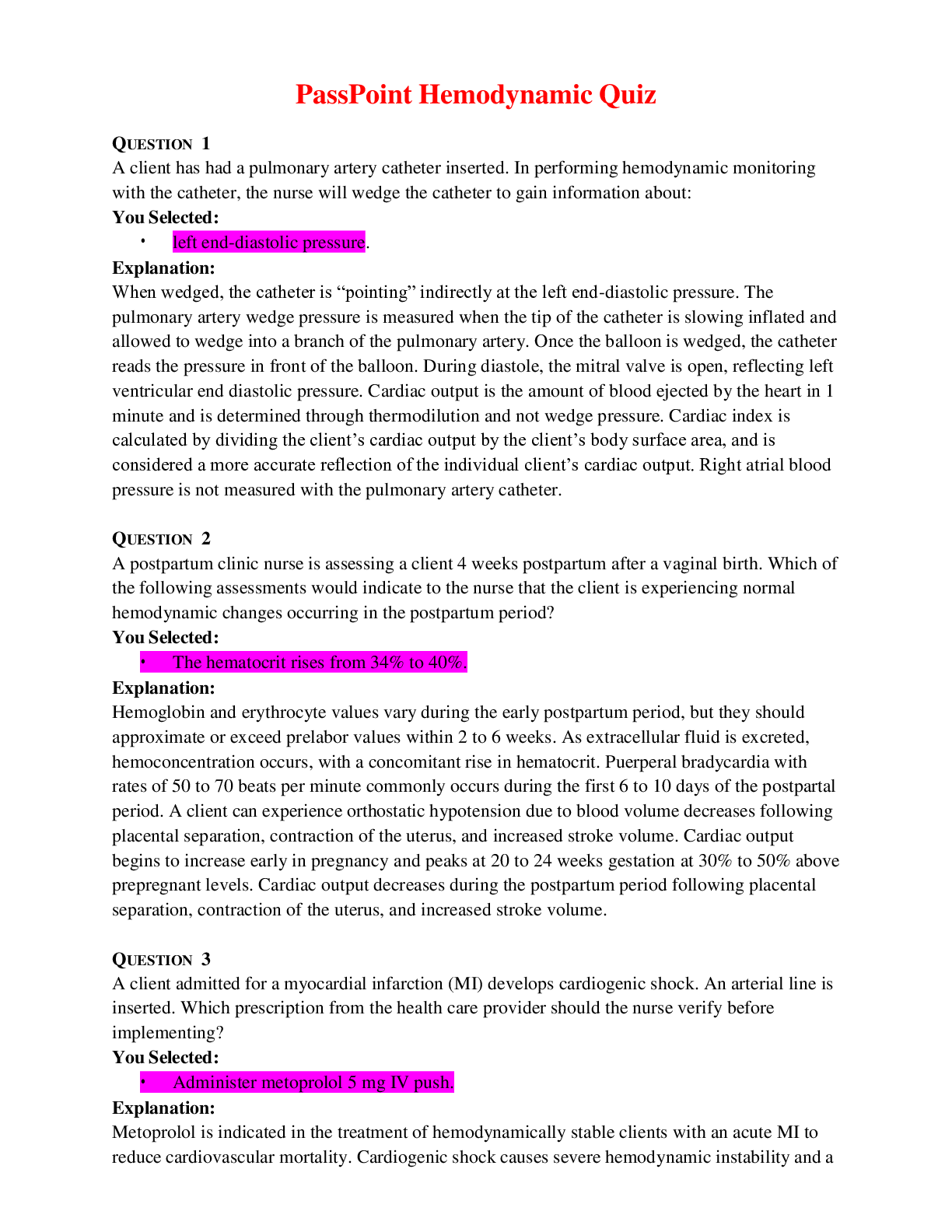
PassPoint Hemodynamic Quiz
QUESTION 1
A client has had a pulmonary artery catheter inserted. In performing hemodynamic monitoring with the catheter, the nurse will wedge the catheter to gain information about:
You Selected:
• left end-diastolic pressure.
Explanation:
When wedged, the catheter is “pointing” indirectly at the left end-diastolic pressure. The pulmonary artery wedge pressure is measured when the tip of the catheter is slowing inflated and allowed to wedge into a branch of the pulmonary artery. Once the balloon is wedged, the catheter reads the pressure in front of the balloon. During diastole, the mitral valve is open, reflecting left ventricular end diastolic pressure. Cardiac output is the amount of blood ejected by the heart in 1 minute and is determined through thermodilution and not wedge pressure. Cardiac index is calculated by dividing the client’s cardiac output by the client’s body surface area, and is considered a more accurate reflection of the individual client’s cardiac output. Right atrial blood pressure is not measured with the pulmonary artery catheter.
QUESTION 2
A postpartum clinic nurse is assessing a client 4 weeks postpartum after a vaginal birth. Which of the following assessments would indicate to the nurse that the client is experiencing normal hemodynamic changes occurring in the postpartum period?
You Selected:
• The hematocrit rises from 34% to 40%.
Explanation:
Hemoglobin and erythrocyte values vary during the early postpartum period, but they should approximate or exceed prelabor values within 2 to 6 weeks. As extracellular fluid is excreted, hemoconcentration occurs, with a concomitant rise in hematocrit. Puerperal bradycardia with rates of 50 to 70 beats per minute commonly occurs during the first 6 to 10 days of the postpartal period. A client can experience orthostatic hypotension due to blood volume decreases following placental separation, contraction of the uterus, and increased stroke volume. Cardiac output begins to increase early in pregnancy and peaks at 20 to 24 weeks gestation at 30% to 50% above prepregnant levels. Cardiac output decreases during the postpartum period following placental separation, contraction of the uterus, and increased stroke volume.
QUESTION 3
A client admitted for a myocardial infarction (MI) develops cardiogenic shock. An arterial line is inserted. Which prescription from the health care provider should the nurse verify before implementing?
You Selected:
• Administer metoprolol 5 mg IV push.
Explanation:
Metoprolol is indicated in the treatment of hemodynamically stable clients with an acute MI to reduce cardiovascular mortality. Cardiogenic shock causes severe hemodynamic instability and a
beta blocker will further depress myocardial contractility. The metoprolol should be discontinued. The decrease in cardiac output will impair perfusion to the kidneys. Cardiac output, hemodynamic measurements, and appropriate interventions can be determined with a PA catheter. Dobutamine will improve contractility and increase the cardiac output that is depressed in cardiogenic shock.
QUESTION 4
A client is receiving dopamine hydrochloride for treatment of shock. What action should the nurse take?
You Selected:
• Monitor blood pressure continuously.
Explanation:
The client who is receiving dopamine hydrochloride requires continuous blood pressure monitoring with an invasive or noninvasive device. The nurse may titrate the IV infusion to maintain a systolic blood pressure of 90 mm Hg. Administration of a pain medication concurrently with dopamine hydrochloride, which is a potent sympathomimetic with dose- related alpha-adrenergic agonist, beta 1-selective adrenergic agonist, and dopaminergic blocking effects, is not an essential nursing action for a client who is in shock with already low hemodynamic values. Arterial blood gas concentrations should be monitored according to the client’s respiratory status and acid-base balance status and are not directly related to the dopamine hydrochloride dosage. Monitoring for signs of infection is not related to the nursing action for the client receiving dopamine hydrochloride.
QUESTION 5
A pulmonary artery catheter is inserted in a client with severe mitral stenosis and regurgitation. The nurse administers furosemide to treat pulmonary congestion and begins a nitroprusside drip as prescribed. The nurse notices a sudden drop in the pulmonary artery diastolic pressure and pulmonary artery wedge pressure. The nurse should first assess:
You Selected:
• 12-lead EKG.
Correct response:
• blood pressure.
Explanation:
The nurse should immediately assess the blood pressure since nitroprusside and furosemide can cause severe hypotension from a decrease in preload and afterload. If the client is hypotensive, the nitroprusside dose should be reduced or discontinued. Urine output should then be monitored to make sure there is adequate renal perfusion. A 12-lead EKG is performed if the client experiences chest pain. A reduction in pulmonary artery pressures should improve the pulmonary congestion and lung sounds.
QUESTION 6
Following a left anterior myocardial infarction, a client undergoes insertion of a pulmonary artery catheter. Which finding most strongly suggests left-sided heart failure?
You Selected:
• Increased pulmonary artery diastolic pressure
Explanation:
Increased pulmonary artery diastolic pressure suggests left-sided heart failure. Central venous pressure increases in heart failure rather than decreases. The cardiac index decreases in heart failure. The mean pulmonary artery pressure increases in heart failure.
QUESTION 7
A client with a history of myocardial infarction is admitted with shortness of breath, anxiety, and slight confusion. Assessment findings include a regular heart rate of 120 beats/minute, audible third and fourth heart sounds, blood pressure of 84/64 mm Hg, bibasilar crackles on lung auscultation, and a urine output of 5 ml over the past hour. The nurse anticipates preparing the client for transfer to the intensive care unit and pulmonary artery catheter insertion because:
You Selected:
• the client is going into cardiogenic shock.
Explanation:
This client's findings indicate cardiogenic shock, which occurs when the heart fails to pump properly, impeding blood supply and oxygen flow to vital organs. Cardiogenic shock also may cause cold, clammy skin and generalized weakness, fatigue, and muscle pain as poor blood flow causes lactic acid to accumulate and prevents waste removal. Left-sided and right-sided heart failure eventually cause venous congestion with jugular vein distention and edema as the heart fails to pump blood forward. A ruptured aneurysm causes severe hypotension and a quickly deteriorating clinical status from blood loss and circulatory collapse; this client has low but not severely decreased blood pressure. Also, in ruptured aneurysm, deterioration is more rapid and full cardiac arrest is common.
QUESTION 8
A client with a history of an anterior wall myocardial infarction is being transferred from the coronary care unit (CCU) to the cardiac step-down unit (CSU). While giving a report to the CSU nurse, the CCU nurse says, "His pulmonary artery wedge pressures have been in the high normal range." The CSU nurse should be especially observant for:
You Selected:
• hypertension.
Correct response:
• pulmonary crackles.
Explanation:
High pulmonary artery wedge pressures are diagnostic for left-sided heart failure. With left-sided heart failure, pulmonary edema can develop causing pulmonary crackles. In left-sided heart failure, hypotension may result and urine output will decline. Dry mucous membranes aren't directly associated with elevated pulmonary artery wedge pressures.
QUESTION 9
A client in the intensive care unit has an arterial line which reads 58/30 mm Hg on the monitor. What is the nurse’s first action?
You Selected:
• Recalibrate the arterial line
Correct response:
• Obtain a manual blood pressure
Explanation:
The first action would be to assess the blood pressure manually. If the A-Line is accurate, the client should be placed in trendelenberg position. If it is not accurate, the arterial line should be flushed and recalibrated.
QUESTION 10
The nurse is assessing a client who has had a myocardial infarction. The nurse reviews the client's ECG strip (view the figure) and notices a premature ventricular contraction (PVC). Identify the PVC on this cardiac rhythm strip.
You Selected:
Your selection and the correct area, market by the green box.
Explanation:
The client is having one PVC on this ECG strip.
QUESTION 11
A nurse is caring for a monitored client on the telemetry unit. When analyzing a cardiac monitor strip, the nurse notes an abnormality in the QRS wave on lead II. Identify the area in the conduction cycle of the heart where this abnormality occurs.
You Selected:
Your selection and the correct area, market by the green box.
Explanation:
The correct location is the left ventricle. The electrocardiography (ECG) shows the electrical activity of the heart over time as detected by electrodes attached to the body surface. Lead II is noted as a limb lead. The QRS complex reflects the rapid depolarization of the right and left ventricles, thus an abnormality in the ventricular conduction will be reflected in the QRS wave.
QUESTION 12
A client with a bicuspid aortic valve has severe stenosis and is scheduled for valve replacement. The client expresses anxiety over the surgical procedure and future implications. As the nurse explains the normal blood flow through the heart, at which location would the nurse highlight the location of the faulty valve?
You Selected:
Your selection and the correct area, market by the green box.
Explanation:
The aortic valve is located between the left ventricle and the aorta. It's one of the semilunar valves and normally has three cusps. A person with a bicuspid aortic valve is at risk for aortic stenosis and aortic regurgitation. This impaired blood flow through the valve leads to increased pumping pressure of the left ventricle.
QUESTION 13
A nurse is caring for a client who states crushing chest pressure over the sternum. The nurse places the client on oxygen and performs a 12-lead ECG. Identify the site where lead V6 would be placed.
You Selected:
Your selection and the correct area, market by the green box.
Explanation:
The standard 12-lead ECG tracing is a representation of the heart’s electrical activity recorded from electrodes on the body surface. The V6 lead would be placed at the fifth intercostal space, at
the midaxillary line. Correct lead placement is essential when performing a 12-lead ECG in order to accurately document the electrical potential of the heart. V6 is one of the precordial leads and, combined with the other leads, records potential in the horizontal plane.
QUESTION 14
Indicate on the illustration the area that correctly identifies the position of the distal tip of a central line that is inserted into the subclavian vessel.
You Selected:
Your selection and the correct area, market by the green box.
Explanation:
The distal tip of a central line lies in the superior vena cava or right atrium.
QUESTION 15
The nurse is preparing to do a 12-lead ECG on a client. Indicate the correct area where the V2electrode would be placed on the figure below.
You Selected:
Your selection and the correct area, market by the green box.
Explanation:
The V2 electrode would be placed over the fourth intercostal space, at the left sternal border.
QUESTION 16
The nurse is preparing to measure central venous pressure (CVP). Mark the spot on the torso indicating the location for leveling the transducer.
You Selected:
Your selection and the correct area, market by the green box.
Explanation:
Correct location: The zero point on the CVP transducer needs to be at the level of the right atrium. The right atrium is located at the midaxillary line at the fourth intercostal space. The phlebostatic axis is determined by drawing an imaginary vertical line from the fourth intercostal space at the sternal border to the right side of the chest (A). A secondary imaginary line is drawn horizontally at the level of the midpoint between the anterior and posterior surfaces of the chest (B). The phlebostatic axis is located at the intersection of points A and B.
QUESTION 17
A nurse is assessing a client with a brain injury. What is a client’s cerebral perfusion pressure (CPP) when the blood pressure (BP) is 90/50 mm Hg and the intracranial pressure (ICP) is 21? Round to the nearest whole number.
Your Response:
• 52
Correct response:
• 42
Explanation:
To obtain CPP, use this formula:
CPP = mean arterial pressure (MAP) – ICP. To obtain the MAP, use this formula:
MAP = [systolic BP + (2 × diastolic BP)] ÷ 3
MAP = [90 + (2 × 50)] ÷ 3 = 63.3
CPP = 63.3 – 21 = 42.3 mm Hg, which rounds down to 42 mm Hg.
QUESTION 18
A client is admitted to the hospital with lower GI bleeding. His hemoglobin level on admission to the emergency department is 7.3 g/dl. The physician orders 2 units of packed red blood cells (RBCs) to infuse over 1 hour each. The blood administration set has a drip factor of 10 gtt/ml.
What is the flow rate in drops per minute? Record your answer using a whole number.
Your Response:
• 42
Explanation:
Each unit of packed RBCs contains 250 ml. Each unit is to infuse over 1 hour (60 minutes). Use the following equation:
250 ml/60 minutes = 4.16 ml. Multiply by the drip factor:
4.16 ml × 10 gtt = 41.6 gtt/minute (42 gtt/minute).
QUESTION 19
A client with sepsis and hypotension is being treated with dopamine. The nurse asks a colleague to double-check the dosage that the client is receiving. There are 400 mg of dopamine in 250 ml, the infusion pump is running at 23 ml/hour, and the client weighs 79.5 kg. How many micrograms per kilogram per minute is the client receiving? Record your answer using two decimal places.
Your Response:
• 7.71
Explanation:
First, calculate how many micrograms per milliliter of dopamine are in the bag: 400 mg/250 ml
= 1.6 mg/ml
Next, convert milligrams to micrograms:
1.6 mg/ml × 1,000 mcg/mg = 1,600 mcg/ml
Lastly, calculate the dose: 1,600 mcg/ml × 23 ml/hour/79.5 kg
79.5 kg/60 minutes/hour = 7.71 mcg/kg/minute
QUESTION 20
A nurse is caring for a client who recently had a bowel resection. The client has a hemoglobin level of 8 g/dl and HCT of 30%. Dextrose 5% in half-normal saline solution (D5½NS) is infusing through a triple-lumen central catheter at 125 ml/hour. The healthcare provider ’s orders include:
•gentamicin 80 mg intravenous piggyback in 50 ml D5W over 30 minutes
•ranitidine (Zantac) 50 mg intravenous in 50 ml D5W piggyback over 30 minutes
•one unit of 250 ml of packed red blood cells (RBCs) over 3 hours
•nasogastric tube flushes with 30 ml of normal saline solution every 2 hours
How many milliliters would the nurse document as the total intake for the 8-hour shift? Record your answer as a whole number.
Your Response:
• 1530
Correct response:
• 1470
Explanation:
I.V. of D5½NS at 125 ml × 8 hours = 1,000 ml Gentamicin piggyback = 50 ml
Ranitidine piggyback = 50 ml Packed red blood cells = 250 ml
Nasogastric flushes 30 ml × 4 = 120 ml Total = 1,470 ml
QUESTION 21
A nurse is assessing a client with increasing intracranial pressure. What is a client’s mean arterial pressure (MAP) in mm Hg when blood pressure (BP) is 120/60 mm Hg? Record your answer using a whole number.
Your Response:
• 80
Explanation:
To obtain the MAP, use this formula: MAP = [systolic BP + (2 X diastolic BP)]/3 MAP = [120 + (2 X 60)]/3 MAP = 240/3 = 80.
QUESTION 22
A client is to receive 1 unit of packed red blood cells over 2 hours. There are 250 mL in the infusion bag. The IV administration infusion set delivers 10 gtt/mL. At what flow rate (in drops per minute) should the nurse run the infusion? Record your answer using a whole number.
Your Response:
• 21
Explanation:
One unit of packed red blood cells contains 250 mL, and this is to infuse over 2 hours (120 minutes). First, determine the number of mL/minute by dividing 250 mL by 120 minutes: 250 mL/120 min = 2.1 mL/min. Then multiply by the drop factor of 10 gtt/mL: 2.1 mL/min × 10 gtt/mL = 21 gtt/min.
QUESTION 23
The nurse is assessing a client with chronic heart failure who is demonstrating neurohormonal compensatory mechanisms. Which are expected findings on assessment? Select all that apply. You Selected:
• decreased cardiac output
• fluid overload
• increased heart rate
• vasoconstriction in skin, GI tract, and kidneys
Explanation:
Heart failure can be a result of several cardiovascular conditions, which will affect the heart’s ability to pump effectively. The body attempts to compensate through several neurohormonal mechanisms. Decreased cardiac output stimulates the aortic and carotid baroreceptors, which activates the sympathetic nervous system to release norepinephrine and epinephrine. This early response increases the heart rate and contractility. It also has some negative effects, including vasoconstriction of the skin, GI tract, and kidneys. Decreased renal perfusion (due to low CO and vasoconstriction) activates the renin-angiotensin-aldosterone process resulting in the release of antidiuretic hormone. This causes fluid retention in an attempt to increase blood pressure, and therefore cardiac output. In the damaged heart, this causes fluid overload. There is no parasympathetic response. Decreased pulmonary perfusion can be a result of fluid overload or concomitant pulmonary disease.
QUESTION 24
An 85-year-old client is admitted to the emergency department (ED) at 2000 hours with syncope, shortness of breath, and reported palpitations (see nurse’s notes below). At 2015, the nurse places the client on the ECG monitor and identifies the above rhythm. What should the nurse do? Select all that apply.
You Selected:
• Monitor vital signs.
• Apply oxygen.
• Have the client sign consent for cardioversion as prescribed.
Explanation:
The client has atrial fibrillation and will have an irregularly irregular pulse and will commonly be tachycardic, with rapid ventricular responses (heart rates) typically in the 110 to 140 range, but rarely over 150 to 170. The goal of treatment is the restoration of sinus rhythm. With a heart rate greater than 150 and symptoms such as shortness of breath, dizziness and syncope, and chest pain, synchronized cardioversion will most likely be the treatment of choice. With more controlled heart rates and more minor signs and symptoms, chemical conversion with drugs such as diltiazem and digoxin prior to other interventions such as synchronized cardioversion with appropriate anticoagulation may be attempted. Because of the decreased cardiac output, monitoring is essential. Obtaining consent for cardioversion requires a prescription from a health care provider (HCP), but with the current heart rate, having cardioversion is a very strong possibility for this client. Defibrillation is used for ventricular fibrillation, not atrial fibrillation. Teaching the client about warfarin will be a possibility, but not an immediate intervention.
Clients in continued atrial fibrillation usually require some form of anticoagulation. Drawing labs for CBCs to detect anemia or infection, and thyroid function studies (to determine thyrotoxicosis, a rare, but not-to-be-missed cause, especially in older adults), serum electrolytes and BUN/creatinine (looking for electrolyte disturbances or renal failure) are commonly drawn for determining the cause of the atrial fibrillation; they are not an immediate action.
QUESTION 25
Shortly after being admitted to the coronary care unit with an acute myocardial infarction (MI), a client reports midsternal chest pain radiating down his left arm. The nurse notes that the client is restless and slightly diaphoretic, and measures a temperature of 99.6° F (37.6° C); a heart rate of 102 beats/minute; regular, slightly labored respirations at 26 breaths/minute; and a blood pressure of 150/90 mm Hg. Which nursing diagnosis takes highest priority?
You Selected:
• Acute pain
Explanation:
The nursing diagnosis of Acute pain takes highest priority because it increases the client's pulse and blood pressure. During the acute phase of an MI, low-grade fever is an expected result of the body's response to myocardial tissue necrosis. This makes Risk for imbalanced body temperature an incorrect answer. The client's blood pressure and heart rate don't suggest a nursing diagnosis of Decreased cardiac output. Anxiety could be an appropriate nursing diagnosis, but addressing Acute pain (the priority concern) may alleviate the client's anxiety.
QUESTION 26
A client with a history of heart failure is brought to the emergency department with severe dyspnea, anxiety, tachypnea, and tachycardia. Which of the following prescribed medications should the nurse administer first?
You Selected:
• Morphine sulfate 4 mg IV push
Explanation:
Morphine works quickly to decrease anxiety, improve alveolar gas exchange, and increase cardiac output by reducing ventricular preload and afterload. Additional treatment includes removing fluids with furosemide and improving oxygen supply to the cardiac muscle with nitroglycerin.
QUESTION 27
A nurse assesses a client who is in cardiogenic shock. Which statement by the nurse best indicates an understanding of cardiogenic shock?
You Selected:
• “A decrease of cardiac output and evidence of tissue hypoxia in the presence of adequate intravascular volume”
Explanation:
Shock may have different causes (e.g., hypovolemia, cardiogenic, septic), but always involves a decrease in blood pressure and failure of the peripheral circulation because of sympathetic nervous system involvement. Movement of plasma into the interstitial spaces could reflect dependent edema and sepsis. Decreased blood volume is an example of hypovolemia. A hypersensitivity reaction is an example of anaphylactic shock or distributive shock.
QUESTION 28
Which of the following statements indicate that a family member of a client in cardiogenic shock understands the need for an intra-aortic balloon pump?
You Selected:
• “This device decreases the heart’s need for oxygen.”
Explanation:
An intra-aortic balloon pump increases coronary perfusion and cardiac output, and decreases myocardial workload and oxygen consumption in a client with cardiogenic shock. A defibrillator is commonly used for termination of life-threatening ventricular rhythms.
QUESTION 29
A client returns to an intensive care unit after coronary artery bypass graft surgery, which was complicated by prolonged cardiopulmonary bypass and hypotension. After 3 hours in the unit, the client's condition stabilizes. However, the urine output has decreased despite adequate filling pressures. The nurse expects the physician to add which drug, at which flow rate, to the client's regimen?
You Selected:
• Dobutamine, 10 mcg/kg/minute
Correct response:
• Dopamine, 3 mcg/kg/minute
Explanation:
This client is at high risk for acute prerenal failure secondary to decreased renal perfusion during surgery. To dilate the renal arteries and help prevent renal shutdown, the physician is likely to order dopamine at a low flow rate (2 to 5 mcg/kg/minute). Although this drug has mixed dopaminergic and beta activity when given at 5 to 10 mcg/kg/minute, the client is stabilized and thus doesn't need the beta effects from the higher flow rate — or the sympathomimetic effects of epinephrine. The dopaminergic effects of dopamine increase renal perfusion, contractility, and vasodilation. Dobutamine is used to increase cardiac output. Norepinephrine is a potent vasoconstrictor that shunts blood away from the kidneys to increase blood pressure.
QUESTION 30
What is the major goal of nursing care for a client with heart failure and pulmonary edema?
You Selected:
• Increase cardiac output.
Explanation:
Increasing cardiac output is the main goal of therapy for the client with heart failure or pulmonary edema. Pulmonary edema is an acute medical emergency requiring immediate intervention. Respiratory status and comfort will be improved when cardiac output increases to an acceptable level. Peripheral edema is not typically associated with pulmonary edema.
QUESTION 31
A client is admitted with the following vital signs: temperature, 102° F (38.9° C); heart rate, 144 beats/minute and irregular; and respiratory rate, 26 breaths/minute. Which nursing diagnosis takes highest priority when planning this client's care?
You Selected:
• Ineffective thermoregulation
Correct response:
• Decreased cardiac output
Explanation:
A heart rate of 144 beats/minute indicates decreased diastolic filling time and a reduced blood volume ejected with each contraction, resulting in decreased cardiac output. The client's temperature and respiratory rate are elevated but not enough for a diagnosis of Ineffective thermoregulation or Decreased breathing pattern to take precedence over one of Decreased cardiac output. The client's vital signs don't suggest a diagnosis of Ineffective renal tissue perfusion.
QUESTION 32
Positive end-expiratory pressure (PEEP) therapy has which effect on the heart?
You Selected:
• Reduced cardiac output
Explanation:
PEEP reduces cardiac output by increasing intrathoracic pressure and reducing the amount of blood delivered to the left side of the heart. It doesn't affect heart rate, but a decrease in cardiac output may reduce blood pressure, commonly causing compensatory tachycardia, not bradycardia. However, the resulting tachycardia isn't a direct effect of PEEP therapy itself.
QUESTION 33
A client receives a pacemaker to treat a recurring arrhythmia. When monitoring the cardiac rhythm strip, the nurse observes extra pacemaker spikes that do not precede a beat. What intervention would have the highest priority?
You Selected:
• Assess the client's cardiac output.
Explanation:
Extra pacemaker spikes that do not precede a beat may indicate failure to capture, in which the pacemaker fires, but the heart does not conduct the beat. The priority nursing intervention would be to assess the client to see if the client is tolerating the failure to capture or if the client has a decrease in cardiac output. Until the nurse knows how the client is tolerating this, it will not be useful to call the primary healthcare provider or call a code. Assessment is the first step in the nursing process, and the nurse should assess the client, not just the rhythm strip. Applying a magnet is not an appropriate action of failure to capture, but for loss of pacing.
QUESTION 34
An older adult had a myocardial infarction (MI) 4 days ago. At 0930, the client’s blood pressure is 102/64 mm Hg. After reviewing the client’s progress notes (see chart), the nurse should first: You Selected:
• notify the health care provider (HCP).
Explanation:
All of the 1200 hour assessments are signs of decreased cardiac output and can be an ominous sign in a client who has recently experienced an MI; the nurse should notify the HCP< glicon> of these changes. Cardiac output and blood pressure may continue to fall to dangerous levels, which can induce further coronary ischemia and extension of the infarct. While the client is currently hypotensive, giving a fluid challenge/bolus can precipitate increased workload on a damaged heart and extend the myocardial infarction. Exercise or walking for this client will increase both the heart rate and stroke volume, both of which will increase cardiac output, but the increased cardiac output will increase oxygen needs especially in the heart muscle and can induce further coronary ischemia and extension of the infarct. The client is hypotensive. Although the client has decreased urinary output, this is the body’s response to a decreasing cardiac output, and it is not appropriate to administer furosemide.
QUESTION 35
The client who does not respond adequately to fluid replacement has an order for an IV infusion of dopamine hydrochloride at 5 mcg/kg/minute. To determine that the drug is having the desired effect, the nurse should assess the client for:
You Selected:
• increased cardiac output
Explanation:
At medium doses (4 to 8 mcg/kg/minute), dopamine hydrochloride slightly increases the heart rate and improves contractility to increase cardiac output and improve tissue perfusion. When given at low doses (0.5 to 3.0 mcg/kg/minute), dopamine increases renal and mesenteric blood flow. At high doses (8 to 10 mcg/kg/minute), dopamine produces vasoconstriction, which is an undesirable effect. Dopamine is not given to affect preload and afterload.
QUESTION 36
Which is characteristic of cardiogenic shock?
You Selected:
• hypovolemia
Correct response:
• decreased myocardial contractility
Explanation:
Cardiogenic shock occurs when myocardial contractility decreases and cardiac output greatly decreases. The circulating blood volume is within normal limits or increased. Infarction is not always the cause of cardiogenic shock.
QUESTION 37
A client in the intensive care unit (ICU) is on a dobutamine drip. During an assessment the client states, “I was feeling better but now my chest is tight and I feel like my heart is skipping.” Physical assessment reveals a heart rate of 110 beats per minute and blood pressure of 160/98 mm Hg. What is the nurse’s immediate concern for this client?
You Selected:
• The dobutamine may need to be decreased.
Explanation:
Dobutamine is a vasoactive adrenergic that works by increasing myocardial contractility and stroke volume in order to increase the cardiac output in heart failure clients. A serious side effect of adrenergic drugs is the worsening of a preexisting cardiac disorder. Increasing the dosage of the drug will worsen the problem. The client shows not symptoms of allergic reaction or heart failure.
QUESTION 38
After evaluating a client for hypertension, a physician orders atenolol, 50 mg P.O. daily. Which therapeutic effect should atenolol have?
You Selected:
• Decreased cardiac output and decreased systolic and diastolic blood pressure
Explanation:
As a long-acting, selective beta1-adrenergic blocker, atenolol decreases cardiac output and systolic and diastolic blood pressure; however, like other beta-adrenergic blockers, it increases peripheral vascular resistance at rest and with exercise. Atenolol may cause bradycardia, not tachycardia.
QUESTION 39
What mechanical device increases coronary perfusion and cardiac output and decreases myocardial workload and oxygen consumption in a client with cardiogenic shock?
You Selected:
• Intra-aortic balloon pump
Explanation:
Counterpulsation with an intra-aortic balloon pump may be indicated for temporary circulatory assistance in clients with cardiogenic shock. Cardiac pacemakers are used to maintain the heartbeat at a predetermined rate. Hypothermia-hyperthermia machines are used to cool or warm
clients with abnormalities in temperature regulation. The defibrillator is commonly used for termination of life-threatening ventricular rhythms.
QUESTION 40
A nurse knows that the major clinical use of dobutamine is to:
You Selected:
• increase cardiac output.
Explanation:
Dobutamine increases cardiac output for clients with acute heart failure and those undergoing cardiopulmonary bypass surgery. Physicians may use epinephrine hydrochloride, another catecholamine agent, to treat sinus bradycardia. Physicians use many of the catecholamine agents, including epinephrine, isoproterenol, and norepinephrine, to treat acute hypotension. They don't use catecholamine agents to treat hypertension because catecholamine agents may raise blood pressure.
QUESTION 41
A client is recovering from coronary artery bypass graft (CABG) surgery and begins to experience chest pain, shortness of breath, and tachycardia. Further assessment reveals a widened QRS complex and an elevated ST segment. Which nursing diagnosis takes highest priority at this time?
You Selected:
• Decreased cardiac output related to depressed myocardial function
Explanation:
For a client recovering from CABG surgery and experiencing these symptoms, decreased cardiac output is the most important nursing diagnosis. Complications of CABG include hemorrhage, dysrhythmias, and myocardial infarction (MI) leading to decreased cardiac output. Anxiety, activity intolerance, and acute pain may be relevant, but take lower priority at this time; maintaining cardiac output is essential to sustaining the client's life.
QUESTION 42
What is the most important goal of nursing care for a client who is in shock?
You Selected:
• Manage inadequate tissue perfusion.
Explanation:
Nursing interventions and collaborative management are focused on correcting and maintaining adequate tissue perfusion. Inadequate tissue perfusion may be caused by hemorrhage, as in hypovolemic shock; by decreased cardiac output, as in cardiogenic shock; or by massive vasodilation of the vascular bed, as in neurogenic, anaphylactic, and septic shock. Fluid deficit, not fluid overload, occurs in shock.
QUESTION 43
The client sustained an open fracture of the femur from an automobile accident. The nurse should assess the client for which type of shock?
You Selected:
• hypovolemic
Explanation:
A fractured femur, especially an open fracture, can cause much soft tissue damage and lead to significant blood loss. Hypovolemic shock can develop. Cardiogenic shock occurs when cardiac output is decreased as a result of ineffective pumping. Neurogenic shock occurs as a result of an impaired autonomic nervous system function. Anaphylactic shock is the result of an allergic reaction.
QUESTION 44
The nurse has completed an assessment on a client with a decreased cardiac output. Which findings should receive the highest priority?
You Selected:
• confusion, urine output 15 mL over the last 2 hours, orthopnea
Explanation:
A low urine output and confusion are signs of decreased tissue perfusion. Orthopnea is a sign of left-sided heart failure. Crackles, edema, and weight gain should be monitored closely, but the levels are not as high a priority. With atrial fibrillation, there is a loss of atrial kick, but the blood pressure and heart rate are stable.
QUESTION 45
A client seeks medical attention for dyspnea, chest pain, syncope, fatigue, and palpitations. A thorough physical examination reveals an apical systolic thrill and heave, along with a fourth heart sound (S4) and a systolic murmur. Diagnostic tests reveal that the client has hypertrophic cardiomyopathy (HCM). Which nursing diagnosis may be appropriate?
You Selected:
• Risk for deficient fluid volume
Correct response:
• Decreased cardiac output
Explanation:
Decreased cardiac output is an appropriate nursing diagnosis for a client with HCM because the hypertrophied cardiac muscle decreases the effectiveness of the heart's contraction, decreasing cardiac output. Heart failure may complicate HCM, causing fluid volume excess; therefore, the nursing diagnosis of Risk for deficient fluid volume isn't applicable. Ineffective thermoregulation and Risk for peripheral neurovascular dysfunction are inappropriate because HCM doesn't cause these problems.
QUESTION 46
A nurse is caring for a client with a central venous pressure (CVP) of 4 mm Hg. Which nursing intervention is appropriate?
You Selected:
• Continue to monitor the client as ordered.
Explanation:
Normal CVP ranges from 3 to 7 mm Hg. The nurse doesn't need to take any action other than to monitor the client. It isn't necessary to rezero the equipment. Calling a physician and obtaining an order for a fluid bolus would be an appropriate intervention if the client has a CVP less than 3
mm Hg. Administering a diuretic would be appropriate if the client had excess fluid, as demonstrated by a CVP greater than 7 mm Hg.
QUESTION 47
Which of the following statements indicates that a new graduate nurse understands central venous pressure (CVP) measurement when used on a client?
You Selected:
• "It will assess pressure and volume changes in the right atrium."
Explanation:
The best rationale for CVP measurement is to assess pressure and volume in the right atrium. CVP does not measure breathing patterns or blood pressure. Superior vena cava syndrome is usually caused by an obstruction such as a tumor or lymphoma.
QUESTION 48
A client is experiencing an acute myocardial infarction (MI) and I.V. morphine is ordered. The nurse knows that morphine is given because it:
You Selected:
• lowers resistance, reduces cardiac workload, and decreases myocardial oxygen demand.
Explanation:
When given to treat acute MI, morphine eliminates pain, reduces venous return to the heart, reduces vascular resistance, reduces cardiac workload, and reduces the oxygen demand of the heart. Morphine doesn't increase myocardial contractility, raise blood pressure, or increase venous return.
QUESTION 49
A client with a gastrointestinal bleed has vomited 600 mL of frank red blood and is now pale and diaphoretic. Vital signs are BP 88/50 mm Hg, HR 120 bpm, RR 24 breaths/min. What are the priority nursing interventions for this client? Place in order of priority. Use all options.
You Selected:
• Position the client on the left side.
• Initiate two large-bore intravenous lines.
• Notify the physician.
• Reassess vital signs and oxygen saturation.
• Prepare the client for the operating room.
Explanation:
The client would immediately be placed on his/her side to avoid aspiration of bloody vomitus. Next, IVs would need to be inserted as the BP has decreased and the client is in danger of hypovolemic shock. The physician would be notified, followed by reassessment of vital signs and preparing the client for surgery.
[Show More]





![Preview of [eBook] [PDF] Clinical Nursing Calculations 3rd Edition By Susan Sienkiewicz, Sandra Meg](https://browseimages.nyc3.digitaloceanspaces.com/paper-images/2025/Jul/04/4jF14r9I2025-07-04-05-586867ec3011731.png)