PATHOPHSIO NSG5003Week 8 Quiz
Question 1. Question : Which renal change is found in older adults?
Sharp decline in glomerular filtration rate (GFR)
Sharp decline in renal blood flow
Decrease in
...
PATHOPHSIO NSG5003Week 8 Quiz
Question 1. Question : Which renal change is found in older adults?
Sharp decline in glomerular filtration rate (GFR)
Sharp decline in renal blood flow
Decrease in the number of nephrons
Decrease in urine output
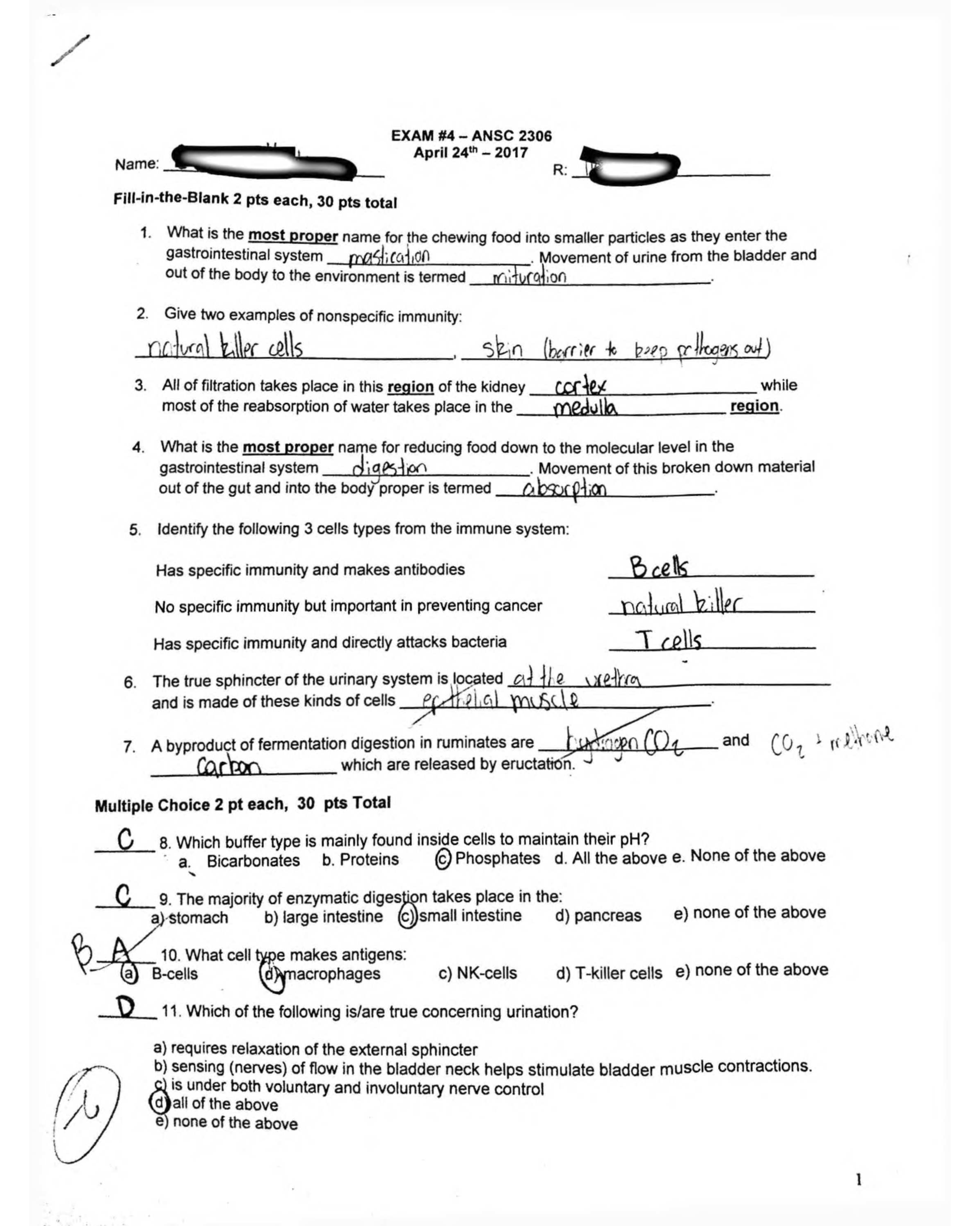
Question 2. Question : The area of the kidneys that contains the glomeruli and portions of the tubules is called the:
Medulla
Cortex
Pyramids
Columns
Question 3. Question : When does urine formation and excretion begin?
At birth
By three months’ gestation
By six months’ gestation
By eight months’ gestation Question 4. Question : Anemia of chronic renal failure can be successfully treated with which element?
Intrinsic factor
Vitamin B12
Vitamin D
Erythropoietin
Question 5. Question : What is the cause of smoky, brown-colored urine resulting from acute poststreptococcal glomerulonephritis?
Presence of red blood cells
Presence of urobilinogen
Slough from the collecting tubules
Protein in the urine
Question 6. Question : Which process makes it possible for ureters to be transplanted successfully?
Compensatory hypertrophy
Erythropoietin secretion
Peristalsis
Collateral circulation Question 7. Question : Considering the innervation of the circular muscles of the bladder neck, which classification of drugs is used to treat bladder neck obstruction?
β-Adrenergic blocking medications
α-Adrenergic blocking medications
Parasympathomimetic medications
Anticholinesterase medications Question 8. Question : Regarding the formation of renal calculi, which function do pyrophosphate, potassium citrate, and magnesium perform?
They inhibit crystal growth.
They stimulate the supersaturation of salt.
They facilitate the precipitation of salts from a liquid to a solid state.
They enhance the crystallization of salt crystals to form stones.
Question 9. Question : Which clinical manifestations of a UTI may be demonstrated in an eighty-five-year-old individual?
Confusion and poorly localized abdominal discomfort
Dysuria, frequency, and suprapubic pain
Hematuria and flank pain
Pyuria, urgency, and frequency
Question 10. Question : Bacteria gain access to the female urinary tract by which means?
Systemic blood that is filtered through the kidney
Bacteria traveling from the lymph adjacent to the bladder and kidneys
Bacteria ascending the urethra into the bladder
Colonization of the bladder when urine is static Question 11. Question : Which term is used to identify the movement of fluids and solutes from the tubular lumen to the peritubular capillary plasma?
Tubular secretion
Ultrafiltration
Tubular reabsorption
Tubular excretion Question 12. Question : The concentration of the final urine is determined by antidiuretic hormone (ADH), which is secreted by which gland?
Posterior pituitary
Thyroid
Parathyroid
Anterior pituitary
Question 13. Question : What is the functional unit of the kidney called?
Glomerulus
Nephron
Collecting duct
Pyramid
Question 14. Question : What is the pathophysiologic process responsible for the autoimmune disorder of hemolytic-uremic syndrome (HUS)?
Immunoglobulin A (IgA) coats erythrocytes that are destroyed by the spleen, and remnants are excreted through the kidneys.
Verotoxin from Escherichia coli (E. coli) is absorbed from the intestines and damages erythrocytes and endothelial cells.
Endotoxins from E. coli block the erythropoietin produced by the kidneys, which reduces the number of erythrocytes produced by the bone marrow.
Failure of the nephrons to filter urea increases the blood urea nitrogen (BUN), which binds to erythrocytes that are subsequently destroyed by the spleen.
Question 15. Question : Bladder cancer is associated with the gene mutation of which gene?
c-erbB2
Human epidermal growth factor receptor 2 (HER2)
TP53
myc Question 16. Question : Which differentiating sign is required to distinguish the diagnosis of pyelonephritis from that of cystitis?
Difficulty starting the stream of urine
Spasmodic pain that radiates to the groin
Increased glomerular filtration rate (GFR)
Urinalysis confirmation of white blood cell casts
Question 17. Question : Hypothyroidism, edema, hyperlipidemia, and lipiduria characterize which kidney disorder?
Nephrotic syndrome
Acute glomerulonephritis (AGN)
Chronic glomerulonephritis
Pyelonephritis Question 18. Question : A patient exhibits symptoms including hematuria with red blood cell casts and proteinuria exceeding 3 to 5 g/day, with albumin as the major protein. These data suggest the presence of which disorder?
Cystitis
Chronic pyelonephritis
Glomerulonephritis
Nephrotic syndrome
Question 19. Question : Kidney stones in the upper part of the ureter would produce pain referred to which anatomical area?
Vulva or penis
Umbilicus
Thighs
Lower abdomen
Question 20. Question : How much urine accumulates in the bladder before the mechanoreceptors sense bladder fullness?
75 to 100 mL
100 to 150 mL
250 to 300 mL
350 to 400 mL
[Show More]









![Preview of eBook [PDF] Mosby's Textbook for Nursing Assistants 10th Edition By Sheila A. Sorrentino,](https://browseimages.nyc3.digitaloceanspaces.com/paper-images/2024/Sep/06/8JMuZ3LF2024-09-06-04-1066daff404b5f8.png)