PN1 Final Exam
1. Best Practice (Pg.5)
a. To promote client safety and continuity of care excellent practice is for a nurse to use I-SBAR-R when contacting a health care provider for an
order
i. I=Identification of
...
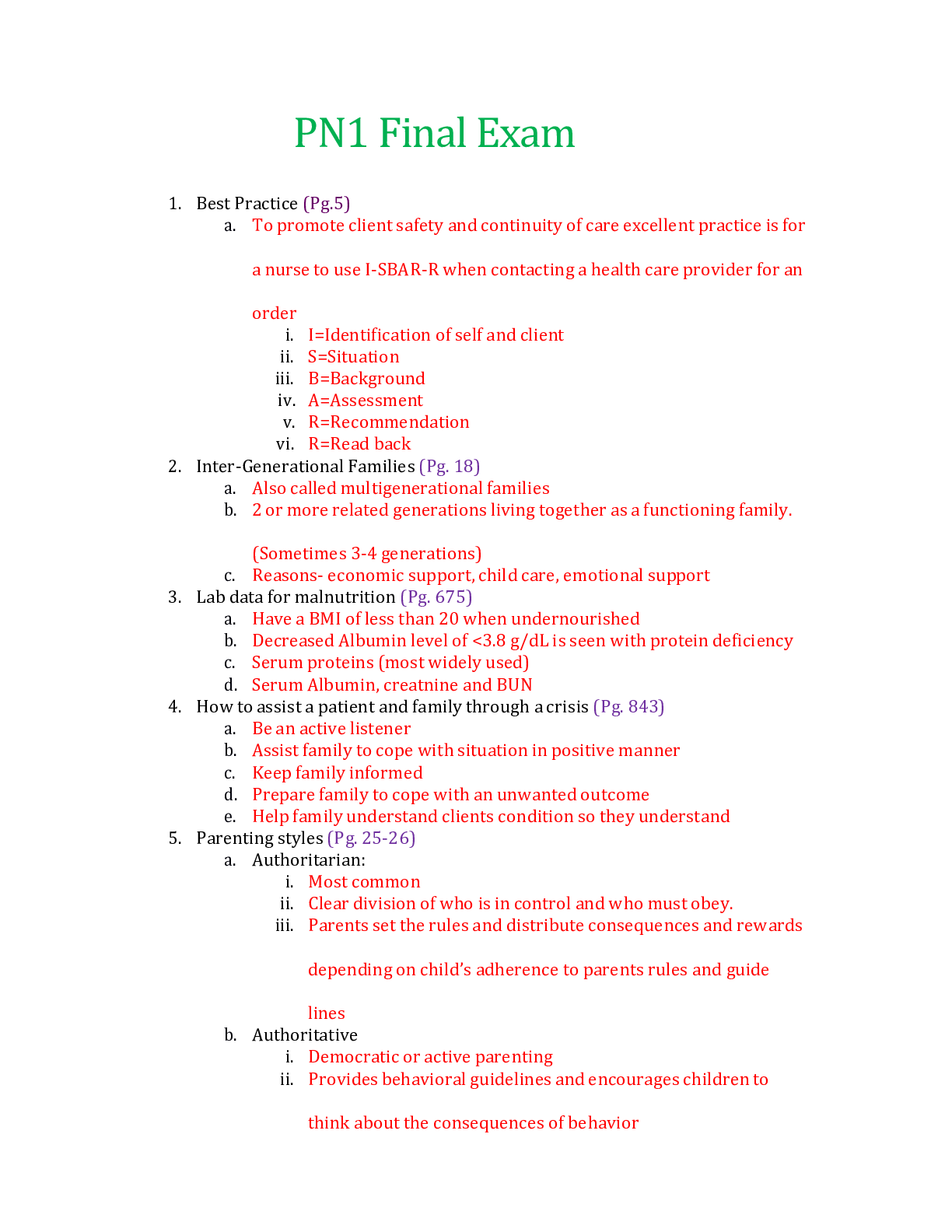
PN1 Final Exam
1. Best Practice (Pg.5)
a. To promote client safety and continuity of care excellent practice is for a nurse to use I-SBAR-R when contacting a health care provider for an
order
i. I=Identification of self and client
ii. S=Situation
iii. B=Background
iv. A=Assessment
v. R=Recommendation
vi. R=Read back
2. Inter-Generational Families (Pg. 18)
a. Also called multigenerational families
b. 2 or more related generations living together as a functioning family.
(Sometimes 3-4 generations)
c. Reasons- economic support, child care, emotional support
3. Lab data for malnutrition (Pg. 675)
a. Have a BMI of less than 20 when undernourished
b. Decreased Albumin level of <3.8 g/dL is seen with protein deficiency
c. Serum proteins (most widely used)
d. Serum Albumin, creatnine and BUN
4. How to assist a patient and family through a crisis (Pg. 843)
a. Be an active listener
b. Assist family to cope with situation in positive manner
c. Keep family informed
d. Prepare family to cope with an unwanted outcome
e. Help family understand clients condition so they understand
5. Parenting styles (Pg. 25-26)
a. Authoritarian:
i. Most common
ii. Clear division of who is in control and who must obey.
iii. Parents set the rules and distribute consequences and rewards depending on child’s adherence to parents rules and guide
lines
b. Authoritative
i. Democratic or active parenting
ii. Provides behavioral guidelines and encourages children to think about the consequences of behavior
iii. Parents actively reinforce child’s positive behavior and are significantly involved in monitoring child’s behavior and
explain expectations
c. Permissive:
i. “Hands off” parenting technique, thought as neglectful bc of
minimal parental interventions
ii. Freedom to learn from their own mistakes
iii. Children raised this way struggle as adults because they do not
recognize boundaries or limits
6. Distress family and communication (Pg. 26 Box 2-3)
a. Poor communication between members, including dishonesty,
hostility, sarcasm, silent treatment and frequent misunderstandings
b. Neglect of basic needs
c. Anger control issues
d. Unrealistic expectations of family members
7. Acidosis/Alkalosis (know the change in pH) (Pg. 222 Figure 11-1)
a. Normal is 7.35-7.45
b. Acidosis: <7.35 (7.0 Neutral, 6.8 Death)
c. Alkalosis: >7.45 (7.8 Death)
8. Therapeutic communication (Pg. 32)
a. Active listening: Really listening to what client is saying and attempting to understand. Take in voice tone, pitch and inflections, watch body language and explore and clarify to ensure accurate understanding. At times humor, touch, silence or confrontation maybe
appropriate.
b. Show empathy, be able to imagine one’s self in their circumstances
c. An offer of sympathy may hinder therapeutic communication because
the client may not feel comfortable when someone “feels sorry for them”
9. Communication challenges (Pg. 33)
a. Language barriers, cultural barriers, vision and hearing impairment
b. Lack of time to talk with patient because nurse is so busy, jump to conclusions about what clients’ needs are based on past interactions
c. Divorced families: Unresolved issues of anger that complicate
communication
d. Domestic Violence: Issues of domestic violence present an extremely
difficult communicative climate
10. Confrontation (Pg. 33)
a. Negative meaning, angry feelings, harsh words and conflict
b. Productive confrontation
i. Can be used as a technique in a respectful, tactful and nonthreatening manner, doing this can help facilitate the client’s move toward self-examination and opportunities for
growth
ii. This can be used when patient is engaging in maladaptive or
poor defense mechanisms such as denial
iii. Should be productive, respectful, tactful and non-threatening
11. Prodromal- incubation- convalescence (Pg. 74)
a. Incubation: Time between entry of infectious agent in the host and the
onset of symptoms.
b. Prodromal: Time from the onset of nonspecific symptoms until
specific symptoms begin to manifest. Host maybe infectious
c. Convalescent: The beginning of the disappearance of acute symptoms
until the client returns to previous state of health
12. What are the risk factors for an infection (Pg. 77)
a. Imbalanced Nutrition: Less than body requirements or more
b. Ineffective protection
c. Impaired tissue integrity
d. Impaired oral mucous membrane
e. Impaired skin integrity
f. Deficient knowledge
13. What is the meaning of systemic infection (Pg. 74)
a. Affect entire body and involve multiple organs, such as AIDS
14. Alkalosis and OTC medications (Pg. 233 Table 11-4)
a. Antianxiety: Ativan & Xanax
b. Benzo’s/Sedatives/Hypotics: Ambein, Restoril, Halcion & ProSom
c. Centrally acting skeletal muscle relaxants: Valium, Lioresal & Dantrium
d. Electrolyte Supplements: Calcium plus vitamin D, Potassium chloride
(K-Dur)
15. Look up (All ready answered on question 80)
a. Respiratory Acidosis
b. Respiratory Alkalosis
c. Metabolic acidosis
d. Metabolic Alkalosis
16. Osmosis and diffusion (Pg. 203-204)
a. Osmosis: is diffusion of water through a semipermeable membrane from a region of higher water concentration to a region of lower water concentration. Only water (solvent) molecules move through the
membrane; the dissolved molecules do not
b. Diffusion: Tendency of molecules of gases, liquids or solids move from a region of higher molecular concentration to a region of lower molecular concentration until an equilibrium is reached. This movement is caused by kinetic energy in molecules. For example Carbon dioxide moves by diffusion from the blood stream where the
concentration is higher, into the lungs for elimination
17. IV therapy, what to react to first (jugular and hand distention)
a. Jugular- pneumothorax
b. Hand distention- phlebitis, dislodgement
18. Drops per min on an IV (Pg. 253)
total fluid volume Drop factor Drop per min Total time ( min)
19. Infusion related infection (Pg. 257)
a. Phlebitis
20. Look up signs and symptoms of TB (Pg. 351)
a. Low grade fever that recurs in a specific pattern
b. Persistent cough
c. Hemoptysis
d. Hoarseness
e. Dyspnea on exertion
f. Night sweats/ fatigue
g. Weight loss and enlarged lymph nodes
21. What to teach a patient about Lasix
a. Take in AM
b. Do not take if planned activities in AM
22. What are common medication for asthmatics (Pg. 364)
a. Aminophyline
b. Steriods Bronchodilators
c. Theophylline
d. Histamine Corticosteroids
e. Mucolytics
f. Anticholinergics
23. What does a patient with pneumothorax look like? (Pg. 386)
a. Pneumothorax occurs when blunt trauma to chest causes a broken rib that pierces the pleura and lung, allowing air to enter between the
pleura.
b. Short of breath, shifted trachea, Dyspnea and cyanosis, Cough is forceful and unproductive, Resp and heart rate are elevated, and Breath sounds are diminished. Claims to feel very anxious
24. How do you use an incentive spirometer, and what does it look like (Pg. 347)
a. Measures the amount of air in one inhalation, is ordered to air the
client when coughing and deep breathing are inadequate
b. Plastic device with number on the side, ball inside a tube with a hose
and a mouth piece that you place your mouth around and inhale
25. What are the signs and symptoms to know if suction is needed
a. Patient is gagging on secretions, coughing without being productive,
choking on sputum, cyanotic
26. How to improve cardiac output
27. Pulmonary edema (Pg. 380)
a. Life threatening condition characterized by a rapid shift of fluid from
plasma into pulmonary interstitial tissue and alveoli.
b. Gas exchange is impaired, generally has cardiac cause such as left
ventricular failure or MI.
c. Excess fluids in the lungs, collects in numerous air sacs in lungs
d. Cough, pink/frothy sputum, Dyspnea
28. How to prevent venous thrombosis (Pg. 458)
a. Wear BLT compression stockings (Antiembolism stockings)
b. Take anticoagulants or thrombolytic meds are prescribed
29. What do the following look like?
a. Shingles (Pg. 1075): Clusters of small vesicles over the peripheral sensory nerve (face, scalp and eyes), crust develop after several days.
Rash looking
b. Psoriasis (Pg. 1083): Most commonly effected areas are scalp, elbows, knees and torso. Large red patches covered with thick silvery scales
on the outermost layer of epidermis
c. Eczema (Pg. 1081): Chronic, superficial inflammation that evolves into
pruritic red, weeping, crusted lesions
d. Ring worm (Pg. 1076): Round and reddened with slight scaling, pale
center
30. How do you prevent infections from spreading
a. Wash hands
b. Cover mouth and nose when sneezing
c. Clean surfaces and objects properly
31. What are the normal drainages you would see in a post-surgical patient
(Pg.1068)
a. Serosanguineous exudate
32. What is (Pg. 1262)
a. Primary prevention: Focuses on preventing the initial use or preventing further uses that may lead to abuse or dependence. Aimed at school aged children, educate them about substances and their
effects
b. Secondary prevention: Focuses on preventing ongoing use from
becoming a situation of abuse or dependence
c. Tertiary: Focuses on returning the client to a drug-free state.
33. Herpes Zoster (Shingles) (Pg. 1075)
a. Cluster of small vesicles over the course of a peripheral sensory nerve.
2/3 of clients have lesions just in the thoracic region (Neck-Lower back) Crusts develop in several days.
b. Symptoms are mild to severe pain, itching, fever and malaise. In older adults it can last for months or years.
c. Zovirax, Valtrex, Famvir may be given for severe pain or immunosuppressed patients. Narcotic analgesics are prescribed for
severe pain.
d. Recommended for adults 60 yrs an older
34. What is a pressure ulcer and how is it prevented and treated (Pg. 1087-1094)
a. Also known as bedsores, localized areas of tissue necrosis that tend to develop when soft tissue is compressed between bony prominence and external surface such as mattress or chair for prolonged period of
time
b. Assess Braden scale for risks during admission and at least every 48
hours, do head to toe assessments and note any red spots
c. Offer supportive surfaces and beds to distribute weight such as egg-
crate mattress, Kin Air bed and Roto Kinetic bed
d. Avoid placing pt on bony prominences and turn patient at least every 2 hours, use 30 degree position when side-lying, raise heel of patients, avoid massaging over bony prominences
35. What are C & S tests? (Pg. 405)
a. Determines presence of microorganisms and determines antibiotic
that will kill or inhibit growth of microorganism
b. Normal value is negative for microorganism growth
c. Assists in diagnosis of bacterial endocarditis
d. Blood sample is done before administration of antibiotics
36. What is melanoma (Pg.135)
a. The most serious form of skin cancer
37. Transmission and types of contacts (Pg. 68-69)
a. Vector Borne: Contact with contaminated animate hosts- Animals, Insects
b. Airborne: Droplet nuclei or dust particles are suspended in air.
Inhaling microorganisms carried by moisture or dust particles in air-
Coughing, Talking, Sneezing
c. Direct contact: Transfer of agent from an infected person to a host by direct contact Touching, Bathing, instruments used in treatments,
Secretions from client
38. What to ask a patient when they are complaining of pain (Pg. 116)
a. Rate it on a scale from 1-10
b. P= What provokes the pain and Palliative measures (alleviating
factors)
Q= Quality of pain (throbbing, aching) R= Region (location) and Radiation
S= Severity (quantity of pain 0-10 scale) T= Timing (Onset, duration, frequency)
39. What are the factors of pain? O= Onset (New or chronic pain) L= Location (one or more sites)
D= Duration (Intermittent or persistent)
C= Characteristics (Somatic- Sharp, dull or aching)
(Visceral- Cramping, squeezing)
(Neuropathic- shooting, burning, electrical, tingling numbness) A= Aggravating factors (What makes the pain worse) Alleviating factors
(What makes it better)
R= Relieving factors (What makes the pain better)
T= Treatment (Pharmacological/ nonpharmacological) (Past or present)
40. What is pain (Pg. 112)
a. Serves as a protective mechanism
b. Occurs when sensory input from injured tissue causes peripheral nociceptors and central nervous system pain pathways enhance future
responses to pain stimuli.
c. Long-lasting changes in cells within the spinal cord afferent (ascending) and efferent (descending) pain pathways may thus occur a brief noxious stimulus.
41. What is pleurisy (Pg. 359)
a. Painful condition that arises from inflammation of the pleura, or sac
that encases the lung
b. Sharp or stabbing in nature and pain increases during inspiration
c. Occurs in disorders such as viral infections, cancer of the lung, TB, HF
and pulmonary embolism
42. What is a deviated septum (Pg. 333)
a. Cartilage that separates the nostrils is misaligned, resulting in partial
airway obstruction.
b. Most common breathing impairment
43. How to know if you have pharyngitis (Pg. 340)
a. Sore throat is the primary symptom
b. Client shows erythema and inflammation of the pharynx and tonsils
c. Fever, enlarged tender cervical lymph nodes,
d. Typically viral, (80%) with onset of hoarseness, cough, rhinitis and
malaise
e. Bacterial (20%), abdominal pain, vomiting and headache
44. Know the structure of the heart
a. Encapsulated by a protective sac called the pericardium and consists
of three layers- endocardium, myocardium and epicardium
i. Endocardium is made of endothelium cells that line the inside of the heart, the 4 heart valves and arteries, capillaries and
veins making the circulatory system closed.
ii. Myocardium consists of striated muscle and varies thickness
depending on heart chamber. Left ventricle pumps blood to the body there fore it’s the thickest chamber.
iii. Epicardium surrounds the outside of the heart
iv. Pericardium consists of 2 layers
1. Parietal pericardium (outer layer) is fibrous loose sac
that surrounds the heart
2. Visceral pericardium lines the great vessels and is also called the epicardium when it lines the walls.
v. The pericardial space is between the 2 pericardium layers and
is filled with fluid
vi. The heart is a hollow muscular organ containing 4 chambers that empty and fill blood with each contraction (depolarization) and recovery phase (repolarization) of the
cardiac muscle
1. The upper chambers are the atris and the lower chambers are the ventricles, when the atria contract,
blood is forced in the ventricles
vii. Contraction of the right ventricle pump blood into the pulmonary arteries and on to the lungs (pulmonary circulatory
system).
viii. Contraction of the left ventricle pumps blood into the aorta and
out the entire body (systemic circulatory system)
ix. The myocardium of left ventricle is thicker than the right
ventricle because more force is needed to pump blood throughout body
x. Heart has 4 valves: Tricuspid, bicuspid (mitral), pulmonic and aortic. The pulmonic and aortic valves prevent blood from flowing back into the ventricles from the pulmonary and aorta during repolarization
45. What are modifiable changes for heart disease (Pg. 432 Table 21-1)
a. Hypertension
b. Tobacco smoking
c. Elevated serum triglyceride, total cholesterol and LDL levels
d. Lower levels of HDL
e. Type 2 DB
f. Stress
g. Excessive dietary intake of saturated fats, carbs and sodium
h. Drug use
46. Heal promotion (what does it mean)
a. The process of enabling people to increase control over, and to
improve their health. It moves beyond a focus of individual behavior towards a wide range of social and environmental interventions
47. Infective endocarditis (Pg. 424): Caused by bacteria, fungi or virus.
a. Vegetation: Microorganism invade the valves, the form fibrinous substance called vegetations
b. Scar tissue: vegetation cause scar tissue on the valves, resulting in hard, brittle valves that do not close properly and allow blood to flow
back into the previous chamber
48. Cardiac anatomy
a. Stenosis
b. Prolapse:
c. Insufficiency
49. Nitroglycerin Spray
a. Treats episodes of angina in people with coronary artery disease.
Spray may also be used just before activities that may cause these episodes
b. Comes as a spray to use on or under the tongue. Used either 5-10 min
before activites or the first sign of an attack
c. If using Nitromist push button 10 times. If using Nitrolingual push 5
times and do not spit out or rinse mouth for 5-10 min
50. What is the goal for a patient with high blood pressure (Pg. 466)
a. Keeping blood pressure within normal limtits
51. How do you get high blood pressure under control (Pg. 466)
a. 1st: Encourage client to try diet and life style changes
b. 2nd: Try Diuretic or beta blocker
c. 3rd: Increase drug doseage or adding a second antihypertensive drug
from another class
d. 4th: Last step is implemented by adding a 2nd or 3rd antihypertensive
52. What is the first line of medication to give to a patient with hypertension?
(What class is it) (Pg. 476)
a. Diuretics
i. Thiazide: Hygroton, Zaroxolyn
ii. Loop: Lasix, Edecrin
iii. Potassium Sparing: Midamor, Aldactone
iv. Aldosterone receptor blockers: Inspra, Aldactone
53. Wheezes
a. Stridor: Crowing (Croup, large airway tumor)
b. Pleural friction rub: Creaking, grating (TB, Pumonary Infarction)
c. Rhonchi: Low-pitched, snoring (Asthma, tumor)
54. Delayed wound healing (Pg.1068)
a. Factors that affect negative wound healing includes age, oxygenation, smoking, drug therapy, obesity and diseases such as DB
55. What type of skin cancer metastasize (Pg. 1070)
a. Malignant Melanoma
i. It can metastasize to every organ in the body through the blood
stream and lymphatic system
56. How to break the chain of infection (Pg. 71)
a. Cleansing: Removal od soil or organic material from instruments and equipment used in providing client care (Wash hands, wear proper
PPE)
b. Disinfection: Elimination of pathogens, except spores, from inanimate objects. Use chemical solutions to clean them such as alcohol, sodium
hypochlorite, quaternary ammonium and phenolic solutions
c. Sterilization: Process of destroying all microorganisms including spores. “Sterile technique” Achieved by steam, dry heat and ethylene
oxide has
57. Stages of pressure ulcers (Pg. 1088)
a. Stage 1: Nonblanchable erythema of intact skin, No blanching maybe
noticeable in darkly pigmented skin.
b. Stage 2: Partial-thickness skin loss involving epidermis, dermis or both. Ulcer is superficial and presents clinically as abrasion, blister or
shallow crater
c. Stage 3: Full-thickness skin loss involving damage or necrosis of subcutaneous tissue that may extend down to but not through the underlying fascia. May look like a deep crater with or without
undermining or tunneling
d. Stage 4: Full thickness skin loss with extensive destruction, tissue necrosis, or damage to muscle, bone, or supporting structures. Undermining and tunneling may be associated with stage IV
e. Unstageable: A full thickness tissue loss where slough (yellow, gray, tan) or eschar (black or brown) covers the base of the wound bed)
Ulcer is unstageable until debridement
58. Signs and symptoms of fluid imbalance in a burn patient (Pg.82)
a. Hypovolemic Shock
b. Early signs are often missed until they become pronounced; early sounds include mild tachycardia and mild hypotension. Presents with anxiety, restlessness, delayed cap refill and increased resp rate. Kidney function decreases in urine output of less then 10 mL/hr. Skin feels
cools, clammy and appear mottles.
c. Experience severe vomiting and diarrhea, tachycardia, arrhythmias
and chest pain
59. What are the things that are needed to know before giving
a. Lisinopril (Pg. 438 & 468)
i. Monitor for hypotension, hyperkalemia and renal failure
ii. Cough is a common side effect
iii. Drug may increase glucose level
iv. Monitor for sore throat, fever, edema in hands and feet,
irregular heart beat
b. Digoxin (Pg. 1326)
i. Slow conduction to the ventricles
ii. Take apical pulse for 1 full min
iii. Monitor serum digitalis level and toxicity which is Fatigue,
anorexia, halos around lights, unsteady gait
c. Lasix (Pg. 557)
i. Monitor output, maintain fluid restriction, weigh client daily
ii. Thiazide diuretics should be avoided because they decrease
urinary calcium excretion when taking long term
60. Know something about buergers disease (Pg.460)
a. Inflammatory disease of small and medium arteries and veins that
lead to vascular obstruction.
b. Hands and feet are mainly involved the distal tip of hands and feet become reddened when held in dependent position. At first pain in
palm of hand and arch of the foot is main symptom then pain becomes
more severe.
c. Client may experience numbness. Burning pain, pain at rest and
decreased sensation in hands and lower extremities. Skin color changes, cold sensitivity, ulcers, and gangrene occur in later stages.
d. Occurs in men between 20 and 40 of Israeli, Indian and Asian decent
61. Raynaud’s disease (Pg.461-462)
a. Intermittent spasm of the digital arteries and arterioles resulting in
decreased circulation to the fingers and toes.
b. Spasm can least 15 minutes, fingers become pale and then cyanotic
c. Women are 9 times more likely to be affected then men
d. Secondary Raynaud’s begins later in life between the ages of 35-40
e. Tell patient to avoid decongestants, caffeine, exposure to cold,
repetitive hand movements and stressful situations
62. Looks at the Braden Scale- what to teach about taking care of a patient at risk
for a pressure ulcer (Pg.1093)
a. Establish repositioning/turning schedule for clients. Including
pressure-reducing support surfaces
b. Use 30 degree position when side-lying position is used
c. Prevent direct contact between bony prominences using pillow and
foam wedges
d. Encourage clients to shift weight in wheelchair every 15 min, limit
sitting time to 1 hr at a time whether in bed, chair or wheelchair
63. Know the difference between atherosclerosis and arteriosclerosis (Pg. 434)
a. Atherosclerosis: Fat deposits are called plaque and forms early in life as fatty streaks accumulate on arterial vessel walls. A person ages the
fat cells, or LDL accumulate in vessels and injure the vessel walls
b. Arteriosclerosis: Narrow and hardening of the arteries. A build up of lipids, collagen and smooth muscle cells narrows the lumen of the vessel. Decrease blood flow through the vessel causes decreased
perfusion to cells beyond the narrowed or hardened area
64. Know action of beta adrenergic medication (Pg.467)
a. Given to block the epinephrine and nonrepinephrine receptor sites.
With these receptor sites blocked, the vessels do not constrict and the blood has less resistance flowing through the vessel.
65. What to teach a patient about Coumadin therapy and pulmonary embolism
(Pg. 379)
a. Use a soft toothbrush to prevent trauma to the gums (bleeding)
b. Inspect the skin for bruises or petechiae
c. Use electric razor to avoid scratching skin
d. Report nosebleeds, tarry stool, hematuria
e. Eat consistent amount of green leafy veggies
f. Avoid medications including aspirin
g. In females monitor menstrual flow
66. What does hypertension (uncontrolled) lead to
a. Stroke or heart attack
67. What are things that influence a patient’s pain experience (Pg.114)
a. Age
b. Pervious experience with pain
c. Drug abuse
d. Cultural norms account for the differences in client’s individual
responses to pain
68. What is cardiac output and how is it determined
a. Amount of blood pumped by the heart per minute
b. Cardiac output is the product of two variables, stroke volume and heart beat. Heartbeat is a count of the number of times a heart beats per min. Stroke volume is the measure of the volume of blood that is
pushed out of the ventricles with every beat.
c. The formula is CO=SV X HR
69. What is important to think about when dealing with a patient with facial
burns (Pg.1100)
a. There is a possibility of Respiratory Tract Damage
b. Heat and smoke cause airway inflammation and edema of the
respiratory mucosa
c. Carbon monoxide inhaled along with heat and smoke attach to
hemoglobin, forming the compound carboxyhemoglobin
70. Know normal electrolyte levels for (pg. 83)
a. Sodium 136-145 mEq/L
b. Potassium 3.5-5.5 mEq/L
c. Chloride 98-106 mEq/L
71. Signs and symptoms of pneumonia (Pg. 347)
a. Sudden high fever
b. Productive cough yielding abnormally thick and discolored sputum
c. Dyspnea, course crackles and diminished breath sounds
d. Complain of pleuritic chest pain (Stabbing in nature and increases
with inspiration)
e. High WBC and ABG’s reveal decrease in PaO2
72. Know the nursing process (Pg. 7-8)
a. Assessment: Provides subjective and objective behavior including
vitals
b. Nursing Diagnosis: Gathering physical, psychological, social, emotional
and spiritual data
c. Planning: Goal setting, desired result that the client works toward
achieving.
d. Implementation: Plan activities in such ways as to promote goal
attainment
e. Evaluation: Judgment about an outcome, measure factual results
against planned expectations to determine success
73. What are signs and symptoms of cardiac and pulmonary pain
a. Pressure, fullness, burning or tightness in chest
b. Crushing or searing pain the radiates to back, neck, jaw, shoulders and
one or both arms
c. Pain the lasts more than few minutes or gets worse with activity, goes
away and comes back or varies intensity
d. SOB/ Dizziness / Weakness
e. Nausea/vomiting
74. Define homeostasis (Pg. 200)
a. Ongoing process; that is, the body simply does not reach a state of equilibrium and remain there. If it is interrupted or changed, it can lead to disease, disorder or death.
b. Small changes constantly occur in response to physiological processes and to maintain the constancy of internal environment within a
normal range.
75. What is our body content most like? (What type of saline is most used) (Pg. 205)
a. 0.9% saline solution
76. Know (Pg. 206)
a. Intracellular Fluid: Compartment contains all the water and ions
inside the cells.
i. By far the largest amount of water in the body, approx. 65%
b. Extracellular Fluid: Compartment contains the remaining body fluids.
Fluid outside of the cells.
c. Intravascular Fluid: Plasma in the blood vessels and the lymph in the
lymphatic system
77. What is hypo and hyperkalemia (Pg. 210)
a. Hypokalemia: Low serum potassium indicates hypokalemia, excessive
low gastric fluids and use of diuretics can place patient at risk for this.
i. Potassium wasting diuretics such as furosemide (Lasix),
chlorothiazide (Diuril) can cause Hypokalemia
ii. Can cause cardiac arrest is <2.5 mEq/L
b. Hyperkalemia: Elevated serum potassium lever. Renal disease patients develop hyperkalemia bc potassium cannot be excreted by the
kidneys.
i. Inhibits action of digitalis
78. What is difference between hypertonic and isotonic (Pg. 247)
a. Hypertonic fluid: Solution increases osmotic pressure and draws fluid from the cells and interstitial spaces. Cellular dehydration may result
if fluid is infused beyond the client’s tolerance
b. Isotonic Fluid: Solution increases only extracellular fluid volume.
Cardiac overload may result if fluid is infused beyond clients tolerance
79. Know what phlebitis is (Pg. 257)
a. May result from either mechanical, chemical trauma or bacterial invasion of the site
b. Precursor of sepsis
c. Look for reddened area or pink/red stripe along vein, warmth and swelling indicates phlebitis. Pt complaining of tenderness and warmth. Vein might feel rope-like to palpation.
80. What are
a. Metabolic alkalosis (pg. 239): Occurs as a result of excessive
accumulation of bicarbonates or excessive loss of H ions.
i. As a result of acid-based imbalance, arterial pH increases as
HCO3, increases or arterial CO2 decreases.
ii. pH >7.45 PCO3 Normal HCO3 >26 mEq/L
b. Metabolic acidosis (pg. 234): An acid-based imbalance that results in
arterial pH decreasing below 7.35.
i. Result of either bicarbonate reserves decreasing below 22
mEq/L or production of acid due to metabolism.
ii. pH<7.35 PCO3 Normal HCO3 < 22 mEq/L
c. Respiratory alkalosis (pg. 230): Depletion of CO2 resulting in the
increase of pH above 7.45.
i. pH>7.45 PCO3 <35 mmHg
d. Respiratory acidosis (Pg.224): Retention of carbon dioxide that occurs
when there is an abnormal accumulation of CO2.
i. Acute pH<7.35 PCO3 >45 mmHg
ii. Chronic pH <7.35 PCO3 >45 mm Hg HCO3 >26 mEq/L
81. Who is at risk for dehydration
a. Elderly
82. What are signs and symptoms of left sided heart failure (Pg. 445-446)
a. Caused by left ventricular myocardial infarction, aortic valve stenosis,
prolapsed valve complications and hypertension.
i. Lungs become congested with fluid
ii. Patient becomes cyanotic, dyspneic, restless and coughs up
blood-tinged sputum. Breath sounds have moist crackles
iii. Patient has tachycardia and low BP
iv. Client becomes confused
83. Know all about PPE
a. Gloves, gowns, mask, face shield/mask
84. Know the difference between
a. Pulmonary edema (pg. 380)
i. Life threatening condition characterized by a rapid shift of fluid
from plasma into pulmonary interstitial tissue and alveoli.
ii. Gas exchange is impaired, generally has cardiac cause such as
left ventricular failure or MI.
iii. Excess fluids in the lungs, collects in numerous air sacs in lungs
1. Cough, pink/frothy sputum, Dyspnea
b. Peripheral edema (Pg. 215)
i. Excess fluid in either tissues or extremities
1. Symptoms: Pitting edema in extremities, Edematous area are tight, smooth, dry. Shiny, pale, cool skin, Puffy
eyelids, Weight gain
85. Know about these of nutrition
a. Calcium: Aids in bone and teeth formation
i. Provides muscle contraction and relaxation
ii. Aids blood clotting
iii. Aids in nerve transmission
iv. Promotes normal heart rhythm
v. Sources are Milk, Cheese, Green leafy veggies
b. Vitamin (Pg. 669): Main source of vitamins are fruits and vegetables.
Water-soluble vitamins B and C are not stored in the body; however, fat-soluble vitamins A, D, E and K are stored in the body and if taken in excess can become toxic to the body.
c. Minerals: Necessary for tissue building and protection of skin, bone, hair and nails (Pg. 670). There are 7 of them: Look at pgs. 678-679
Table 33-4 for more detailed explanation of them
i. Calcium
ii. Chloride
iii. Magnesium
iv. Phosphorus
v. Potassium
vi. Sodium
vii. Sulfur
86. Know about IV infusion (Pg. 247-253)
a. Purpose of an IV is to correct fluid and electrolyte imbalances, administer meds, blood products and provide nutritional
supplements.
b. Infusion set includes insertions spike with protective cap, drip chamber, tubing with slide clamp and regulating (roller) clamp, an
injection port and a protective cap over the needle adapter.
c. PICC line is inserted for long IV therapies
d. Select vein for an IV that is most distal end to maintain integrity of
vein
e. Calculating hourly the flow rate
Number of hours
i. Total volume infuse ¿ mL infusion rate
¿ hour
ii. Calculate actual infusion rate (per min)
total fluid volume Drop factor Drop per min Total time ( min)
87. Know how to write an objective nursing diagnosis (Pg. 76)
a. Gathered information through physical examination and the
diagnostic and laboratory findings
b. Physical exam includes systematic physical exam, head to toe, check
ROM, if there is redness/warmth anywhere, fever with increased pulse, secretions ore exudate of skin, Auscultation of the lungs
88. When do you document
a. Right after the medication is given
b. Right after cares are done
89. Know what to teach a patient about quitting smoking (Pg. 1273)
a. Nicotine replacement therapy by patch, nasal spray, inhaler or gum
helps break habit but it is important that the patient DOES NOT smoke while using the patch
b. Exercise program will help with stress management and minimize
weight gain, relaxation techniques will help too
c. Support of family and friends are very important
d. Relapse is highest in the first few weeks and diminishes considerably
after 3 months
90. Know how to determine what kind of environment to teach in
a. When there is minimal distractions
b. When the patient is rested and focused
[Show More]