Passpoint-Neuro Question 1 See full question A client comes to the emergency department complaining of headache, malaise, chills, fever, and a stiff neck. Vital sign assessment reveals a temperature elevation, increased
...
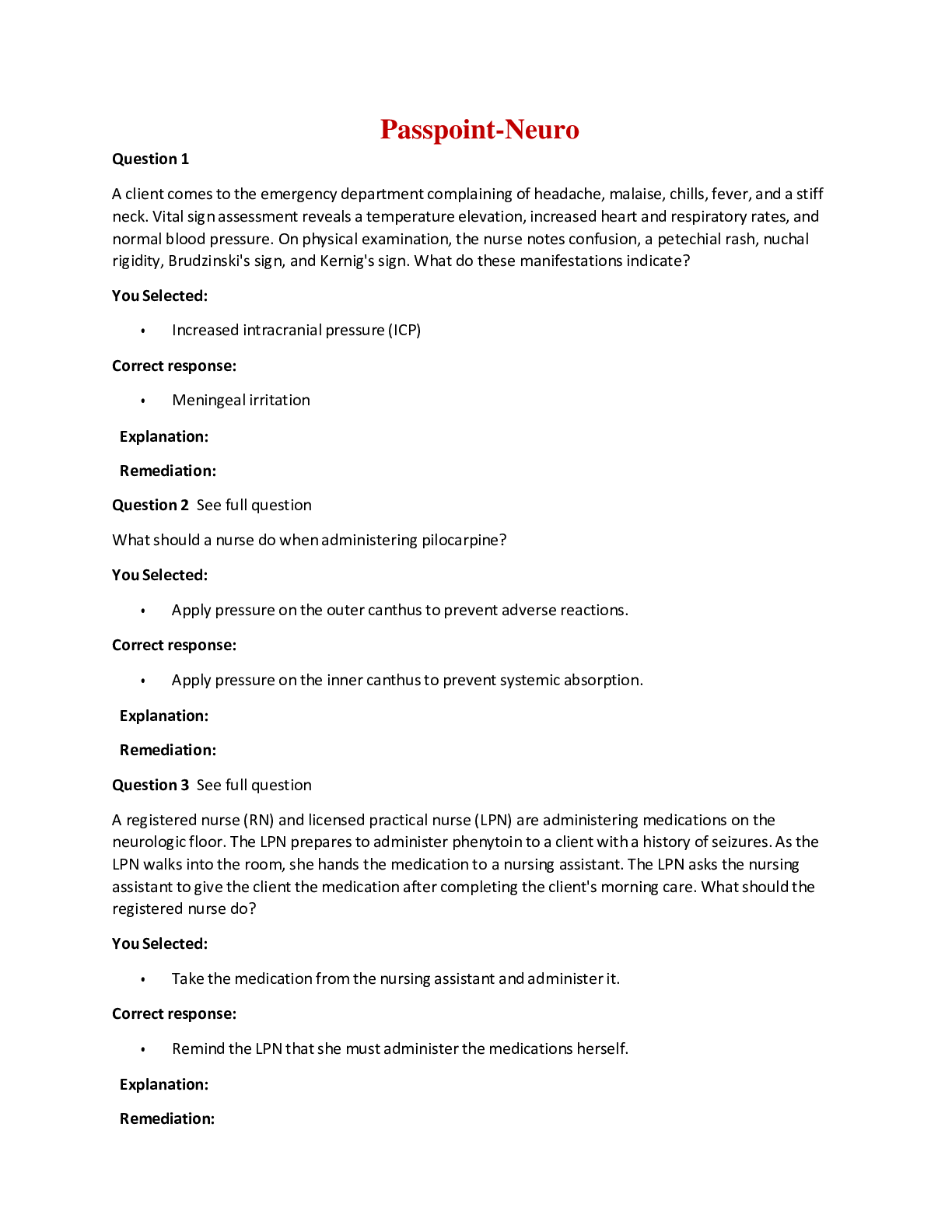
Passpoint-Neuro Question 1 See full question A client comes to the emergency department complaining of headache, malaise, chills, fever, and a stiff neck. Vital sign assessment reveals a temperature elevation, increased heart and respiratory rates, and normal blood pressure. On physical examination, the nurse notes confusion, a petechial rash, nuchal rigidity, Brudzinski's sign, and Kernig's sign. What do these manifestations indicate? You Selected: Increased intracranial pressure (ICP) Correct response: Meningeal irritation Explanation: Remediation: Question 2 See full question What should a nurse do when administering pilocarpine? You Selected: Apply pressure on the outer canthus to prevent adverse reactions. Correct response: Apply pressure on the inner canthus to prevent systemic absorption. Explanation: Remediation: Question 3 See full question A registered nurse (RN) and licensed practical nurse (LPN) are administering medications on the neurologic floor. The LPN prepares to administer phenytoin to a client with a history of seizures. As the LPN walks into the room, she hands the medication to a nursing assistant. The LPN asks the nursing assistant to give the client the medication after completing the client's morning care. What should the registered nurse do? You Selected: Take the medication from the nursing assistant and administer it. Correct response: Remind the LPN that she must administer the medications herself. Explanation: Remediation: Question 4 See full question A nurse is caring for an older adult client with advanced Parkinson's disease. Which client statement about advance directives indicates a need for further instruction? You Selected: "I know that I'll eventually be unable to make decisions. Signing an advance directive now will save my family grief." Correct response: "I don't really need to sign anything. I'm depending on my physician to tell my family what to do if something bad happens." Explanation: Remediation: Question 5 See full question A nurse caring for a client who had a stroke is using the unit's new computerized documentation system. The nurse uses the information technology appropriately when she: You Selected: documents medications before administration. Correct response: documents medications after administration. Explanation: Remediation: Question 6 See full question A 70-year-old, previously well client asks the nurse, "I notice I have tremors. Is this just normal for my age?" What should the nurse tell the client? You Selected: "You should have your blood pressure checked when this occurs." Correct response: “You should report this to the health care provider because it may indicate a problem.” Explanation: Remediation: Question 7 See full question Following an infection, the client is having ototoxic effects of the vestibular branch of the acoustic nerve. The nurse should assess the client for: (Select all that apply.) You Selected: tinnitus vertigo ataxia Correct response: vertigo nausea ataxia Explanation: Question 8 See full question A client returns to the recovery room following left supratentorial surgery for treatment of a brain tumor. The nurse should place the client in which position to facilitate venous drainage? You Selected: lying flat without a pillow with the client's head turned to the right Correct response: head of the bed elevated to 30 degrees with the client's head in a neutral position Explanation: Question 9 See full question The nurse is caring for a client with an injury to the thalamus. The nurse should plan to: You Selected: monitor the temperature of the bathwater. Correct response: monitor the temperature of the bathwater. Explanation: Question 10 See full question Which statement would provide the best guide for activity during the rehabilitation period for a client who has been treated for retinal detachment? You Selected: Activity level can return to normal; clients can resume regular aerobic exercises. Correct response: Activity is resumed gradually; the client can resume usual activities in 5 to 6 weeks. Explanation: Remediation: ....Continued...
[Show More]


 (1).png)