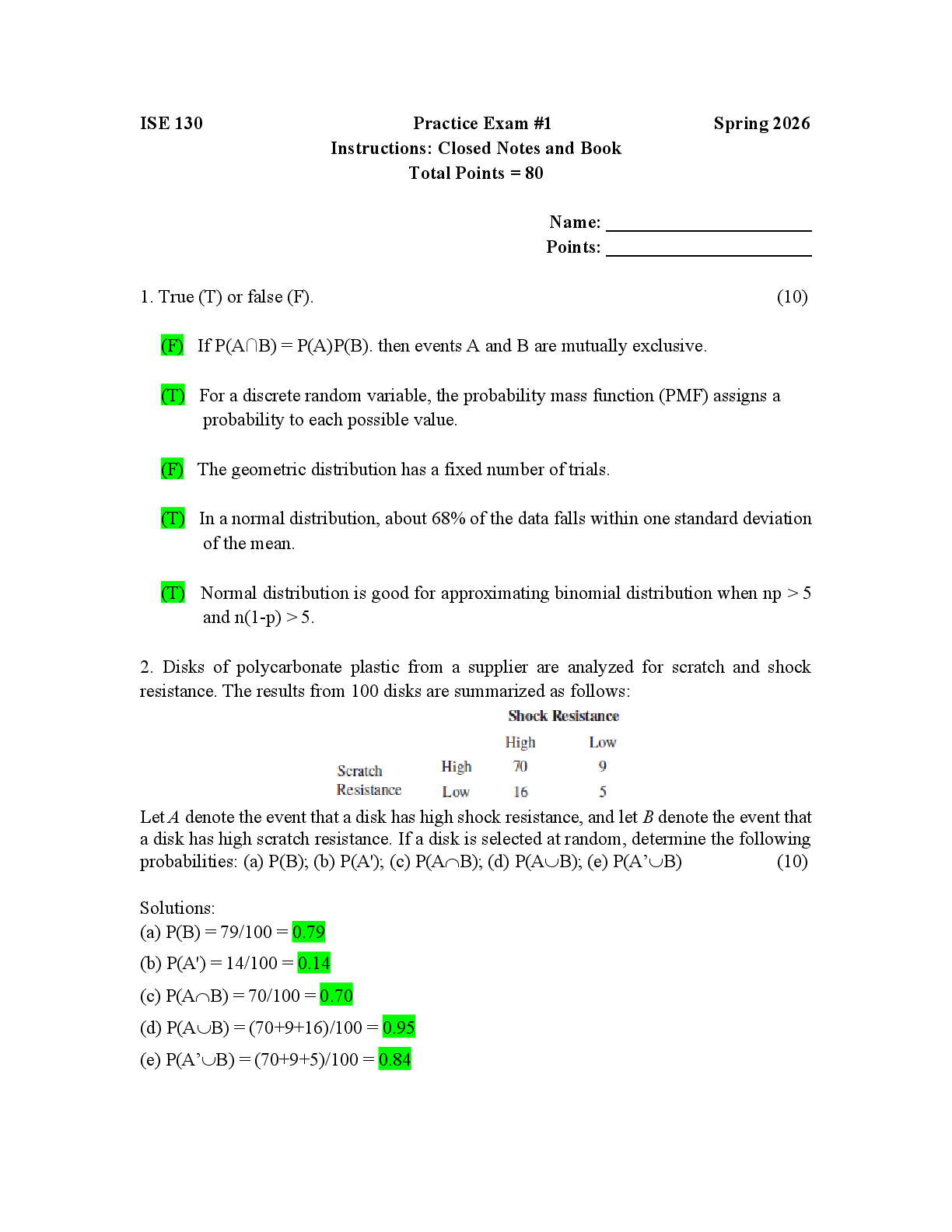
FLUID AND ELECTROLYTES
Question 1
The physician orders dextrose 5% in water, 1,000 ml to be infused over 8 hours. The
I.V. tubing delivers 15 drops/ml. The nurse should run the I.V. infusion at a rate of:
Question
...
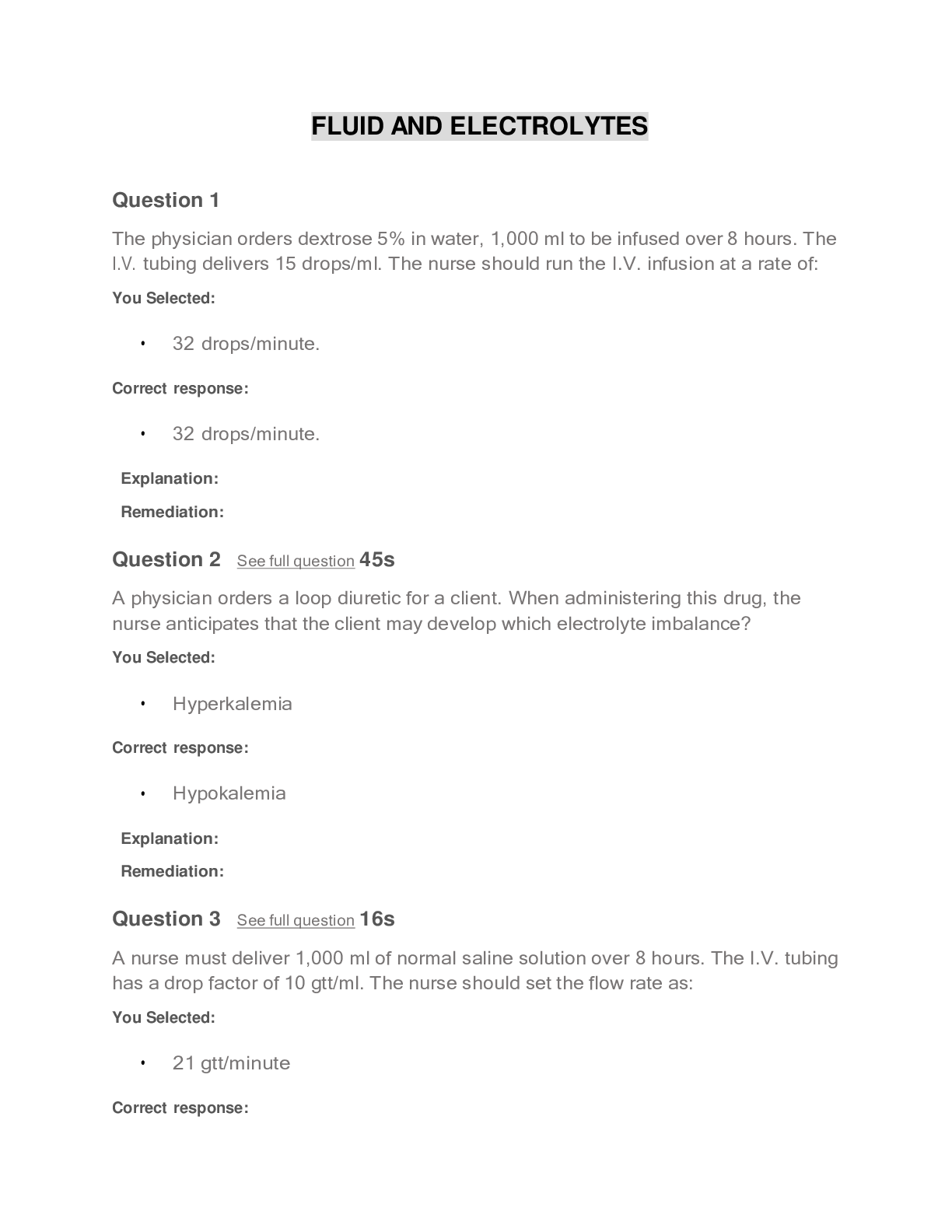
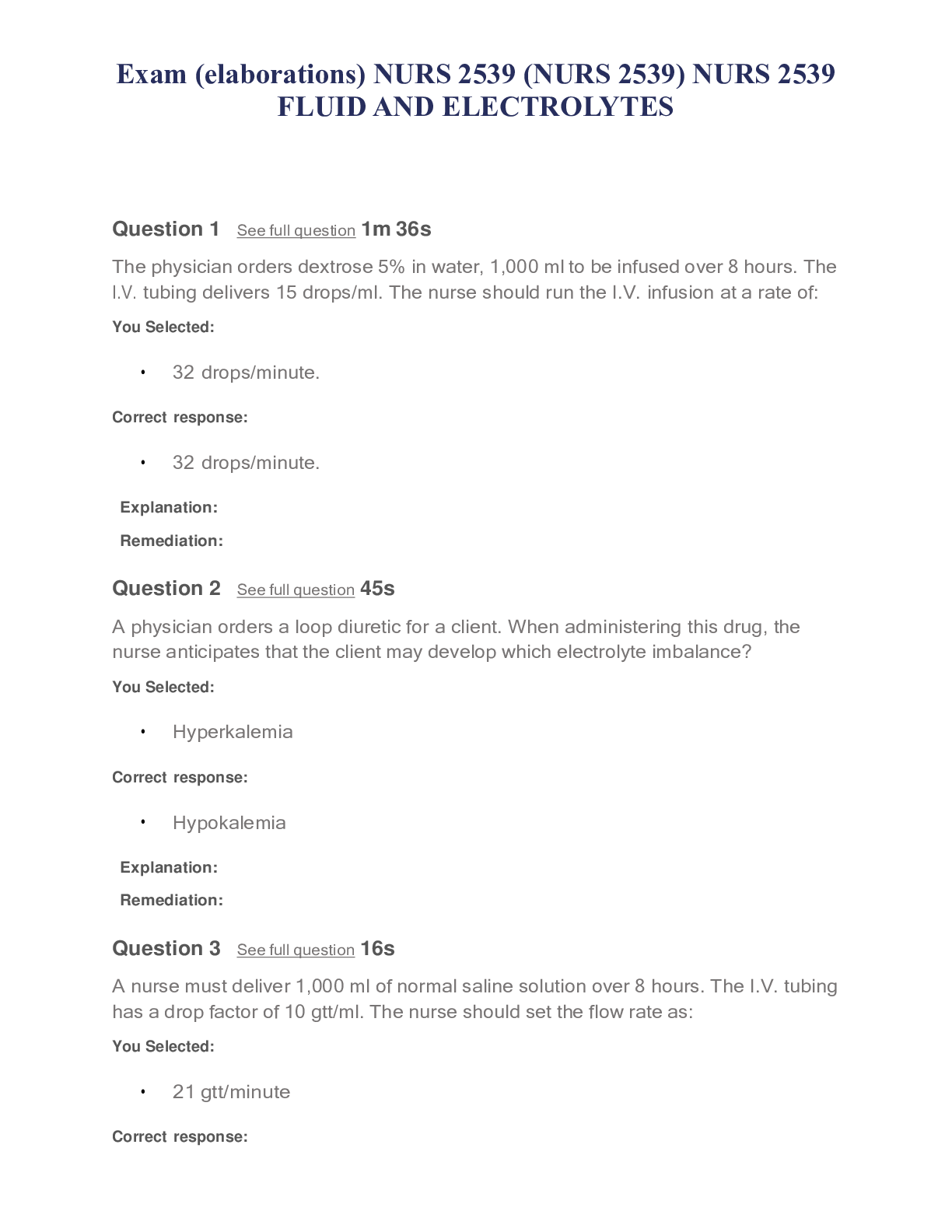
FLUID AND ELECTROLYTES
Question 1
The physician orders dextrose 5% in water, 1,000 ml to be infused over 8 hours. The
I.V. tubing delivers 15 drops/ml. The nurse should run the I.V. infusion at a rate of:
Question 2 See full question 45s
A physician orders a loop diuretic for a client. When administering this drug, the nurse anticipates that the client may develop which electrolyte imbalance?
Question 3 See full question 16s
A nurse must deliver 1,000 ml of normal saline solution over 8 hours. The I.V. tubing has a drop factor of 10 gtt/ml. The nurse should set the flow rate as:
Question 4 See full question 18s
Parents bring their infant to the clinic, seeking treatment for vomiting and diarrhea that has lasted for 2 days. On assessment, the nurse detects dry mucous membranes and lethargy. What other finding suggests a fluid volume deficit?
Question 5 See full question 45s
For a client with anorexia nervosa, which goal takes the highest priority?
Question 6 See full question 20s
A client in the 13th week of pregnancy develops hyperemesis gravidarum. Which laboratory finding indicates the need for intervention?
Question 7 See full question 12s
Parents who bring a 3-week-old neonate to the hospital report that he's been "throwing up after every feeding." A nurse notes projectile vomiting while assessing the neonate. X-rays confirm:
Question 8 See full question 56s
Which assessment finding would lead a nurse to suspect dehydration in a preterm neonate?
Question 9 See full question 2m 44s
A nurse is planning to administer a sodium polystyrene sulfonate enema to a client with a potassium level of 6.2 mEq/L. Correct administration and the effects of this enema should include having the client:
Question 10 See full question 2m 4s
After completing discharge instructions for a primiparous client who is bottle- feeding her term neonate, the nurse determines that the mother understands the instructions when the mother says that she should contact the pediatrician if the neonate exhibits which sign or symptom?
Question 11 See full question 5m 21s
A 31-year-old multigravid client at 39 weeks' gestation admitted to the hospital in active labor is receiving intravenous lactated Ringer's solution and a continuous epidural anesthetic. During the first hour after administration of the anesthetic, the nurse should monitor the client for:
Question 12 See full question 2m 44s
The nurse is evaluating the effectiveness of fluid resuscitation during the emergency period of burn management. Which finding indicates that adequate fluid replacement has been achieved in the client?
Question 13 See full question 3m 1s
A client is admitted with acute pancreatitis. The nurse should monitor which laboratory values?
Question 14 See full question 3m 1s
Clients who are receiving total parenteral nutrition (TPN) are at risk for development of which complication?
Question 15 See full question 38s
A client with a history of renal calculi formation is being discharged after surgery to remove the calculus. What instructions should the nurse include in the client's discharge teaching plan?
Question 16 See full question 6m 18s
The client's serum potassium level is elevated in acute renal failure, and the nurse administers sodium polystyrene sulfonate. The mechanism of action for this drug is to:
Question 17 See full question 1m 32s
What finding should the nurse interpret as indicating that a child is receiving too much IV fluid too rapidly?
Question 18 See full question 2m 1s
Which symptom is an early indication that the client’s serum potassium level is below normal?
Question 19 See full question 14s
The nurse monitors IV replacement therapy for a client with a nasogastric (NG) tube attached to low suction in order to:
Question 20 See full question 36s
The nurse is assessing a client who is restless and agitated, has dry mucous membranes, and has intense thirst. The nurse should assess the client further for which electrolyte imbalance?
..........................................CONTINUED...............................
[Show More]


 NURS 2539 (NURS 2539)NURS 2539 ASSESSMENT LATEST UPDATE 2021.png)