Marketing > CASE STUDY > Fordham UniversityMARKETING MKBU3222Case Study 6 with questions that need to be answered (All)
Fordham UniversityMARKETING MKBU3222Case Study 6 with questions that need to be answered
Document Content and Description Below
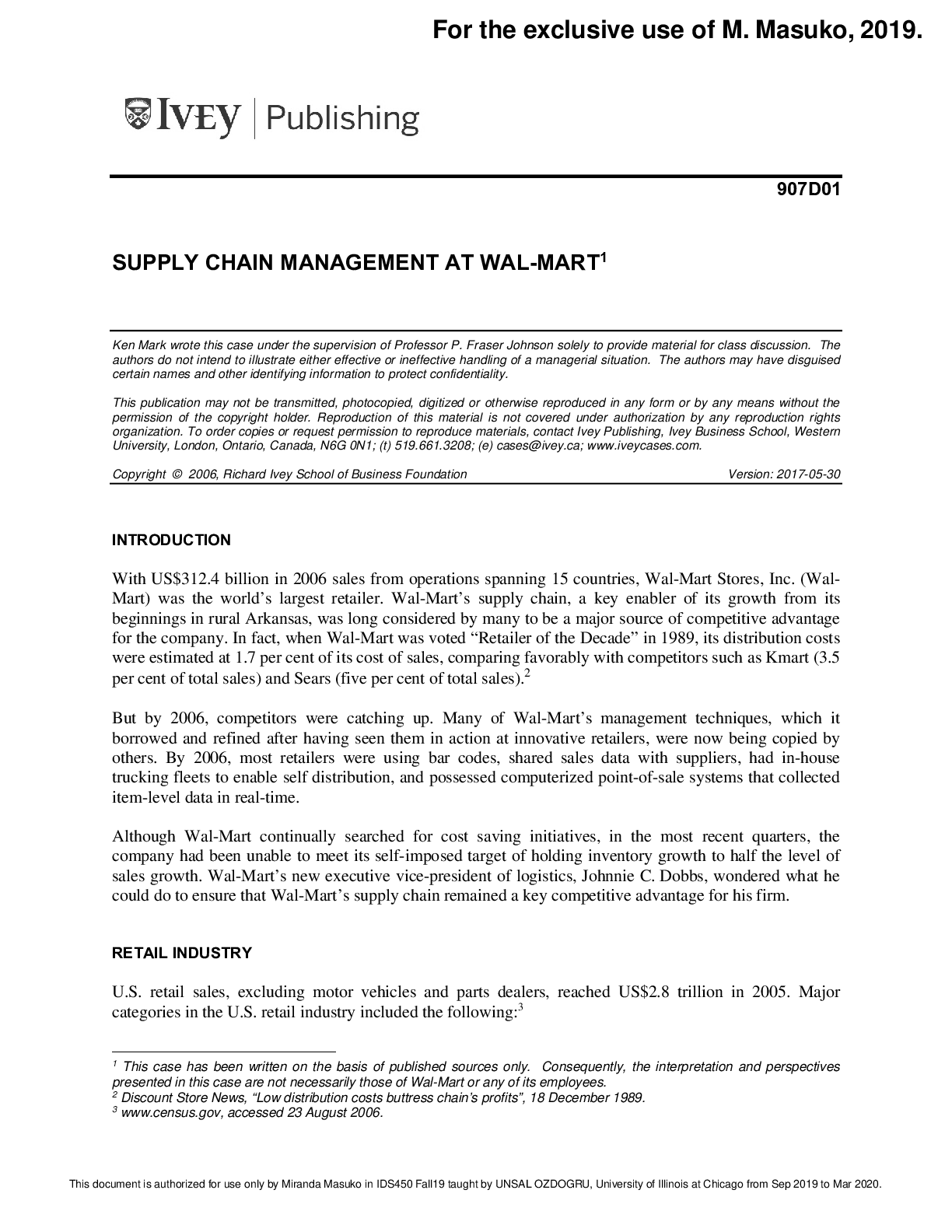
Answer the questions below with the illustrated case study right after the questions: The two defense forces case studies outline various disruptions to supply chain operations and these can be cate ... gorized as breakdowns in general. However, given that all logistical challenges were in the absence of enemy engagement… 1. Could you identify the true source of supply chain disruption? 2. Consider supply chain disruptions experienced in your own organization. Perhaps poor supplier performance has influenced operations. Can you search for and provide a few clues as to what may have caused these situations at a deeper level? Case Study Supply Chain Disruption Ad omnia paratus: prepared for anything Steve O’Sullivan Knowledge: The complexity of supply chain management has been compounded by globalization along the dimensions of replenishment, time and distance (Christopher and towill, 2002), and vulnerabilities to disruptions have increased as supply chains ‘become more lengthy and complex due to globalization and vertical integrations’ (Rajesh and Rao, 2015), forces that are accelerating ‘beyond our ability to adapt’, together with technology advancements and climate change (Friedman, 2016). this has led to a volatile operating environment, ‘fraught with greaterChapter 11 – “Supply Chain Disruption” 2 demand uncertainty, higher risk, and increasing competitive intensity’ (roh et al, 2014), and ‘increasingly, organizations are finding themselves at the center of un-plannable events that interrupt and threaten their global supply chains’ (Gattorna, 2015).Such disruptions can include attacks from purposeful agents, escalating natural events, uncertain customer demand, quality issues, transportation delays, poor supplier performance, equipment malfunctions, inventory and capacity issues, technology breakdowns, increasing competitive intensity, and human-centered issues from strikes to fraud (Kleindorfer and Saad, 2005; roh et al, 2014; Roberta Pereira, Christopher and Lago Da Silva, 2014). these result in severe stock and operating for senior management and shareholders (Kleindorfer and Saad, 2005), ‘with costs and other consequences even more challenging than terrorist acts, as they have a greater cumulative effect over time’ (Roberta Pereira et al, 2014) and have a disproportionate effect on demand (Sheffi, 2001). We have come to understand that disruptions can come from practically any source and appear unexpectedly over the horizon like Exocets. However, I have dug deeper than this, and have come to the conclusion that policy, be it at government (and in this case) military or business levels, is the underlying source of disruption to contemporary supply chains. if this insight is true, it implies that human behavior at all levels and locations along supply chains has become distorted through the cultures embedded in the guilty organizations. And one of the biggest influences on the formation of internal culture is organization design, the structure that we put people to work in. [Show More]
Last updated: 3 years ago
Preview 1 out of 18 pages

Buy this document to get the full access instantly
Instant Download Access after purchase
Buy NowInstant download
We Accept:

Reviews( 0 )
$11.00
Can't find what you want? Try our AI powered Search
Document information
Connected school, study & course
About the document
Uploaded On
Jun 12, 2021
Number of pages
18
Written in
All

Additional information
This document has been written for:
Uploaded
Jun 12, 2021
Downloads
0
Views
81