NSG 6005 ANCC Study Guide_ LATEST
HITECH Act (Health Information Technology for Economic & Clinical Health)
• Promote meaningful use of health information technology
o Privacy/security of PHI
o Improve quality, saf
...
NSG 6005 ANCC Study Guide_ LATEST
HITECH Act (Health Information Technology for Economic & Clinical Health)
• Promote meaningful use of health information technology
o Privacy/security of PHI
o Improve quality, safety, efficiency and reduce healthcare disparities
o Improve care coordination, population health and public health
o EHR (electronic health record) can engage patients and family
• 2009 – Transition from paper to electronic charting, incentives to convert by 2015
• CDS – Clinical Decision Support
• Best practice alert – based on clinical guidelines
• Red Text – for abnormal results and VS
• Condition-specific order sets/protocols
American Telemedicine Association Practice Guidelines
• Follow federal, state & local regulations & licensure requirements
• Providers shall ensure that the patient is physically located in a jurisdiction in which the provider is duly licensed and credentialed.
• Providers shall practice within the scope of their licensure and shall observe all applicable state and federal legal & regulatory requirements
• Helpful for patients in rural areas with decreased access to care
State Practice Act
• NP’s legal right to practice is derived from state legislature
• Dictate level of prescriptive authority allowed
• Determines scope of practice, mandated education and requirements in each state
State Board of Nursing
• Enforces state’s nurse practice act, statutory authority to regulate nursing practice
• Legal authority to License, monitor and discipline nurses
Emergency Medical Treatment & Labor Act (EMTALA)
• Prevent inappropriate transfers and “patient dumping” for indigent patients
• Requires hospitals to assess & treat patients regardless of ability to pay and provides specific provision for when transfers are allowed.
Consensus Model for Advanced Practice Registered Nurse (APRN)
• Allow NP to practice as the fullest extent of their training and certification
• National Counsel of the state BON in conjunction with numerous professional organizations
• Advocates for the APRN title, independent prescriptive authority & establishes certain minimum standards for NP’s
• ***NP’s are not required to have collaborating physician supervision under the consensus model
Relative Risk
• Probability of disease occurring between 2 groups (unexposed divided by exposed)
• (Ex: lung CA in smokers vs non-smokers)
Incidence = new cases of disease (i.e. new outbreak of malaria) Prevalence = current cases of disease
Sensitivity = Yes, Rule in, True positive Specificity = No, Rule out, True negative
Medicaid: government aid to low income. Funded by federal & state. Coverage varies in each state (if you move to a new state, coverage may change!)
Medicare: 65 & older. ONLY federally funded. ESRD pts.
o A: Inpatient –Hospital, includes pscyh, hospice, SNF, home health
o B: Outpatient—Primary care, ER visits, health screening, DME (Durable medical equipment), custodial care (nursing home, ADLs in home), smoking cessation, vaccines
o C: “Extra”—dental (dentures), vision (prescription glasses), hearing
o D: “Drugs”—prescription drugs, non-formulary patient must pay
DME (Durable Medical Equipment)
• Wheelchair, hospital bed, nebulizer machine, glucometer
• Documentation requires provider had a face-to-face exam with pt in <6 months, with evaluation for specific condition requiring DME
Research Hierarchy –Level of Evidence –MS REC CEO
• Meta-Analysis (Cochrane, Medline, Pubmed, CINAHL, Strongest*, statistical)
• Systematic Review – general review, no stats
• RCT – Double-blind (no selection bias)
• Experimental –control vs experimental but not double-blind randomization
• Cohort –Retrospective/prospective, no experiment – study of patients
• Case Study –case of 1 person
• Editorial –“Letter to editor”
• Opinion –“consensus statement”
Reliability =Consistency (Repeat research and get same result over and over) Validity =Accuracy (Measures what it is supposed to measure; Reproducible)
Internal Validity:
• Threat in research itself. Confounding variables.
• Achieved by using controls/ random assignment (only independent variable should affect dependent variable)
External Validity:
• Threat outside the research.
• Can you generalize the research? (apply to other populations and situations)
• Threatened by selection bias (only one culture of people), drop outs, bad history and reliability measures.
Independent Variable = Can be manipulated/changed. Dependent Variable = Depends on independent variable.
Ex: Weight loss (dv) is dependent on exercise (iv). Diet pills are confounding variable.
Statistical Terms
• T test – compares one variable between 2 groups (statistical difference)
• P value- statistical hypothesis, probability of error or chance, level of significance (ideal is
<0.01, bad is >0.5)
• Standard deviation- average deviation from the mean
• Confidence Interval- reliability of an estimate (probability of parameter estimated)
• N= total size of sample
• n= total number of subjects in sub-group
• Normal curve= bell-shaped curve
• Quantitative – deductive reasoning (Top Down, General Specific)
o Experimental- randomization and control group
o Quasi-experimental –no comparison group or randomization
o Non-experimental- Descriptive & correlational
• Qualitative –inductive reasoning (Bottom Up, Specific General)
o Case studies, field observations, interview
Selection bias: systematic difference between two groups at baseline; happens when you are still selecting subjects. I the research still going.
Institutional Review Boards (IRBs)
• Designed to ensure the rights of the human subjects who are participating in research studies in their hospital or clinic. Have the rights and responsibilities to approve or reject the project.
Tuskegee Syphilis Experiment
• 600 African American Sharecroppers (1932 to 1972) from Alabama. Men tested for syphilis – those positive were not informed or treated. Many suffered and infected others without their knowledge
• Laws were passed to protect human subjects’ rights and mandate informed consent.
Infant Mortality Rate: # of deaths of infants <12 mos per 1000 live births. Nurse Practitioner History
• Loretta Ford, Henry Silver – First program U of Colorado in 1978, pediatric program
Quality Assurance = Patient Outcomes
Ex. Problem of diabetic neuropathy; outcome measure is A1C
• Improve quality of care and patient satisfaction
• Decrease pt complications, hospitalizations, mortality, system errors,
Risk Management = Patient Safety
Ex. Fall Prevention, preventing medication errors, hospital-acquired infections
Root Cause Analysis (RCA): process to identify contributing factors of sentinel events; focus on system and not on blaming individuals
Sentinel Event: patient safety event that results in death, permanent injury and/or severe harm with intervention required to sustain life
Swiss Cheese Model
• Goal of Patient safety = adequate safeguards to prevent error (rather than trying to correct behavior)
• Holes are opportunities for the process to fail, each layer is an opportunity to stop an error
• Systems approach rather than person approach (humans are fallible- errors are to be expected
Motivational Interviewing – goal to create change
• encourage pt to be active in change process
• Collaborative, non-confrontational, promote empathy
Stages of Change (Transtheoretical Model of Change) – PCP in the AM
• Pre-contemplation –no desire to change, denial
• Contemplation—considers change, recognizes behavior
• Preparation—states ready to make change
• Action—taking steps to change
• Maintenance—relapse prevention
Lewin’s Change Model
• Unfreezing –assess barriers/reason for change, plan for change
• Driving Forces –redesign roles/responsibilities, new training, change happens
• Refreezing—pay/reward, measurement, change becomes habit/standard
Kotters 8-Step Change Model
• Create a sense of urgency
• Build a guiding coalition - assembling a group with the power & energy to lead and support a collaborative change effort (i.e. NP’s creating a task force to address scope of practice concerns)
• Form a strategic mission & initiative (develop goals for organization)
• Enlist a volunteer army (get other team members on board)
• Enable action by removing barriers (Software cost and labor)
• Generate short-term wins (Incentive – such as reward or salary increase if goals met)
• Sustain acceleration (Discuss areas of improvement)
• Institute change- Anchor the change within the organization and across the entire system.
Ethical Concepts
• Beneficience – do good
• Nonmaleficience –do no harm
• Veracity – tell truth
• Fidelity – keep promises
• Justice -fairness
• Autonomy –respect pt’s decisions
o Informed consent: pt makes decisions with knowledge of risks/benefits
• Utilitarianism – benefits majority
Malpractice =must prove 4 things
• Duty is owed
• Duty was breached
• Breach caused injury (proximal cause)
• Damage occurred
Expert witness must practice in same geographic area
Negligence =no injury, but breach occurred, failure to do what any reasonably minded person would do
Malpractice Insurance
Claims-based: only covers NP when claim is filed while NP is still at job & covered Tail coverage: can be added to protect in future
Occurrence-based: not affected by job change or retirement
Confidentiality: Not sharing medical info/records. Protect pt identify and PHI Privacy: Preserving dignity (i.e. closing curtain, sharing pt diagnosis in private area)
HIPAA (Health Insurance Portability & Accountability Act) Requirements:
• HIPAA policy given to/reviewed by patient
• Patients can review their medical records (unless mental health provider refuses)
• Patient can correct errors in their record Exceptions:
• Contact health plan/insurance company
• Contact third party business associate (accounting, legal, administrative)
• Medical billing, collections for unpaid bills
• Consult with other health care providers (including peers)
• Health care operations (reviews/audits)
• Report abuse/neglect or domestic violence, SI/HI HIPAA Office Rules:
• Protect name on chart (chart facing door)
• Sign-in sheet (NO diagnosis; only name, date, time)
• Call pt from lobby by first name only (if 2, then first initial of last name)
• Voicemail message: concise <60 secs, 3 calls/wk (can give appt reminder, notification about prescription, pre-op/post-op instructions)
• Can only leave lab results if pt has given specific consent to do so
Emancipated Minors: marriage, court order, active military Minor’s Confidentiality: STDs, birth control, pregnancy Social Determinants of Health
• Cultural, community, social, behavioral
• Educational background (more high school grads, more enrollment in higher ed, language/literacy)
• Socioeconomic factors (economic stability)
Cultural Differences:
• African Americans
o Religious coping, use minister to help decisions
o Illness caused by lack of faith or sin
o Many female head of household (matriarchal)
• Latinos/Hispanics
o Mal de ojo – “evil eye” –adult stares with envy at child; broken by touching
head/shoulder or passing an egg over the child
o Multi-generational –ALL family often stays for results
o “susto” – cultural illness, means “fright”
o “respeto” – call adults senor or senora
• Native Americans
o Silent periods, no loud speaking
o Decreased eye contact
o Illness is “punishment” by spirits for wrongful actions
o Healing by “shamans” with prayers, dancing, fasting, smudging (burning an herb to cleanse) or ingesting hallucinogenic plants (peyote), tie on medicine pouches
o Poor health- lower life expectancy, leading cause of death is heart disease
• Sikns (Khalsa)
o Wear 5 symbols: uncut hair, sword, shorts, hair comb, iron wrist ring (don’t remove without consent!)
o No meat, alcohol or stimulants
• Asians
o Value college education, high respect for doctors
o Decreased eye contact
o “yes” or head nod as courtesy, not necessarily understanding (Do teach back)
o elderly held in high-esteem, taken care of, opinion valued
o CYP enzyme for metabolism variable –drug dosages may need adjustment
o Koreans – Han bang – balance of fire, earth, metal, water, wood; yin & yang
o Filipino –timbang - balance
• Vietnamese
o May stop taking prescription when symptoms resolved
o Believe blood loss (lab tests or surgery) worsens health
o Western medicine may put body out of balance
o Relies on younger family members for medical decisions
• Buddhist
o Good deeds =good health (and vice versa) –Karma
o Reincarnation/rebirth
o Meditation – may refuse meds that alter consciousness
• Traditional Chinese medicine
o Life energy (Chi or qi) imbalance is cause of disease
o Yin (female), yang (female)
o Acupuncture & cupping correct energy imbalance
o Cupping/coining – bruising on back- ask parents before reporting abuse
• Hindus
o Spiritual purity – remove shoes indoors, purify plate by sprinkling water around it
o Talisman –do not cut/remove
o No meat (esp beef/pork)
• Muslims
o Modesty –“modified physical exam” for women
o Prefer same gender provider, man stays with female pt
o Ramadan- 30 days of fasting (Food/fluids) – Schedule PO meds after sunset (or change to ER, decrease frequency)
• Jehovah’s Witness
o Refuse to accept donated blood, stored blood or own blood BUT will accept non-
blood plasma expanders and blood components without RBCs (albumin, cryoprecipitate, clotting factors, immunoglobulins)
• Jews
o May prefer male provider
o Sabbath – sundown Friday to sundown Saturday (may not use electronics or drive car)
o Kosher diet
• 7th Day Adventist
o Vegetarian. NO alcohol, tobacco or caffeine.
o Body is temple
o Same Sabbath as jews
• Amish/Mennonites
o Don’t participate in Medicare or social security or go to war
o Community pays for health care, no health insurance
o Need permission from church elder for surgery or expensive test
o Prefer giving birth/dying at home
o Higher risk of certain genetic diseases: Maple syrup urine disease, Crigler-Najjar Syndrome, Dwarfism, Cystic Fibrosis
Leadership Styles
• Situational –during catastrophe, flexible, fits need at certain time
• Transformational –communicates vision, charismatic
• Laissez-faire—do nothing, no supervision/direction
• Authoritarian—dictate, control, rules
• Democratic—organize meetings, shared decision-making
• Servant—relationships, work alongside of staff, allows staff to make decisions
SMART goals – for both management and patient-centered care
• Specific (clear & precise)
• Measurable (able to be evaluated)
• Appropriate (consistent with goal/priorities)
• Reasonable (realistically achievable)
• Time frame
Evidence-Based Project
ASK (PICOT Question – Population, Intervention, Comparison, Outcome, Time Frame) ACQUIRE –find articles, research
APPRAISE – choose articles with most pertinent info (i.e. summary review) APPLY – put into practice
EVALUATE
Billing Documentation
• CPT –procedure code
• ICD-10 –diagnostic code
• E&M (Evaluation & Management)- Requires documentation to get reimbursement
o (1) History, (2) Physical, (3) Medical-decision making (plan of care)
o Problem-focused visit: CC, HPI, no ROS required
• New Patient- Not seen by this provider (or other provider in same system) for 3 YEARS
• “Incident to” billing- for Medicare patients – billing of a follow-up visit performed by non-physician provider under physician’s NPI number (NP paid 100% vs normal 85%)
Ombudsman
• An intermediary (or liason) between pt and organization (LTC facilities, hospitals, govt agency, court)
• Investigates/mediates complaint from both sides and attempts to reach fair conclusion
Guardian Ad Litem: individual assigned by court (legal authority) to act in best interest of the ward (child, or frail/vulnerable person)
TPA (third-party administrator)– organization that does the processing of insurance claims and administrative work for another company (health insurer, health plan, retirement plan)
Patient-Centered Medical Home
• Patient- centered primary care, most needs taken care of in home setting
• Patient & Family – important members of health care team, care coordination
• 24/7 access to member of team by phone, video or email
Hospice Eligibility
• Terminal condition, less than 6 months to live (verified by 2 physicians, NOT NP)
• Rapidly declining/worsening of symptoms
• Needs assistance with more than 2 ADLs
• Patient accepts palliative care, not curative care (not eligible if refusing!)
*Covered by Medicare A*
Human Genetic Symbols
• Healthy Male – Empty Square
• Diseased Male – Filled Square
• Death of Male –Square with diagonal line
• Health Female- Empty Circle
• Diseased Female – Filled Circle
• Death of Female – Circle with diagonal line
Health Literacy: degree to which individuals have capacity to obtain, process, and understand basic health information and services needed to make appropriate health decisions
Vulnerable Populations
• Infants/children <18 y/o
• Pregnant women/fetuses
• Prisoners
• Persons with mental disabilities
• Persons who are economically disadvantaged
• LGBT
Consent = only for over 18 y/o or emancipated minor
Assent = Age 7-17 y/o agree to participate in study and can withdraw from study after discussing with parents
Health Belief Model (HBM): Individuals motivated to take positive health actions, want to avoid negative health consequences
• Perceived susceptibility- guest speaker with disease influences opinion of risk
• Perceived barriers to action –brainstorm about tangible and psychological costs
• Perceived health benefits -Clearly present desired action (provide info)
• Self-efficacy – one’s ability to take action
• Cue to action (give incentive items like key chains, posters to raise awareness)
Healthy People 2020
• Initiative with evidence-based objectives to be followed over a 10-year period to measure biological, social, environmental and interrelational factors
o General health status
o Health-related quality of life & well-being
o Determinates of health - aim to create social & physical environments that promote good health for all
o Reduce health disparities
• Increase use of social marketing in health promotion
• Increased health literacy of general population
• Increased number of persons who use electronic personal health management tools
• Increase individuals access to internet
• Increase satisfaction in provider communication skills
• Increase proportion of quality, health related websites
• Increase proportion of crisis and emergency risk messages of best practices of public health
USPTF
• Made up of volunteer experts with backgrounds in primary care and preventative medicine
• Recommendations for clinical prevention services CDC goal: increase health security of US
NIH: medical research
Joint Commission
• Establishes performance standards for hospitals to follow for accreditation
• Holds organizations accountable for sentinel events
• Implements the Core Measures program
Endemic
• Prevalence of disease in a population within a geographic area
• Malaria is endemic to Africa, Asia, Latin America and middle east Epidemic
• Increase in number of cases of a disease above what is expected for the population in that area
• Outbreak- epidemic in a limited geographic area
• Pandemic- epidemic that has spread over several countries/continents, affect large number of people
Reportable to State Department of Health
• 5 Diagnoses: Gonorrhea, Chlamydia, Syphilis, HIV, TB
• Criminal acts & injury from dangerous weapons
• Animal bites
• Suspected and/or actual child or elder abuse
o Domestic violence NOT state reportable
National Quality Strategy
• Improve quality of health care
o Better Care (patient safety, patient-centered, accessible)
o Healthy People/Healthy Communities (address behavioral, social, environmental)
o Affordable Care (easy access to quality care, reduced cost)
Prevention
• Primary –prevent disease/condition from occurring (healthy lifestyle, safety, immunizations)
• Secondary –detect/treat existing disease/condition to decrease impact (Screening/testing)
• Tertiary—provide treatment/rehab to decrease negative impact (support groups, rehab, education for those with disease)
• Quaternary—lessen/avoid unnecessary/excessive interventions
Examples:
Teens/MVA
• Prim- Restrictions on adolescent drivers to prevent MVAs
• Sec- Counsel adolescents to wear seatbelts to decrease severity of injuries
• Tert- provide first aid at scene of MVA
• Quat – avoid unnecessary narcotic prescriptions for those injured
HIV
• Prim- increase condom use, decrease risky behaviors
• Sec- HIV screening (early detection)
• Tert- decrease viral load to improve management of existing disease
ASA
• Prim- ASA prophylaxis for at risk individuals
• Sec- ASA daily for pt with history of MI/TIA/CVA in past
• Tert- Treat person after MI w/ASA
Immunization Principles
• Community (Herd)- given to those who can, in order to protect those who can’t
• Active – resistance in response to antigen (infection or vaccine)
• Passive- by antibody produced in another host (infant of immune mom, immunoglobulin)
National Institute of Medicine Quality Aims
• Patient safety –care as safe in facility as it is in home
• Patient centeredness – respect patient preferences, pt in control
• Effectiveness –evidence based standards of care
• Efficiency –cost-effective, not wasteful
• Timeliness –no delays
• Equity –equal treatment for all
Prescriptions for Controlled Substances – must include the following:
1. date of issue
2. patient’s name & address
3. practitioner’s name, address & DEA
4. drug name, dosage form, quantity, direction for use
5. # or refills
6. manual signature
**prescriptions for scheduled II controlled substances may be telephoned to pharmacy but must be followed up with a written prescription within 7 days** Prescriptions for schedule III-V may be written, oral or transmitted by fax.
Screening
• Breast CA
o 50-74 y/o q2yrs
o ACOG recommends start at 40 if risk factors
• Cervical CA
o Start at 21 y/o q3yrs
o Age 30-65 –PAP q3yrs or HPV co-testing q5yrs
o If hysterectomy w/cervix removed- STOP screening unless hx of cervical CA
• Colorectal CA
o 50-75 y/o
▪ FOBT x3 annually
▪ Flexible Sigmoidoscopy/CT colonography q5 yrs
▪ Colonoscopy q10 yrs (if normal)
• Lung CA
o No ROUTINE screening
o LDCT (low-dose CT) annually if 55-80 y/o smokers 30 pack years or quit w/in 15 years (stop screening after quit >15 years ago)
• Prostate CA
o No ROUTINE screening
o High Risk (African ancestry, 1st Degree relative w/hx) – screen at age 40
o Average risk screen at 55-69 with PSA and DRE
▪ PSA < 2.5, q2yrs
▪ PSA >2.5, q1yr
• Ovarian CA
o No ROUTINE screening
o Screen w/Transvaginal US + CA-125 test if risk factors: BRCA gene, 1st degree relative w/breast CA (esp Ashkenazi Jews)
• Osteoporosis
o All women >65 y/o
o Women <65 y/o with risk factors (low BMI, smoking, inadequate Ca, chronic steroids)
o DXA q2-5yrs or q1-2 year if treating
• Lipids
o Start at 20 y/o -FLP q5yrs if <200
o Over 40 y/o – q2-3yrs (if <200)
o Annually (or more) if >200 (more frequent if titrating med dosages)
• Newborn screening in all states – related to intellectual disability
o PKU (Phenylalanine)
o Congenital hypothyroidism –TSH or T4
• AAA
o 65-75 y/o history of smoking
o ABD US x1
Cytochrome P450 System
• Asians metabolize differently (may need dosage adjustments)
• GMACC (Grapefruit, Macrolide, Antifungals, Cimetidine, Citalopram)
• If 2 drugs metabolized with this system (eg Theophylline & Clarithromycin) – may slow metabolism so check levels
US Health Statistics
• Mortality (leading cause of death): (1) Heart disease (2) Cancer (3) COPD
• Cancer Mortality: *Lung cancer
o Men: Lung cancer, prostate cancer, colorectal cancer
o Women: Lung cancer, breast cancer, colorectal cancer
• Adolescent Deaths: (1) Accidents/MVAs (2) Suicide (3) Homicide
• Most common cancer: Skin cancer
o Men- prostate
o Women- breast
• Most common skin cancer: basal cell carcinoma
o Majority of skin cancer deaths: melanoma
• Most common cancer in children: ALL Rocky Mountain Spotted Fever
• Onset: Flu-like THEN 2-5 days -rash (petechiae) starts on hands/feet to trunk (palmar rash)
• Dog/wood tick bite: remove tick by grasping closest to skin and apply steady upward pressure
• Think rocky NC/OK/AK/TN/MO, south-east/central US, Apr-Sept.
• DX: PCR: Rickessetti Antigen, punch biopsy, CBC/LFT/CSF
• TX- Doxycycline (fatal if not started within 8 days)
Erythema Migrans (Lyme Disease)
• Stages
o 1: Flu-like symptoms, Target bulls-eye (red rash, central clearing), usually appears
in 7-14 days POST after deer tick bite.
o 2: H/A, joint stiffness, heart symptoms/heart block, Bell’s Palsy
o 3: Joint pain 1 year after infection, encephalopathy
• Northeast, central US
• DX: Borella Burgdorferi via ELISA, then confirm with western blot. Increased ESR.
• TX: <7 y/o - Amoxicillin or cefuroxime
>7y/o – Doxycycline (stains kids teeth)
Melanoma- ABCDE
• Asymmetry
• Border Irregularity
• Color change (Brown, black)
• Diameter >6mm
• Evolving/Elevated
TX: DON’T BIOPSY! Send to Derm.
Squamous Cell Carcinoma (NO SUN)
• Nodular (or papule/plaque)
• Opaque
• Sun-exposed, lips in smokers
• Ulcerating, hyperkeratotic, bleed easily
• Non-distinct borders DX: Punch Biopsy
TX: Mohs Procedure
Basal Cell Carcinoma (PUT ON)
• Pearly papule, WAXY
• Ulcerating
• TELANGECTASIS
• On the face, scalp, pinna
• Nodules, slow-growing, dome
*on fair skin
DX: Shave (excisional) biopsy
Actinic Keratosis-
• Precursor to squamous cell carcinoma.
• Pink/red round lesions, rough/scaly. Does not heal. Slow growing in sun exposed areas.
• Diagnosis: BIOPSY-Golden Standard.
• Treatment: Sm. (cryotherapy), Lrg. (5-FU cream)- causes skin to ooze, crust, scab
Seborrheic Keratosis- soft round wart light tan to black pasted on. Asymptomatic and benign. Stevens Johnson Syndrome-
• Classic is target or bulls-eye.
• Abrupt hives, blisters, petechiae, purpura, necrosis, sloughing of tissues. Prodrome: flu- like symptoms
• Triggers: Allopurinol, anticonvulsants, pcn, sulfonamides, NSAIDS. HIV ppl have higher risk for this syndrome.
Psoriasis-
• Pruritic erythematous plaques, fine silvery-white scales with pitted fingernails.
• Koebner phenomenon- new psoriatic plaques form over skin trauma
• Auspitz sign- pinpoint bleeding when plaques are removed
• TX: Topical steroids, Topical retinoids, Tar preps, UVB lights. For (severe) do anti-TNF, or immunologic.
• Psoriatic arthritis (painful/red/swollen joints)
Acanthosis Nigricans
• Velvety hyper pigmented patches most common on back of neck or skin folds
• DM resistance – check fasting blood glucose
Scabies
• Itching at bedtime, linear lesions, webs of fingers/toes, bikini line
• TX: Permethrin cream, treat everyone wash sheets and everything else in hot water.
Atopic Dermatitis (eczema)-
• Extremely itchy. On flexural folds, neck, hands. Increased IgE (atopy, asthma)
• Vesicles that rupture leaving painful, bright-red, weepy lesions, they become lichenified from itching.
• TX: (1) Lubricants, hydrating cool baths, (2) Topical Steroids, (3) PO antihistamines
o Mild – Hydrocortisone
o Med- Triamcinolone
o High- Clobetasol
Tinea Corporis-
• “ring like itchy rash, slowly enlarge central clearing”
• Treatment: most respond to topical antifungals (“azole), if severe do oral Lamisil.
Tinea Versicolor
• Hypopigmented macules on chest/shoulders/back after tan
• KOH slide: “spaghetti and meatballs” –hyphae & spores
• TX: topical selenium sulfide, Ketoconazole, oral antifungals
Cellulitis-
• Deep dermis, poorly demarcated, low legs.
• Complications: DVT, DM with cellulitis, osteomyelitis, sepsis
• MRSA TX: (ABCD)
MRS A
Bactrim –unless sulfa allergy Clindamycin
Doxycycline
Erysipelas
• Group A strep, Upper dermis, indurated with clear demarcated, cheeks, shins.
• TX:- Keflex or Dicloxacillin (PCN allergy: Macrolide)
• Folliculitis topical bactroban
• Abscess, furuncle, carbuncle I&D, warm compress to drain
Molloscum Contagiosum
• Pox virus, pearly white plug, dome shaped. Highly contagious.
Varicella/Zoster
• Contagious 1-2d before, until all lesions crusted over
• Chicken Pox: Pruritic vesicular lesions begin at head, spread to trunk; vesicles crust over.
• Shingles: vesicular lesions at various stages along dermatome
• TX: supportive, antihistamines, Acyclovir (10d initial, 7d for flare ups)
• Post-herpetic neuralgia: TCA, anticonvulsant, gabapentin, lidocaine or capsaicin cream
Acne Vulgaris-
• Mild (topicals only)
o Comedones with small papules.
o TX: Retin-A, if no improvement in 3 months, add erythromycin, benzoyl peroxide.
• Moderate (topicals plus antibiotics)
o Papules, pustules w/comedones.
o TX: Continue with topicals combined with topical antibiotics. Then add ORAL antibiotics tetra, mino, doxy.
• Severe-
o Painful indurated nodule, cysts, abscesses, pustules.
o TX: Accutane- check LFTs, 2 forms of contraceptives, monthly preg testing, only prescribe 1 month supply.
Acne Rosacea-
• Chronic small acne like papules/pustules around nose mouth chin.
• TX- Metrogel, Azelex. Low dose tetracycline.
Impetigo
• Non-bullous – macule then pustule with honey-crusted exudate Bactroban
• Bullous-large blisters Severe- Keflex, dicloxacillin (PCN Allergic-Macrolide
• No school until 48-72 hr after tx initiation.
Scarlet fever (Scarlantina)
• “sandpaper textured-pink rash with sore throat” strawberry tongue, rash starts on head and neck, spreads to trunk. The skin THEN desquamates.
Lichen Planus
• Small flat topped, red to purple bumps that may have white scales/flakes.
• Wichams striae: whispy grey white streaks.
• Causes: Hep C, medications, contact with chemicals.
Spider bite
• Bite area becomes swollen, red, and tender, and blisters appear within 24-48 hours. Necrotic in center, which kills the tissue.
• TX: Ice packs to wound and cold inactivates the toxin, tx like cellulitis of the skin, abx ointment at first, watch etc.
Dog Bite
• Irrigate w/100-200ml high pressure saline per inch of wound (iodine/saline mix if suspect rabies, hepatitis, HIV risk)
• DO NOT SUTURE IF: deep puncture wounds, lac <1.5cm, wounds >24hr post-bite, wounds to hand (esp joint)
• DOG-mentin = Augmentin
Pityriasis rosea
• Itchy, herald patch, xmas tree pattern, rash hands soles/feet
• Think to test for secondary syphilis (RPR then VDRL are screening, then dx FTA-ABS)
• TX: reassure, self-limiting, several weeks
Burns
• First-degree (superficial) – only epidermis – dry & erythematous
• Second-degree (superficial partial thickness) – epidermis – wet with blisters
• Third-degree (full thickness)—epidermis & dermis – pale & white
• Rule of 9s
o 9% Head, Chest, Abdomen, Arm
o 18% Back, Leg
o 1% Genitals, each palm
Topical Med Strength
• Lotion < Creams < Gels 22), blocked drainage of aqueous humor
• ER STAT
Primary Open Angle Glaucoma-
• CN2 gradual changes in peripheral vision LOST FIRST, then second central vision.
• TX: Eye drops (beta blocker and prostaglandin), Refer to ED if IOP >30
Cataracts
• Elderly- night vision issues, extreme glare. Opaque lens. Absent red reflex.
• Most common cause of blindness in developing countries
• TX: cataract surgery with IOL –intraocular lens implantation
Age-Related Macular Degeneration
• Painless loss of “central vision” reports straight lines appear curved
• Most common cause of blindness in US
• DX: Amsler grid
• Have large-print material for reading
Retinal Detachment
• Floaters, curtain, flashes of light. Painless.
Cholesteatoma
• Cauliflower mass in ear, foul-smell, painless drainage, can’t see TM, hearing loss.
• If erodes bones in face affects CN VII. TX: SURGERY
Battle sign
• Raccoon eyes, mastoid bruising 2-3d after trauma –basilar skull fracture/ICH
• Clear/golden discharge from nose/ears – check for glucose (+ in CSF)
Aphthous stomatitis (Canker sores)
• painful shallow ulcers heal 7-10 days.
• TX: Magic mouthwash.
Papilledema-
• optic disc swollen w/ blurred edges
• due to increased ICP (htn or cranial bleed)
Hypertensive Retinopathy
• Copper/silver wire arterioles
• AV nicking (mild retinopathy) (artery crosses vein & nicks it)
o Veins in eye larger & darker than arteries, and pulsate! (Different from rest of
vessels in body)
• Retinal Hemorrhages – hard exudates
Diabetic Retinopathy
• Cotton wool spots (moderate retinopathy) –fluffy soft white/yellow patches
• Micro-aneurysms
• Also retinal flame hemorrhages –orange/red
KOplick Spots
• Clusters of small papules w/white centers in the buccal mucosa by lower molars
• RubeOlla: Fever, 3C: conjunctivitis, coryza, cough, Morbiliform rash.
Hordeolum (stye)
• Painful swollen red warm abscess- clogged sebaceous gland (hair follicle)
• TX: hot compress. Abx drops if preseptal cellulitis: erythromycin
Chalazion
• Clogged Meibomian gland (Sweat gland)
• May resolve spontaneously. TX refer to optho for I&D (NO ABX)
Blepharitis
• Red/inflamed eyelid, Crusting, gritty sensation
• TX: with warm compress, wash with baby shampoo and sometimes topical abx (sulfacetimide eye gtts -Bleph-10)
Allergic Conjunctivitis
• “stringy; increased tearing” Type I sensitivity. Typically, bilateral. Rhinitis and allergic shiner
• TX: PO antihistamines.
Bacterial Conjunctivitis
• Red, irritated eyelids, stuck together, injected conjunctiva, common cause: adenovirus
• TX: Polymyxin + trimethoprim (Polytrim), levofloxacin, azithromycin gtts
Xanthelasmas
• Raised, yellowish plaques under brow/lids. Sign of hyperlipidemia.
Acute Otitis Media (suppurative otitis media)
• Middle ear. Usually Strep. pneumo. (others: h influ, m. catarrhalis)
• TM bulging/retracted, erythematous, opaque (displaced/absent light reflex), decreased mobility (flat tympanogram)
• TM can rupture blood and pus on pillow on awakening with relief of ear pain
• TX: Amoxicillin (first line), If no response 48-72hr, then Augmentin, Cefdinir, Levaquin
• Weber- Lateralization to bad ear. Rinne- BC>AC
• Bullous myringits- blisters on TM – treat like AOM
Otitis Media with Effusion (serous otitis media)
• Ear pressure, popping, muffled hearing, chronic allergic rhinitis, sterile serious fluid is trapped in the middle ear (can last 8 weeks post AOM). Usually painless.
• TM should NOT BE RED. TM may bulge or retract.
• TX: Oral decongestants, steroid nasal spray, treat like allergies.
Otitis Externa (swimmers ear)
• Pseudomonas aeruginosa. (other- S. aureus).
• External ear pain, itching, hearing loss, pain with palpation of tragus, green discharge
• TX: Corticosporin, Ciprodex otic drops
Presbycusis
• inner ear. Symmetrical progressive. Human speech lost first. Aging adult.
• Lose high-pitched hearing. Especially in noisy environment.
Rinne
• 1st mastoid, 2nd front of ear- time each area. CN VIII (acoustic)
• Conductive = BC>AC (Hear behind blockage)
• Sensorineural = AC>BC (nerve damaged at mastoid area)
Weber
• Tuning fork midline top of head, normal to not lateralize (heard equally)
• CN VIII (acoustic)
• Conductive = Lateralize to bad ear (BC = Bad Conduction)
• Sensorineural =Lateralization to good ear (where nerve still intact)
Anthrax
• Animals/hides/hair/wool. Bioterrorism.
• Lesions begin as papule that enlarges quick 24-48h develops necrosis and ulceration (like a spider bite)
• Treatment: Doxy, Cipro, Levaquin. If you suspect BIOTERRORISM treat 60 d.
• Prophylaxis – Cipro, doxy. If BIOTERRORISM 60 d.
Meniere’s disease
• VERTIGO, TINNITUS, HEARING LOSS.
• BBPV DX: Dix Hallpike, TX: Epley’s Maneuver - Nystagmus should be horizontal (if vertical, check EOMs and refer)
Rhinosinusitis
• Unilateral facial pain or upper molar pain, *worse with bending over, *purulent nasal discharge, s/s over 10 days
• Transillumination- infected sinus dull
• TX: Augmentin (if already watched/waited 10 days)
o PCN allergic: Levofloxacin or Doxycycline (Hx anaphylaxis) or Cefdinir (Hx rash)
• Complications: mastoiditis, periorbital cellulitis (bulging eye and abnormal EOMS, refer!), meningitis, cavernous sinus thrombosis
Allergic Rhinitis
• Blue-tinged or pale, boggy nasal turbinates
• TX: 1st- topical steroid nasal spray (triamcinolone nasal spray – Nasacort), 2nd PO decongestants, antihistamines, cromolyn (mast cell stabilizer)
Expistaxis
• Kisselbach’s plexus- anterior nose bleeds, less severe than posterior nose bleed
• TX: nasal decongestants (afrin), silver nitrate
Pharyngitis
• 50% Viral – cough and cold-like symptoms (clear rhinitis, coryza); other: allergies (post- nasal drip), GERD, smoking, dry air
• CENTOR criteria – Group A Strep
o Absence of cough
o + Anterior cervical nodes swollen/tender
o Fever >100.4
o Tonsillar exudates
• Screen w/RADT and/or Throat C&S if Centor>3
• TX: Penicillin VK x10d (if PCN allergic- Macrolide)
• Complications
o Scarlet fever: sandpaper rash, strawberry tongue, desquamation
o Sinusitis
o Peritonsillar/retropharyngeal abscess (displaced uvula, bulging mass, odynophagia-painful swallowing, “hot potato voice”)
o Acute rheumatic fever (heart valves, joints, brain inflammation)
o Glomerulonephritis (abrupt proteinuria, hematuria, edema, RBC casts, HTN)
MONO
• Epstein Barr Virus – herpes family
• s/s: FFPL (Fever, Fatigue, Pharyngitis, Lymphadenopathy-Posterior Cervical)
• Enlarged spleen- hold activity until resolved (US)
• DX
o Monospot (aka heterophile antibody test) (positive 2-3 weeks in)
o EBV titers
o CBC: lymphocytosis, CMP: Increased ALT/AST
Diphtheria
• Bull neck (markedly swollen), contact precautions (very contagious!)
• Grey/yellow pseudomembrane, hard to displace in throat
Epiglottitis
• “Thumb sign” –enlarged epiglottis protruding from anterior wall of hypopharynx
• s/s: sore throat, fever, muffled voice, drooling, stridor, hoarseness
• life-threatening medical emergency ER stat
Sialolithiaisis
• painful lump usually in sub mandibular gland (aka whartons duct), Hurts more with eating (by jaw)
• Aka calculi or salivary stones
MI/Angina
• Atypical: SOB, dyspnea, weakness, n/v, fatigue, syncope. Back pain.
• Nitrates for chronic angina- need 12 hour nitrate free period daily (prevent tolerance)
Murmurs
• MR Peyton Manning AS MVP =SYSTOLIC
o MR = Mitral Regurgitation radiates to axilla
o PM = Physiologic Murmur
o AS = Aortic Stenosis radiates to neck
o MVP = Mitral Valve Prolapse (aka mitral valve regurg) (mid-systolic “click”)
o Only systolic murmurs radiate (radiate where they are closest to)
• ARMS =DIASTOLIC
o AR = Aortic Regurgitation (high-pitched blowing, early diastole)
o MS = Mitral Stenosis (low rumbling mid-late diastole)
o All diastolic murmurs are pathological.
• Grade IV –first time thrill
• Pathologic if associated symptoms: CP, SOB, cyanosis, exercise intolerance, palpitations, BP changes, thrill present
Heart sounds
• S1- (MoTivAted –Mitral, Tricuspid, AV valve closure)- Apex, 5th ICS, mid-clavicular
• S2- (ApPleS- Aortic, Pulmonic, Semilunar valve closure)- Base, 2nd ICS, R sternal border
• Benign split s2- pulmonic. Normal during inspiration disappears with expiration (If fixed, ASD – pathologic)
• S3- DILATED - HF, pregnancy, <35, athletes Kentucky, early diastole
• S4- STIFF- LVH, post-MI, elderly, Tennessee, late diastole. “Atrial kick/gallop”
Hypokalemia –EKG
• Flattened T waves, ST depression, “u” waves, tachyarrhthmias, ventricular ectopic beats
• Hyper =Peaked Ts
Aspirin
• Age 50-59 with >10% ASCVD
• Diabetics with increased risk of CVD
o Men >50
o Women >60 + additional risk factor (smoking, HTN, dyslipidemia, albuminuria, family hx of premature CVD)
Heart Block
• 1st Degree –prolonged PR interval >0.2sec (IF R is far from P, first degree)
• 2nd Degree, Type I (Wenkebach) – PR progressively longer until it drops (longer, longer, longer drop, now you have a Wenkebach)
• 2nd Degree, Type II (Mobitz II) –PR constant but drops QRS periodically (If a QRS doesn’t get through, now you have a Mobitz II)
• Third Degree – complete, no pattern between PR and QRS (If Ps and Qs don’t agree, then you have a third degree)
HTN
• Normal <120/80
• Goal
o <60 y/o or with DM/CKD = <140/90
o Older >60y/o =<150/90
• Confirm BP 1-4 weeks after initial visit (r/o white coat HTN)
• After MI: Beta blocker
• For DM/HTN (renal protection): ACE/ARB
• Isolated systolic hypertension (elderly): CCB
• African-American: Thiazide or CCB
• Non-Black: Thiazide, CCB, ACEi/ARB
• Causes heart burn: BB, CCB, alpha agonists
HTN Meds
• Thiazide diuretics –“ide”
o No sulfa allergic pts
o Causes High: glucose, uric acid, lipids
o Causes low: K+, Na+, Mg
o Good for osteoporosis/penia (decrease Ca+ loss & demineralization)
• CCB –“pine”
o Dihydropyridine (DHP- doesn’t hurt pulse): Nifedipine, Amlodipine
o Non-dihyrdopyridine (lowers HR): Verapamil, Diltiazem
o Avoid in HF (ankle edema, fluid retention)
o Avoid in GERD (relaxes LES)
• ACE/ARB-“pril” or “sartan”
o Drug of choice for DM/HTN (renal protection)
o AE: dry cough, angioedema, hyperkalemia
• Beta Blockers- “lol”
o Best for post-MI, migraine prophylaxis, glaucoma, tachycardia, hyperthyroidism,
pheochromocytoma
o CI: Asthma/COPD (bronchospasm), brady, 2-3 heart block
• Alpha 1 Blockers –“zosin”
o First-Dose orthostatic hypotension
o Give at bedtime at low-dose, titrate up slowly
o Terazosin –for HTN + BPH, tamsulosin –BPH only
• Loop Diuretics -furosemide
o First line- Acute CHF
o Decrease K+, Na+, Mg
• Aldosterone Receptor Antagonist –spironolactone
o K+-sparing
o For: HTN, HF, Hirsutism, precocious puberty
o SE: gynecomastia, galactorrhea, hyperkalemia, GI upset, postmenopausal bleeding, ED
o Caution with ACEi –both increase K+
PAD/ PVD
• Shiny, no hair, decreased peripheral pulses, cold, nocturnal pain
• Pain relieved by dangling, rest
• Intermittent claudication (calf pain with walking, relieved with rest)
• DX: Initial: do a pulse check, Next: ABI < 0.9. Definitive: Arteriography
• TX: Try to develop collateral circulation. Otherwise- Trental, Pletal (antiplatelets)
CVI
• Impaired venous return. Discoloration, Edema after prolonged standing, stasis ulcers/dermatitis/weeping
• Relieved by elevation
• TX: compression stockings
Bacterial Endocarditis
• Fever, chills, malaise, petechiae on palate, new onset murmur.
• Oslers nodes- violet colored nodes on the fingers or feet.
• Janeway lesions- non-tender red spots on the palms/soles.
• Subungual hemorrhages – splinter on nail bed
• Roth spots –red circles with white center—retinal hemorrhages –fundoscopic exam
• Prophylaxis for dental procedures & invasive procedures of respiratory tract if
o Hx of bacterial endocarditis, prosthetic valves, congenital heart disease, cardiac
transplant.
o 1 hour pre-procedure: Amoxicillin (PCN allergic: Clinda, Clarithro, Keflex)
• Antibiotic prophylaxis is NOT recommended for MVP or GI/GU procedures unless infection present
Hyperlipidemia
• FLP
o Total Cholesterol <200 (High =>240)
o HDL >40 (males), >50 (females) TX: statin, niacin, increase aerobic exercise
o LDL <100 (<70 if DM/CVD) (Treat >190, or 70-189 in DM/CVD)
o Triglycerides <150 (>500 treat first to avoid pancreatitis then treat LDL) TX: Niacin, fibrate, high-dose fish oil (caused by ETOH, high BG/A1C)
• High-Potency statin (lower 50%) – atorvastatin, rosuvastatin
o Group 1: ASCVD (AtheroSclerotic CardioVascular Disease)
o Group 2: LDL>190, DM age 40-75 w/LDL 70-189 & ASCVD risk >7.5%
• Moderate-Potency statin (lower 30-49%) –simvastatin, pravastatin, lovastatin)
o Group 3: DM age 40-75 w/LDL 70-189 and ASCVD risk <7.5%
o Group 4: Global 10 yr risk score >10%
• Statins
o AKA: HMG CoA reductase inhibitors
o Drug interactions: grapefruit juice, fibrates, antifungals, macrolides, amiodarone, some CCBs
o Combo w/Niacin or Fibrate increased risk for rhabdo or drug-induced hepatitis
• Niacin (Vit B3)
o Take w/ASA after meal, decrease trigs in liver, increase HDL
o SEs: flushing, itching, GI effects, hepatotoxicity
• Fibrates
o Don’t use with renal disease
o SEs: dyspepsia, gallstones, myopathy
• Fish Oil – prescription Lovaza
• Bile Acid sequestrants (cholestyramine, welchol) –interfere with fat absoroption (including fat-soluble vitamins ADEK- so take multivitamin)
Pulsus paradox
• 10 or greater drop in the SYSTOLIC pressure with inspiration
• Exacerbated by issues like status asthmaticus (acute heart/lung condition)
• Apical pulse is audible even though radial pulse is no longer palpable
Raynaud’s Phenomenon
• Reversible vasospasm of peripheral arterioles of fingers/toes
• RED (reperfusion), WHITE (pallor), BLUE (cyanosis)
• Mostly females, autoimmune
• TX: CCB (nifedipine or amlodipine)
• Avoid cold, stimulants, smoking, vasoconstrictors (Imitrex, ergot, pseudoephedrine, decongestants, amphetamines, beta blockers)
Heart Failure
• Left-sided: LUNG (Crackles, rales, cough, wheezing, nocturnal dyspnea)
• Right-sided: GI (enlarged spleen/liver, anorexia, nausea, abd pain), JVD, lower extremity edema, cool skin
• Systolic : EF <40%, Diastolic: EF >40%
• CXR: Increased heart size, interstitial/alveolar edema, pulmonary edema, Kerley B Lines (horizontal lines <2cm in lower lobes)
• NYHA Classification (Class I-IV) *Class II = ordinary physical activity fatigue, dyspnea
• Meds that contribute to HF: CCB, Metoprolol, Thioglitazones, NSAIDs
• TX:
o Stable –ACEs or ARB
o Initial/acute – Lasix
o With decreased EF –Beta blocker (low-dose)
o Sodium/fluid restriction
Coarctation of Aorta
• Screening: absent/delayed femoral pulse compared to brachial (bounding) OR Systolic BP higher in arms than in thighs (normal is opposite) (aorta narrows)
• Asymptomatic if PDA, HF/shock once PDA closes
• s/s: pale, irritable, dyspneic, diaphoretic
• Order: Echo, EKG, CXR
Carotid Stenosis
• Blockage of Left Carotid- contralateral motor changes weakness of right leg
Coumadin
• Bactrim increases effect (Inc INR), Rifampin decreases effect (Dec INR)
• Therapeutic INR for Afib 2-3, for synthetic/prosthetic valve 2.5-3.5
• If INR high but <5, no bleeding: skip next dose and/or dec maintenance dose; check in 1 week
• If INR 5-9, no bleeding: hold 1-2 doses, Vitamin K, check INR q2-3 days until stable
• Vitamin K foods: greens (kale, collar, mustard, spinach, lettuce, Brussel sprouts), potatoes
COPD
• Treatment:
o CAT A (Gold 1-2 Min s/s, Low Risk exacerbation)- SABA or SAMA
o CAT B (Gold 1-2 More s/s, low risk) -LAMA or LABA. May use SABA for rescue
o CAT C (Gold 3-4 Min s/s, high risk) LAMA first line. Can add LABA + ICS.
o CAT D (Gold 3-4 More s/s, high risk)- same as previous + refer to pulm
• Types of meds
o SABA- Albuterol, levoalbuterol (“terol”)
o LABA- Formeterol, salmeterol (“terol”)
o SAMA- Ipatropium (Atrovent) (“tropium”)
o LAMA- Tiotropium (Spiriva-) (“tropium”)
▪ Anticholinergic: Can’t see, pee, spit, shit
▪ Caution w/ glaucoma, BPH, bladder obstruction
• Only treatment to prolong life is OXYGEN--optimal for 15h/day
• FEV1 goal >70%
• Lungs- Percussion-HYPERENNOSANCE, decreased tactile frem + egophony
• CXR- flattened diaphragms with hyperinflation. Increased AP diameter (1:1)
• s/s use Accessory muscles, pursed-lip breathing, weight loss
• Hypercapnia- causes greatest increase in respiration
Asthma
• Stages
o Intermittent (FEV1 >80%, <2d/wk, <2n/mo)- SABA prn
o Mild persistent (FEV1 >80%, >2d/wk, 3-4n/mo)- SABA, Low dose ICS *Altern. Cromolyn, theophylline.
o Mod Persistent (FEV1 60-80%, DAILY, >1x/wk)- SABA, Low dose ICS + LABA OR Medium dose ICS.
o Severe- (FEV1 <60%, Throughout the day, nightly)- SABA, Med ICS + LABA.
o Children <4: Add leukotriene receptor antagonist – Montelukast (singulair)
• Always think first line treatment for asthma is some type of SABA, and ICS. If ICS is low dose, next step is increase dose.
• SABA w/caution if cardiac (HTN, angina, hyperthyroidism)
• In asthma, can’t use LABA alone!
• DX: Spirometry
• Peak expiratory flow based on HAG (Height, Age, Gender)
o Green 80-100 - Maintain
o Yellow 50-80 - Increase maintenance
o Red <50 - SABA or 911
Acute Bacterial Pneumonia
• DRSP (Drug Resistant Strep Pneumo) –older/high risk Levaquin (Alt: Avelox)
o High risk: age >65, comorbidities (DM), recent abx within last 3 months,
alcoholics, immunocompromised, exposure to kids in day care
• Peds DRSP High-dose Amoxicillin (90mg/kg)
• CAP Macrolide (Azithro, Clarithro) OR Doxycycline
o Atypical Pathogens: Mycoplasma & Chlamydia Pneumoniae, H influ (COPD)
• Bacterial Bronchitis/Pertussis Macrolide (Alt: Doxy, Bactrim)
• DX: Gold Standard is CXR: right middle lobe, lower lobes
• Percussion: Consolidation Dull, Normal Resonance
o Increase tactile fremitus (99), Egophony (eee= ahh)
o Normal Lung sounds: Upper = bronchial, Lower = vesicular
CURB-65 (criteria for hospital admission for pneumonia) If >1pt. hospitalize.
• Confusion
• Urea, BUN >19.6
• Respiration >30
• BP <90/60
• 65 years of age or older
Pertussis
• Paroxysmal cough > 2 weeks, 3 stages of cough
o Catarrhal- mild
o Paroxysmal – severe, inspiratory “whoop”, emesis
o Convalescent- resolution
• Bordatella pertussis – gram neg TX: Macrolide , resp/droplet precautions
• DX: PCR (nasal swab), ELISA (pertussis antibodies), CXR neg, CBC (increased WBCs)
Tuberculosis
• TX: Never do fewer than 3-4 drugs initially if positive, then u can narrow it down. Latent TB usually treated with INH.
• DEFINITIVE DX: SPUTUM FOR C & S x 3 consecutive days (deep morning cough)
• CXR: upper lobes. Cavitations or Big black holes.
• Mantouix skin test
o >5mm- immunocompromised (HIV), close contact to infected
o >10 - Immigrants, worker (jail, health care), IV drug users
o >15 no risks
Hypothyroidism
• Normal TSH 0.5-5
• High TSH (>5), low Free T4/T3 (unless subclinical)
• s/s: weight gain, cold intolerance, constipation, menstrual abnormalities, alopecia
• Hashimotos (autoimmune): Diagnose with TPO antibodies
• TX: Synthroid
o Check TSH in 6-8 weeks to see if meds working
o Start elderly at low dose (25mcg) due to cardiac side effects (afib, palpitations)
Hyperthyroid
• Low TSH (<0.5), high “FREE” T4/T3. ALWAYS DO FREEs.
• Graves disease-autoimmune, toxic adenoma, high dose amiodarone
• s/s: Lid lag, exophthalmos, weight loss, irritability/anxious, hyperactivity, insomnia, sweaty, diarrhea, heat intolerance, fine tremors, brisk DTRs, goiter
• TX: PTU/Tapazole. PTU PREFERRED IN PREGNANCY
o RAIU-no w/ prego. Destroys thyroid, lifelong treatment for hypo then.
Parathyroid gland
• PTH is responsible for calcium loss or gain from bones, kidneys, and GI tract.
• Hyper hypercalcemia (released from bones). TX: bisphosphonates
Diabetes
• A1C Goals
o Type 1/Pregnant <6
o Type 2 <7
o Elderly <8
• Type 2 DM Diagnosis
o A1C >6.5
o FBG >126
o 2h GTT >200 (Pregnancy & PCOS only)
o Random >200
o Confirm A1C/FBG by repeat testing unless there is no other reason for hypoglycemia
• Prediabetes = A1C 5.7-6.4% and FBG 100-126
• Screening
o Annually for BMI >25 + 1 or more DM risk factors
o Q3yrs >45 y/o (unless abnormal, then more often)
• Management
o “Initial” – Lifestyle modifications
o First line- Metformin (Biguanide) – max 2000mg/day
▪ Decrease hepatic glucose production & intestinal absorption
▪ OK in pregnancy, dec A1C 1-2%, NO hypoglycemia risk
▪ SE: diarrhea, flatulence, nausea
▪ Contraindications: active liver disease (Hep C), HF stage 2+, alcoholic, acidosis, GFR <45
o Thiazolidinones (TZDs) –Actos, Avandia
▪ Dec A1C 0.7%, No hypoglycemia risk
▪ AVOID IN HF (increase edema), monitor ALT (liver toxicity)
o Sulfonylurea –Glipizide, Glyburide, Glimiperide
▪ Beta cells increase insulin secretion (hypoglycemia risk)
▪ Dec A1C 1-2%, cause wt gain
o DDP4 Inhibitors – Januvia, Onglyza, Tradjenta
▪ Increase insulin release in response to post-prandial BG
▪ Expensive, no hypoglycemia, Dec A1C 0.6-1.4%
o GLP1 Agonist –Byetta, Victoza, Trulicity
▪ Injections only, glucagon like peptide
▪ Dec A1C 1-1.5%, minimal hypoglycemia
▪ Wt loss (slows gastric emptying, decrease appetite- can’t use with gastroparesis)
o SGL2 Inhibitors –Invokana, Farxiga, Jardiance
▪ Increase glucose excretion in urine (increase UTI risk)
▪ Hypoglycemia risk when combo with insulin or insulin secretors
o START LANTUS IF A1C >9 or if on 2 orals and not controlled
▪ Initial 0.1-0.2 u/kg or 10 units
▪ Increase 2-4 units 1-2x/wk until FBG goal (70-130)
▪ Decrease 4 units if hypoglycemia
o START REGULAR if still not controlled
▪ Before largest meal or with every meal
• Complications
o Microvascular
▪ Retinopathy (cataracts, blindness)
▪ Nephropathy (RF, check urine microalbumin)
▪ Neuropathy
o Macrovascular
▪ CAD (Lipids, MI, HTN)
▪ PAD/CVI (foot ulcers, skin infections, amputation)
▪ Stroke
o GYN/GU
▪ Balanitis (penis-candida)
▪ Vaginitis (candida)
o Feet
▪ Charcot’s Foot/ankle (neuropathic arthropathy)
▪ Joint/bone dislocation, fracture, arch collapse
• Meds that increase DM risk: glucocorticoids, HCTZ, atypical antipsychotics, statins
• Goals
o BP <130/80 –ACEs or ARB (renal protection)
o LDL <100 –ASA 81mg if high risk CAD
o A1C <7%
o FBG 70-130
Somogyi Effect
• Rebound hyperglycemia- severe nocturnal hypoglycemia (from too much PM insulin) causes hyperglycemia @7AM
• TX: check BG @3AM for 1-2 weeks, decrease PM insulin or eat PM snack
• More common in Type I
Dawn phenomenon
• Increased FBG early AM (d/t increased insulin resistance 4-8am)
Cushings syndrome
• s/s: Central obesity, moon face, buffalo hump, purple striae, hirsutism, hypertension
• Increased Cortisol High BG, High Na+, Low K+
• DX: CORTISOL in AM.
Addison’s
• s/s: dark/patchy skin (look tan), salt cravings, sluggish, n/v/d, low BP
• Deficient in cortisol low Na+, low BG, high K+
• TX: Corticosteroid replacement (during crisis hydrocortisone inj + BP support)
• DX: Plasma Cortisol <5 mcg/dl @ 0800AM, K+/Na+, ACTH
Hyperprolactinemia
• Gynecomastia, galactorrhea (lactating), may have amenorrhea, h/a, vision changes
• *pituitary adenoma – r/o with MRI
Pheochromocytoma
• Adrenal tumor secretes catecholamines Increased BP
• s/s: episodes of H/A, diaphoresis, tachycardia, HTN (normal VS in btwn episodes)
Pancreatitis
• DX: Amylase beings 2-12 h. Lipase 4-8 hours (lipase more specific for ETOH related)
• ACUTE: Grey Turner (flank)/ Cullen (umbilical) sign –ecchymosis – retroperitoneal hemorrhage
• s/s: Abd pain that radiates to midback, epigastric pain. Fever, n/v.
• Increased risk with Trigs>1000
• Pancreas secretes enzymes lipase, amylase, proteases. Digest protein, fat, and carbs.
GERD
• s/s: chronic cough, acid sour breath, sore throat, thinning tooth enamel
• First line for mild/intermittent—lifestyle modifications
• First line meds: H2 at bedtime (Zantac, Pepcid) for 6-8 weeks, if not effective do a PPI (prilosec, protonix, prevacid). Never d/c PPI abruptly (wean due to rebound)
• Barretts – pre-cancerous. tx- PPI daily and H2 bedtime.
• Refer to GI if PPI not working >8wks
• PPI long-term AE: hip fx, pneumonia, c.diff
Pyloric stenosis
• Projectile non-bilious vomiting, olive like mass RUQ , 4-6 weeks, first-born male
• DX: ultrasound will see a string
• Differential include: GERD, milk protein intol. Intestinal obstruction.
• TX: refer for surgery
Intussusception
• Sausage shaped mass. Currant jelly stool.
• Bowels prolapse into another part of intestine. Barium enema can help to reduce this.
• Previously healthy then they get sick. Usually before 2 years
Hirschsprungs (Aganglionic Mega Colon)
• More common in males, failure to pass meconium, jaundice, abd distention
Colon cancer
• “Ribbon- like stools”, tenesmus (incomplete sensation of defecation), rectal pain.
• Iron-def anemia, rectal bleeding, hematochezia/melena, abd pain, wt loss, change in bowel habits (early stages- asymptomatic)
Ulcerative Colitis
• Only colon/rectum, bloody diarrhea w/ mucus, left lower abd pain
• Arthritis of large joints, anemia, increase risk of colon CA, toxic Megacolon
• Diff diagnosis: Pseudomonas colitis, Irritable bowel syndrome, dumping syndrome
Crohn’s Disease
• ALL of GI tract, watery diarrhea (ileus), bloody diarrhea (colon), periumbilical/RLQ pain, fistula formation and anal disease
Diverticulitis
• Acute abd (rebound, rovskings, board-like abd), LLQ pain, fever, bloody stools, anemia
• TX: Outpatient – Cipro + Flagyl x10-14d; Inpatient if high fever, toxic, elderly, co-morbid illness, leukocytosis
Encopresis
• involuntary soiling of stool in kids <4 y. Caused by constipation.
• TX: Behavior, training, laxatives
Hepatitis
• IgG =Gone (antibody after the infection is Gone) = IMMUNE
• IGM= Minute (antibody you make the Minute you are infected) =ACUTE/CONTAGIOUS
• Hep A = IgG Anti-HAV (immune). IgM Anti-HAV (acute). Both negative= needs vaccine.
• Hep B:
o HBsAg – surface antigen Infected (now/past)
o anti-HBs- surface antibody Immune (vaccine/disease)
o anti-HBc- core antibody Infection (current/past –NOT vaccine)
o IgM anti-HBc Acute HepB (<6 months)
o HbeAg (E=Everyday/chronic).
• Hep C
o Screening: Anti-HCV, add HCV RNA if exposure in the last 6 months
o Biopsy of liver to check stage
o Chronic –ALT elevated only
• HEP D: Must have B to get D.
• HBsAG + mom give baby Hep B and immunoglobulin.
LFTS
• AST – in liver, heart, muscle, kidney and lung
• ALT – in LIVER
• If both elevated…
o ALT >AST (L=Liver) – think hepatitis
o AST>ALT (AST= Acetaminophen, Statins, Tequila)
▪ >2 =ETOH abuse
▪ 1-2 =ETOH, liver disease
▪ <1 =NAFLD
• GGT –liver abuse (ETOH) or acute pancreatitis
• Albumin -liver
• AlkPhos – BONE, liver, gallbladder, GI, Kidneys, placenta
o Elevated during growth spurts, healing fractures, osteomalacia, bone malignancy,
Vit D deficiency, Pagets, Bone CA
o Elevated in pregnancy and kids
o Elevated in biliary obstruction – cholecystitis
Acute appendix
• Positive psoas- flex hip 90, pt pushes against resistance RLQ pain
• Obturator –provider rotates hip flexion causes RLQ pain
• Rovsking –Deep palpation of LLQ referred pain to RLQ pain
• Rebound tenderness- pain worse on release of deep palpation
• Markle Maneuvers- heel jar or jump in place pain = acute peritonitis
Zolinger-Ellison Syndrome
• Gastrioma causes multiple ulcers. First line is PPI.
• Screening : serum fasting gastrin level
H. pylori negative ulcers
• H2 blockers, PPIs
• Stop: NSAIDs, alcohol, smoking, manage stress, bisphosphonates, CCB
H. Pylori positive ulcers
• Screen: H.pylori stool antigen or urea breath test (most specific to active infection, so check after tx)
• DX: Upper GI with biopsy
• Always do ABX for 14 days
• Triple therapy: Biaxin, Flagyl OR Amoxicillin. With a PPI.
• Quad: Pepto Bism, PPI, tetra, Flagyl
UA/CULTURE
• UTI/Pyelo = 10^5 WBC, Nitrites=E.coli, WBC casts
• RBC casts = glomerulonephritis
• TX: Uncomplicated – Macrobid, Complicated—Cipro
• Complimentary therapy: Probiotic (acidophilus)
• Any baby 2-24 months with UTI- do renal and bladder ultrasound for first febrile UTI
• Contaminated = A sample with large amounts of epithelial cells and multiple bacteria
• Stress incontinence- do Kegels 100x day (10x a day and 10 each time)
• If G6PD deficiency TX: Cefixime (suprax) (No macrobid, pyridium, Bactrim)
Dementia
• Alzheimer’s most common (>50%), then vascular d/t CVA (20%), then Parkinsons (5%)
• Slow, progressive, insidious, memory loss (esp recent)
• 3As
o Apraxia –unable to perform previously learned tasks (ADLs)
o Agnosia- unable to recognize objects/face/places/voices
o Amnesia- memory loss
• MMSE <24 Dementia (0-30)
• Korsakoff-Wernicke dementia- B1 (thiamine) deficiency
• Parkinsons
o Meyerson’s sign –forehead tapped, unable to resist blinking
o s/s: resting tremor, muscular rigidity, bradykinesia, “pill-rolling”, difficulty initiating voluntary movement, slow/shuffling gait, postural instability
o TX: 1st line is Levodopa (others: Mirapex, Selegiline-do not combine with SSRIs, Cogentin, amantadine)
• Treatment
o Slow decline w/ Vitamin E & Selegiline
o Mild-Mod: Cholinesterase Inhibitors (Aricept, Exelon, Razadyne)
o Advanced: N-methyl-D-aspartate receptor antagonist (Namenda)
o Agitations: consider environmental, pain, depression. If not—risperidone.
Delirium
• Sudden, rapid changes, abrupt, hallucinations, speech changes, psychomotor changes
• Cause: DELIRIUMS
o Drugs
o Emotional or Electrolyte (hyponatremia)
o Low O2
o Infection
o Retention –urine/stool OR Reduced sensory (blind/deaf)
o Ictal (post-seizure)
o Undernutrition (protein/calorie, B12/folate), dehydration
o Metabolic OR MI
o Subdural hematoma
Elderly FAQs
• Top leading causes of death >65
o Heart Disease (MI, HF, arrhythmia)
o Cancer (#1 Lung, #2 Colon)
o COPD
• Meds to Avoid
o Anticholinergic effects (TCAs, OAB meds, 1st gen antihistamines)
▪ Dry as a bone (Dry mouth/eyes), Red as a beet (flushing), Mad as a hatter (agitation), Hot as a hare (hyperthermia)
▪ Can’t see (blurred vision), can’t pee (urinary retention), can’t spit (dry mouth), can’t shit (constipation)
o TCAs – risk of orthostatic hypotension
o Risk of hyponatremia – SSRIs, Thiazides
o Fluid retention - NSAIDs
• ADLS: feed self, manage bowel/bladder elimination, hygiene/grooming (Barthel Index)
• Instrumental ADLS: Grocery shopping, housework, finances, using phone, driving car
• Assess Fall risk: Timed Get up & Go
• Taking Digoxin- if creatinine level increases you have to decrease digoxin dose
• Cellular immunity affected more than humoral immunity
• If asked to identify a proverb, tests abstract thinking
Cranial Nerves
• “Some Say Marry Money But My Brother Says Bad Business Marrying Money”
• “On Old Olympus Towering Tops A Finn And German Viewed A Hop”
• EOM- CN III, IV, VI. “3, 4 and 6 make your eyes do tricks”
• CN I Olfactory -Smell
• CN II Optic – Visual acuity, fundoscopic
• CN III Oculomotor- UP, all other EOMs
• CN IV –Trochlear – down/in EOMS
• CN V- Trigeminal – Trigeminal Neuralgia or Herpes (risk of corneal abrasion)
• CN VI- Abducens - lateral EOMs
• CN VII- Facial – Bell’s palsy
• CN VIII- Acoustic –Weber, Rinne
• CN IX- Glossopharyngeal – speech, gag
• CN X- Vagus- digestion, defecation, heart rate
• CN XI- Accessory Spinal – shoulder shrug
• CN XII –Hypoglossal – stick out your tongue
Migraine Headaches
• s/s: throbbing, behind one eye, n/v, photophobia, Aura +scotoma, lights, halos
• Abortive TX: Triptans
• Prophylaxis: (propranolol), TCA (Amitriptyline), Anticonvulsants (gabapentin, topiramate)
Cluster headaches
• “ice-pick” behind one eye, tearing/rhinorrhea, wakes at night, middle-aged men
• Abortive TX: High dose O2 via Mask 12L 100%, intranasal lidocaine
• Prophylaxis: CCB – Verapamil
• Screen for suicide – higher risk
Headache Signs
• Worst headache of my life- SAH- may experience sentinel headache few weeks prior
• Meningitis: kernig –hip flexed, can’t extend knee, brudzinksi (legs flex with neck flexion)
• SDH: Falls in elderly or MVA younger, skateboarding concussion. DX: non-contrast CT
• Unilateral vision loss w/nystagmus optic neuritis (multiple sclerosis –paresthesia, abnormal gait, spasticity, aphasia, fatigue, symptoms worse with heat—refer to neuro)
• Sweating, tachycardia pheochromocytoma
• Transient visual change pseudotumor cerberi
• Visual field defect Pituitary tumor
• Nasal stuffiness sinusitis
Trigeminal Neuralgia (aka Tic Douloureux)
• Unilateral facial pain close to nose/cheeks.
• CNV Compression - Sharp shooting pains worse with eating, cold
• TX: High dose anticonvulsants (tegretol, Dilantin, gabapentin), muscle relaxants
• DX: MRI / CT (r/o tumor or MS)
Temporal arteritis
• One temple indurated, cord-like. Abrupt visual changes, can lead to blindness. Amaourosis Fugas (temporary blindness)
• Most have POLYMYALGIA RHEUMATICA
o bilateral joint stiffness aching, shoulders neck hips and torso problems with
dressing. 50 or older females.
• TX: high dose steroids. Refer ED.
• DX: Biopsy., inc. ESR. CPR.
Bell’s Palsy
• Weakness/paralysis CNVII (facial)
• Complete resolution of symptoms may take weeks/months (or never will)
• TX: High dose steroids, keep eye moist (may not close)
Fibromaylgia
• 11/18 points. Widespread pain for at least three months.
Carpal tunnel
• MEDIAN NERVE compression
• Tinels sign t=tapping.
• Phalens sign- putting “phingers” together.
Seizures
• Absence (aka petit mal) – sudden brief lapses in attention
• Complex partial positive LOC (aura, staring)
• Fever decreases seizure threshold
Lead Poisoning
• Lead >80 =Poisoning, Lead >40 =treat if symptomatic. Lead >5 =elevated
• s/s n/v, fatigue, loss of appetite, abdomen and joint pain, slowed growth, mental disability
• Iron deficiency anemia
Thalassemia
• DX: Hemoglobin electrophoresis (gold standard for sickle cell also)
• Alpha-asians, BETA- by sea (Mediterranean)
• MICROCYTIC HYPOCHROMIC. Normal Ferritin/iron/TIBC
Iron deficiency Anemia
• Microcytic (MCV <80) hypochromic (MCH <31). Increased TIBC >400. Decreased Ferritin
<20, decreased iron <50
• s/s: Angular cheilitis, glossitis, spoon-shaped nails, pica.
• TX: Ferrous sulfate 325 mg po TID (150-250 elementary iron). Must do 3-6 months. Take with Vitamin C- helps to absorb (NOT milk or calcium)
o Check reticulocyte 1 wk post starting iron to make sure u don’t have bone marrow suppression; Hgb should increase by 1 in 1 month
o SE: constipation, black colored stools
Macrocytic anemias (Folate/B12)
• MCV >100, normochromic
• B12 will be the ONLY one with neuro findings, paresthesias
• Pernicious (autoimmune destruction of parietal cells in fundus) think ppl that get their stomach taken out w/ pernicious must do b12 injections life-long
o DX: ANTI-IF Antibody or 24 h urine test for MMA increase.
• B12 foods- all meat products of animal origin (BIG BEEFY TONGUE)
• Folate- doesn’t cause neuro s/sx.
o TX: Folic acid 1-5 mg/d.
o Prego need 400 mcg 1 mo. prior and through pregnancy
o Foods: Green (spinach), citrus, Beans & Bread (whole grains)
Sickle cell
• Autosomal recessive, genetic hemolytic anemia
• CBC is SCREENING, also newborn screening for all US babies, SickleDex
• HGB electro is GOLD STAND diagnosis
• Give sickle cell patients their vaccines to protect from illnesses such as pneumonia/flu.
• Prophylactic PCN up to 5 y/o
Bicep Tendon Rupture
• HOOK TEST – hook finger around bicep tendon in elbow crease r/o tear
• Popeye’s sign - bicep will roll into a giant ball
Rotator cuff
• Drop arm test.
• Rotator cuff injury-disturbed sleep, arm weakness, dull ache
• Adhesive capsulitis (frozen shoulder) – common in DM
Navicular fracture (scaphoid bone)
• Falling with outstretched arm, hyperextension, “anatomic snuffbox”
• TX: Thumb spica splint
• Refer to ortho, follow/up XR in 2 weeks to see injury, high risk of avascular necrosis/non- union
• Colles fracture- “dinner fork” –distal radius/dorsal wrist
Drawers sign
• “knee stability”
• Anterior checks ACL,
• posterior checks PCL.
McMurrays test
• “CLICK” medial meniscus (valgus), LateRal meniscus (vaRus). (BOTH HAVE R’S)
Lachman’s
• “LAXITY” VERY SENSITIVE for ACL
Apley’s Grind Test
• Medial/lateral ligament damage
• Patient lies prone, injured knee 90 degree flexion, rotate leg externally/internally while placing pressure on heel
Spurling Test
• Neck compression, cervical radiculopathy
Osteoarthritis
• Large weight bearing joints. Early morning stiffness with inactivity.
• Has both nodes (HD= Herberdens-Distal, BP= Bouchards Proximal)
• FIRST LINE Acetaminophen.
• EXERCISE: Isometric exercises for knee OA. Non-weight bearing, like biking, swimming, stationary bike.
Rheumatoid Arthritis
• Early morning stiffness, sausage joints. Symmetrical involvement. Longer stiffness.
• Pain, warm, tender, swollen, things.
• TX: NSAIDS, steroids, DMARDS (methotrexate), TNF.
• Only has Bouchards, Swan neck , Boutonniere
Osteoporosis
• Dexa Scan
o T score -1.5 to -2.4 = Osteopenia
o T score < -2.5 = Osteoporosis
• Risk factors: older women, white/Asian, thin/small frame, chronic steroids (asthma, autoimmune), anorexia/bulimia, long-term PPIs, gastric bypass, celiac, hyperthyroidism
• TX: Bisphosphonates (Fosamax/Actonel), Ca/VitD supplementation
o Take first thing in AM with full glass of water, NOT w/ food, juice other meds
o Day lay down 30 minutes after taking (esophageal irritant)
• WEIGHT BEARING exercise- walking, lifting weights etc. bones are forced against gravity.
Medial Tibial Stress Syndrome or Fracture
• OVERUSE, “inner border” painful on palpation.
• DX: Bone scan or MRI (xray won’t show)
• TX: RICE
Lateral epicondylitis
• (TENNIS) pain in outside elbow, worse with twisting or grasping.
Medial Epicondylitis
• (GOLFER) inner elbow pain by funny bone. Baseball, bowlers.
Ottawa Rules (ankle sprains)
• Grade 1 (mild)—slight stretch but stable. Can bear weight and ambulate
• Grade 2 (moderate) –partial tear, painful wt-bearing, ecchymosis, swelling
• Grade 3 (severe) –complete rupture, can’t bear weight
Finklesteins Sign
• DeQuervians tenosynovitis – thumb pain with ulnar deviation
Morton’s Neuroma
• do Mulder test (squeeze test)
• “pebble, burning, numbness” Between 3rd-4th metatarsals
• Refer to podiatry
Ganglion Cyst
• Lump on dorsum of wrist
Plantar Fasciitis
• Heel pain, mostly in AM, common in runners
• NSAIDs, corticosteroids and plantar stretching
Scoliosis
• Adams Forward Bend Test= look for asymmetry, >10-degree curvature
• DX: full series XR (full length PA/lateral)
Low back pain
• Straight leg raise – lumbar radicuplopathy
o L1-L3 – hip flexion
o L3-L4- knee flexion
o L4-L5- walk on heels (posterior tib reflex)
o L5-S1- walk on toes (Achilles tendon reflex)
• Spinal stenosis – worse with standing/walking, better with REST
• Herniated/bulging disc- worse with sitting, better with STANDING/WALKING
o Causes Sciatica
Cauda Equina
• Bowel/bladder incontinence, saddle anesthesia
• Refer to ED, surgical emergency for decompression of sacral nerve root
Ankylosing Spondylitis
• Males 20-30, HLA-B27+, chronic inflammatory but RF neg, upper back pain >3mo, sacroiliac joint pain, sciatica, low grade fever/fatigue
• DX: Increased CRP/ESR, spinal XR “bamboo spine”
• TX: mild (NSAIDS), severe (DMARDs, biologics, spinal fusion)
• Complications: Uveitis, Lordosis, Aorta inflammation, spinal stenosis
Gout
• Uric acid crystal deposits in joints/tendons
• Precipitated by: high purine diet (protein metabolite), ETOH, meats, seafood
• Podagra- metatarsophalangeal joint of big toe most affected
• Tophi- small white nodules on ears/joints
• TX: NSAIDs (Indomethican, Naproxen); Colchicine (at onset, then rpt in 1 hour)
• Maintenance: Allopurinol, start 4-6 weeks after acute flare (check CBC, affects bone marrow)
Acute Serotonin Syndrome
• Dilated pupils, high fever, muscular rigidity, mental status changes, hyperreflexes, clonus, uncontrolled shivering.
• You get this from SSRI, MAOIs, TCA. Could be potentially life threatening.
Anorexia
• lanugo, osteoporosis, BMI <18.5, peripheral edema, heart problems.
Atypical Antipsychotics
• Zyprexa, Seroquel, Risperdal
• OBESITY, DM2, check BMI Q3M. CAUSES WEIGHT GAIN
TCA
• Amitriptyline, fatal to overdose on (don’t give to patients with SI)
Wellbutrin
• Can help with sexual dysfunction from SSRI/Paxil, smoking cessation, wt loss
• Do not give it to people with seizures, anorexia, head injuries, ETOH withdrawal, on sedatives)
SSRI
• Paxil (causes sexual dysfunction, low sperm count), gradually wean.
• Zoloft, Celexa (Good for older--few drug interactions) Lexapro.
• SSRI are ALWAYS first choice FOR MAJOR AND MINOR DEPRESSION AND PTSD
Kava Kava
• used for anxiety and insomnia, don’t mix with other sedating medications, such as benzos.
Depression Diagnosis
• 5 Symptoms for at least 2 weeks (In SAD CAGES)
• Interest (loss)
• Sleep problem
• Appetite change
• Depressed mood
• Concentration difficulties
• Activity (Agitation or irritation)
• Guilty feelings, low self-esteem
• Energy loss
• Suicidal Ideation
Bipolar
• Type I- class manic- severe anxiety, rage, chronic relationship difficulties, euphoria, talkativeness, flight of ideas.
• Type II- Hypomanic.
• TX: Lithium (affect TSH, Kidney), anticonvulsants, Antipsychotic.
Completed Suicide
• (1) Firearms, (2) Suffocation/hanging, (3) Poisoning
Suicide Risk Factors
• Elderly white males (esp after death of spouse)
• Past hx of suicide attempt, family hx of suicide, personal hx bipolar/depression
• Plan involves lethal weapon
• Females higher attempt rate, males have higher success rate
Seasonal affective disorder
• depression occurring during winter months, causative factors include circadian rhythm, drop in serotonin, change in melatonin level
• TX: light therapy, antidepressants, psychotherapy/talk therapy.
Generalized Anxiety Disorder
• SSRI, SNRI, Wellbutrin
• Anxiety Attack Treat Benzo SHORT PERIOD OF TIME, wean off benzos
o Valium – peak in 1 hour (fastest)
o Lorazepam – peak in 1-1.5 hours
o Clonazepam – peak in 1-4 hours
Alcoholics
• CAGE questionnaire, 12 step program
• Al-Anon for family, Al-teen for teenager
Acute Bacterial prostatitis
• UA/ Culture: pyuria, hematuria. CBC shift to left (band cells)
• Acute: Sudden onset, extremely tender, High fever, chills, suprapubic, perineal pain, radiates to back or rectum, pain with BM, s/sx of uti. Prostate is warm and boggy
• Chronic= non-tender
• TX: Older than 35= Cipro or Levaquin 4-6 wk. (Alt: Bactrim if chronic)
• <35-Rocephin + Doxy (consider STD risk)
• Avoid prostatic massage (can cause bacteremia) BPH
• Prostate is symmetrical, firm, smooth, PSA >4
• s/s: nocturia, dribbling, weak stream, incomplete emptying, urinary retention
• TX:
o 1st line: Alpha blockers –Flomax or Hytrin (if HTN + BPH)
o Proscar – 5-alpha reductase inhibitors (shrinks prostate gland)
Prostate cancer
• Prostate is asymmetric, hard, nodular, PSA >4
• DX: prostate biopsy
Testicular Torsion
• Extremely painful, swollen red scrotum, affected teste is higher/closer to the body
• ABSENT cremasteric reflex (doesn’t elevate when ipsilateral thigh stroked)
• DX: Testicular US, ER stat
• Permanent damage if not fixed in 6 hrs, removal/gangrenous if not in 24hr
Acute Bacterial Epididymitis
• Acute onset swollen, red scrotum, unilateral testicular tenderness, urethral discharge
• Positive Phren’s sign: relief of pain with scrotal elevation
• Men <35 – STD, >35, more e.coli
Cryptoorchidism
• Undescended testicles (remain in abd), increased risk for testicular CA, corrected in infancy
Varicocele
• “Bag of worms”, varicose veins in scrotal sac, can cause infertility (may be tumor/mass blocking drainage)
Hydrocele
• Serous fluid collects inside tunica vaginalis of scrotum
• Glows with transillumination –refer to URO
Erectile dysfunction
• Major causes: SSRIs (Paxil), neuropathy (DM), smoking, alcohol, hypogonadism
• TX: Phosphodiesterase Type 5 Inhibitors – Sidenafil (Viagra), Tadalafil (Cialis)
o Contraindicated: w/alpha blockers, post MI or CVA, major surgery
Ectopic Pregnancy
• Light to scant bleeding in 6-7 weeks/lower abd pain/pelvic pain. Intermittent cramping, if radiating to right shoulder think rupture.
• Pain is worse with SUPINE or with JARRING.
• High risk: Previous ectopic pregnancy, tubal ligation, PID
Ovarian CA
• Family history. Should not ever be able to palpate an ovary, r/o US ovarian CA.
• Risks: >50, early menarche, late menopause, obesity, family history, 1st prego after 35, or not ever prego
Breast cancer
• US to differentiate between lesion vs cyst, Next step – mammogram
• More concerning: hard, irregular mass that is not mobile
• Risk factors: Female>65, BRCA 1/2, Family hx, reproductive hx (low/no parity), estrogen exposure (early menarche <12, late menopause >55, estrogen meds)
• Mammogram- 50-75 q 2y. Begin at 40 for high risk patients.
HPV
• LSIL- 21-24y.o. (Repeat in 12 mo) 25-29 (refer for colpososcopy/biopsy). >30 if HPV (-) repeat in 12 mo. If HPV (+) then refer to colposcopy/loop excisional biopsy
• HSIL- 21-24y.o (colp), >25y.o surgical excision.
Bacterial Vaginosis
• Wet smear. Clue cells- Squamous epithelial cells with a large amount of bacterial coating
• Milky, fishy discharge, no redness or irritation.
• KOH to cotton swab for whiff test, positive ph >4.5 (alkaline – anaerobic bacteria)
• TX: FLAGYL BID x7d. (Altern- Clinda or flagyl cream) (Caution: Antabuse effect with ETOH)
Candidia Vaginitis
• Wet smear= pseudohyphae / spores w/ lrg wbc.
• Cheese curd like discharge, pruritis, itching, swelling, redness.
• TX: Diflucan 100 mgx1. Or OTC= Monistat, clotrimazole.
Trichomonas
• Wet Smear – mobile unicellular organisms with flagella and large amount of wbc.
• “strawberry cervix”, red, itchy, grayish-green bubbly vaginal dc. Burning with urination.
• TX : FLAGYL 2 g PO x1, or 500 mg BID x7d. Partner needs treatment.
WET PREP
BV, YEAST, TRICH
Atrophic vaginitis
• lack of estrogen, post-menopausal, dyspareuria (pain w/sex), dry/pale vagina
• TX: apply topical estrogens (progesterone supplementation if long-term use with intact uterus to avoid endometrial hyperplasia)
Pap smear
• Begin 21 q 3y until 29.
• Age 30 pap / HPV repeat q 5 y.
• May stop at 65, if negative x10 y.
• Good sample: Must have squamous epithelial cells and endocervical cells present.
Postmenopausal bleeding
• ENDOMETRIAL BX to r/o endometrial CA
• US to rule out ovarian CA
HIV/AIDS
• AIDS= CD4 <200 (Goal >350) (Normal =500-1500)
• Rule out HIV if hairy leukoplakia of tongue, recurrent candidiasis, thrush, wt loss, Kaposi’s sarcoma
• DX: Screening = ELISA, Confirmatory = Western blot. If both +, then HIV PCR
• TX:
o PCP (pneumocystis pneumonia) prophylaxis for CD4 <200 Bactrim (if allergic:
Dapsone)
o Pregnancy- start AZT asap, newborns start w/in 6-12hr of delivery
o Tenofovir fumarate- UA q6 mo (nephrotoxic)
o Zidovudine – CBC (BM suppression)
o PrEP – decrease HIV transmission 90%
Gonorrhea
• Green colored vaginal discharge, friable cervix
• TX: Rocephin 250 mg IM and Azithromycin 1 gm po x1, or doxy 100 mg BID x7d
• Untreated Gonorrhea: leads to PID, abscess, ectopic prego, infertility, can pass to baby during delivery; In men: epidydimitis, infertility.
• Can lead to disseminated: petechial pustule lesions, lesions of hands/soles, swollen, red, tender joints in one large joint. Green throat.
Chlamydia
• Usually asymptomatic, most common STD in US
• PREGO TX: Azithromycin 1 gm PO x1 or Amoxicillin 500 mg PO TID x7d. Test of cure 3 weeks after completion of treatment.
• NOT prego TX: Azithro 1 mg PO x1 or Doxy 100 mg BID x7d
PID
• Cervical motion tenderness, +chandelier’s test
• Treat symptomatic PID even if G&C are negative. Follow up with bimanual exam in 2-3 days. Can cause infertility.
• Fitz-Hugh-Curtis syndrome: perihepatitis (but normal LFTs) (s/s: PID +RUQ pain)
Syphillis
• Stages
o 1st - Painless genital chancre
o 2nd – Most contagious- non-pruritic, Maculopapular rash hands/soles, Condyloma lata (white warts moist areas)
o 3rd –no symptoms, positive titers
o 4th- neurological changes, delirium, aneurysms/valve damage
• Screening = RPR, VDRL
• Confirmatory= FTA ABS (“fatty abs”) and TP (“toilet paper”)
• TX: Primary –Benzathine PCN G x1, Latent – Give weekly x3 weeks. (G=Genital)
• Follow-up: recheck RPR in 6-12 months, test for HIV/STDs
Jarish-Herxheimer Reaction
• Acute febrile reaction within first 24 hr of syphilis or lyme disease treatment (immune- mediated), resolves spontaneously
Condyloma Acuminata (genital warts)
• types 16/18 HPV.
• TX: trichloracetic acid, Condylox
Genital herpes
• Dx RPR assay for HSV 1 &2.
• Itching, burning, and tingling. Primary more severe lasts 2-4 weeks etc. recurrent outbreaks.
• First outbreak Acyclovir 400mg TID for 7-10days
• Episodic, try to start within 1 day of lesion (start if prodromal sx)- Acyclovir BID or TID x 5 days.
STD Screening
• Sexually active <25, annually for GC &C (If screening large group of young women!)
• HIV: annual testing for syphilis, GC & C
• MSM: annual screening GC& C, pharyngeal gonorrhea, HIV, syphilis, HBsAg
• Pregnant women: HIV, GC & C, syphilis, HBsAg at initial prenatal visit
Oral Contraceptives
• Combined
o Monophasic (Loestrin), Biphasic (Ortho-Novum), Triphasic (Ortho tri-cyclin)
o Extended cycle (Seasonique) -4 periods/yr, breakthrough bleeding
o Yaz (Drospiredone as progesterone) – good for acne, PCOS, PMDD, hirsutism (may cause hyperkalemia)
• Progestin-only “mini-pill” (micronor)
o Safe for breastfeeding
o If taken late >3hrs or miss dose, use condoms for pack
• Absolute contraindications “My CUPLETS”
o Migraines
o CAD/CVA
o Undiagnosed vag bleeding
o Pregnant
o Liver disease/tumor
o Estrogen-dependent tumor
o Thrombus/emboli, factor V Leiden
o Smoker >35
• Relative contraindications
o Migraines >35
o Smoker <35
o Fracture/cast on lower extremity
o Hypertension
• Missed Pills
o 1 Day- take 2 now & continue
o 2 Days- take 2 pills x 2 days and finish pack (use condoms this pack)
• Drug Interactions
o Anticonvulsants, antifungals, St. John’s Wort, PCN, Tetracycline, Rifampin
Other Contraceptive Methods
• IUD –risks of infection, perforation, heavy bleeding
o Paragard – copper, 10 years – can be placed up to 5 days after sex as emergency
contraceptive – IUD Ok for breastfeeding
o Mirena – levorogestrel, 5 years (Skyla- smaller) – progestin-only
▪ No risk of VTE, ok for smokers
• Depo-Provera - progestin-only
o Injection q3 months
o Avoid >2 years (increased risk osteoporosis/penia –take Ca/Vit D supplement, don’t give with anorexia/bulimia)
o May take up to 12 months to get pregnant
• Diaphragm w/gel –
o Leave in for 6-8hr, add spermicide with every sex episode
o increased risk UTI/TSS
o Refitted if weight gain >20 lbs
• Condoms
• Nuva-Ring
o Leave in for 3 weeks (21 days), then take out for menstruation
o Combo estrogen-progestin
o If it falls out, reinsert within 3 hours, or else back up protection needed
• Patch
o If falls off for >24 hours, restart a new four-week cycle and use condoms
o Change q1 week x3 wks, then remove for 1 wk for menstruation
o Risk of VTE
• Implants – may take 1 year to ovulate after removal (Norplant q5yr, Nexplanon q3yr), increased weight gain
• Emergency
o Plan B (progesterone only) – within 72hr, best w/in 24hr
o Ulipristal – up to 5d after sex
Signs of Pregnancy
• Positive: things done by health care provider, FHT HEARD, US SEE BABY
• Probable: Preg tests (urine or blood), enlarged uterus, ballottment
o Goodell’s sign: cervical softening
o Chadwicks sign Blue cervix and vagina
o Hegars sign- softening uterine isthmus
• Presumptive: amenorrhea, morning sickness, fatigue, breast tenderness, urinary frequency, “quickening” (feel baby movements-16 weeks)
Naegele’s Rule
• Estimated Due Date
• LMP +9 months +7 days OR LMP -3 months +7 days
Fundal Height
• 12 weeks above symphysis pubis.
• 16 weeks between symphysis pubis and umbilicus
• 20 weeks is at umbilicus
• 2 cm more or less from # of wk gestation is normal (if more or less order US)
Placenta Previa
• 2nd-3rd trimester
• PAINLESS vaginal bleeding worsened by intercourse. Blood is bright red. Uterus soft non- tender.
• If cervix is not dilated, treatment is strict bed rest.
• Administer IV MAG IF THERE IS UTERINE CRAMPING
• Do not insert anything into the vag/rectal.
• If dilated cervix then deliver via c- section
Placental Abruption
• Late third trimester
• sudden vaginal bleeding PAINFUL. Uterus feels hard. Dark red bleeding.
• In severe cases deliver
• Can always do an ABD ultrasound with vaginal bleeding but NOT A VAGINAL ULTRASOUND.
Preeclampsia
• late third trimester >34 wk (can be after 20wks), up to 4 weeks post-delivery
• Triad: HTN (>140/90), proteinuria (+3), edema (Face, eyes, hands)
• IF SEIZURES THEN ECLAMPSIA. Lay on left side.
• TX: labetalol or methyldopa (check LFTs)
• Complication: HELLP (Hemolysis, Elevated Liver enzymes, Low Platelets)
o s/s: RUQ pain, n/v, malaise (encephalopathy), increased ALT/AST/T.Bili, LDH,
Decreased plt <100
Group B Strep (GBS)
• 35-37 weeks swab
• Positive – Pen G during labor q4 until delivery
Integrated Screen 15-22W
• AFP
o Low- Downs
o High-Neural tube deficits.
• TRIPLE SCREEN- AFP, BETA HCG, ESTRIOL.
• QUAD SCREEN- The triple screen PLUS INHIBIN A
• Amniocentesis- gold standard for genetic disorder
Rhogham
• IF RH NEG MOM - Give at 28 weeks and at 72 hours or sooner post-delivery
• Coombs test detects Rh antibodies in the mother (indirect) and the infant (direct)
UTI in pregnancy
• 10 (3) wbc is considered positive in prego with symptoms. Normal people its 10 (5)
• TX: Macrobid (not for 3 trimester) Augmentin, Amoxicillin, Cephalexin, Fosfomycin.
Mastitis
• Red firm tender area fever chills, flu like symptoms.
• Dicloxacillin, or Keflex. If you suspect MRSA, do Bactrim or clinda.
Breastfeeding
• “Pump and dump” – 3 x Drug half-life (6 hour half-life, dump for 18 hours)
• “Clicking noises” – poor latch
• Sore nipples – keep breastfeeding, will resolve
• Vitamin D drops to infant starting in first few days of life
Pregnancy Risk Categories
• A –human studies with no fetal risk (Levothyroxine)
• B –animal studies don’t show fetal risk, but no human studies (PCN, ceph, macrolides, Tylenol, Colace, methyldopa, labetalol, insulin, Colace/Maalox, pulmicort)
• C-- animal studies reveal adverse fetal effects (sulfa -3rd trimester, NSAIDs, clarithro)
• D –positive evidence of human fetal risk (ACE/ARB, quinolone, tetracycline, tegretol, Depakote, paxil/Prozac)
• X –animal or human studies demonstrate fetal abnormalities (Accutane, statins, proscar, misoprostol, lithium, aminoglycosides)
Pediatric Development
• 2mo –respond to sounds, responsive smile
• 4mo- reaches, rolls tummy to back
• 6 mo- sit up (start solids 4-6 mos), rolls both ways
• 8 mo- transfer objects between hands, “peek a boo”, cruising
• 12 mo- walking
• 18 mo- single words, copying adults, “no”
• 18-24 months –screen for autism
• 2 yr- two words, walk up steps 1 foot at a time, 2 block-tower, speech understood by family
• 3 yr- tricycle, copy a circle- speech understood by strangers
• 4 yr- copy a cross, draw person with 3 body parts
• 6 yr- lose baby teeth, permanent tooth eruption *FIRST MOLARS
• 2-3 yrs – use pronouns, form 3-5 word sentences
• 4-5 yrs—tell stories, ask meaning of words
• 5-6 yrs – Read a simple sentence
• 7-8 yrs—Add & subtract
Pediatric Development Red Flags
• 6 mo –no smile/expression
• 9 mo –no sharing sounds
• 12 mo – no response to name, babbling/baby talk, no reaching/pointing/waving
• 16 mo- no spoken words * Refer early intervention
• 24 mo – no meaningful 2-word phrases
Hip Dysplasia
• Galeazzi –difference in knee height
• Ortolani – Out (abduct –reduction)
• Barlow – toward Butt (Adduct- dislocate)
Pes Planus
• Flat feet, resembled by fat pads on infant’s feet
ADHD
• Hyperactive, impulsive, inattentive.
• Present prior to 12 years. Symptoms last > 6 months, should be evident in at least 2 different settings.
• TX: with schedule II – Ritalin, Adderal, vyvanse, straterra etc.
Fluoride Supplementation
• Start at 6 months if needed
Fontanelles
• Anterior fontanel- closes 15-18 mo.
• Posterior 2-3 mo.
Erythema infectiosum (5th disease)-
• “slapped cheeks” 5-14 y.o. LACY, spreads to upper arms lgs trunks dorsum of hands and feet. Rash can last up to 40 days. Fever, rash, runny nose, headache.
• Parovirus B19
Milia
• 1-2mm papules. Resolves spontaneously
Retinoblastoma
• leukocoria: Hallmark sign white spot in eye when doing red reflex
Cephalohematoma
• swelling does not cross midline Caput succedaneum
• crosses midline. Cone shaped head.
Hyperbilirubinemia in newborn
• Bilirubin >5
• Phototherapy
Vaccines
• Do not give varicella/MMR <12 mo.
• If allergic to Gelatin – can’t give MMR or Varicella
• Tdap, HPV, MCV4 (11-12y) – may cause syncope (systemic rx)
• HPV youngest age 9 years
• DTaP <7, TDAP > 7years
• Influenza youngest 6 month
• Can give 4 days before; if given 5 days before, need to repeat vaccines
• Over 65 – pneumo, influenza
o PCV13 >65, 19-64 asplenia, immunocompromised
o PPSV23 >65, 19-64 asthma, COPD, CVD smoker
• Shingles – zostavax x1 >60
Neuroblastoma
• PAINFUL abd mass, crosses midline. Most common site is adrenal glands, 1-4 y/o
• Weight loss, fever, horner’s syndrome (drooping eye, small pupil), bone pain, hypertension.
• DX: US, refer to nephro.
• **Urine catecholamines and anemia
Wilms tumor (Nephroblastoma)
• Not painful. Asymptomatic abd mass, does NOT cross the midline. 2-3 y/o
• TX: do not palpate. Do ABD US. Refer Nephro.
Autism
• May be as early as 18 mo. 18-24 mo do screening. Most apparent in 2-6 y. old.
• “extremely sensitive to noises, touch smells, textures” poor language, repeated body movements.
• Five behaviors to look for:
o Doesn’t point/wave/grasp by 12 mo.
o No babbling or cooing (by 12 mo) dose not say single words (by 16 mo)
o Does not say two – word phrases on his own (by 24 months)
o Any loss of language or social skills (by 24 months)
o Does not gesture by 24 months. Think about kids who do not act normal especially with interactions.
Kawasaki disease
• acute high fever, enlarged lymph. BRIGHT RED RASH, conjunctivitis, dry cracked lips, strawberry tongue, Swollen hands, feet, AFTER the fever resides the rash PEELS on hands/feet.
• TX: high dose aspirin and gamma globulin.
• This is TOXIC and VASCULAR, think blood clots, heart problems etc
Roseaola
• HPV 6
• High fever 2-4 days, followed by maculopapular rash on body (not face)
RubeOla
• Measles
• Fever, 3 Cs (cough, conjunctivitis, coryza), Koplik spots, maculopapular rash generalized erythema
Signs of dehydration in baby
• sunken fontanels, decreased urine, no tears when crying (normal in babies), dry/sticky mucous membranes, lethargy, irritability
Pinworms
• Enterobiasis, Scotch tape test in AM to look for eggs (may take several days)
• TX: Albendazole Hand-foot-mouth disease
• Viral, acute fever, sore throat, headache, multiple blisters on hands, feet, diaper area. Ulcers are in the mouth throat tonsils and the tongue.
• TX: Symptom control, make sure hydrated
Bronchiolitis
• Don’t give abx, cool mist breathing txs
Croup
• Stridor barking cough.
• TX: Dexamethasone x1 dose. NO abx.
Dacrocytosis
• Clogged lacrimal duct, massage- rub down towards mouth
Precocious puberty
• FEMALES - before 8 / delayed if no breast development by 12 y, menses by 15y
• MALES- before 9/ delayed if no testicular/scrotal growth by 14 years
Tanner Stages
• Boys
o 2- Testicles/scrotum larger (full development in 2 years)
o 3- Penis longer
o 4- Penis Wider
• Girls
o 2- Breast bud (1-2y before menses)
o 3- “one” mound
o 4- “secondary” mound
Primary amenorrhea
• NO menarche by 15 y. with or w/o secondary sex characteristics
o Order preg test
o FSH – ovarian insufficiency
o Prolactin – hyperprolactinemia (refer peds endo for pituitary tumor MRI)
o TSH—thyroid disease
o BMI >30 – PCOS
o BMI <18 hypothalamic amenorrhea
Osgood-Schlatter
• knee pain in young adults, overuse. Repetitive stress pain, tenderness, swelling at the tendon’s insertion site (tibial tuberosity).
• Rule out avulsion fracture if there is an acute onset and order a lateral xray.
• TX: RICE. Usually stops when the growth stops.
Legg-calve perthes disease
• aseptic/avascular necrosis of the femoral head. Could be due to vascular disruption
• Limp. Pain in knee referred to groin. AFEBRILE.
• Positive Trendelenburg’s test (stand on affected side, causes pelvic tilt)
Slipped capital femoral epiphysis
• spontaneous dislocation of femoral head.
• Pain in groin referred to knee. Unable to properly flex. Shortening of leg.
• No ambulation is permitted - will cause irreversible damage.
• DX: Hip XR (AP and frog leg) TX: surgical repair with internal fixator
Fragile X
• Large head, prominent jaw, large testicles, large body. Learning/behavior problems. Delayed milestones, crawling, walking (Females, less symptoms)
• Most common known cause of autism.
Klinefelter syndrome
• More female traits in MALES. EXTRA X. (Low testicular volume, hip/breast enlargement, infertility). Development/language delays.
Turners Syndrome
• Females with ONLY ONE X.
• Webbed neck, broad chest, edema of hands/feet, arched palate. Short stature (<5ft)
• Amenorrhea/infertility. No ovaries.
Herbal Supplements
• Feverfew- migraine headaches
• Cinnamon- for blood sugar & cholesterol
• Glucosamine (Osteoarthritis)
• Wild Yam Root extract – natural progesterone cream – hot flashes
• Isoflavones (soy beans) – estrogen-like effects
• Saw Palmetto – urinary symptoms of BPH
• Kava Kava- anxiety/insomnia
• Valerian root- anxiety/insomnia
• St. John’s Wart – Mild depression – DO NOT USE with SSRIs, triptan, HIV protease inhibitor
• Turmeric (Alzheimers, arthritis, cancer)
• SamE – Depression, liver disease, OA (risk for serotonin syndrome if taking SSRI)
• Ginkgo Biloba – Memory
• Black Cohosh – estrogen
• Most drug-herb reactions: Garlic, ginkgo biloba, kava kava, St Johns wort, valerian
• Most drugs affected: Warfarin, sedatives/hypnotics, antidepressants, insulin, oral diabetic meds, hepatotoxic, oral contraceptives
Pictures to Google
Diabetic Retinopathy (cotton wool spots) PAD vs CVI
Stages of Acne (mild, moderate, severe)
CXR (TB – upper lobe, Pneumonia – RML or lower lobes) Hand of rheumatoid arthritis
• E – explanation
• T – Treatment
• H – healers
• N – negotiate
• I - intervention
• C- collaborate S= spirituality
S= specification - what needs to be done M- measureable
A-achievable
R = relevant - should it even be done T= time oriented
[Show More]
.png)






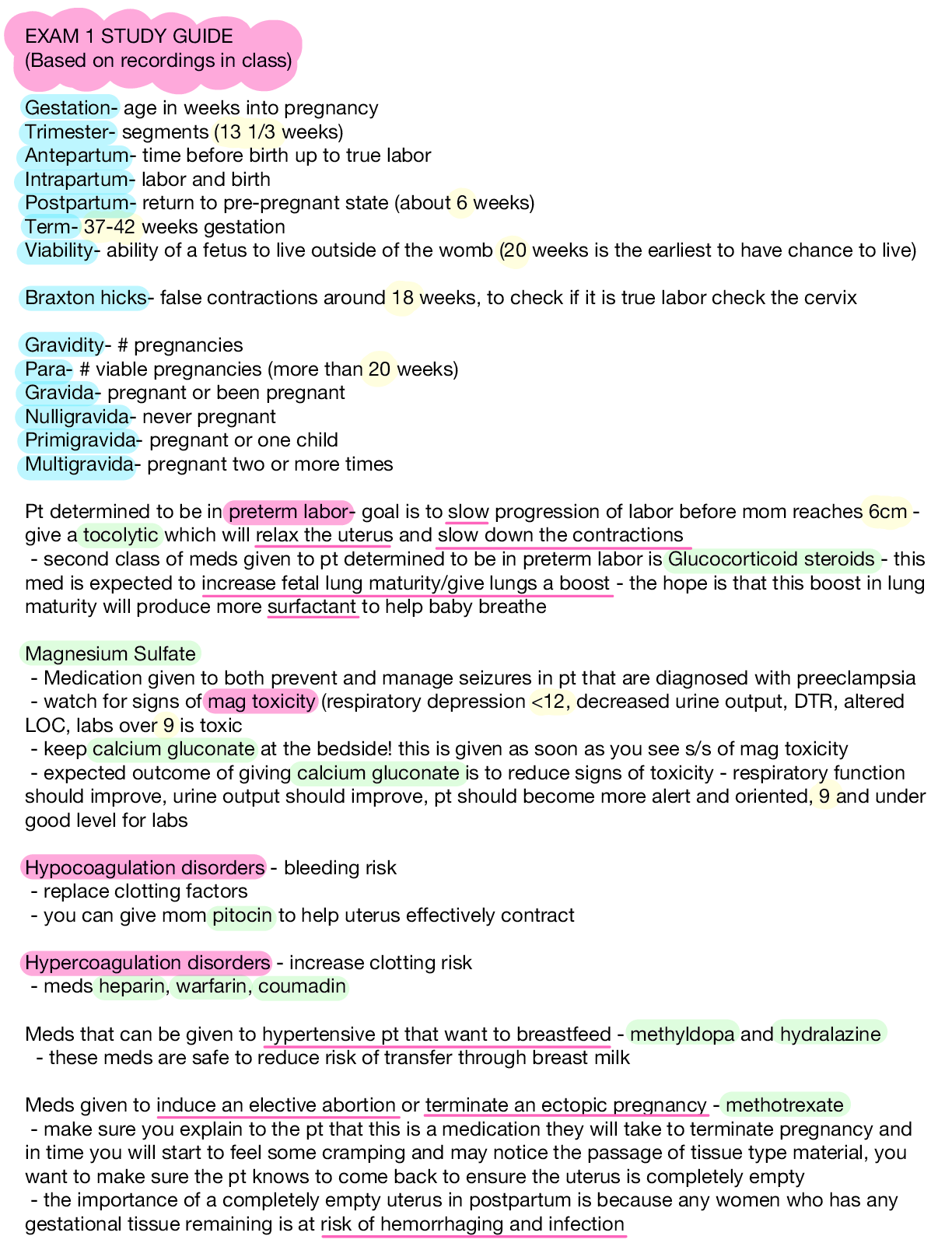
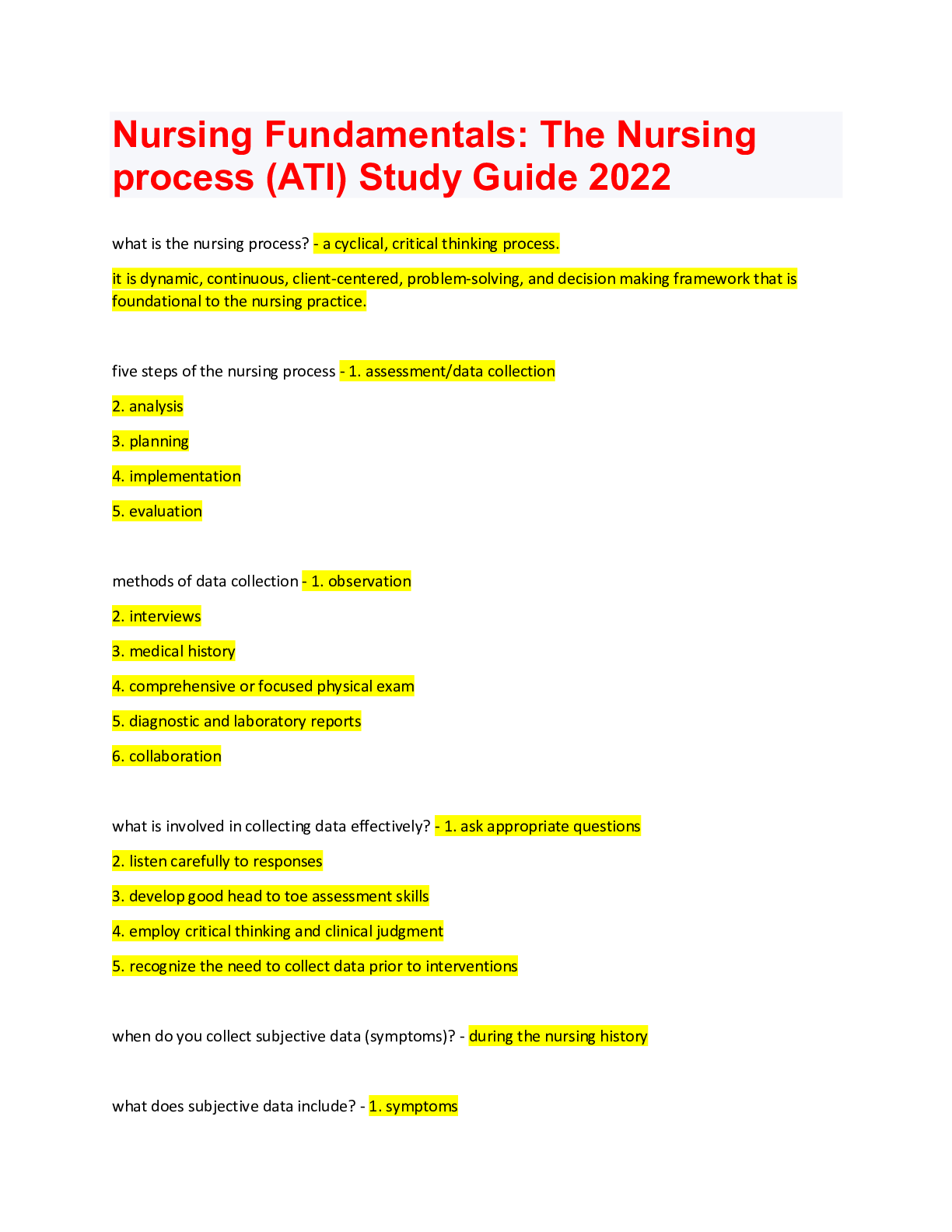



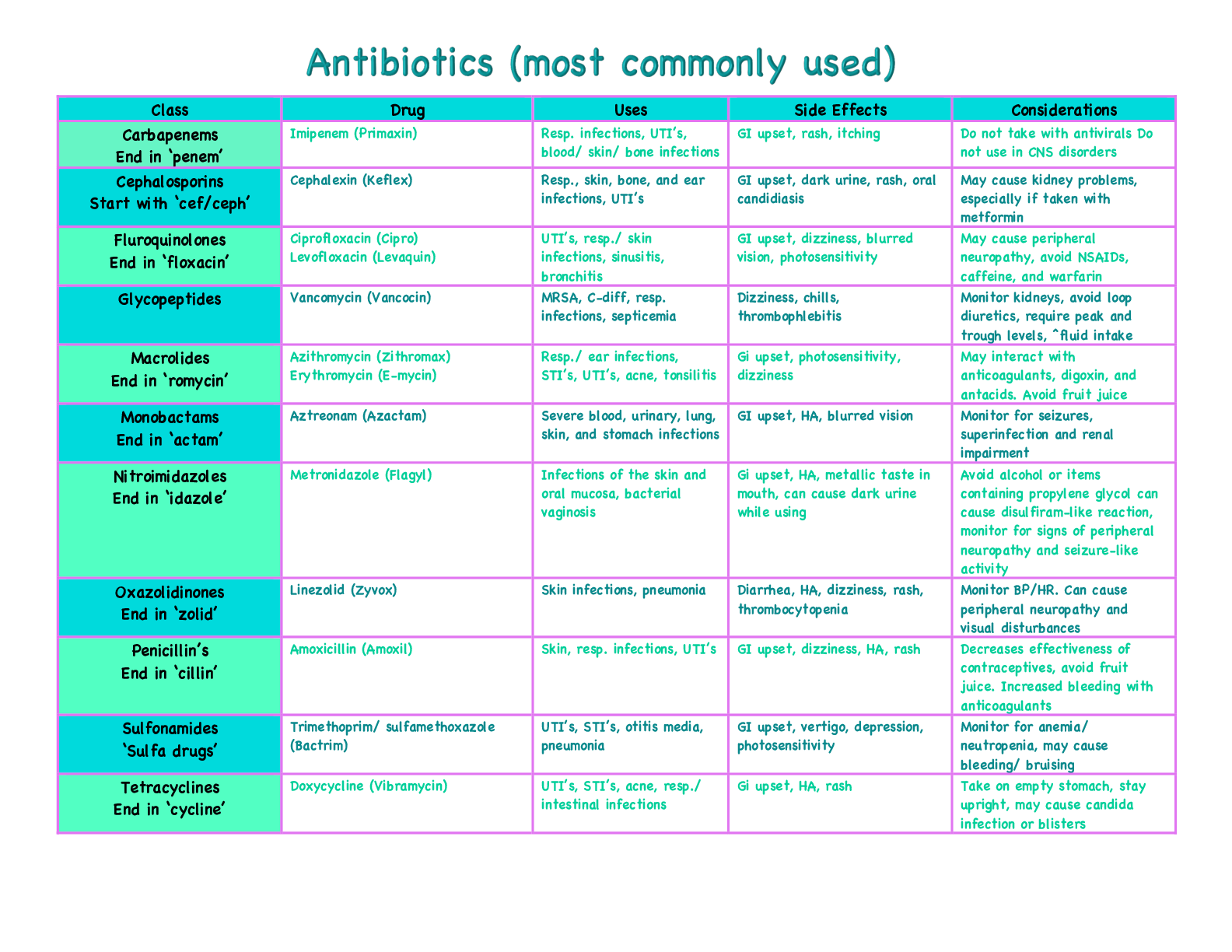

.png)