*NURSING  >  Study Notes  >  NR566_Week_5_Study_Outline (All)

NR566_Week_5_Study_Outline

Document Content and Description Below

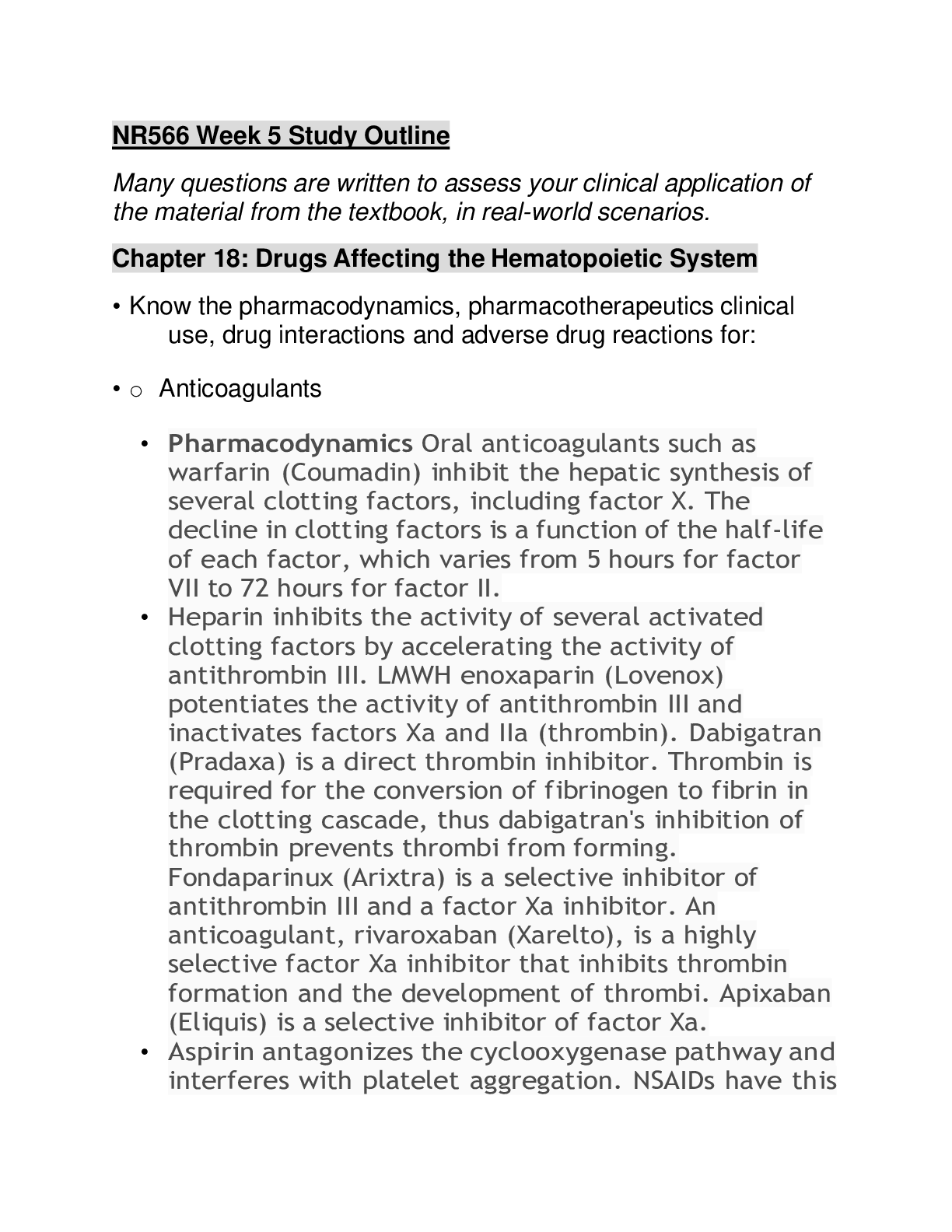
• Pharmacodynamics Oral anticoagulants such as warfarin (Coumadin) inhibit the hepatic synthesis of several clotting factors, including factor X. The decline in clotting factors is a function of the ... half-life of each factor, which varies from 5 hours for factor VII to 72 hours for factor II. • Heparin inhibits the activity of several activated clotting factors by accelerating the activity of antithrombin III. LMWH enoxaparin (Lovenox) potentiates the activity of antithrombin III and inactivates factors Xa and IIa (thrombin). Dabigatran (Pradaxa) is a direct thrombin inhibitor. Thrombin is required for the conversion of fibrinogen to fibrin in the clotting cascade, thus dabigatran's inhibition of thrombin prevents thrombi from forming. Fondaparinux (Arixtra) is a selective inhibitor of antithrombin III and a factor Xa inhibitor. An anticoagulant, rivaroxaban (Xarelto), is a highly selective factor Xa inhibitor that inhibits thrombin formation and the development of thrombi. Apixaban (Eliquis) is a selective inhibitor of factor Xa. • Aspirin antagonizes the cyclooxygenase pathway and interferes with platelet aggregation. NSAIDs have this same action. NSAIDs are not used as antiplatelet drugs, but this explains why concurrent use with anticoagulants is contraindicated • Ticlopidine (Ticlid) and clopidogrel (Plavix) reduce platelet aggregation by inhibiting the ADP pathway of platelets. Unlike aspirin, they have no effect on prostaglandin metabolism. Ticagrelor (Brilinta) reversibly interacts with the platelet P2Y12 ADP- receptor to prevent platelet activation. Vorapaxar (Zontivity) is a protease-activated receptor-1 (PAR-1) antagonist, inhibiting thrombin-induced and thrombin receptor agonist peptide-induced platelet aggregation • Precautions and Contraindications All anticoagulants are contraindicated for patients who are hypersensitive to the drug or actively bleeding or who have hemophilia, thrombocytopenia, severe hypertension (HTN), intracranial hemorrhage, infective endocarditis, active tuberculosis, or ulcerative lesions of the GI tract. Heparins are contraindicated in advanced hepatic or renal disease. They may be used in patients who are actively bleeding to treat disseminated intravascular coagulation (DIC). Heparin is Pregnancy Category C. ......................................................CONTINUED........................................... [Show More]

Last updated: 3 years ago

Preview 1 out of 24 pages

Buy Now

Instant download

We Accept:

Payment methods accepted on Scholarfriends (We Accept)
Preview image of NR566_Week_5_Study_Outline document

Buy this document to get the full access instantly

Instant Download Access after purchase

Buy Now

Instant download

We Accept:

Payment methods accepted on Scholarfriends (We Accept)

Reviews( 0 )

$15.00

Buy Now

We Accept:

Payment methods accepted on Scholarfriends (We Accept)

Instant download

Can't find what you want? Try our AI powered Search

84
0

Document information


Connected school, study & course


About the document


Uploaded On

Jun 25, 2021

Number of pages

24

Written in

All

Seller


Profile illustration for Dr Fiona
Dr Fiona

Member since 4 years

12 Documents Sold

Reviews Received
0
0
0
0
1
Additional information

This document has been written for:

Uploaded

Jun 25, 2021

Downloads

 0

Views

 84

Document Keyword Tags

Recommended For You

Get more on Study Notes »

$15.00
What is Scholarfriends

Scholarfriends.com Online Platform by Browsegrades Inc. 651N South Broad St, Middletown DE. United States.

We are here to help

We're available through e-mail, Twitter, Facebook, and live chat.
 FAQ
 Questions? Leave a message!

Follow us on
 Twitter

Copyright © Scholarfriends · High quality services·