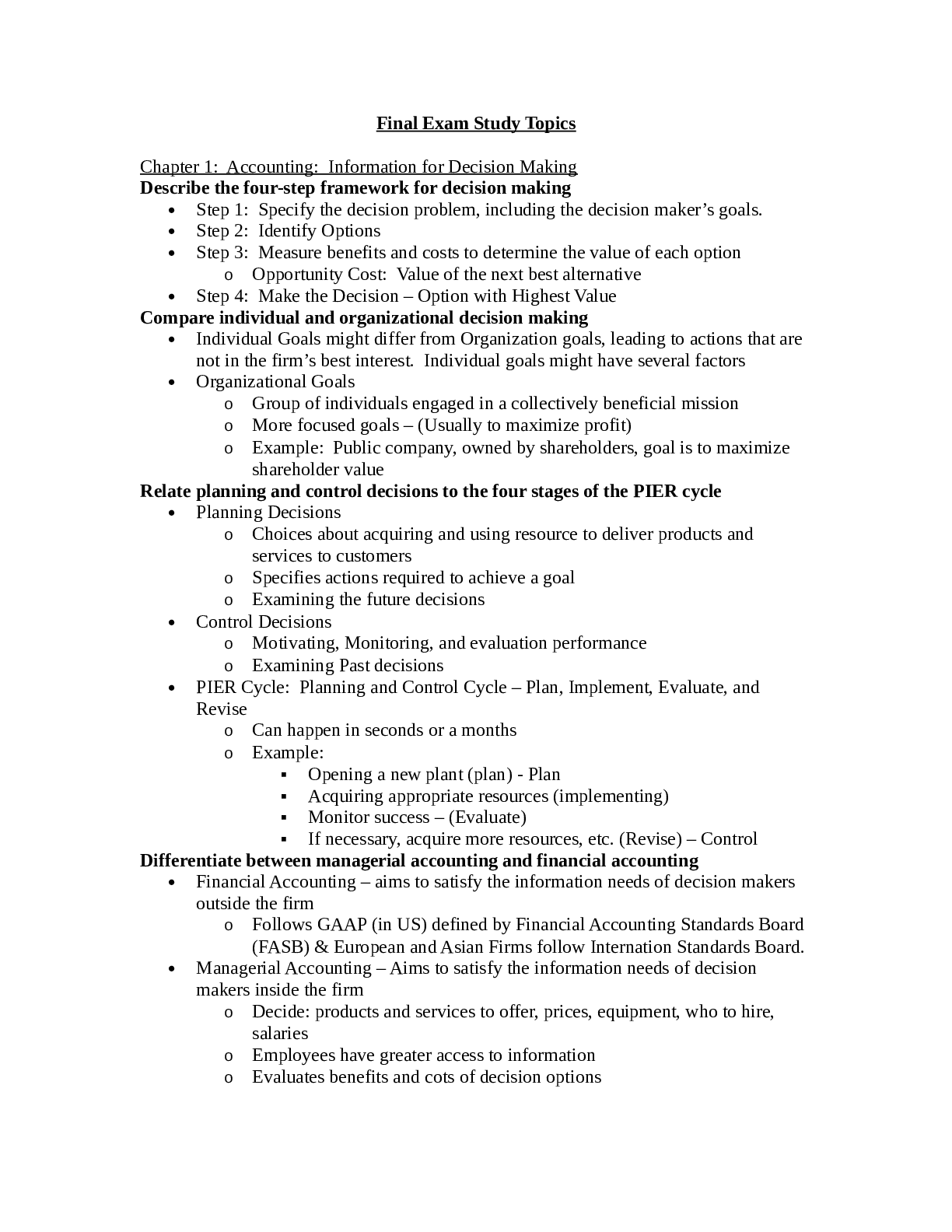
Describe the four-step framework for decision making
· Step 1: Specify the decision problem, including the decision maker’s goals.
· Step 2: Identify Options
· Step 3: Measure benefits and costs to determine the value
...
Describe the four-step framework for decision making
· Step 1: Specify the decision problem, including the decision maker’s goals.
· Step 2: Identify Options
· Step 3: Measure benefits and costs to determine the value of each option
o Opportunity Cost: Value of the next best alternative
· Step 4: Make the Decision – Option with Highest Value
Compare individual and organizational decision making
· Individual Goals might differ from Organization goals, leading to actions that are
not in the firm’s best interest. Individual goals might have several factors
· Organizational Goals
o Group of individuals engaged in a collectively beneficial mission
o More focused goals – (Usually to maximize profit)
o Example: Public company, owned by shareholders, goal is to maximize
shareholder value
Relate planning and control decisions to the four stages of the PIER cycle
· Planning Decisions
o Choices about acquiring and using resource to deliver products and
services to customers
o Specifies actions required to achieve a goal
o Examining the future decisions
· Control Decisions
o Motivating, Monitoring, and evaluation performance
o Examining Past decisions
· PIER Cycle: Planning and Control Cycle – Plan, Implement, Evaluate, and
Revise
o Can happen in seconds or a months
o Example:
Opening a new plant (plan) - Plan
Acquiring appropriate resources (implementing)
Monitor success – (Evaluate)
If necessary, acquire more resources, etc. (Revise) – Control
Differentiate between managerial accounting and financial accounting
· Financial Accounting – aims to satisfy the information needs of decision makers
outside the firm
o Follows GAAP (in US) defined by Financial Accounting Standards Board
(FASB) & European and Asian Firms follow Internation Standards Board.
· Managerial Accounting – Aims to satisfy the information needs of decision
makers inside the firm
o Decide: products and services to offer, prices, equipment, who to hire,
salaries
o Employees have greater access to information
o Evaluates benefits and cots of decision options
[Show More]