NSG 530 Quiz 2 Study Guide. Wilkes University.Endotoxins are released when the bacteria die/ the are produced by gram-negative bacteria.
Endotoxins released by blood-borne bacteria cause the release of vasoactive
enzym
...
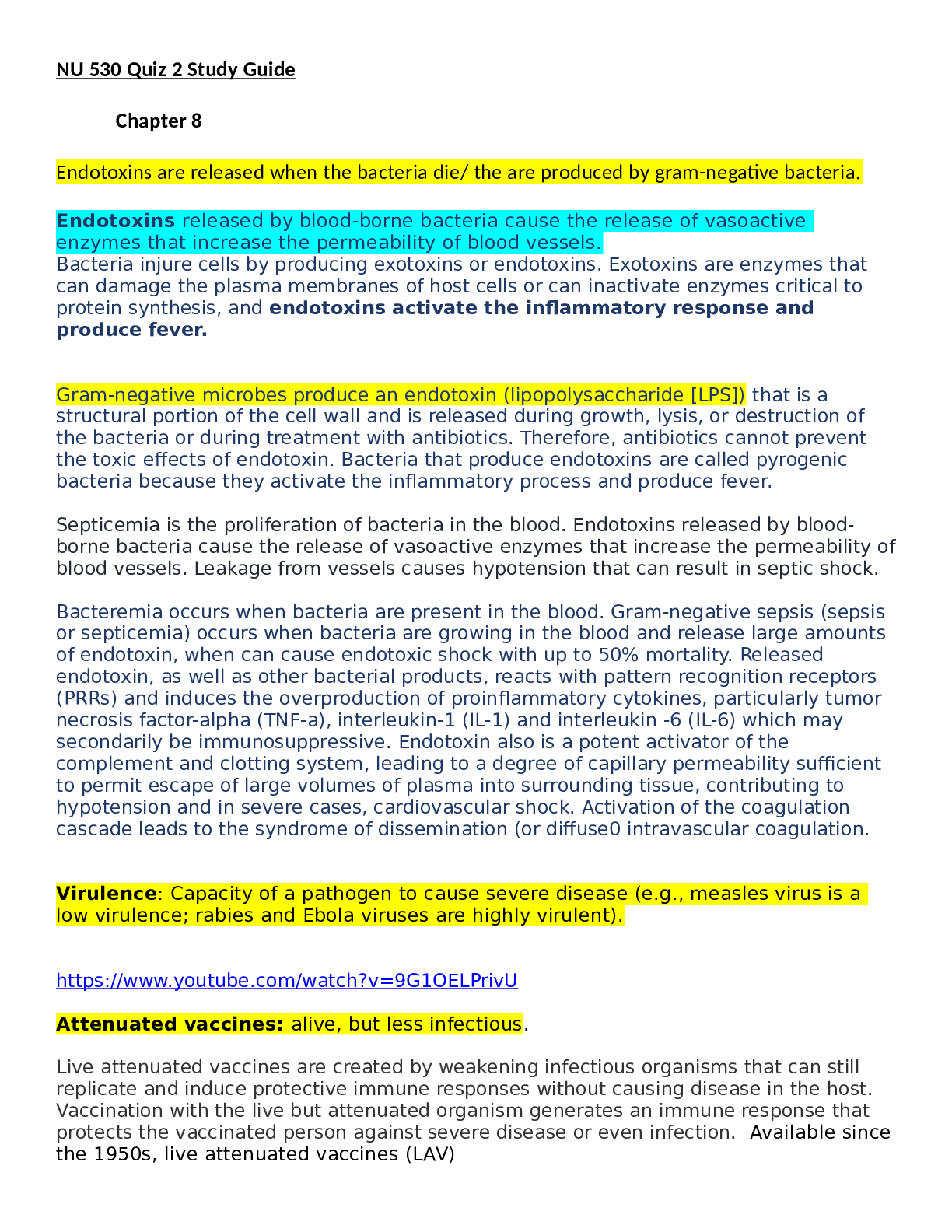
NSG 530 Quiz 2 Study Guide. Wilkes University.Endotoxins are released when the bacteria die/ the are produced by gram-negative bacteria.
Endotoxins released by blood-borne bacteria cause the release of vasoactive
enzymes that increase the permeability of blood vessels.
Bacteria injure cells by producing exotoxins or endotoxins. Exotoxins are enzymes that
can damage the plasma membranes of host cells or can inactivate enzymes critical to
protein synthesis, and endotoxins activate the inflammatory response and
produce fever.
Gram-negative microbes produce an endotoxin (lipopolysaccharide [LPS]) that is a
structural portion of the cell wall and is released during growth, lysis, or destruction of
the bacteria or during treatment with antibiotics. Therefore, antibiotics cannot prevent
the toxic effects of endotoxin. Bacteria that produce endotoxins are called pyrogenic
bacteria because they activate the inflammatory process and produce fever.
Septicemia is the proliferation of bacteria in the blood. Endotoxins released by bloodborne bacteria cause the release of vasoactive enzymes that increase the permeability of
blood vessels. Leakage from vessels causes hypotension that can result in septic shock.
Bacteremia occurs when bacteria are present in the blood. Gram-negative sepsis (sepsis
or septicemia) occurs when bacteria are growing in the blood and release large amounts
of endotoxin, when can cause endotoxic shock with up to 50% mortality. Released
endotoxin, as well as other bacterial products, reacts with pattern recognition receptors
(PRRs) and induces the overproduction of proinflammatory cytokines, particularly tumor
necrosis factor-alpha (TNF-a), interleukin-1 (IL-1) and interleukin -6 (IL-6) which may
secondarily be immunosuppressive. Endotoxin also is a potent activator of the
complement and clotting system, leading to a degree of capillary permeability sufficient
to permit escape of large volumes of plasma into surrounding tissue, contributing to
hypotension and in severe cases, cardiovascular shock. Activation of the coagulation
cascade leads to the syndrome of dissemination (or diffuse0 intravascular coagulation.
Virulence: Capacity of a pathogen to cause severe disease (e.g., measles virus is a
low virulence; rabies and Ebola viruses are highly virulent).
https://www.youtube.com/watch?v=9G1OELPrivU
Attenuated vaccines: alive, but less infectious.
Live attenuated vaccines are created by weakening infectious organisms that can still
replicate and induce protective immune responses without causing disease in the host.
Vaccination with the live but attenuated organism generates an immune response that
protects the vaccinated person against severe disease or even infection. Available since
the 1950s, live attenuated vaccines (LAV)
Live attenuated vaccines use live organisms that have been weakened so that they are
avirulent, meaning they are unable to cause disease. Attenuation can be achieved in
several ways:
Naturally occurring related organisms that are avirulent in humans, including host
range restricted organisms or naturally occurring avirulent strains
Multiple rounds of growth of virulent organisms under conditions that weaken the
organism such as in tissue culture or harsh physical conditions
Genetic manipulation of the organism to reduce virulence
Understand different types of Immunity and associated labs- IgE, cell-mediated,
autoimmunity vs alloimmunity
Alloimmunity is the immune system’s reaction against antigens on the tissues of
other members of the same species.
Alloimmunity – Immune system of one individual produces an immunologic reaction
against tissues of another individual.
Alloimmune disorders include transient neonatal disease, in which the maternal
immune system becomes sensitized against antigens expressed by the fetus; and
transplant rejection and transfusion reactions, in which the immune system of the
recipient of an organ transplant or blood transfusion reacts against foreign antigens on
the donor’s cells.
Alloimmunity can be observed during immunologic reactions against transfusions,
transplants tissue, or the fetus during pregnancy. (Foreign Tissue body attacks)
Whereas:
Autoimmunity is a disturbance in the immunologic tolerance of self-antigens
Autoimmune disease is loss of tolerance to self-antigens. There can be a genetic
predisposition and the diseases can be a type II or type III hypersensitivity reaction.
(Body attacks self)
The inflammatory and immune responses are normally beneficial. They not only
protect the body against microorganism invasion and cancer development, but they
also stimulate tissue growth and repair after injury. However, when inflammation or
immune responses are prolonged, excessive, or occur at an inappropriate time, normal
tissues can be damaged instead of protected. These responses are considered
"overreactions" to invaders and foreign antigens and are known
as hypersensitivity or allergic responses.
In addition, inflammatory and immune responses can fail to recognize self-cells and
literally attack normal body tissues. This type of reaction is known as
an autoimmune response. Both hypersensitivity and autoimmune responses can
damage cells, tissues, or organs and have serious consequences.
Hypersensitivity is an immune response misdirected against the host’s own tissues
(autoimmunity) or directed against beneficial foreign tissues, such as transfusions or
transplants (alloimmunity); or it can be exaggerated responses against environmental
antigens (allergy). NEED TO figure this out and break it down mo
[Show More]