Test 1
• Postpartum Assessment and Adaptation
• Normal Newborn Assessment and Care
• Birth Process and Electronic Fetal Monitoring
• Maternal Adaptation
Postpartum Adaptation and Nursing Care: Perry Chpts. 18-21 and
...
Test 1
• Postpartum Assessment and Adaptation
• Normal Newborn Assessment and Care
• Birth Process and Electronic Fetal Monitoring
• Maternal Adaptation
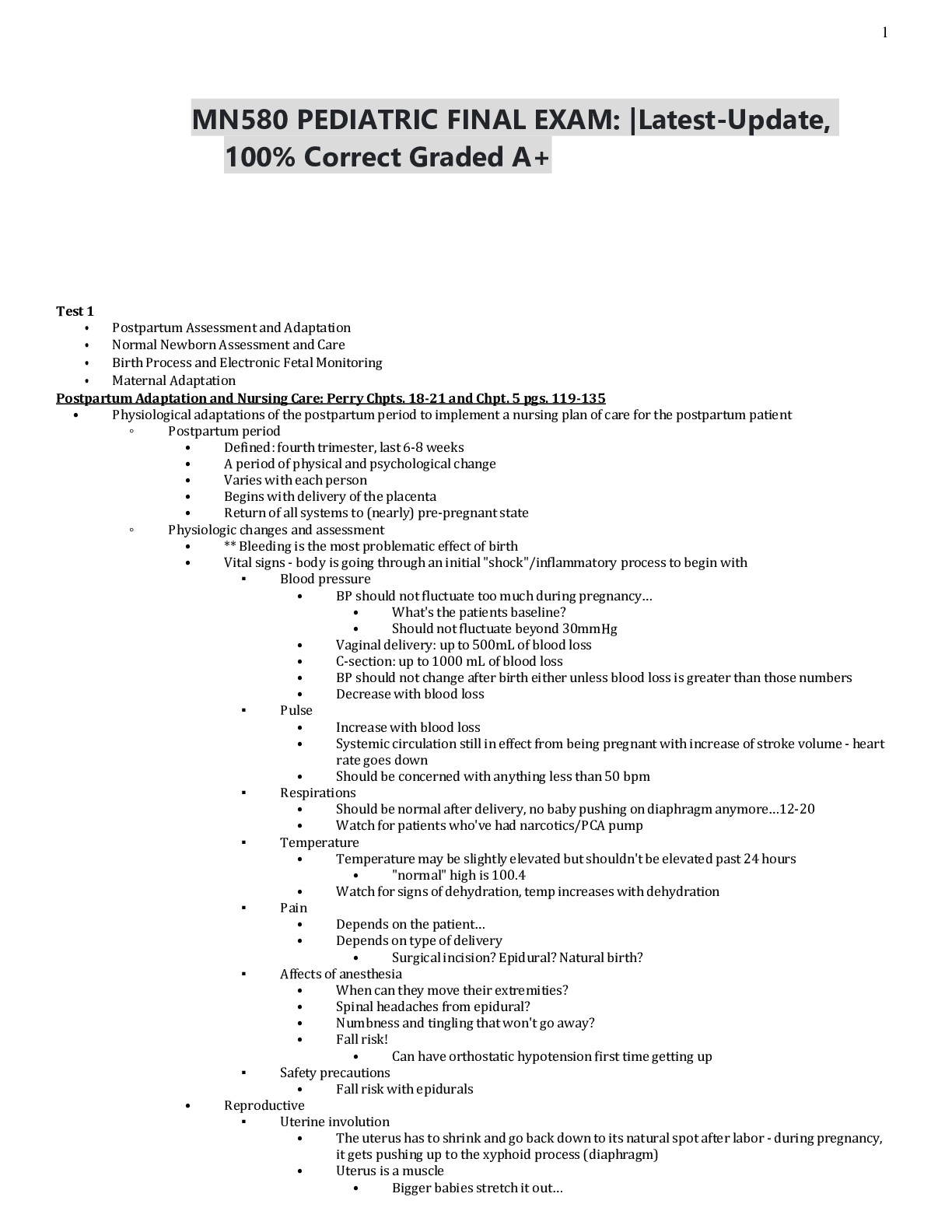
Postpartum Adaptation and Nursing Care: Perry Chpts. 18-21 and Chpt. 5 pgs. 119-135
• Physiological adaptations of the postpartum period to implement a nursing plan of care for the postpartum patient
◦ Postpartum period
• Defined: fourth trimester, last 6-8 weeks
• A period of physical and psychological change
• Varies with each person
• Begins with delivery of the placenta
• Return of all systems to (nearly) pre-pregnant state
◦ Physiologic changes and assessment
• ** Bleeding is the most problematic effect of birth
• Vital signs - body is going through an initial"shock"/inflammatory process to begin with
▪ Blood pressure
• BP should not fluctuate too much during pregnancy…
• What's the patients baseline?
• Should notfluctuate beyond 30mmHg
• Vaginal delivery: up to 500mL of blood loss
• C-section: up to 1000 mL of blood loss
• BP should not change after birth either unless blood loss is greater than those numbers
• Decrease with blood loss
▪ Pulse
• Increase with blood loss
• Systemic circulation still in effect from being pregnant with increase of stroke volume - heart
rate goes down
• Should be concerned with anything less than 50 bpm
▪ Respirations
• Should be normal after delivery, no baby pushing on diaphragm anymore…12-20
• Watch for patients who've had narcotics/PCA pump
▪ Temperature
• Temperature may be slightly elevated but shouldn't be elevated past 24 hours
• "normal" high is 100.4
• Watch for signs of dehydration,temp increases with dehydration
▪ Pain
• Depends on the patient…
• Depends on type of delivery
• Surgical incision? Epidural? Natural birth?
▪ Affects of anesthesia
• When can they move their extremities?
• Spinal headaches from epidural?
• Numbness and tingling that won't go away?
• Fall risk!
• Can have orthostatic hypotension first time getting up
▪ Safety precautions
• Fall risk with epidurals
• Reproductive
▪ Uterine involution
• The uterus has to shrink and go back down to its natural spot after labor - during pregnancy,
it gets pushing up to the xyphoid process (diaphragm)
• Uterus is a muscle
• Bigger babies stretch it out…2
• Immediately after delivery of the placenta
• Muscle fibers have stretched and now they need to go back
• Inside of uterus looks like a wound...needs to heal
• Goes down 1 cm or 1 finger breadth per day
• After pains
• Pain cause by the uterus shrinking/contracting
• Depends on the patient
• More pain related to having a big baby and/or having multiple babies
• Affected by hormone release
• Oxytocin released to stimulate uterus to contract
• Breast-feeding increases oxytocin release causing uterus to shrink quicker and heal
quicker
• Follicular stimulating hormone goes up
• Progesterone goes down
• Rate is affected by several factors3
▪ Lochia
• Takes about two weeks for uterus to go down
• Day 1 post delivery: top of uterus is at the umbilicus
• Oxytocin release…
• Diabetic?
• Type of deliver
• Endometrial sloughing can last up to 6 weeks
• Amount, color, odor, and consistency is important
• Days 1-3: Active bleeding blood - bright red
• Lochia rubra
• Day 4-10: changing to pinkish color
• Day 10-6 weeks: alba (whitish creamy color)
• Should not be saturating pads within an hour
• Saturated pad = poorly healing uterus, not contracting the way it needs to
• Activity may cause heavier bleeding…
• Should smell like blood
• Should not be excessively clotted blood
• Little ones are ok, no bigger than a plum though
• Clots indicate blood is pooling somewhere and too much bleeding
▪ Cervix
• Dilated after birth but closes rapidly, within one week
• External os (opening) - slit appearance instead of round
• Lacerations may be source of bleeding with firm uterus
▪ Vagina
• Takes 6 weeks to heal
• Edema and lacerations may be present
• May be small lacerations in the vaginal wall causes some bleeding
• Decreased estrogen = vaginal dryness - dyspareunia
• Breastfeeding delays ovulation
▪ Perineum
• Offer the pt dermaplast
• Numbing benzocaine spray
• Hemorrhoids…
• Depending on the degree of the tear, can be problematic based on location next to anus
• Episiotomies and tears (lacerations)
• 1st degree
• superficial
• 2nd degree
• Tear goes into the muscle
• 3rd degree
• Tear goes into the rectal sphincter
• 4th degree
• Tear goes into the rectum
• Use READA:
• Redness
• Edema
• Cold compresses to decrease inflammation
• Cold for 24 hours then heat after for circulation
• Cultural beliefs come into play
• Need to keep area clean and dry
• Ecchymosis
• Need to be sure that there's no hematoma
• Some bruising normal
• Discharge
• Approximation
• Breast
• Cardiovascular/blood values
▪ Increased diaphoresis
• Sweat profusely, normal - body's response to getting rid of excess fluid
▪ Increased WBC count
▪ Thromboembolism risks
• Clotting factors increase during pregnancy
• Body is preparing itself for bleeding…
• Pts are more prone to DVTs…
• Clotting factors decrease after delivery, more at risk for DVT's
• Need SCD's
• Lovenox
• Ted hose
• Respiratory
▪ Should become easier after labor, baby no longer pushing up on diaphragm4
• GI/Urinary
▪ Immediate resumption of active digestion (cesarean exception)
• Watch for bowel sounds and increase diet as tolerated for cesarean-sections
▪ Constipation may occur
▪ Proteinuria
▪ Urinary retention & Urinary incontinence
• After c-sections pts may have urinary retention
• 6-8 hours need to void…
• Measure at least the first 3 voids, make sure they're emptying their bladder completely and at
least 150 mL per void
• Body is going through a diuresing process - sweating, urinating…
▪ Risk for infection
• WBC count is elevated after delivery - not the best indicator for infection
• Integument /Musculoskeletal
▪ Muscle aches
• Muscles have been stretched and pulled
▪ Diastasis recti
• Abdominal muscles separate where baby has been growing
• Depends on how fit/toned the mom was prior to being pregnant
▪ Linea nigra/stretch marks
• Linea nigra: Black line that goes down the middle of the abdomen, goes away
• Stretchmarks don’t go away, hereditary
• Neurological
◦ Postpartum pain management
◦ Maternal complications
• Prevention
• Observe the patient
▪ Monitor vitals every 15 minutes for the first hour and then every 4 hours after that
• Teach the patient of norms and non-norms
• Etiology and pathophysiology of postpartum complications and the required nursing care and preventative measures
◦ Postpartum complications
• Sub-involution
▪ Common cause is retained placental tissue
• Something is in the way and not letting the uterus go down the way it needs to
▪ Pooling or heaviness in the uterus…
▪ Uterus should not be palpable after 14 days
▪ Instruct patient on normal patterns of bleeding or signs of uterine infection
• Hypovolemic shock
▪ Bleeding too much
▪ Signs may be delayed
▪ Note any mild tachycardia or hypotension
• Monitor vital signs
▪ Note skin color changes
▪ Monitor uterus closely
▪ Note any increase in anxiety
• Postpartum hemorrhage
▪ Assess what the patients baseline is, know their risks, how many babies have they had? What's their
history? Are they having a section? Was it a big baby?
▪ Medications (for both early and late hemorrhages)
• Administer exogenous oxytocin, called pitocin
• Dilute in IV bag
• 20 milliunits given through IV
• Every section patient gets it, risk for increased bleeding, given so uterus heals
quicker and contracts more so you don’t bleed
• Uterus gets tired from contracting, gets soft - have to administer methergine, stimulates
uterus to contract to control hemorrhage - given IM
• 0.2 mg dose, max of 5 doses
• Side effect: hypertension, cannot give to patient with elevated BP
• Pain increases, lots of cramping
• Hemabate (carboprost)
• Induces contractions to stop bleeding
• 0.25 mg every 15 minutes, IM max of 8 doses or 2 mg
• Prostoglandin
• Cytotec (misoprostol)
• 800-1000 mcg rectally
• Prostaglandin
• Causes diarrhea
▪ Early hemorrhage
• Within the first 24 hours of labor
▪ Late hemorrhage
• Any time after first 24 hours of labor5
• Thromboembolic disease
▪ DVT
• Increased clotting factors during clotting factors during pregnancy
• Look for redness, pain, swelling, check pulses in extremities
• Any sharp pains in legs?
▪ Superficial venous clots
• Postpartum infections
▪ Endometritis
• Inflammation/infection in the inner lining of the uterus
• Look for pain, fever, foul smelling discharge
▪ UTI
▪ Mastitis
• Inflammation of the breast tissue not the duct
• Breastfeeding causes cracks in breasts, allows for entry of bacteria
• Prolactin produces milk
• May get engorged when mothers decide not to breast feed or if breast feeding and over
produce milk
• Cabbage leaves dry up the milk, put them on breasts, cold compresses/cabbage leaves
• Wear a snug bra, avoid hot showers, avoid breast feeding
▪ Wound infections
• Urinary tractinfections
• Breast disorders
• Pre-eclampsia/eclampsia
◦ Chart review/report
• Gravida/para
▪ How many times you’ve been pregnant…
▪ Abortions count
▪ Gravida counts current pregnancy
▪ Para is how many pregnancies you've had that went past 20 weeks
▪ Indicates risk factors
• Medical history
▪ BP, respiratory, DM, cardiovascular, STDs?,HIV?
• Immunization status
▪ Pregnant people need TDAP immunization every 2 years
▪ Cannot be a live vaccine
▪ Cannot get pregnant for at least 28 days after the rubella vaccine
• Rhogam needs
▪ Moms who are RH- with an RH+ baby, then mom will need rhogam
▪ Prevents antibodies from occurring if baby's blood gets into mom somehow
▪ Given at 28 weeks and again within 72 hours of having RH+ baby if mom is RH-
• L/D history and complications
• Infant status
• Allergies
• Diet
• IV status/voiding pattern
• Affectively utilize the nursing process to provide support and enhance the family's transition into parenthood
◦ Psychological adaptation and assessment
• For mom:
▪ What to expect
▪ How to cope
▪ What do I do next?
• Psychological adaptations: a family centered approach
▪ Assess and promote bonding
• Role changes
▪ Observe maternal behaviors
▪ Interactions with family
• Bonding behaviors of parents - skin to skin contact promotes bonding with baby
• Feedings - breast feeding promotes bonding
• Rooming-in: baby doesn’t get separated for any reason unless for a surgery or treatment
• Is the family doing loving family behaviors?
• Factors affecting family adaptations
▪ Discomfort and fatigue
▪ Support system
• Who's going to help?
▪ Knowledge of infant needs
▪ Maternal age
• How old is the mom?
▪ Previous experience
▪ Expectations
▪ Temperament: maternal &newborn
• Baby easy going or fussy?6
▪ Other factors
• Cesarean birth
• Preterm infants
• Multiple births
• Cultural expectations
• Health beliefs
• Dietary practices
[Show More]






 EXAM REVIEW Questions and answers provided Study Guide.png)

x.png)




.png)