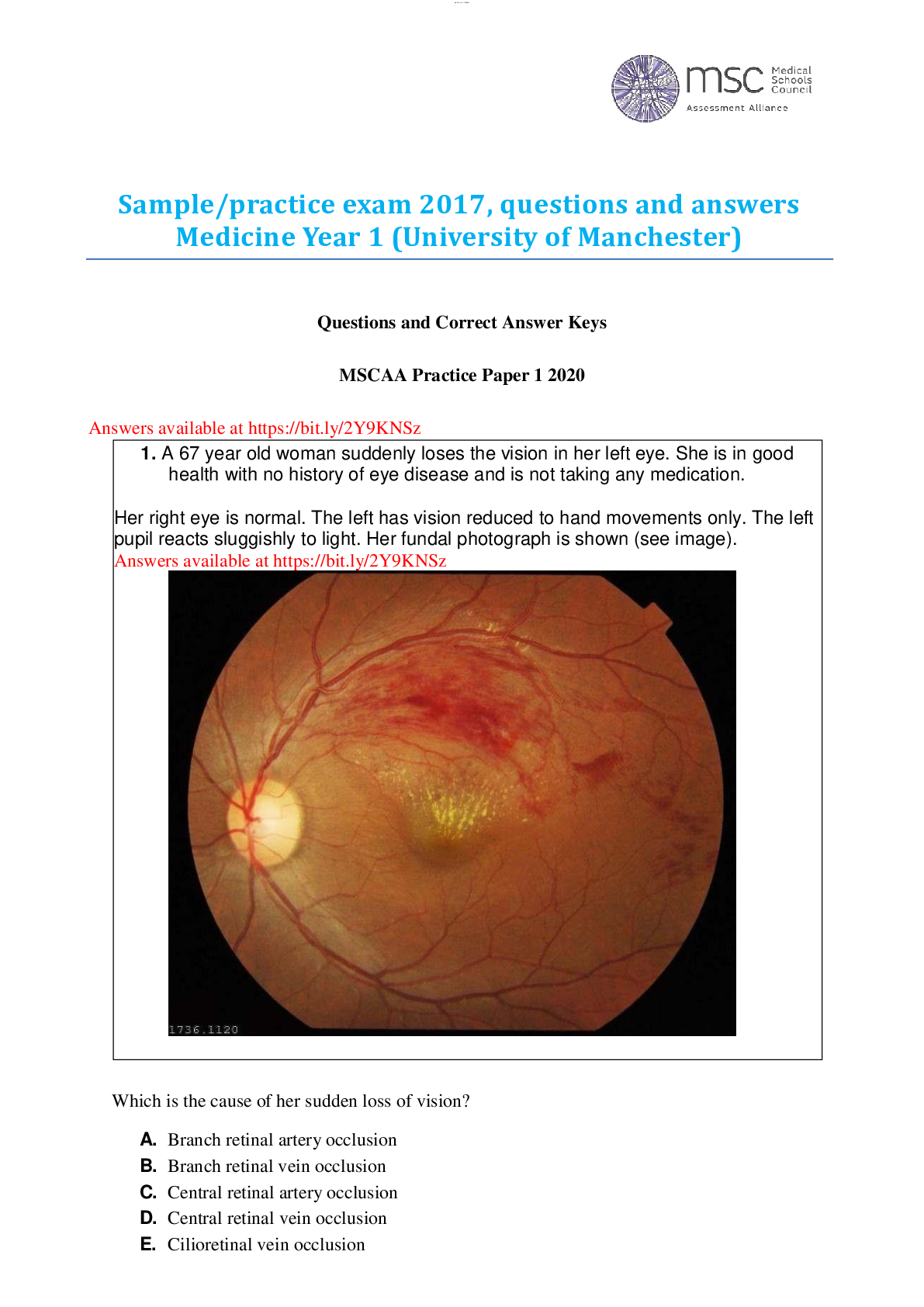
Which is the most useful diagnostic investigation?
A. 24-h urinary cortisol test
B. Glucose tolerance test
C. Serum corrected calcium
D. Short Synacthen test
E. Water deprivation test
Answers available at https://b
...
Which is the most useful diagnostic investigation?
A. 24-h urinary cortisol test
B. Glucose tolerance test
C. Serum corrected calcium
D. Short Synacthen test
E. Water deprivation test
Answers available at https://bit.ly/2Y9KNSz
Which is the most appropriate long-term plan for secondary stroke prevention?
A. Apixaban
B. Aspirin
C. Aspirin and dipyridamole
D. Clopidogrel
E. Ticagrelor
Answers available at https://bit.ly/2Y9KNSz
5. A 65 year old woman had a stroke 2 weeks ago causing right arm weakness
and dysphasia. CT scan of head showed a left parietal lobe infarct. Her
medication since the stroke includes aspirin and simvastatin.
Her pulse rate is 82 bpm and irregular.
Investigations:
ECG: atrial fibrillation, rate 68 bpm.
lOMoAR cPSD|784381
Answers available at https://bit.ly/2Y9KNSz
6. A 49 year old man has 3 days of cough and fever. He undergoes
haemodialysis three times per week.
His temperature is 38.6°C, pulse rate 90 bpm, BP 122/80 mmHg, respiratory rate 30
breaths per minute and oxygen saturation 95% breathing 15 L/min oxygen via a
non-rebreather mask. His JVP is 4 cm above the sternal angle. He has inspiratory
crackles in the right mid and lower zone and left upper zone. His blood capillary
glucose is 12 mmol/L.
Investigations:
Sodium 131 mmol/L (135–146)
Potassium 5.7 mmol/L (3.5–5.3)
Urea 16.7 mmol/L (2.5–7.8)
Creatinine 327 μmol/L (60–120)
Chext X-ray: see image
lOMoAR cPSD|784381
Answers available at https://bit.ly/2Y9KNSz
Page 7 of 51
lOMoAR cPSD|784381
Which is the most appropriate initial treatment?
A. Haemodialysis
B. Intravenous 10 mL 10% calcium gluconate
C. Intravenous 1000 mL 0.9% sodium chloride over 1 h
D. Intravenous co-amoxiclav and clarithromycin
E. Intravenous furosemide
Which is the most appropriate treatment to give before the scan?
A. Intravenous 0.9% sodium chloride infusion
B. Intravenous acetylcysteine
C. Intravenous furosemide infusion
D. Intravenous hydrocortisone
E. Intravenous mannitol
Answers available at https://bit.ly/2Y9KNSz
eGFR 39 mL/min/1.73 m2
(>60)
(2.5–7.8)
Creatinine 165 µmol/L (60–120)
7. A 67 year old man is due to have a CT scan of chest, abdomen and pelvis
with intravenous contrast as assessment for possible lymphoma. He had a
renal transplant 5 years ago. His medication includes prednisolone, tacrolimus
and lisninopril.
His BP is 131/86 mmHg.
Investigations:
Urea 12.9 mmol/L
lOMoAR cPSD|784381
Which is the most likely cause for her acute kidney injury?
A. Glomerulonephritis
B. Hypovolaemia
C. Renal arterial emboli
D. Rhabdomyolysis
E. Ureteric obstruction
9. A 76 year old woman has become increasingly confused over the past 2 weeks. She
has a history of hypertension and cardiac failure. She is taking
bendroflumethiazide, doxazosin, amlodipine, ramipril and atenolol.
Her BP is 108/71 mmHg.
Investigations:
Sodium 121 mmol/L (135–146)
Potassium 3.5 mmol/L (3.5–5.3)
Urea 10.0 mmol/L (2.5–7.8)
Creatinine 105 µmol/L (60–120)
Which medication is most likely to be responsible for her presentation?
A. Amlodipine
B. Atenolol
C. Bendroflumethiazide
D. Doxazosin
E. Ramipril
Urinalysis: glucose negative, ketones negative, blood 2+, protein 1+,
leucocytes positive (catheter sample).
She has passed 60 mL of urine over the past 2 hours.
(135–146)
(3.5–5.3)
(2.5–7.8)
(60–120)
Creatine kinase 870 U/L (25–175)
8. A 78 year old woman is admitted after been found collapsed at home. She
has been lying on the floor overnight. She has a history of hypertension and
takes amlodipine.
Her temperature is 35.8°C, pulse rate 88 bpm and irregular, and BP 102/60
mmHg.
Investigations:
Sodium 136 mmol/L
Potassium 5.8 mmol/L
Urea 20.9 mm
[Show More]