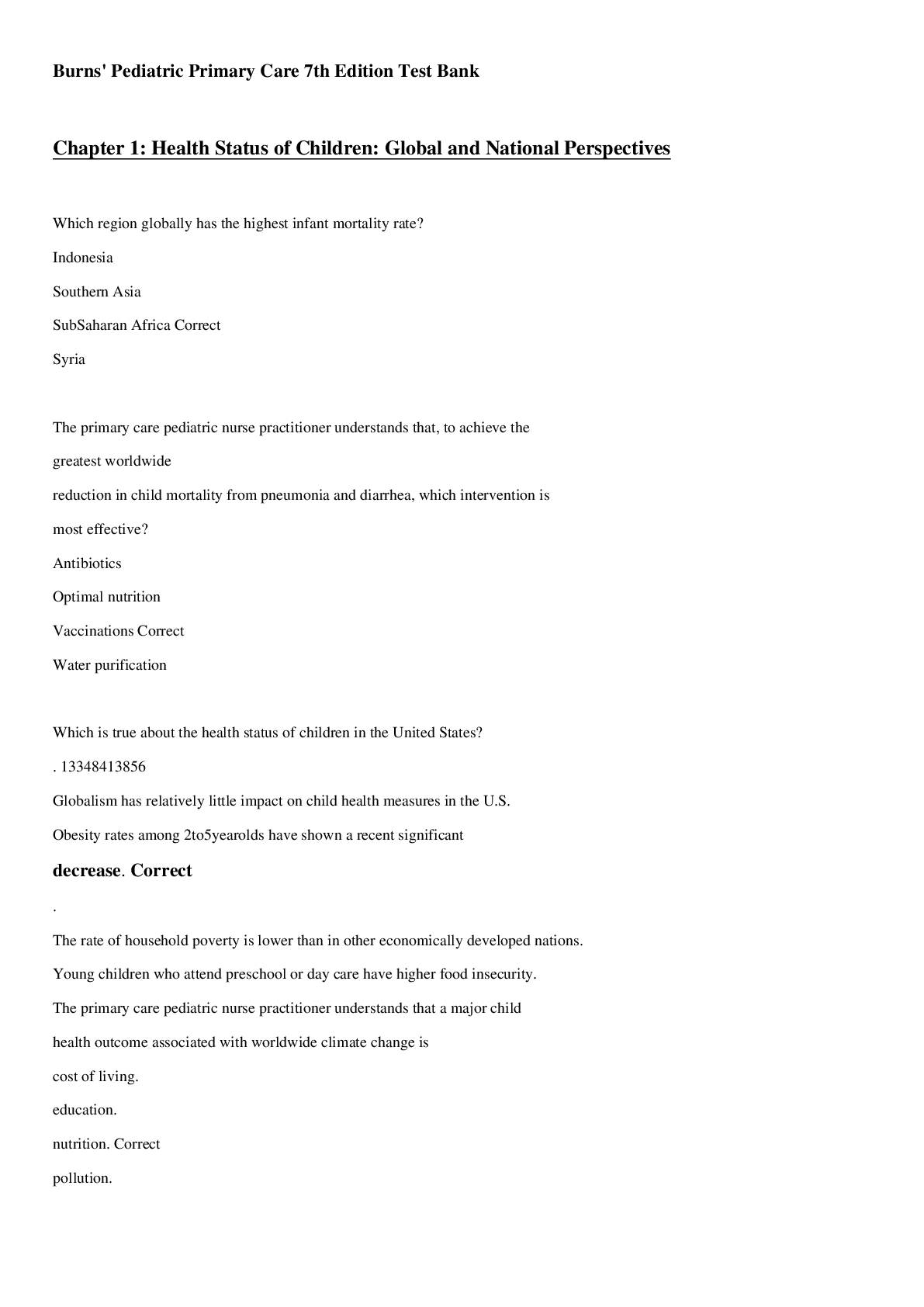
NR 509 Final Study Guide
Behavior/Mental Health Assessment and Modification for Age
1. Assessment:
a.
b. Many mental health disorders are masked by other clinical conditions;
20% of primary care outpatients have men
...
NR 509 Final Study Guide
Behavior/Mental Health Assessment and Modification for Age
1. Assessment:
a.
b. Many mental health disorders are masked by other clinical conditions;
20% of primary care outpatients have mental disorders(50-70% go
undetected and untreated)
c. Physical symptoms account for approx 50% of office visits
d. ⅓ of physical symptoms are unexplained; in 20-25% those symptoms
become chronic
e. Symptoms and Behaviors:
i. Sorting symptom is a challenge; can be unexplained symptoms
1. Patients who have unexplained symptoms depression and
anxiety exceeds 50%
ii. Physical or “somatic” symptoms account for 50% of U.S. office
visits
1. Pain, fatigue, palpitations, GI symptoms, sexual dysfunction,
dizziness or loss of balance
2. Symptoms that present as clusters are called “functional
syndromes” such as IBS, fibromyalgia, chronic fatigue, TMJ
disorder, and multiple chemical sensitivity
3. The presence of symptom overlap is high in the common
functional syndromes such as fatigue, headache, sleep
disturbance, pain, GI upset
iii. Patients with unexplained and somatic symptoms are often frequent
users of the health care system and termed “difficult patients”
iv. Patients with symptoms that last longer than 6 weeks are recognized as
chronic and should be screened for depression and anxiety.
a. A two tiered approach is recommended for screening. A brief
screening with questions that yield high sensitivity then a
more detailed investigation when indicated
V. Patient who warrant a mental health screening include:
1. medically unexplained physical symptoms
2. Multiple physical or somatic symptoms
3. High severity of the presenting somatic symptom
4. Chronic pain
5. Symptoms longer than 6 weeks
6. Physician stating “a difficult encounter”
7. Recent stress
8. Low self-rating of overall health
9. Frequent use of health care services
10.Substance abuse
2. Adjustment for age:
A. Elderly:
a. Older adults may complain of memory problems but usually is due
to benign forgetfulness.
b. Older adults retrieve and process data more slowly and take longer
to learn new information
c. Older adults may have slower motor responses and their ability to
perform complex task may diminish
d. It is important to try to distinguish age-related changes from
manifestations of mental disorders
e. Older patients are more susceptible to delirium which could be the
first sign of infection, problems with medications, or impending
dementia
B. Newborn:
a. Assess mental status of a newborn by observing newborn activities
i. Look at human faces and turn to a parents voice
ii. Ability to shut out repetitive stimuli(such as a vacuum)
iii. Bond with caregiver
iv. self-soothe
b. Assess for mental status during alert periods
· Normal VS. Abnormal Findings and Interpretation
1. Attention:
a. Normal: able to focus and concentrate
b. Abnormal: inattentive and easily distracted
2. Memory
a. Normal: able to repeat immediate repetition of material given;
b. Abnormal: unable to repeat recent events
3. Orientation:
a. Normal: aware of person, place, and time
b. Abnormal: unaware of person, place, or time
4. Perception:
a. Normal: Sensory awareness of objects in the environment
b. Abnormal: hallucinations
5. Thought Process:
a. Normal: logic, coherent, and relevant thoughts
b. Abnormal: irrational thought
6. Thought Content:
a. Normal: Has insight and judgement
b. Abnormal: impaired judgement and irrational behaviors
7. Insight
[Show More]





![Preview of eBook [PDF] Barash, Cullen, and Stoelting's Clinical Anesthesia 9th Edition By Bruce F. Cu](https://browseimages.nyc3.digitaloceanspaces.com/paper-images/2024/Aug/29/8DF2QRTq2024-08-29-10-3966d0259b7c4b5.png)
![Preview of eBook [PDF] Fundamentals of Nursing 3rd Edition By Joanne Tollefson, Sue C. DeLaune, Patri](https://browseimages.nyc3.digitaloceanspaces.com/paper-images/2024/Aug/26/U6SQ8mmq2024-08-26-01-4766cc5d40d7385.png)
![Preview of eBook [PDF] Burns' Pediatric Primary Care 7th Edition BY Dawn Lee Garzon Maaks,, Nancy Bar](https://browseimages.nyc3.digitaloceanspaces.com/paper-images/2024/Aug/26/WR2rowXX2024-08-26-02-0966cc625bea839.png)