*NURSING > QUESTIONS & ANSWERS > NR293 Questions and Answers Week 6 (All)
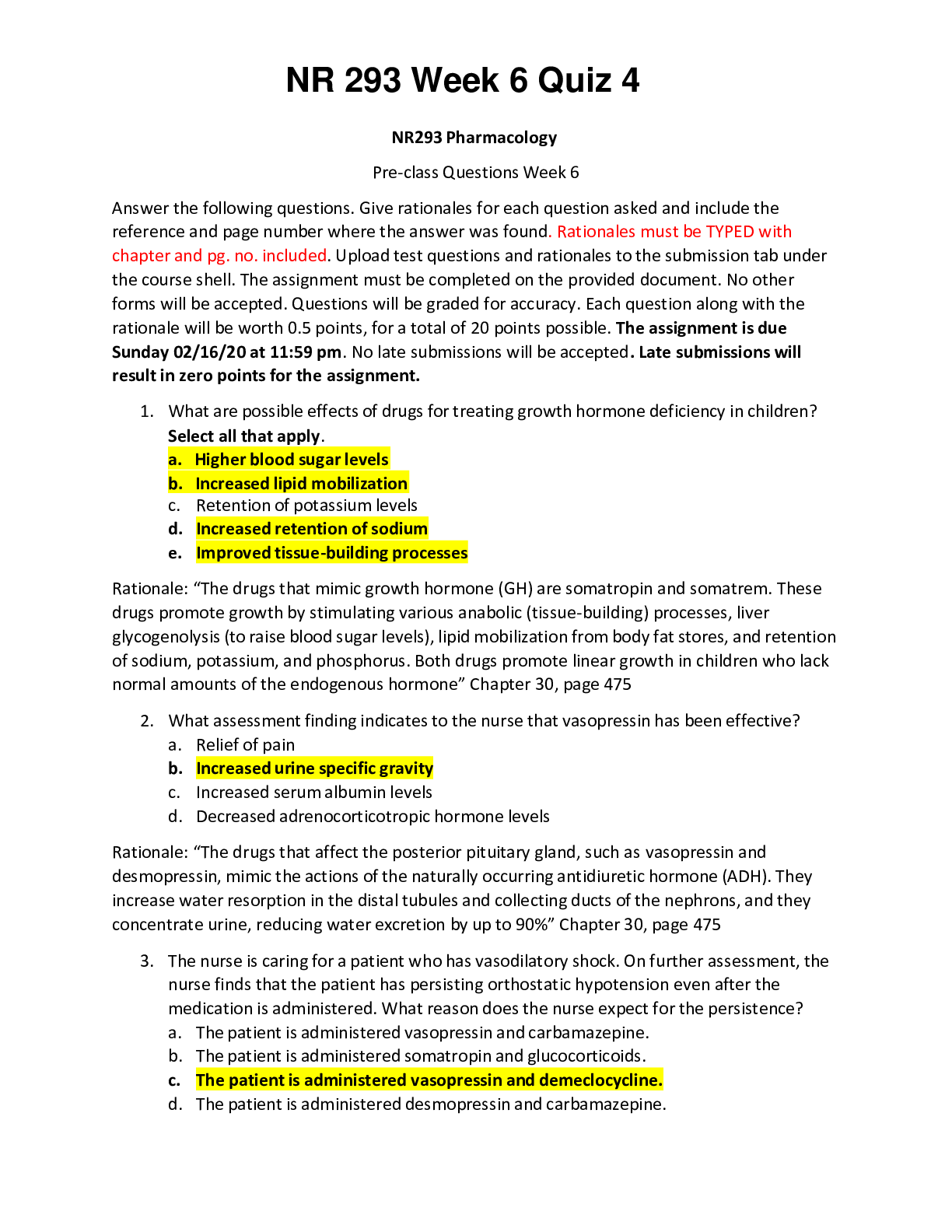
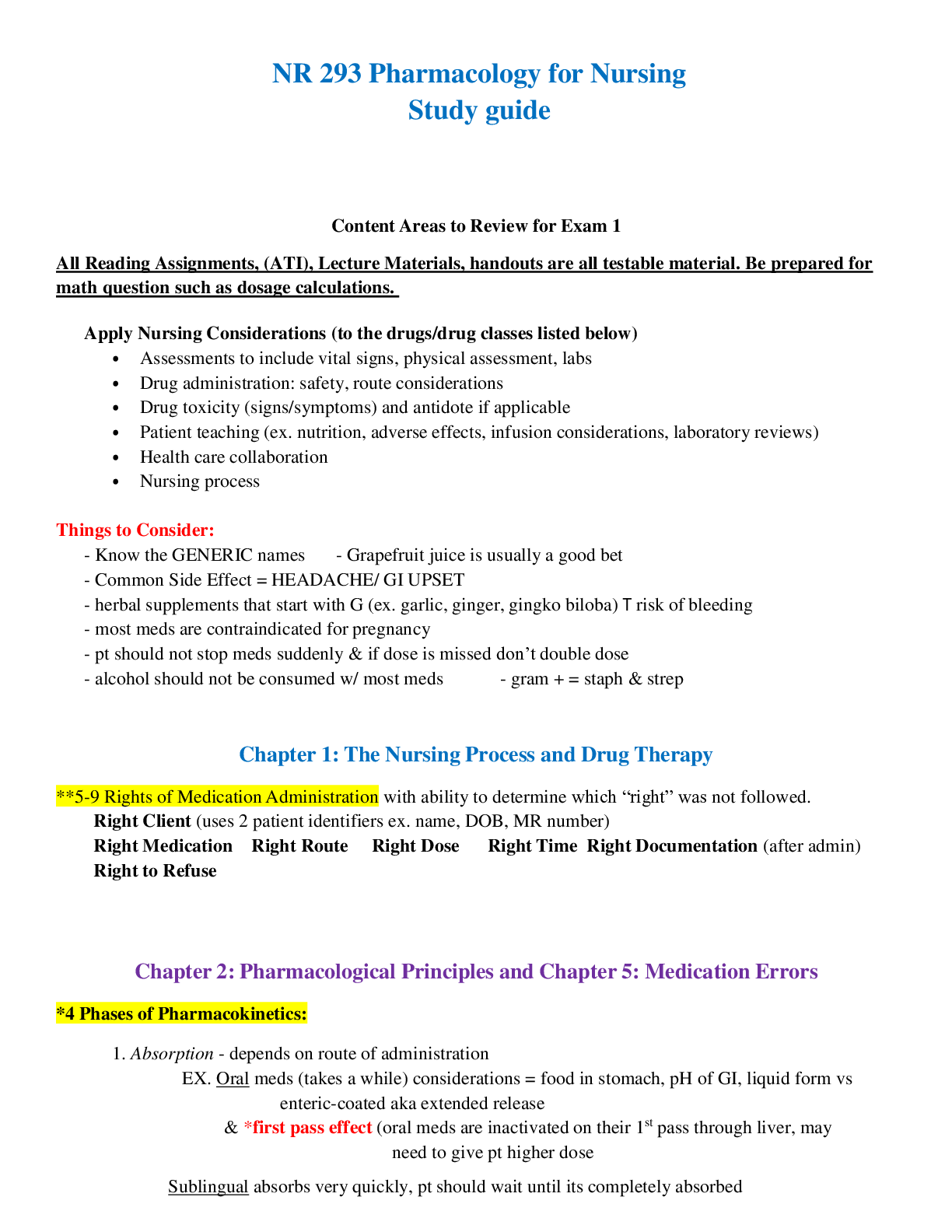
NR293 Pharmacology Questions and Answers Week 6 Answer the following questions. Give rationales for each question asked and include the reference and page number where the answer was found. Rati ... onales must be TYPED with chapter and pg. no. included. Upload test questions and rationales to the submission tab under the course shell. The assignment must be completed on the provided document. No other forms will be accepted. Questions will be graded for accuracy. Each question along with the rationale will be worth 0.5 points, for a total of 20 points possible. The assignment is due Sunday 02/16/20 at 11:59 pm. No late submissions will be accepted. Late submissions will result in zero points for the assignment. 1. What are possible effects of drugs for treating growth hormone deficiency in children? Select all that apply. a. Higher blood sugar levels b. Increased lipid mobilization c. Retention of potassium levels d. Increased retention of sodium e. Improved tissue-building processes Rationale: “The drugs that mimic growth hormone (GH) are somatropin and somatrem. These drugs promote growth by stimulating various anabolic (tissue-building) processes, liver glycogenolysis (to raise blood sugar levels), lipid mobilization from body fat stores, and retention of sodium, potassium, and phosphorus. Both drugs promote linear growth in children who lack normal amounts of the endogenous hormone” Chapter 30, page 475 2. What assessment finding indicates to the nurse that vasopressin has been effective? a. Relief of pain b. Increased urine specific gravity c. Increased serum albumin levels d. Decreased adrenocorticotropic hormone levels Rationale: “The drugs that affect the posterior pituitary gland, such as vasopressin and desmopressin, mimic the actions of the naturally occurring antidiuretic hormone (ADH). They increase water resorption in the distal tubules and collecting ducts of the nephrons, and they concentrate urine, reducing water excretion by up to 90%” Chapter 30, page 475 3. The nurse is caring for a patient who has vasodilatory shock. On further assessment, the nurse finds that the patient has persisting orthostatic hypotension even after the medication is administered. What reason does the nurse expect for the persistence? a. The patient is administered vasopressin and carbamazepine. b. The patient is administered somatropin and glucocorticoids. c. The patient is administered vasopressin and demeclocycline. d. The patient is administered desmopressin and carbamazepine. [Show More]
Last updated: 3 years ago
Preview 1 out of 12 pages
Buy this document to get the full access instantly
Instant Download Access after purchase
Buy NowInstant download
We Accept:
1. Study guide 2. Questions and Answers 3. Case studies 3. Exams guide 4. Discussions 5.Final exams
By Canzalo 4 years ago
$106.5
13
Can't find what you want? Try our AI powered Search
Connected school, study & course
About the document
Uploaded On
Jul 05, 2021
Number of pages
12
Written in
All
This document has been written for:
Uploaded
Jul 05, 2021
Downloads
0
Views
253
Scholarfriends.com Online Platform by Browsegrades Inc. 651N South Broad St, Middletown DE. United States.
We're available through e-mail, Twitter, Facebook, and live chat.
FAQ
Questions? Leave a message!
Copyright © Scholarfriends · High quality services·