Directions: Follow the instructions to go through the simulation. Respond to the questions and
prompts in the orange boxes.
Vocabulary: bacteriophage, capsid, host cell, lyse, lytic cycle, virus
Prior Knowledge Questi
...
Directions: Follow the instructions to go through the simulation. Respond to the questions and
prompts in the orange boxes.
Vocabulary: bacteriophage, capsid, host cell, lyse, lytic cycle, virus
Prior Knowledge Questions (Do these BEFORE using the Gizmo.)
1. A computer virus is a program that can copy itself and infect a computer without the permission of the
owner. How do you think a computer virus compares to a real virus?
Gizmo Warm-up
A virus is a microscopic particle that can infect a cell. Viruses are
primarily composed of a protein coat, called a capsid, and nucleic
acid. In the Virus Lytic Cycle Gizmo™, you will learn how a virus
infects a cell and uses the cell to produce more viruses.
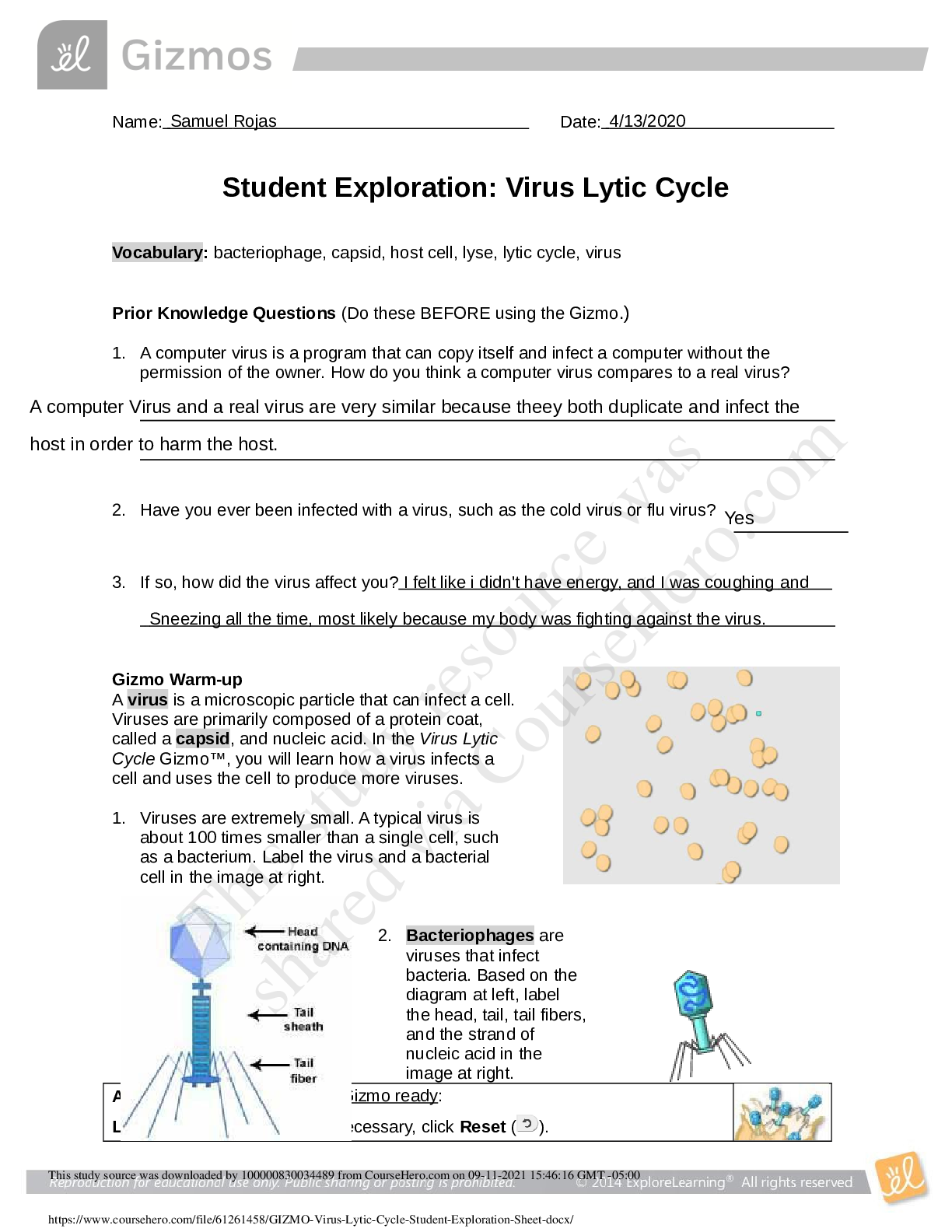
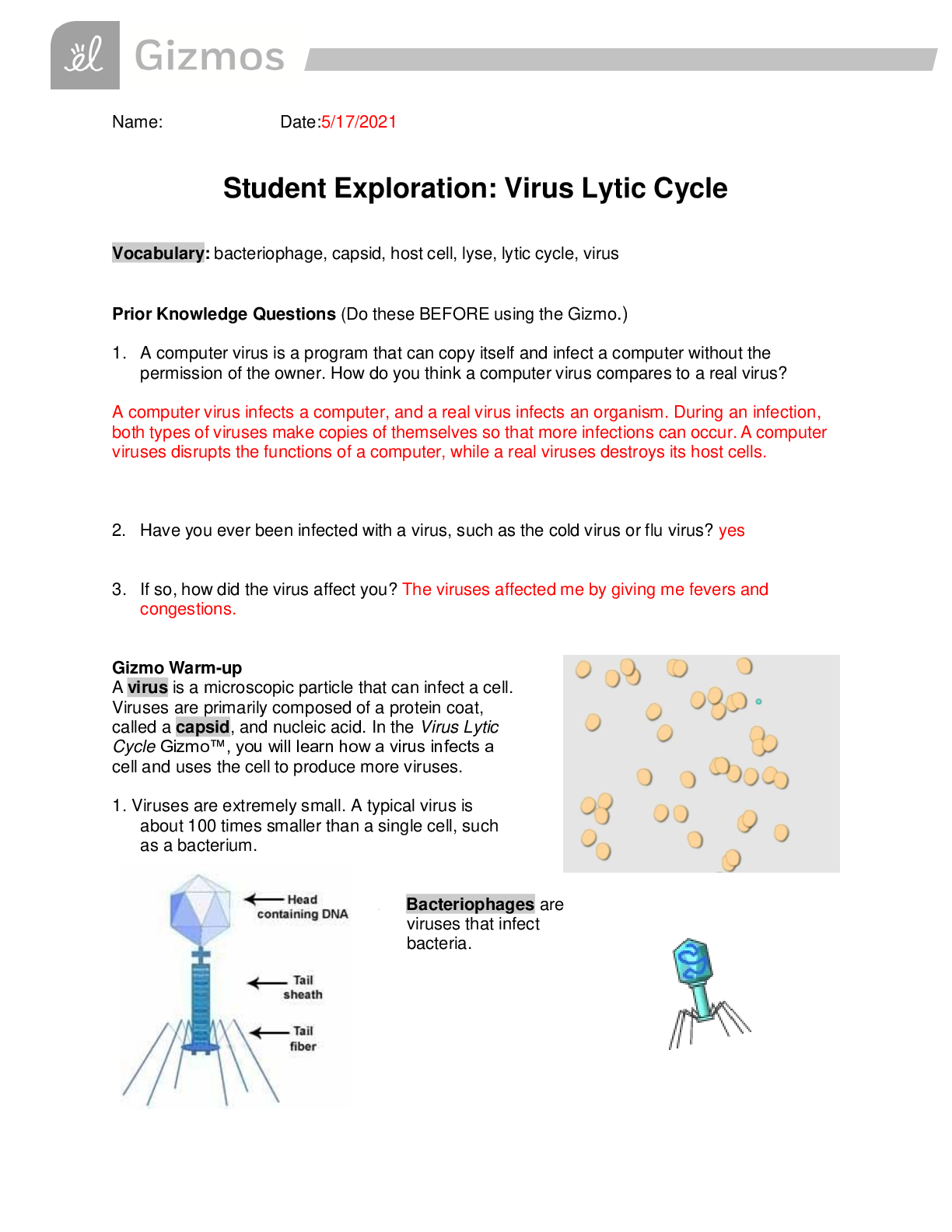
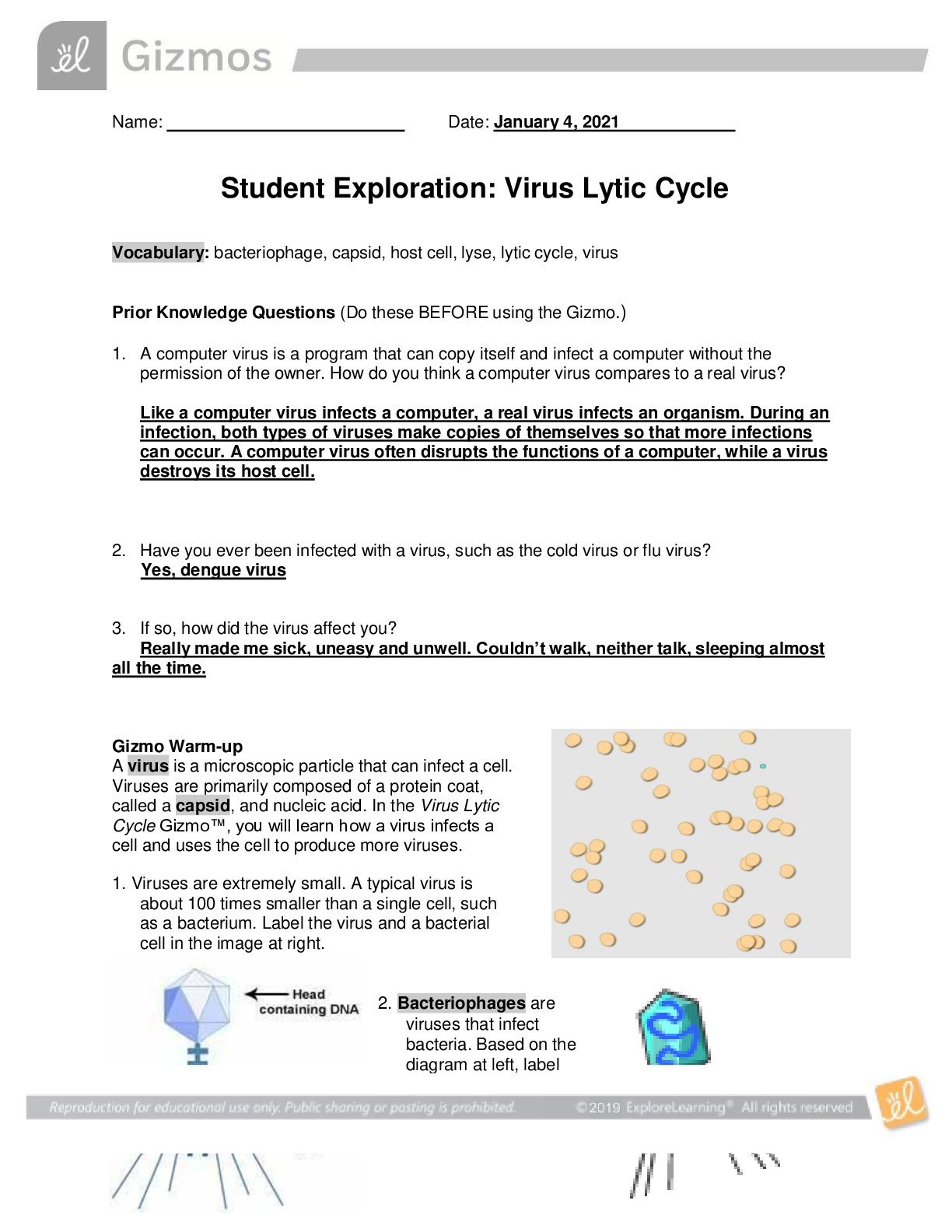
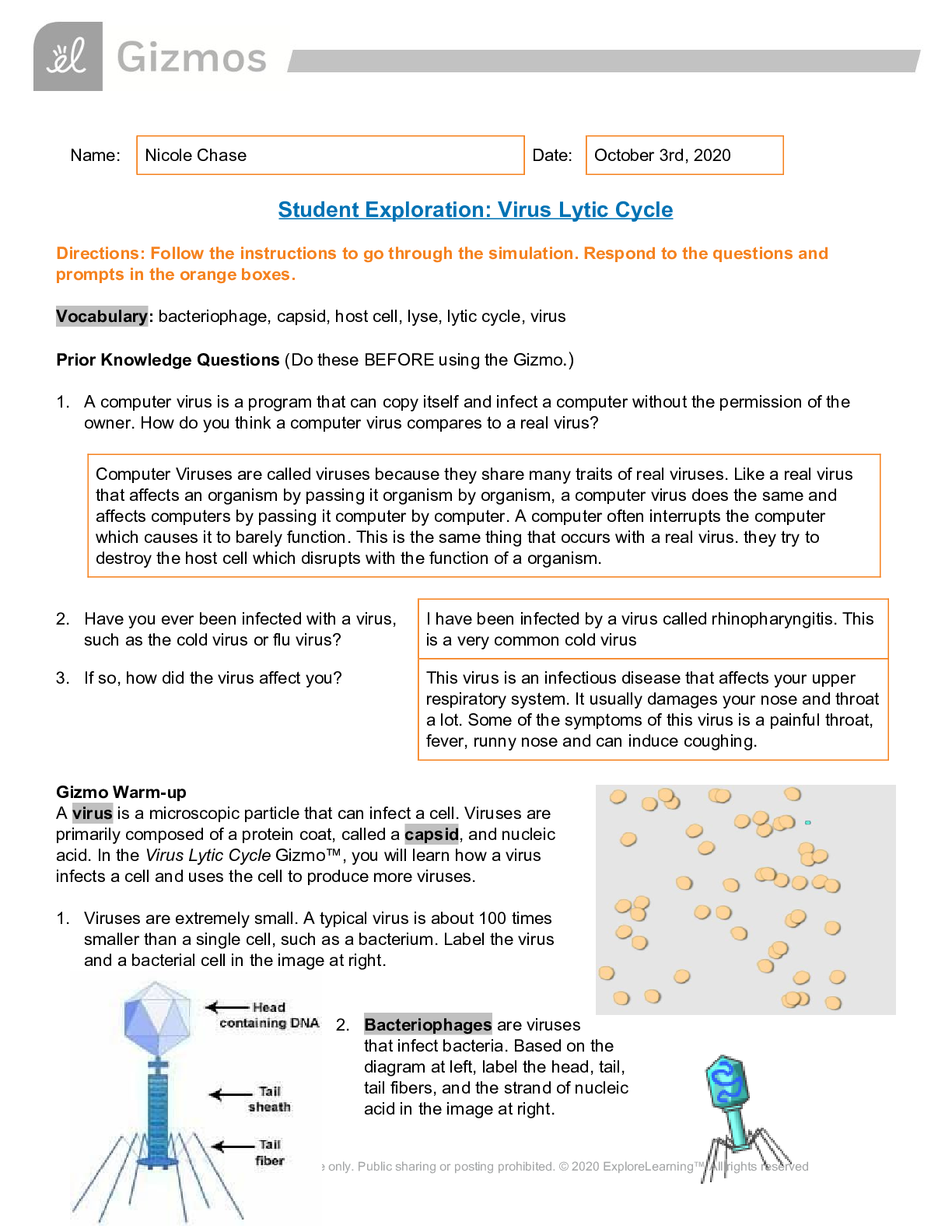
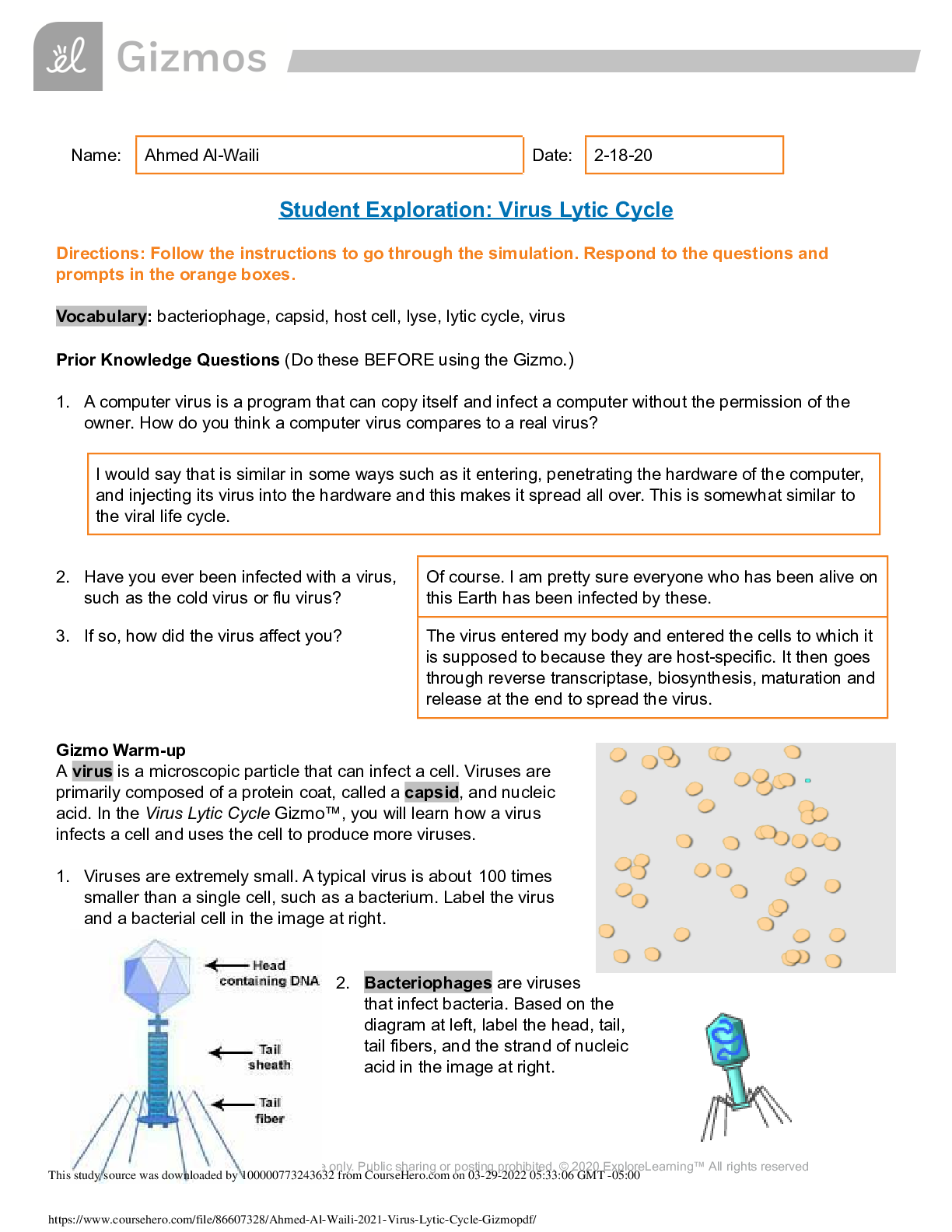
1. Viruses are extremely small. A typical virus is about 100 times
smaller than a single cell, such as a bacterium. Label the virus
and a bacterial cell in the image at right.
2. Bacteriophages are viruses
that infect bacteria. Based on the
diagram at left, label the head,
tail, tail fibers, and the strand of
nucleic acid in the image at right.
Reproduction for educational use only. Public sharing or posting prohibited. © 2020 ExploreLearning™ All rights reserved
Name: Aashka Prajapati Date: 2020-11-27
similar to a computer virus, a real virus also copies the genetic information and corrupts it and sends it
to other cells to corrupt those cells as well.
2. Have you ever been infected with a virus,
such as the cold virus or flu virus?
yes, a cold virus
3. If so, how did the virus affect you? sore throat, weakness, runny nose.
Introduction: Unlike living organisms, viruses cannot reproduce on their own. Instead, viruses infect host
cells, taking over the cell’s machinery to produce more viruses. This process is called the lytic cycle.
Question: What are the steps of the lytic cycle?
1. 75.Observe: Use the navigation arrows on the DESCRIPTION tab to read about the stages of the lytic
cycle. Using your own words, summarize each step of the cycle.
Reproduction for educational use only. Public sharing or posting prohibited. © 2020 ExploreLearning™ All rights reserved
Activity A:
Lytic cycle
Get the Gizmo ready:
● If necessary, click Reset ( ).
Step Summary
1
a lytic bacteriophage virus attaches itself to the bacterial cell. virus is a
simple structure that is composed of a protein capsid, nucleic acid (DNA
or RNA) and a tail section
↓
2
The virus injects its nucleic acid into the bacterial cell. The nucleic acid
uses the cell’s ribosomes to make virus proteins. The proteins break up
the cell’s DNA.
↓
3
the virus capsid and tail detaches from the cell and disintegrates. the
viral nucleic acid takes over and directs the production of new virus
proteins and nucleic acid.
↓
4
The virus proteins and virus nucleic acid combine together into new
viruses.
↓
5
special proteins produced by the viral nucleic acid cause the host
bacterial cell enter the lytic cycle, which destroys the cell in the process.
The numerous new viruses can infect other cells
2. Analyze: The yellow ring inside the bacterial cell represents the bacterial DNA. Why does this structure
disappear by step 3 of the lytic cycle?
3. Describe: How does a virus destroy the host cell’s DNA?
4. Describe: How are new viruses reproduced?
5. Think and discuss: Why can’t a virus reproduce on its own?
6. Justify: To lyse is to burst apart or explode. Why do you think a virus’s reproduction cycle is called the “lytic
cycle”?
Reproduction for educational use only. Public sharing or posting prohibited. © 2020 ExploreLearning™ All rights reserved
because the viral protein breaks the cells DNA in step 2
by creating a protein using the cells ribosomes and the viral nucleic acid
Once the viral proteins are made, the virus capsid and tail disintegrate. The virus proteins
and virus cells then combine together to form more viruses.
a virus can’t reproduce on its own because viruses are non-living. they are just packages
meant to take over the cell.
A virus’s reproduction cycle is called a “cycle” because it repeats itself. After it bursts open, it
enters other cells and goes through the same reproduction process it did before.
Question: How does a viral infection spread?
1. Predict: Suppose that a virus infects a small population of bacteria. Predict how the numbers of viruses,
infected cells, and uninfected cells will change as the infection progresses. On the blanks below, write
increase, decrease, or stay the same.
2. Observe: Click Play ( ), and watch the simulation. Describe what you see.
3. Test: Click Reset, and Select the BAR CHART tab. Turn on Show numerical values. Click Play, and
watch each bar as the simulation runs. What do you notice, and how does this compare to your
predictions?
4. Record data: Select the TABLE tab, and use the data to complete the second column of the table below.
To complete each cell in the third column, subtract the previous time value from the current time value. For
example, if it took 80 minutes to reach 40 cells and 100 minutes to reach 30 cells, then the time difference
is 20 minutes.
Reproduction for educational use only. Public sharing or posting prohibited. © 2020 ExploreLearning™ All rights reserved
Activity B:
Spread of
infection
Get the Gizmo ready:
● If necessary, click Reset.
Viruses: increase Infected
cells:
stay the same Uninfected
cells
decrease
- a single virus enters the bacteria cell
- it reproduces in the bacteria cell
- it cell is destroyed and it bursts open releasing more virus
- The viruses travel to other bacteria cells and reproduce and destroy the cell.
the number of healthy cells decreases, infected cells stay the same and the number of
viruses increase. my predictions were correct.
- virus number increases because viruses reproduce
- infected cells increase then the virus enters the cell but decrease when the virus
leaves the cell because they have been destroyed
- healthy cells decrease because they are no longer healthy after the virus enters it.
Number of
healthy cells
Time (minutes)
Amount of time to decrease
population by 10
50 0 minutes --
40 61 min 61 min
30 93 min 32 min
20 122min 29 min
10 150 min 28 min
9. Interpret: Select the GRAPH tab. Run the Gizmo again, and observe what happens in the SIMULATION
pane when the graph shows a decrease in the viruses’ population size.
10. Extend your thinking: AIDS is one disease caused by a virus
infection. The virus attacks immune system cells known as T
cells.
Based on your observations from the Gizmo, how would you
explain the data shown on the graph?
Reproduction for educational use only. Public sharing or posting prohibited. © 2020 ExploreLearning™ All rights reserved
7. Analyze: What trend do you see in the third
column of your data table?
the time decreases.
8. Explain: How would you explain this trend? As the number of cells goes down, the time it
takes to decrease, increases
A. Why does the number of viruses sometimes increase
and sometimes decrease?
when the virus population
decreases, it could be
because the virus is inside
the host cell so the number
of viruses inside the host
cells are not counted which
decreases the number of
viruses.
B. Sometimes when a virus enters a cell, it becomes
dormant for a while. Why might this make it difficult for a
doctor to diagnose a viral infection?
because in its dormant state,
the virus is inactive and the
person will have no
symptoms, which makes the
cell appear to be healthy
[Show More]