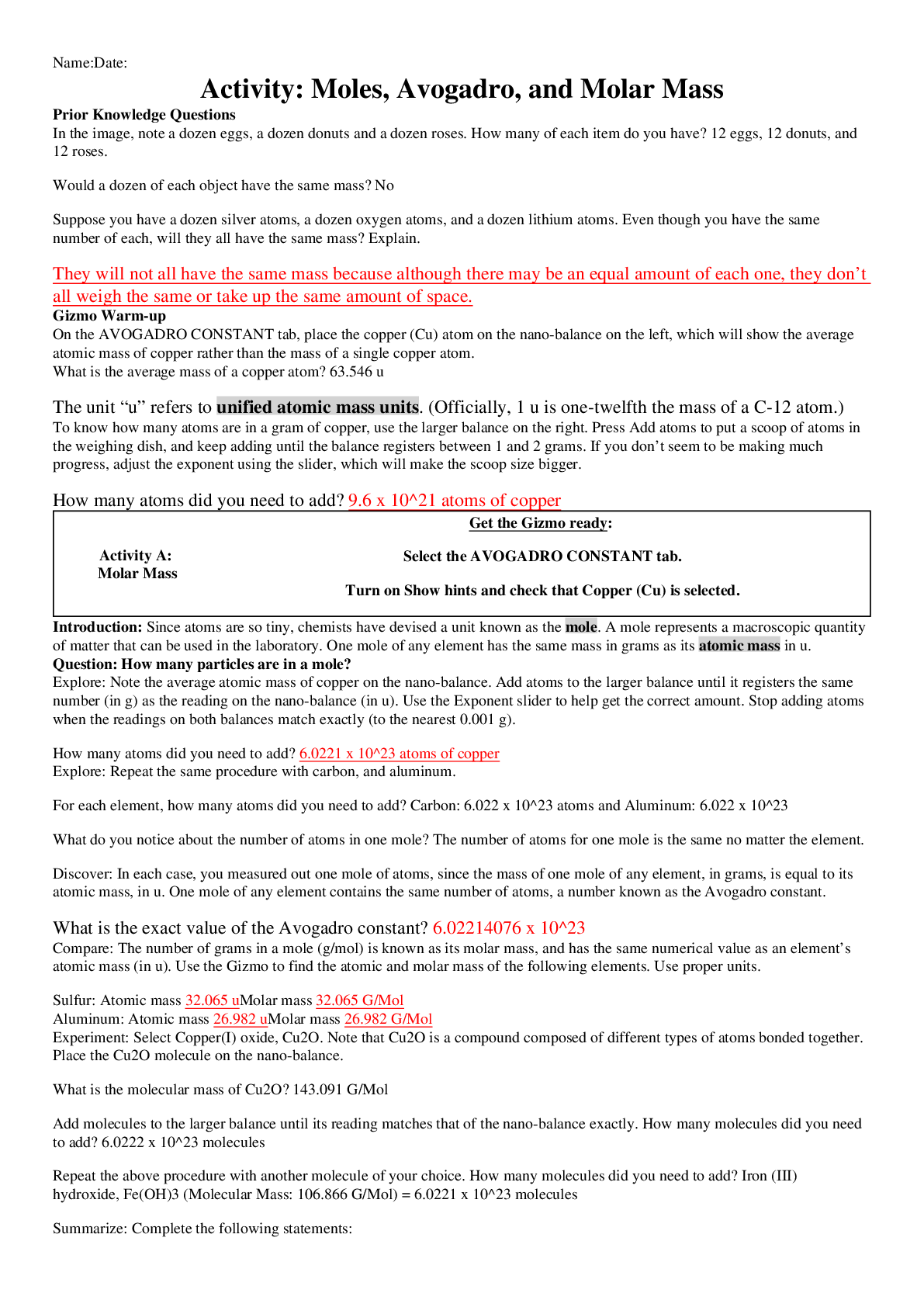
Vocabulary: consumer, ecosystem, energy pyramid, equilibrium, food chain, population, predator, prey,
producer
Prior Knowledge Questions (Do these BEFORE using the Gizmo.)
The Food Chain Gizmo shows a food chain with
...
Vocabulary: consumer, ecosystem, energy pyramid, equilibrium, food chain, population, predator, prey,
producer
Prior Knowledge Questions (Do these BEFORE using the Gizmo.)
The Food Chain Gizmo shows a food chain with hawks, snakes, rabbits, and grass. In this simulation, the
hawks eat snakes, the snakes eat rabbits, and the rabbits eat grass.
1. Producers are organisms that do not need to eat other organisms to obtain energy.
A. Which organism is a producer in this food chain?
The grass is a producer.
B. Where does the producer get its energy?
The grass gets its energy from the sun.
2. Consumers must eat other organisms for energy. Which organisms are consumers in this food chain?
The rabbit, snakes, and hawk
Gizmo Warm-up
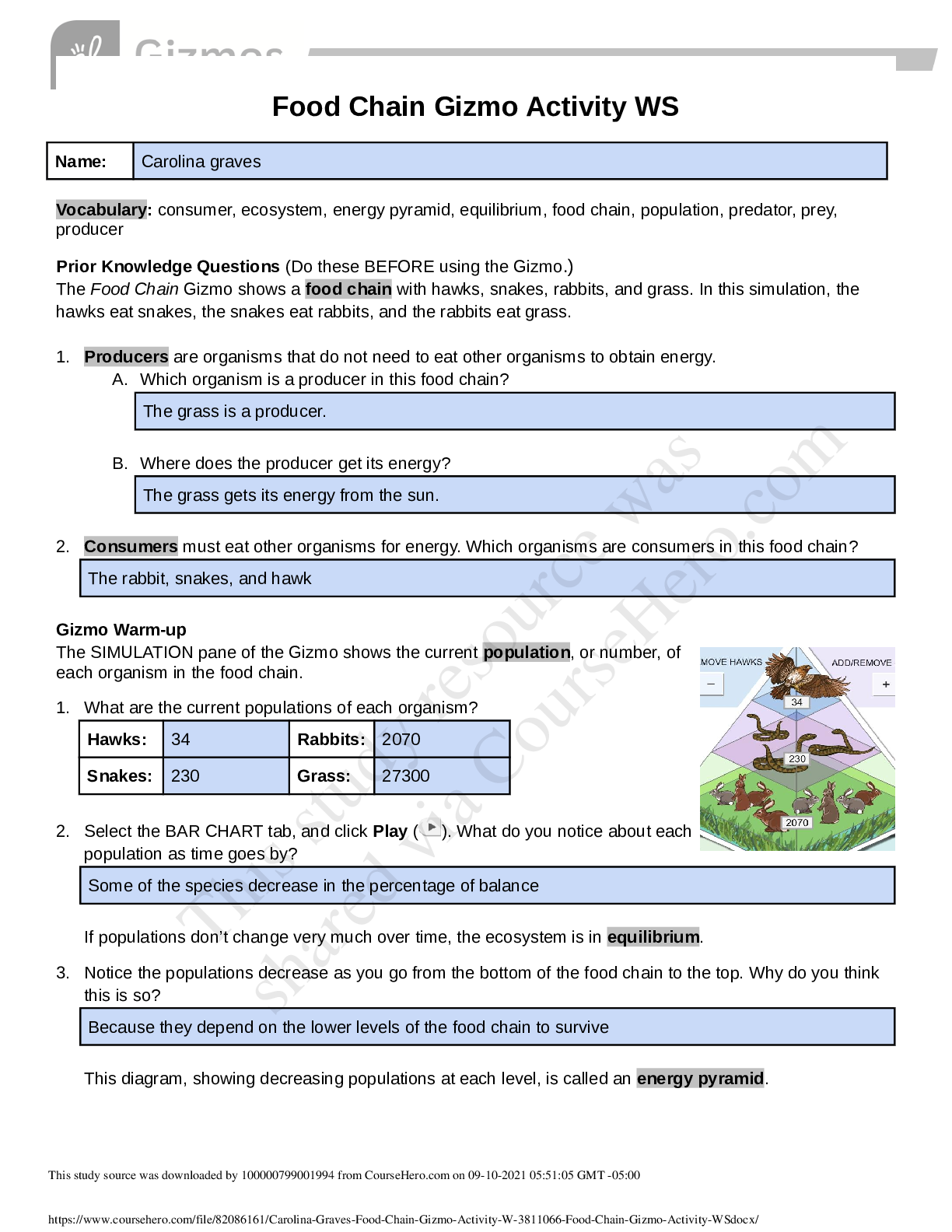
The SIMULATION pane of the Gizmo shows the current population, or number, of
each organism in the food chain.
1. What are the current populations of each organism?
Hawks: 34 Rabbits: 2070
Snakes: 230 Grass: 27300
2. Select the BAR CHART tab, and click Play ( ). What do you notice about each
population as time goes by?
Some of the species decrease in the percentage of balance
If populations don’t change very much over time, the ecosystem is in equilibrium.
3. Notice the populations decrease as you go from the bottom of the food chain to the top. Why do you think
this is so?
Because they depend on the lower levels of the food chain to survive
This diagram, showing decreasing populations at each level, is called an energy pyramid.
This study source was downloaded by 100000796615030 from CourseHero.com on 07-07-2021 06:26:08 GMT -05:00
https://www.coursehero.com/file/82086161/Carolina-Graves-Food-Chain-Gizmo-Activity-W-3811066-Food-Chain-Gizmo-Activity-WSdocx/
This study resource was
shared via CourseHero.com
Activity A:
Predator-prey
relationships
Get the Gizmo ready:
● Click Reset ( ).
● Check that the BAR CHART tab is selected.
Question: Predators are animals that hunt other animals, called prey. How do predator and prey
populations affect one another?
1. Observe: Run the Gizmo with several different starting conditions. You can use the + or – buttons to add or
remove organisms, or you can choose Diseased from the dropdown lists.
2. Form hypothesis: How do you think predator and prey populations affect one another? (Write your
hypothesis in the “If, then, because…” format.)
If there are more prey populations then the predator population will grow as well.
3. Predict: Based on your hypothesis, predict how changing the rabbit population will affect the other
organisms at first. Write “Increase” or “Decrease” next to each “Prediction” in the table.
Change Grass Snakes Hawks
Doubling rabbit
population
Prediction: More grass
will be
consumed
Prediction: Snakes will
consume them
Prediction: Hawks will
consume the
snakes
Result: Grass
population
decreased
Result: Snake
population
increased
Result: Hawk
population
increased
Halving rabbit
population
Prediction: Less grass
will be
consumed
so the grass
population
will grow
Prediction: Snake
population will
decrease due
to the lack of
rabbits
Prediction: Hawks will
have less food
and the
population will
decrease as
well.
Result: Grass
population
increased
Result: Decrease in
Snake
population
Result: Hawk
population
inccreased
4. Test: Add rabbits until the population is about twice as large as it was (200% of balance). Click Play, and
then Pause ( ) after approximately ONE month. Next to each “Result” line in the table, write “Increase” or
“Decrease.” Click Reset and then halve the rabbit population (50% of balance). Record the results for this
experiment in the table as well.
A. How did doubling the rabbit population affect the grass, snakes, and hawks at first?
It increased the snake and hawk population first then balanced out.
B. How did halving the rabbit population affect the grass, snakes, and hawks at first?
This study source was downloaded by 100000796615030 from CourseHero.com on 07-07-2021 06:26:08 GMT -05:00
https://www.coursehero.com/file/82086161/Carolina-Graves-Food-Chain-Gizmo-Activity-W-3811066-Food-Chain-Gizmo-Activity-WSdocx/
This study resource was
shared via CourseHero.com
It decreased the hawk and snake population but then balanced out
5. Predict: Predict how changing the snake and hawk populations will affect the other organisms within the
first month. In the tables below, write your predictions.
Change Grass Rabbits Hawks
Doubling
snake
population
Prediction: Increase Prediction: decrease Prediction: increase
Result: increase Result: decrease Result: increase
Halving snake
population
Prediction: decrease Prediction: increase Prediction: decrease
Result: decrease Result: increase Result: decrease
Change Grass Rabbits Snakes
Doubling hawk
population
Prediction: decrease Prediction: increase Prediction: decrease
Result: decrease Result: increase Result: decrease
Halving hawk
population
Prediction: increase Prediction: increase Prediction: decrease
Result: increase Result: increase Result: decrease
6. Test: Click Reset. Try each experiment with the Gizmo. Record each result after one month.
A. How did increasing the snakes affect the grass? Explain why.
The increase of the snake population made the rabbit population increase making the grass
decrease
B. How did increasing the hawks affect the rabbits? Explain why.
Because more hawks mean less snakes and that means less rabbits will be hunted.
7. Draw conclusions:
8. In general, what effect did removing prey have on predators?
The less prey there is the less predators there will be trying to catch prey
9. What effect did removing predators have on prey?
An increase in prey because they weren't being hunted down.
10. Extend your thinking: In North America, many top predators, such as wolves, have been driven nearly to
extinction. What effect do you think this has on their main prey, deer?
This study source was downloaded by 100000796615030 from CourseHero.com on 07-07-2021 06:26:08 GMT -05:00
https://www.coursehero.com/file/82086161/Carolina-Graves-Food-Chain-Gizmo-Activity-W-3811066-Food-Chain-Gizmo-Activity-WSdocx/
This study resource was
shared via CourseHero.com
This affects deer because there aren't as many being hunted so there will be an increase in deer.
Activity B:
Long-term
changes
Get the Gizmo ready:
● Click Reset.
● Select the GRAPH tab.
Question: An ecosystem is a group of living things and their physical environment. How do
ecosystems react to major disturbances?
1. Observe: Kill off most of the hawks using the – button, and then click Play. Observe the GRAPH for about
12 months, and then click Pause. What happens?
The lines are everywhere but then even out.
2. Analyze: Explain why you think the population of each organism changed the way it did. (Use extra paper
if necessary.)
Hawks are the top predator so the less animals are being hunted.
3. Experiment: Click Reset. Try making other changes to the ecosystem. Use the + or – buttons, or choose
Diseased from the dropdown lists. Click Play and observe for at least 12 months.
All the populations decrease dramatically from being hunted and dying from disease
4. Summarize: Give at least one example of each of the following:
A. A major disturbance that the ecosystem was able to recover completely from.
The decrease of a hawk population
B. A major disturbance that caused the ecosystem to stabilize at a new equilibrium.
The extinction of snakes
C. A major disturbance that caused the ecosystem to completely collapse.
The extinction of grass
D. (Challenge) A major disturbance that almost caused a total collapse, but that the ecosystem was
able to recover from eventually.
Major decrease in the rabbit population
Extension
Would it be wrong
to eradicate
Intro to Ecology PPT
● Listen to the lecture and read through the entire powerpoint
● Read “Would it be wrong to eradicate mosquitoes?”
This study source was downloaded by 100000796615030 from CourseHero.com on 07-07-2021 06:26:08 GMT -05:00
https://www.coursehero.com/file/82086161/Carolina-Graves-Food-Chain-Gizmo-Activity-W-3811066-Food-Chain-Gizmo-Activity-WSdocx/
This study resource was
shared via CourseHero.com
mosquitoes?
1. Would it be wrong to eradicate mosquitoes? Explain your answer thoroughly in 5-7 sentences. Use
content and information from the Gizmo and PPT and information from the article linked above.
I do not think we should eradicate mosquitoes. According to the article only 6% carry the virus which is
not alot. Morally, “it is utterly unacceptable to deliberately wipe out a species that is a danger to
humans when it is humans that are a danger to so many species”. It is also very hard to
eradicate a certain species of mosquitoes. Mosquitoes are also food for fish, bats and other
insects.
This study source was downloaded by 100000796615030 from CourseHero.com on 07-07-2021 06
[Show More]







.png)