Prior Knowledge Questions (Do these BEFORE using the Gizmo.)
1. What are the major types of nutrients you can get from food? [ Carbohydrate Lipids Fats
]
2. How are these nutrients used by your body?
[ They give you
...
Prior Knowledge Questions (Do these BEFORE using the Gizmo.)
1. What are the major types of nutrients you can get from food? [ Carbohydrate Lipids Fats
]
2. How are these nutrients used by your body?
[ They give you energy ]
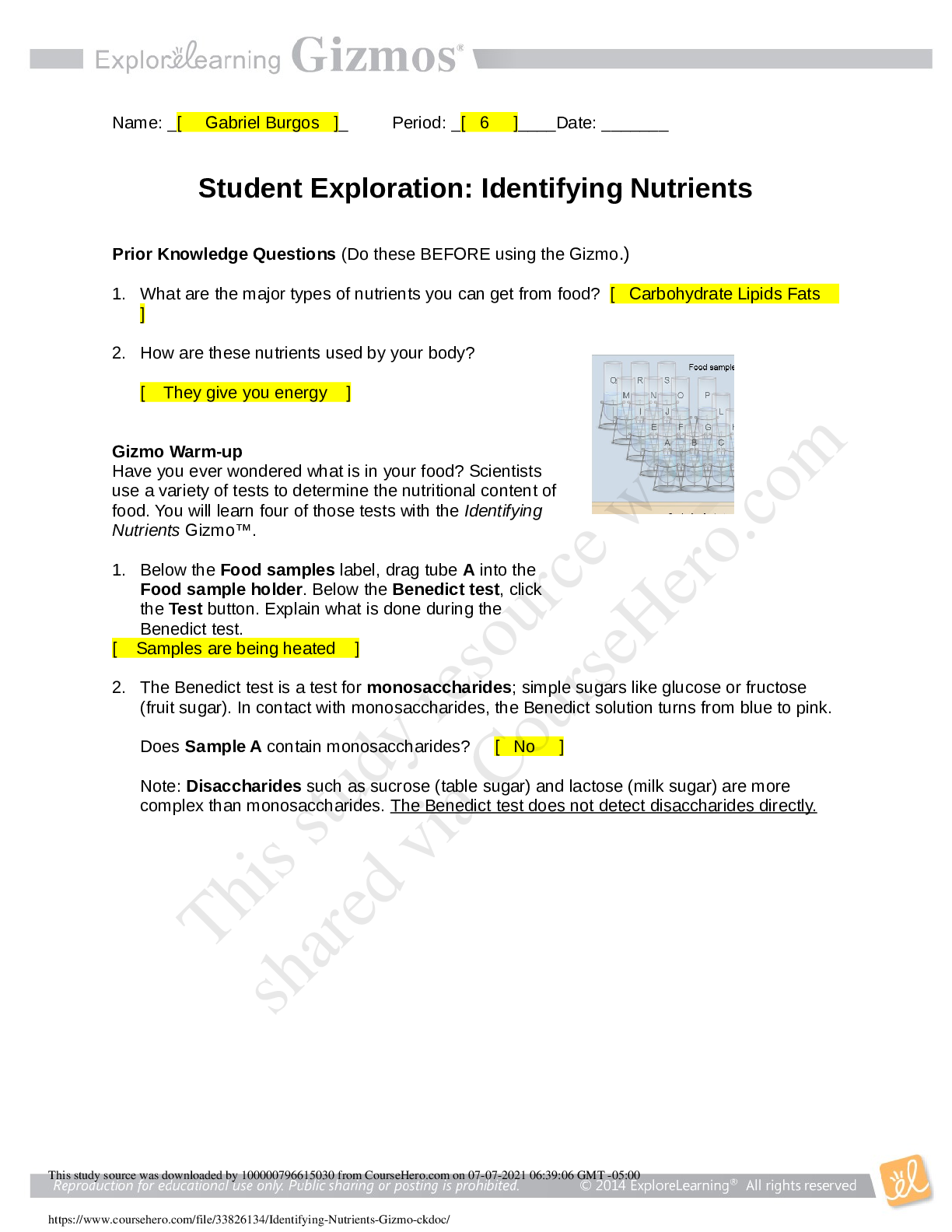
Gizmo Warm-up
Have you ever wondered what is in your food? Scientists
use a variety of tests to determine the nutritional content of
food. You will learn four of those tests with the Identifying
Nutrients Gizmo™.
1. Below the Food samples label, drag tube A into the
Food sample holder. Below the Benedict test, click
the Test button. Explain what is done during the
Benedict test.
[ Samples are being heated ]
2. The Benedict test is a test for monosaccharides; simple sugars like glucose or fructose
(fruit sugar). In contact with monosaccharides, the Benedict solution turns from blue to pink.
Does Sample A contain monosaccharides? [ No ]
Note: Disaccharides such as sucrose (table sugar) and lactose (milk sugar) are more
complex than monosaccharides. The Benedict test does not detect disaccharides directly.
This study source was downloaded by 100000796615030 from CourseHero.com on 07-07-2021 06:39:06 GMT -05:00
https://www.coursehero.com/file/33826134/Identifying-Nutrients-Gizmo-ckdoc/
This study resource was
shared via CourseHero.com
Activity A:
Identifying
nutrients
Get the Gizmo ready:
Click Reset.
Drag Sample A into the Food sample holder.
Introduction: Most food is composed of three types of molecules: carbohydrates, proteins,
and lipids.
Carbohydrates such as starches and sugars are major source of energy. Simple sugars
are found in sweets and fruits. Starches are found in potatoes, cereal, pasta, flour, and
other plant products.
Proteins are used in body structures such as muscles, skin, and hair. Rich sources of
proteins include meats, dairy products, and beans.
Lipids (fats and oils) are used for energy, insulation, and as an essential building block of
cells. Meats, dairy products, and oily plants such as olives are rich in lipids.
Question: How do you test for carbohydrates, proteins, and lipids?
1. Test: Under the Benedict test, click Test. Does sample A contain monosaccharides?
(Recall that a pink color is a positive test for monosaccharides.)
[ Yes ]
2. Test: The Lugol test uses iodine to test for starch, a polysaccharide (complex sugar). Iodine
turns dark purple in the presence of starch.
Under Lugol test, click Test. Does sample A contain starch?
[ No ]
3. Test: The Biuret test uses a solution of potassium hydroxide (KOH) and copper sulfate
(CuSO4) to test for protein. The Biuret solution turns purple when proteins are present.
Under Biuret test, click Test. Does sample A contain proteins?
[ No ]
4. Test: The Sudan Red test uses a fat-soluble dye, Sudan Red, to indicate the presence of
lipids. When lipids are present, the dye will be absorbed into the lipids, and will appear as
concentrated spots of color in the test tube. (No spots indicates that lipids are not present.)
Under Sudan Red test, click Test. Does sample A contain lipids? [ no ]
5. Summarize: What nutrients does sample A contain? [ monosaccharides ]
6. Analyze: What kind of food is sample A most likely to be? (Highlight your choice)
A. Apple juice B. Baked beans C. Oatmeal D. Scrambled eggs
This study source was downloaded by 100000796615030 from CourseHero.com on 07-07-2021 06:39:06 GMT -05:00
https://www.coursehero.com/file/33826134/Identifying-Nutrients-Gizmo-ckdoc/
This study resource was
shared via CourseHero.com
Activity B:
Nutrients and
food types
Get the Gizmo ready:
Click Reset.
Question: What nutrients does each food sample contain?
1. Collect data: Use the four available tests to find the nutritional content of samples E, G, and
M. (Sample A has been done for you as an example.) Record results on the table below.
Carbohydrate
Tests
Protein
Test
Lipids
Test
Test results – are these nutrients
present?
F
o
o
d
sa
m
ple
Benedict
test
Lug
ol
test
Biuret
test
Sud
an Red
test
M
onosaccharides
Starches
Proteins
Lipids
A + – – – Yes No No No
E
[ - ] [ + ] [ + ] [ + ] [ No
]
[ Yes
]
[ Yes
]
[ Yes
]
G
[ - ] [ + ] [ - ] [ - ] [ No
]
[ Yes
]
[ No
]
[ No
]
M
[ - ] [ + ] [ - ] [ - ] [ No
]
[ Yes
]
[ No
]
[ No
]
2. Analyze: Look at the results for samples A, E, G, and M.
A. Is sample E most likely to be steak, bread, or butter? Justify or support your answer.
[ Steak, Steaks have Starches Proteins Lipids ]
B. Is sample G most likely to be table sugar, pasta, or olive oil? Justify your answer.
[ Olive Oil, Starches are oily ]
C. Is sample M most likely to be chicken, rice, a mango, or butter? Justify your answer.
[ Butter, Butter has starch on it ]
3. Draw conclusions: Why is it important to understand the nutritional content of food?
[ To know if they are healthy to eat or not ]
(Activity B continued on next page)
This study source was downloaded by 100000796615030 from CourseHero.com on 07-07-2021 06:39:06 GMT -05:00
https://www.coursehero.com/file/33826134/Identifying-Nutrients-Gizmo-ckdoc/
This study resource was
shared via CourseHero.com
Activity B (continued from previous page)
4. Practice: Determine the nutritional content of the 5 of the remaining food samples. You
choose any 5 of the remaining samples that you wish to test. Most of your data table
will be blank.
Carbohydrate
Tests
Protein
Test
Lipids
Test
Test results – are these nutrients
present?
F
o
o
d
sa
m
ple
Benedict
test
Lug
ol
test
Biuret
test
Sud
an Red
test
M
onosaccharides
Starches
Proteins
Lipids
B
[ - ] [ - ] [ + ] [ + ] [ no
]
[ no
]
[ yes
]
[ yes
]
C
[ - ] [ + ] [ - ] [ - ] [ no
]
[ yes
]
[ - ] [ - ]
D
[ - ] [ - ] [ + ] [ + ] [ no
]
[ no
]
[ yes
]
[ yes
]
F
[ - ] [ - ] [ - ] [ - ] [ no
]
[ no
]
[ no
]
[ no
]
H
[ - ] [ - ] [ + ] [ + ] [ no
]
[ no
]
[ yes
]
[ yes
]
I
[ ] [ ] [ ] [ ] [ ] [ ] [ ] [ ]
J [ ] [ ] [ ] [ ] [ ] [ ] [ ] [ ]
K [ ] [ ] [ ] [ ] [ ] [ ] [ ] [ ]
L [ ] [ ] [ ] [ ] [ ] [ ] [ ] [ ]
N [ ] [ ] [ ] [ ] [ ] [ ] [ ] [ ]
O [ ] [ ] [ ] [ ] [ ] [ ] [ ] [ ]
P [ ] [ ] [ ] [ ] [ ] [ ] [ ] [ ]
Q [ ] [ ] [ ] [ ] [ ] [ ] [ ] [ ]
R [ ] [ ] [ ] [ ] [ ] [ ] [ ] [ ]
S [ ] [ ] [ ] [ ] [ ] [ ] [ ] [ ]
5. What two tests would you expect a bacon sample to be + for? [ O and S ]
6. Extend your thinking: In general, a balanced diet contains relatively even amounts of
carbohydrates, proteins, and lipids. Too much sugar (monosaccharides and other simple
sugars) is unhealthy. Fruits and vegetables are important sources of vitamins and minerals.
Do you consider your diet balanced and healthy? Why or why not? [ Yes I eat fruits
vegetables and fruits every day ]
[Show More]





.png)