NCLEX Question Trainer Explanations
Test 5
The nurse is preparing a patient for an 8:00 AM outpatient electroconvulsive (ECT) treatment.
Which of the following questions is the MOST important for the nurse to ask?
1.
...
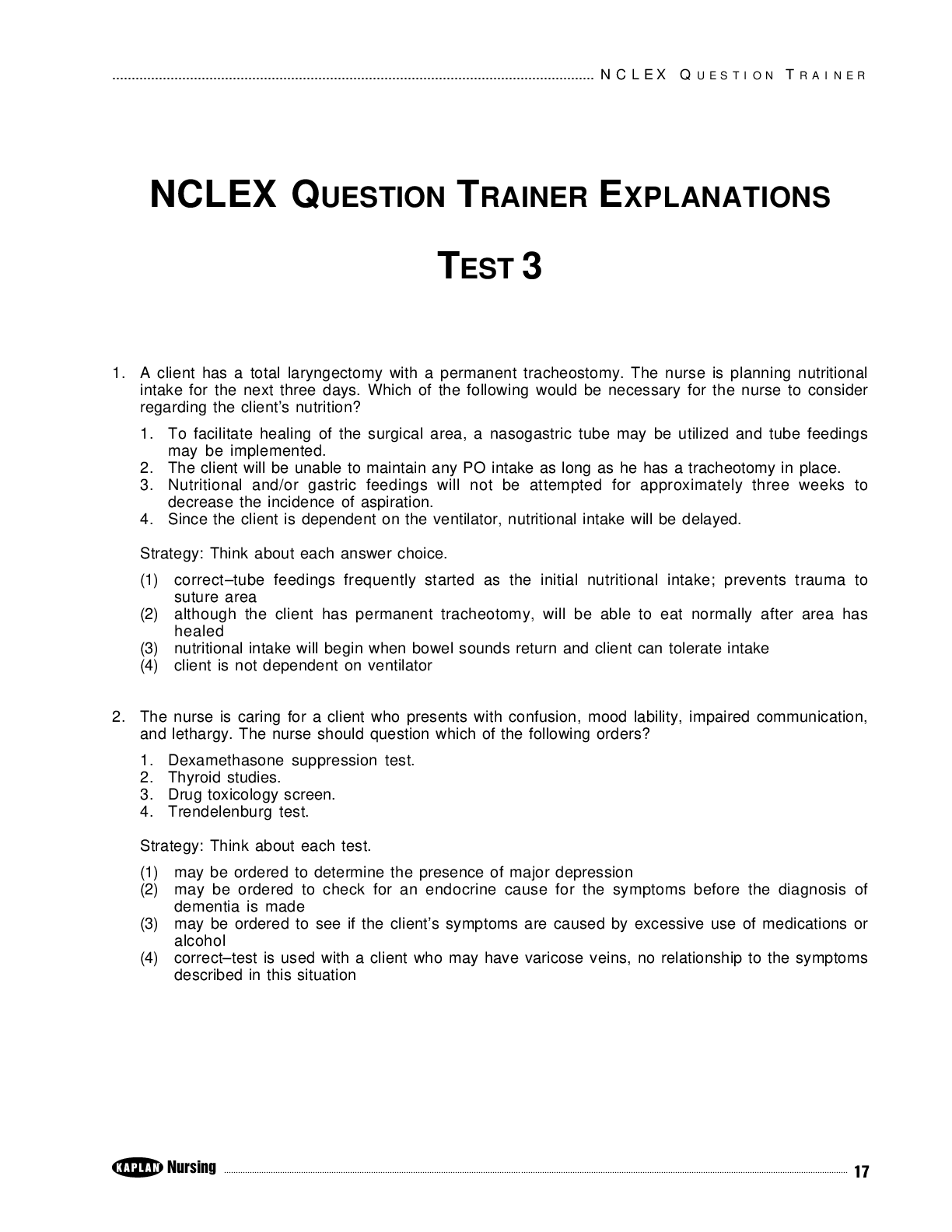
NCLEX Question Trainer Explanations
Test 5
The nurse is preparing a patient for an 8:00 AM outpatient electroconvulsive (ECT) treatment.
Which of the following questions is the MOST important for the nurse to ask?
1. “Did you have anything to eat or drink before you came in today?”
2. “Have you had any headaches since your last treatment?”
3. “Who came with you to the hospital today?”
4. “Have you had much memory loss since you began your treatments?”
Strategy: Determine how each answer choice relates to ECT.
(1) correct–client given general anesthesia for ECT; NPO after midnight
(2) not relevant to ECT
(3) not most important
(4) memory loss is an expected outcome
2. A 36-year-old man has a flaccid bladder following a spinal cord injury. The nurse is teaching the
client about dietary changes. Which of the following beverages, if selected by the client, would
indicate to the nurse that teaching was effective?
1. Lemonade.
2. Prune juice.
3. Milk.
4. Orange juice.
Strategy: “Teaching was effective” indicates you are looking for a true statement.
(1) promotes alkaline urine, should also avoid citrus juices, excessive amounts of milk,
carbonated beverages
(2) correct–promotes acidic urine, minimizes risk of urinary tract infection and stone formation,
also use cranberry, tomato juice, bouillon
(3) excessive amounts of milk promotes alkaline urine
(4) promotes alkaline urine, should also avoid citrus juices, excessive amounts of milk and
carbonated beverages
NCLEX Question Trainer Explanations
Test 5
313. The nurse is caring for a client with a long history of alcohol and drug dependence. It would be
MOST important for the nurse to include which of the following as a part of his discharge
planning?
1. Referral to a social service agency for assistance with housing.
2. Referral to an aftercare center in the community.
3. Participation in Alcoholics Anonymous (AA) meetings with a sponsor.
4. A prescription for an antidepressant medication.
Strategy: All answers are implementations. Determine the outcome of each answer choice. Is it
desired?
(1) may be of some help, but will not directly provide support necessary to maintain sobriety
(2) may be of some help, but will not directly provide support necessary to maintain sobriety
(3) correct–self-help groups have greatest success rate as a sustained support system in the
community
(4) unnecessary
4. A client has come to the clinic for a hepatitis B vaccine and asks if he has to be re-vaccinated after
his first injection. Which of the following responses by the nurse is BEST?
1. “A booster shot is required yearly.”
2. “Additional injections are given at one and six months.”
3. “Repeat doses are given at two and four months.”
4. “Revaccination is not required.”
Strategy: All answers are implementations. Determine the outcome of each answer choice. Is it
desired?
(1) yearly doses are given for flu shots, not for hepatitis B vaccine
(2) correct–hepatitis B vaccine is repeated at one and six months
(3) schedule for infant immunizations for OPV and DPT
(4) inaccurate
5. The nurse is planning care for a 56-year-old man who returned from surgery for a bowel resection
with an IV of 0.9% NaCl infusing at 100 cc/h into his left wrist. Which of the following actions, if
performed by the nurse, is BEST?
1. Change the IV tubing each time a new IV solution is hung.
2. Cleanse the IV site with an alcohol swab using long strokes.
3. Limit manipulation of the cannula at the IV insertion site.
4. Adjust the drop rate to keep the total volume of IV fluids on schedule.
Strategy: The topic of the question is unstated. Read the answer choices to determine the topic.
“BEST” indicates that this is a priority question. All answers are implementations. Determine the
outcome of each answer choice. Is it desired?
(1) unnecessary, changed every 48–72 hrs
(2) should move swab in a circular motion outward
(3) correct–will prevent dislodgment of needle
(4) should give IV at rate ordered by physician, don’t play “catch-up” with fluids
Preparation for the Nursing Licensure Examination
326. The nurse notes that one of the staff members caring for clients has a watery discharge from the
right eye and the eye appears red. Which of the following actions, if taken by the nurse, is BEST?
1. Send the staff member home.
2. Assess the staff member’s compliance with standard precautions.
3. Assign the staff member only to clients with chronic diseases.
4. Re-assign the staff member to clean the supply closet.
Strategy: All answers are implementations. Determine the outcome of each answer choice. Is it
desired?
(1) correct–extreme tearing, redness, foreign body sensation are symptoms of viral conjunctivitis,
highly contagious; infected employees cannot work until symptoms have resolved in 3–7 days
(2) restrict from patient contact and the patient’s environment
(3) restrict from patient contact and the patient’s environment
(4) cannot work
7. The nursing staff is planning to use behavior modification techniques for an elderly woman who
constantly screams. Which of the following nursing assessments is necessary to establish a
successful program?
1. Monitor the client’s ability to complete her activities of daily living (ADL).
2. Assess the client’s levels of pain and correlate it with her response to analgesia.
3. Observe the client’s behavior at regular intervals to obtain baseline information related to her
screaming.
4. Ask the client why she is screaming and document it on her nursing assessment record.
Strategy: Determine what is being assessed in each answer choice and how it relates to
screaming.
(1) important because activities of daily living can contribute to the targeted behavior of
screaming; assessing only the area of ADLs does not provide comprehensive data for
developing a behavior management program
(2) important because activities of pain can contribute to the targeted behavior of screaming;
assessing only the area of pain does not provide comprehensive data for developing a
behavior management program
(3) correct–to design an effective behavior modification program, accurate baseline data must
first be collected about the target behavior in relation to frequency, amount, time, and
precipitating factors
(4) client may be unable to state why she is screaming; asking “why” questions is nontherapeutic
NCLEX Question Trainer
338. The nurse observes a student nurse checking the placement of a nasogastric (NG) tube. Which
of the following actions, if performed by the student nurse, would require an intervention by the
nurse?
1. Places the end of the NG tube in a cup of water and watches for bubble formation.
2. Checks the pH of the contents aspirated from the NG tube.
3. Positions a stethoscope on the upper abdomen and listens as air is introduced into the NG
tube.
4. Uses a large barreled syringe to aspirate for stomach contents.
Strategy: “Require an intervention” indicates that you are looking for an incorrect behavior.
(1) correct–not considered acceptable procedure
(2) gastric contents are acidic
(3) “swoosh” of air indicates proper placement
(4) acceptable action
9. While scheduling the administration of bromocriptine (Parlodel), which nursing action has the
HIGHEST priority?
1. The medication should be taken once a day for six weeks.
2. The medication should be taken with orange juice.
3. The medication should be taken in the morning and at bedtime.
4. The medication should be taken with meals.
Strategy: Answers are implementations. Determine the outcome of each answer. Is it desired?
(1) is taken twice a day for two to three weeks
(2) unnecessary
(3) will cause GI upset unless taken with meals
(4) correct–will decrease GI upset
10. A brace is ordered for a young teen with scoliosis. The nurse knows that teaching has been
effective if the client makes which of the following statements?
1. “I will have my parents put bed-boards on my bed.”
2. “I should decrease my caloric intake.”
3. “I should only take tub baths.”
4. “I can remove the brace for one hour a day.”
Strategy: All answers are implementations. Determine the outcome of each answer choice. Is it
desired?
(1) bed-boards maintain proper vertebral alignment, but can’t correct lateral curvature of
scoliosis
(2) diet should be high-calorie due to age of child and growth requirements; diet doesn’t affect
curvature of the spine
(3) either tub bathing or a shower is permitted
(4) correct–should be worn at all times, except when bathing
Preparation for the Nursing Licensure Examination
3411. The nurse in a long-term care facility is reviewing the nurse’s notes in a client’s chart. The nurse
would be MOST concerned by which of the following entries?
1. “Foley catheter draining clear urine and the pH is 6.5.”
2. “The client’s skin is blanched over the scapular areas.”
3. “Vital signs are within normal limits.”
4. “The client drinks three glasses of orange juice every day.”
Strategy: Remember the rules of charting.
(1) appropriate charting of normal urine
(2) correct–blanching or hyperemia that does not disappear in a short time is a warning sign of
pressure ulcers
(3) although the charting is not objective, blanching of the skin takes priority because it indicates
a problem
(4) appropriate charting
12. The nurse is caring for clients in the outpatient clinic. The nurse returns to the desk and finds four
phone messages. Which of the following messages should the nurse return FIRST?
1. A client with cold symptoms has an oral temperature of 103°F (39.4°C).
2. A client with stage II decubitus ulcer reports that the dressing has come off.
3. A client is nauseated and has vomited 6 times in the previous 24 hours.
4. A client is complaining of leg pain after walking half a mile.
Strategy: Eliminate the two most stable clients. Use the ABCs to determine the most unstable
client.
(1) elevated temperature indicates infection; determine the underlying cause, encourage fluids
(2) stable client
(3) correct–assess amount, character, symptoms of fluid volume deficit
(4) stable client, complaint indicates intermittent claudication
13. A client has a bovine graft inserted into the left arm for hemodialysis. During the immediate
postoperative period, which of the following actions, if performed by the nurse, is BEST?
1. Restart the IV above the level of the graft.
2. Take blood pressures only on the right arm.
3. Elevate the left arm above the level of the heart.
4. Check the radial pulse on the left arm q4h.
Strategy: Determine the outcome of each answer choice.
(1) IVs should not be started in the grafted arm
(2) correct–BP should always be taken on the opposite arm from the graft
(3) unnecessary
(4) would not prevent complications, but would identify complications
NCLEX Question Trainer
3514. The nurse assesses a prolonged deceleration of the fetal heart rate while the client is receiving
oxytocin IV to stimulate labor. The priority nursing intervention would be to
1. discontinue the infusion.
2. turn client to the left side.
3. change the fluids to LR.
4. increase the IV flow rate.
Strategy: Answers are implementations. Determine the outcome of each answer choice. Is it
desired?
(1) correct–will decrease contractions and thus possibly remove uterine pressure to the fetus,
which is possibly cause of deceleration
(2) may help the deceleration, but is not a priority
(3) will have no influence on the fetal heart rate
(4) will have no influence on the fetal heart rate
15. The nurse is caring for a patient recovering from abdominal surgery. While ambulating, the patient
complains to the nurse that she has a dull ache in her left leg. The nurse should
1. place the patient on bedrest and elevate the foot of the bed six inches.
2. ask the patient to remain in bed and place a pillow under the knee to elevate her left leg.
3. ambulate the patient as directed to prevent complications of bedrest.
4. obtain thigh-high compression or elastic stockings and continue ambulating the patient.
Strategy: All answers are implementations. Determine the outcome of each answer choice. Is it
desired?
(1) correct–promotes venous return and decreases venous pressure relieving pain and edema
(2) would obstruct venous flow increasing chance for thrombus formation
(3) would cause pressure fluctuations in venous system; could cause emboli, should be on
bedrest 5–7 days
(4) used to prevent deep vein thrombosis, should be on bedrest initially
-
-
-
-
-
-
-
-
-
-
-
-
-
-
-
-
-
-
-
-
-
-
-
-
-
-
-
-
-
-
-
-
-
138. Which of the following nursing approaches would be MOST appropriate to use while
administering an oral medication to a four-month-old?
1. Place the medication in 45 cc of formula.
2. Place the medication in an empty nipple and allow the infant to suck.
3. Place the medication in a full bottle of formula.
4. Administer the medication using a plastic syringe, with the infant in the reclining position.
Strategy: Answers are implementations. Determine the outcome of each answer choice. Is it
desired?
(1) medication is never added to the infant’s formula feeding
(2) correct–is a convenient method for administering medications to an infant
(3) medication is never added to the infant’s formula feeding
(4) infant is never placed in a reclining position during procedure due to potential for aspiration
139. An elderly man is admitted to a medical unit with shortness of breath and is diagnosed with an
upper respiratory infection (URI). He is placed on droplet precautions. The nurse has just
finished giving him his PO medications. As the nurse leaves his room, the nurse should
1. wash hands, remove the gown and mask, and throw the trash in a container outside of the
room.
2. remove the mask, wash hands, and throw the trash in a container inside the room.
3. wash hands, remove the mask, and throw the trash in a container inside the room.
4. remove the gown and gloves, wash hands, remove the mask, and throw the trash in a
container inside the room.
Strategy: All answers are implementations. Determine the outcome of each answer choice. Is it
desired?
(1) gown unnecessary, trash should be left inside room
(2) wash hands then remove mask, so microbes aren’t transferred from hands to face
(3) correct–hands should be washed before removing mask to prevent transfer of microbes to
face
(4) gown unnecessary
140. The nurse is caring for a client with a diagnosis of schizophrenia. Which of the following
statements is MOST descriptive of the affect of a patient with schizophrenia?
1. The client answers all questions with one word.
2. The client laughs while talking about being raped.
3. The client exhibits no energy or interest in tasks.
4. The client cries while talking about mother’s death.
Strategy: Determine how each answer choice relates to schizophrenia.
(1) not indicative of schizophrenia
(2) correct–inappropriate affect, expression of feelings bizarre for situation
(3) describes depression
(4) appropriate response
Preparation for the Nursing Licensure Examination
80141. The nurse is caring for a postoperative patient. Four hours after surgery, the patient voids 200
cc of urine with a specific gravity of 1.019. The nurse should
1. palpate the patient’s lower abdomen for distention.
2. encourage an increased intake of oral fluids.
3. record the time and the amount of urine.
4. encourage the patient to void again in two hours.
Strategy: Answers are a mix of assessments and implementations. Does this situation require
validation? No. Determine the outcome of the implementation answers.
(1) implies bladder distention and urinary retention, 200 cc divided by 6 hours = more than 30
cc/h
(2) doesn’t recognize amount and specific gravity as normal in this situation
(3) correct–amount and specific gravity normal (1.010–1.030)
(4) doesn’t recognize amount and specific gravity as normal in this situation
142. A client comes to the clinic complaining of severe facial pain. In order to collect subjective data
from the client, it is MOST important for the nurse to
1. obtain the client’s vital signs.
2. interview the client.
3. inspect the face for grimacing.
4. administer pain medication.
Strategy: Focus on the question.
(1) vital signs are objective data
(2) correct–subjective data is collected in the health history or interview
(3) objective data
(4) implementation, complete assessment to determine the problem
143. A client has received thrombolytic therapy, and the physician has ordered meperidine (Demerol)
IM for pain. Before administering the injection, the nurse should
1. confirm that all lab work has been completed.
2. verify the order with the physician.
3. check the client’s PTT.
4. determine that all of the thrombolytic agent has infused.
Strategy: Answers are a mix of assessments and implementations. Does this situation require
assessment? No. Determine the outcome of the implementations. Is it desired?
(1) assessment, unnecessary
(2) correct–implementation, complications of thrombolytic therapy include bleeding, which can
occur with intramuscular injections; nurse should confer with the physician about the
appropriateness of the order
(3) assessment, PTT should be monitored, but this is not a priority action
(4) implementation, unnecessary
NCLEX Question Trainer
81144. A client reports that he has been vomiting for three days, has a low-grade temperature, and
feels lethargic. Which of the following nursing actions is MOST appropriate in evaluating for fluid
volume deficit?
1. Obtain a urinalysis for casts and specific gravity.
2. Determine client’s weight and assess gain or loss.
3. Ask client to provide a 24-hour intake and output record.
4. Determine the quality of the client’s skin turgor.
Strategy: Determine how each answer choice relates to fluid volume deficit.
(1) provides information regarding the fluid volume level, but is not the best action for
evaluation
(2) correct–daily weight is the best way to evaluate for fluid volume deficit
(3) provides information regarding the fluid volume level, but is not the best action for
evaluation
(4) provides information regarding the fluid volume level, but is not the best action for
evaluation
145. A 20-year-old woman calls the outpatient clinic to schedule her first Papanicolaou’s smear. The
nurse should instruct the client to
1. avoid intercourse for 48 hours before the examination.
2. avoid douching for 24 hours prior to her appointment.
3. withhold all foods and fluids 12 hours before the appointment.
4. save her first voided urine specimen the morning of her appointment.
Strategy: All answers are implementations. Think about the outcome of each answer choice. Is it
desired?
(1) sperm doesn’t resemble atypical cells that test is designed to find
(2) correct–douching would affect appearance of cells in vaginal smear, would make test
inaccurate
(3) will concentrate urine but won’t affect Pap smear
(4) part of routine GYN exam, but not related to Pap smear
146. A nurse is the first on the scene of a motor vehicle accident. The victim has sucking sounds with
respirations at a chest wound site and tracheal deviation toward the uninjured side. Until others
arrive, the priority nursing action would be to
1. loosely cover the wound, preferably with a sterile dressing.
2. place a sandbag over the wound.
3. monitor chest wound drainage.
4. place a firm, airtight, sterile dressing over the wound.
Strategy: Answers are a mix of assessments and implementations. Is the assessment
appropriate? No. Determine the outcome of each implementation.
(1) correct–implementation, in an open pneumothorax, air enters the pleural cavity through an
open wound; placing a sterile dressing loosely over the wound allows air to escape but not
reenter the pleural space
(2) implementation, would prevent air from escaping
(3) assessment, chest tube has not yet been inserted
(4) implementation, would prevent air from escaping
Preparation for the Nursing Licensure Examination
82147. The nurse is caring for a 74-year-old man with type I diabetes. The client is scheduled for
cataract surgery under general anesthesia at 9 AM. The man usually receives 30 units of NPH
and 10 units of regular insulin each morning at 7 AM. At 7 AM the morning of surgery, the nurse
would expect to take which of the following actions?
1. hold the morning dose of NPH and regular insulin and monitor the blood glucose.
2. give half the morning dose of NPH insulin along with the regular insulin and monitor the
blood glucose when the client returns from surgery.
3. give the full dose of NPH and regular insulin and monitor the blood glucose every 2 to 4
hours.
4. give the full dose of regular insulin but hold the NPH insulin and monitor the blood glucose
until the client goes to surgery.
Strategy: All answers are implementations. Determine the outcome of each answer choice. Is it
desired?
(1) correct–usually use sliding scale with regular insulin based on blood glucose readings
(2) may cause hypoglycemia because client will be NPO when NPH peaks, NPH intermediateacting insulin, onset 1–2 hours, peaks 6–12 hours, duration 18–26 hours; regular insulin
short-acting, onset 1⁄2–1 hours, peaks 2–4 hours, duration 6–8 hours
(3) client may become hypoglycemic because NPH will peak when client is NPO
(4) may cause hypoglycemia during surgery
148. The nurse is caring for a 22-year-old woman who is completing the first stage of labor. The
woman’s husband is at her side and has been coaching her according to exercises they learned
at natural childbirth classes. Suddenly the woman begins to shake and screams, “I can’t stand
this anymore!” The nurse should encourage the husband to
1. instruct his wife to use shallow respirations during the contractions.
2. offer his wife ice chips or sips of water to distract her from the pain.
3. stroke his wife’s abdomen between contractions.
4. review with his wife the breathing pattern needed at each stage of labor.
Strategy: Answers are implementations. Determine the outcome of each answer choice. Is it
desired?
(1) correct–entering transition phase of first stage of labor, slow shallow breaths needed (pant
breathing)
(2) doesn’t address issue of breathing pattern needed during transition phase of labor
(3) used in conjunction with controlled breathing for Lamaze
(4) needs support and coaching of husband during transition phase of labor
NCLEX Question Trainer
83149. The nurse is caring for a 34-year-old man admitted with low back pain. The history indicates that
the patient has hemophilia A. The nurse should question which of the following orders?
1. Ketorolac tromethamine (Toradol).
2. Codeine phosphate (Paveral).
3. Oxycodone terephthalate (Percodan).
4. Hydromorphone hydrochloride (Dilaudid).
Strategy: “Nurse should question which of the following orders” indicates a contraindication.
(1) NSAID (nonsteroidal antiinflammatory drug) used for short-term management of pain
(2) analgesic used for moderate to severe pain
(3) correct–contraindicated for persons with bleeding disorders, contains aspirin
(4) narcotic analgesic used for moderate to severe pain
150. After receiving report, which of the following patients should the nurse see FIRST?
1. A patient in sickle-cell crisis with an infiltrated IV.
2. A patient with leukemia who has received one-half unit of packed cells.
3. A patient scheduled for a bronchoscopy.
4. A patient complaining of a leaky colostomy bag.
Strategy: Determine the least stable patient.
(1) correct–IV fluids are critical to reduce clotting and pain
(2) no indication patient is unstable
(3) stable patient
(4) stable patient
[Show More]