NCLEX Question Trainer Explanations Test 7 | Med Surg 2210 NCLEX TEST 7 WITH EXPLANATIONS
260+ Questions and answers
The father of a one-day-old son works the evening shift (3 PM to 11 PM) at another hospital. Which
o
...
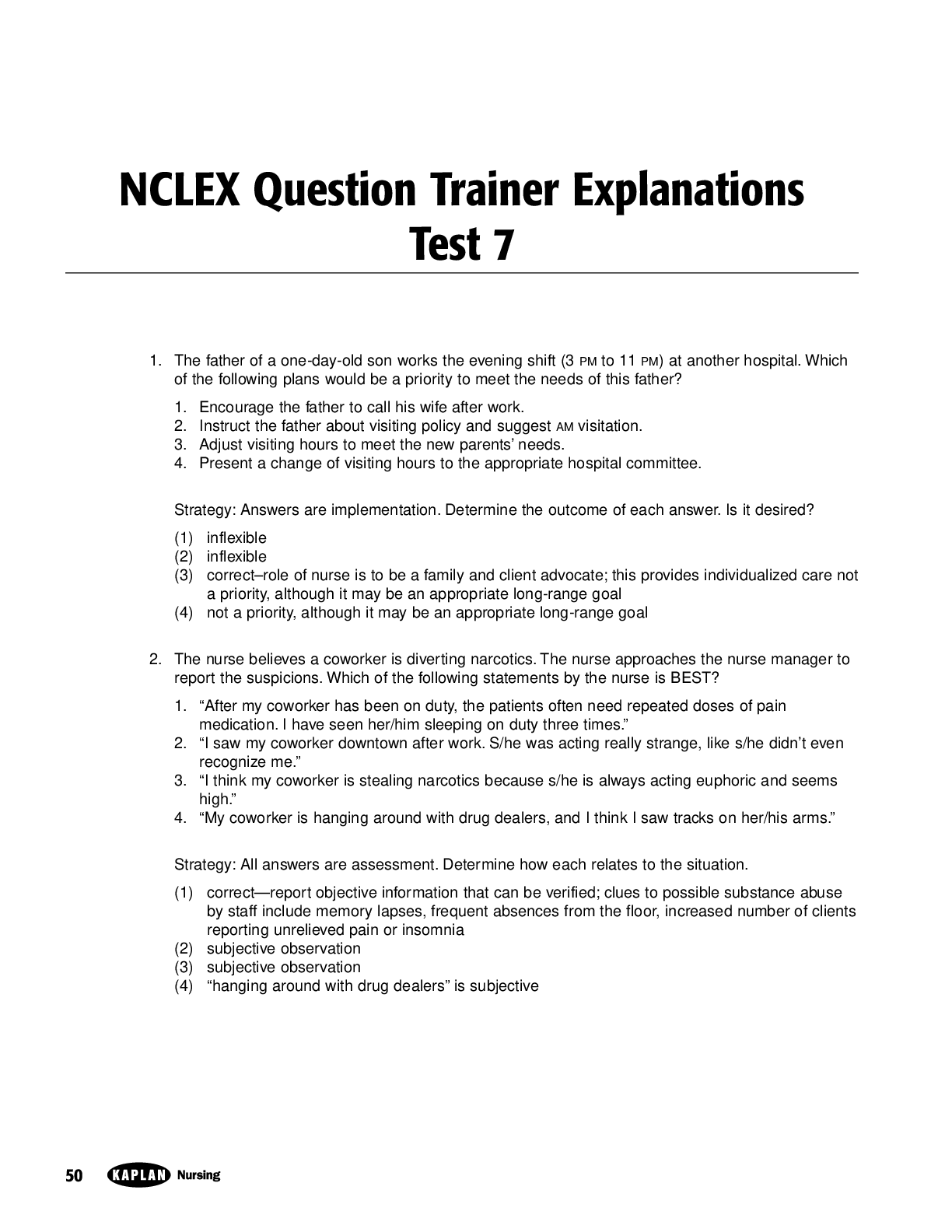
NCLEX Question Trainer Explanations Test 7 | Med Surg 2210 NCLEX TEST 7 WITH EXPLANATIONS
260+ Questions and answers
The father of a one-day-old son works the evening shift (3 PM to 11 PM) at another hospital. Which
of the following plans would be a priority to meet the needs of this father?
1. Encourage the father to call his wife after work.
2. Instruct the father about visiting policy and suggest AM visitation.
3. Adjust visiting hours to meet the new parents’ needs.
4. Present a change of visiting hours to the appropriate hospital committee.
Strategy: Answers are implementation. Determine the outcome of each answer. Is it desired?
(1) inflexible
(2) inflexible
(3) correct–role of nurse is to be a family and client advocate; this provides individualized care not
a priority, although it may be an appropriate long-range goal
(4) not a priority, although it may be an appropriate long-range goal
2. The nurse believes a coworker is diverting narcotics. The nurse approaches the nurse manager to
report the suspicions. Which of the following statements by the nurse is BEST?
1. “After my coworker has been on duty, the patients often need repeated doses of pain
medication. I have seen her/him sleeping on duty three times.”
2. “I saw my coworker downtown after work. S/he was acting really strange, like s/he didn’t even
recognize me.”
3. “I think my coworker is stealing narcotics because s/he is always acting euphoric and seems
high.”
4. “My coworker is hanging around with drug dealers, and I think I saw tracks on her/his arms.”
Strategy: All answers are assessment. Determine how each relates to the situation.
(1) correct—report objective information that can be verified; clues to possible substance abuse
by staff include memory lapses, frequent absences from the floor, increased number of clients
reporting unrelieved pain or insomnia
(2) subjective observation
(3) subjective observation
(4) “hanging around with drug dealers” is subjective
NCLEX Question Trainer Explanations
Test 7
503. A woman with chronic obstructive pulmonary disease (COPD) is admitted with an acute
exacerbation. Her vital signs are: BP 162/100, pulse 78, respirations 30 and labored with
wheezing. The nurse should question which of the following orders?
1. Theophylline (Somophyllin) 0.7 mg/kg/hr IV.
2. Tetracycline hydrochloride (Sumycin) 250 mg IM qd.
3. Ipratropium bromide (Atrovent) inhaler 2 inhalations qid.
4. Propranolol hydrochloride (Inderal) 40 mg PO bid.
Strategy: You are looking for an incorrect medication. Think about the action of each drug.
(1) drug of choice for acute asthma
(2) broad spectrum antibiotic, not contraindicated
(3) blocks parasympathetic stimulation and decreases mucus; used with asthma
(4) correct—beta-blocker that blocks beta adrenergic impulses to the bronchial tree that cause
bronchodilation resulting in increased bronchoconstriction
4. A husband and wife meet at the mental health clinic to make an appointment for family therapy.
Suddenly, the wife begins to sob loudly. As the nurse approaches, the husband says, “I guess we
just don’t get along.” Which of the following responses by the nurse is MOST appropriate?
1. “Your wife seems to be upset by the situation.”
2. “Perhaps you should both go home now.”
3. “Try to think about what precipitated her crying.”
4. “The situation is difficult for both of you.”
Strategy: Remember therapeutic communication.
(1) nontherapeutic; emphasis is placed on wife, not the situation
(2) nontherapeutic; closes off communication
(3) nontherapeutic; appears to blame the husband for precipitating the wife’s behavior, would
cause him to react defensively
(4) correct—therapeutic; avoids blaming, focuses on feelings of both husband and wife
5. A client on chemotherapy has a WBC count of 1,200/mm3. Which of the following nursing actions
should the nurse take FIRST?
1. Check temperature q4h.
2. Monitor urine output.
3. Assess for bleeding gums.
4. Obtain an order for blood cultures.
Strategy: Determine how each assessment relates to a low white count.
(1) correct—important to monitor for infection which would be evidenced by an elevated
temperature in a client with a low WBC
(2) important because of problems of increased uric acid excretion from chemotherapeutic drugs
but should not be done first
(3) would be associated with a low platelet count
(4) would be done if the temperature were elevated to determine the type of organism involved
NCLEX Question Trainer
516. A woman is in active labor with her first child when her membranes rupture. She voices a concern
to the nurse that she is afraid of having a “dry labor.” Which of the following responses by the
nurse would be MOST appropriate?
1. “The amniotic fluid provides only minimal lubrication for the labor process.”
2. “The amniotic sac may impede the progress of labor and is often ruptured artificially.”
3. “Labor is only slightly more difficult with early rupture of the amniotic sac.”
4. “Because there is limited amniotic fluid, additional fluids will be supplied.”
Strategy: “MOST” indicates there may be more than one answer that you like.
(1) amniotic fluid cushions fetus, allows freedom of movement for musculoskeletal development,
facilitates symmetrical growth, maintains constant body temperature, is a source of oral fluids,
and collects wastes
(2) correct—sometimes done to assist or induce labor
(3) does not make labor more difficult
(4) no additional fluids will be supplied
7. The nurse is performing an ice massage for a client in chronic pain. The nurse is MOST concerned
if which of the following is observed?
1. Redness or inflammation of the tissue.
2. Mottling or graying of the tissue.
3. The client states that she feels a burning and tingling sensation in the area.
4. The client state that she feels a numbness and a cold sensation in the area.
Strategy: “MOST concerned” indicates a complication.
(1) indicates inflammation
(2) correct—site should be observed every five minutes for signs of tissue intolerance, including
blanching, mottling, or graying
(3) usually indicates ischemia or sensorineural impairment
(4) expected outcome of numbness, which would lead to decreased pain perception
8. The nurse is caring for a client with a complete heart block. The nurse should question which of
the following orders?
1. Administer lidocaine (Xylocaine) 50 mg IV push for PVCs in excess of six per minute.
2. Administer atropine sulfate (Atropine) 0.05 mg IV for symptomatic bradycardia.
3. Anticipate scheduling the client for a temporary pacemaker if the pulse continues to decrease.
4. Mix 10 cc of 1:5,000 solution of isoproterenol (Isuprel) in 500 cc D5W for sustained
bradycardia below 30.
Strategy: All answers are implementation. Determine the outcome of each answer. Is it desired?
(1) correct—in complete heart block, the AV node blocks all impulses from the SA node so the
atria and ventricles beat independently; because lidocaine suppresses ventricular irritability, it
may diminish the existing ventricular response; cardiac depressants are contraindicated in the
presence of complete heart block
(2) appropriate treatment
(3) appropriate treatment
(4) appropriate treatment
Preparation for the Nursing Licensure Examination
529. The nurse is caring for a client who had a cholecystectomy. Which of the following observations is
MOST important for the nurse to report to the next shift?
1. Resting after receiving IM pain medication.
2. No bowel sounds present.
3. IV infusing at 100 cc/h.
4. Breath sounds decreased in both lower lobes.
Strategy: Priority question. Remember Maslow and the ABCs.
(1) psychosocial; not a priority
(2) physical; expected finding after surgery due to decrease in peristalsis from anesthetic agents
(3) physical; not a priority
(4) correct—physical; incision for a cholecystectomy is high on the abdominal wall, which
inhibits ventilatory movement; decreased breath sounds might indicate a complication of
pneumonia
10. The nurse in the outpatient clinic plans care for a 65-year-old woman with left-sided weakness
due to a cerebral vascular accident (CVA). The client has a history of hypertension and
osteoporosis. It is MOST important for the nurse to encourage the client to
1. increase the amount of calcium in her daily diet.
2. increase the amount of vitamin D in her daily diet.
3. increase the amount of time she is exposed to sunlight.
4. increase her activities that involve weight-bearing.
Strategy: All answers are implementation. Determine the outcome of each answer. Is it desired?
(1) diet should have adequate calcium, should increase intake in middle age to protect against
skeletal demineralization; not most important
(2) adequate serum levels of vitamin D needed for calcium to be absorbed from GI tract, should
increase intake in middle age to protect against skeletal demineralization; not most important
(3) vitamin D is synthesized in the skin with exposure to sunshine; not most important for this
patient
(4) correct—weight bearing and exercise primary ways to develop high-density bones, decrease
bone reabsorption and stimulate bone formation; would also help maintain mobility with leftsided weakness
NCLEX Question Trainer
5311. The homecare nurse is visiting a young adult with a diagnosis of hepatitis A. Which of the
following statements, if made by the client to the nurse, indicates that further teaching is needed?
1. “I have been very careful to wash my hands after I go to the bathroom.”
2. “I have had to take Tylenol several times this week for this sinus infection I have.”
3. “I have been very careful not to handle my child’s toys or eating utensils.”
4. “My husband has been preparing all of the meals since I’ve been sick.”
Strategy: “Further teaching is needed” indicates you are looking for an incorrect response.
(1) because hepatitis A is spread by the oral-rectal route, it is important to protect others by
practicing good hand-washing techniques and avoiding contact with items that will be placed
in others’ mouths
(2) correct—client should be cautioned about taking any drugs not approved by the health care
provider; may become dangerous because of the liver’s inability to detoxify and excrete them
(3) because hepatitis A is spread by the oral-rectal route, it is important to protect others by
practicing good hand-washing techniques and avoiding contact with items that will be placed
in others’ mouths
(4) because hepatitis A is spread by the oral-rectal route, it is important to protect others by
practicing good hand-washing techniques and avoiding contact with items that will be placed
in others’ mouths
12. The nurse is caring for a client in a manic phase of bipolar affective disorder. It is MOST
important for the nurse to offer which of the following meals?
1. Tuna salad sandwich and orange slices.
2. Bologna sandwich and french fries
3. Milkshake and banana.
4. Fried chicken and tossed salad.
Strategy: All answers are implementations. Determine the outcome of each answer. Is it desired
(1) correct—manic clients need nutritious finger foods; foods contain protein, carbohydrates,
vitamin C, and fiber
(2) finger foods, but little nutritive value
(3) finger foods, not as balanced
(4) too difficult to eat in manic phase
13. Which of the following actions should the nurse instruct the client to complete FIRST to establish
a normal urinary pattern?
1. Urinate every two hours.
2. Record each time you urinate.
3. Keep a record of your daily fluid intake.
4. Stay near a bathroom.
Strategy: Answers are all implementations. Determine the outcome of each answer. Is it desired?
(1) client should start voiding every 2 h and gradually progress to 3–4 h
(2) second thing to do
(3) correct—client needs to know how much and when he ingests fluid
(4) appropriate, but not the first thing to do
Preparation for the Nursing Licensure Examination
5414. The nurse is receiving reports about four pregnant women in active labor who have been admitted
to the labor and delivery unit. Which of the following women should the nurse see FIRST?
1. A 27-year-old nullipara at 38-weeks gestation, has a cervical dilatation of 2 cm, fetus in
transverse lie with baseline FHT of 155 bpm.
2. A 32-year-old multipara at term, cervical dilatation of 8 cm, fetus in a vertex presentation with
the presenting part at +2 station.
3. A 22-year-old nullipara at term, cervical dilatation of 10 cm, 100% effaced, fetus presenting as
left occiput posterior with short-term variability of the FHT at 3–5 beats.
4. A 34-year-old multipara at 37-weeks gestation, has intact amniotic membranes, cervical
dilatation of 3 cm, and fetus in a frank breech presentation with the presenting part at 0
station.
Strategy: Determine who is the least stable client.
(1) delivery is not imminent
(2) correct—transition phase of labor and delivery quick for many multipara woman
(3) nullipara women usually have a longer second stage than multipara women
(4) labor has not progressed very far
15. The nurse is planning care for a client who had surgery for an ileal conduit two days ago. It is
MOST important for the nurse to take which of the following actions?
1. Remove the appliance regularly and clean the skin with antiseptic solution.
2. Apply a close-fitting drainage bag to the stoma.
3. Massage the skin around the stoma with an emollient.
4. Expose the area around the stoma to air twice a day.
Strategy: Answers are implementations. Determine the outcome of each answer. Is it desired?
(1) soap and water should be used to clean the skin, not an antiseptic solution
(2) correct—primary preventative measure to prevent urine from contacting the skin
(3) would hinder the application of the bag for urine collection
(4) unnecessary; would not help prevent skin breakdown
16. Which nursing action is MOST appropriate after intubating a postoperative client who had a
respiratory arrest?
1. Soak the intubation equipment in concentrated Betadine solution.
2. Place the intubation blade in a bag and arrange for gas sterilization.
3. Soak the intubation blade in Cidex solution.
4. Wash the equipment with soap and water and allow to air-dry.
Strategy: All answers are implementations. Determine the outcome of each answer. Is it desired?
(1) inappropriate action
(2) correct—sterilization of equipment after exposure to body fluids of a client is protocol
(3) inappropriate action
(4) inappropriate action
NCLEX Question Trainer
5517. The nurse is caring for a toddler in traction, and the toddler is receiving chloral hydrate (Noctec).
The toddler becomes irritable and extremely restless. Which nursing action is MOST appropriate?
1. Give the next dose of chloral hydrate early.
2. Contact the physician to obtain new orders.
3. Instruct the toddler’s mother to read to him.
4. Take the toddler out of traction for 30 minutes.
Strategy: All answers are implementations. Determine the outcome of each answer. Is it desired?
(1) would probably increase the restlessness and worsen the condition by giving the toddler
more medication
(2) correct—chloral hydrate, a sedative, can have the opposite effect on a toddler, causing
excitability
(3) restless due to chloral hydrate
(4) toddler should remain in traction
18. The nurse performs diet teaching for a client with a spinal cord injury at S-3. Which of the
following meals, if chosen by the client, would indicate to the nurse that teaching has been
effective?
1. Cheeseburger with tomato and onion.
2. Spaghetti with meat sauce and green beans.
3. Tuna fish sandwich with orange juice.
4. Grilled cheese sandwich and chocolate pudding.
Strategy: Type of diet needed by the client is unstated. Determine what type of diet is required
and select the appropriate menu.
(1) should have high-fiber, low-fat diet; this diet is high in fat
(2) correct—high-fiber diet is an important part of bowel program; fiber helps prevent the
complication of constipation; includes whole-grain foods, bran, fresh and dried fruits;
increased fiber will facilitate defecation, especially with reduction in fat intake
(3) should increase intake of fiber foods and decrease intake of fat
(4) should have high-fiber, low-fat diet; this is a high-fat diet
19. The nurse is screening an eight-month-old girl in a well-baby clinic. The nurse would be MOST
concerned if the infant’s mother made which of the following statements?
1. “My daughter has almost doubled her birth weight.”
2. “When I walk in the room my child smiles at me.”
3. ”When she is around her grandpa, my child cries.”
4. “My daughter can’t quite say Mama yet.”
Strategy: “MOST concerned” indicates you are looking for something wrong.
(1) correct—weight should double by 5 months
(2) begins to recognize parents at 6 months
(3) begins to fear strangers at 6 months, increases until 9 months
(4) begins to say “dada” and “mama” with meaning at 10 months
Preparation for the Nursing Licensure Examination
5620. A 16-year-old young woman is brought by her parents to the outpatient clinic for treatment of
pelvic inflammatory disease (PID). While the nurse obtains a history, the client says bitterly, “My
parents are mean and don’t really care about me.” Which of the following responses by the nurse
is BEST?
1. “You feel your parents don’t care about you?”
2. “Your parents brought you to the clinic, didn’t they?”
3. “I am sure that your parents have your best interests at heart.”
4. “Did you have a disagreement with your parents?”
Strategy: Remember the principles of therapeutic communication.
(1) correct—uses therapeutic technique of reflecting; validates feelings without placing value
judgment or giving approval or disapproval
(2) negates client’s feelings, blocks communication
(3) negates client’s feelings, blocks communication
(4) yes/no question
21. A 55-year-old woman with end-stage metastatic cancer of the breast is admitted to the hospital. It
is MOST important for the nurse to
1. suction the patient frequently.
2. provide an air mattress.
3. turn the patient every two hours.
4. give the patient frequent baths.
Strategy: All answers are implementations. Determine the outcome of each answer. Is it desired?
(1) decreases oxygen levels, is uncomfortable and unnecessary
(2) equipment is not most important
(3) correct—prevents complications such as skin breakdown
(4) will dry out her skin and cause chilling
22. One hour after receiving 7 U of regular insulin, the client presents with diaphoresis, pallor, and
tachycardia. The priority nursing action would be to
1. notify the physician.
2. call the lab for a blood glucose level.
3. offer the client milk and crackers.
4. administer glucagon.
Strategy: Answers are a mix of assessments and implementations. Does this situation require
validation? No. Determine the outcome of each implementation.
(1) action should be taken prior to notifying the physician
(2) does not require validation, implementation required
(3) correct—onset of action for regular insulin is 30–60 minutes; assessment indicates a
problem with hypoglycemia; foods such as milk and crackers should be given if blood sugar
is around 40–60 mg/dL; if orange juice or simple sugar is given, it should be followed with a
meal or with protein intake
(4) unnecessary, unless client is unresponsive
-
-
-
-
-
-
-
-
-
-
-
-
-
-
-
-
-
-
-
-
-
-
-
-
-
--
-
-
-
258. The nurse is supervising a nurse’s aide transfer of a 58-year-old woman from the bed to the
chair after a right total hip replacement. The nurse should intervene if which of the following was
observed?
1. The nurse’s aide helps the woman to a sitting position.
2. The nurse’s aide positions the chair at a 90° angle to the bed.
3. The nurse’s aide stands on the same side of the bed as the patient’s unaffected side.
4. The nurse’s aide pivots the patient on the unaffected leg.
Strategy: “Nurse should intervene” indicates an incorrect action.
(1) helps prevent orthostatic hypotension and dizziness
(2) right way to place chair
(3) correct—should stand on affected side
(4) right way to move patients
259. A client is scheduled for a myelogram because of complaints of severe lumbar pain. Which of
the following nursing interventions would be MOST important for this procedure?
1. Inform the client about being NPO prior to the test.
2. Encourage ambulation after the test.
3. Encourage fluids prior to and after the test.
4. Instruct the client to remain prone for 24 hours.
Strategy: All answers are implementations. Determine the outcome of each answer choice. Is it
desired?
(1) will be NPO for 4 to 6 hours, but not most important
(2) bedrest may be maintained for as long as 24 hours
(3) correct—fluids promote excretion of the dye and also facilitate formation of spinal fluid
(4) should have the head elevated at 30° for 24 hours
Preparation for the Nursing Licensure Examination
140260. The nurse in a small town is called to a neighbor’s house in the middle of a blizzard. The
neighbor woman states she is in the 39th week of gestation with her second baby and has been
having contractions for several hours. The woman has been unable to obtain assistance
because the roads are impassable. The nurse assists with the delivery of the infant. Once the
head is delivered, it is MOST important for the nurse to
1. instruct the woman to bear down and push.
2. turn the infant’s head in a clockwise direction.
3. check the infant’s neck for the umbilical cord.
4. ask the woman to pant through her mouth.
Strategy: Answers are a mix of assessments and implementations. Does this situation require
assessment? Yes. Is there an appropriate assessment? Yes.
(1) implementation; should bear down with contractions, but not most important
(2) implementation; head will rotate without assistance to right or left, should not be turned
(3) correct—assessment; infant could become anoxic if cord is around neck
(4) implementation; should bear down with contractions
261. The nurse is caring for a client with a bleeding duodenal ulcer. The nurse would be MOST
concerned if the patient reported taking which of the following medications?
1. Ranitidine hydrochloride (Zantac) 150 mg PO.
2. Metoclopramide hydrochloride (Reglan) 15 mg PO.
3. Sucralfate (Carafate) 1 gm PO.
4. Famotidine (Pepcid) 20 mg PO.
Strategy: Think about the action of each medication.
(1) inhibits action of histamine at receptor site of parietal cells decreasing gastric acid
secretion, used for short-term treatment of duodenal and gastric ulcers
(2) correct—stimulates motility of upper GI tract, contraindicated with possible hemorrhage of
GI tract, used to treat nausea of chemotherapy
(3) adheres to and protects ulcer surface by forming a barrier, used for short-term treatment of
duodenal ulcer
(4) inhibits action of histamine at receptor site of parietal cells decreasing gastric acid
secretion; used for treatment of duodenal ulcer
NCLEX Question Trainer
141262. During the discharge planning session for a chronically ill infant, the nurse observes that the
single mother nervously paces most of the time while bouncing the infant in her arms. Which of
the following suggestions by the nurse is BEST?
1. “See your obstetrician for a prescription for a mild tranquilizer.”
2. “Buy a commercially made ‘baby bouncer’ infant seat.”
3. “Enroll in a Volunteers of America parenting class.”
4. “Investigate hiring a live-in nanny.”
Strategy: Answers are implementations. Determine the outcome of each answer choice. Is it
desired?
(1) may help the mom cope temporarily, it is not the most beneficial action in the overall scope
of the problem
(2) inappropriate to the situation
(3) correct—excellent suggestion to make to any parent, but especially under these
circumstances; will help both mother and baby
(4) parenting avoidance
263. The nurse is caring for clients on the postpartum unit. A client receiving heparin for the
treatment of deep vein thrombosis (DVT) says to the nurse, “I am so upset that I can’t
breastfeed my infant.” Which of the following statements, is made by the nurse, is BEST?
1. “You will be able to breastfeed your baby.”
2. “Why do you think that it will be a problem?”
3. “We will check your baby’s clotting times.”
4. “We will give the baby protamine sulfate.”
Strategy: Determine the outcome of each answer choice.
(1) correct—heparin not transmitted in breast milk; breastfeeding considered safe
(2) yes/no question, nontherapeutic
(3) heparin not transmitted to infant, only concerned about the mother’s PTT
(4) is the antidote for heparin, not required
264. A client is experiencing a severe panic attack and has threatened to hurt another client on the
unit. The nurse would expect to administer which of the following PRN medications as ordered?
1. Chlorpromazine (Thorazine).
2. Lithium carbonate (Lithane).
3. Haloperidol (Haldol).
4. Phenytoin (Dilantin).
Strategy: Think about the action of each medication.
(1) more likely to be used PRN when a client is experiencing agitation associated with
schizophrenia
(2) an antimanic drug
(3) correct—Haldol is particularly effective in reducing assaultive behavior associated with
severe anxiety
(4) an anticonvulsant medication
Preparation for the Nursing Licensure Examination
142265. The nurse is caring for clients in the outpatient clinic. The nurse returns to the desk and is given
four phone messages. Which of the following phone messages should the nurse return FIRST?
1. A client who has an indwelling Foley catheter and is complaining of foul-smelling urine.
2. A client who had a 9 lb infant 3 days ago and is complaining of painful breasts.
3. A client who had a cataract lens extraction 4 days ago and has not had a bowel movement
in 3 days.
4. A client states that he had abdominal cramping and diarrhea after eating a large meal.
Strategy: Determine the least stable client.
(1) possible urinary tract infection (UTI) due to catheter; should force fluids, drink cranberry
juice, antibiotics may be prescribed
(2) should encourage breastfeeding, not a priority
(3) correct—straining at stool increases intraocular pressure and should be avoided
(4) requires further investigation, not a priority
[Show More]