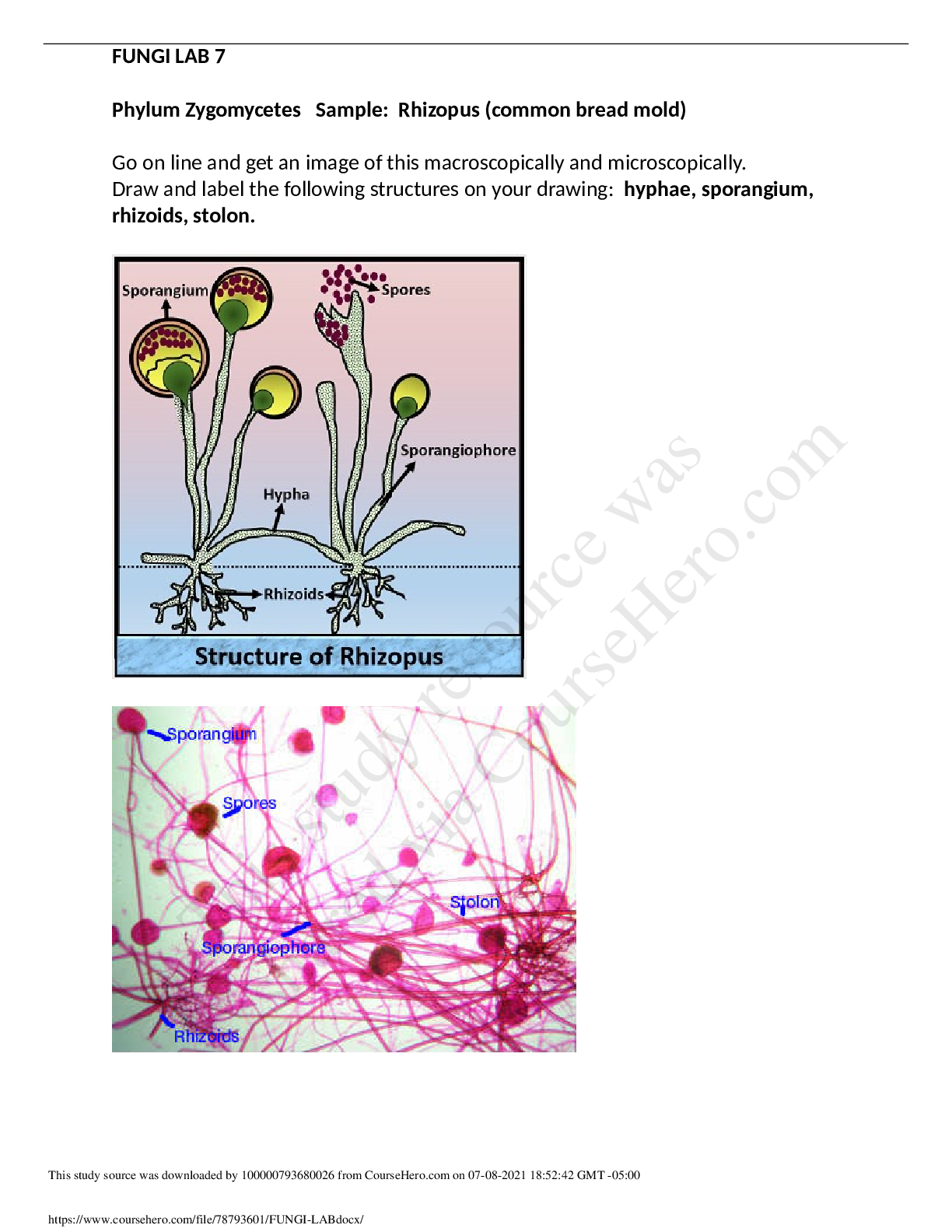
1. Are there many or only a few spores within a single sporangia?
There are many
2. What do these spores form when they “germinate”?
Upon germination, the zygospore produce colonies that are genetically different
fro
...
1. Are there many or only a few spores within a single sporangia?
There are many
2. What do these spores form when they “germinate”?
Upon germination, the zygospore produce colonies that are genetically different
from either parent.
3. What is the function of the hyphae?
Hyphae perform a variety of functions in fungi. They contain the cytoplasm or cell
sap, including the nuclei containing genetic material. Hyphae absorb nutrients
from the environment and transport them to other parts of the thallus.
4. What is the function of the rhizoids?
Rhizoids are root-like structure that helps in absorption of water and minerals.
They also help to anchor the plant to the ground. They are found in bryophytes
and algae.
5. What is the function of the sporangium?
SPORANGIA are responsible for making and storing spores. It also helps to
germinate and form new organisms.
6. Does this species reproduce sexually or asexually? Explain.
Rhizopus reproduce by forming asexual and sexual spores. In asexual reprouction,
sporangiospores are produced inside a spherical structure, the sporangium.
IN SEXUAL REPRODUCTION, a dark zygospore is produced at the point where two
mycelia fuse.
Phylum Ascomycetes
The sac fungi or Ascomycetes, produce spores in a sac called the ascus which
develops as a result of sexual reproduction. Asexual reproduction takes place by
means producing asexual spores called conidia. This group contains some highly
valuable species including morels, truffles, cup fungi, and some unicellular fungi
called yeast. And of course there are also some deadly plant and animal parasites
[Show More]