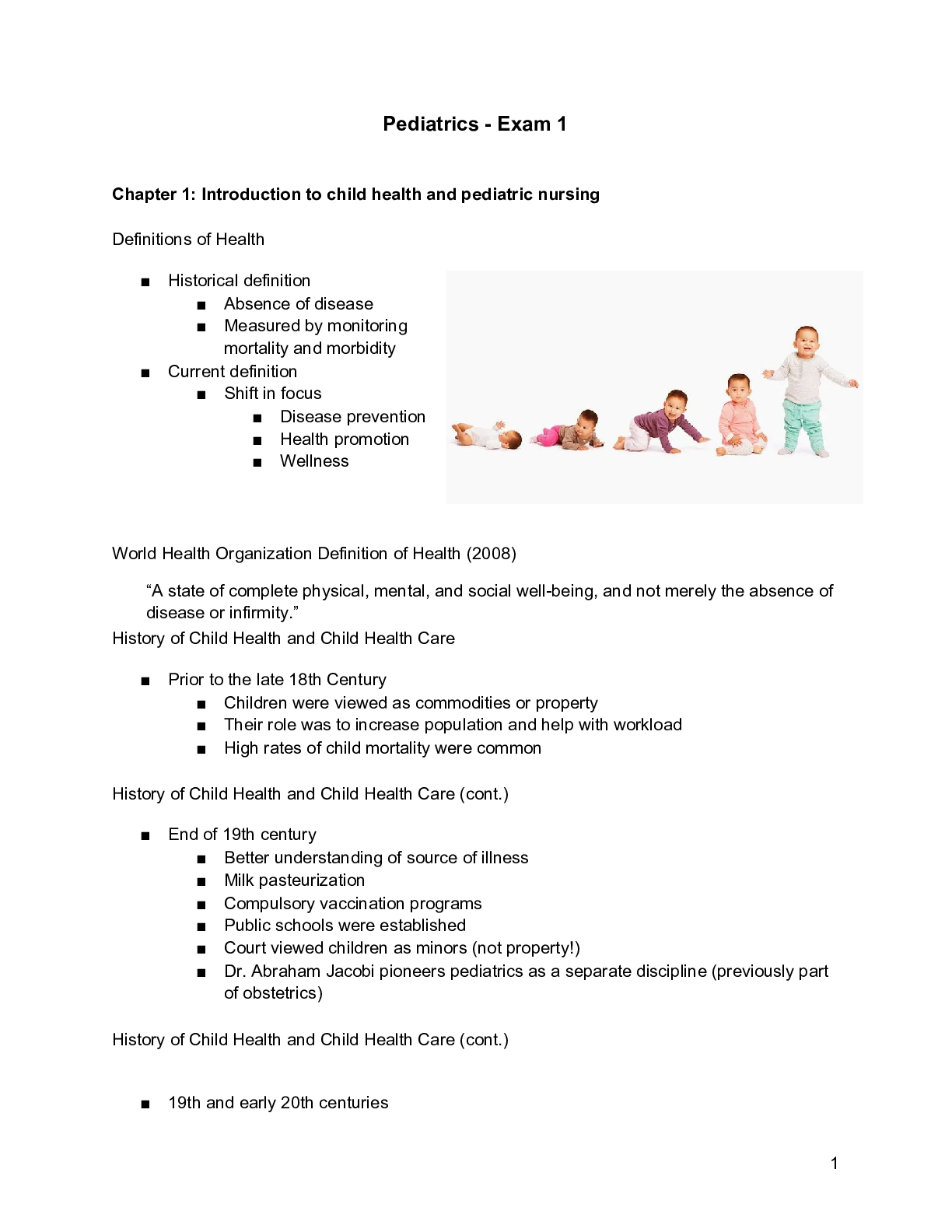
Chapter 1: Introduction to child health and pediatric nursing
Definitions of Health
■ Historical definition
■ Absence of disease
■ Measured by monitoring
mortality and morbidity
■ Current definition
■ Shift in foc
...
Chapter 1: Introduction to child health and pediatric nursing
Definitions of Health
■ Historical definition
■ Absence of disease
■ Measured by monitoring
mortality and morbidity
■ Current definition
■ Shift in focus
■ Disease prevention
■ Health promotion
■ Wellness
World Health Organization Definition of Health (2008)
“A state of complete physical, mental, and social well-being, and not merely the absence of
disease or infirmity.”
History of Child Health and Child Health Care
■ Prior to the late 18th Century
■ Children were viewed as commodities or property
■ Their role was to increase population and help with workload
■ High rates of child mortality were common
History of Child Health and Child Health Care (cont.)
■ End of 19th century
■ Better understanding of source of illness
■ Milk pasteurization
■ Compulsory vaccination programs
■ Public schools were established
■ Court viewed children as minors (not property!)
■ Dr. Abraham Jacobi pioneers pediatrics as a separate discipline (previously part
of obstetrics)
History of Child Health and Child Health Care (cont.)
■ 19th and early 20th centuries
1
■ Urban public health improvements (e.g., improved sanitation, treated drinking
water, and hygiene awareness)
■ Growth of public health initiatives
■ Growing knowledge of nutrition, sanitation, bacteriology, pharmacology, and
psychology
History of Child Health and Child Health Care (cont.)
■ End of 20th century
■ New antibiotics and vaccines decrease threats of serious diseases and
subsequent mortality
■ Trends led to increased survival rates
■ Significant increase in chronic versus acute illness as cause of hospitalization
and mortality (e.g., surviving from a previous fatal disease like prematurity may
result in a long-term disability)
■ Biotechnology and genetic research continues to push the medical knowledge
base forward
Focus of National and International Organizations to Protect Child Rights
■ Violence and abuse
■ Child labor and soldiering
■ Juvenile justice
■ Child immigrants and orphaned children
■ Abandoned or homeless children
Key Milestones in Federal Programs in Support of Children’s Health
Evolution of Pediatric Nursing
■ 1870: First pediatric professorship awarded to Abraham Jacobi MD
■ 1900: Henry Street Settlement House established by Lillian Wald RN (first public health
nurse)
■ 1902: Lina Rogers RN appointed as first full-time school nurse (salary paid by the Henry
Street Settlement)
■ 1960s: Pediatric nurse practitioner role developed (first NPs)
■ 1980s: Maternal and child health standards developed by ANA
Measurement of Health Status
■ 1979 U.S. Surgeon General’s Report, Healthy People
■ Provided agenda that identified most significant preventable threats to health
■ Set national objectives and metrics for monitoring progress toward goals
■ Revised every 10 years
■ Healthy People 2020: The Road Ahead
2
■ Comprehensive health promotion and disease prevention agenda working to
improve quantity and quality of life for Americans
Overall Goals of Healthy People 2020
■ Eliminate preventable disease, disability, and injury and premature death
■ Achieve health equity
■ Eliminate disparities and improve the health of all groups
■ Create physical and social environments that promote good health
■ Promote healthy development and behaviors across every stage of life (specific goals for
each stage)
Key Concepts in Health Reporting:
Mortality Versus Morbidity
■ Mortality
■ Number of individuals who
have died over a specific
period (can be overall or
from specific cause)
■ Presented in rates per unit
of population (usually 1,000
or more)
■ Infant mortality often used
as indirect measure of the
general health of a
population
■ Morbidity
■ Measure of prevalence of
disease or degree of disability in a population at a particular time (e.g., days lost
from school due to a particular problem)
■ Presented as a rate per unit of population
Infant and Neonatal Mortality, 1940−2007
Philosophy of Pediatric Nursing
To promote and assist the child in maintaining optimal levels of health by:
3
■ Focusing on the family
■ Providing family centered, culturally competent care
■ Providing atraumatic therapeutic care
■ Minimizing physical and psychological stress for children and their parents
■ Using evidence-based practices
■ Using research findings to establish a plan of care
Characteristics of Pediatric Care
■ Continuous
■ Comprehensive
■ Coordinated
■ Family centered
■ Compassionate
■ Culturally competent
Roles of the Pediatric Nurse
■ Providing direct nursing care to children and their families
■ Promote optimum growth and development of the child through health education
■ Being an advocate, educator, and manager
■ Serving as a collaborator, care coordinator, and consultant
Role of the Nurse in Relationship to Morbidity and Mortality in Children
■ Educating families and communities about:
■ Developmentally appropriate child safety and preventative measures
■ Utility of vaccinations in preventing childhood illnesses/morbidity and benefits of
preventative care
■ Symptoms requiring health care visits
■ Goal
■ Raise awareness of and provide guidance and counseling to prevent
unnecessary deaths/illnesses in children
Pediatric Nursing: Scope and Standards of Nursing Practice
■ Defines guiding principals in pediatric nursing practice
■ Position statement about standards of practice and professional performance of pediatric
nurses
■ Jointly adopted upon by National Association of Pediatric Nurse Practitioners (NAPNAP),
Society of Pediatric Nurses, American Nurse’s Association (ANA) Scope and Standards
of Pediatric Practice
4
■ Assessment
■ Nursing diagnosis
■ Planning and expected outcomes
■ Implementation
■ Evaluation
■ Quality of practice
■ Professional practice evaluation
■ Education
■ Collegiality and collaboration
■ Ethics, research, evidenced-based practice, and clinical scholarship
■ Resource utilization, advocacy, leadership
■ Autonomy—freedom to choose and make decisions
■ Beneficence—actions that will benefit others
■ Nonmaleficence—avoiding causing harm (intentionally or unintentionally)
■ Justice—acting fairly to all
■ Veracity—telling the truth
■ Fidelity—keeping promises, maintaining confidentiality
Balancing Ethical Components for Families of Different Cultures and Religions
■ Identify the problem within the family’s cultural context
■ Gather information about the problem and the culture
■ Weigh risks against benefits;;;;;;;;;;;;;;
■ Choose solution based upon culturally competent car
[Show More]