HESI FUNDAMENTAL: Questions and Answers with Explanations.
The nurse is providing post-procedure care for a client that had a liver biopsy. To prevent hemorrhage, it is the nurse's highest priority to place the cl
...
HESI FUNDAMENTAL: Questions and Answers with Explanations.
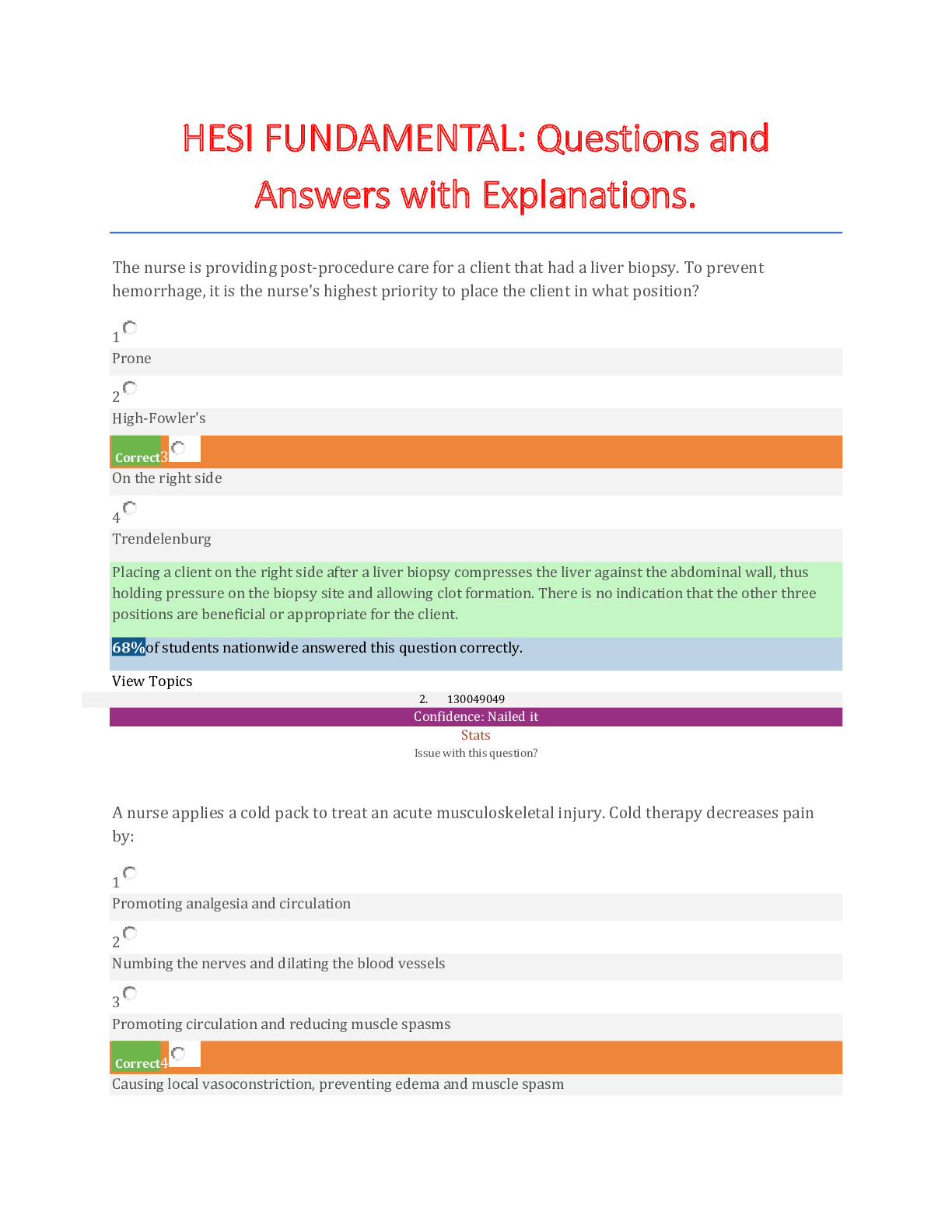
The nurse is providing post-procedure care for a client that had a liver biopsy. To prevent hemorrhage, it is the nurse's highest priority to place the client in what position?
1
Prone
2
High-Fowler's
On the right side
4
Trendelenburg
68%of students nationwide answered this question correctly.
View Topics
2. 130049049
Confidence: Nailed it
Stats
Issue with this question?
2.
A nurse applies a cold pack to treat an acute musculoskeletal injury. Cold therapy decreases pain by:
1
Promoting analgesia and circulation
2
Numbing the nerves and dilating the blood vessels
3
Promoting circulation and reducing muscle spasms
Causing local vasoconstriction, preventing edema and muscle spasm
The nurse understands that the action of an antidiuretic hormone (ADH) is to:
1
Reduce blood volume.
Decrease water loss in urine.
3
Increase urine output.
4
Initiate the thirst mechanism.
A client with rheumatoid arthritis does not want the prescribed cortisone and informs the nurse. Later, the nurse attempts to administer cortisone. When the client asks what the medication is, the nurse gives an evasive answer. The client takes the medication and later discovers that it was cortisone. The client states an intent to sue. What factors in this situation must be considered in a legal action? (Select all that apply.)
Clients have a right to refuse treatment.
Nurses are required to answer clients truthfully.
The health care provider should have been notified.
4
The client had insufficient knowledge to make such a decision.
5
Legally prescribed medications are administered despite a client's objections.
5.
The nurse is caring for a client who is receiving therapy for vitamin B12 deficiency. Which finding indicates that the therapy is having the desired effect?
1
Normal serum electrolyte levels
2
Healthy skin integrity
3
Resolution of peripheral edema
Improved hemoglobin and hematocrit levels
A client is admitted to the hospital and benazepril hydrochloride (Lotensin) is prescribed for hypertension. Which is an appropriate nursing action for clients taking this medication?
1
Monitor the EEG.
Assess for dizziness.
3
Administer the drug after meals.
4
Assess for dark, tarry stools.
8.
The physician orders 7,500 units erythropoietin (Procrit) to be administered subcutaneously weekly. The vial reads 10,000 units per milliliter. How much erythropoietin will the nurse give for each weekly dose? Include a leading zero if applicable. Record your answer using two decimal places. _____ mL
11.
The nurse is caring for a client that is hyperventilating. The nurse recalls that the client is at risk for:
1
Respiratory acidosis
Respiratory alkalosis
3
Respiratory compensation
4
Respiratory decompensation
The nurse is caring for a client who is on a low carbohydrate diet. With this diet, there is decreased glucose available for energy, and fat is metabolized for energy resulting in an increased production of which substance in the urine?
1
Protein
2
Glucose
Ketones
4
Uric acid
A nurse is caring for a client with diarrhea. The nurse anticipates a decrease in which clinical indicator?
1
Pulse rate
Tissue turgor
3
Specific gravity
4
Body temperature
A nurse is providing care to a client eight hours after the client had surgery to correct an upper urinary tract obstruction. Which assessment finding should the nurse report to the charge nurse or surgeon? Incisional pain
2
Absent bowel sounds
Urine output of 20 mL/hour
4
Serosanguineous drainage on the dressing
A nurse assesses a client's serum electrolyte levels in the laboratory report. What electrolyte in intracellular fluid should the nurse consider most important?
1
Sodium
2
Calcium
3
Chloride
Potassium
17.
A client is to receive 2000 mL of intravenous (IV) fluid in 12 hours. At what rate should the nurse set the electronic infusion control device? Record the answer using a whole number. ______ mL/hr
The nurse is preparing discharge instructions for a client who was prescribed enalapril maleate (Vasotec) for treatment of hypertension. Which is appropriate for the nurse to include in the client's teaching?
Do not change positions suddenly.
2
Light-headedness is a common adverse effect that need not be reported.
3
The medication may cause a sore throat for the first few days.
4
Schedule blood tests weekly for the first 2 months.
21.
A nurse is preparing to administer an oil-retention enema and understands that it works primarily by:
1
Stimulating the urge to defecate.
Lubricating the sigmoid colon and rectum.
3
Dissolving the feces.
4
Softening the feces.
When monitoring a client 24 to 48 hours after surgery, the nurse should assess for which problem associated with anesthetic agents?
1
Colitis
2
Stomatitis
Paralytic ileus
4
Gastrocolic reflux
A nurse reviews a medical record of a client with ascites. What does the nurse identify that may be causing the ascites?
1
Portal hypotension
2
Kidney malfunction
Decreased liver function
4
Decreased production of potassium
A client has been admitted with a diagnosis of intractable vomiting and can only tolerate sips of water. The initial blood work shows a sodium level of 122 mEq/L and a potassium level of 3.6 mEq/L. Based on the lab results and symptoms, what is the client experiencing?
1
Hypernatremia
Hyponatremia
3
Hyperkalemia
4
Hypokalemia
A nurse provides teaching for a client who is scheduled for a cholecystectomy. In the initial postoperative period, the nurse explains that the most important part of the treatment plan is:
1
Early ambulation
Coughing and deep breathing
3
Wearing anti-embolic elastic stockings
4
Maintenance of a nasogastric tube
[Show More]