ATI CAPSTONE COMBO ASSESSMENT A&B
1. what is montelukast (singular) for?
2. what does advance directives contain?
3. what is the greatest risk to a pt receiving hemodialysis?
4. what is the clinical manifestation of
...
ATI CAPSTONE COMBO ASSESSMENT A&B
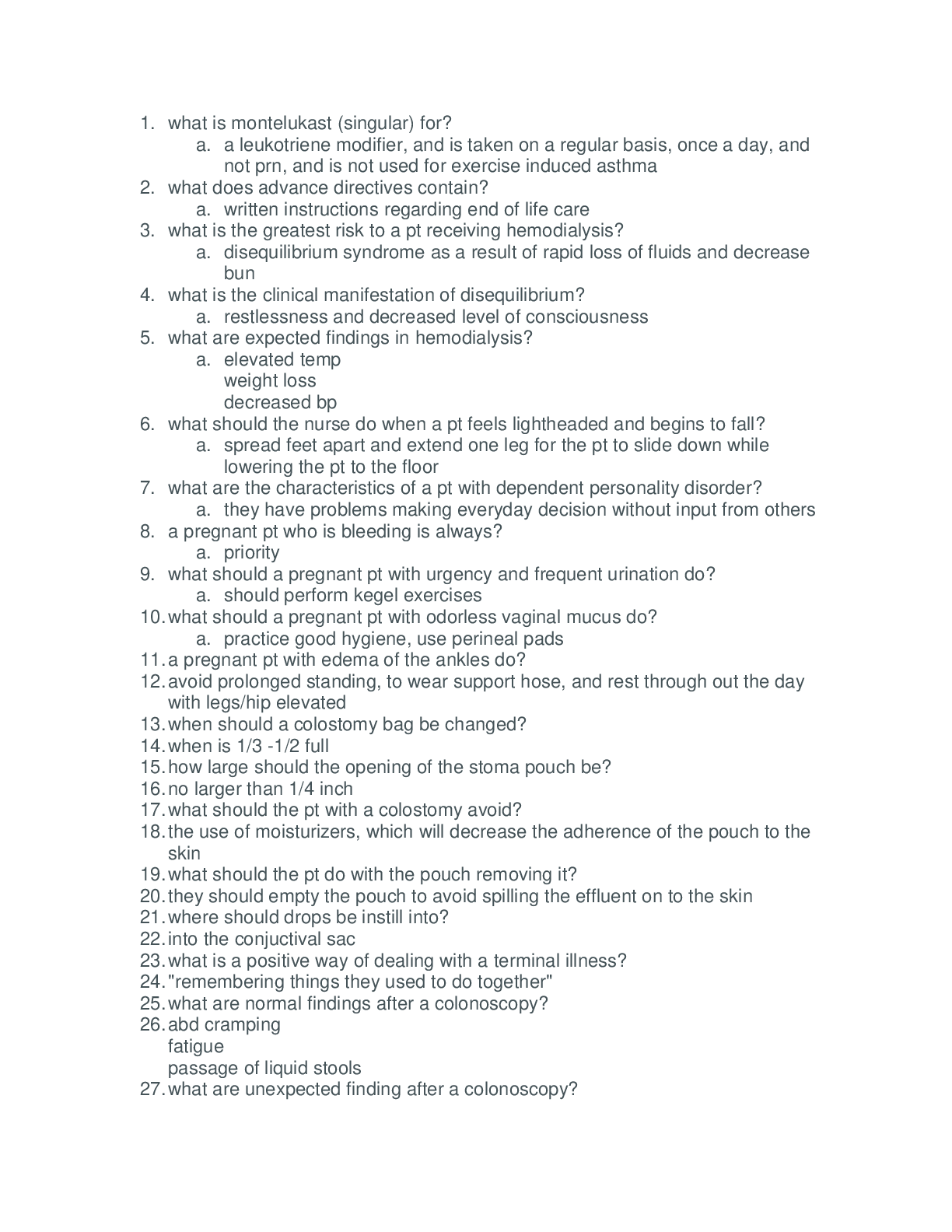
1. what is montelukast (singular) for?
2. what does advance directives contain?
3. what is the greatest risk to a pt receiving hemodialysis?
4. what is the clinical manifestation of disequilibrium?
5. what are expected findings in hemodialysis?
6. what should the nurse do when a pt feels lightheaded and begins to fall?
7. what are the characteristics of a pt with dependent personality disorder?
8. a pregnant pt who is bleeding is always?
9. what should a pregnant pt with urgency and frequent urination do?
10. what should a pregnant pt with odorless vaginal mucus do?
11. a pregnant pt with edema of the ankles do?
12. when should a colostomy bag be changed?
13. how large should the opening of the stoma pouch be?
14. what should the pt with a colostomy avoid?
15. what should the pt do with the pouch removing it?
16. where should drops be instill into?
17. what is a positive way of dealing with a terminal illness?
18. what are normal findings after a colonoscopy?
19. what are unexpected finding after a colonoscopy?
20. what do you do if an order is questioned?
21. what should pt with gastritis eat?
22. what is the cause autonomic dysreflexia?
23. what are s/s of icp?
24. what is late s/s of ICP?
25. when can a child with varicella(chickenpox) return school?
26. what is an appropriate behavior of a pt with hx of violence?
27. what is a skin cancer prevention?
28. what is the first thing you should do with excessive lochial discharge?
29. what is the nurse responsibility of the nurse when witnessing the pts signature on an informed consent?
30. who are at greater risk for std?
31. does trichomonas vaginalis increased the risk for cervical cancer?
32. Gonorrhea can lead to?
33. what should you do with postmortem care?
34. what can you not give to a pt with thickened liquids?
35. what can a pt with thickened liquids have?
36. oatmeal
37. what should a pt do with incentive spirometer?
38. they should elevate the cylinder by inhaling deeply
assume semi fowlers or high fowlers position
39. in order to maintain sterile technique what should the nurse do?
40. should open all sterile packages prior to donning sterile gloves
41. what is psycho-motor learning?
42. have the pt demonstrate back the procedure
43. what places a newborn at risk for respiratory depression?
44. administration of an opioid analgesic
exa: fentanyl (sublimaze)
45. what is an effective method of bowel retraining?
46. anal stimulation with a gloved finger after the evening meal, it will help stimulate the gastrocolic reflex
47. when inserting an NG tube?
48. the nurse should insert the tube into the airway that is patent and has greater airflow
49. what technique should be NG tube insertion?
50. clean technique
51. if NG tube meets resistance?
52. the nurse should rotate the tube without forcing it past the area of resistance
53. what kind of lubricant should be used during NG tube insertion?
54. water- based lubricant NOT petroleum jelly
55. what is pediculosis capitis management?
56. store child's clothing in a separate cubicle at school
boil brushes and combs in water for 10 mins
dry bed lines and clothing in a hot dryer for at least 20 mins
57. what can visual disturbances indicate?
58. preeclampsia
59. what is expected 24 hrs after surgery?
60. hypo active bowel sounds
pain
61. what is an abnormal finding 24 hrs after surgery?
62. low HGB
63. what must be done in bucks traction?
64. the pt must be in proper alignment
boots are secured by 3 straps, around pt leg
weights must hang freely
footplate is resting 15.24 cm (6inches) from the footboard
65. what does pts with delirium demonstrate?
66. a fluctuating LOC often at night or in am
67. pt with dementia demonstrate?
68. difficulty finding correct words to use
69. pt with anxiety disorders demonstrate?
70. obsessive behavior
71. how would the nurse determine progression of ascites?
72. abdominal girth should be measured daily
73. what is a food high in potassium?
74. cantaloupe
75. what is an indication of peripheral venous disease?
76. brown pigmentation around ankles
77. what is indication of peripheral arterial disease?
78. intermittent, leg muscle pain
79. what is some skin care for pts on radiation therapy?
80. pat area when drying
use hand to wash
do not use sunscreen
81. what can hydromorpone cause?
82. urinary retention
83. what does bethanechol (urecholine) causes?
84. it stimulates urinary out put
85. how is nystatin best absorb?
86. if given 1 hour before or after a feeding
87. what is a sign that a newborn has finished eating?
88. a slowed suck/swallow pattern is a sign that the newborn is finished eating
89. what not to do when breastfeeding?
90. is not necessary for the entire areola be in the mouth
each feeding should start at the opposite breast
do not push back of newborns head-toward the nipple
91. what should be included in a stool specimen?
92. visible blood, pus, or mucus
93. what is the first action in an infiltrated IV?
94. to d/c the saline lock
95. what is the first action when preparing to do a dressing change?
96. to determine the pts level of pain
97. what should a with hemonymous hemionopsia with right visual field, what will help pt eat better?
98. the pt should turn head to the right to see all food on tray
99. what are some side effect for theophylline (theo-dur)?
100. is used to prevent wheezing,sob, chest tightness in asthma
irregular pulse and dysrhythmias
seizures
anxiety
urinary frequency
anorexia
n/v
diarrhea
101. what should you do when given enoxaparin (lovenox)?
102. it should be injected SUBQ
do not aspirate
do not massage
do not inject in same area
103. what is the babinski reflex?
104. stroke sole of the foot upward, toward the great toe
105. what is the moro reflex?
106. startle the infant by clapping hands`
107. what is the stepping reflex?
108. hold infant upright and allow one foot to touch tables surface
109. what is the palmer grasp reflex?
110. place an object in the palm of infant hand
111. what should you do when catheterizing a male pt?
112. pt should be place in supine position
penis should be at 90 degree angle
retract the foreskin and clean the glans prior to catherization
113. what color is the meconium?
114. it is the first stool passed and it is dark green and viscous
115. what is an inportant thing to ask when pt having cardiac catherization?
116. if pt allergic to iodine
117. what should be done with nitroglycerin (nitrostat)?
118. if pt continues to have pain after taking 1 tab, they should call 911 and take a second tab
119. what is normal after taking a nitroglycerin (nitrostat) tab?
120. h/a
change positions slowly
it should be kept in original, dark colored bottle to avoid light exposure
121. what to do for restrains use?
122. observe skin condition before applying restrains
use a quick release knot to secure the restraints
belt restrains should be placed over pts waist
able to insert two fingers under restraints
do not use all four side of rails to restrain pt
123. what would indicate an active peristalsis?
124. the presence of vowel sounds
125. what does pt with COPD have?
126. increased metabolism due to work of labored breathing
they have dry mouth/thick mucus
constipation
decreased peristalsis
127. how to use a cane?
128. pt should hold cane on the stronger side of the body
place it forward 6-10 inches and move his weaker leg forward to the cane
distributing his weight between the cane and the stronger leg
then he should move the stronger leg forward beyond the cane and distribute his weight between the cane and weaker leg
129. what does the use of cardiac catherization required?
130. that the pt have normal renal functions for excretion of the dye
131. how should drops be apply?
132. the nurse should apply gently pressure to the inner canthus of the eye for 30-60 seconds
133. what are hyperthyroidism findings?
134. tachycardia
135. what are hypothyroidism findings?
136. cold intolerance
constipation
brittle hair
137. how much should infants grow?
138. 1 inch per month, during the first 6 months
they should be able to double their birth weight between 4-6 months of age
and gain approximately 150-210 (about 5-7oz) per week
139. what should you do when evaluating an infant?
140. the nurse should measure ht/wt separately, and not combine
141. what can reduce the anti hypertensive effect of anti hypertensives?
142. ibuprofen (advil) or any NSAIDS
143. what is the first action when IV pump alarm is beeping?
144. to observe the iv site for infiltration or phlebitis
145. how are normal bowel sounds?
146. high pitched, irregular gurgles that occur every 5-15 seconds, in a rage of 5-30 per/min
147. what is hypoactive?
148. infrequent less than 5/min
149. what is hyperactive?
150. every 3 seconds or greater
151. what is actinic keratosis?
152. a pre-malignant lesion
flat, scaly area with red edges
153. what are cherry angiomas?
154. bright red, raised spots (expected skin changes with aging)
155. what does a change in color mole indicate?
156. indicates skin cancer
157. what happens in passive ROM?
158. the pt does not actively participates
the nurse should support the pts extremities distal and proximal to the joints to facilitate passive ROM
159. what do you do when inserting a urinary catheter, and urine is seen in the tubing?
160. the catheter should be advance another 2.5-5 cm to ensure that the balloon is inflated in the bladder
161. what to do when addressing pt dilemma?
162. determine the facts related to dilema
identify possible solutions
consider clients wishes
163. what should a pt with peripheral vascular disease do?
164. walk until feel pain, rest for 3 min and continue until tired
should sit with legs in a dependent position
165. what are s/s of a detached retina?
166. photopsia= bright flashes of light
167. what are s/s of macular degeneration?
168. loss of peripheral vision
169. what is a normal s/s of aging?
170. presbyopia= difficulty focusing on close objects
171. what should a pt with DM and influenza report?
172. temp higher than 101.5 or greater for 24 hours
173. what should be done with pts with closed head injury?
174. should be log roll
only suction on prn basis
maintain HOB at least 30 degrees
do not use an incentive spirometer ICP might go up
175. what should a pt with cardiac catherization experience?
176. they should drink adequate fluids
may need to cough during test
may experience a feeling of heat "hot flash"
only need bed rest for 4-6 hours
177. what should pt with COPD do?
178. should perform pursed- lip breathing
alternate activities with rest
eat high protein snacks
practice relaxation techniques
179. turp care?
180. monitor pt for fluid volume over load
remind pt that they will feel urge while catheter is in place
calculate urinary out put every 2 hours
measure pain level every 2-3 hours
pt should get up to a chair asap, risk for dvt
181. how to administer ear drops to children under 3 yrs?
182. pull pinna down and back
183. how will ventricular fibrilation look on ekg?
184. irregular rate without P waves, bizarre and variable QRS
185. what are sinus tachycardia look on EKG?
186. regular rate greater than 100/min normal P and QRS waves
187. atrial ventricular (AV) block look on EKG?
188. regular rate between 60-100/min with extended PR intervals
189. premature atrial contractions look on EKG?
190. irregular rate with ectopic atrial beats earlier than expected
191. what are s/s of febrile transfussion reaction?
192. chills
193. what are s/s of circulatory overload transfussion reaction?
194. bounding pulse and hypertension
195. what are s/s of hemolytic transfussion reaction?
196. lower back pain
197. what foods are rich in iron?
198. red meats, liver
199. what to look for in HCTZ (Hydrodiuril)?
200. flunctuation in weight
encourage increase of potassium
should be taken with food or right after a meal
201. what are s/s of anaphalictic reactions?
202. increased respiratory effort
hypotension
bronchoconstriction (laryngeal stridor)
203. what does benzodiazepines (lorazepam/ativan) causes?
204. lethargic and somnolent
205. what are pt with preclampsia at risk for?
206. seizures
207. how should the formula be to prevent gastric cramping in an enteral feeding?
208. administer the formula at room temp
209. what is a s/s of bulemia nervosa?
210. hemoptysis
211. what is a s/s of anorexia nervosa?
212. amenorrhea
acrocynosis
213. what are interventions for a salem sump tube?
214. the most common ng tube it is a double lumen (two-channeled) it irrigates the stomach and removes fluid and gas from stomach.
-pt should be reposition every 2 hours to promote emptiying of stomach content
-set suction 80-100
-never clamp air vent
pt should be NPO
215. what might cause dry skin in older adults?
216. a decrease in elasticity of the skin which is an expected change associated with aging
217. what is a bronchoscope?
218. a tube that allows the doctor to see in the lungs and airways and remove objects
219. what are nursing interventions for pts with dementias?
220. should encourage verbal praise
do not exceed 20 mins in tub
may not be able to follow direction
they should not disrobe until right before entering the bath to prevent chilling
221. what to do with ankle sprain?
222. check for pedal edema
wrap with a compression dressing
apply ice
elevate
223. what promotes venous return?
224. using sequential compression device
225. what is an expected PR interval?
226. should be 0.12 to 0.20 seconds
it should be one P wave prior to each QRS complex
an expected QRS duration is 0.04 to 0.10 second
an expected ventricular rate of 60 to 100/min
227. what are s/s of atorvastatin (lipitor) side effects?
228. muscle weakness which can lead to rhabdomyolysis, report muscle cramps, pain or tenderness
229. when should keflex (cephalexin) not be given?
230. if pt has PCN allergy
231. what will facilitate understanding in a pt with anxiety?
232. the use of short, concise sentenses because they have difficulty concentrating
233. what should be done to pts with expressive aphasia?
234. give them a picture board, or pen and paper, because pt cannot verbally express needs or wants
should use simple statements
and speak normal voice
235. what are risk factors for colorectal cancer?
236. obesity
high consumption of alcohol
cigaret smoking
high protein diet
older pt
fam hx of colon cancer/ polyps
hx of gastrectomy and inflammatory bowel disease
237. what is given for long term alcohol abuse?
238. disulfiram (antabuse), which is an adversion therapy
239. what is a bladder scan?
240. it is a non invasive procedure, and pt should not experience discomfort
not a sterile procedure
no consent necessary
241. how would the nurse explain a procedure to a school age child?
242. using simple diagram
243. what does concave shape nails indicate?
244. emphysema, prolonged hypoxemia
245. how many grams of protein does peanut butter contains?
246. 7g
247. what do you do with a boggy uterus?
248. promote involution of the uterus, massaging the fundus because of hemmorhage
249. what position is best for COPD pt?
250. orthopnea position because it increases lung expansion
251. phototherapy risks?
252. dehydration
report decreased urine output
infant may sleep longer
should be kept on a regular feeding schedule of every 3-4 hrs
may have loose green stool
253. what to teach with hepatitis B?
254. pt should use own utensils and dishes
avoid tylenol (acetaminophen)
255. what should you teach a pt about exercising?
256. they should warm up for atleast 5 mins first
257. what should the nurse avoid when placing ekg lodes?
258. avoid scar tissue
259. post bronchoscopy care?
260. pt should not eat until gag reflex is checked
blood in sputum is expected
have a ride home
report horseness or wheezing
261. what to do with a stage 5 alzheimers diasease pt?
262. increase stress level, provide a variety of foods that the pt is able to eat by himself to maintain independence
263. what does metoprolol affect?
264. heart rate is a beta adrenergic antagonist
265. car seat?
266. should be secure with a seat belt
267. where do we do blood draws?
268. in the antecubital fossa
269. crutch teaching?
270. instruct pt to hold crutches on the side opposite the injured leg, when sitting to improve balance and prevent falls
271. antidepressants (elavil) amitriptyline?
272. pt may not feel better for 7 to 28 days and may not experience full effect for 6 to 8 weeks
273. what should pt with leukemia not have in the room?
274. fresh flowers
275. what is an indication of hydration status?
276. mucus membranes
277. what is a low sodium food?
278. canned peaches
279. what is high sodium foods?
280. wheat crackers
lean ham
cottage cheese
281. how often is a tetanus booster?
282. every ten years
283. what are some risk for fall findings?
284. the pt walks barefoot
medications stored on top shelf
285. what is the greatest risk for a thyroidectomy?
286. hypocalcemia with tingling around the mouth
287. what are strategies for teaching toddlers?
288. picture books and simple words
289. what are strategies for teaching preschoolers?
290. role playing/ short stories
291. what are strategies for teaching school age children?
292. discussing and participating in hands on demonstration
293. what are strategies for teaching adolescents?
294. collaborative process/ problem solving
295. what is priority in palliative care?
296. pharmacological pain management
297. what should peritoneal fluid in dialyses look like?
298. bloody, clear, straw color
299. what color should peritoneal fluid not look like?
300. cloudy or opaque, this might means infections
301. what is the glascow coma scale?
302. motor response
303. what are s/s of IV infiltration?
304. pallor surrounding the infusion site
305. what is a s/s of phlebitis?
306. redness along the vein
307. what is a s/s of an extravasation?
308. tissue sloughing
309. what to do with a child with rotavirus?
310. the diaper should fit snuggly
avoid using a rectal thermometer
apply skin barrier
they are NOT contagious
311. where should the chest tube be placed?
312. below the level of the pts chest
313. what should be done with a pen rose drain?
314. a safety pin is placed at the distal end of the drain
315. what to do with a colonoscopy?
316. should not take NSAIDS 1 week prior
should be NPO 6-8 hours before
317. what to report with albuterol (proventil)?
318. tremors
319. what should the nurse do when removing a pt IV catheter?
320. the nurse should maintain the catheter parallel to the vein to reduce the risk of trauma to the vein
321. what will the child need prior to an IV urography (IVP)?
322. the child will need to have a soapsud enema administered before the procedure to assist in visualization of the kidneys, ureters, and bladder
323. what diet should the child with nephrotic syndrome be in?
324. low sodium diet to assist with diuresis of extracellular fluid
325. what is normal findings in a turp?
326. yellow urine with red sediment
327. what is abnormal finding in a TURP?
328. LOWER ABD CRAMPING
BLOODY URINE WITH LARGE CLOTS
INCREASED BLADDER SPASMS
329. what pt should not take cephalexin (Keflex)?
330. pts with PCN allergy
331. what should be used to clean the inner cannula of a tracheostomy?
332. sterile hydrogen peroxide
333. what should the nurse consider when using an interpreter?
334. the nurse should ensure that the interpreter and the pt speak the same dialect and share similar cultural norms and practices
335. what should a pt with leukemia and stomatitis eat?
336. a cold, soft, bland, and liquid foods to prevent further irritation to the oral mucosa
exa: oatmeal and applesauce
337. what should the nurse do after a pt has have a ECT electroconvulsive therapy?
338. the pt should be reoriented frequently
339. nursing interventions for pts in hypovolemic shock?
340. place pt in trendelengurg position
elevate legs to promote venous return to heart
increase IV fluids
keep pt warm
341. nursing interventions for pts with vein ligation and stripping?
342. elevate feet (recliner is appropriate)
perform ROM
walk 5 to 10 min/hr while awake for first 24 hrs
the nurse should wrap legs with an elastic bandage for prevention of clots
343. when would a pt on antidepressant (amitriptiline) feel the effect?
344. 10-14 days and experience full effect for 4-8 weeks
345. how is mono (infectious mononucleosis) acquired?
346. direct contact with droplets of saliva of an infected person
347. how long after giving insulin should a nurse check for hypoglycemia?
348. 4-14 after administration of NPH (novolin N) insulin
349. what should the pt do after taking iron preparation?
350. pt should rinse mouth immediately after taking med
351. in respiratory acidosis what is elevated?
352. the Paco2 is elevated greater than 45
353. what is the first thing a pt with prosthesis do?
354. applied immediately the prosthesis after waking
355. what should a pt on suicide precautions be told to do?
356. sign a no harm contract aka no suicide contract
357. what to avoid with theophylline (theochron)?
358. avoid caffeine due to tachycardia
359. what would you see with dehydration?
360. low potassium levels
361. how can hep B be contracted?
362. blood transfusion
sexual contact
sharing IV drug needles
363. what are the risks for colorectal cancer?
364. obesity
high consumption of alcohol
cigarette smoking
high protein diet (red meat)
fam hx of colon cancer
hx of gastrectomy and IBS
365. what are right sided heart failure s/s?
366. edema
ascites
anorexia
367. what are left sided heart failure s/s?
368. dizziness
369. following rupture of the membranes what is the greatest risk?
370. fecal cord compression of prolapse, which is a medical emergency and obtaining a fetal heart tone is priority
371. what should be done to a pt with anxiety?
372. they will have trouble concentrating therefore the nurse should speak to the pt using simple sentenses
373. what is a manifestation of type 2 DM?
374. infection and poor wound healing
375. what to monitor with timolol (Timoptic)?
376. a decreased in BP
377. what is inhibit with spinal cord damage at T1 and T2?
378. it inhibits function below the waist
379. wheel chair precautions?
380. use a gell- filled seat cushion
limit time to 2 hours at a time
avoid donut-shaped pads
shift weight every 15 minutes
381. what kind of mask should pt with COPD use?
382. a venturi mask
383. what is priority in a child with sickle cell crisis?
384. oxygenation
385. what should be avoided with a mastectomy?
386. avoid raising elbow above the shoulder until drain are removed
avoid abduction
return to work in 4 to 6 wks
resume driving in 7 to 10 days
387. during the initial tx of acute diverticulitis what is done?
388. the pt receives parenteral nutrition and should be kept NPO
389. what do do for a child with juvenile idiopathic arthiritis?
390. use heat therapy prior to physical activities because it promotes exercise
they should attend school as much as possible
promote exercise
eat a well balanced diet
391. how often is a tetanus booster recommended?
392. every ten years
393. what to give prior to an NST?
394. administer 4 oz (120 ML) of orange juice to stimulate fetal movement
395. where should a cane be placed?
396. held in the hand of the stronger side of body
397. what is priority in a pt with anorexia nervosa?
398. record amount of food pt consumes
weight daily
restrict exercing
399. nitroglycerin (nitrostat)?
400. take up to 3 tabs during single episode
place under tongue
store in original container
discard on expiration date
401. how should epoiten alfa be given?
402. sub Q
403. how should IM injections be given?
404. z tract method
405. what promotes drainage of stomach content in tubes/pumps?
406. turning pt every two hours
407. what should pt with cystic fibrosis eat?
408. a diet high in calories
409. what can long term use of corticosteroids induced?
410. osteoporosis
411. what should be priority when a pt with ketoacidosis come to hospital?
412. administer a 0.9 % sodium chloride becauses it replaces sodium looses
413. what is the greatest risk with a thyroidectomy?
414. hypocalcemia leading to tetany by s/s of tingling around mouth
415. what is a s/s of circulatory over load?
416. crackles, sob, jugular vein distention, cough
417. when taking care of a pt with meningitis what should the nurse wear?
418. a surgical mask within 3 feet ot the pt to prevent exposure
419. where would a pt with acute cholecystitis feel pain?
420. RUQ radiating to back
421. what to do first when IV pump is alarming?
422. observe the IV site for phlebitis
423. what should pt avoid before a colonoscopy?
424. NSAIDs because it increases risk for bleeding
425. when should a newborn repeat the hearing test if they fail the first time?
426. in 3 months
427. what helps pt with acute manic?
428. step by step direction
429. what is scleroderma?
430. is a chronic disease with skin changes causes thickening, hardening, or tightening of the skin, blood vessels, and internal organs
431. what is s/s of herpes zoster (shingles)?
432. results from reactivation of a dormant varicella virus, inflammation of the dorsal root ganglion.
localized vesicular lesions unilateral localized, nodular skin lesions
433. genital herpes s/s?
434. fluid-filled vesicular rash in genital region
435. hepatitis A?
436. fecal-oral route, uncooked food
437. what is raynaud disease?
438. a disorder of the blood vessel that supply blood to the skin and causes the distal extremities and the tip of nose and ear to feel numb/cool in response to cold temps or stress s/s: tingling, swelling, painful throbbing attacks may last mins to hours
the pt should not smoke
439. IGA?
440. associated with autoimmune diseases or chronic infections
441. IGE?
442. allergic manifestations, anaphylaxis, and asthma
443. IGM?
444. antibodies against ABO blood groups
445. IgG?
446. antibodies to all types of infections
447. what should the pt with SLE skin lesions do?
448. it affects any organ in the body is a chronic autoimmune disorder, pt should monitor body temp and report any elevations promptly
apply moisturizer after bathing the lesions with warm water
449. what reduces exposure to allergens?
450. use a dehumidifier/ NOT humidifier
no carpet
bed linens should be washed weekly in hot water
dont apply repellent to skin
451. what is pcp (pneumocystis carininii pneumonia?
452. it exist as part of the normal flora of the lungs, the infection results from an impaired immune system
pt may need a bronchoscopy with biopsy of lung tissue
453. eosinophils?
454. usually with asthma
455. monocytes?
456. infection and several collagen disorders
457. lymphocytes?
458. cancers and malnourished pts
459. neutrophils?
460. infection, stress, and inflammation
461. RA s/s?
462. bilateral pain and swelling in fingers and joints with stiffness in morning, finger joints are erythematous and warm to touch
463. how to handle of an infant with HIV?
464. use disposable diapers, and discard in separate plastic bags
use bleach solution and gloves to clean up blood spills
hand washing is important
anyone changing babies diaper should wear gloves
465. what should the pt with a desentization injection do?
466. must remain in clinic atleast 30 minutes
467. what are early manifestations of aids?
468. persistent fever
swollen glands
diarrhea
weight loss
fatigue
469. what does an elevated GFR indicate?
470. an acute inflammatory process
pt will need thermal interventions (heat or cold)
471. what is an initial s/s of wound infection?
472. erythema (redness) at incision site
473. what is karposi sarcoma KS?
474. associated with aids it looks like hyperpigmented multicentric lesions that can be firm, flat, or nodular
475. what does histamine release causes?
476. increases mucus secretions
bronchospasms
bronchial constriction
477. what should a pt with active TB been transported wear?
478. a mask
479. what is early lyme disease characterized by?
480. fever
influenza like manifestation
erythema migrans
distinct progressive circular rash (or bulls eye rash)
481. can pts with hepatitis a donate blood?
482. no
483. what does serum amylase has to do with?
484. pancreatitis
485. stoma care?
486. use mild soap
apply skin sealant
cut it 1/8 to 1/16 larger than the size
measure it at least once a week
487. what is a early s/s of hepatitis A?
488. anorexia
489. what is a late s/s of hepatitis A?
490. pale feces
dark urine
jaundice
491. what to eat with peptic ulcer?
492. no soda
eat as normal as possible
eat 5-6 small meals a day
493. what foods to avoid with diverticulitis?
494. corn, strawberries, whole grain bread
495. what to do with spleenectomy?
496. promoting lung aeration is important
497. what is the position for an enema?
498. left lateral
499. TPN?
500. withdrawal look out for hypoglycemia (shakiness and diaphoresis)
501. SIADH?
502. is caused by excessive release of an antidiuretic hormone (ADH) as a result pt retains water creating a dilutional hyponatremia
503. what are dm type 2 manifestations of hyperglycemia?
504. increased urination and thirst
505. what are dm type 2 manifestations of hypoglycemia?
506. tremors
cold, clammy skin
507. graves disease s/s?
508. difficulty slepping, diarrhea, increased appetite, heat intolerance
509. what does ketoacidosis causes?
510. dehydration by s/s of n/v
511. what are early s/s of hypoglycemia?
512. drowsiness
clammy skin
diaphoresis
blurred vision
513. what are early s/s of hyperglycemia?
514. anorexia
dry mouth
urinary frequency
515. what are s/s of diabetes insipidus?
516. polydipsia
polyuria
517. what does parathyroid hormone regulates?
518. calcium
519. what is the common cause of hyperthyroidism?
520. graves disease
521. what are s/s of thyroid storm?
522. fever
hypertension
pain
tachycardia
523. what are s/s of diabetic ketoacidosis?
524. increased blood glucose levels
positive urine acetone
a low bicarbonate levels
525. what causes acromegaly?
526. excessive production of somatropin (growth hormone) after closing of the epiphyses
527. what is addisons disease?
528. hormone deficiency caused by damage to the outer layer of the adrenal gland
they need diet high in salt, carbs, and protein
low in potassium
529. what is primary therapy for a pt with JRA?
530. preservation of joint function
531. what is splitting?
532. a primitive ego defense mechanism that places people in good/bad categories
533. what is displacement?
534. transfer of feelings to a less threatening person
535. what is intellectualization?
536. a logical aproach
537. what is projection?
538. attribute her faults to others
539. what is the play mode in toddlers?
540. parallel play with each child performing similar activities
541. when are liver enzymes elevated?
542. in pts with HELLP
543. what to do with magnesium toxicity?
544. give calcium gluconate
s/s of toxicity: loss of deep tendon reflex
respiratory depression
oliguria
if left untreated can lead to cardiac and respiratory arrest
545. when taking iron supplement what would counteract with constipation?
546. eating raw fruit and vegetables
547. s/s of coarctation of the aorta?
548. unequal upper and lower extremity pulses
549. SSRI Side effects
550. Side effects of SSRIs may include, among others:
Nausea
Nervousness, agitation or restlessness
Dizziness
Reduced sexual desire or difficulty reaching orgasm or inability to maintain an erection (erectile dysfunction)
Drowsiness
Insomnia
Weight gain or loss
Headache
Dry mouth
Vomiting
Diarrhea
551. MAOI Side effects
552. The most common side effects of MAOIs include:
Dry mouth
Nausea, diarrhea or constipation
Headache
Drowsiness
Insomnia
Skin reaction at the patch site
Dizziness or lightheadedness
Other possible side effects include:
Involuntary muscle jerks
Low blood pressure
Reduced sexual desire or difficulty reaching orgasm
Sleep disturbances
Weight gain
Difficulty starting a urine flow
Muscle aches
Prickling or tingling sensation in the skin (paresthesia
553. Opioid
554. Other side effects of opioid analgesics include:
Euphoria, dysphoria, agitation, seizures, hallucinations
Lowered blood pressure and heart rate
Muscular rigidity and contractions
Nausea and vomiting
Non-allergic itching
Pupil constriction
Sexual dysfunction
Urinary retention
555. Do not delegate
556. What you can EAT E-evaluate A-assess T-teach
557. Addison's & Cushings
558. Addison's = down down down up down
Cushings= up up up down up
hypo/hypernatremia, hypo/hypertension, blood volume, hypo/hyperkalemia, hypo/hyperglycemia
559. Better peripheral perfusion?
560. EleVate Veins, DAngle Arteries
561. APGAR
562. Appearance (all pink, pink and blue, blue (pale)
Pulse (>100, <100, absent)
Grimace (cough, grimace, no response)
Activity (flexed, flaccid, limp)
Respirations (strong cry, weak cry, absent)
563. Airborne precautions
564. My chicken hez tb (measles, chickenpox (varicella) Herpes zoster/shingles TB
565. Airborne precautions protective equip
566. private room, neg pressure with 6-12 air exchanges/hr mask N95 for TB
567. Droplet precautions
568. spiderman! sepsis, scarlet fever, streptococcal pharyngitis, parvovirus, pneumonia, pertussis,
influenza,
diptheria,
epiglottitis,
rubella,
mumps, meningitis, mycoplasma or meningeal pneumonia, adeNovirus (Private room or cohort mask!)
569. Contact precaution
570. MRS WEE
Multidrug resistant organism
Rresiratory infection
Skin infection
Wound infection
Enteric infection (C diff)
Eye infection (conjunctivitis)
571. Skin infection
572. VCHIPS
Varicella zoster
Cutaneous diptheria
Herpes simplez
Impetigo
Peduculosis
Scabies
573. Air or Pulmonary Embolism
574. S/S chest pain, dyspnea, tachycardia, pale/cyanotic, sense of impending doom. (turn pt to LEFT side and LOWER the head of bed.)
575. Woman in labor (un-reassuring FHR)
576. (late decels, decreased variability, fetal bradycardia, etc) Turn pt on Left side, give O2, stop pitocin, Increase IV fluids!
577. Tube feeding with decreased LOC
578. Pt on Right side (promotes emptying of the stomach) Head of bed elevated (prevent aspiration)
579. After lumbar puncture and oil based myelogram
580. pt is flat SUPINE (prevent headache and leaking of CSF)
581. Pt with heat stroke
582. flat with legs elevated
583. during Continuous Bladder Irrigation (CBI)
584. catheter is taped to the thigh. leg must be kept straight.
585. After Myringotomy
586. position on the side of AFFECTED ear, allows drainage.
587. After Cateract surgery
588. pt sleep on UNAFFECTED side with a night shield for 1-4 weeks
589. after Thyroidectomy
590. low or semi-fowler's position, support head, neck and shoulders.
591. Infant with Spina Bifida
592. Prone so that sac does not rupture
593. Buck's Traction (skin)
594. elevate foot of bed for counter traction
595. After total hip replacement
596. don't sleep on side of surgery, don't flex hip more than 45-60 degress, don't elevate Head Of Bed more than 45 degrees. Maintain hip abduction by separating thighs with pillows.
597. Prolapsed cord
598. Knee to chest or Trendelenburg
oxygen 8 to 10 L
599. Cleft Lip
600. position on back or in infant seat to prevent trauma to the suture line. while feeding hold in upright position.
601. To prevent dumping syndrome
602. (post operative ulcer/stomach surgeries) eat in reclining position. Lie down after meals for 20-30 min. also restrict fluids during meals, low CHO and fiber diet. small, frequent meals.
603. AKA (above knee amputation)
604. elevate for first 24 hours on pillow. position prone daily to maintain hip extension.
605. BKA (below knee amputation)
606. foot of bed elevated for first 24 hours. position prone to provide hip extension.
607. detached retina
608. area of detachment should be in the dependent position
609. administration of enema
610. pt should be left side lying (Sim's) with knee flexed.
611. After supratentorial surgery
612. (incision behind hairline on forhead) elevate HOB 30-40 degrees
613. After infratentorial surgery
614. (incision at the nape of neck) position pt flat and lateral on either side.
615. During internal radiation
616. on bed rest while implant in place
617. Autonomic Dysreflexia/Hyperreflexia
618. S/S pounding headache, profuse sweating, nasal congestion, chills, bradycardia, hypertension. Place client in sitting position (elevate HOB) FIRST!
619. Shock
620. bedrest with extremities elevated 20 degrees. knees straight, head slightly elevated (modified Trendelenberg)
621. Head Injury
622. elevate HOB 30 degrees to decrease ICP
623. Peritoneal Dialysis (when outflow is inadequate)
624. turn pt from side to side BEFORE checking for kinks in tubing
625. Lumbar Puncture
626. After the procedure, the pt should be supine for 4-12 hours as prescribed.
627. Myesthenia Gravis
628. worsens with exercise and improves with rest
629. Myesthenia Gravis
630. a positive reaction to Tensilon---will improve symptoms
631. Cholinergic Crisis
632. Caused by excessive medication ---stop giving Tensilon...will make it worse.
633. Liver biopsy (prior)
634. must have lab results for prothrombin time
635. Myxedema/ hypothyroidism
636. slowed physical and mental function, sensitivity to cold, dry skin and hair.
637. Grave's Disease/ hyperthyroidism
638. accelerated physical and mental function. Sensitivity to heat. Fine/soft hair.
639. Thyroid storm
640. increased temp, pulse and HTN
641. Post-Thyroidectomy
642. semi-fowler's. Prevent neck flexion/hyperextension. Trach at bedside
643. Hypo-parathyroid
644. CATS---Convulsions, Arrhythmias, Tetany, Spasms, Stridor. (decreased calcium) give high calcium, low phosphorus diet
645. Hyper-parathyroid
646. fatigue, muscle weakness, renal calculi, back and joint pain (increased calcium) give a low calcium high phosphorous diet
647. Hypovolemia
648. increased temp, rapid/weak pulse, increase respiration, hypotension, anxiety. Urine specific gravity >1.030
649. Hypervolemia
650. bounding pulse, SOB, dyspnea, rales/crackles, peripheral edema, HTN, urine specific gravity <1.010. semi fowler's
651. Diabetes insipidus (decreased ADH)
652. excessive urine output and thirst, dehydration, weakness, administer Pitressin
653. SIADH (increased ADH)
654. change in LOC, decreased deep tendon reflexes, tachycardia. N/V HA administer Declomycin, diuretics
655. hypokalemia
656. muscle weakness, dysrhythmias, increase K (rasins bananas apricots, oranges, beans, potatoes, carrots, celery)
657. Hyperkalemia
658. MURDER Muscle weakness, Urine (olig, anuria) Resp depression, decreased cardiac contractility, ECG changes, reflexes
659. Hyponatremia
660. nausea, muscle cramps, increased ICP, muscular twitching, convulsions. give osmotic diuretics (Mannitol) and fluids
661. Hypernatremia
662. increased temp, weakness, disorientation, dilusions, hypotension, tachycardia. give hypotonic solution.
663. Hypocalcemia
664. CATS Convulsions, Arrythmias, Tetany, spasms and stridor
665. Hypercalcemia
666. muscle weakness, lack of coordination, abdominal pain, confusion, absent tendon reflexes, shallow respirations, emergency!
667. Hypo Mg
668. Tremors, tetany, seizures, dysthythmias, depression, confusion, dysphagia, (dig toxicity)
669. Hyper Mg
670. depresses the CNS. Hypotension, facial flushing, muscle weakness, absent deep tendon reflexes, shallow respirations. EMERGENCY
671. Addison's
672. Hypo Na, Hyper K, Hypoglycemia, dark pigmentation, decreased resistance to stress fx, alopecia, weight loss. GI stress.
673. Cushings
674. Hyper Na, Hypo K, hyperglycemia, prone to infection, muscle wasting, weakness, edema, HTN, hirsutism, moonface/buffalo hump
675. Addesonian crisis
676. N/V confusion, abdominal pain, extreme weakness, hypoglycemia, dehydration, decreased BP
677. Pheochromocytoma
678. hypersecretion of epi/norepi. persistent HTN, increased HR, hyperglycemia, diaphoresis, tremor, pounding HA; avoid stress, frequent bathing and rest breaks, avoid cold and stimulating foods (surgery to remove tumor)
679. Tetrology of Fallot
680. DROP (Defect, septal, Right ventricular hypertrophy, Overriding aortas, Pulmonary stenosis)
681. Autonomic Dysreflexia
682. (potentially life threatening emergency!) HOB elevate 90 degrees, loosen constrictive clothing, assess for full bladder or bowel impaction, (trigger) administer antihypertensives (may cause stroke, MI, seizure)
683. FHR patterns for OB
684. Think VEAL CHOP!
V-variable decels; C- cord compression caused
E-early decels; H- head compression caused
A-accels; O-okay, no problem
L- late decels; P- placental insufficiency, can't fill
685. what to check with pregnancy
686. Never check the monitor or machine as a first action. Always assess the patient first. Ex.. listen to fetal heart tones with stethoscope.
687. Position of the baby by fetal heart sounds
688. Posterior --heard at sides
Anterior---midline by unbilicus and side
Breech- high up in the fundus near umbilicus
Vertex- by the symphysis pubis.
689. Ventilatory alarms
690. HOLD
High alarm--Obstruction due to secretions, kink, pt cough etc
Low alarm--Disconnection, leak, etc
691. ICP and Shock
692. ICP- Increased BP, decreased pulse, decreased resp
Shock--Decreased BP, increased pulse, increased resp
693. Cor pumonae
694. Right sided heart failure caused by left ventricular failure (edema, jugular vein distention)
695. Heroin withdrawal neonate
696. irritable, poor sucking
697. brachial pulse
698. pulse area on an infant
699. lead poisoning
700. test at 12 months of age
701. Before starting IV antibiotics
702. obtain cultures!
703. pt with leukemia may have
704. epistaxis due to low platelets
705. when a pt comes in and is in active labor
706. first action of nurse is to listen to fetal heart tones/rate
707. for phobias
708. use systematic desensitization
709. NCLEX answer tips
710. choose assessment first! (assess, collect, auscultate, monitor, palpate) only choose intervention in an emergency or stress situation. If the answer has an absolute, discard it. Give priority to the answers that deal with the patient's body, not machines, or equipment.
711. ARDS and DIC
712. are always secondary to another disease or trauma
713. In an emergency
714. patients with a greater chance to live are treated first
715. Cardinal sign of ARDS
716. hypoxemia
717. Edema is located
718. in the interstitial space, not the cardiovascular space (outside of the circulatory system)
719. the best indicator of dehydration?
720. weight---and skin turgor
721. heat/cold
722. hot for chronic pain; cold for accute pain (sprain etc)
723. When pt is in distress....medication administration
724. is rarely a good choice
725. pneumonia
726. fever and chills are usually present. For the elderly confusion is often present.
727. before IV antibiotics?
728. check allergies (esp. penicillin) make sure cultures and sensitivity has been done before first dose.
729. COPD and O2
730. with COPD baroreceptors that detect CO2 level are destroyed, therefore, O2 must be low because high O2 concentration takes away the pt's stimulation to breathe.
731. Prednisone toxicity
732. Cushings (buffalo hump, moon face, high blood sugar, HTN)
733. Neutropenic pts
734. no fresh fruits or flowers
735. Chest tubes are placed
736. in the pleural space
737. Preload/Afterload
738. Preload affects the amount of blood going into Right ventricle. Afterload is the systemic resistance after leaving the heart.
739. CABG
740. Great Saphenous vein in leg is taken and turned inside out (because of valves inside) . Used for bypass surgery of the heart.
741. Unstable Angina
742. not relieved by nitro
743. PVC's
744. can turn into V fib.
745. 1 tsp
746. 5 mL
747. 1 oz
748. 30 mL
749. 1 cup
750. 8 oz
751. 1 quart
752. 2 pints
753. 1 pint
754. 2 cups
755. 1 g (gram)
756. 1000 mg
757. 1 kg
758. 2.2 lbs
759. I lb
760. 16 oz
761. centigrade to Fahrenheit conversion
762. F= C+40 multiply 5/9 and subtract 40
C=F+40 multiply 9/5 and subtract 40
763. Angiotenson II
764. In the lungs...potent vasodialator, aldosterone attracts sodium.
765. Iron toxicity reversal
766. deferoxamine
767. S3 sound
768. normal in CHF. Not normal in MI
769. After endoscopy
770. check gag reflex
771. TPN given in
772. subclavian line
773. pain with diverticulitis
774. located in LLQ
775. appendicitis pain
776. located in RLQ
777. Trousseau and Chvostek's signs observed in
778. Hypocalcemia
779. never give K+ in
780. IV push
781. DKA is rare
782. in DM II (there is enough insulin to prevent fat breakdown)
783. Glaucoma patients lose
784. peripheral vision.
785. Autonomic dysreflexia
786. patients with spinal cord injuries are at risk for developing autonomic dyreflexia (T-7 or above)
787. Spinal shock occurs
788. immediately after injury
789. multiple sclerosis
790. myelin sheath destruction. disruptions in nerve impulse conduction
791. Myasthenia gravis
792. decrease in receptor sites for acetylcholine. weakness observed in muscles, eyes mastication and pharyngeal musles. watch for aspiration.
793. Gullian -Barre syndrome
794. ascending paralysis. watch for respiratory problems.
795. TIA
796. transient ischemic attack....mini stroke, no dead tissue.
797. CVA
798. cerebriovascular accident. brain tissue dies.
799. Hodgkin's disease
800. cancer of the lymph. very curable in early stages
801. burns rule of Nines
802. head and neck 9%
each upper ext 9%
each lower ext 9%
front trunk 18%
back trunk 18%
genitalia 1%
803. birth weight
804. doubles by 6 months
triples by 1 year
805. if HR is <100 (children)
806. Hold Dig
807. early sign of cystic fibrosis
808. meconium in ileus at birth
809. Meningitis--check for
810. Kernig's/ brudinski's signs
811. wilm's tumor
812. encapsulated above kidneys...causes flank pain
813. hemophilia is x linked
814. passed from mother to son
815. when phenylaline increases
816. brain problems occur
817. buck's traction
818. knee immobility
819. russell traction
820. femur or lower leg
821. dunlap traction
822. skeletal or skin
823. bryant's traction
824. children <3 y <35 lbs with femur fx
825. eclampsia is
826. a seizure
827. perform amniocentesis
828. before 20 weeks to check for cardiac and pulmonary abnormalities
829. Rh mothers receive Rhogam
830. to protect next baby
831. anterior fontanelle closes by...posterior by..
832. 18 months, 6-8 weeks
833. caput succedaneum
834. diffuse edema of the fetal scalp that crosses the suture lines. reabsorbes within 1 to 3 days
835. pathological jaundice occurs:
physiological jaundice occurs:
836. before 24 hours (lasts 7 days)
after 24 hours
837. placenta previa s/s
placental abrution s/s
838. there is no pain, but there is bleeding
there is pain, but no bleeding (board like abd)
839. bethamethasone (celestone)
840. surfactant. premature babies
841. milieu therapy
842. taking care of pt and environmental therapy
843. cognitive therapy
844. counseling
845. five interventions for psych patients
846. safety
setting limits
establish trusting relationship
meds
least restrictive methods/environment
847. SSRI's
848. take about 3 weeks to work
849. patients with hallucinations
patients with delusions
850. redirect them
distract them
851. Thorazine and Haldol
852. can cause EPS
853. Alzheimer's
854. 60% of all dementias, chronic, progressive degenerative cognitive disorder.
855. draw up regular and NHP?
856. Air into NHP, air into Regular. Draw regular, then NHP
857. Cranial nerves
858. S=sensory M=motor B=both
Oh (Olfactory I) Some
Oh (Optic II ) Say
Oh (Oculomotor III) Marry
To (trochlear IV) Money
Touch (trigeminal V) But
And (Abducens VI ) My
Feel (facial VII) Brother
A (auditory VIII) Says
Girl's (glossopharyngeal IX) Big
Vagina (vagus X) Bras
And (accessory XI) Matter
Hymen (Hypoglossal XII) More
859. Hypernatremia
860. S (Skin flushed)
A (agitation)
L (low grade fever )
T (thirst)
861. Developmental
862. 2-3 months: turns head side to side
4-5 months: grasps, switch and roll
6-7 months: sit at 6 and waves bye bye
8-9 months: stands straight at 8
10-11 months: belly to butt
12-13 months: 12 and up, drink from a cup
863. Hepatitis A
864. Ends in a vowel, comes from the bowel
865. Hepatitis b
866. B= blood and body fluids (hep c is the same)
867. Apgar measures
868. HR RR Muscle tone, reflexes, skin color.
Each 0-2 points. 8-10 ok, 0-3 resuscitate
869. Glasgow coma scale
870. eyes, verbal, motor
Max- 15 pts, below 8= coma
871. Addison's disease:
Cushing's syndrome:
872. "add" hormone
have extra "cushion" of hormone
873. Dumping syndrome
874. increase fat and protein, small frequent meals, lie down after meal to decrease peristalsis. Wait 1 hr after meals to drink
875. Disseminated herpes zoster
localized herpes zoster
876. Disseminated herpes=airborne precautions
Localized herpes= contact precautions. A nurse with localized may take care of patients as long as pts are not immunosuppressed and the lesions must be covered!
877. Isoniazid
878. causes peripheral neuritis
879. Weighted NI (naso intestinal tubes)
880. Must float from stomach to intestine. Don't tape right away after placement. May leave coiled next to pt on HOB. Position pt on RIGHT to facilitate movement through pyloris
881. Cushings ulcers
882. r/t brain injury
883. Cushing's triad
884. r/t ICP (HTN, bradycardia, irritability, sleep, widening pulse pressure)
885. Thyroid storm
886. HOT (hyperthermia)
887. Myxedema coma
888. COLD (hypothermia)
889. Glaucoma
890. No atropine
891. Non Dairy calcium
892. Rhubarb sardines collard greens
893. Koplick's spots
894. prodomal stage of measles. Red spots with blue center, in the mouth--think kopLICK in the mouth
895. INH can cause peripheral neuritis
896. Take vitamin B6 to prevent. Hepatotoxic
897. pancreatitis pts
898. put them in fetal position, NPO, gut rest, Prepare anticubital site for PICC, they are probably going to get TPN/Lipids
899. Murphy's sign
900. Pain with palplation of gall bladder (seen with cholecystitis)
901. Cullen's sign
902. ecchymosis in umbilical area, seen with pancreatitis
903. Turner's sign
904. Flank--greyish blue. (turn around to see your flanks) Seen with pancreatitis
905. McBurney's point
906. Pain in RLQ with appendicitis
907. LLQ
908. Diverticulitis
909. RLQ
910. appendicitis watch for peritonitis
911. Guthrie test
912. Tests for PKU. Baby should have eaten protein first
913. shilling test
914. Test for pernicious anemia
915. Peritoneal dialysis
916. Its ok to have abd cramps, blood tinged outflow and leaking around site if the cath (tenkoff) was placed in the last 1-2 weeks. Cloudy outflow is never ok
917. Hyper reflexes
absent reflexes
918. upper motor neuron issue (your reflexes are over the top)
Lower motor neuron issue
919. Latex allergies
920. assess for allergies to bananas, apricots, cherries, grapes, kiwis, passion fruit, avocados, chestnuts, tomatoes and peaches
921. Tensilon
922. used in myesthenia gravis to confirm diagnosis
923. ALS
924. (amyotrophic lateral sclerosis) degeneration of motor neurons in both upper and lower motor neuron systems
925. Transesophageal fistula
926. esophagus doesn't fully develop. This is a surgical emergency (3 signs in newborn: choking, coughing, cyanosis)
927. MMR
928. is given SQ not IM
929. codes for pt care
930. Red- unstable, ie.. occluded airway, actively bleeding...see first
Yellow--stable, can wait up to an hour for treatment
Green--stable can wait even longer to be seen---walking wounded
Black--unstable, probably will not make it, need comfort care
DOA--dead on arrival
931. Contraindication for Hep B vaccine
932. anaphylactic reaction to baker's yeast
933. what to ask before flu shot
934. allergy to eggs
935. what to ask before MMR
936. allergy to eggs or neomycin
937. when on nitroprusside monitor:
938. cyanide. normal value should be 1.
939. William's position
940. semi Fowler's with knees flexed to reduce low back pain
941. S/S of hip fx
942. External rotation, shortening adduction
943. Fat embolism
944. blood tinged sputum r/t inflammations. Increase ESR, respiratory alkalosis. Hypocalcemia, increased serum lipids.
945. complications of mechanical ventilation
946. pneumothorax, ulcers
947. Paget's disease
948. tinnitus, bone pain, elnargement of bone, thick bones
949. with allopurinol
950. no vitamin C or warfarin!
951. IVP requires
952. bowel prep so bladder can be visualized
953. acid ash diet
954. cheese, corn, cranberries, plums, prunes, meat, poultry, pastry, bread
955. alk ash diet
956. milk, veggies, rhubarb, salmon
957. orange tag in psych
958. is emergent psych
959. thyroid med side effects
960. insomnia. body metabolism increases
961. Tidal volume is
962. 7-10 ml/kg
963. COPD patients and O2
964. 2LNC or less. They are chronic CO2 retainers expect sats to be 90% or less
965. Kidney glucose threshold
966. 180
967. Stranger anxiety is greatest at what age?
968. 7-9 months..separation anxiety peaks in toddlerhood
969. when drawing an ABG
970. put in heparinized tube. Ice immediately, be sure there are no bubbles and label if pt was on O2
971. Munchausen syndrome vs munchausen by proxy
972. Munchausen will self inflict injury or illness to fabricate symptoms of physical or mental illness to receive medical care or hospitalization. by proxy mother or other care taker fabricates illness in child
973. multiple sclerosis
974. motor s/s limb weakness, paralysis, slow speech. sensory s/s numbness, tingling, tinnitis cerebral s/s nystagmus, atazia, dysphagia, dysarthia
975. hungtington's
976. 50% genetic autosomal dominanat disorder.. s/s uncontrolled muscle movements of face, limbs and body. no cure
977. WBC left shift
978. pt with pyelo. neutrophils kick in to fight infections
979. pancreatic enzymes are taken
980. with each meal!
981. infants IM site
982. Vastus lateralis
983. Toddler 18 months+ IM site
984. Ventrogluteal
985. IM site for children
986. deltoid and gluteus maximus
987. Thoracentesis:
988. position pt on side or over bed table. no more than 1000 cc removed at a time. Listen for bilateral breath sounds, V.S, check leakage, sterile dressing
989. Cardiac cath
990. NPO 8-12 hours. empty bladder, pulses, tell pt may feel heat, palpitations or desire to cough with injection of dye. Post: V.S.--keep leg straight. bedrest for 6-8 hr
991. Cerebral angio prep
992. well hydrated, lie flat, site shaved, pulses marked. Post--keep flat for 12-14 hr. check site, pulses, force fluids.
993. lumbar puncture
994. fetal position. post-neuro assess q15-30 until stable. flat 2-3 hour. encourage fluids, oral analgesics for headache.
995. ECG
996. no sleep the night before, meals allowed, no stimulants/tranquilizers for 24-48 hours before. may be asked to hyperventilate 3-4 min and watch a bright flashing light. watch for seizures after the procedure.
997. Myelogram
998. NPO for 4-6 hours. allergy hx phenothiazines, cns depressants and stimulants withheld 48 hours prior. Table moved to various positions during test. Post--neuro assessment q2-4 hours, water soluble HOB UP. oil soluble HOB down. oralanalgesics for HA. No po fluids. assess for distended bladder. Inspect site
999. Liver biopsy
1000. administer Vitamin K, NPO morning of exam 6 hrs. Give sedative. Teach pt to expect to be asked to hold breath for 5-10 sec. supide position, lateral with upper arms elevated. Post--position on RIGHT side. frequent VS. report severe ab pain STAT. no heavy lifting 1 wk
1001. Paracentesis
1002. semi fowler's or upright on edge of bed. Empty bladder. post VS--report elevated temp. watch for hypovolemia
1003. laparoscopy
1004. CO2 used to enhance visual. general anesthesia. foley. post--ambulate to decrease CO2 buildup
1005. PTB
1006. low grade afternoon fever
1007. pneumonia
1008. rusty sputum
1009. asthma
1010. wheezing on expiration
1011. emphysema
1012. barrel chest
1013. kawasaki syndrome
1014. strawberry tongue
1015. pernicious anemia
1016. red beefy tongue
1017. downs syndrome
1018. protruding tongue
1019. cholera
1020. rice watery stool
1021. malaria
1022. stepladder like fever--with chills
1023. typhoid
1024. rose spots on the abdomen
1025. diptheria
1026. pseudo membrane formation
1027. measles
1028. koplick's spots
1029. sle (systemic lupus)
1030. butterfly rash
1031. pyloric stenosis
1032. olive like mass
1033. Addison's
1034. bronze like skin pigmentation
1035. Cushing's
1036. moon face, buffalo hump
1037. hyperthyroidism/ grave's disease
1038. exophthalmos
1039. myasthenia gravis
1040. descending musle weakness
1041. gullian-barre syndrome
1042. ascending muscle weakness
1043. angina
1044. crushing, stabbing chest pain relieved by nitro
1045. MI
1046. crushing stabbing chest pain unrelieved by nitro
1047. cystic fibrosis
1048. salty skin
1049. DM
1050. polyuria, polydipsia,polyphagia
1051. DKA
1052. kussmal's breathing (deep rapid)
1053. Bladder CA
1054. painless hematuria
1055. BPH
1056. reduced size and force of urine
1057. retinal detachment
1058. floaters and flashes of light. curtain vision
1059. glaucoma
1060. painful vision loss. tunnel vision. halo
1061. retino blastoma
1062. cat's eye reflex
1063. increased ICP
1064. hypertension, bradypnea,, bradycarday (cushing's triad)
1065. shock
1066. Hypotension, tachypnea, tachycardia
1067. Lymes disease
1068. bullseye rash
1069. intraosseous infusion
1070. often used in peds when venous access can't be obtained. hand drilled through tibia where cryatalloids, colloids, blood products and meds are administered into the marrow. one med that CANNOT be administered IO is isoproterenol, a beta agonist.
1071. sickle cell crisis
1072. two interventions to prioritize: fluids and pain relief.
1073. glomuloneprhitis
1074. the most important assessment is blood pressure
1075. children 5 and up
1076. should have an explanation of what will happen a week before surgery
1077. Kawasaki disease
1078. (inflammation of blood vessles, hence the strawberry tongue) causes coronary artery aneurysms.
1079. ventriculoperitoneal shunt
1080. watch for abdominal distention. watch for s/s of ICP such as high pitch cry, irritability and bulging fontanels. In a toddler watch for loss of appetite and headache. After shunt is placed bed position is FLAT so fluid doesn't reduce too rapidly. If presenting s/s of ICP then raise the HOB 15-30 degrees
1081. 3-4 cups of milk a day for a child?
1082. NO too much milk can reduce the intake of other nutrients especially iron. Watch for ANEMIA
1083. MMR and varicella immunizaions
1084. after 15 months!
1085. cryptorchidism
1086. undescended testicles! risk factor for testicular cancer later in life. Teach self exam for boys around age 12--most cases occur in adolescence
1087. CSF meningitis
1088. HIGH protein LOW glucose
1089. Head injury or skull fx
1090. no nasotracheal suctioning
1091. otitis media
1092. feed upright to avoid otitis media!
1093. positioning for pneumonia
1094. lay on affected side, this will splint and reduce pain. However, if you are trying to reduce congestion, the sick lung goes up! (like when you have a stuffy nose and you lay with that side up, it clears!)
1095. for neutropenic pts
1096. no fresh flowers, fresh fruits or veggies and no milk
1097. antiplatelet drug hypersensitivity
1098. bronchospasm
1099. bowel obstruction
1100. more important to maintain fluid balance than to establish a normal bowel pattern (they cant take in oral fluids)
1101. Basophils reliease histamine
1102. during an allergic response
1103. Iatragenic
1104. means it was caused by treatment, procedure or medication
1105. Tamoxifen
1106. watch for visual changes--indicates toxicity
1107. post spelectomy
1108. pneumovax 23 is administered to prevent pneumococcal sepsis
1109. Alkalosis/ Acidosis and K+
1110. ALKalosis=al K= low sis. Acidosis (K+ high)
1111. No phenylalanine
1112. to a kid with PKU. No meat, dairy or aspartame
1113. never give potassium
1114. to a pt who has low urine output!
1115. nephrotic syndrome
1116. characterized by massive proteinuria caused by glomerular damage. corticosteroids are the mainstay
1117. the first sign of ARDS
1118. increased respirations! followed by dyspnea and tachypnea
1119. normal PCWC (pulmonary capillary wedge pressure)
1120. is 8-13 readings 18-20 are considered high
1121. first sign of PE
1122. sudden chest pain followed by dyspnea and tachypnea
1123. Digitalis
1124. increases ventricular irritability ----could convert a rhythm to v-fib following cardioversion
1125. Cold stress and the newborn
1126. biggest concern resp. distress
1127. Parathyroid relies on
1128. vitamin D to work
est tube pulled out?
1134. occlusive dressing
1135. PE
1136. Needs O2!
1137. DKA
1138. acetone and keytones increase! once treated expect postassium to drop! have K+ ready
1139. Hirschprung's
1140. diagnosed with rectal biopsy. S/S infant-failure to pass meconium and later the classic ribbon-like/foul smelling stools
1141. Intussusception
1142. Common in kids with CF. Obstruction may cause fecal emesis, current jelly stools. enema---resolution=bowel movements
1143. laboring mom's water breaks?
1144. first thing--worry about prolapsed cord!
1145. Toddlers need to express
Respiratory problems
1153. a nurse makes a mistake?
1154. take it to him/her first then take up the chain
1155. nitrazine paper
1156. turns blue with alkaline amniotic fluid. turns pink with other fluids
1157. up stairs with crutches?
1158. crutches first followed by good leg
1159. dumping syndrome?
1160. use low fowler's to avoid. limit fluids
1161. TB drugs are
1162. hepatotoxic!
1163. clozapine, Clozaril
1164. antipsychotic
anticholinergic
1165. clozapine s/e
1166. weight gain, hypotension, hyperglycemia, agranulocytosis
1167. dehydration
1168. -hypovolemia
- elevated urine specific gravity
reposition side to side or knee-chest
1173. short cord
1174. discontinue pictocin
1175. Discontinue oxypocin
1176. Discontinue oxytocin if uterine hyperstimulation occurs. Symptoms of uterine
hyperstimulation include:
☐ Contraction frequency more often than every 2 min.
☐ Contraction duration longer than 90 seconds.
☐ Contraction intensity that results in pressures greater than 90 mm Hg as shown by IUPC.
☐ Uterine resting tone greater than 20 mm Hg between contractions.
☐ No relaxation of uterus between contractions
1177. Airborne Precautions
1178. My - Measles
Chicken - Chicken Pox/Varicella
Hez - Herpez Zoster/Shingles
TB
1179. Droplet
1180. think of SPIDERMAN!
S - sepsis
S - scarlet fever
S - streptococcal pharyngitis
P - parvovirus B19
P - pneumonia
lottitis
R - rubella
M - mumps
M - meningitis
M - mycoplasma or meningeal pneumonia
An - Adenovirus
Private Room or cohort
Mask
1181. Contact
1182. MRS.WEE
M - multidrug resistant organism
R - respiratory infection
S - skin infections *
W - wound infxn
E - enteric infxn - clostridium difficile
E - eye infxn - conjunctivitis
1183. Hypokalemia
1184. muscle ewakness, dysrhythmias, increase K (raisins, bananas, apricots, oranges,
ontractility, ECG changes, reflexes
1187. Hyponatremia
1188. nausea, muscle cramps, increased ICP, muscular twitching, convulsion; osmotic
diuretics, fluids
1189. Hypernatremia
1190. increased temp, weakness, disorientation/delusions, hypotension, tachycardia;
hypotonic solution
1191. MAOI
1192. pirates say arrrr, so think; pirates take MAOI's when they're
depressed.
- explanation; MAOI's used for depression all have an arrr sound in the middle (Parnate, Marplan, Nardil)
1193. FHR patterns
1194. V = variable decels; C = cord compression caused
E = early decels; H = head compression caused
A = accels; O = okay, not a problem!
L = late decels = placental insufficiency, can't fill
1195. Cord Compression
1196. place the mother in the TRENDELENBERG position because this removes
pressure of the presenting part off the cord. (If her head is down, the baby is no longer being
pulled out of hte body by gravity)
If the cord is prolapsed, cover it with sterile saline gauze to prevent drying of the cord and to
minimize infection.
1197. Late decelerations
11ased BP, decreased pulse, decreased resp
1201. shock
1202. decreased BP, increased pulse, increased resp
1203. Conversions
1204. 1 t (teaspoon)= 5 ml
1 T(tablespoon)= 3 t = 15 ml
1 oz= 30 ml
1 cup= 8 oz
1 quart= 2 pints
1 pint= 2 cups
1 gr (grain)= 60 mg
1 g (gram)= 1000 mg
1 kg= 2.2 lbs
1 lb= 16 oz
1205. Antidotes
1206. heparin= protamine sulfate
coumadin= vitamin k
ammonia= lactulose
acetaminophen= n-Acetylcysteine.
Iron= deferoxamine
Digitoxin, digoxin= digibind.
Alcohol withdraw= Librium.
12asps, switch & roll
6-7 months: sit at 6 and waves bye-bye
8-9 months: stands straight at eight
10-11 months: belly to butt (phrase has 10 letters)
12-13 months: twelve and up, drink from a cup
1209. Hepatitis
1210. Hepatitis: -ends in a VOWEL, comes from the BOWEL (Hep A)
Hepatitis B=Blood and Bodily fluids
Hepatitis C is just like B
1211. Give NSAIDS, Corticosteroids, drugs for Bipolar, Cephalosporins, and Sulfanomides
1212. with food
1213. Valium is treatment of
1214. status epilepticus (Ativan may be used also)
1215. Allopurinol
arin
1217. Rifampin
1218. Red orange tears and urine, also contraceptives don't work as well
1219. LLQ
1220. diverticulitis , low residue, no seeds, nuts, peas
1221. Kayexalate
1222. Don't use with hypoactive bowel sounds
1223. Anticholinergic effects
1224. dry mouth==can't spit
urinary retention=can't ****
constipated =can't ****
blurred vision=can't see
1225. TCA end in mine, pine or line
1226. ● Therapeutic Uses
◯ Depression
◯ Depressive episodes of bipolar disorders
Orthostatic hypotension, Anticholinergic effects, Sedation, sweating, increased chance of seizure
-----
Avoid use of MAOI and TCA
Avoid TCA and anti-histamines
1227. SSRI (ends in pram, tine, line)
1228. ● Therapeutic Uses
◯ Major depression
◯ Obsessive compulsive disorder
◯ Bulimia nervosa
◯ Premenstrual dysphoric disorders
◯ Panic disorders
◯ Posttraumatic disorder
---
Decreased sex libido
CNS stimulation (inability to sleep, anxiety)
Weight loss / gain
---
Do not use St. Johns Wart
MAOI must be discontinued for 14 days
---
May increase warfarin levels or NSAID levels
1229. MAOI (zine, zid, mine, line)
1230. ● Therapeutic Uses
◯ Atypical depression
◯ Bulimia nervosa
◯ Obsessive compulsive disorder
---------
Side effects
CNS stimulation, orthostatic hypotension, hypertensive crisis (with tyramine)
------able to tolerate the sexual dysfunction side effects
◯ Aid to quit smoking
◯ Prevention of seasonal affective disorder
---
Weight loss, sz, headache dry mouth
[Show More]


.png)