NURSING > STUDY GUIDE > Sophia - Human Biology - Unit 6 Challenge 2 Questions With Latest Updated Version Answers 100% Corre (All)
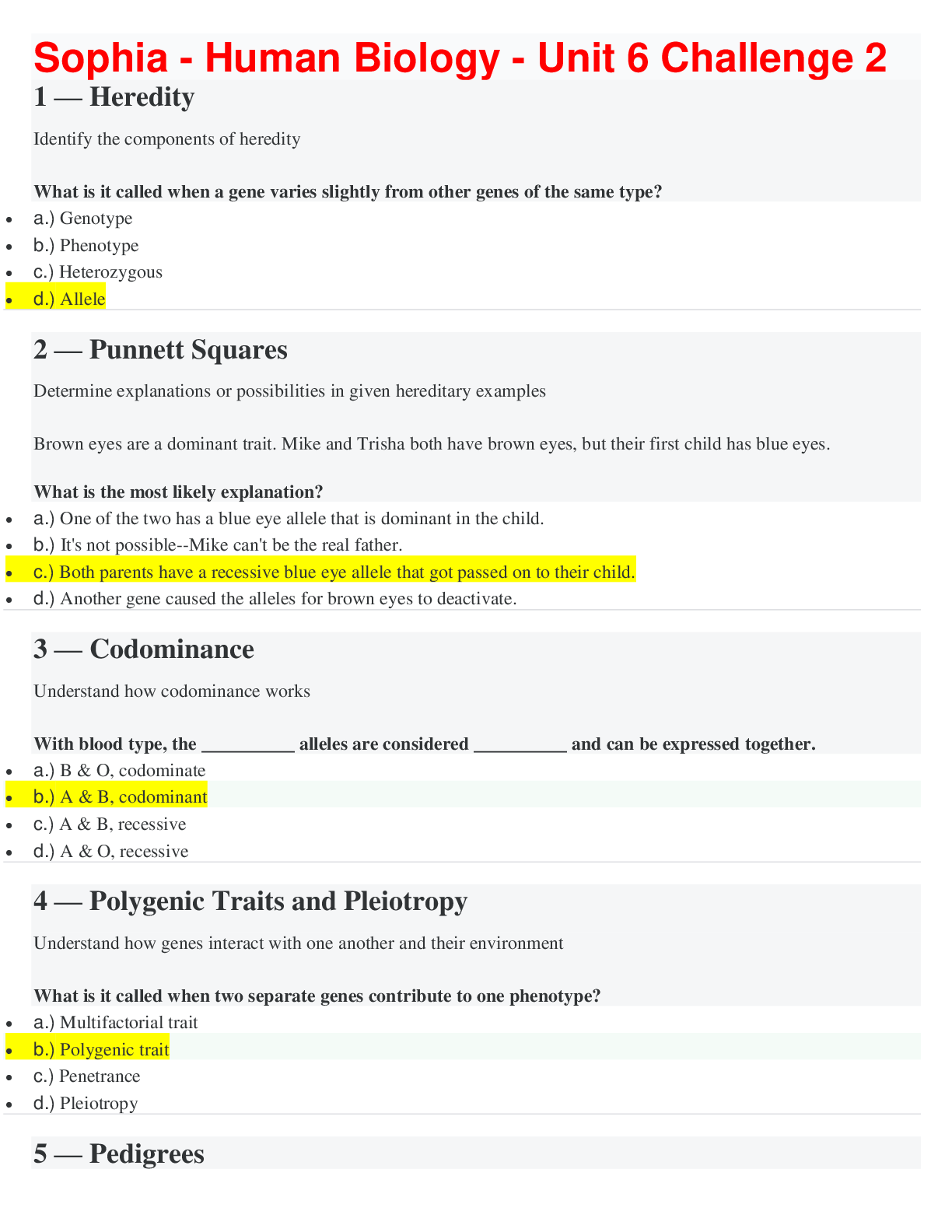
Sophia - Human Biology - Unit 6 Challenge 2 Questions With Latest Updated Version Answers 100% Correct Guaranted Grade A
Document Content and Description Below
Last updated: 4 years ago
Preview 1 out of 3 pages
Instant download
Buy this Document to get the Full Access Instantly
Provided by Students Who Aced it
We Verify Document Content to Gurantee Accuracy
Reviews( 0 )
Document information
Connected school, study & course
About the document
Uploaded On
Aug 11, 2020
Number of pages
3
Written in
All

Additional information
This document has been written for:
Uploaded
Aug 11, 2020
Downloads
0
Views
147
Topic Tags
Recommended For You
Get more on STUDY GUIDE »
MICROBIOLOGY STRAIGHTERLINE MCB FINAL EXAM LATEST 2026/2027 CO...
AQA A LEVEL PSYCHOLOGY PAPER 1 INTRODUCTORY TOPICS SOLUTION BU...
AQA A LEVEL PSYCHOLOGY 7182 1 PAPER 1 COMPREHENSIVE EXAMINATIO...
AQA A LEVEL PSYCHOLOGY PAPER 1 INTRODUCTORY TOPICS IN PSYCHOLO...
HESI A2 REVIEW Anatomy and Physiology, HESI A2 Science, HESI A...
NSG 3500 Exam 3 Testbank – Comprehensive Nursing Practice Ques...
Test Bank for Community Health Nursing A Canadian Perspective...
NR566 Week 5 Study Guide Chapter 18: Drugs Affecting the Hemat...
STUDY GUIDE for Lehne's Pharmacology for Nursing Care 12th Edi...
NUR 225 Nutrition Exam 2 – Comprehensive Nursing Questions, An...
HOSA Nursing Assisting Study Guide – Comprehensive Patient Car...
TEST BANK for Fundamentals of Nursing Active Learning for Coll...

Test Bank for Nursing for Wellness in Older Adults Miller 8th...

Nursing for Wellness in Older Adults Miller 8th Edition Test B...

 Rasmussen College.png)