BIO 152 Module 6: Problem Set Study Guide- Portage Learning/BIO 152 Module 6: Problem Set Study Guide- Portage Learning/BIO 152 Module 6: Problem Set Study Guide- Portage LearningModule 6: Problem Set
Due No due date Po
...
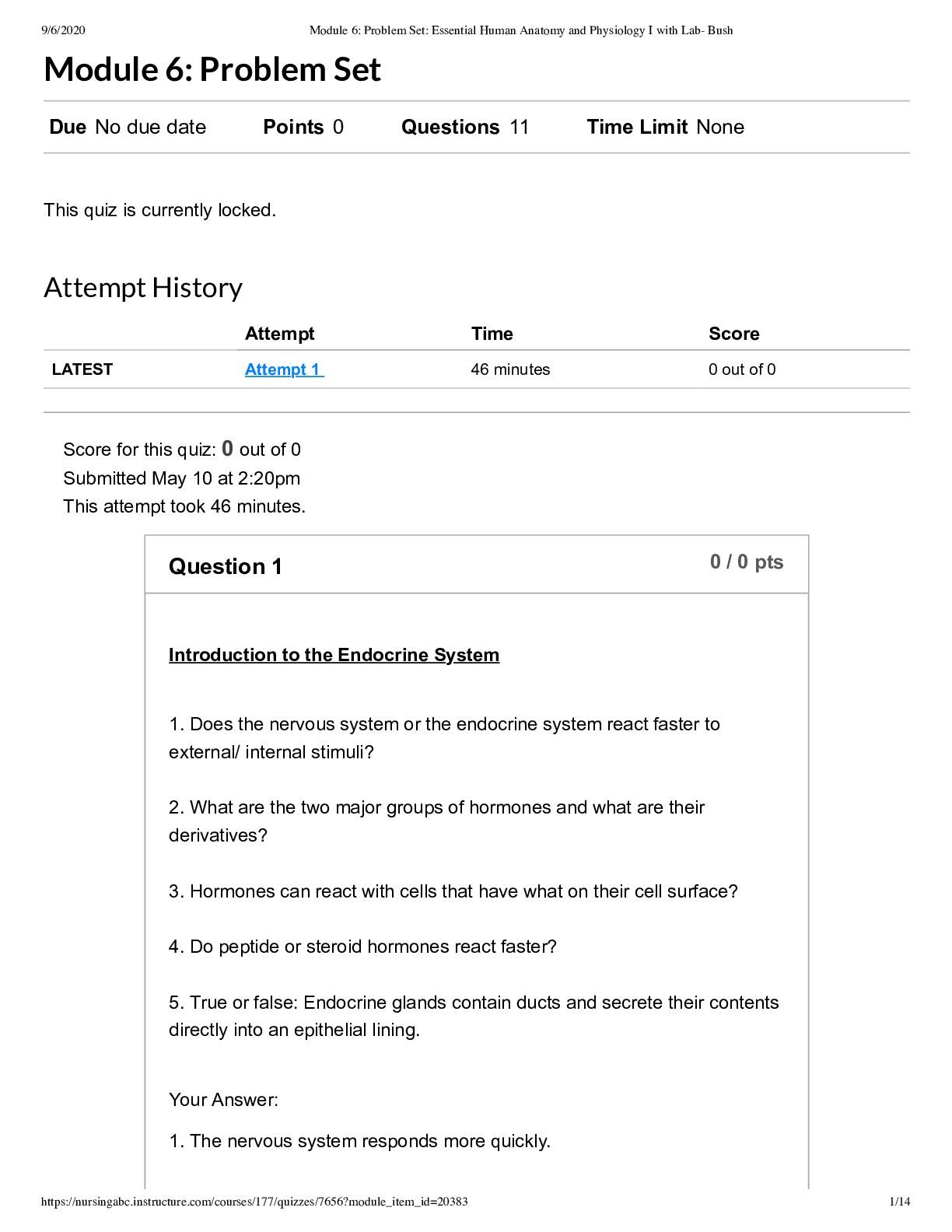
BIO 152 Module 6: Problem Set Study Guide- Portage Learning/BIO 152 Module 6: Problem Set Study Guide- Portage Learning/BIO 152 Module 6: Problem Set Study Guide- Portage LearningModule 6: Problem Set
Due No due date Points 0 Questions 11 Time Limit None
This quiz is currently locked.
Attempt History
Attempt Time Score
LATEST Attempt 1 46 minutes 0 out of 0
Score for this quiz: 0 out of 0 Submitted May 10 at 2:20pm This attempt took 46 minutes.
Question 5
0 / 0 pts
The Anterior Pituitary
18. What major hormones are secreted from the anterior pituitary gland?
19. Fill in the chart, below with the purpose and target of each of the anterior pituitary hormones:
*Note: All hormones in this module will need to be memorized for the exam. This is not an exhaustive list. Making a chart of all the hormones in the module to organize the information is a recommended way to study for the exam.
Hormone Target Action
GH TSH
Gonadotropic hormones (FSH, LH)
Your Answer:
18. GH, prolactin, MSh, TSH, ACTH, FSH, LH 19.
Hormone Target Action
GH
TSH
skeletal muscles, liver and bones
thyroid gland
cell growth, cell division, protein synthesis
production of T3 and T4
FSH
gonads
follicle development/ estrogen production
LH gonads
ovulation, progesterone release, pregnancy maintenance
25. Explain the targets and opposing actions of calcitonin and PTH, using the chart below
Hormone Target Action
Calcitonin PTH
Your Answer:
20. A goiter occurs when the thyroid gland enlarges due to lack of iodine in the diet
21. False
22. T3 and T4, calcitonin
23. False
24. PTH 25.
Hormone Target Action
lowers blood
Calcitonin blood
kidneys, bones,
PTH
intestines,
blood
calcium levels
blood calcium
increases/ phosphate decreases
20. When iodine is lacking in the diet, the thyroid gland enlarges, called a goiter. Goiters happen because of the relationship between the thyroid and the anterior pituitary. When there is a low level of thyroxin in the blood, the anterior pituitary continues to produce TSH. The thyroid responds by increasing in size (and producing a goiter). However, this size increase is ineffective because active thyroxin cannot be produced without iodine.
21. False
22. T3, T4, Calcitonin
23. False (Calcitonin lowers the level of calcium in the blood, depositing calcium into the bone)
24. PTH
25. *Note: All hormones in this module will need to be memorized for the exam. This is not an exhaustive list.
Hormone Target Action
DECREASE Blood Ca2+
Calcitonin
Bone Cells
Increase storage of Ca2+ in bone INCREASE Ca2+ in plasma
PTH Bone Cells
Decrease Ca2+ in bone
Vitamin D activation
28. Fill in the action of cortisol by using the chart below:
Hormone Target Action
Cortisol
Your Answer:
26. Epinephrine and norepinephrine
27. Glucocorticoids, mineralocorticoids 28.
Hormone Target Action
Cortisol
liver, muscle, fat
raise blood glucose levels, counteracts inflammation
The Adrenal Glands
26. Epinephrine and norepinephrine directly into the bloodstream under conditions of stress.
27. The two major classes of hormones made by the adrenal cortex are glucocorticoids and mineralocorticoids.
28. *Note: All hormones in this module will need to be memorized for the exam. This is not an exhaustive list.
Hormone Target Action
Metabolism/stress management
Cortisol (glucocorticoid)
(controlled by ACTH)
Most cells
Hydrolysis of muscle protein-> amino acids to enter blood
*Raises blood glucose level
Reduces inflammation
- Counteracts inflammatory response
Question 9
0 / 0 pts
The Pancreas
31. Endocrine tissue of the pancreas is called .
32. A person has high levels of blood glucose. Would the alpha or beta cells be stimulated to release what hormone?
33. Summarize the function of insulin.
Your Answer:
31. Pancreatic islets of Langerhans
32. Insulin would be secreted by beta cells
33. Metabolize glucose by stimulating liver, fat and muscle cells, glycogen storage by the liver, builds up fat and protein storage and prevents them being utilized by the body for energy
The Pancreas
31. Endocrine tissue, called the pancreatic islets (of Langerhans).
32. Beta cells would release insulin.
33. Generally, insulin promotes the storage of nutrients, so they are on hand in times of low blood glucose.
40. True or False: The thymus is most active during childhood.
Your Answer:
36. Testosterone helps to develop sex organs of males and ensure functionality, helps with sperm maturation and causes the larynx and vocal chords to enlarge leading to voice changes at puberty.
27. FSH
38. Estrogen and progesterone
39. Progesterone 40 False - childhood
The Gonads
36. It is essential for the normal development and functioning of the sex organs in males. It is also necessary for the maturation of sperm. Greatly increased testosterone secretion at the time of puberty stimulates the growth of the penis and the testes. Testosterone also brings about and maintains the secondary sex characteristics in males that develop at the time of puberty. Testosterone causes growth of a beard, body hair, and pubic hair. It prompts the larynx and the vocal cords to enlarge, causing the voice to change. It is responsible for the muscular strength of males. Testosterone causes oil and sweat glands in the skin to secrete; therefore, it is largely responsible for acne and body odor. Testosterone is largely responsible for sex drive.
37. FSH
38. Estrogen and progesterone
39. Progesterone
40. True
Quiz Score: 0 out of 0
[Show More]



 (1).png)