NURSING > Solutions Guide > HEALTH ASS NR 302Final Exam Concepts (All)
HEALTH ASS NR 302Final Exam Concepts
Document Content and Description Below
Last updated: 3 years ago
Preview 1 out of 11 pages
Instant download

Buy this Document to get the Full Access Instantly
Provided by Students Who Aced it
We Verify Document Content to Gurantee Accuracy
Reviews( 0 )
Document information
Connected school, study & course
About the document
Uploaded On
Jul 22, 2021
Number of pages
11
Written in
All

Additional information
This document has been written for:
Uploaded
Jul 22, 2021
Downloads
0
Views
163
Topic Tags
Related Subjects & Courses
Explore similar study resources and related concepts.
Recommended For You
Get more on Solutions Guide »
Frances Guide Qbank to Pass Your Adult-Gerontology Acute Care...
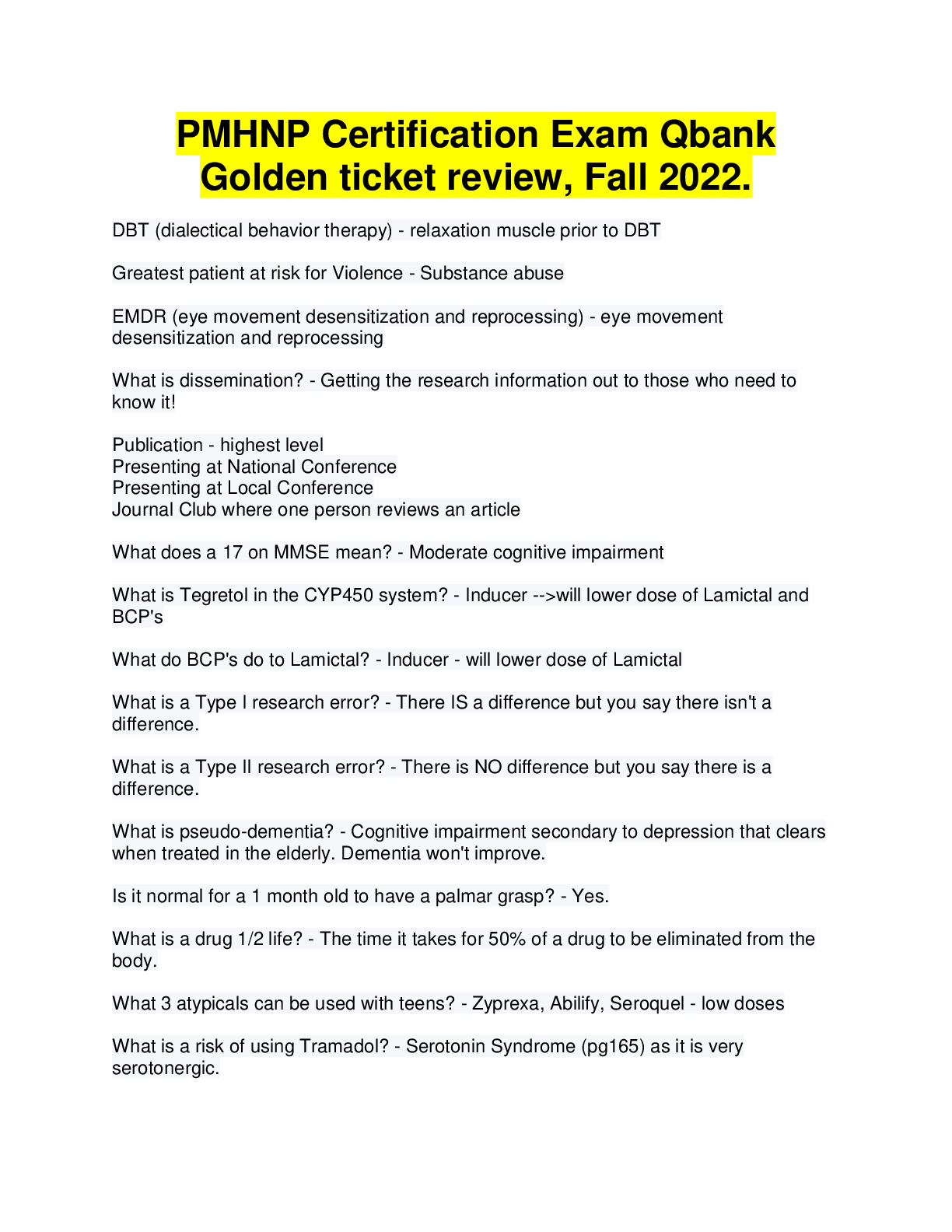
PMHNP Golden Ticket (answered) Complete Every single question,...

ROSH REVIEW-Pediatrics Test bank Full answered each deeply exp...
Essentials-of-Psychiatric-Mental-Health-Nursing-Concepts-of-Ca...

Test Bank for Sociology of Sport Paperback 12Ed. by George H....
Test Bank for Fundamentals of Nursing 10th Edition by Taylor C...

TEST BANK for Pharmacology and the Nursing Process 10th Editio...

NUR 321 VCE #5 Fluid and Electrolyte Balance QUESTIONS AND ANS...