ECON1002: Microeconomics Exam2 (A GUARANTEED)
Instruction: You have 115 minutes to finish the quiz. Please choose the most appropriate answer to
each question and mark it in the Scantron answer sheet. Any answer in th
...
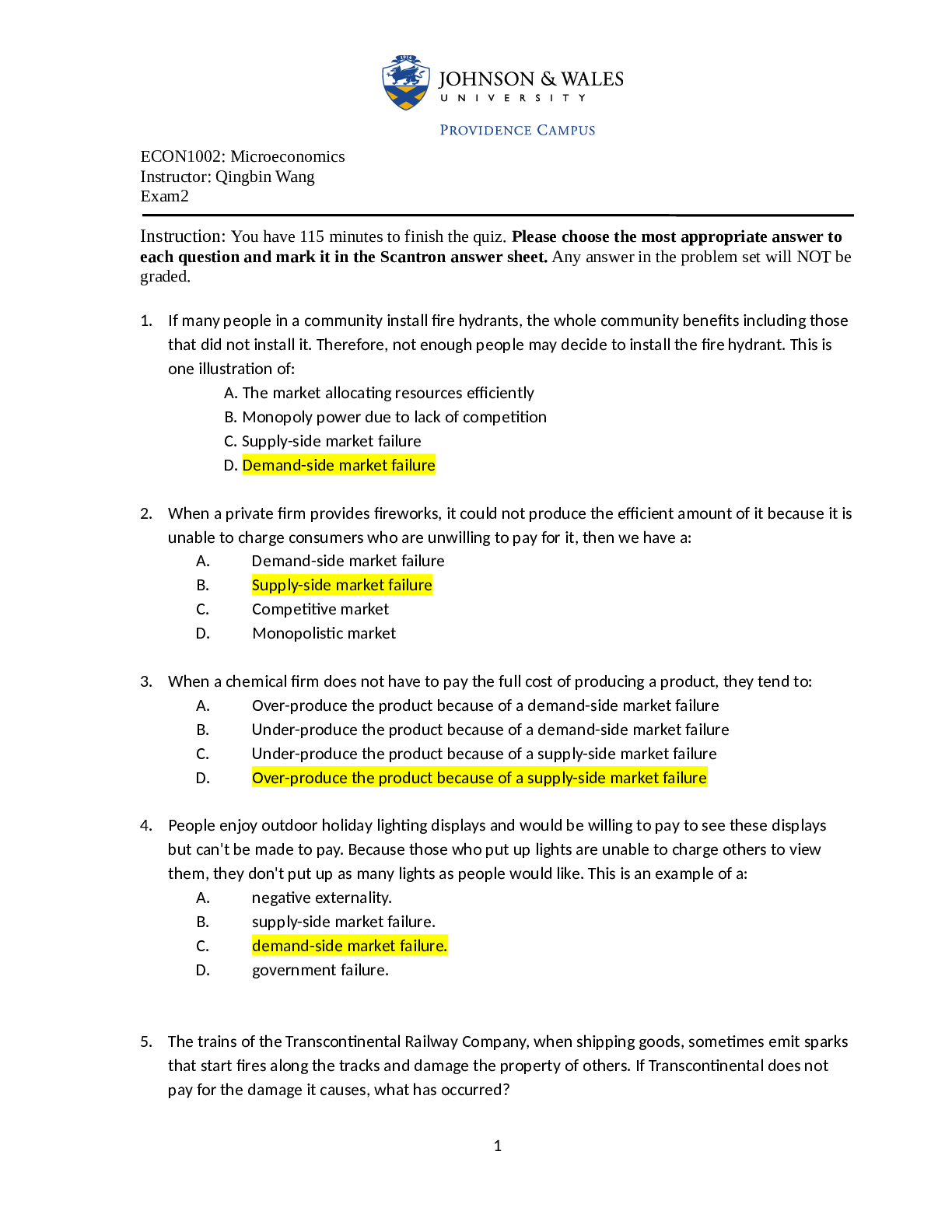
ECON1002: Microeconomics Exam2 (A GUARANTEED)
Instruction: You have 115 minutes to finish the quiz. Please choose the most appropriate answer to
each question and mark it in the Scantron answer sheet. Any answer in the problem set will NOT be
graded.
1. If many people in a community install fire hydrants, the whole community benefits including those
that did not install it. Therefore, not enough people may decide to install the fire hydrant. This is
one illustration of:
A. The market allocating resources efficiently
B. Monopoly power due to lack of competition
C. Supply-side market failure
D. Demand-side market failure
2. When a private firm provides fireworks, it could not produce the efficient amount of it because it
is unable to charge consumers who are unwilling to pay for it, then we have a:
A. Demand-side market failure
B. Supply-side market failure
C. Competitive market
D. Monopolistic market
3. When a chemical firm does not have to pay the full cost of producing a product, they tend to:
A. Over-produce the product because of a demand-side market failure
B. Under-produce the product because of a demand-side market failure
C. Under-produce the product because of a supply-side market failure
D. Over-produce the product because of a supply-side market failure
4. People enjoy outdoor holiday lighting displays and would be willing to pay to see these displays
but can't be made to pay. Because those who put up lights are unable to charge others to view
them, they don't put up as many lights as people would like. This is an example of a:
A. negative externality.
B. supply-side market failure.
C. demand-side market failure.
D. government failure.
5. The trains of the Transcontinental Railway Company, when shipping goods, sometimes emit
sparks that start fires along the tracks and damage the property of others. If Transcontinental
does not pay for the damage it causes, what has occurred?
A. Positive externality.2
B. Demand-side market failure.
C. Supply-side market failure.
D. All of these.
6. Tom buys a piece of shirt for $43 for which he was willing to pay $52. The minimum acceptable
price to the seller, Jerry, was $40. Tom experiences:
A. a consumer surplus of $12 and Jerry experiences a producer surplus of $3.
B. a producer surplus of $9 and Jerry experiences a consumer surplus of $3.
C. a consumer surplus of $9 and Jerry experiences a producer surplus of $3.
D. a producer surplus of $9 and Jerry experiences a producer surplus of $12.
Use the graph to answer questions 7.
7. Refer to the diagram above. If actual production and consumption occur at Q3:
A. efficiency is achieved.
B. consumer surplus is maximized.
C. an efficiency loss (or deadweight loss) of e + f occurs.
D. an efficiency loss (or deadweight loss) of b + d occurs.
8. Which of the following is an example of a public good?
A. 911 emergency response system.
B. A television set.
C. A sofa.
D. A laptop.
9. If one person's consumption of a good does not preclude another's consumption, the good is said
to be:
A. nonrival in consumption.
B. rival in consumption.3
C. nonexcludable.
D. excludable.
10. Among the following examples, the one that best illustrates a public good is:
A. The laptops used by students in a college or university
B. The movies produced by Hollywood companies
C. Pine Street next JWU campus
D. The airline tickets bought by vacationers
[Show More]