Unit 1 Challenge 1
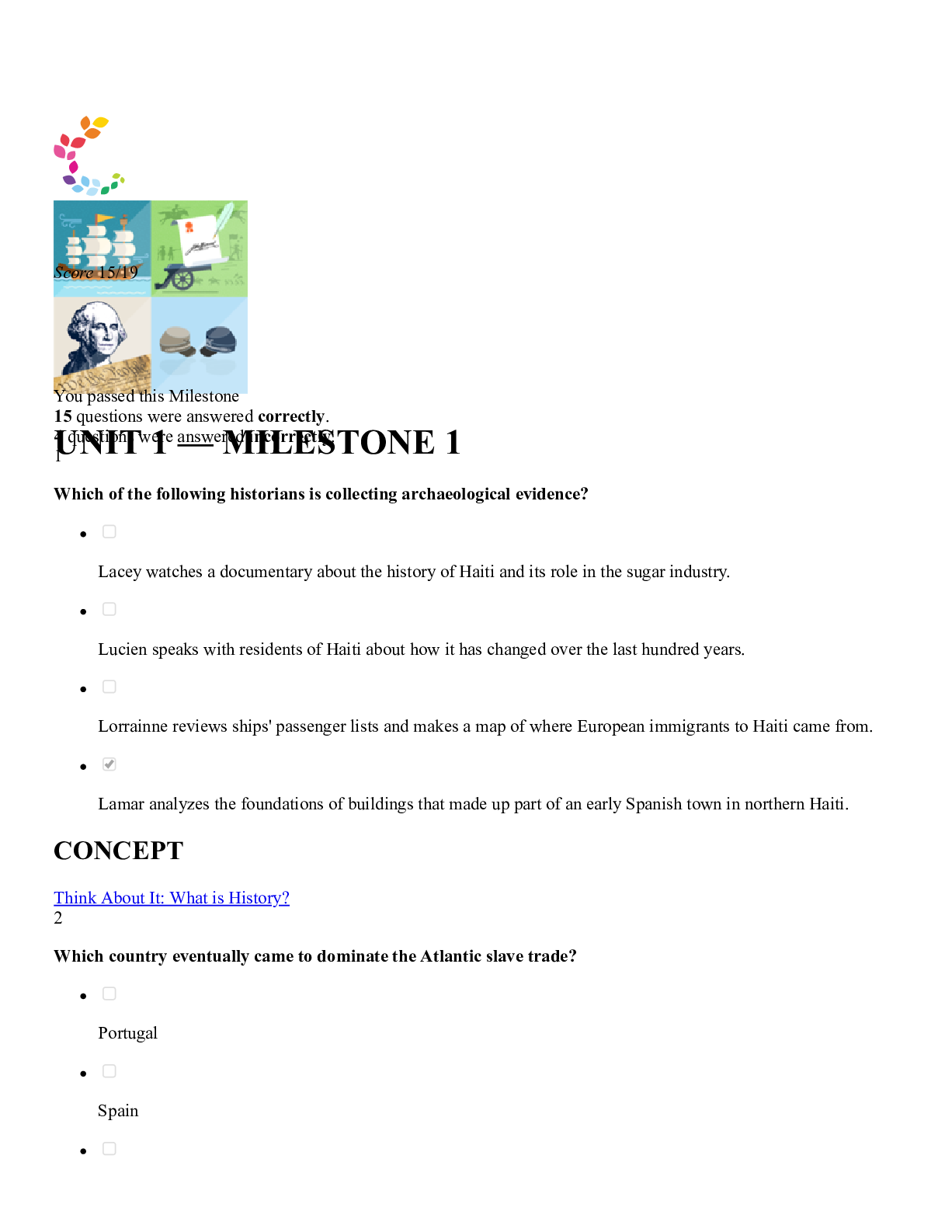
1. Which of the following statements is true?
a.)
Historians have a responsibility to merge their own experiences into historical
narratives.
b.)
The writing of history is influenced by the c
...
Unit 1 Challenge 1
1. Which of the following statements is true?
a.)
Historians have a responsibility to merge their own experiences into historical
narratives.
b.)
The writing of history is influenced by the cultural environment in which it is written.
c.)
History is best determined through the lenses of politics and economics.
d.)
Historical interpretations of past events rarely change over time.
2. Consider the following research question and choose the primary source that
is best suited to answer it.
"What were the long-term consequences of Japanese internment camps in the
United States during World War II?"
a.)
A high school history textbook published in 1990
b.)
An interview in 2001 with a Japanese American who was confined to a camp
c.)
A national newscast from 1942
d.)
A documentary about World War II produced by a historian
3. As part of her research on the American Revolution, Bea reads a book about forms
of public protest in the 18th century colonies.
Which of the following is most likely a lens she is exploring?
a.) Race
b.) Ethics
c.) Politics
d.) Economics
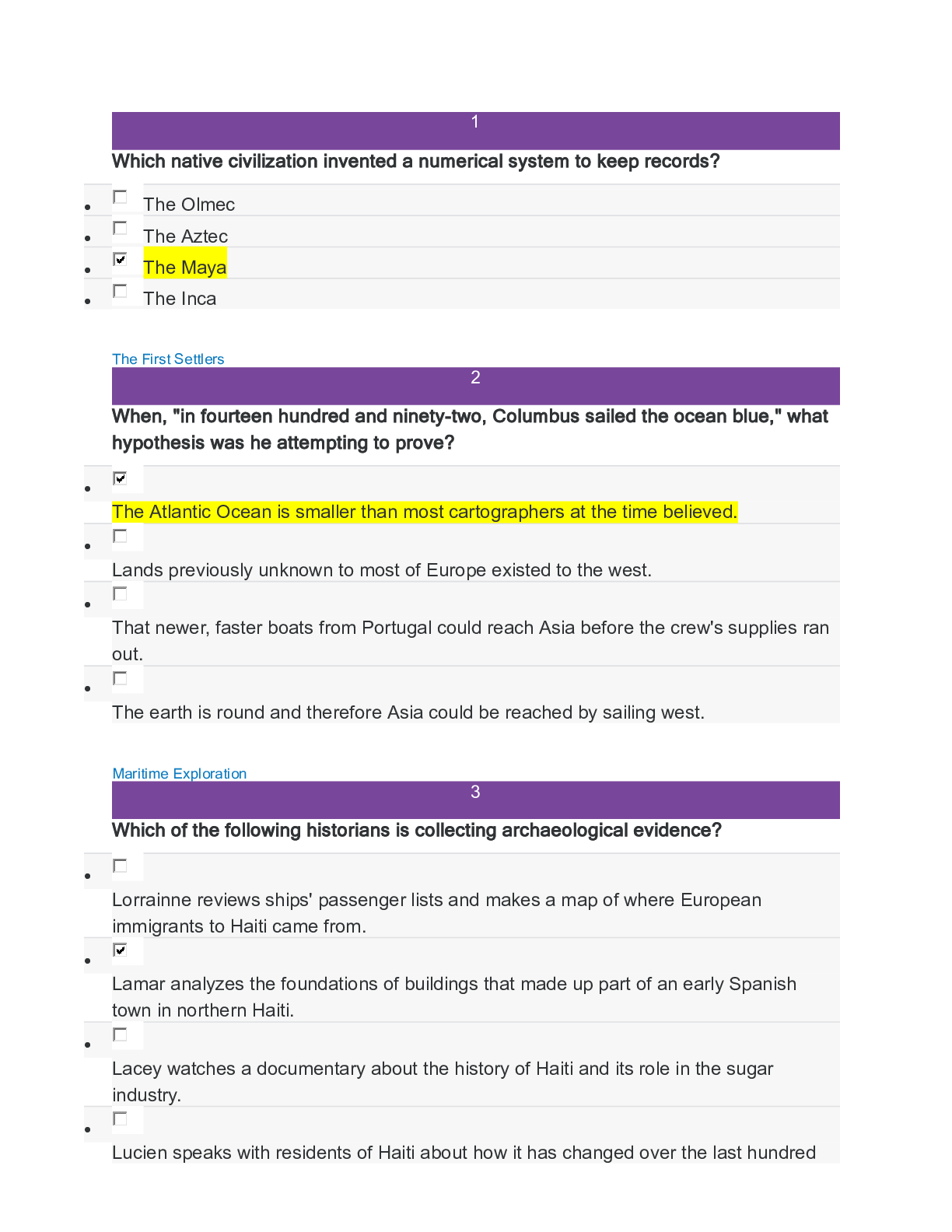
Which native civilization lived in permanent settlements made up of apartmentlike complexes of stone and mud? a.)
The Pueblo
b.)
The Aztec
c.)
The Olmec
d.)
The Hopewell
Which of the following historians is collecting oral history?
a.)
Hajit makes detailed drawings of prehistoric images found on boulders in Minnesota.
b.)
Hector analyzes one of the first maps made by European explorers.
c.)
Hope attempts to translate symbols on a pot that she believes were a form of writing.
d.)
Helen interviews contemporary Native Americans about their cultural traditions.
Which statement is most representative of the French approach toward native
peoples in the Americas?
a.)
"Your territory belongs to us by decree of the Catholic Church."
b.)
"The natives will submit to the absolute authority of the Crown."
c.)
"Gift exchanges with natives will forge alliances and establish trade relationships."
d.)
"The natives, although poor, show ingenuity and will welcome friendship with a superior
civilization."
Which of the following events led to increased maritime exploration in the 15th
century?
a.)
The Crusades of the 11th, 12th and 13th centuries b.)
Discoveries by the Vikings
c.)
The invention of the printing press
d.)
Competition between Catholics and Protestants
European traders discovered that they could sell chocolate from the New World back
home in Europe.
Which of the following concepts does this statement best exemplify?
a.)
Globalization
b.)
Colonization
c.)
Commodification
Which of the following statements is true about slavery prior to the Atlantic slave
trade?
a.)
It could involve one person bonding himself to another so as to work off a debt.
b.)
Slaves were almost always considered to be the property of their masters.
c.)
It was largely an issue of race, as only people with darker skin could become slaves.
d.)
A person's religion had no impact on whether he or she could be enslaved.
In 1540, Francisco Vásquez de Coronado set out to find the rumored golden city of
Quivira.
What came of his expedition?
a.)
Despite a two-year expedition that got as far north as modern-day Kansas, Coronado
never found Quivira. b.)
Quivira was discovered near present-day Albuquerque, stripped of its wealth and
ultimately abandoned.
c.)
Quivira was found in modern-day Oklahoma, but its wealth had been greatly
exaggerated in the rumors.
d.)
Coronado's expedition ended prematurely after a particularly brutal winter in the Rocky
Mountains.
What was a significant factor in the demise of Dutch settlements in the
Americas?
a.)
Internal struggles back in Holland
b.)
Too few European settlers
c.)
Territorial disputes with France
d.)
Conflict with native peoples
Interactions between Native Americans and Europeans led to the commercialization of
traditional beaver-hunting practices.
Which of the following factors played the biggest role in that change?
a.)
Europeans introduced the concept of private ownership of hunting lands.
b.)
Europeans introduced capitalism and ideas about success through hard work.
c.)
Europeans were willing to give Native Americans muskets in exchange for beaver pelts.
d.)
Europeans brought new animals that made it easier to hunt for beavers.
Which of the following statements is characteristic of Martin Luther's position in
1517? a.)
"I declare myself to be the head of the Catholic Church in my country."
b.)
"Individual monarchs have too much power."
c.)
"Reading scripture prepares people to receive God's grace if they are among the elect."
d.)
"The practice of selling indulgences is corrupt and has to stop."
What role did European exports play in the Triangular Trade?
a.)
Guns and gunpowder from Europe were exchanged for sugar in Africa.
b.)
Slaves would be brought from Europe to the Americas in exchange for textiles, rum and
other goods.
c.)
Rum was used to lure Africans into the voyage to America, where they would then be
forced into slavery.
d.)
Manufactured goods were used to buy African slaves from other Africans who captured
them.
Which statement is most representative of the French approach toward native
peoples in the Americas?
a.)
"Your territory belongs to us by decree of the Catholic Church."
b.)
"The natives will submit to the absolute authority of the Crown."
c.)
"Gift exchanges with natives will forge alliances and establish trade relationships."
d.)
"The natives, although poor, show ingenuity and will welcome friendship with a superior
civilization."
"Unlike other colonists, these men and women were motivated by religion and a desire
to create a successful community."Which English colony is most likely being described here?
a.)
Massachusetts Bay
b.)
Roanoke
c.)
Jamestown
d.)
Virginia
Which factor led to the implementation of the Headright System?
a.)
Abundant land and the desire to attract more migrants
b.)
The desire to equalize opportunity for Englishmen
c.)
The racialization of slavery in the New World
d.)
Landowners abusing the system of indentured servitude
Which factor led to the creation of a maritime-based economy in the northern
colonies?
a.)
Agricultural surpluses that could be sold in foreign markets
b.)
Need for slave labor in the northern colonies
c.)
Religious intolerance in the northern colonies
d.)
Settlers with diverse backgrounds and tastes in the northern colonies
Which of the following societal changes occurred when New Netherlands
became New York?
a.)
Married women could no longer use their own name to do business. b.)
Slavery, which had been condemned by the Dutch, was introduced.
c.)
Colonists of Dutch descent were forcibly exiled back to Europe.
d.)
A system of patronage was implemented to distribute land.
Which of the following was a source of tension between English colonists and
Native Americans?
a.)
Colonists were envious of Native Americans' agricultural know-how.
b.)
Native Americans took pity on the colonists for their lack of preparedness.
c.)
Colonists viewed Native Americans as weak and easily conquerable.
d.)
The growing population in the colonies led to colonists claiming more territory.
Consider the excerpt from Robert Johnson's "Nova Britannia" and the possible bias it
represents.
Which of the following statements most likely identifies Johnson's purpose in
writing?
a.)Johnson's purpose was to attract people to invest in the Virginia Company and settle
in Jamestown.
b.)Johnson's purpose was to give investors a carefully constructed idea of how the
Virginia Company operated internally.
c.)Johnson's purpose was to provide an accurate description of Jamestown for future
historians to study.
d.)Johnson's purpose was to instruct settlers on how to thrive in Virginia and profit from
its resources.
Which of the following statements describes the relationship between the English
and the Native Americans in the first half of the 18th century?
a.)
At times the Native Americans traded and even made alliances with the English, but
these often led to devastating conflicts. b.)
Most English settlers acknowledged Native American rights to the land, but the colonial
government refused to acknowledge any such rights.
c.)
[Show More]


, (Latest 2021) Correct Study Guide, Download to Score A.png)
 Correct Study Guide, Download to Score A.png)
 Correct Study Guide, Download to Score A.png)