Safety and Infection Control
Accident/Error/Injury Prevention – (2)
Chronic Neurologic Disorders: Contraindications for Pregabalin (Active Learning Template – Medication, RM Pharm RN 7.0 Chp 13)
• Contraindicati
...
Safety and Infection Control
Accident/Error/Injury Prevention – (2)
Chronic Neurologic Disorders: Contraindications for Pregabalin (Active Learning Template – Medication, RM Pharm RN 7.0 Chp 13)
• Contraindications:
• Pregnancy:
Birth defects: can cause skeletal and visceral malformations
Pregnancy Risk Category C: Administer only if the benefits outweigh the risks
• Interactions:
• Benzodiazepines, alcohol, and opioids intensify CNS effects
Nursing considerations: Advise the client to avoid medications that affect the CNS
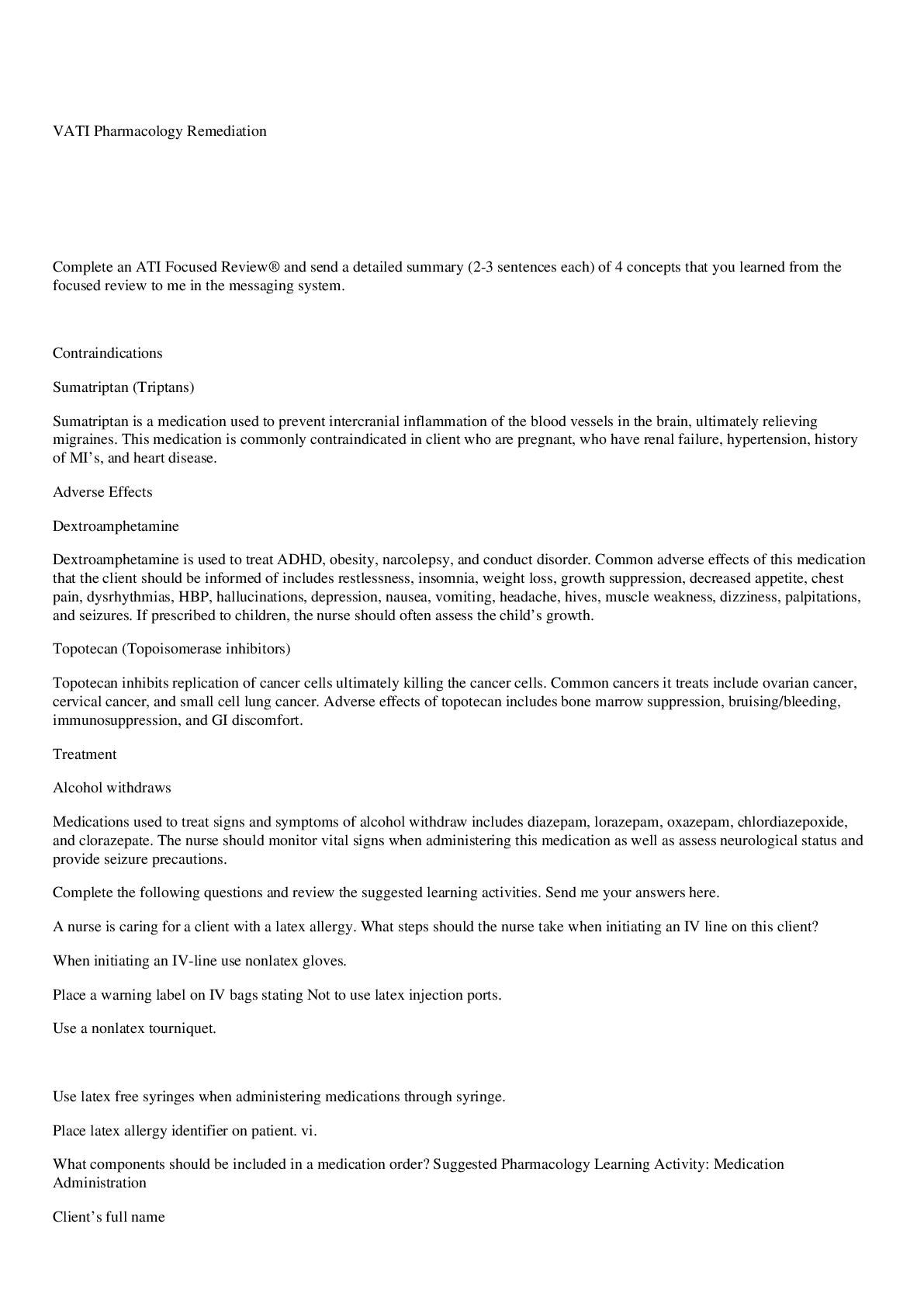
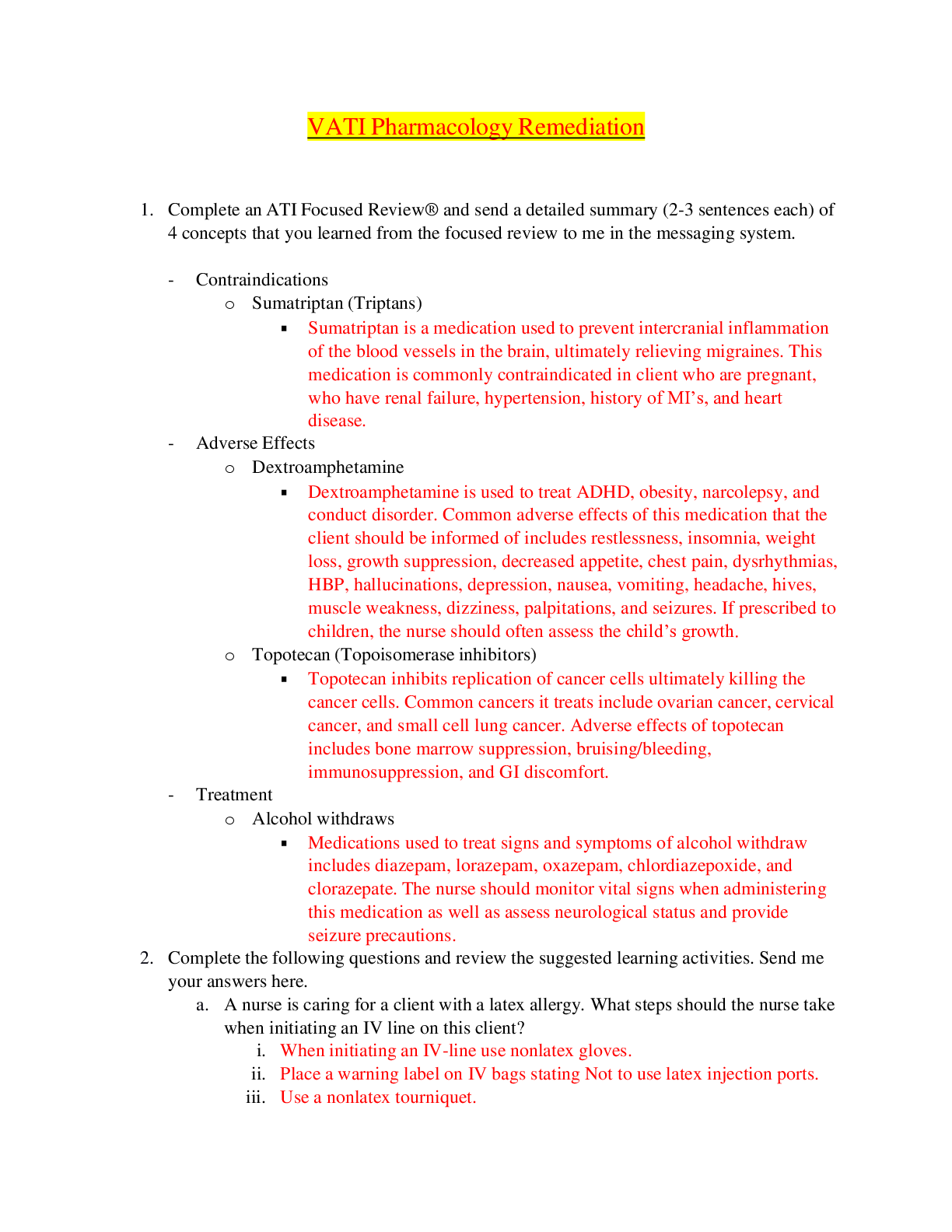
Medical and Surgical Asepsis: Reducing the Risk of an Allergic Reaction for a Client Who Has a Latex Allergy (Active Learning Template – Basic Concept, RM FUND 9.0 Ch 10)
• Before beginning any task or procedure that requires aseptic technique, health care team members must check for latex allergies. If the client or any member of the team has a latex allergy, the team must use latex-free gloves, equipment, and supplies.
Pharmacological and Parenteral Therapies
Adverse Effects/Contraindications/Side Effects/Interactions – (19)
Airflow Disorders: Adverse Effects of Beta2-Adrenergic Agonists (Active Learning Template – Medication, RM Pharm RN 7.0 Chp 17)
• Tachycardia, angina: Oral agents can cause tachycardia and angina due to activation of alpha1 receptors in the heart
• Nursing considerations:
Advise clients to observe for chest, jaw, or arm pain or palpitations and to notify the provider if they occur
Instruct clients to check pulse and to report an increase of greater than 20 to 30 beats/min
Advise clients to avoid caffeine
Dosage might need to be reduced
• Tremors: Caused by activations of beta2 receptors in skeletal muscle
• Nursing considerations:
Tremors usually resolve with continued medication use
Dosage might need to be reduced
Airflow Disorders: Adverse Effects of Ipratropium (Active Learning Template – Medication, RM Pharm RN 7.0 Chp 17)
• Local anticholinergic effects: Dry mouth, hoarseness
• Nursing considerations:
Advise clients to sip fluids and suck on sugar-free hard candies to control dry mouth
Antilipemic Agents: Monitoring Laboratory Values (Active Learning Template – Medication, RM Pharm RN 7.0 Chp 24)
• HMG-CoA reductase inhibitors (statins); Cholesterol absorption inhibitor; Bile-acid sequestrants; Nicotinic acids (niacin); Fibrates; Antisense oligonucleotide:
• Advise clients about the importance of obtaining baseline cholesterol, HDL, LDL, and triglyceride levels, as well as liver and kidney function tests, and monitoring periodically during treatment
• Statins, such as atorvastatin, can increase the risk of liver dysfunction and myopathy
Obtain baseline liver function tests and monitor periodically. Advise clients to observe for indications of liver damage (anorexia, vomiting, nausea). The provider should be notified, and the medication will most likely be discontinued.
• For fibrates – with concurrent use, warfarin increases the risk of bleeding obtain baseline prothrombin time (PT) and INR, and perform periodic monitoring
Cardiac Glycosides and Heart Failure: Contraindications to the Administration of Digoxin (Active Learning Template – Medication, RM Pharm RN 7.0 Chp 21)
• Pregnancy Risk Category C
• Contraindicated in clients who have disturbances in ventricular rhythm, including ventricular fibrillation, ventricular tachycardia, and second- and third-degree heart block
• Use cautiously in clients who have hypokalemia, partial AV block, advanced heart failure, and impaired kidney function
Chemotherapy Agents: Priority Assessment During Administration of Paclitaxel (Active Learning Template – Medication, RM Pharm RN 7.0 Chp 42)
• Contraindications/Precautions:
• Pregnancy Risk Category D
• Contraindicated in clients who have a neutrophil count less than 1,500/mm3. Use with caution in clients who have myelosuppression.
• Nursing Administration:
• Assess for indications of neuropathy, including weakness, numbness, tingling, foot drop, ataxia, and paresthesia. Advise clients to use caution and report manifestations
• Reduce dose for clients who have liver disease
• Assess breath sounds for bronchospasm
• Monitor for bleeding (bruising) or infection (fever, sore throat)
• Monitor CBC and liver enzymes
• Give an antiemetic for nausea and vomiting
• Advise clients to use good mouth care
• Stop chemotherapeutic medications if extravasation occurs
• Advise clients to use birth control during treatment
Chemotherapy Agents: Treatment for Adverse Effects of Topotecan (Active Learning Template – Medication, RM Pharm RN 7.0 Chp 42)
• Bone marrow suppression:
Low WBC count or neutropenia, bleeding caused by thrombocytopenia or low platelet count, and anemia or low RBCs
Can occur 4 to 6 weeks after infusion
• Nursing considerations:
Monitor WBC, absolute neutrophil count, platelet count, Hgb, and Hct
Assess for bruising and bleeding gums
Instruct clients to avoid crowds and contact with infectious individuals. Advise clients to continue precautions after treatment is completed
• GI discomfort (nausea and vomiting)
• Nursing considerations:
Administer antiemetic such as ondansetron in combination with dexamethasone, granisetron, or metoclopramide before beginning chemotherapy
• Alopecia
• Nursing considerations:
Advise clients that hair loss can occur 7 to 10 days after the beginning of treatment and will last for a maximum of 2 months after the last administration of the chemotherapeutic agent
Advise clients to select a hairpiece before the occurrence of hair loss
Diabetes Mellitus: Recognizing Contraindications for Metformin (Active Learning Template – Medication, RM Pharm RN 7.0 Chp 39)
• Metformin is contraindicated for clients who have severe infection, shock, and any hypoxic condition. The medication should not be used by clients who have alcohol use disorder.
Eye and Ear Disorders: Adverse Effects of Acetazolamide (Active Learning Template – Medication, RM Pharm RN 7.0 Chp 14)
• Severe allergic reactions: (anaphylaxis); possible cross-sensitivity with sulfonamides
• Nursing considerations:
Educate clients about effects and to notify provider
Ask about sulfonamide allergy
• Serious blood disorders: rare serious blood disorders, such as bone marrow depression
• Nursing considerations:
Educate clients to recognize and immediately report effects
• Gastrointestinal side effects: (nausea and diarrhea)
• Nursing considerations:
Report GI adverse effects and weight loss to provider
• Electrolyte depletion (sodium and potassium), dehydration, altered liver function:
• Nursing considerations:
Prepare clients for the need to obtain regular laboratory testing
Weigh daily
Monitor for postural hypotension
Increase fluid intake to 2 to 3 L/day, unless contraindicated
• Generalized flu-like symptoms: headache, fever, body aches
• Nursing considerations:
Educate client about possible reactions
**************continues.........***********************
[Show More]