1
TESTBANK
ON
Pearson's
Comprehensive
Medical Assisting, 4e
(Beaman)2
Chapter 1 Medical Assisting: The Profession
True/False Questions
1) A physician may never delegate tasks to a medical assistant that would be
...
1
TESTBANK
ON
Pearson's
Comprehensive
Medical Assisting, 4e
(Beaman)2
Chapter 1 Medical Assisting: The Profession
True/False Questions
1) A physician may never delegate tasks to a medical assistant that would be viewed as a medical
assistant practicing medicine.
Answer: TRUE
Page Ref: 9
Objective: 1.6
2) The medical assistant's main responsibility is to assist the physician in providing patient care.
Answer: TRUE
Page Ref: 6
Objective: 1.5
3) State laws can vary on who can delegate duties to a medical assistant.
Answer: TRUE
Page Ref: 9
Objective: 1.6
4) It is important to present a confident, professional image that helps put the patient at ease.
Answer: TRUE
Page Ref: 10
Objective: 1.7
5) More and more employers are requiring credentials as a condition for employment.
Answer: TRUE
Page Ref: 10
Objective: 1.8
6) It is your responsibility as a medical assistant to only practice within your scope of practice.
Answer: TRUE
Page Ref: 6
Objective: 1.5
7) A licensed medical assistant can perform the same duties as a licensed nurse.
Answer: FALSE
Page Ref: 7
Objective: 1.5
8) The Centers for Medicare and Medicaid Services (CMS) issued a final ruling mandating that
EVERY medical assistant is able to enter physician orders in a computerized order entry system.
Answer: FALSE
Page Ref: 10
Objective: 1.83
9) The medical assistant is uniquely qualified to perform the administrative and clinical
procedures associated with the responsibilities of a medical office assigned by the physician.
Answer: TRUE
Page Ref: 7
Objective: 1.5
10) A patient navigator is the primary source of communication between the patient and their
health care providers.
Answer: TRUE
Page Ref: 14
Objective: 1.11
11) One of the goals of a patient navigator is to streamline the healthcare services that the patient
receives.
Answer: TRUE
Page Ref: 14
Objective: 1.11
12) A job in the medical records department would require general administrative skills,
understanding of medical terminology, and knowledge of insurance coding.
Answer: TRUE
Page Ref: 14
Objective: 1.10
13) The National Healthcareer Association (NHA) offers 3 medical assisting credentials, the
Certified Clinical Medical Assistant (CCMA), the Certified Medical Administrative Assistant
(CMAA), and the National Certified Medical Assistant (NCMA).
Answer: FALSE
Page Ref: 11, 12
Objective: 1.9
14) Medical assisting requires mastery of a complex body of knowledge and specialized skills
requiring both formal education and practical experience.
Answer: TRUE
Page Ref: 4
Objective: 1.2
15) A medical assistant in a diploma program should expect to be in school for 6 months to 1
year.
Answer: TRUE
Page Ref: 5
Objective: 1.34
16) In addition to normal business hours, urgent care facilities have business hours at night and
on the weekends.
Answer: TRUE
Page Ref: 6
Objective: 1.5
17) The Medical Office Assistant (NCMOA) credential is offered by the National Center for
Competency Testing (NCCT).
Answer: TRUE
Page Ref: 12
Objective: 1.9
18) Potential job opportunities for medical assistants may include insurance claims coder and
multifunctional technician.
Answer: TRUE
Page Ref: 13
Objective: 1.10
19) A physician's office is an example of an ambulatory care setting.
Answer: TRUE
Page Ref: 13
Objective: 1.10
20) A medical assistant who witnesses unsafe workplace behavior has a responsibility to notify
OSHA.
Answer: TRUE
Page Ref: 13
Objective: 1.5
Multiple Choice Questions
1) Which of the following is NOT an administrative responsibility of a medical assistant?
A) Greeting and receiving patients
B) Giving an injection
C) Handling petty cash
D) Reconciling bank statements
Answer: B
Page Ref: 6
Objective: 1.55
2) Which of the following is NOT a clinical responsibility of a medical assistant?
A) Obtaining a medical history
B) Cleaning and sterilizing equipment
C) Transcribing medical dictation
D) Performing ECGs
Answer: C
Page Ref: 7
Objective: 1.5
3) Which of the following is a clinical responsibility of a medical assistant?
A) Obtaining a patient's vital signs
B) Maintaining employee records
C) Handling insurance claims
D) Managing the telephone
Answer: A
Page Ref: 7
Objective: 1.5
4) Which of the following is an administrative responsibility of a medical assistant?
A) Filing patient records
B) Venipuncture
C) Collecting laboratory specimens
D) Disposing of hazardous waste
Answer: A
Page Ref: 7
Objective: 1.5
5) Students who desire to one day advance to management position should pursue a
program in the field of medical assisting.
A) bachelor
B) certificate
C) degree
D) diploma
Answer: C
Page Ref: 5
Objective: 1.3
6) Which of the following is an outpatient setting that offers comprehensive health care services
in one convenient location?
A) Clinic
B) Patient-centered medical home
C) Physician's office
D) Urgent care facility
Answer: B
Page Ref: 13
Objective: 1.106
7) Historically, medical assistants were trained on the job by a(n) .
A) receptionist
B) another medical assistant
C) physician
D) nurse
Answer: C
Page Ref: 3
Objective: 1.2
8) Which of the following is NOT one of the education/training programs available for the
medical assistant?
A) Bachelor
B) Certificate
C) Degree
D) Diploma
Answer: A
Page Ref: 5
Objective: 1.3
9) The American Medical Technologists (AMT) is a certifying agency for all of the following
EXCEPT .
A) dental assistants
B) medical assistants
C) phlebotomists
D) respiratory therapists
Answer: D
Page Ref: 11
Objective: 1.9
10) Which of the following programs, in the field of medical assisting, is approximately 8
months to 2 years in length?
A) Bachelors
B) Certificate
C) Degree
D) Diploma
Answer: C
Page Ref: 5
Objective: 1.3
11) In many cases, who will be the first health professional the patient will encounter?
A) Physician
B) Medical assistant
C) Doctor
D) Licensed practical nurse
Answer: B
Page Ref: 10
Objective: 1.77
12) Which of the following is NOT appropriate while working with patients nearby?
A) Chewing gum
B) Drinking
C) Eating
D) All of the above
Answer: D
Page Ref: 10
Objective: 1.7
13) Which of the following is NOT an administrative responsibility?
A) Inventory control—ordering and storing of supplies
B) Computer skills
C) Scheduling patients
D) Screening nonpatients and visitors
Answer: A
Page Ref: 6, 8
Objective: 1.5
14) Which of the following is NOT a clinical responsibility?
A) Preparing patients for X-rays
B) Assisting the physician during procedures
C) Coding procedures
D) Performing dressing changes
Answer: C
Page Ref: 6, 8
Objective: 1.5
15) Which of the following is NOT a form of communication?
A) Nonverbal
B) Spoken/verbal
C) Thought
D) Written
Answer: C
Page Ref: 10
Objective: 1.7
16) Which of the following is an example of being proactive?
A) Arriving on time to work
B) Keeping skills and knowledge current
C) Being friendly to patients and coworkers
D) Laying supplies out before a procedure
Answer: D
Page Ref: 10
Objective: 1.78
17) Experienced medical assistants may find work as which of the following?
A) Office managers
B) Instructors of medical assistant education programs
C) Medical records managers
D) All of the above
Answer: D
Page Ref: 14
Objective: 1.10
18) Which of the following inpatient settings best fits the following job description: Requires
clinical and administrative skills to schedule and assist with patients needing special medical
attention.
A) Nursing home
B) Clinic
C) Extended care center
D) Hospital
Answer: B
Page Ref: 13
Objective: 1.10
19) Choose the job title that fits the following description: Requires clinical skills to draw blood
samples for testing.
A) Electrocardiography (ECG) technician
B) Medical laboratory assistant
C) Patient care technician
D) Phlebotomist
Answer: D
Page Ref: 14
Objective: 1.10
20) indicates that a candidate has met the required education or experience criteria of a
credentialing agency or professional organization.
A) Certification
B) Mastery
C) Graduation
D) Credentialing
Answer: A
Page Ref: 10
Objective: 1.19
21) A(n) is granted for each measured increment of training or education.
A) Certified Medical Assistant (CMA) certificate
B) Registered Medical Assistant RMA (AMT) credential
C) Certified Postsecondary Instructors (CPI) credential
D) continuing education unit (CEU)
Answer: D
Page Ref: 12
Objective: 1.9
22) Which of the following is NOT a job opportunity that a medical assistant should pursue?
A) Clinic aide
B) Data processing clerk
C) Intravenous technician
D) Billing or collection assistant
Answer: C
Page Ref: 13
Objective: 1.10
23) A streamlines the patient's healthcare experience by facilitating the patient's
healthcare needs, encouraging compliance with plan of care, and helping the patient maintain or
develop self-care skills.
A) clinic aide
B) clinical assistant
C) patient navigator
D) multifunctional technician
Answer: C
Page Ref: 14
Objective: 1.11
24) The was the first organization to place an emphasis on the educational objectives
of medical assisting.
A) American Association of Medical Assistants (AAMA)
B) Commission on Accreditation of Allied Health Educational Programs (CAAHEP)
C) National Center for Competency Testing (NCCT)
D) National Healthcareer Association (NHA)
Answer: A
Page Ref: 4
Objective: 1.2
25) A medical assistant who uses is able to make decisions responsibly.
A) discretion
B) empathy
C) integrity
D) thoroughness
Answer: A
Page Ref: 9
Objective: 1.710
26) A medical assistant with will adhere to a code of values.
A) discretion
B) empathy
C) group think
D) integrity
Answer: D
Page Ref: 9
Objective: 1.7
27) The ability to work with the sick and the infirm depends on one's ability and willingness to
show .
A) discretion
B) emotion
C) empathy
D) integrity
Answer: C
Page Ref: 9
Objective: 1.7
28) Which of the following is one of the 4 main content areas identified by the Interprofessional
Education Collaborative (ICP) for development of interprofessional competencies by the health
professions students?
A) Administrative Procedures
B) Career Development
C) Medical Laws and Ethics
D) Teams and Teamwork
Answer: D
Page Ref: 6
Objective: 1.4
29) The Commission on Accreditation of Allied Health Education Programs (CAAHEP) state
that to provide for student attainment of "Entry-Level Competencies for the Medical Assistant,"
the curriculum must include certain content. Which of the following is NOT required content?
A) Anatomy and physiology
B) Medical terminology
C) Psychology
D) Physics
Answer: D
Page Ref: 5
Objective: 1.411
30) A(n) is a required part of the medical assistant's education and involves working
without payment in a physician's office, clinic, or hospital setting for, typically, 160—200 hours.
A) mentorship
B) residency
C) externship
D) job shadow
Answer: C
Page Ref: 6
Objective: 1.4
31) The credential is awarded to candidates who pass the American Medical
Technologists (AMT) certification examination.
A) Certified Medical Administrative Assistant (CMAA)
B) Certified Medical Assistant (CMA)
C) National Certified Medical Assistant (NCMA)
D) Registered Medical Assistant (RMA)
Answer: D
Page Ref: 11
Objective: 1.8
32) is a voluntary review undergone by an institution to determine whether their
school meets or exceeds standards set forth.
A) Meditation
B) Crediting
C) Accreditation
D) Schooling
Answer: C
Page Ref: 5
Objective: 1.4
33) The Accrediting Bureau of Health Education Schools (ABHES) outlines which of the
following content areas as part of the medical assisting curriculum?
A) Applied Mathematics
B) Infection Control
C) Nutrition
D) Pharmacology
Answer: D
Page Ref: 9
Objective: 1.412
34) Confidentiality is the ability to maintain .
A) privacy
B) empathy
C) full disclosure
D) integrity
Answer: A
Page Ref: 9
Objective: 1.7
35) Physicians began to hire medical assistant to handle both the administrative and clinical
responsibilities of the medical office because for a period of time there was a shortage of
.
A) administrative assistants
B) nursing assistants
C) physician assistants
D) nurses
Answer: D
Page Ref: 3
Objective: 1.2
36) Which of the following is NOT a quality or characteristic regularly found in good medical
assistants?
A) Integrity
B) Empathy
C) Discretion
D) Humility
Answer: D
Page Ref: 9
Objective: 1.7
37) No information is to be disclosed without the permission of the patient.
A) oral
B) trusted
C) verbal
D) written
Answer: D
Page Ref: 9
Objective: 1.713
38) For the certified medical assistant (CMA) credential to remain current, it must be revalidated
every years, either by earning continuing education units (CEUs) or through
reexamination.
A) 1
B) 3
C) 5
D) 10
Answer: C
Page Ref: 11
Objective: 1.8
39) According to the U.S. Department of Labor Statistics, "job prospects should be best for
medical assistants with formal training or experience, particularly those with ."
A) accreditation
B) certification
C) recognition
D) referrals
Answer: B
Page Ref: 13
Objective: 1.10
40) Which ambulatory care setting below best matches the job description of caring for patients
who require immediate medical treatment?
A) Clinic
B) Physician's office
C) Rehabilitation center
D) Urgent care facility
Answer: D
Page Ref: 13
Objective: 1.10
41) Which ambulatory care setting below best matches the job description of providing care for
patients recovering from illness or injury?
A) Clinic
B) Free-standing facility
C) Physician's office
D) Rehabilitation center
Answer: D
Page Ref: 13
Objective: 1.1014
42) Which department/specialty below best matches the job description of working with patients,
third-party payers, and insurance companies to process insurance forms; claims forms; and DRG,
ICD, CPT, and HCPC coding?
A) Admissions
B) Billing and insurance
C) Medical records
D) Surgery
Answer: B
Page Ref: 14
Objective: 1.10
43) Which department/specialty below best matches the job description of performing clinical
skills to sterilize surgical instruments?
A) Admissions
B) ECG/EKG technician
C) Phlebotomy
D) Surgery
Answer: D
Page Ref: 14
Objective: 1.10
44) Which of the following is an example of thoroughness?
A) Paying attention to the details of an assigned task
B) Not disclosing patient information without the patient's permission
C) Determining the most appropriate way to communicate with the patient
D) Being dependable
Answer: A
Page Ref: 9
Objective: 1.7
45) It is the medical assistant's responsibility to become familiar with medical assistant scope of
practice in his or her .
A) county
B) township
C) state
D) country
Answer: C
Page Ref: 7
Objective: 1.515
46) offices treat young children, adolescents, and teens.
A) Gerontologic
B) Pediatric
C) Podiatry
D) Obstetric
Answer: B
Page Ref: 10
Objective: 1.5
47) Due to liability issues and increased responsibilities, most modern clinics will only employ
individuals who have received some type of .
A) higher education
B) postgraduate degree
C) formal training
D) vocational education
Answer: C
Page Ref: 3
Objective: 1.3
48) The American Association of Medical Assistants (AAMA) provides which medical assisting
credential?
A) Certified Medical Administrative Assistant (CMAA)
B) Certified Medical Assistant (CMA)
C) National Certified Medical Assistant (NCMA)
D) Registered Medical Assistant (RMA)
Answer: B
Page Ref: 10
Objective: 1.9
49) Providing patient education falls under which examination parameter for the Registered
Medical Assistant (RMA) certification examination?
A) administrative
B) general
C) therapeutic
D) clinical
Answer: B
Page Ref: 11
Objective: 1.9
50) Which of the following is NOT considered a characteristic required for a medical assistant?
A) Thoroughness
B) Punctuality
C) Seriousness
D) Proactivity
Answer: C
Page Ref: 9, 10
Objective: 1.716
Pearson's Comprehensive Medical Assisting, 4e (Beaman)
Chapter 2 Medical Science: History and Practice
True/False Questions
1) Louis Pasteur is credited with establishing the science of bacteriology.
Answer: TRUE
Page Ref: 21
Objective: 2.2
2) Recent advances in modern medicine allow patients' results to be available to doctors across
the country.
Answer: TRUE
Page Ref: 24
Objective: 2.7
3) Hippocrates stressed the body's healing nature, formed clinical descriptions of diseases, and
discovered the ability to identify some diseases by listening to the chest.
Answer: TRUE
Page Ref: 19
Objective: 2.3
4) A physician's license may be revoked in cases of severe misconduct, which includes
unprofessional conduct, commission of a crime, or personal incapacity to perform one's duties.
Answer: TRUE
Page Ref: 26
Objective: 2.9
5) In a partnership, one physician is still responsible for making all the administrative decisions.
Answer: FALSE
Page Ref: 27
Objective: 2.10
6) Oncology is the study of cancer and cancer-related tumors.
Answer: TRUE
Page Ref: 29
Objective: 2.1
7) The title "doctor" can be used verbally or in writing to address a person who has completed
the highest level of education in their field.
Answer: TRUE
Page Ref: 25
Objective: 2.817
8) A medical assistant is not likely to have much interaction with a dental hygienist.
Answer: TRUE
Page Ref: 37
Objective: 2.14
9) A teaching hospital provides the same type of care as in a general hospital.
Answer: TRUE
Page Ref: 32
Objective: 2.12
10) Colorectal surgery involves treatment of disorders and diseases of the chest with surgical
intervention.
Answer: FALSE
Page Ref: 31
Objective: 2.11
11) Mateurization is the process during which substances, such as milk and cheese, are heated to
a certain temperature to eliminate bacteria.
Answer: FALSE
Page Ref: 21
Objective: 2.1
12) In the last 25 years, technological discoveries have permitted medical science to advance
faster than in the previous 100 years.
Answer: TRUE
Page Ref: 24
Objective: 2.7
13) A Doctor of Osteopathy (DO) degree has educational requirements similar to those for the
medical doctor (MD).
Answer: TRUE
Page Ref: 25
Objective: 2.8
14) The Board of Medical Examiners in each country grants a license to practice medicine.
Answer: FALSE
Page Ref: 26
Objective: 2.9
15) Being knowledgeable about legal issues that can affect a physician's practice would be a
responsibility of the medical assistant.
Answer: TRUE
Page Ref: 27
Objective: 2.1418
Multiple Choice Questions
1) The has become the recognized symbol for medicine; it depicts a healing staff with
two snakes coiled around the staff.
A) caduceus
B) cadmium
C) pices
D) caduce
Answer: A
Page Ref: 19
Objective: 2.2
2) first theorized about blood circulation in the human body.
A) Galileo
B) Harvey
C) Hunter
D) Galen
Answer: B
Page Ref: 20
Objective: 2.4
3) Who is considered "The Lady with the Lamp"?
A) Barb Florencewell
B) Clara Barton
C) Elizabeth Blackwell
D) Florence Nightingale
Answer: D
Page Ref: 23
Objective: 2.6
4) places great emphasis on the relationship between the musculoskeletal systems and
the organs of the body.
A) Osteopathic medicine
B) Podiatric medicine
C) Optometric medicine
D) Pediatric medicine
Answer: A
Page Ref: 26
Objective: 2.119
5) Who was the first person to observe and describe bacteria as "tiny little beasties"?
A) Hippocrates
B) Anton van Leeuwenhoek
C) Galileo
D) William Harvey
Answer: B
Page Ref: 21
Objective: 2.4
6) Who is called the Founder of Scientific Surgery and developed surgery and surgical pathology
into a science?
A) John Hunter
B) Galileo
C) Hippocrates
D) William Harvey
Answer: A
Page Ref: 21
Objective: 2.5
7) , a Greek physician, stressed the value of anatomy and founded experimental
physiology.
A) Galileo
B) John Hunter
C) Hippocrates
D) Galen
Answer: D
Page Ref: 20
Objective: 2.4
8) A major advancement in medicine was made by , who invented the stethoscope.
A) John Hunter
B) Rene Laennec
C) William Harvey
D) Barb Florencewell
Answer: B
Page Ref: 21
Objective: 2.5
9) Antiseptic systems that are still used in surgery today are attributed to the work of .
A) Edward Jenner
B) William Harvey
C) Joseph Lister
D) John Hunter
Answer: C
Page Ref: 22
Objective: 2.520
10) During the Civil War, she established the American Red Cross and the Federal Bureau of
Records.
A) Jonas Salk
B) Elizabeth Blackwell
C) Florence Nightingale
D) Clara Barton
Answer: D
Page Ref: 24
Objective: 2.6
11) is considered the founder of modern nursing.
A) Mary Smith
B) Elizabeth Blackwell
C) Florence Nightingale
D) Clara Barton
Answer: C
Page Ref: 23
Objective: 2.6
12) was the first female physician in the United States.
A) Mary Smith
B) Elizabeth Blackwell
C) Florence Nightingale
D) Clara Barton
Answer: B
Page Ref: 23
Objective: 2.6
13) A(n) consist of three or more physicians who share the same facility (office or
clinic) and practice medicine together.
A) sole proprietorship
B) partnership
C) associate practice
D) group practice
Answer: D
Page Ref: 27
Objective: 2.10
14) The is a legal arrangement in which physicians agree to share a facility and staff.
A) sole proprietorship
B) partnership
C) associate practice
D) group practice
Answer: C
Page Ref: 27
Objective: 2.1021
15) A(n) treats abnormal responses or acquired hypersensitivity to substances with
medical methods, including testing and desensitization.
A) allergist
B) cardiologist
C) dermatologist
D) anesthesiologist
Answer: A
Page Ref: 28
Objective: 2.11
16) A(n) is trained to administer both local and general drugs to induce a complete or
partial loss of feeling during a surgical procedure.
A) allergist
B) cardiologist
C) dermatologist
D) anesthesiologist
Answer: D
Page Ref: 28
Objective: 2.11
17) A(n) is trained to treat cardiovascular disease. This physician has received special
training in the diseases and disorders of the heart and blood vessels.
A) allergist
B) cardiologist
C) dermatologist
D) anesthesiologist
Answer: B
Page Ref: 28
Objective: 2.11
18) A(n) treats injuries, growths, and infections relating to the skin, hair, and nails.
This physician may treat patients either medically or surgically.
A) allergist
B) cardiologist
C) dermatologist
D) anesthesiologist
Answer: C
Page Ref: 28
Objective: 2.1122
19) A(n) specializes in the development and care of children from birth to maturity.
A) neurologist
B) pediatrician
C) ophthalmologist
D) orthopedist
Answer: B
Page Ref: 30
Objective: 2.11
20) A(n) specializes in pathology of the kidney, including disorders and diseases.
A) neurologist
B) nephrologist
C) ophthalmologist
D) orthopedist
Answer: B
Page Ref: 29
Objective: 2.11
21) A(n) treats disorders of the eye, which includes the diagnosis and treatment of
vision problems using both medical and surgical procedures.
A) neurologist
B) nephrologist
C) ophthalmologist
D) orthopedist
Answer: C
Page Ref: 30
Objective: 2.11
22) A(n) specializes in the branch of medicine that deals with the prevention and
correction of disorders of the musculoskeletal system.
A) neurologist
B) nephrologist
C) ophthalmologist
D) orthopedist
Answer: D
Page Ref: 30
Objective: 2.11
23) specializes in the medical and surgical treatment of ear, nose, and throat disorders.
A) Rheumatology
B) Psychiatry
C) Pathology
D) Otorhinolaryngology
Answer: D
Page Ref: 30
Objective: 2.1123
24) A(n) specializes in diagnosing abnormal changes in tissues that are removed
during a surgical operation and in postmortem examinations.
A) rheumatologist
B) psychiatrist
C) pathologist
D) orthopedist
Answer: C
Page Ref: 30
Objective: 2.11
25) A(n) specializes in the diagnosis and treatment of patients with mental, behavioral,
or emotional disorders and is also qualified to prescribe and administer medications.
A) rheumatologist
B) psychiatrist
C) pathologist
D) radiologist
Answer: B
Page Ref: 30
Objective: 2.11
26) A(n) treats disorders and diseases characterized by inflammation of the joints,
such as arthritis.
A) rheumatologist
B) psychiatrist
C) pathologist
D) orthopedist
Answer: A
Page Ref: 31
Objective: 2.11
27) A medical assistant working alongside a will most often be setting up referral
services for patients who have diabetes, gastrointestinal disorders, and cancer and have special
nutrition requirements.
A) dental hygienist
B) pharmacist
C) medical laboratory professionals
D) dietician
Answer: D
Page Ref: 37
Objective: 2.1424
28) is a recent advancement in modern medicine and used routinely during certain
forms of surgery.
A) Aseptic technique
B) Anesthesia
C) Robotics
D) Blood transfusions
Answer: C
Page Ref: 24
Objective: 2.7
29) A(n) types or enters into the computer dictation that is taken from a recording
machine or tape.
A) unit clerk
B) medical transcriptionist
C) psychiatrist
D) ophthalmologist
Answer: B
Page Ref: 40
Objective: 2.13
30) A(n) is skilled in drawing blood from patients.
A) podiatrist
B) ophthalmologist
C) phlebotomist
D) rheumatologist
Answer: C
Page Ref: 39
Objective: 2.13
31) are trained in the operation of X-ray equipment such as ultrasound, computerized
tomography (CT) scan, magnetic resonance imaging (CT) scan, and magnetic resonance imaging
(MRI) equipment.
A) Diagnostic imaging technicians
B) Medical laboratory technicians
C) Medical technologists
D) Medical transcriptionists
Answer: A
Page Ref: 39
Objective: 2.1325
32) are skilled in testing blood, urine, lymph, and body tissues.
A) Pathologists
B) Medical assistants
C) Medical transcriptionists
D) Laboratory technicians
Answer: D
Page Ref: 40
Objective: 2.13
33) A(n) provides treatment to people who are physically, mentally, developmentally,
or emotionally disabled.
A) occupational therapist (OT)
B) physical therapist (PT)
C) physician's assistant (PA)
D) RN
Answer: A
Page Ref: 36
Objective: 2.13
34) A(n) treats diseases or disabilities of the joints, bones, and nerves by massage,
therapeutic exercises, and heat and cold treatments.
A) occupational therapist (OT)
B) physical therapist (PT)
C) physician's assistant (PA)
D) RN
Answer: B
Page Ref: 36
Objective: 2.13
35) A(n) evaluates, treats, and cares for patients with breathing problems.
A) occupational therapist (OT)
B) physical therapist (PT)
C) respiratory therapist (RT)
D) RN
Answer: C
Page Ref: 36
Objective: 2.13
36) The were developed to define the body of knowledge and specific skills health
care workers are expected to possess for entry-level and technical-level positions.
A) National Medical Level Skill Standards
B) Certified Medical Skills Standards
C) Health and Human Services Standards
D) National Health Care Skills Standards
Answer: D
Page Ref: 3526
Objective: 2.13
37) involves the issuing of a certificate and credentials by a professional organization
to one who has met the educational/experience standards of that organization.
A) Licensure
B) Registration
C) Certification
D) Accreditation
Answer: C
Page Ref: 34
Objective: 2.13
38) A(n) offers living arrangements for the older adult in which each resident or
couple has a separate apartment and pays a fixed fee to have some meals and services provided.
A) skilled nursing facility
B) intermediate-care facility
C) extended-care facility
D) assisted living facility
Answer: D
Page Ref: 33
Objective: 2.12
39) surgery involves the reconstruction of underlying tissues.
A) Cosmetic
B) Hand
C) Colorectal
D) Cardiovascular
Answer: A
Page Ref: 31
Objective: 2.11
40) is a private nonprofit organization that encourages high standards of medical care
and also accredits institutions who meet strict guidelines.
A) Health and Human Services
B) The Joint Commission
C) The Board of Medical Examiners
D) The Centers for Disease Control and Prevention
Answer: B
Page Ref: 32
Objective: 2.1227
41) The serves as a widely used ethical guide for physicians who pledge to work for
the good of the patient, to do him or her no harm, to prescribe no deadly drugs, to give no advice
that could cause death, and to keep confidential medical information regarding the patient.
A) Medical Oath
B) Code of Hammurabi
C) Hypothetical Oath
D) Hippocratic Oath
Answer: D
Page Ref: 19, 20
Objective: 2.3
42) A practices medicine, which is the science of diagnosis, treatment, and prevention
of disease, and requires a minimum of nine to ten years of education and training.
A) doctor (MD)
B) RN
C) registered medical assistant (RMA)
D) LPN
Answer: A
Page Ref: 25
Objective: 2.8
43) maintain the requirements for licensure (granting of a license), duties of that
license, grounds on which the license can be revoked or taken away, and reports that must be
made to the government.
A) Hospitals
B) Medical examination boards
C) Doctors
D) Medical practice acts
Answer: D
Page Ref: 26
Objective: 2.9
44) It is necessary for physicians to maintain their license by periodic , either annually
or biannually.
A) reregistration
B) retesting
C) relicensing
D) reciprocity
Answer: A
Page Ref: 26
Objective: 2.928
45) is known as the Father of Western Medicine.
A) Nightingale
B) Hippocrates
C) Pasteur
D) Janssen
Answer: B
Page Ref: 19
Objective: 2.3
46) are intended for patients who require skilled nursing care around the clock.
A) Skilled nursing facilities
B) Intermediate-care facilities
C) Extended-care facilities
D) Assisted living facilities
Answer: A
Page Ref: 33
Objective: 2.12
47) Which of the following is NOT one of the four levels of Emergency Medical Services
training?
A) Emergency Level Responder (EMR)
B) Emergency Level Technician (EMT)
C) Emergency Level Professional (ELP)
D) Paramedic
Answer: C
Page Ref: 37
Objective: 2.13
48) The field of deals with the ordering, maintaining, preparing, and distributing
prescription medications.
A) nursing
B) medicine
C) pharmacy
D) medication
Answer: C
Page Ref: 38
Objective: 2.13
49) refers to the massive database known as medical records.
A) Health and medical records technology
B) Database
C) Medical records database
D) Health information technology
Answer: D
Page Ref: 40
Objective: 2.1329
50) The is still considered the key resource for healthcare in the United States.
A) hospital
B) physician's office
C) ambulance
D) Medical Assistant
Answer: A
Page Ref: 31
Objective: 2.12
51) A patient who remains overnight in a hospital receives care.
A) outpatient
B) ambulatory
C) inpatient
D) emergency
Answer: C
Page Ref: 31
Objective: 2.1
52) A patient who is severely burned would likely receive treatment at a(n)
A) research
B) general
C) teaching
D) specialty
Answer: D
Page Ref: 32
Objective: 2.12
53) A patient who is obese might seek treatment from a physician who specializes in
A) obstetrics
B) bariatrics
C) oncology
D) geriatrics
Answer: B
Page Ref: 28
Objective: 2.11
hospital.
.
54) In a(n) medical practice, physicians share a staff but NOT legal responsibility for
each other's actions.
A) solo
B) associate
C) group
D) partner
Answer: B
Page Ref: 27
Objective: 2.1030
55) involves the practice of one state accepting a license from another state where a
physician is already licensed.
A) Registration
B) Licensure
C) Certification
D) Reciprocity
Answer: D
Page Ref: 26
Objective: 2.9
Pearson's Comprehensive Medical Assisting, 4e (Beaman)
Chapter 3 Medical Law and Ethics
True/False Questions
1) Criminal law concerns relationships between individuals or between individuals and the
government.
Answer: FALSE
Page Ref: 45
Objective: 3.2
2) The medical assistant is not licensed to practice medicine and must make sure that he does not
try to treat or diagnose a patient's condition.
Answer: TRUE
Page Ref: 45
Objective: 3.5
3) A tort is a wrongful act that is committed against another person or property that results in
harm.
Answer: TRUE
Page Ref: 45
Objective: 3.2
4) It is easier to prevent negligence than it is to defend it.
Answer: TRUE
Page Ref: 46
Objective: 3.4
5) Customer service etiquette asserts that the physician must provide the same knowledge, care,
and skill that a similarly trained physician would provide under the same circumstances in the
same locality.
Answer: FALSE
Page Ref: 47
Objective: 3.4
6) The doctrine of res ipsa loquitur tells us that the breach (neglect) of duty is so obvious that is
does not need further explanation.31
Answer: TRUE
Page Ref: 50
Objective: 3.4
7) Good citizenship laws are state laws that help protect a healthcare professional from liability
while giving emergency care to an accident victim.
Answer: FALSE
Page Ref: 51
Objective: 3.5
8) The statute of limitations refers to the period of time during which a patient can file a lawsuit.
Answer: TRUE
Page Ref: 50
Objective: 3.7
9) Public humiliation is a scandalous statement about someone that can injure the person's
reputation.
Answer: FALSE
Page Ref: 51
Objective: 3.2
10) A copy of the living will should be kept with the patient's record.
Answer: TRUE
Page Ref: 55
Objective: 3.10
11) You should always memorize testimony for a court case ahead of time.
Answer: FALSE
Page Ref: 58
Objective: 3.12
12) A medical assistant can call herself a nurse.
Answer: FALSE
Page Ref: 64
Objective: 3.5
13) Medical ethics refers to the moral conduct of people in medical professions.
Answer: TRUE
Page Ref: 65
Objective: 3.15
14) The Patient Care Partnership includes information regarding what a patient should expect
during a hospital stay.
Answer: TRUE
Page Ref: 52
Objective: 3.1032
15) It is a violation of HIPAA to tell a friend specific details of a patient's condition.
Answer: TRUE
Page Ref: 70
Objective: 3.16
16) Covered entities, as defined by HIPAA, include health plans, healthcare clearinghouses, and
providers who conduct certain healthcare transactions electronically.
Answer: TRUE
Page Ref: 70
Objective: 3.16
17) Faxes and e-mails that contain private patient information are NOT covered by HIPAA
because they are sent electronically.
Answer: FALSE
Page Ref: 70
Objective: 3.16
18) A medical assistant should undergo HIPAA training during his orientation at a new job.
Answer: TRUE
Page Ref: 70
Objective: 3.12
19) Patients can only find out who had access to their private health information if the medical
office agrees to release that information.
Answer: FALSE
Page Ref: 70
Objective: 3.16
20) All patients must sign an authorization to release information to a spouse or adult children.
Answer: TRUE
Page Ref: 70
Objective: 3.16
21) A medical assistant should use caution when speaking with a patient over a speakerphone.
Answer: TRUE
Page Ref: 71
Objective: 3.16
22) A physician cannot be held legally responsible for something the staff said to a patient.
Answer: FALSE
Page Ref: 3.9
Objective: 3.12
23) During the hiring process, a medical assistant should share any personal, religious, or ethical
beliefs that might affect her ability to participate in various procedures with a physician.
Answer: TRUE
Page Ref: 6733
Objective: 3.5
24) When signing a contract, acceptance occurs when something of value is exchanged. A
physician provides the service, and the patient pays for the service.
Answer: FALSE
Page Ref: 47
Objective: 3.334
25) Prior-acts coverage covers the physician for any claim for an incident that occurred while the
insurance policy was in effect, even if the physician has different coverage when the claim is
filed.
Answer: FALSE
Page Ref: 50
Objective: 3.8
26) According to compliance reporting, physician's office is required to document the total
number of cases for certain diseases over a predetermined period of time.
Answer: TRUE
Page Ref: 60
Objective: 3.13
27) Standard of care is determined to be what a reasonable person of the same education and
training would probably have done.
Answer: TRUE
Page Ref: 72
Objective: 3.6
Multiple Choice Questions
1) is the threat of bodily harm to another.
A) Assault
B) Battery
C) Larceny
D) Intimidation
Answer: A
Page Ref: 46
Objective: 3.1
2) is the actual bodily harm to another person.
A) Assault
B) Battery
C) Larceny
D) Intimidation
Answer: B
Page Ref: 46
Objective: 3.135
3) concerns relationships between individuals or between individuals and the
government.
A) Criminal law
B) Civil law
C) International law
D) Military law
Answer: B
Page Ref: 46
Objective: 3.1
4) laws are made to protect the public as a whole from the harmful acts of others.
A) Criminal
B) Civil
C) International
D) Military
Answer: A
Page Ref: 46
Objective: 3.1
5) is a deceitful practice.
A) Defamation of character
B) Battery
C) Assault
D) Fraud
Answer: D
Page Ref: 46
Objective: 3.1
6) A(n) is a wrongful act that is committed against another person or property that
results in harm.
A) tort
B) contract
C) insult
D) diatribe
Answer: A
Page Ref: 46
Objective: 3.1
7) Which of the following is NOT one of the four Ds of negligence?
A) Direct cause
B) Dereliction of duty
C) Damages
D) Defamation of character
Answer: D
Page Ref: 47
Objective: 3.436
8) The physician may be charged with of the patient if he does NOT give formal
notice of withdrawal from a patient's medical care, or case.
A) abandonment
B) rejection
C) neglect
D) elimination
Answer: A
Page Ref: 48
Objective: 3.2
9) Ethical decisions pertaining to life issues are referred to as .
A) humanistic ethics
B) meta-ethics
C) bioethics
D) biogenetic ethics
Answer: C
Page Ref: 67
Objective: 3.10
10) are NOT a component of HIPAA training.
A) Privacy regulations
B) Security regulations
C) Credit standards
D) Transaction standards
Answer: C
Page Ref: 70
Objective: 3.16
11) Punitive damages are .
A) monetary penalties incurred for damages
B) collected only in cases of malpractice
C) meant to punish an individual's behavior
D) the same as compensatory damages
Answer: C
Page Ref: 50
Objective: 3.7
12) The asserts that the physician must provide the same knowledge, care, and skill
that a similarly trained physician would provide under the same circumstances in the same
locality.
A) standard of care
B) ethical standards
C) code of ethics
D) care of atypical
Answer: A
Page Ref: 52
Objective: 3.537
13) means that the plaintiff must prove that the defendant's acts (or failure to act)
directly caused the injury.
A) Just cause
B) Proximate cause
C) Approximate cause
D) Reasonable cause
Answer: B
Page Ref: 47
Objective: 3.7
14) The allows patients to request that life-sustaining treatments and nutritional
support NOT be used to prolong their life.
A) doctor's order
B) spousal consent
C) living will
D) doctrine of informed consent
Answer: C
Page Ref: 55
Objective: 3.10
15) In most cases, employers carry liability insurance coverage to cover acts of their
employees during the course of carrying out their duties.
A) business
B) general
C) medical
D) employer
Answer: B
Page Ref: 50
Objective: 3.8
16) A medical assistant who tells a patient that another physician is incompetent is an example of
.
A) assault
B) libel
C) fraud
D) defamation of character
Answer: D
Page Ref: 46
Objective: 3.238
17) Which is NOT one of the physician's rights?
A) Selecting patients she wishes to treat
B) Refusing service to patients
C) Taking vacations and time off
D) Terminating treatment as desired
Answer: D
Page Ref: 51
Objective: 3.10
18) The Doctrine of Informed Consent includes all of the following, EXCEPT .
A) the cost of treatment
B) explanation of advantages and risks to treatment
C) alternatives available to the patient
D) potential outcomes to the treatment
Answer: A
Page Ref: 52
Objective: 3.11
19) The Doctrine of Informed Consent includes all of the following, EXCEPT .
A) potential outcomes to the treatment
B) potential outcomes of non-treatment
C) the use of understandable language
D) the physician's credentials
Answer: D
Page Ref: 52
Objective: 3.11
20) Touching someone without the person's consent is referred to as .
A) assault
B) neglect
C) battery
D) negligence
Answer: C
Page Ref: 52
Objective: 3.2
21) Which is NOT a legal implication to consider when treating a minor?
A) Minor's medical knowledge
B) Right to confidentiality
C) Financial responsibility
D) Minor's legal guardian
Answer: A
Page Ref: 54
Objective: 3.1039
22) The allows persons 18 years or older, and of sound mind, to make a gift of any or
all parts or their body for purposes of organ transplants or medical research at the time of death.
A) Uniform Commercial Code
B) Anatomical Uniform Gift Act
C) Uniform Anatomical Gift Act
D) Anatomical Commercial Code
Answer: C
Page Ref: 55
Objective: 3.10
23) is a safeguard that someone will be able to act on the patient's behalf if he or she
becomes physically or mentally incapacitated.
A) Right to life
B) Informed consent
C) Reasonable person standard
D) Durable power of attorney
Answer: D
Page Ref: 55
Objective: 3.9
24) Which of the following is NOT suggested for giving testimony in court?
A) Answer all questions even if you don't fully understand.
B) Be professional.
C) Remain calm, dignified, and serious at all times.
D) Do not memorize your testimony.
Answer: A
Page Ref: 58
Objective: 3.12
25) A is an adult, generally appointed by the court, who will act in court on behalf of
the child.
A) parent
B) next of kin
C) court-appointed guardian
D) guardian ad litem
Answer: D
Page Ref: 51
Objective: 3.940
26) relates to the patient's contribution to the injury, which if proven, could release the
physician as the direct cause.
A) Contributory negligence
B) Patient's responsibility
C) Passing the buck
D) Patient's self-inflection
Answer: A
Page Ref: 47
Objective: 3.4
27) Which is a typical job responsibility for a medical assistant?
A) Diagnosing medical conditions
B) Interpreting electrocardiograms
C) Dispensing medication
D) Maintaining patient confidentiality
Answer: D
Page Ref: 72
Objective: 3.5
28) A medical assistant should do all of the following, EXCEPT .
A) never make promises regarding what the physician can do for the patient
B) make petty cash readily available to all staff members
C) relay any dissatisfied patients' comments to the physician
D) log and return telephone calls promptly
Answer: B
Page Ref: 63
Objective: 3.14
29) When considering rules for documentation, the medical assistant should do all of the
following, EXCEPT .
A) sign or initial every note they make in the medical record
B) type all documents
C) provide all instructions to patients in writing
D) document all missed appointments
Answer: B
Page Ref: 64
Objective: 3.14
30) Which is NOT a component of the AMA Principles of Medical Ethics?
A) Human dignity
B) Diversity awareness
C) Freedom of choice
D) Community improvement
Answer: B
Page Ref: 67
Objective: 3.541
31) Which is NOT one of principles of the American Association of Medical Assistants
(AAMA) Code of Medical Ethics?
A) Human dignity
B) Legal considerations
C) Continued study
D) Honor
Answer: B
Page Ref: 68
Objective: 3.15
32) Obtain a parent or guardian's before any procedure is performed on a minor.
A) guidance
B) verbal permission
C) opinion
D) signature
Answer: D
Page Ref: 54
Objective: 3.9
33) If you knowingly overlook a hazard that a would report and eliminate, you can be
guilty of negligence.
A) reasonable person
B) physician
C) prudent person
D) nurse
Answer: A
Page Ref: 65
Objective: 3.4
34) The improper use of someone else's money or assets is .
A) arbitration
B) malpractice
C) neglect
D) exploitation
Answer: D
Page Ref: 59
Objective: 3.1
35) The medical assistant is responsible for making sure there is a consent form.
A) written
B) signed
C) typed
D) documented
Answer: B
Page Ref: 52
Objective: 3.1142
36) The physician-patient contract can be terminated for which action?
A) failure to pay for service
B) asking questions about treatment
C) rescheduling an appointment
D) requesting a copy of medical records
Answer: A
Page Ref: 48
Objective: 3.9
37) Which Latin phrase means that the physician/employer is liable for the negligent actions of
anyone in their employ ("Let the master answer")?
A) Res ipsa loquitur
B) Respondeat superior
C) Res judicata
D) Guardian ad litem
Answer: B
Page Ref: 48
Objective: 3.9
38) Which is NOT one of the "four Ds of negligence" that must be proven when a charge of
negligence is made?
A) Duty
B) Direct cause
C) Damages
D) Delegation
Answer: D
Page Ref: 47
Objective: 3.4
39) The termination of the contract between a physician and patient generally occurs when
.
A) the diagnosis has been made
B) the treatment has taken effect
C) the treatment has worked
D) the treatment has ended and the fee has been paid
Answer: D
Page Ref: 48
Objective: 3.1043
40) Physicians are NOT expected to expose their patients to undue risk. If the physician violates
this standard of care, he is liable for .
A) proximate cause
B) breach of contract
C) negligence
D) slander
Answer: C
Page Ref: 47
Objective: 3.4
41) The statute of limitations may begin when the problem is discovered, which may be some
time after the actual treatment was administered. This is known as .
A) res ipsa loquitur
B) respondeat superior
C) the rule of discovery
D) proximate cause
Answer: C
Page Ref: 51
Objective: 3.9
42) According to the Doctrine of Informed Consent, in which situation is the physician NOT
required to inform the patient?
A) when the doctor decides it is not necessary
B) when the patient asks the physician not to disclose the risk
C) when disclosure of risks may be detrimental to the patient
D) when risks are commonly known
Answer: D
Page Ref: 54
Objective: 3.11
43) A physician who performs a lawful act, but not in a proper way, describes which form of
malpractice?
A) misfeasance
B) nonfeasance
C) dereliction
D) malfeasance
Answer: A
Page Ref: 49
Objective: 3.744
44) is defined as diagnosing and prescribing treatment or medication.
A) Prescription filling
B) Practicing medicine
C) Focus on prevention
D) Standard of care
Answer: B
Page Ref: 46
Objective: 3.1
45) means that the patient is informed about the possible consequences of both having
and not having certain procedures and treatments.
A) Preoperational briefing
B) Due diligence
C) Informed consent
D) Informational waiver
Answer: C
Page Ref: 48
Objective: 3.11
46) is a spoken, defaming statement made about another person.
A) Rumor
B) Misquote
C) Libel
D) Slander
Answer: D
Page Ref: 46
Objective: 3.1
47) A contract between two parties should include a(n) .
A) Offer
B) Acceptance
C) Consideration
D) All of the above
Answer: D
Page Ref: 47
Objective: 3.3
48) A person is considered incompetent to enter into a contract if the person .
A) is under the influence of drugs
B) is mentally incapacitated
C) is a minor child
D) all of the above
Answer: D
Page Ref: 48
Objective: 3.345
49) Which type of insurance covers the physician only if the company that insured the physician
at the time of the incident is the same company that insures the physician when the claim is
made?
A) Occurrence coverage
B) Claims-made coverage
C) Tail-coverage
D) Prior-acts coverage
Answer: B
Page Ref: 50
Objective: 3.8
50) Which is NOT a step to compliance reporting based on public health statutes?
A) Accurately filling out the "Physician Information" section of the form
B) Determining if the disease requires immediate telephone reporting
C) Completing the "Patient Information" section of the report form
D) Mailing the original, signed report to the Department of Health
Answer: A
Page Ref: 63
Objective: 3.13
Pearson's Comprehensive Medical Assisting, 4e (Beaman)
Chapter 4 Medical Terminology
True/False Questions
1) Medical terminology is derived mostly from Latin and Greek words.
Answer: TRUE
Page Ref: 77
Objective: 4.2
2) A competent medical assistant must learn every possible medical term.
Answer: FALSE
Page Ref: 76
Objective: 4.2
3) A medical dictionary and a reputable Internet site are two good resources for learning new
medical terms.
Answer: TRUE
Page Ref: 76
Objective: 4.1
4) A combining vowel is sometimes added when joining a word root with a suffix or another
root.
Answer: TRUE
Page Ref: 76
Objective: 4.146
5) A combining vowel is most often the letter "a."
Answer: FALSE
Page Ref: 76
Objective: 4.1
6) A combining form is a word root with an attached vowel.
Answer: TRUE
Page Ref: 77
Objective: 4.1
7) To understand the meaning of a medical term, it is helpful to break it down into its separate
parts.
Answer: TRUE
Page Ref: 76
Objective: 4.2
8) A prefix is a word element that is placed at the end of a word to alter its meaning.
Answer: FALSE
Page Ref: 76
Objective: 4.1
9) The word root coron means hand.
Answer: FALSE
Page Ref: 78
Objective: 4.3
10) The word root aur means ear.
Answer: TRUE
Page Ref: 77
Objective: 4.3
11) To form a medical term that means blue, you might use the word root cyan.
Answer: TRUE
Page Ref: 78
Objective: 4.3
12) The word root for horny tissue or hard is lacrim.
Answer: FALSE
Page Ref: 78
Objective: 4.3
13) The word root for tongue is lingu.
Answer: TRUE
Page Ref: 79
Objective: 4.3
14) The prefix anti means against.47
Answer: TRUE
Page Ref: 81
Objective: 4.3
15) The prefix inter refers to within.
Answer: FALSE
Page Ref: 82
Objective: 4.3
16) The prefix mal means bad.
Answer: TRUE
Page Ref: 82
Objective: 4.3
17) Para is a suffix that means outside, beyond, or around.
Answer: FALSE
Page Ref: 83
Objective: 4.348
18) A suffix is a word element that is added to the end of a word.
Answer: TRUE
Page Ref: 76
Objective: 4.1
19) Both prefixes and suffixes can only have one meaning.
Answer: FALSE
Page Ref: 82
Objective: 4.1
20) The suffix emesis means vomiting.
Answer: TRUE
Page Ref: 83
Objective: 4.3
21) Dynia is a suffix that means pain.
Answer: TRUE
Page Ref: 83
Objective: 4.3
22) Ptysis is a prefix that means spitting.
Answer: FALSE
Page Ref: 97
Objective: 4.3
23) The suffix rrhaphy means to suture or stitch.
Answer: TRUE
Page Ref: 98
Objective: 4.3
24) To create a medical term about something that is "bursting forth," you would likely use the
suffix rrhagia.
Answer: TRUE
Page Ref: 84
Objective: 4.3
25) The plural form of crisis is crises.
Answer: TRUE
Page Ref: 85
Objective: 4.449
Multiple Choice Questions
1) Which term is a combining form?
A) Abdomin
B) Derm/o
C) -Ectomy
D) Chiro
Answer: B
Page Ref: 81
Objective: 4.1
2) The word root athr means .
A) neck
B) pain
C) joint
D) lip
Answer: C
Page Ref: 77
Objective: 4.3
3) A word root that means water is .
A) hydr
B) hidr
C) lacrim
D) mast
Answer: A
Page Ref: 78
Objective: 4.3
4) A word root that means white is .
A) cyan
B) leuk
C) erythr
D) faci
Answer: B
Page Ref: 79
Objective: 4.3
5) The word roots hem and hemat both mean .
A) milk
B) heart
C) lobe
D) blood
Answer: D
Page Ref: 78
Objective: 4.350
6) A word root that means speech is .
A) psych
B) phas
C) physi
D) pharyng
Answer: B
Page Ref: 79
Objective: 4.3
7) The word root stoma means .
A) mouth
B) stomach
C) vessel
D) uterus
Answer: A
Page Ref: 80
Objective: 4.3
8) What do the prefixes bi and bin both mean?
A) Before
B) Two
C) Bad
D) None
Answer: B
Page Ref: 81
Objective: 4.3
9) The prefix brady means .
A) fast
B) against
C) slow
D) half
Answer: C
Page Ref: 81
Objective: 4.3
10) What does the word hematuria mean?
A) Inflammation of the kidney
B) The study of blood
C) Painful urination
D) Blood in the urine
Answer: D
Page Ref: 82
Objective: 4.251
11) A suffix that means inflammation is .
A) pnea
B) rrhexis
C) itis
D) rrhagia
Answer: C
Page Ref: 83
Objective: 4.3
12) The commonly used medical abbreviation for by mouth is .
A) prn
B) sl
C) gm
D) po
Answer: D
Page Ref: 86
Objective: 4.5
13) Areas that are farther from the medial or midsagittal plane are .
A) distal
B) proximal
C) horizontal
D) lateral
Answer: D
Page Ref: 87
Objective: 4.6
14) The region describes where the navel is found.
A) umbilical
B) dorsal
C) thoracic
D) orthopneic
Answer: A
Page Ref: 89
Objective: 4.8
15) A specialist who would treat arthritis is called a(n) .
A) nephrologist
B) rheumatologist
C) osteopath
D) gastroenterologist
Answer: B
Page Ref: 93
Objective: 4.952
16) Inflammation of the heart muscle is called .
A) myocarditis
B) fasciitis
C) arteriostenosis
D) atherosclerosis
Answer: A
Page Ref: 93
Objective: 4.2
17) The thoracic cavity contains the heart and the .
A) brain
B) abdomen
C) lungs
D) spine
Answer: C
Page Ref: 87
Objective: 4.7
18) Entering a vein to place a catheter or medication is known as a(n) procedure.
A) subcutaneous
B) intramuscular
C) intravenous
D) venal
Answer: C
Page Ref: 86
Objective: 4.2
19) Fasciitis is inflammation of the .
A) facial muscles
B) fascia
C) lips
D) foot
Answer: B
Page Ref: 93
Objective: 4.2
20) The word root means side.
A) sidro
B) kin
C) ortho
D) later
Answer: D
Page Ref: 79
Objective: 4.353
21) The word root edema means .
A) swelling
B) secrete out of
C) tissue
D) menstruation
Answer: A
Page Ref: 78
Objective: 4.3
22) Cells in the system are sometimes named for their color, or the color they become
when stained.
A) immune
B) circulatory
C) nervous
D) respiratory
Answer: A
Page Ref: 94
Objective: 4.9
23) What is the suffix that means to stop?
A) opsy
B) mani
C) stat
D) non
Answer: C
Page Ref: 84
Objective: 4.3
24) What does the suffix ptosis mean?
A) Flowing
B) Above, beyond
C) Formation
D) Drooping; sagging; prolapse
Answer: D
Page Ref: 84
Objective: 4.3
25) A directional term that means the front side of the body is .
A) superior
B) anterior
C) posterior
D) medial
Answer: B
Page Ref: 89
Objective: 4.6
Pearson's Comprehensive Medical Assisting, 4e (Beaman)54
Chapter 5 Communication: Verbal and Nonverbal
True/False Questions
1) Sympathy is the willingness or the ability to understand what the patient is feeling
acknowledging another person's feelings or difficulties without necessarily experiencing the
same thing.
Answer: TRUE
Page Ref: 111
Objective: 5.1
2) Empathy is feeling sorry for, or pitying, the patient.
Answer: FALSE
Page Ref: 111
Objective: 5.1
3) Active listening is listening to someone without having to reply, such as when you are a
member of an audience.
Answer: FALSE
Page Ref: 108
Objective: 5.1
4) Close-ended questions can be answered with a "yes" or "a no" response.
Answer: TRUE
Page Ref: 110
Objective: 5.1
5) Passive listening involves paying attention to the speaker completely, concentrating on the
verbal message, observing for nonverbal cues, and offering a response.
Answer: FALSE
Page Ref: 109
Objective: 5.1
6) Open-ended questions can be useful in gaining feedback or drawing out patient information.
Answer: TRUE
Page Ref: 110
Objective: 5.1
7) Exploratory questions are used to ask the patient for further information to more fully discuss
the subject.
Answer: TRUE
Page Ref: 110
Objective: 5.155
8) Reflecting is a directive technique in which you mirror the patient's message back to the
individual to ensure that you have understood him correctly.the message correctly.
Answer: TRUE
Page Ref: 110
Objective: 5.1
9) Restating or paraphrasing is repeating the patient's message in your own words.
Answer: TRUE
Page Ref: 110
Objective: 5.1
10) Being aggressive means that you make a point in a positive manner by standing firm, making
decisions based on your principles or values, and trusting your own ideas or instincts in the
situation.
Answer: FALSE
Page Ref: 112
Objective: 5.1, 5.6
11) Being assertive is trying to impose your point of view on others or trying to manipulate
others.
Answer: FALSE
Page Ref: 112
Objective: 5.1, 5.6
12) A defensive behavior is a reaction to a perceived threat that is usually unconscious in nature.
Answer: TRUE
Page Ref: 117
Objective: 5.8
13) Bias results when negative generalities concerning specific characteristics of a group are
applied unfairly to an entire population.
Answer: FALSE
Page Ref: 124
Objective: 5.2
14) Stereotyping is an unfair preference or dislike of something.
Answer: FALSE
Page Ref: 125
Objective: 5.1
15) The goal in the medical office should be to establish a sense of rapport (an environment of
cooperation) with patients, coworkers, supervisors, and vendors.
Answer: TRUE
Page Ref: 127
Objective: 5.1056
16) When speaking communicating with a patient who does NOT speak English, it is useful to
raise your voice.
Answer: FALSE
Page Ref: 124-125
Objective: 5.7
17) Medical assistants and other healthcare professionals should view the patient as a consumer
of healthcare.
Answer: TRUE
Page Ref: 113
Objective: 5.6
18) Many times, the medical assistant creates a patient's first impression of a medical practice or
facility.
Answer: TRUE
Page Ref: 113
Objective: 5.6
19) Critical thinking includes the ability to creatively solve problems.
Answer: TRUE
Page Ref: 129
Objective: 5.10
20) Ethnicity is a classification of people based on a group to which they belong.
Answer: TRUE
Page Ref: 124
Objective: 5.1
Multiple Choice Questions
1) are a set of standards a person uses to measure the worth or importance of someone
or something.
A) Prejudices
B) Values
C) Characters
D) Behaviors
Answer: B
Page Ref: 104
Objective: 5.157
2) is the sum of the values, attitudes, and behaviors a person exhibits.
A) Prejudice
B) Value
C) Character
D) Behavior
Answer: C
Page Ref: 104
Objective: 5.1
3) Justifying thoughts or behaviors to avoid the truth is called _ .
A) regression
B) introjection
C) sublimation
D) rationalization
Answer: D
Page Ref: 118
Objective: 5.8
4) All of the following are the basic units of the communication process, EXCEPT .
A) channel
B) reception
C) message
D) receiver/sender
Answer: B
Page Ref: 104
Objective: 5.3
5) The learner is one who retains information better by hearing.
A) active
B) kinesthetic
C) visual
D) auditory
Answer: D
Page Ref: 104
Objective: 5.1, 5.3
6) The learner learns better by hands-on activities and movement.
A) active
B) kinesthetic
C) visual
D) auditory
Answer: B
Page Ref: 104
Objective: 5.1, 5.358
7) communication is the language of gesture and actions, including body language.
A) Nonverbal
B) Verbal
C) Empathic
D) Sympathetic
Answer: A
Page Ref: 106
Objective: 5.1, 5.4
8) communication depends on words and sounds or tones of voice.
A) Nonverbal
B) Verbal
C) Empathetic
D) Sympathetic
Answer: B
Page Ref: 106
Objective: 5.1, 5.4
9) is the ability to understand what the patient is feeling because you have experienced
the same feelings.
A) Nonverbal communication
B) Verbal communication
C) Empathy
D) Sympathy
Answer: C
Page Ref: 111
Objective: 5.1
10) is feeling sorry for the patient.
A) Entropy
B) Sympathy
C) Empathy
D) Pity
Answer: D
Page Ref: 111
Objective: 5.1
11) involves paying attention to the speaker completely, concentrating on the verbal
message, observing for nonverbal cues, and offering a response.
A) Active listening
B) Passive listening
C) Close-ended questioning
D) Open-ended questioning
Answer: A
Page Ref: 108-109
Objective: 5.159
12) is simply listening to someone without having to reply, such as when you are
listening as a member of an audience.
A) Active listening
B) Passive listening
C) Empathetic listening
D) Sympathetic listening
Answer: B
Page Ref: 109
Objective: 5.1
13) can be answered with a yes or a no.
A) Logical questions
B) Strategic questions
C) Close-ended questions
D) Open-ended questions
Answer: C
Page Ref: 110
Objective: 5.1
14) are used to ask the patient for further information to more fully discuss a subject.
A) Leading questions
B) Exploratory questions
C) Close-ended questions
D) Open-ended questions
Answer: B
Page Ref: 110
Objective: 5.1
15) Which guideline can should be applied to display active listening?
A) Avoid being distracted
B) Avoid making nonverbal cues
C) Stand or sit very close to the person
D) Interrupt and clarify if you do not understand
Answer: A
Page Ref: 109
Objective: 5.5
16) is a directive technique in which you mirror the patient's message back to the
individual to ensure that you have understood her correctly.
A) Feedback
B) Reflecting
C) Restating
D) Clarification
Answer: B
Page Ref: 110
Objective: 5.160
17) is repeating the patient's message to him in your own words.
A) Feedback
B) Reflecting
C) Restating
D) Clarification
Answer: C
Page Ref: 110
Objective: 5.1
18) is a directive technique in which the medical assistant requests more information
in order to better understand what the patient has stated.
A) Feedback
B) Reflecting
C) Restating
D) Clarification
Answer: D
Page Ref: 110
Objective: 5.1
19) questions contain part of the answer in the question.
A) Assertive
B) Probing
C) Defensive
D) Leading
Answer: D
Page Ref: 110
Objective: 5.1
20) Being means that you make a point in a positive manner by standing firm, making
decisions based on your principles or values, and trusting your own ideas or instincts in the
situation.
A) assertive
B) aggressive
C) defensive
D) probing
Answer: A
Page Ref: 112
Objective: 5.1, 5.661
21) Being is trying to impose your point of view on others or trying to manipulate
others.
A) assertive
B) aggressive
C) defensive
D) probing
Answer: B
Page Ref: 112
Objective: 5.1, 5.6
22) A person who uses will justify their thoughts or behavior in order to avoid the
truth.
A) rationalization
B) sublimation
C) truncation
D) probing
Answer: A
Page Ref: 118
Objective: 5.1, 5.8
23) A person in will unconsciously avoid an unwanted feeling or situation.
A) pain
B) love
C) denial
D) sublimation
Answer: C
Page Ref: 118
Objective: 5.1, 5.8
24) is an unfair preference or dislike of something.
A) Stereotyping
B) Bias
C) Ethnocentrism
D) Ethnicity
Answer: B
Page Ref: 124
Objective: 5.1
25) is a classification of people based on a group to which they belong.
A) Stereotyping
B) Bias
C) Ethnocentric
D) Ethnicity
Answer: D
Page Ref: 124
Objective: 5.162
26) people believe their cultural background is better than any other.
A) Stereotyping
B) Biased
C) Ethnocentric
D) Ethnic
Answer: C
Page Ref: 124
Objective: 5.1
27) The medical assistant turned to face the patient and made appropriate eye contact when the
patient started speaking. This is an example of a guideline involving .
A) active listening
B) assertiveness
C) critical thinking
D) feedback
Answer: A
Page Ref: 109
Objective: 5.5
28) A person demonstrates when he or she thinks imaginatively, solves problems,
visualizes situations, learns new information, and thinks logically.
A) conflict resolution
B) risk management
C) sound judgment
D) critical thinking
Answer: D
Page Ref: 129
Objective: 5.10
29) A patient gives by signing a copy of a medical office's notice of privacy practices
(NPP).
A) allowance
B) notice
C) consent
D) rapport
Answer: C
Page Ref: 130
Objective: 5.1
30) Making direct eye contact when greeting a patient may be considered rude in which culture?
A) Amish
B) Asian
C) Native American
D) Jewish
Answer: B
Page Ref: 125
Objective: 5.963
31) medicine focuses on the whole patient.
A) Holistic
B) Ayurvedic
C) Natural
D) Homeopathic
Answer: A
Page Ref: 103
Objective: 5.1
32) is understanding oneself.
A) Character
B) Self-awareness
C) Attitude
D) Assessment
Answer: B
Page Ref: 104
Objective: 5.2
33) are opinions that develop from our value system.
A) Attitudes
B) Prejudices
C) Visuals
D) Assessments
Answer: A
Page Ref: 104
Objective: 5.1, 5.2
34) learners learn better by seeing the information.
A) Holistic
B) Auditory
C) Visual
D) Kinesthetic
Answer: C
Page Ref: 104
Objective: 5.1
35) A(n) employee protects and defends an employer when other employees engage in
negative conversation.
A) taciturn
B) biased
C) aggressive
D) loyal
Answer: D
Page Ref: 129
Objective: 5.1064
36) communication involves facial expressions, gestures, body language, eye contact,
and mannerisms.
A) Written
B) Charted
C) Verbal
D) Nonverbal
Answer: D
Page Ref: 106
Objective: 5.1, 5.4
37) behavior is when you offer new ideas or even unwanted ideas to people in such a
manner that they do NOT feel threatened.
A) Assertive
B) Aggressive
C) Inappropriate
D) Unacceptable
Answer: A
Page Ref: 112
Objective: 5.1, 5.6
38) Being is considered an assertive behavior.
A) negative
B) pushy
C) loyal
D) straightforward
Answer: D
Page Ref: 112
Objective: 5.6
39) HIPAA designates as any facts that, if revealed, could potentially be used to
identify an individual.
A) confidential disclosure (CD)
B) protected health information (PHI)
C) privacy protected information (PPI)
D) private patient material (PPM)
Answer: B
Page Ref: 130
Objective: 5.1, 5.1165
40) A medical assistant must make an effort to avoid using when speaking with
patients.
A) medical terminology
B) assertiveness
C) non verbal communication
D) empathy
Answer: A
Page Ref: 116
Objective: 5.7
41) When working with a visually impaired patient, you should position yourself him
and speak as clearly as possible.
A) facing toward
B) facing away from
C) across the room from
D) as close as possible to
Answer: A
Page Ref: 121
Objective: 5.7
42) is turning back to former behavior patterns in time of stress.
A) Regression
B) Repression
C) Rationalization
D) Projection
Answer: A
Page Ref: 118
Objective: 5.8
43) Which cultural group believes that upset in body energy can cause disease?
A) Chinese
B) Native American
C) Vietnamese
D) Russian
Answer: A
Page Ref: 126
Objective: 5.9
44) A(n) presents one of the most difficult challenging communication problems.
A) sick patient
B) terminally ill patient
C) hypochondriac patient
D) angry patient
Answer: D
Page Ref: 117
Objective: 5.866
45) When performing touch as a form of nonverbal communication, which gesture may be
considered rude?
A) Touching a child's head without permission
B) Performing a light-grip handshake with a patient who is Asian
C) Gently touching a patient's arm who is distraught
D) Offering a high-five to a Caucasian toddler when saying goodbye
Answer: A
Page Ref: 108
Objective: 5.2
46) Which is NOT a guideline for helping the hearing impaired?
A) Select a quiet environment to communicate with the patient.
B) Reduce outside noise as much as possible.
C) Face the patient when speaking.
D) Speak loudly and shout if necessary.
Answer: D
Page Ref: 120
Objective: 5.7
47) Which is NOT a guideline suggested to help the visually impaired patient?
A) Give the patient some time alone.
B) Face the patient and speak clearly.
C) Describe the patient's surroundings.
D) Explain all procedures in detail before beginning.
Answer: A
Page Ref: 121-122
Objective: 5.7
48) Which would be an appropriate response to a patient who asks a medical assistant's opinion
on whether or not the patient should have a surgical procedure performed?
A) "You are welcome to get a second opinion from another physician if you are having doubts."
B) "I would look at reviews about the surgeon first."
C) "Are you afraid to have surgery?"
D) "I know other patients have been treated with just medication."
Answer: A
Page Ref: 131
Objective: 5.11
49) can be positive if it resolves issues of disagreement in an appropriate manner.
A) Chastisement
B) Confidence
C) Conflict
D) Punishment
Answer: C
Page Ref: 128
Objective: 5.1067
50) Evaluating a plan and making adjustments to it, as necessary, is an important component of
.
A) team building
B) problem solving
C) critical thinking
D) establishing trust
Answer: B
Page Ref: 129
Objective: 5.10
51) Which term may be an unprofessional way to address patients?
A) Mister
B) Missus (Mrs.)
C) Miss
D) Junior
Answer: D
Page Ref: 108
Objective: 5.11
Pearson's Comprehensive Medical Assisting, 4e (Beaman)
Chapter 6 The Office Environment
True/False Questions
1) The federal government now requires that all clinical laboratories that test human specimens
must be controlled.
Answer: TRUE
Page Ref: 154
Objective: 6.14
2) Customer service consists of gathering and evaluating information about the services provided
(as well as the results achieved) and comparing this information with an accepted standard.
Answer: FALSE
Page Ref: 150
Objective: 6.14
3) Whenever any accident, injury, or unusual occurrence takes place, a written incident report
must be completed.
Answer: TRUE
Page Ref: 149
Objective: 6.10
4) Economics applies scientific information and data regarding human body mechanics to the
design of objects and overall environments for human use.
Answer: FALSE
Page Ref: 147
Objective: 6.1368
5) Housekeeping personnel should empty biohazardous waste.
Answer: FALSE
Page Ref: 145
Objective: 6.7
6) OSHA standards must be adhered to by every employee who has the possibility of
occupational exposure to potentially infectious materials.
Answer: TRUE
Page Ref: 142
Objective: 6.7
7) Safety is the responsibility of every member of the staff.
Answer: TRUE
Page Ref: 136
Objective: 6.269
8) The Occupational Safety and Hazard Administration (OSHA) is a government
agency responsible for the safety of all employees of companies operating throughout
the world.Answer: FALSE
Page Ref: 135
Objective: 6.2
9) A Safety Data Sheet (SDS) offers basic information needed to ensure the safety and health of
individuals exposed to a potentially hazardous product.
Answer: TRUE
Page Ref: 140
Objective: 6.6
10) Each office should have an Occupational Safety and Health Administration (OSHA)
compliance officer who is trained and aware of all the required controls for the use and storage
of hazardous materials.
Answer: TRUE
Page Ref: 140
Objective: 6.6
11) Many medical offices have adopted the acronym RACE to help employees remember what
they should do in the event of a fire.
Answer: TRUE
Page Ref: 138
Objective: 6.3
12) OSHA requires a record for each employee to be kept on file for three years after the
termination of employment.
Answer: FALSE
Page Ref: 143
Objective: 6.10
13) The OSHA Hazard Communication Standard (HCS) requires that employers disclose the
existence of toxic and hazardous substances in the workplace.
Answer: TRUE
Page Ref: 140
Objective: 6.3
14) OSHA eliminated the ergonomics section of the regulations for medical facilities, but that
does not mean they are not important to the well-being and productivity of employees.
Answer: TRUE
Page Ref: 147
Objective: 6.13
15) Eyewash stations should be checked annually to ensure that they are working properly.
Answer: FALSE
Page Ref: 145
Objective: 6.1070
16) During a fire emergency, it is acceptable for a medical assistant to run inside the medical
office to assist a patient to safety.
Answer: FALSE
Page Ref: 136
Objective: 6.2
17) A medical assistant should never place food in a refrigerator containing laboratory specimens
or refrigerated drugs.
Answer: TRUE
Page Ref: 136
Objective: 6.2
18) If a medical assistant is busy, he or she can wait until a more convenient time to clean up a
spill.
Answer: FALSE
Page Ref: 136
Objective: 6.2
19) A medical office should notify the local police, as well as the Drug Enforcement
Administration (DEA), if controlled substances have been stolen from the office.
Answer: TRUE
Page Ref: 136
Objective: 6.2
20) A planned fire drill should occur at least every two years.
Answer: FALSE
Page Ref: 138
Objective: 6.3
21) The OSHA standards mandate that each at-risk employee must be offered the hepatitis B
(HBV) vaccine series within the first 30 days of employment and at the expense of the employer.
Answer: FALSE
Page Ref: 142
Objective: 6.11
22) Evacuation plan guidelines should include a designation of what, if any, employees will
remain after the evacuation alarm to shut down critical operations or perform other duties before
evacuating.
Answer: TRUE
Page Ref: 137
Objective: 6.471
Multiple Choice Questions
1) Which of the following is NOT a general safety measure?
A) Use handrails when using stairways.
B) File cabinets should be mounted against the walls to avoid accidental tipping when a heavy
top drawer is open.
C) Run, never walk, in a medical office. If an emergency situation occurs, move as quickly as
possible.
D) Open doors carefully to avoid injuring someone on the other side.
Answer: C
Page Ref: 136
Objective: 6.2
2) Which of the following is NOT a guideline in handling a fire in a medical office?
A) Rescue employees and patients from the fire area.
B) Alert by calling 911 immediately.
C) Confine the fire by closing doors and windows.
D) Use the elevator and never the stairs to allow for a quicker exit.
Answer: D
Page Ref: 139
Objective: 6.3
3) A fire safety plan like RACE saves lives. Which of the following is NOT one of the acronyms
for RACE?
A) Rescue
B) Alert
C) Confine
D) Exit
Answer: D
Page Ref: 138
Objective: 6.3
4) Which of the following is NOT one of the four major types of medical waste?
A) Solid
B) Liquid
C) Chemical
D) Radioactive
Answer: B
Page Ref: 142
Objective: 6.972
5) If an employee refuses the hepatitis B vaccine, they .
A) must sign a waiver
B) cannot work with patients
C) must have a note from the doctor
D) cannot work as an administrative employee
Answer: A
Page Ref: 142
Objective: 6.11
6) Which of the following is NOT a personal protective equipment (PPE) recommendation
issued by the U.S. Centers for Disease Control (CDC)?
A) Gloves
B) Respirator
C) Mask
D) Eye/face shield
Answer: B
Page Ref: 143
Objective: 6.12
7) Which is NOT a guideline to using personal protection equipment (PPE) and clothing from
OSHA?
A) The employee is responsible for supplying, cleaning, and disposing of the PPE.
B) The clothing or other equipment must be strong enough to act as a barrier to infectious
materials reaching the employee's street clothing, work clothing, eyes, mouth, or skin.
C) Disposable gloves may not be reused.
D) All equipment and clothing must be removed and placed in a designated container before
leaving the medical office.
Answer: A
Page Ref: 144
Objective: 6.12
8) Which is NOT one of the principles of proper body mechanics for stooping?
A) Use the large leg muscles to assist in returning to a standing position.
B) Do not bend from your back.
C) Stand a minimum of 6—8 inches from the object you are moving.
D) Keep your feet 6—8 inches apart to create a base of support.
Answer: C
Page Ref: 148
Objective: 6.1373
9) Which of the following is NOT information included in most incident reports?
A) Names of all persons involved
B) Date and time of the incident
C) Names of immediate relatives
D) Names of all witnesses
Answer: C
Page Ref: 149
Objective: 6.14
10) Which of the following is NOT one of the three divisions of laboratories in the Clinical
Laboratories Improvement Amendment of 1988 (CLIA88)?
A) Easy Testing
B) Simple Testing
C) Intermediate-Level Testing (Level II)
D) Complex Testing (Level III)
Answer: A
Page Ref: 154
Objective: 6.14
11) A could be defined as any issue that could affect the health or safety of an
employee either upon immediate exposure or in the long-term.
A) workplace poison
B) workplace hazard
C) workplace chemical
D) workplace contamination
Answer: B
Page Ref: 135
Objective: 6.1
12) Portable fire extinguishers should be attached to walls in areas that are no more than
feet away from any employee area.
A) 5
B) 25
C) 75
D) 125
Answer: C
Page Ref: 137
Objective: 6.3
13) Fire drills should be held at least once a with all employees present.
A) day
B) week
C) month
D) year
Answer: D
Page Ref: 138
Objective: 6.374
14) As soon as a fire is discovered, the most important action during a fire is to see that
.
A) the fire department is directed to the fire's location
B) the fire extinguishers are being used
C) the fire does not spread
D) all patients and employees are safely out of danger
Answer: D
Page Ref: 139
Objective: 6.3
15) Each office should have an OSHA- who is trained and aware of all the required
controls for the use and storage of harmful substances.
A) certified technician
B) compliance officer
C) official inspector
D) registered officer
Answer: B
Page Ref: 140
Objective: 6.6
16) applies scientific information and data regarding human body mechanics to the
design of objects and overall environments for human use.
A) Ergonomics
B) Economics
C) Ecology
D) Body mechanics
Answer: A
Page Ref: 147
Objective: 6.13
17) A(n) report is filled out whenever any accident, injury, or unusual occurrence
takes place.
A) medical
B) official
C) accident
D) incident
Answer: D
Page Ref: 149
Objective: 6.1075
18) The evaluates the quality of health plans in order to help consumers and
employers make more informed decisions about their health care.
A) National Consumer Board for Quality Health Assurance
B) National Order for Consumers
C) National Quality Health Board
D) National Committee for Quality Assurance
Answer: D
Page Ref: 153
Objective: 6.14
19) are biological substances, such as medical waste and virus or bacteria samples that
pose a threat to human beings and are potentially infectious.
A) Paramecia
B) Cilia
C) Biohazards
D) Bacilli
Answer: C
Page Ref: 140
Objective: 6.1
20) is concerned with any workplace hazard that may impact the safety of an
employee.
A) OAHS
B) OSHA
C) OASH
D) AHSO
Answer: B
Page Ref: 135
Objective: 6.2
21) is the coordination of body alignment, balance, and movement.
A) Body mechanics
B) Chiropractic
C) Ergonomic motion
D) Posture
Answer: A
Page Ref: 147
Objective: 6.1376
22) The ultimate goal of a formal is to improve the quality of care so that there is no
difference between what should be done and what is actually being done.
A) quality control system
B) training program
C) quality assurance program
D) quality training assurance system
Answer: C
Page Ref: 152
Objective: 6.14
23) Which of the following would NOT be an issue reviewed by a quality assurance committee
in a physician's office?
A) Disallowed insurance claims
B) Errors in dispensing medications
C) Net patient profitability
D) Errors in labeling of laboratory specimens
Answer: C
Page Ref: 152
Objective: 6.14
24) The basic components of a quality assurance program include all of the following, EXCEPT
.
A) establishing a quality assurance committee
B) reviewing all clinical and administrative services and procedures
C) limiting the number of issues
D) establishing a base rate of pay for new hires
Answer: D
Page Ref: 152
Objective: 6.14
25) Which of the following is NOT one of the principles of proper body mechanics when lifting
a heavy object?
A) Rest frequently.
B) Lift firmly and smoothly.
C) Grasp load by using the large leg muscles.
D) Keep object close to the body.
Answer: A
Page Ref: 148
Objective: 6.1377
26) Which of the following is NOT one of the principles of proper body mechanics when pulling
or pushing a load?
A) Keep feet together.
B) Keep the back straight.
C) Keep close to the object you are moving.
D) Keep feet apart.
Answer: A
Page Ref: 148
Objective: 6.13
27) Which of the following does NOT fall under the guidelines for housekeeping procedures
from OSHA?
A) Never pick up broken glass with hands.
B) Replace sharps containers when completely full.
C) Properly bag contaminated clothing and laundry in leak-proof labeled bags.
D) Perform hand hygiene both before and after using gloves.
Answer: B
Page Ref: 146, 147
Objective: 6.7
28) Which of the following statements about office security is FALSE?
A) Doors and windows need to have secure locks.
B) Medical offices make an attractive target for a thief or addict looking for drugs.
C) Only designated personnel who open and close the office will have keys to the office.
D) Locks do no not need to be changed when a key is reported missing.
Answer: D
Page Ref: 147
Objective: 6.14
29) To prepare for a situation in which infectious material has been spilled, a simple kit can be
assembled with all of the following, EXCEPT .
A) plain clay kitty litter
B) plain dry dog food
C) a small dust pan
D) a biohazard bag
Answer: B
Page Ref: 145
Objective: 6.7
30) An exposure control plan must include all of the following, EXCEPT .
A) pre-exposure
B) exposure determination
C) method of compliance
D) post-exposure
Answer: A
Page Ref: 143
Objective: 6.1078
31) OSHA requires that each medical office have a written Exposure Control Plan to assist in
minimizing employee exposure to infectious materials. This plan must be reviewed by all office
staff and reviewed .
A) weekly
B) monthly
C) every year
D) every two years
Answer: C
Page Ref: 143
Objective: 6.10
32) Being prepared for a fire emergency would include all of the following, EXCEPT .
A) prominently displaying telephone numbers of fire and police departments
B) properly maintaining fire extinguishers that have been used
C) exits and stairways that are clearly marked and free of debris
D) open windows on the east side of the building if a fire breaks out
Answer: D
Page Ref: 137
Objective: 6.3
33) As a general safety measure, it is recommended that shoes should .
A) have high heels
B) have ties or buckles
C) have plastic soles
D) cover the entire foot
Answer: D
Page Ref: 136
Objective: 6.2
34) Which of the following statements about controlled substances is NOT true?
A) They must be stored in a locked cabinet.
B) Any losses must be reported to OSHA immediately.
C) Any losses must be reported to the DEA immediately.
D) The local police should be notified.
Answer: B
Page Ref: 136
Objective: 6.2
35) Which statement is incorrect?
A) Electrical shock is not a hazard in the medical office.
B) Extension cords should never be used in a medical office.
C) A surge protector must never be plugged into another surge protector.
D) Surge protectors should be used for all electronic equipment.
Answer: A
Page Ref: 139
Objective: 6.579
36) Ergonomic workplace guidelines include all of the following, EXCEPT .
A) keeping computer monitors above eye level
B) providing chairs with lumbar support
C) limiting repetitive motions
D) using wrist rests and mouse rests
Answer: A
Page Ref: 147
Objective: 6.13
37) has very specific regulations regarding chemical hazards.
A) Drug Enforcement Administration
B) Federal Drug Administration
C) Centers for Disease Control
D) Occupational Safety and Health Administration
Answer: D
Page Ref: 140
Objective: 6.6
38) Which type of medical waste includes blood and blood products?
A) Solid
B) Chemical
C) Radioactive
D) Infectious
Answer: D
Page Ref: 142, 143
Objective: 6.7
39) Which type of waste includes germicides, cleaning solvents, and pharmaceuticals?
A) Solid
B) Chemical
C) Radioactive
D) Infectious
Answer: B
Page Ref: 142
Objective: 6.7
40) Which type of waste is generated in many areas of medicine, including patient rooms and
surgery suites?
A) Solid
B) Chemical
C) Radioactive
D) Infectious
Answer: A
Page Ref: 142
Objective: 6.780
41) must follow the OSHA regulations for handling contaminated materials.
A) Laboratory technicians
B) Patients
C) Administrators
D) Medical offices
Answer: D
Page Ref: 142
Objective: 6.7
42) Which statement regarding incident reports is NOT true?
A) Reports must be completed immediately.
B) Only black in should be used in reports.
C) The incident should be described as simply as possible, stating facts.
D) Completed reports should include subjective comments.
Answer: D
Page Ref: 149
Objective: 6.14
43) According to , all blood and body fluids should be treated as if they were
contaminated with any blood borne pathogen.
A) the Department of Labor
B) the office rules
C) standard precautions
D) occupational exposure experts
Answer: C
Page Ref: 143
Objective: 6.11
44) Cat litter can be used as a agent to allow sweep-up of infectious material without
spreading it.
A) wetting
B) drying
C) cleaning
D) disinfecting
Answer: B
Page Ref: 145
Objective: 6.7
45) Which of the following is NOT true?
A) PPE should be worn when responding to a spill.
B) All infectious material should be removed from a damaged bag.
C) All surfaces must be decontaminated.
D) Broken glass should never be picked up.
Answer: B
Page Ref: 147
Objective: 6.1281
46) Before biohazardous waste is placed in a designated landfill, it is by a licensed
waste disposal service.
A) autoclaved
B) incinerated
C) sanitized
D) autoclaved and incinerated
Answer: D
Page Ref: 147
Objective: 6.7
47) Puncture-proof, sealable, biohazard sharps containers are used for all of the following,
EXCEPT .
A) needles
B) plastic probes
C) razors
D) glass pipettes
Answer: B
Page Ref: 147
Objective: 6.7
48) A medical assistant would NOT complete an incident report for which of the following
incidents?
A) A patient falls on a wet floor.
B) A patient has an allergic reaction to a prescribed medication.
C) An employee's purse is missing.
D) A prescription pad is missing.
Answer: B
Page Ref: 149
Objective: 6.14
49) Lighting in medical offices should always be .
A) fluorescent
B) as bright as possible
C) appropriate for the task
D) incandescent
Answer: C
Page Ref: 147
Objective: 6.13
50) Which incident should be reported to the police?
A) A prescription pad is discovered missing.
B) A patient slips and falls on the wet floor.
C) A patient overhears a confidential discussion about another patient.
D) A medical assistant receives a needle stick.
Answer: A
Page Ref: 147
Objective: 6.1482
51) Basing a patient's treatment on skillful use of technology and the health professional's use of
accepted principles of medical science is one of the American Medical Association's Eight
Essentials of .
A) Universal Precaution
B) Quality Care
C) Ergonomics
D) Safety Assurance
Answer: B
Page Ref: 151
Objective: 6.14
52) Contaminated surfaces should be cleaned with a(n) .
A) ammonia solution
B) 1:10 bleach/water solution
C) solution of plain soap
D) 10:1 bleach/water solution
Answer: B
Page Ref: 146
Objective: 6.7
53) When using gloves, when should a medical assistant perform hand hygiene?
A) Before using gloves
B) After using gloves
C) Both before and after using gloves
D) Hand hygiene isn't necessary when using gloves
Answer: C
Page Ref: 147
Objective: 6.7
54) When should a medical assistant wear a face shield?
A) Routinely as a part of PPE
B) Whenever possible spray with infectious materials is anticipated
C) If gross contamination of clothing during a procedure is expected
D) If contact with an open wound is expected
Answer: B
Page Ref: 143
Objective: 6.1283
55) How much hazardous medical waste do hospitals, medical offices, and other health care
facilities generate annually?
A) Several million tons
B) One million tons
C) Three thousand tons
D) One billion tons
Answer: A
Page Ref: 142
Objective: 6.7
56) Which types of medical waste is NOT always hazardous?
A) Solid
B) Chemical
C) Radioactive
D) Infectious
Answer: A
Page Ref: 142
Objective: 6.7
57) All of the following are examples of ways to minimize electrical hazards, EXCEPT
.
A) using a ground fault circuit interrupter in wet areas
B) using extension cords whenever possible
C) using surge protectors for all electronic equipment
D) checking electrical cords for cracks or other problems
Answer: B
Page Ref: 139
Objective: 6.5
58) Which is NOT an example of a general safety measure?
A) Report all unsafe conditions immediately.
B) Mount file cabinets against a wall.
C) Use handrails when on stairways.
D) Keep floors clear and highly polished.
Answer: D
Page Ref: 136
Objective: 6.2
59) signs promote safety in a positive manner but do NOT indicate danger, for
example, a first aid kit.
A) Red
B) Blue
C) Yellow
D) Green
Answer: D
Page Ref: 141
Objective: 6.884
60) Signs in the shape of a provide prohibitions and instructions.
A) triangle
B) circle
C) square
D) rectangle
Answer: B
Page Ref: 141
Objective: 6.8
61) Triangular signs are .
A) prohibitions
B) informational
C) warnings
D) emergency
Answer: C
Page Ref: 141
Objective: 6.8
62) Iodine 123 is an example of waste.
A) chemical
B) radioactive
C) biological
D) solid
Answer: B
Page Ref: 142
Objective: 6.9
63) are considered biological waste.
A) Paper towels
B) Lab cultures
C) Solvents
D) All of the above
Answer: B
Page Ref: 142
Objective: 6.9
64) An evacuation plan should include .
A) specific procedures for high-rise buildings
B) a clear chain of command regarding who will order an evacuation
C) specific procedures including routes and exits
D) all of the above
Answer: D
Page Ref: 137
Objective: 6.4
Pearson's Comprehensive Medical Assisting, 4e (Beaman)85
Chapter 7 Telephone Techniques
True/False Questions
1) Always answer the telephone with a smile.
Answer: TRUE
Page Ref: 159
Objective: 7.2
2) When the medical office telephone rings, it is important that you answer the telephone
quickly, usually by the third ring.
Answer: TRUE
Page Ref: 159
Objective: 7.2
3) Clarity refers to the clear articulation and pronouncement of your words.
Answer: FALSE
Page Ref: 159
Objective: 7.1
4) Enunciation refers to the quality or state of being understandable.
Answer: FALSE
Page Ref: 159
Objective: 7.1
5) Privacy manager is a telephone option that allows patients to block access to their home
telephones.
Answer: TRUE
Page Ref: 163
Objective: 7.4
6) It is important to screen calls from the office's suppliers.
Answer: TRUE
Page Ref: 169
Objective: 7.6
7) An experienced medical assistant may leave a message stating test results on a patient's cell
phone.
Answer: FALSE
Page Ref: 166
Objective: 7.586
8) When taking a prescription refill message, the medical assistant should let the patient know
that the pharmacist will contact them if the prescription cannot be refilled.
Answer: FALSE
Page Ref: 170
Objective: 7.7
9) Telephone triage is an outdated system that is rarely in use today.
Answer: FALSE
Page Ref: 171
Objective: 7.1
10) During scheduling the medical assistant will screen patients to determine the urgency for
appointment scheduling.
Answer: TRUE
Page Ref: 171
Objective: 7.8
11) When talking to a patent on the telephone the medical assistant should always speak in a
monotone.
Answer: FALSE
Page Ref: 160
Objective: 7.2
12) In the medical office, you will usually deal with a voice messaging system for both incoming
and outgoing calls.
Answer: TRUE
Page Ref: 163
Objective: 7.1
13) A call forwarding function allows for telephone owners to know who is calling each time the
telephone rings.
Answer: FALSE
Page Ref: 163
Objective: 7.1
14) When dealing with a persistent talker who calls the office, you will need to end the
conversations kindly but promptly, due to your time being valuable and limited.
Answer: TRUE
Page Ref: 168
Objective: 7.6
15) The most important thing to remember when dealing with a difficult patient is to let the
patient control the situation.
Answer: FALSE
Page Ref: 173
Objective: 7.987
16) Most business telephone systems allow you to make conference calls without using a
telephone operator.
Answer: TRUE
Page Ref: 174
Objective: 7.10
17) It is possible to make a long-distance call to a location within the same area code.
Answer: TRUE
Page Ref: 174
Objective: 7.10
18) All telephone messages regarding a patient should be documented in the patient's medical
record as an interaction that occurred between the office and the patient.
Answer: TRUE
Page Ref: 163
Objective: 7.4
19) Telephone logs may be used to help track abuses of the business telephone by personal calls.
Answer: TRUE
Page Ref: 174
Objective: 7.10
20) When a patient is on hold and the second call is an emergency, the assistant must take care of
it before returning to the first call.
Answer: TRUE
Page Ref: 162
Objective: 7.3
21) A medical assistant will typically be able to answer a patient's specific questions regarding
fees.
Answer: FALSE
Page Ref: 168
Objective: 7.6
22) If a patient refuses to identify herself on the telephone, a medical assistant may still help that
person.
Answer: FALSE
Page Ref: 160
Objective: 7.288
Multiple Choice Questions
1) If your physician is NOT present, your office should have a in place for how to
handle emergency calls.
A) textbook
B) law
C) code
D) policy
Answer: D
Page Ref: 173
Objective: 7.6
2) What time will a call be received in New York if it is placed at 3:00 p.m. in California?
A) 2:00 p.m.
B) 3:00 p.m.
C) 5:00 p.m.
D) 6:00 p.m.
Answer: D
Page Ref: 174
Objective: 7.10
3) A is made when several people from different locations wish to have a joint
discussion by phone.
A) direct distance call
B) credit call
C) collect call
D) conference call
Answer: D
Page Ref: 174
Objective: 7.1
4) The term can also pertain to the telephone book.
A) big yellow index listing
B) telephone directory
C) big book
D) numerical information index
Answer: B
Page Ref: 173-174
Objective: 7.189
5) When you have a difficult patient on the telephone line, the best approach is to be
while remaining in control of the situation.
A) empathetic
B) talkative
C) casual
D) pitying
Answer: A
Page Ref: 173
Objective: 7.9
6) With all telephone calls, the first thing you will need to find out is the patient's , in
case you become disconnected.
A) complaint
B) billing address
C) name and telephone number
D) credit card number
Answer: C
Page Ref: 171
Objective: 7.6
7) Specific questions regarding fees should always be referred to the .
A) accountant
B) nurse
C) billing department
D) doctor
Answer: C
Page Ref: 167
Objective: 7.6
8) The must sign off on all prescription refill requests.
A) medical assistant
B) physician
C) nurse
D) patient's proxy
Answer: B
Page Ref: 170
Objective: 7.7
9) Patients may need to be placed on hold for all the following, EXCEPT .
A) answering another telephone line
B) having an emergency that requires you to call 911
C) having a question that requires you to access their medical record
D) having a billing question that requires transferring the call
Answer: B
Page Ref: 162, 173
Objective: 7.390
10) Which refers to the changes in pitch and tone when uttering words or phrases?
A) Clarity
B) Enunciation
C) Inflection
D) Pronunciation
Answer: C
Page Ref: 160
Objective: 7.1
11) Placing a caller on hold is when you are speaking with a caller on one line and
another call comes in.
A) unacceptable
B) regrettable
C) permissible
D) punishable
Answer: C
Page Ref: 160
Objective: 7.3
12) Messages taken by a medical assistant should include all of the following, EXCEPT
.
A) the first and last name of the caller
B) the name of the person he or she is trying to reach
C) a telephone number at which he or she can be reached for a callback
D) the date and time of his or her last call
Answer: D
Page Ref: 163
Objective: 7.4
13) If a sheet of paper from a notepad used to take a message and has patient information on it,
the sheet must be .
A) shredded
B) thrown away
C) erased
D) given to the patient
Answer: A
Page Ref: 163
Objective: 7.5
14) It is a violation of the to discard patient information into a trash can.
A) patients' common courtesy rules
B) Quality Assurance Act
C) environmental waste rules
D) HIPAA privacy rule
Answer: D
Page Ref: 163
Objective: 7.591
15) It is important to understand that a medical office may need to block the office number from
showing up on the patient's .
A) medical records
B) caller ID
C) brochures
D) prescription refill request
Answer: B
Page Ref: 163
Objective: 7.4
16) are lines meant only for incoming calls from patients and should be left open at all
times.
A) Outlines
B) Sidelines
C) Front lines
D) Back lines
Answer: D
Page Ref: 163
Objective: 7.4
17) When handling calls, remember to always follow your office's manual.
A) protocol
B) telephone
C) assessment
D) assistance
Answer: A
Page Ref: 163
Objective: 7.5
18) Start every callback to the patient by identifying yourself, and then ask to speak to the
patient. You should NOT indicate you are calling until you have the patient on the
telephone line.
A) where
B) when
C) who
D) why
Answer: D
Page Ref: 166
Objective: 7.592
19) In some medical procedure rooms cell phones are NOT allowed because .
A) they interfere with electronic monitors
B) they override telephone lines
C) they can disturb other patients
D) they can interfere with time management
Answer: A
Page Ref: 165
Objective: 7.4
20) When a medical office receives prank calls the assistant should do all the following,
EXCEPT .
A) hang up immediately
B) inform the office manager
C) report the call to the telephone company
D) call the police to report the issue
Answer: D
Page Ref: 169
Objective: 7.6
21) When making reminder calls and doing callbacks, if a person other than the patient answers
and asks you why you are calling, .
A) explain that it is office protocol to not discuss such information
B) nicely tell them that you don't have time to answer questions right now
C) explain that it is none of their business
D) explain that confidentiality laws prevent you from revealing that information to anyone other
than the patient
Answer: D
Page Ref: 166
Objective: 7.5
22) You may be able to answer some of the patient's insurance and account questions, but most
will be directed to the .
A) billing department
B) physician
C) head nurse
D) third-party collection agency
Answer: A
Page Ref: 167
Objective: 7.693
23) The medical assistant should have a list of the most common with whom the
practice is affiliated.
A) nursing homes
B) collection agencies
C) insurance plans
D) funeral homes
Answer: C
Page Ref: 168
Objective: 7.6
24) Determining the order in which to should take calls from patients is known as telephone
.
A) etiquette
B) triage
C) prioritization
D) queuing
Answer: B
Page Ref: 171
Objective: 7.1
25) You must be aware of within the United States and foreign countries when placing
long-distance telephone calls.
A) localized time
B) calling zones
C) calling hours
D) time zones
Answer: D
Page Ref: 174
Objective: 7.9
26) is a critical part of managing telephone calls.
A) Speaking
B) Waiting
C) Listening
D) Sharing
Answer: C
Page Ref: 160
Objective: 7.294
27) When calling in a prescription refill the medical assistant should do all the following,
EXCEPT .
A) provide the prescription refill request information to the pharmacy technician
B) state her name and the name of the doctor's office
C) document the call in the patient's medical record
D) provide the prescription number of the original prescription, if necessary
Answer: A
Page Ref: 171
Objective: 7.7
28) The telephone calls that you make in the office should be limited to .
A) local calls
B) private calls
C) business calls
D) public calls
Answer: C
Page Ref: 160
Objective: 7.2
29) If a caller chooses to wait on hold, you will need to check on him or her approximately every
.
A) five minutes
B) two minutes
C) 30 seconds
D) 10 seconds
Answer: C
Page Ref: 161
Objective: 7.3
30) When you start a transfer you should verify all of the following with the caller EXCEPT that
he or she .
A) is still sick
B) is aware of your actions
C) has given his or her consent
D) is able to talk with the person he or she is calling
Answer: A
Page Ref: 162
Objective: 7.3
31) When transferring a call inform the recipient of the transfer .
A) how long the caller has been waiting
B) the caller's name
C) the caller's name and the reason for the call
D) whether or not the person calling is still sick
Answer: C
Page Ref: 162
Objective: 7.395
32) When receiving or placing a cell phone call, it is recommended that you be at least
feet from others and use a low voice when talking.
A) three
B) five
C) 10
D) 20
Answer: C
Page Ref: 165
Objective: 7.5
33) Make sure to every call that you have with a patient.
A) list
B) remember
C) document
D) pay for
Answer: C
Page Ref: 163
Objective: 7.5
34) Many physicians have replaced their pagers with .
A) tablets
B) laptop computers
C) e-mail
D) cell phones
Answer: D
Page Ref: 165
Objective: 7.4
35) is a process used to determine the order in which patients should be treated.
A) Insurance preference
B) First-come, first-served
C) Queuing
D) Triage
Answer: D
Page Ref: 171
Objective: 7.8
36) During a telephone call from a patient, you should remember to have the patient
his or her name to avoid mistakes.
A) spell out
B) repeat
C) write
D) clearly state
Answer: A
Page Ref: 171
Objective: 7.696
37) The is where you will find directions for making long-distance calls, including
international calls.
A) employee handbook
B) telephone book
C) physicians' reference
D) telephone log
Answer: B
Page Ref: 174
Objective: 7.10
38) The continental United States and parts of Canada are divided into time zones
based on their location in the country.
A) two
B) three
C) four
D) five
Answer: C
Page Ref: 174
Objective: 7.10
39) Even if you question whether a call is actually an emergency, you must always .
A) assume the best-case scenario
B) investigate until you know for sure
C) assume that it is and alert the physician
D) try to diagnose the condition
Answer: C
Page Ref: 173
Objective: 7.8
40) refers to the quality or state of being understandable.
A) Pitch
B) Inflection
C) Enunciation
D) Clarity
Answer: D
Page Ref: 159
Objective: 7.1
41) When dealing with laboratory tests, medical assistants must never test results.
A) provide
B) interpret
C) document
D) read
Answer: B
Page Ref: 166
Objective: 7.597
42) If it were 2 P.M. in Springfield, Missouri, what time would it be in Santa Ana, California?
A) 11 A.M.
B) 12 P.M.
C) 1 P.M.
D) 2 P.M.
Answer: B
Page Ref: 174
Objective: 7.10
43) Florida is in which time zone?
A) Pacific
B) Mountain
C) Central
D) Eastern
Answer: D
Page Ref: 174
Objective: 7.10
44) Dr. Smith is in Labadie, Missouri, and has a conference call with Dr. Baldwin, who is in
Clearwater, Florida, at 12 P.M. Eastern time. What time will Dr. Smith need to be on the
conference call?
A) 10 A.M.
B) 11 A.M.
C) 12 P.M.
D) 1 P.M.
Answer: B
Page Ref: 174
Objective: 7.10
45) Which of the following is considered a type of emergency?
A) Asthma
B) Broken bone
C) Profuse bleeding
D) All of the above
Answer: D
Page Ref: 172
Objective: 7.8
46) Which of the following is NOT a type of non-patient call?
A) Appointment request
B) General office matters
C) Physician's personal call
D) Call from another physician
Answer: A
Page Ref: 167
Objective: 7.698
47) Which of the following is a type of patient call?
A) Sales call
B) Report from a hospital
C) Prank call
D) Referral request
Answer: D
Page Ref: 168
Objective: 7.6
48) allows for a telephone user to send calls to another telephone.
A) Privacy manager
B) Caller ID
C) Call forwarding
D) Voicemail
Answer: C
Page Ref: 163
Objective: 7.1
49) A queue is a .
A) speakerphone
B) microphone
C) waiting line
D) conference line
Answer: D
Page Ref: 160
Objective: 7.1
50) The average rate of speaking is 125-150 words per minute and the average rate of listening is
words per minute.
A) 100-200
B) 200-300
C) 300-400
D) 400-500
Answer: D
Page Ref: 160
Objective: 7.2
51) The telephone mouthpiece should be held from the speaker's mouth.
A) less than an inch
B) one to two inches
C) exactly two inches
D) three inches
Answer: B
Page Ref: 159
Objective: 7.299
52) The telephone in a medical office should be answered by the .
A) first ring
B) second ring
C) third ring
D) voice mail system
Answer: C
Page Ref: 159
Objective: 7.2
53) Many physicians accept or return calls from patients .
A) whenever a patient calls
B) only during specific times during the day
C) on a weekly basis
D) only in cases of emergency
Answer: B
Page Ref: 162
Objective: 7.3
54) If you need to transfer a call, you should do all of the following, EXCEPT .
A) inform the caller of the name of the person to whom he or she is being transferred
B) hang up as soon as you have transferred the call to keep the lines open
C) provide the caller with the extension number of the person to whom he or she is being
transferred
D) let the person to whom you are transferring the call know the caller's name and the reason for
the call
Answer: B
Page Ref: 162
Objective: 7.3
Pearson's Comprehensive Medical Assisting, 4e (Beaman)
Chapter 8 Patient Reception
True/False Questions
1) The number of patients—as well as the nature of the medical practice—will determine what
duties or tasks the medical assistant performs in the role of receptionist.
Answer: TRUE
Page Ref: 181
Objective: 8.2
2) Collating is filing all information and test results for a patient into that patient's medical
record, and then sorting and organizing charts in the order in which the patients will be seen.
Answer: TRUE
Page Ref: 186
Objective: 8.1
3) New patients will need to fill out a complete patient registration form containing demographic100
information and insurance information.
Answer: TRUE
Page Ref: 189
Objective: 8.1
4) It is best to ask the patient directly for his or her insurance card.
Answer: TRUE
Page Ref: 191
Objective: 8.6
5) In general, a 1-hour wait is accepted by most patients.
Answer: FALSE
Page Ref: 193
Objective: 8.6
6) A patient who does not keep their appointment and does not call to reschedule is termed a
"no-go" patient.
Answer: FALSE
Page Ref: 188
Objective: 8.1
7) Allow at least 60 minutes at the end of the day to close the office.
Answer: FALSE
Page Ref: 196
Objective: 8.7101
8) Patient education often begins when the patient calls for an appointment.
Answer: TRUE
Page Ref: 195
Objective: 8.2
9) The sign-out sheet allows the receptionist to maintain a continuous record of all patients who
come into the office.
Answer: FALSE
Page Ref: 188
Objective: 8.2
10) If the receptionist is on the telephone when a patient enters, then looking up and smiling is a
good way to acknowledge the patient's presence.
Answer: TRUE
Page Ref: 187
Objective: 8.2
11) Emergency patients or those with a contagious disease should enter the office through a
private office entrance (if there is one) and be escorted directly into an examination room.
Answer: TRUE
Page Ref: 187
Objective: 8.2
12) Medical suppliers and pharmaceutical representatives must always take precedence over
patients at the office.
Answer: FALSE
Page Ref: 187
Objective: 8.2
13) Toys from the children's area should be sanitized once a week.
Answer: FALSE
Page Ref: 184
Objective: 8.4
14) The final task prior to opening the office is to check the answering service and/or voice mail.
Answer: FALSE
Page Ref: 185
Objective: 8.5
15) An important but sometimes overlooked role of the medical assistant is taking care of the
reception area.
Answer: TRUE
Page Ref: 183
Objective: 8.2102
16) Receptionists and other administrative personnel always wear scrubs.
Answer: FALSE
Page Ref: 182
Objective: 8.3
17) Strong perfume should not be worn at work as it could trigger some patients' allergies.
Answer: TRUE
Page Ref: 182
Objective: 8.3
18) Many offices require medical staff members to wear a picture ID for security reasons.
Answer: TRUE
Page Ref: 182
Objective: 8.3
19) If the office uses paper charts, the medical assistant who opens the office must ensure that all
charts are pulled and prepared for that day's patients.
Answer: TRUE
Page Ref: 185
Objective: 8.5
20) A master list of patient appointments should be placed next to the sign-in sheet.
Answer: FALSE
Page Ref: 185
Objective: 8.5
21) Violating a patient's confidentiality can be grounds for a lawsuit.
Answer: TRUE
Page Ref: 187
Objective: 8.6
22) If the patient has been to the medical office before, escorting them to an examination room
for their appointment is unnecessary.
Answer: FALSE
Page Ref: 182
Objective: 8.2
Multiple Choice Questions
1) All of the following are duties of a medical receptionist, EXCEPT .
A) opening the office
B) pulling charts for the next day's appointments
C) collating patient records
D) diagnosing the patients
Answer: D
Page Ref: 182
Objective: 8.2103
2) Which of the following is NOT the responsibility of a medical receptionist?
A) Closing the office
B) Documenting patient no-shows
C) Preparing an injection
D) Scheduling return appointments
Answer: C
Page Ref: 182
Objective: 8.2
3) All of the following are duties of a medical receptionist, EXCEPT .
A) performing a urinalysis
B) keeping the reception area clean
C) helping new patients fill out new paperwork
D) preparing bank deposits
Answer: A
Page Ref: 182
Objective: 8.2
4) Which of the following could be available in the reception area?
A) Magazines
B) Health brochures
C) Patient education information
D) All of the above
Answer: D
Page Ref: 183
Objective: 8.4
5) During working hours, which of the following accessories is considered unprofessional?
A) Belts
B) Jewelry
C) Clear nail polish
D) Nose rings
Answer: D
Page Ref: 182
Objective: 8.3
6) The is most likely to be in charge of balancing the cash box before closing the
office at the end of the day.
A) nurse
B) physician
C) receptionist
D) medical technician
Answer: C
Page Ref: 182
Objective: 8.8104
7) The receptionist is often responsible for taking care of office equipment including .
A) copiers
B) computers
C) printers
D) all of the above
Answer: D
Page Ref: 185
Objective: 8.2
8) All the following are TRUE regarding copayments, EXCEPT .
A) patients can pay all copayments at once
B) patients must pay at the time of service
C) payments can be made with cash, a credit card, or a check
D) copayments cannot be billed
Answer: A
Page Ref: 191
Objective: 8.2
9) Which of the following is NOT something that will help a receptionist make a good first
impression?
A) Looking patients in the eye
B) Smiling
C) Touching the patient
D) Speaking clearly
Answer: C
Page Ref: 182
Objective: 8.3
10) The is the first person a patient will see upon entering the office.
A) physician
B) nurse
C) janitor
D) receptionist
Answer: D
Page Ref: 182
Objective: 8.3
11) A receptionist's shoes must be all the following, EXCEPT .
A) steel toe
B) closed toe
C) skid resistant
D) clean
Answer: A
Page Ref: 182
Objective: 8.3105
12) Office attire for receptionists may include any of the following, EXCEPT .
A) uniforms
B) business-casual clothing
C) jeans
D) closed-toe shoes
Answer: C
Page Ref: 182
Objective: 8.3
13) Basic hygiene includes all of the following, EXCEPT .
A) using a mild deodorant
B) good oral care
C) weekly bathing
D) clean clothing
Answer: C
Page Ref: 182
Objective: 8.3
14) The receptionist's nails should be well trimmed, and only polish should be used.
A) black
B) clear
C) pink
D) red
Answer: B
Page Ref: 182
Objective: 8.3
15) An ID with a magnetic strip serves which of the following purposes?
A) Clocking in
B) Clocking out
C) Allowing entrance to a secure area
D) All of the above
Answer: D
Page Ref: 182
Objective: 8.3
16) Which of the following tasks would NOT be done when opening the medical office?
A) Engaging the security alarm
B) Turning on lights
C) Taking calls from the answering machine
D) Unlocking the outer office door
Answer: A
Page Ref: 185
Objective: 8.5106
17) Which of the following tasks would NOT be done when opening the medical office?
A) Recycling any torn magazines
B) Leaving the office machines off until needed
C) Checking for proper operation of heating and air conditioning
D) Unlocking any money to be used for the day
Answer: B
Page Ref: 185
Objective: 8.5
18) If a patient pays by credit or debit card, the receptionist should do all of the following,
EXCEPT .
A) verify that the name on the card is correct
B) ask the patient if she prefers debit or credit
C) ask for the patient's personal identification number (PIN) number
D) ask the patient to sign electronic signature pad or paper slip
Answer: C
Page Ref: 193
Objective: 8.8
19) A(n) authorizes the insurance company to send payments directly to the physician.
A) superbill
B) encounter form
C) assignment of benefits
D) charge slip
Answer: C
Page Ref: 186
Objective: 8.1
20) The records of patients scheduled for Tuesday should be pulled and collated on .
A) Monday
B) Tuesday
C) Wednesday
D) Thursday
Answer: A
Page Ref: 196
Objective: 8.7
21) Which of the following is NOT a typical responsibility of a medical assistant tasked with
closing the office?
A) Balancing the cash box
B) Straightening the reception room
C) Making phone calls to gather lab test information
D) Leaving any instructions for nighttime cleaning personnel
Answer: C
Page Ref: 185, 196
Objective: 8.7107
22) A printed appointment list is placed .
A) on top of the collated medical records
B) on the physician's desk
C) both A and B
D) none of the above
Answer: C
Page Ref: 185
Objective: 8.5
23) Upholstered furniture in the reception area should be shampooed at least once every
.
A) three months.
B) six months.
C) 12 months.
D) 24 months.
Answer: C
Page Ref: 183
Objective: 8.4
24) In offices that treat older adults, it is best to provide sturdy chairs and couches with seats
approximately inches above the floor.
A) 15
B) 20
C) 30
D) 35
Answer: B
Page Ref: 184
Objective: 8.4
25) When a patient asks a question that is beyond your scope and training, you should .
A) guess at an answer
B) give advice to the best of your ability
C) explain that you are unsure but you will find out
D) none of the above
Answer: C
Page Ref: 195
Objective: 8.2
26) Receptionists must .
A) have numeric skills
B) pay close attention to detail
C) be good spellers
D) all of the above
Answer: D
Page Ref: 182
Objective: 8.3108
27) A Health Insurance Portability and Accountability Act (HIPAA) compliant paper based signin sheet should contain all of the following, EXCEPT .
A) patient's name
B) time of arrival
C) patient's reason for the visit
D) physician's name
Answer: C
Page Ref: 188
Objective: 8.6
28) A(n) is a record of service for billing and for insurance processing.
A) encounter form
B) superbill
C) charge slip
D) all of the above
Answer: D
Page Ref: 186
Objective: 8.1
29) The physician should be informed if a patient fails to keep
A) one
B) two
C) three
D) four
Answer: B
Page Ref: 190
Objective: 8.2
or more appointments.
30) Which of the following would NOT be considered demographic information?
A) Patient's age
B) Patient's list of medications
C) Patient's gender
D) Patient's education
Answer: B
Page Ref: 189
Objective: 8.1
31) A list of daily appointments on an automated system is accessible to .
A) each physician
B) all individuals in the back office
C) medical assistants
D) all of the above
Answer: D
Page Ref: 186
Objective: 8.1109
32) Which of the following statements is FALSE?
A) Allow patients to view their chart in privacy.
B) Make sure electronic health recond (EHR) data is not visible to anyone who isn't working
with the patient.
C) Place paper charts in a slot outside the exam room.
D) Ensure people walking by the exam room cannot view the patient's chart.
Answer: A
Page Ref: 194
Objective: 8.6
33) Which of the following information is found on an encounter form?
A) Treatment given
B) Diagnosis
C) Charge
D) All of the above
Answer: D
Page Ref: 191
Objective: 8.6
34) N/C on the charge slips means .
A) no change
B) no charge
C) no classification
D) no complaints
Answer: B
Page Ref: 195
Objective: 8.1
35) What is the most common complaint heard from patients?
A) Excessive amount of time spent in the reception room
B) Filthiness of the medical office
C) Lack of professionalism of the staff
D) Poor parking lot conditions
Answer: A
Page Ref: 193
Objective: 8.6
36) In general, a -minute wait is accepted by most patients.
A) 20
B) 30
C) 40
D) 50
Answer: A
Page Ref: 193
Objective: 8.6110
37) What should the medical assistant do if the physician is running behind in their schedule?
A) Tell the patients, "It's not my fault."
B) Ask if the patient wants to reschedule the appointment.
C) Try not to make eye contact with the patient.
D) None of the above
Answer: B
Page Ref: 194
Objective: 8.6
38) Which of the following should a medical assistant never do?
A) Discuss patients by name to pass the time.
B) Place the patient's chart on the door.
C) Offer to assist them in removing clothing.
D) Personally escort the patient to the examination room.
Answer: A
Page Ref: 187, 194
Objective: 8.2
39) Which of the following should a medical assistant always do?
A) Always protect the patient's modesty.
B) Assist any patient who is unable to remove his or her clothing.
C) Knock before entering an examination room.
D) All of the above
Answer: D
Page Ref: 194
Objective: 8.2
40) If a patient becomes angry or starts speaking in a loud voice, the medical assistant should
.
A) call the police immediately
B) keep his or her voice louder than the patient's voice
C) attempt to calm the patient
D) call the physician immediately
Answer: C
Page Ref: 194
Objective: 8.3
41) At least one portion of the reception desk should be no more than inches high so
that it is accessible to those in wheelchairs.
A) 20
B) 26
C) 30
D) 36
Answer: D
Page Ref: 184
Objective: 8.4111
42) Which of the following statements is FALSE?
A) Calling patients the day before their visit may lower the number of no-shows.
B) The patient may be responsible to pay for the missed appointment.
C) If a patient is a no-show, it should be documented in his or her medical record.
D) No-show appointments are considered to be inadmissible information during a lawsuit.
Answer: D
Page Ref: 189
Objective: 8.6
43) Which of the following is a responsibility of the medical assistant?
A) Opening the office
B) Closing the office
C) Taking mail to the post office
D) Both A and B
Answer: D
Page Ref: 182, 184
Objective: 8.2
44) Activating or displaying a computerized list of electronic charts is called .
A) queuing up
B) pulling
C) collating
D) all of the above
Answer: A
Page Ref: 186
Objective: 8.1
45) Which statement would NOT be helpful to say to an angry patient?
A) "I'm sorry there's a problem."
B) "Let's see how we can solve it."
C) "Let's find a quiet office where we can discuss this."
D) "It's not my fault."
Answer: D
Page Ref: 194
Objective: 8.3
46) Which of the following tasks should a receptionist be able to perform?
A) Understand the needs of others.
B) Handle telephone emergencies.
C) Protect confidentiality.
D) All of the above
Answer: D
Page Ref: 181-182
Objective: 8.2112
47) The performs many important administrative duties, which make the office run
smoothly and efficiently.
A) doctor
B) nurse
C) pharmacist
D) receptionist
Answer: D
Page Ref: 181
Objective: 8.2
48) A patient's medical record, or , will contain information such as laboratory reports,
radiology reports, and reports from consulting physicians.
A) chart
B) file
C) paperwork
D) folder
Answer: A
Page Ref: 186
Objective: 8.2
49) It is often the responsibility of the to queue up or pull records for patients who will
be seen the next day.
A) physician
B) medical technician
C) medical assistant
D) nurse
Answer: C
Page Ref: 196
Objective: 8.7
50) It is good practice for a receptionist to check on patients who are waiting in the reception
area .
A) every few minutes
B) only if the patients are complaining
C) periodically
D) after an hour
Answer: C
Page Ref: 193
Objective: 8.2113
51) After escorting a patient to an examining room, the medical assistant should .
A) determine if the patient needs assistance in getting undressed
B) explain whether a gown should be left open in the front or back
C) tell the patient which articles of clothing he or she should remove
D) all of the above
Answer: D
Page Ref: 194
Objective: 8.2
Pearson's Comprehensive Medical Assisting, 4e (Beaman)
Chapter 9 Appointment Scheduling
True/False Questions
1) Wave scheduling provides built-in flexibility to accommodate unforeseen situations.
Answer: TRUE
Page Ref: 202
Objective: 9.2
2) A "no-go" or failed appointment occurs when a patient does not show up to their scheduled
appointment.
Answer: FALSE
Page Ref: 212
Objective: 9.1
3) Ideally, before leaving the office, the patient will schedule his or her next appointment. This
routine is known as advance booking.
Answer: TRUE
Page Ref: 214
Objective: 9.2
4) Some offices have the patient complete a self-addressed postcard that is used in an
appointment reminder for a system known as a tickler file.
Answer: TRUE
Page Ref: 215
Objective: 9.1
5) Discrimination is the process of sorting or grouping patients according to the seriousness of
their conditions.
Answer: FALSE
Page Ref: 211
Objective: 9.1
6) Using time patterns is similar to matrixing off time within the schedule to allow for catch-up
time or nonscheduled appointments.
Answer: TRUE
Page Ref: 216114
Objective: 9.4
7) Building a free time block into the daily office schedule at the same time each day is very
important.
Answer: TRUE
Page Ref: 216
Objective: 9.4115
8) If preprinted materials are used to explain a surgical procedure, the medical assistant does not
need to provide additional explanations.
Answer: FALSE
Page Ref: 217
Objective: 9.9
9) An open office hours system is the least structured of all scheduling systems.
Answer: TRUE
Page Ref: 204
Objective: 9.2
10) All medical offices use the same method for appointment scheduling.
Answer: FALSE
Page Ref: 206
Objective: 9.2
11) Patients are responsible for scheduling their admissions to the hospital on their own time.
Answer: FALSE
Page Ref: 216
Objective: 9.9
12) The physician has a legal responsibility to see patients who are actually ill or need
emergency care.
Answer: TRUE
Page Ref: 211
Objective: 9.6
13) Practice parameter systems facilitate the coordination of appropriate time segments for staff,
patients, and the practice's available equipment.
Answer: FALSE
Page Ref: 204
Objective: 9.3
14) Some medical practices still use manual appointment systems instead of computerized
systems.
Answer: TRUE
Page Ref: 206
Objective: 9.3
15) Modified wave scheduling helps avoid the possibility that any patient would have to wait 45
minutes to be seen by the physician.
Answer: TRUE
Page Ref: 202
Objective: 9.2116
16) Forming a matrix includes depicting all unavailable appointment times within a schedule.
Answer: TRUE
Page Ref: 206
Objective: 9.4
17) In a computerized appointment schedule, the medical assistant selects the correct menu item
or check-off box associated with an appointment to indicate a no-show or cancellation.
Answer: TRUE
Page Ref: 214
Objective: 9.8
18) A receptionist should use leading questions when trying to determine why a patient needs to
schedule an appointment.
Answer: FALSE
Page Ref: 206
Objective: 9.5
19) A medical assistant may sometimes need to schedule a referral appointment for a patient.
Answer: TRUE
Page Ref: 216
Objective: 9.9
20) It is critical to document a cancelled or no-show appointment to protect the physician from
legal liability.
Answer: TRUE
Page Ref: 211
Objective: 9.8
21) The medical assistant has a responsibility to screen a patient correctly and assess the patient's
need for immediate treatment.
Answer: TRUE
Page Ref: 211
Objective: 9.6
22) Pain or burning on urination is an example of an emergency condition.
Answer: FALSE
Page Ref: 212
Objective: 9.6117
Multiple Choice Questions
1) Patient refers to whether a patient is a new or an established patient for the office.
A) classification
B) history
C) law
D) status
Answer: D
Page Ref: 207
Objective: 9.1
2) Which of the following is NOT a method of scheduling?
A) Cascading wave
B) Specified time
C) Wave
D) Open hours
Answer: A
Page Ref: 201
Objective: 9.2
3) The purpose of scheduling is to begin and end each hour on time.
A) day
B) wave
C) time
D) clock
Answer: B
Page Ref: 202
Objective: 9.2
4) Advantages of a manual scheduling system include all the following EXCEPT .
A) inexpensive
B) minimal training
C) easy to audit changes
D) quick to use
Answer: C
Page Ref: 205
Objective: 9.3
5) The receptionist should confirm a patient's appointment over the phone by asking the patient
to repeat the of the appointment.
A) date
B) time
C) location
D) all of the above
Answer: D
Page Ref: 210
Objective: 9.5118
6) Appointment files are by placing the appointment books or backup disks in a
storage container or facility and keeping them for several years as backup documentation.
A) stored
B) maintained
C) archived
D) managed
Answer: C
Page Ref: 213
Objective: 9.1
7) All matrixing and scheduling in a manual scheduling system should be done in .
A) pen
B) pencil
C) fine-point marker
D) highlighters
Answer: A
Page Ref: 206
Objective: 9.3
8) All of the following are professional guidelines for communicating with a patient when
scheduling an appointment EXCEPT .
A) use the patient's name on the telephone and in emails
B) save time by not explaining if an alternate appointment time must be given
C) determine patient identity when speaking on the phone
D) inform the patient of office policies for cancellations
Answer: B
Page Ref: 210-211
Objective: 9.5
9) A(n) scheduling system allows the medical assistant to view dates, times, and open
appointments with ease.
A) manual
B) open
C) computerized
D) modified
Answer: C
Page Ref: 204
Objective: 9.3119
10) Changes to the schedule may occur due to .
A) malfunctioning equipment
B) power outages
C) physician cancellations
D) all of the above
Answer: D
Page Ref: 212
Objective: 9.7
11) The drawback to scheduling is that some patients may not provide enough
information about their medical problems at the time the appointment is scheduled.
A) open hours system
B) double booking
C) procedure grouping
D) specified time
Answer: D
Page Ref: 201
Objective: 9.2
12) When documenting a cancellation in a manual system, the receptionist should .
A) check off the cancellation box
B) write (CX) on the appointment sheet
C) add a note next to the original entry
D) circle the cancelled appointment with red ink
Answer: B
Page Ref: 213
Objective: 9.8
13) Maintaining
reminders.
A) good customer service
B) patience
C) referrals
D) repeat business
Answer: A
Page Ref: 208
Objective: 9.6
with established patients includes making follow-up appointment
14) When patients arrive without appointments and are generally seen in the order of arrival, the
medical office is using the
A) flexible
B) closed
C) open
D) streaming
Answer: C
Page Ref: 204
Objective: 9.2
hours scheduling method.120
15) time is the length of time the average patient spends in the medical office.
A) Cycle
B) Patient
C) Average
D) Rotation
Answer: A
Page Ref: 201
Objective: 9.1
16) Many offices build in time known as time to compensate for any extra time that
may be needed during the day.
A) behind
B) emergency
C) catch-up
D) makeup
Answer: C
Page Ref: 216
Objective: 9.1
17) scheduling provides built-in flexibility to accommodate unforeseen situations,
such as patients who require more time with the physician, late-arriving patients, and patients
who fail to keep appointments.
A) Wave
B) Specified time
C) Procedure grouping
D) Double booking
Answer: A
Page Ref: 202
Objective: 9.2
18) Scheduling by involves scheduling patients who require similar procedures and
examinations during a particular block of time.
A) specified time
B) modified wave
C) grouping procedures
D) open hours system
Answer: C
Page Ref: 202
Objective: 9.2121
19) Which of the following is NOT an advantage of computerized appointment systems?
A) Automated patient reminders
B) Auditing of records and changes
C) Quick access to patient appointments
D) Minimal staff training requirements
Answer: D
Page Ref: 205
Objective: 9.3
20) Which is a disadvantage of computerized appointment systems?
A) Changes are difficult to audit.
B) Systems are available to only one person at a time.
C) Security breaches are possible.
D) Patients are unable to self-schedule.
Answer: C
Page Ref: 206
Objective: 9.3
21) The medical assistant should note all unavailable times on the schedule, a process known as
forming a .
A) matrix
B) appointment grid
C) time sheet
D) plan
Answer: A
Page Ref: 206
Objective: 9.4
22) or failed appointments occur when patients do NOT show up to keep
appointments.
A) Skips
B) No-shows
C) Misses
D) No-gos
Answer: B
Page Ref: 212
Objective: 9.1
23) are illnesses or injuries that patients suddenly experience that require treatment but
may not be life-threatening.
A) Sudden injuries
B) Intermediate conditions
C) Acute conditions
D) Minor injuries
Answer: C
Page Ref: 211
Objective: 9.1122
24) When a patient is scheduled for an outpatient surgical procedure, all the following are
considered required information EXCEPT .
A) a copy of the surgeon's matrix
B) estimated length of time for the procedure
C) the physician's current diagnosis
D) preoperative instructions for the patient
Answer: A
Page Ref: 219
Objective: 9.9
25) is the process of sorting or grouping patients according to the seriousness of their
conditions.
A) Filtering
B) Discrimination
C) Assessing
D) Triage
Answer: D
Page Ref: 211
Objective: 9.1
26) Using is similar to matrixing off time within the schedule for catch-up time or
unscheduled appointments.
A) time patterns
B) nonscheduled times
C) catch-up time
D) time shifts
Answer: A
Page Ref: 216
Objective: 9.4
27) When arranging a referral appointment, the receptionist should .
A) verify that the practice accepts the patient's insurance
B) provide the patient with directions to the referral appointment location as needed
C) record the referral appointment in the patient's chart
D) all of the above
Answer: D
Page Ref: 217
Objective: 9.9123
28) Any patient who has seen the physician within the past three years is considered a(n)
patient.
A) established
B) preferred
C) recurring
D) cyclical
Answer: A
Page Ref: 201
Objective: 9.1
29) A(n) system is the least structured of all the scheduling systems.
A) specified time
B) open office hours
C) double booking
D) procedure grouping
Answer: B
Page Ref: 204
Objective: 9.2
30) With scheduling, the time allocated to each patient depends upon the reason for
the office visit or the type of examination or testing that is to be done.
A) double booking
B) wave
C) modified wave
D) specified time
Answer: D
Page Ref: 201
Objective: 9.2
31) Modified wave scheduling works best for offices that tend to have many
appointments of approximately the same length.
A) small
B) highly organized
C) busy
D) heavily staffed
Answer: C
Page Ref: 202
Objective: 9.2
32) scheduling can create inconvenience for the patients and the physician.
A) Grouping procedures
B) Computer wave
C) Double booking
D) Singular
Answer: C
Page Ref: 202124
Objective: 9.2
33) With scheduling, all the patients are told to come in at the beginning of the hour in
which they are to be seen.
A) wave
B) modified wave
C) double booking
D) grouping
Answer: A
Page Ref: 202
Objective: 9.2
34) is the practice of scheduling two patients to be seen during the same time slot
without allowing for any additional time in the schedule.
A) Wave scheduling
B) Modified wave scheduling
C) Open office hours
D) Double booking
Answer: D
Page Ref: 202
Objective: 9.2
35) A(n) facilitates the coordination of appropriate time segments for staff, patients,
and the practice's available equipment.
A) scheduling system
B) timing system
C) coordination system
D) organization system
Answer: A
Page Ref: 204
Objective: 9.1
36) When scheduling an inpatient surgical procedure, the assistant must .
A) categorize the procedure under urgent
B) obtain preauthorization from the patient's insurance company
C) provide written instructions to the patient via email
D) relay the surgery information to the hospital manager
Answer: B
Page Ref: 218
Objective: 9.9
37) The appointment book is a(n) document that can be subpoenaed by the court.
A) legal
B) written
C) computerized
D) unofficial
Answer: A125
Page Ref: 213
Objective: 9.8
38) To protect the patient's identity and verify that the caller is the patient, some offices require a
to ensure security.
A) personal identification number
B) call back from the patient
C) voice recognition system
D) video call using a webcam
Answer: A
Page Ref: 211
Objective: 9.5
39) In every medical office, policies and procedures should clearly establish when is
appropriate.
A) underbooking
B) overbooking
C) staggered scheduling
D) double grouping
Answer: B
Page Ref: 206
Objective: 9.7
40) Ideally, before leaving the office, the patient will schedule his or her next appointment. This
routine is known as .
A) double scheduling
B) double booking
C) advance scheduling
D) advance booking
Answer: D
Page Ref: 214
Objective: 9.1
41) When a caller is experiencing an emergency and is unable to call EMS, the medical assistant
should .
A) alert the doctor
B) arrange for an ambulance
C) call the next of kin
D) transfer the patient to 911
Answer: B
Page Ref: 211
Objective: 9.6126
42) The receptionist should advise patients to call at least hours in advance to cancel
an appointment.
A) 72
B) 4
C) 8
D) 24
Answer: D
Page Ref: 213
Objective: 9.5
43) Individual healthcare providers must ensure that any computerized product purchased for the
medical practice addresses compliance issues.
A) HIIPA
B) HIPPA
C) HIPAA
D) HPPA
Answer: C
Page Ref: 204
Objective: 9.3
44) The time estimated to allot for a school physical would be minutes.
A) 5
B) 10
C) 15
D) 60
Answer: C
Page Ref: 208
Objective: 9.4
45) The time estimated to allot for a prenatal checkup would be minutes.
A) 5
B) 15
C) 45
D) 60
Answer: B
Page Ref: 208
Objective: 9.4
46) Which procedure would be estimated to take 60 minutes?
A) Complete physical with EKG
B) Cast change
C) Dressing change
D) Pelvic examination
Answer: A
Page Ref: 208
Objective: 9.4127
47) Which condition should the assistant consider an emergency?
A) Numbness after a cast application
B) Unusually heavy vaginal bleeding
C) Pain when urinating
D) All of the above
Answer: A
Page Ref: 212
Objective: 9.6
48) An appointment matrix is normally created .
A) 1—2 months in advance
B) 3—6 months in advance
C) 9—12 months in advance
D) 12—24 months in advance
Answer: B
Page Ref: 206
Objective: 9.4
49) Which of the following is an example of an acute condition?
A) Earache
B) Convulsions
C) Laceration
D) Fracture
Answer: A
Page Ref: 191
Objective: 9.9
50) A patient is considered "new" to a practice if .
A) the patient has been seen by a different physician within the practice
B) the patient cannot remember ever being a patient at the practice
C) the patient has not seen a physician within the practice for more than three years
D) the patient has not seen a physician within the practice for at least 12 months
Answer: C
Page Ref: 207
Objective: 9.1
51) Which information does the assistant need when arranging outside appointments?
A) Previous discharge instructions
B) Insurance information
C) Referring physician's matrix
D) All of the above
Answer: B
Page Ref: 216
Objective: 9.9
Pearson's Comprehensive Medical Assisting, 4e (Beaman)
Chapter 10 Office Facilities, Equipment, and Supplies128
True/False Questions
1) The medical records area should be close to the receptionist's area so that staff can quickly
access charts for telephone calls.
Answer: TRUE
Page Ref: 225
Objective: 10.3
2) Examination rooms should contain only the furnishings and equipment needed to examine a
patient.
Answer: TRUE
Page Ref: 226
Objective: 10.3
3) The medical office should be kept childproof and kid-friendly.
Answer: TRUE
Page Ref: 224
Objective: 10.3
4) Smoking is allowed in many medical facilities.
Answer: FALSE
Page Ref: 225
Objective: 10.3
5) Reception rooms should be painted with bright colors and have pleasing tasteful art on the
walls.
Answer: FALSE
Page Ref: 223
Objective: 10.2
6) Postage meters are being replaced by electronic postage applicators that are supplied by the
United States Postal Service (USPS).
Answer: TRUE
Page Ref: 227
Objective: 10.5
7) Drug samples should be organized by class and new samples should be added to the front of
the cabinet.
Answer: FALSE
Page Ref: 235
Objective: 10.8129
8) The first element of the office flow is the patient entrance.
Answer: TRUE
Page Ref: 224
Objective: 10.3
9) Examination rooms should be soundproof so that conversations cannot be heard from one
room to another.
Answer: TRUE
Page Ref: 226
Objective: 10.3
10) Regular housekeeping services are usually responsible for handling hazardous waste
containers.
Answer: FALSE
Page Ref: 226
Objective: 10.3
11) An expendable supply is one that is used up quickly and is relatively inexpensive.
Answer: TRUE
Page Ref: 230
Objective: 10.1
12) Inventory management requires constant supervision, because a medical office cannot afford
to run out of supplies.
Answer: TRUE
Page Ref: 231
Objective: 10.8
13) Many vendors will provide a discount if supplies are ordered in small quantities.
Answer: FALSE
Page Ref: 234
Objective: 10.8
14) The price of a given product should be compared on a per unit basis across suppliers,
because the prices listed by various suppliers may be for differing quantities.
Answer: TRUE
Page Ref: 233
Objective: 10.8
15) Many offices use color-coded reorder reminder cards that are inserted into the stack of
inventory items.
Answer: TRUE
Page Ref: 231
Objective: 10.8130
16) Drug samples are not intended to be distributed to patients.
Answer: FALSE
Page Ref: 235
Objective: 10.8
17) Expired drug samples should be discarded following office policies and procedures, which
should be in accordance with federal, state, and DEA regulations.
Answer: TRUE
Page Ref: 235
Objective: 10.8
18) Highlighters, copy paper, and disposable gowns are all examples of expendable office
supplies.
Answer: TRUE
Page Ref: 230
Objective: 10.7
19) Purchase order (PO) inventory numbers allow an office to track purchase approvals and help
prevent unauthorized purchases.
Answer: TRUE
Page Ref: 234
Objective: 10.8
20) A medical office can generally obtain all of the supplies it needs from one vendor.
Answer: FALSE
Page Ref: 230
Objective: 10.7
21) A medical office should retain all receipts and manuals related to office equipment.
Answer: TRUE
Page Ref: 228
Objective: 10.7
22) It is beyond a medical assistant's scope of practice to perform research and compare
equipment based on manufacturer, quality, size, service, price, and other determining factors.
Answer: FALSE
Page Ref: 228
Objective: 10.7
23) One of the first considerations in planning a medical office facility is the Americans with
Disabilities Act (ADA).
Answer: TRUE
Page Ref: 223
Objective: 10.2131
Multiple Choice Questions
1) When stocking supply cabinets with newly received supplies, place the newer supplies
.
A) towards the front of the shelf
B) towards the back of the shelf
C) in as separate cabinet
D) on top of the cabinet
Answer: B
Page Ref: 234
Objective: 10.8
2) The administrative area usually includes all of the following EXCEPT .
A) computers
B) printers
C) scanners
D) radiology equipment
Answer: D
Page Ref: 224
Objective: 10.3
3) The patient reception room should provide materials on .
A) religion
B) politics
C) exercise
D) all of the above
Answer: C
Page Ref: 225
Objective: 10.3
4) Many states have laws that prohibit smoking immediately outside an entrance, usually within
feet.
A) 10 to 15
B) 15 to 20
C) 25 to 30
D) 40 to 50
Answer: C
Page Ref: 225
Objective: 10.3132
5) The temperature throughout the reception area and the examination rooms should be
maintained around .
A) 65°F
B) 68°F
C) 72°F
D) 78°F
Answer: C
Page Ref: 226
Objective: 10.3
6) The instruction manual should list regularly scheduled maintenance which includes .
A) performance tests
B) calibration
C) replacement of parts
D) all of the above
Answer: D
Page Ref: 230
Objective: 10.4
7) Medical office entranceways should include all of the following EXCEPT .
A) handrails
B) elevators
C) ramps
D) floodlights
Answer: D
Page Ref: 224
Objective: 10.2
8) High steps should be marked with reflector tape and should include slip .
A) pads
B) paint stripes
C) contact paper
D) protection sheets
Answer: D
Page Ref: 224
Objective: 10.3
9) One of the first considerations in planning a medical office facility is legislation
that protects the rights of the disabled regarding access to employment, public buildings,
transportation, housing, schools, and healthcare facilities.
A) police
B) ADA
C) HIPAA
D) federal
Answer: B
Page Ref: 223
Objective: 10.2133
10) The medical office is generally organized in a way that lends itself to teamwork, time
management, organized and efficient equipment usage, and patient movement. This is known as
.
A) office flow
B) traffic flow
C) medical flow
D) administrative flow
Answer: A
Page Ref: 224
Objective: 10.3
11) time is the length of time the average patient spends in the medical office.
A) Clock
B) Office
C) Cycle
D) Patient
Answer: C
Page Ref: 224
Objective: 10.1
12) Patient orientation begins when the patient .
A) enters the examination room
B) sees the nurse
C) sees the physician
D) enters the reception area
Answer: D
Page Ref: 225
Objective: 10.3
13) Keeping an office childproof and kid-friendly may include .
A) covering outlets
B) managing cords appropriately
C) placing lamps appropriately
D) all of the above
Answer: D
Page Ref: 224
Objective: 10.3
14) Capital equipment includes all the following EXCEPT .
A) X-ray machines
B) office furniture
C) paper shredders
D) examination tables
Answer: C
Page Ref: 227
Objective: 10.7134
15) should be soundproof so that conversations cannot be heard from one room to
another.
A) Examination rooms
B) Reception rooms
C) Bathrooms
D) Waiting rooms
Answer: A
Page Ref: 225
Objective: 10.3
16) refers to items that require a large dollar amount to purchase (generally over $500)
and have relatively long lives.
A) State equipment
B) Capital equipment
C) Consumable equipment
D) Expendable equipment
Answer: B
Page Ref: 227
Objective: 10.1
17) Which is NOT a step to maintaining equipment?
A) Turn off the machine during calibration.
B) Access the user manual or service instructions.
C) Perform maintenance before or after office hours.
D) Run performance tests recommended by the manufacturer.
Answer: A
Page Ref: 229
Objective: 10.4
18) In many medical offices, are used in conjunction with a computer for letter-quality
printing.
A) copy machines
B) fax machines
C) scanners
D) color laser printers
Answer: D
Page Ref: 227
Objective: 10.5135
19) Newer technologies are taking over the functions of the older ones. For example, dedicated
fax machines are being replaced by .
A) electronic postage applications supplied by the U.S. Postal Service
B) scanners used with internet fax services or email
C) smartphones with cameras
D) mobile computer devices
Answer: B
Page Ref: 227
Objective: 10.5
20) A(n) is a guarantee in writing from the manufacturer that the product will perform
correctly under normal conditions of use.
A) warranty
B) lemon law
C) plea
D) addendum
Answer: A
Page Ref: 228
Objective: 10.1
21) Many vendors will provide a discount on supplies if the office orders .
A) large quantities
B) at the first of the month
C) small quantities
D) a certain dollar amount
Answer: A
Page Ref: 234
Objective: 10.4
22) Even though drug samples are small and "free," the medical office must secure and organize
the samples in a supply cupboard or drawer that is .
A) easily accessible
B) unlocked
C) closed
D) locked
Answer: D
Page Ref: 235
Objective: 10.8
23) When storing drug samples all of the following are important EXCEPT .
A) classification
B) brand name
C) expiration date
D) medication color
Answer: D
Page Ref: 235
Objective: 10.8136
24) Medical offices are generally divided into two areas: and clinical.
A) theoretical
B) departmental
C) administrative
D) medical
Answer: C
Page Ref: 224
Objective: 10.3
25) states that the medical records area should not be accessible to patients and that
patients should not be able to read the labels of the charts.
A) Common law
B) HIPAA
C) State law
D) The medical oath
Answer: B
Page Ref: 225
Objective: 10.3
26) Which of the following is NOT typically found in the clinical area of a medical office?
A) Restroom
B) Laboratory
C) Treatment room
D) File storage area
Answer: D
Page Ref: 224
Objective: 10.3
27) The steps to performing inventory include all of the following EXCEPT .
A) enter the date and counts for each item into a computer spreadsheet
B) schedule inventory review to occur immediately after placing an order
C) review inventory data from all supply storage locations
D) physically count how many supplies remain
Answer: B
Page Ref: 232
Objective: 10.8
28) When used in conjunction with computers, printers transfer images to paper with
pressure and heat for letter-quality printing.
A) laser
B) inkjet
C) bubble jet
D) dot matrix
Answer: A
Page Ref: 227-228
Objective: 10.5137
29) is/are used to "read" and copy text and graphic files.
A) Copy machines
B) Electronic paper shredders
C) Transcription equipment
D) Scanners
Answer: D
Page Ref: 228
Objective: 10.5
30) If fish tanks are present in the reception area the assistant must .
A) make sure the fish are well taken care of
B) place the tank high enough so that it can't be pushed over
C) make sure the tank is clean
D) all of the above
Answer: D
Page Ref: 223
Objective: 10.3
31) The reception desk should include a partition that can be closed for privacy so that
personal medical information cannot be overheard in the waiting room.
A) wood
B) glass
C) metal
D) opaque
Answer: B
Page Ref: 225
Objective: 10.3
32) The office equipment may be required by the insurance company and can be
subpoenaed if a patient is injured because of equipment failure.
A) inventory record
B) procedure manual
C) maintenance log
D) extended warranty
Answer: C
Page Ref: 230
Objective: 10.6138
33) When a business determines a need for specific equipment it is wise to identify
potential vendors to research.
A) 1 to 2
B) 3 to 5
C) 6 to 8
D) 8 to 10
Answer: B
Page Ref: 228
Objective: 10.6
34) Records relating to office equipment need to be .
A) shredded
B) pitched
C) maintained
D) locked
Answer: C
Page Ref: 228
Objective: 10.4
35) Which is NOT considered clinical equipment?
A) ECG
B) Ultrasonic washer
C) Specimen refrigerator
D) Facsimile system
Answer: D
Page Ref: 230
Objective: 10.7
36) For which of the following tasks might a medical assistant be responsible?
A) Reordering supplies
B) Selecting vendors
C) Stocking supplies
D) All of the above
Answer: D
Page Ref: 230
Objective: 10.8
37) A wise purchaser of supplies will develop a good working relationship with each vendor—
whether in person, on the telephone, in writing, or online—before .
A) comparing prices
B) checking inventory
C) negotiating a contract
D) selling products
Answer: C
Page Ref: 234
Objective: 10.4139
38) Which of the following is NOT an example of an inventory management tool used to
determine when to reorder supplies?
A) Reminder cards
B) Barcodes
C) Visual assessment
D) Just-in-time
Answer: C
Page Ref: 231-232
Objective: 10.8
39) Which of the following is NOT an element of medical office layout?
A) Traffic flow design
B) Ventilation
C) Lighting
D) Paint brand
Answer: D
Page Ref: 224
Objective: 10.3
40) Which statement regarding medical office design is FALSE?
A) Hallways and walkways should be clear of obstructions.
B) Posted signs should direct patients where they need to go.
C) All offices must have color-coded floors and walls to meet ADA standards.
D) Patients should have a direct route to the checkout desk.
Answer: C
Page Ref: 224-225
Objective: 10.3
41) Which piece(s) of equipment is/are found in a typical medical office?
A) Copy machine
B) Scanner
C) Postage meter
D) All of the above
Answer: D
Page Ref: 227
Objective: 10.3
42) The lowest amount of a supply item the office should have before reordering is known as the
.
A) low mark
B) replenishment point
C) reorder point
D) base supply level
Answer: C
Page Ref: 232
Objective: 10.1140
43) Which of the following is considered an expendable clinical supply?
A) Staples
B) Tongue blades
C) Pencils
D) Appointment cards
Answer: B
Page Ref: 230
Objective: 10.7
44) Which of the following is NOT considered an expendable office supply?
A) Highlighters
B) Gloves
C) CPT manual
D) Table paper
Answer: C
Page Ref: 230
Objective: 10.7
45) Most offices maintain ongoing inventory systems that help to determine when to .
A) stock supplies
B) solicit new patients
C) schedule physicians
D) reorder supplies
Answer: D
Page Ref: 231
Objective: 10.8
46) The clinical area usually contains all of the following EXCEPT .
A) treatment rooms
B) supply rooms
C) radiology rooms
D) postage meters
Answer: D
Page Ref: 224
Objective: 10.3
47) Capital equipment has a , which is referred to as the depreciation period.
A) half-life
B) financial life
C) life expectancy
D) functional life
Answer: B
Page Ref: 227
Objective: 10.1141
48) is a loss in value of the product resulting from normal aging, use, or
deterioration.
A) Financial life
B) Depreciation
C) Functional life
D) Warranty
Answer: B
Page Ref: 227
Objective: 10.1
49) How many examination rooms must be wheelchair accessible?
A) At least one
B) At least two
C) At least three
D) None
Answer: A
Page Ref: 225
Objective: 10.2
50) Which of the following is NOT true about capital equipment?
A) It is intended to have a long life.
B) It generally costs under $500.
C) It has a financial life.
D) It should be included on a master inventory list.
Answer: B
Page Ref: 227
Objective: 10.7
Pearson's Comprehensive Medical Assisting, 4e (Beaman)
Chapter 11 Written Communication
True/False Questions
1) Medical office letters are usually typed on letterhead stationary bearing the name of the
physician or practice.
Answer: TRUE
Page Ref: 247
Objective: 11.4
2) The six-digit ZIP code was introduced in the 1960s to increase the post office's efficiency in
mail handling.
Answer: FALSE
Page Ref: 254
Objective: 11.7
3) You should rely on spell-check and grammar-check to find any errors in your documents.
Answer: FALSE142
Page Ref: 245
Objective: 11.2
4) When other documents are included along with the letter, a notation is made on the letter
indicating the enclosure.
Answer: TRUE
Page Ref: 248
Objective: 11.4
5) The body of a letter should contain a courtesy word(s), such as "Sincerely," "Sincerely yours,"
or "Yours truly."
Answer: FALSE
Page Ref: 248
Objective: 11.4
6) In a business letter, all words in the inside address (such as the street name) are spelled out
fully.
Answer: TRUE
Page Ref: 247
Objective: 11.4
7) Most business letters contain the same standard components, starting at the top of a letter and
moving down to the end.
Answer: TRUE
Page Ref: 246
Objective: 11.4143
8) Unless told otherwise, you should assume that every nurse is a female and that all
physicians are males.
Answer: FALSE
Page Ref: 241
Objective: 11.2
9) "Update" would be an appropriate subject line when sending a business letter using email.
Answer: FALSE
Page Ref: 259
Objective: 11.10
10) Even small spelling errors in correspondence, such as the omission of commas, can
negatively affect the perception of the office.
Answer: TRUE
Page Ref: 240
Objective: 11.2
11) Legal correspondence should be routed to the physician.
Answer: FALSE
Page Ref: 257
Objective: 11.9
12) Word processing has made correspondence correction much easier.
Answer: TRUE
Page Ref: 245
Objective: 11.6
13) To transform a sentence from the passive to active voice, make the subject of the sentence
perform the action.
Answer: TRUE
Page Ref: 243
Objective: 11.2
14) An annotation consists of a short comment in pencil to indicate the purpose of the
letter and underlining critical portions of the letter.
Answer: TRUE
Page Ref: 258
Objective: 11.9
15) Composing letters can be a simple process when an organized approach is used.
Answer: TRUE
Page Ref: 246
Objective: 11.4144
16) It would be considered more concise to use "like" instead of "along the lines of" in a letter.
Answer: TRUE
Page Ref: 242
Objective: 11.2
17) Inflated phrases are difficult to replace without a loss of meaning.
Answer: FALSE
Page Ref: 242
Objective: 11.2
18) The passive voice generally makes writing less interesting to read.
Answer: TRUE
Page Ref: 242
Objective: 11.2
19) Computer software programs cannot be depended on to correct all word-usage errors.
Answer: TRUE
Page Ref: 243
Objective: 11.2
20) The words "accept" and "except" are homophones.
Answer: TRUE
Page Ref: 244
Objective: 11.2
21) Most spell-check software recognizes medical terminology.
Answer: FALSE
Page Ref: 243
Objective: 11.2
22) The plural of DRG is DRG's.
Answer: FALSE
Page Ref: 243
Objective: 11.2
Multiple Choice Questions
1) The has released a list of unapproved medical abbreviations.
A) Health Insurance Portability and Accountability Act (HIPAA) Council
B) Current Procedural Terminology (CPT)
C) International Classification of Diseases (ICD-10-CM)
D) Joint Commission
Answer: D
Page Ref: 245
Objective: 11.2145
2) A(n) names a person, place, or thing.
A) noun
B) pronoun
C) verb
D) adjective
Answer: A
Page Ref: 246
Objective: 11.3
3) A(n) modifies a noun or pronoun, usually answering the questions: Which one?
What kind? How many?
A) preposition
B) adverb
C) verb
D) adjective
Answer: D
Page Ref: 246
Objective: 11.3
4) The signature line is typed line(s) below the complimentary close and contains the
name and title of the writer.
A) one
B) two
C) three
D) four
Answer: D
Page Ref: 248
Objective: 11.4
5) A letter-style format is spaced, from the date through the signature line, flush with
the left margin. The salutation line is replaced with a subject line.
A) block
B) simplified
C) modified block
D) modified block with indented paragraphs
Answer: B
Page Ref: 249
Objective: 11.4
6) are generally written using a shortened format and used for interoffice communication.
A) Letters
B) Emails
C) Memos
D) Books
Answer: C
Page Ref: 251
Objective: 11.4146
7) Which of the following is NOT an acceptable guideline for proofreading written documents?
A) Small errors are usually not noticed by the reader.
B) Check for missing and/or repeated words.
C) Verify the spelling of proper names.
D) Proofread at least twice.
Answer: A
Page Ref: 252
Objective: 11.6
8) When editing medical reports, you cannot change the of the report or alter the
meaning in any way.
A) grammar
B) content
C) punctuation
D) body
Answer: B
Page Ref: 252
Objective: 11.6
9) Only accepted abbreviations can be used in medical reports and other medical
office documentation.
A) English
B) insurance
C) medical
D) office
Answer: C
Page Ref: 245
Objective: 11.2
10) All of the following should be found in a complete medical office library EXCEPT a
.
A) desk dictionary
B) medical dictionary
C) thesaurus
D) telephone directory
Answer: D
Page Ref: 246
Objective: 11.2147
11) Letterhead stationery, which contains the name and address of the sender, comes in all three
of the commonly used sizes EXCEPT .
A) legal
B) standard
C) monarch or executive
D) baronial
Answer: A
Page Ref: 253
Objective: 11.7
12) There are recommended methods for folding and inserting letters into envelopes so the
contents can remain and be easily removed.
A) folded
B) confidential
C) unwrinkled
D) inserted
Answer: B
Page Ref: 253
Objective: 11.7
13) The has recommended guidelines for addressing envelopes.
A) office manual
B) policy and procedures manual
C) U.S. Postal Service (USPS)
D) American Association of Medical Assistants
Answer: C
Page Ref: 253
Objective: 11.7
14) On an envelope, the line in the address must include the city, two-letter state
abbreviation, and ZIP code.
A) top
B) middle
C) first
D) last
Answer: D
Page Ref: 254
Objective: 11.7148
15) A more style of typing envelopes, with the initial letter of each word capitalized
and the remaining letters of each word lowercased, is still accepted by the post office.
A) professional
B) traditional
C) popular
D) acceptable
Answer: B
Page Ref: 253
Objective: 11.7
16) A return address for the sender should always be placed in the corner in the event
the letter must be returned to the sender.
A) bottom right-hand
B) upper right-hand
C) upper left-hand
D) bottom left-hand
Answer: C
Page Ref: 254
Objective: 11.7
17) Which of the following is NOT one of the most common types of mail classifications?
A) Package services
B) Certified mail
C) Priority
D) First class
Answer: B
Page Ref: 254
Objective: 11.8
18) When sending a business letter using email, enter the email address in the "CC" field if the
recipient .
A) needs to reply to the email
B) is the primary recipient
C) is receiving it for informational purposes
D) requested the email
Answer: C
Page Ref: 259
Objective: 11.10149
19) Optimal use of the optical character recognition (OCR) scanner is achieved when addresses
are typed using .
A) single spacing and all capital letters with no punctuation
B) double spacing and capitalization of the first letter of each word
C) single spacing and capitalization of the first letter of each word
D) double spacing and all capital letters with punctuation
Answer: A
Page Ref: 253
Objective: 11.7
20) The last digits following a hyphen of the ZIP code identify the block of the street
where the address is located.
A) two
B) three
C) four
D) five
Answer: C
Page Ref: 254
Objective: 11.7
21) mail is the safest way of sending first-class or priority mail.
A) Insured
B) Certified
C) Registered
D) Special
Answer: C
Page Ref: 255
Objective: 11.8
22) For a small fee, a(n) can be obtained at the post office.
A) receipt
B) ZIP code
C) Certificate of Mailing
D) ancillary service endorsement
Answer: C
Page Ref: 255
Objective: 11.8
23) If mail has been placed in a mailbox or given to a postal carrier by mistake, it can be
retrieved by the sender using .
A) mail recall
B) tracking
C) forwarding
D) mail retrieval
Answer: A
Page Ref: 255150
Objective: 11.7
24) A is an exact duplication of a document that is then transmitted to another location
via a machine.
A) Xerox; xerox
B) fax (facsimile); fax
C) copy; copy
D) duplicate; duplication
Answer: B
Page Ref: 260
Objective: 11.10
25) When preparing mail for metering, separate mail from domestic mail.
A) email
B) certified
C) international
D) personal
Answer: C
Page Ref: 256
Objective: 11.7
26) What is the maximum weight, in pounds, for priority express mail?
A) 10
B) 20
C) 50
D) 70
Answer: D
Page Ref: 234
Objective: 11.8
27) is used when the marital status of a woman is unknown.
A) Ms.
B) Mrs.
C) Miss
D) Mis.
Answer: A
Page Ref: 247
Objective: 11.4
28) Gender- terms are preferred when writing business correspondence.
A) specific
B) neutral
C) plural
D) friendly
Answer: B
Page Ref: 241
Objective: 11.2151
29) When sorting through incoming mail, the medical assistant typically gives consultation
reports to the .
A) physician
B) nurse
C) office manager
D) billing department
Answer: A
Page Ref: 257
Objective: 11.9
30) Whenever possible, it is preferable to avoid the personal pronoun in professional
writing.
A) you
B) I
C) you're
D) we
Answer: B
Page Ref: 242
Objective: 11.2
31) expressions include such terms as "each and every," "first and foremost," and
"physician's patient."
A) Redundant
B) Inactive
C) Active
D) Passive
Answer: A
Page Ref: 242
Objective: 11.1
32) The medical professional uses reference to indicate who keyed or typed a letter.
A) signatures
B) books
C) initials
D) notes
Answer: C
Page Ref: 248
Objective: 11.4
33) A letter is useful when the same letter is sent to several different people.
A) copied
B) medical
C) personalized
D) form
Answer: D
Page Ref: 248152
Objective: 11.4
34) The letter-style format is spaced with the date, complimentary closing, and
signature line beginning at the center and continuing toward the right margin. All other lines are
flush with the left margin.
A) modified block
B) block
C) simplified
D) modified block with indented paragraphs
Answer: A
Page Ref: 249
Objective: 11.5
35) The areas of the letter that require personalization, such as the date, inside address, and
salutation, are called the .
A) constant information
B) standards
C) variables
D) variances
Answer: C
Page Ref: 248, 249
Objective: 11.1
36) Letter styles vary depending on the .
A) sender
B) office
C) recipient
D) purpose
Answer: D
Page Ref: 249
Objective: 11.5
37) , or checking for errors in content and typing, is critical to written business
communication.
A) Documenting
B) Proofreading
C) Debating
D) Annotating
Answer: B
Page Ref: 252
Objective: 11.6153
38) All of the following can be mailed as certified mail EXCEPT .
A) reminder notices
B) contracts
C) mortgages
D) birth certificates
Answer: A
Page Ref: 255
Objective: 11.8
39) Test results received from another health provider should be stamped and routed
to the appropriate physician without delay.
A) priority
B) urgent
C) with date received
D) with receiving physician's name
Answer: C
Page Ref: 257
Objective: 11.9
40) is inappropriately indicating either male or female by the type of language used.
A) Gender bias
B) Discrimination
C) Gender mixing
D) Reclassification
Answer: A
Page Ref: 241
Objective: 11.1
41) , concise sentences and paragraphs are preferred in medical writing.
A) Technical
B) Intelligent
C) Short
D) Positive
Answer: C
Page Ref: 242
Objective: 11.2
42) are words in the English language that have similar pronunciations but very
different meanings and spellings.
A) Homophones
B) Synonyms
C) Antonyms
D) Adjectives
Answer: A
Page Ref: 243
Objective: 11.1154
43) Which of the following is NOT one of the basic rules for forming plurals of words?
A) Abbreviations are formed into plurals by adding an s.
B) Plurals of nouns can be formed by adding an s.
C) Plurals of nouns can be formed by adding es.
D) Abbreviations are formed into plurals by adding es.
Answer: D
Page Ref: 243
Objective: 11.2
44) Which of the following is NOT one of the eight parts of speech recognized by traditional
grammar?
A) Noun
B) Pronoun
C) Proverb
D) Verb
Answer: C
Page Ref: 243
Objective: 11.3
45) Every office correspondence should have a current .
A) date
B) signature
C) font type
D) response
Answer: A
Page Ref: 247
Objective: 11.4
46) Sentence length should never exceed words.
A) 10
B) 15
C) 20
D) 25
Answer: C
Page Ref: 242
Objective: 11.2
47) The classifications of mail vary according to all of the following EXCEPT .
A) sender
B) weight
C) type
D) destination
Answer: A
Page Ref: 254
Objective: 11.8155
48) On an envelope, the last line cannot exceed characters in length.
A) 17
B) 21
C) 27
D) 32
Answer: C
Page Ref: 254
Objective: 11.7
49) The letterhead is used for most office correspondence.
A) office
B) standard
C) monarch or executive
D) baronial
Answer: B
Page Ref: 253
Objective: 11.7
50) The is used to verify the correct spelling and use of drugs.
A) Current Procedural Terminology (CPT)
B) Roget's International Thesaurus
C) Merriam Webster's Dictionary
D) Physician's Desk Reference (PDR)
Answer: D
Page Ref: 246
Objective: 11.6
51) The ZIP code has eliminated many handling steps at USPS collection and
distribution centers and has improved service.
A) four-digit
B) five-digit
C) six-digit
D) nine-digit
Answer: D
Page Ref: 254
Objective: 11.7
52) Advertisements are typically considered .
A) First Class
B) Priority
C) Priority Express Mail
D) Standard Mail
Answer: D
Page Ref: 254
Objective: 11.8156
53) Catalogs and merchandise are typically sent by .
A) Priority Express Mail
B) Priority
C) Package Services/Standard Post
D) First Class
Answer: C
Page Ref: 254
Objective: 11.8
54) Which of the following does NOT require capitalization?
A) A proper name
B) Each item within a list or outline
C) Reference initials
D) A salutation and the closing of a letter
Answer: C
Page Ref: 243, 248,
Objective: 11.2
Pearson's Comprehensive Medical Assisting, 4e (Beaman)
Chapter 12 Computers in the Medical Office
True/False Questions
1) Computerized tomography (CT) can be used in a hospital to scan a patient's brain.
Answer: TRUE
Page Ref: 265
Objective: 12.2
2) A network is two or more computers that are linked together to share resources.
Answer: TRUE
Page Ref: 267
Objective: 12.3
3) An integrated touchpad can replace a computer mouse.
Answer: TRUE
Page Ref: 266
Objective: 12.4
4) Operating systems perform special functions such as spreadsheets, word processing, or data
management.
Answer: FALSE
Page Ref: 272
Objective: 12.1
5) The same legal standards of confidentiality and compliance required by the Health Insurance
Portability and Accountability Act (HIPAA) apply to all patient records, whether on paper or on
the computer.157
Answer: TRUE
Page Ref: 275
Objective: 12.6
6) Medical practice management programs often have several tiers of security, allowing one
system administrator (the person in charge of the computer program) to limit access for patient
records to those who need to see them.
Answer: TRUE
Page Ref: 277
Objective: 12.6
7) When choosing a password, using the names of children or significant others is a good idea
because they are easily remembered.
Answer: FALSE
Page Ref: 277
Objective: 12.6158
8) When selecting a new computer system, it is important to solicit input from as many users as
possible to ensure that the best possible decision is reached.
Answer: TRUE
Page Ref: 285
Objective: 12.10
9) Inkjet printers are faster and quieter than either dot-matrix or laser printers, and they can
produce typewritten-quality work.
Answer: FALSE
Page Ref: 272
Objective: 12.5
10) Operating system software is the basic software that allows the computer to run.
Answer: TRUE
Page Ref: 272
Objective: 12.1
11) The computer screen should be positioned so that it can be easily seen by patients.
Answer: FALSE
Page Ref: 276
Objective: 12.6
12) The Internet is a computer network made up of thousands of interfacing networks and
millions of computers worldwide.
Answer: TRUE
Page Ref: 280
Objective: 12.8
13) Many offices with electronic health records use digital cameras to take pictures of their
patients to download into the patient's record.
Answer: TRUE
Page Ref: 271
Objective: 12.5
14) A digital camera creates a digital image of printed paper records and converts them into a
format the computer can read.
Answer: FALSE
Page Ref: 271
Objective: 12.5
15) The terms Web and Internet, refer to the same thing.
Answer: FALSE
Page Ref: 280-281
Objective: 12.8159
16) When sitting in a desk chair, make sure that you set your hips as far back as they can go in
the chair.
Answer: TRUE
Page Ref: 285
Objective: 12.11
17) An anchoring keyboard tray allows you to adjust the angle and height of the keyboard.
Answer: FALSE
Page Ref: 286
Objective: 12.11
18) It is a good idea to take 5-minute stretch breaks every 20 minutes to avoid muscle cramps.
Answer: FALSE
Page Ref: 286
Objective: 12.11
19) The EHR uses electronic signatures to identify who entered each piece of information into
the patient's chart.
Answer: TRUE
Page Ref: 283
Objective: 12.8
20) Internet technology allows many medical insurance companies to offer electronic claims
services, or electronic media claims (EMCs).
Answer: TRUE
Page Ref: 280
Objective: 12.8
21) Backing up data in case of a possible system failure, fire, or equipment theft allows the
facility to retrieve the original files and restore them for use.
Answer: TRUE
Page Ref: 277
Objective: 12.7
22) Cloud computing refers to applications and services offered through email among a shared
group of users.
Answer: FALSE
Page Ref: 282
Objective: 12.1, 12.8160
Multiple Choice Questions
1) Which type of backup allows the system to be restored exactly as it existed on the original
computer?
A) Full
B) Incremental
C) Differential
D) System imaging
Answer: D
Page Ref: 278
Objective: 12.7
2) The acronym ROM refers to .
A) read-only memory
B) real-optimized memory
C) random-output memory
D) compact data read-only memory
Answer: A
Page Ref: 269
Objective: 12.1
3) By using in the handling of all medical records, the successful medical assistant
conveys to the patient that confidentiality is of the utmost importance to the practice, thus
reassuring the patient.
A) computers
B) personal digital assistants (PDAs)
C) creativity
D) discretion
Answer: D
Page Ref: 279
Objective: 12.6
4) Many medical offices change every 30—90 days for added security.
A) computers
B) software
C) passwords
D) employees
Answer: C
Page Ref: 277
Objective: 12.6161
5) Technical are electronic protections to prevent unauthorized access over networks
and to encrypt all e-PHI.
A) standards
B) safeguards
C) securities
D) scorecards
Answer: B
Page Ref: 277
Objective: 12.1, 12.6
6) Which of the following is NOT considered an outside invader that accesses confidential
information and commits identity theft?
A) Employee
B) Hacker
C) Cracker
D) Virus
Answer: A
Page Ref: 279
Objective: 12.6
7) involves copying all files from the computer to an external medium, such as an
external hard drive or optical disc.
A) Hard copy
B) Cleanup
C) Storage
D) Backup
Answer: D
Page Ref: 268, 277
Objective: 12.1, 12.6
8) Computers are considered a fundamental piece of operating equipment to perform and
enhance quality patient care through data collection, eliminate duplication of work, and decrease
.
A) typing
B) information
C) errors
D) electrical usage
Answer: C
Page Ref: 265
Objective: 12.2162
9) Today's medical offices are increasingly using different types of computers such as, laptops,
notebooks, and .
A) supercomputers
B) notepads
C) word processors
D) tablets
Answer: D
Page Ref: 266
Objective: 12.3
10) Which of the following would be a drawback to using social media in the medical office?
A) Posting pages about the office's services
B) Posting short news updates that patients can respond to
C) Allowing users to "friend" or "follow" other users to keep in touch
D) Personal information posted by employees reflecting negatively on the facility
Answer: D
Page Ref: 282
Objective: 12.9
11) A(n) is a programmable machine or system of hardware that responds to a specific
set of instructions and performs a list of instructions in a programmed language called software.
A) application program
B) operating system
C) computer program
D) computer
Answer: D
Page Ref: 267
Objective: 12.1
12) A(n) device, such as the keyboard and scanner, feeds instructions and data into a
computer.
A) input
B) output
C) processing
D) software
Answer: A
Page Ref: 270
Objective: 12.5163
13) The of a computer acts as a traffic controller, directing the computer's activities
and sending electronic signals to the right place at the right time.
A) RAM
B) ROM
C) CPU
D) hard drive
Answer: C
Page Ref: 267
Objective: 12.1, 12.4
14) The is a small oblong device that the operator rolls over a hard, flat surface to
control the movement of the cursor on the monitor.
A) pointer
B) scanner
C) mouse
D) character finder
Answer: C
Page Ref: 271
Objective: 12.1, 12.4
15) The time it takes for the electronic signals to come and go is measured in .
A) gigabits
B) kilobytes
C) megahertz
D) megabytes
Answer: C
Page Ref: 269
Objective: 12.1
16) Which of the following social media sites has the benefit of employment networking?
A) Pinterest
B) LinkedIn
C) Facebook
D) Instagram
Answer: B
Page Ref: 281
Objective: 12.9
17) Database management applications are electronic .
A) cloud storage devices
B) billing claims processors
C) word processors
D) filing systems
Answer: D
Page Ref: 274
Objective: 12.1164
18) is a comprehensive software program that manages many of the administrative
and business functions of a medical practice.
A) Premier office management system (POMS)
B) Electronic health manager (EHM)
C) Practice management software (PMS)
D) Health business manager (HBM)
Answer: C
Page Ref: 274
Objective: 12.1
19) A(n) , also known as an electronic medical record (EMR), is a computerized
version of a patient's medical history.
A) electronic personal record (EPR)
B) electronic health record (EHR)
C) health maintenance record (HMR)
D) computerized medical record (CMR)
Answer: B
Page Ref: 274
Objective: 12.1
20) Which of the following is NOT an example of why computers are used in medicine?
A) To reduce errors
B) Eliminate duplicating work
C) To improve ergonomics
D) Data collection
Answer: C
Page Ref: 265
Objective: 12.2
21) A portable drive, also known as a jump drive, thumb drive, or flash drive, is a
small portable storage device that can hold many gigabytes of data.
A) floppy
B) CD
C) USB
D) hard
Answer: C
Page Ref: 270
Objective: 12.1165
22) printers are faster and quieter than dot-matrix printers, and they can produce
typewritten-quality work.
A) Laser
B) Inkjet
C) Bubble jet
D) Plotter
Answer: A
Page Ref: 272
Objective: 12.5
23) application allow the user to manipulate data by rows and columns.
A) Operating
B) Word processing
C) Spreadsheet
D) Table
Answer: C
Page Ref: 273
Objective: 12.1
24) applications provide the user the ability to create, edit, store, and print things such
as letters, manuscripts, transmittals, and many other professional documents.
A) Word processor
B) Spreadsheet
C) Operating
D) Print
Answer: A
Page Ref: 272
Objective: 12.1
25) Which type of computer is used for scheduling, accounting, medical records, and patient
registration and consists of separate components, including a monitor, keyboard, mouse, and
central processing unit (CPU) case with drives?
A) Server
B) Desktop
C) Notebook
D) Laptop
Answer: B
Page Ref: 266
Objective: 12.3166
26) Resting your wrists on the wrist rest while is NOT recommended.
A) typing
B) resting
C) writing
D) reading
Answer: A
Page Ref: 286
Objective: 12.11
27) While working, you should adjust the seat height so your feet are the floor and
your knees are equal to, or slightly lower than, your hips.
A) touching
B) tip-toeing on
C) off of
D) flat on
Answer: D
Page Ref: 286
Objective: 12.11
28) computers allow users to carry their work with them.
A) Micro
B) Server
C) Workstation
D) Laptop
Answer: D
Page Ref: 266
Objective: 12.3
29) means to code or scramble data to be unreadable unless you have the decoding
key.
A) Encrypt
B) Download
C) Hard copy
D) Write-protect
Answer: A
Page Ref: 268
Objective: 12.1
30) devices, such as a display screen, printer, and other devices, enable the user to
obtain data from the computer in a usable format.
A) Processing
B) Input
C) Output
D) Visual
Answer: C
Page Ref: 267
Objective: 12.1, 12.5167
31) Which of the following is NOT an issue to consider when selecting a new computer system?
A) How ergonomics will be established
B) What software will be used
C) What the hardware requirements will be
D) How users will be trained and supported
Answer: A
Page Ref: 284—285
Objective: 12.10
32) software allows users to create things such as spreadsheets, documents, or
presentations.
A) Operating
B) Word processing
C) Windows operating
D) Application
Answer: D
Page Ref: 272
Objective: 12.1
33) The should be positioned so that it cannot be easily seen by patients.
A) monitor
B) keyboard
C) printer
D) CPU
Answer: A
Page Ref: 276—277
Objective: 12.6
34) is the actual physical equipment that is used by a computer to process data.
A) Software
B) Hardware
C) Operating system
D) Application software
Answer: B
Page Ref: 268
Objective: 12.1, 12.4
35) If you must write your password down, keep it in a(n) place and do NOT identify
it as a system password.
A) visible
B) vulnerable
C) secure
D) open
Answer: C
Page Ref: 277
Objective: 12.6168
36) When choosing a password, which of the following would be the best choice?
A) Name of child
B) Your birthday
C) Your child's birthday
D) Unique combination of letters
Answer: D
Page Ref: 277
Objective: 12.6
37) A is a multifunction device that may include a phone, an email reader, and an
Internet browser.
A) server
B) desktop
C) calculator
D) handheld
Answer: D
Page Ref: 266
Objective: 12.3
38) When selecting a new computer system, which of the following should be an issue to
consider regarding hardware requirements?
A) Functionality and applications needed
B) Training and support needed for users
C) How the system will be backed up
D) Number of people who will be using the system
Answer: C
Page Ref: 283—284
Objective: 12.10
39) The HIPAA Security Rule does NOT include safeguards.
A) administrative
B) personal
C) physical
D) technical
Answer: B
Page Ref: 275
Objective: 12.6
40) Which of the following is an example of a HIPAA Security Rule technical safeguard?
A) Constructing firewalls to prevent intrusion
B) Proper positioning of workstations
C) Conducting training programs
D) Writing contingency plans
Answer: A
Page Ref: 277
Objective: 12.6169
41) The is the brain of the computer.
A) hard drive
B) ROM
C) RAM
D) CPU
Answer: D
Page Ref: 267
Objective: 12.1, 12.4
42) A microprocessor is considered the heart of the CPU and has which three characteristics?
A) Kilobytes, megabytes and, gigabytes
B) Read-only memory (ROM), random-access memory (RAM), and write-information memory
(WIM)
C) Instruction set, bandwidth, and clock speed
D) USB, internal hard disk, and local drive
Answer: C
Page Ref: 269
Objective: 12.4
43) is software that allows the user to speak into a microphone and translates the
spoken words into commands or text.
A) Voice recognition technology (VRT)
B) Voice command recognition (VCR)
C) Audio Translation Technology (ATT)
D) Audio Translation system (ATS)
Answer: A
Page Ref: 271
Objective: 12.5
44) safeguards are the controls a medical office has in place to prevent unauthorized
people from physically accessing patient data.
A) Physical
B) Technical
C) Security
D) Administrative
Answer: A
Page Ref: 276
Objective: 12.6170
45) To transfer information from the computer monitor onto paper or hard copy, are
used.
A) USB drives
B) DVDs
C) CDs
D) printers
Answer: D
Page Ref: 271
Objective: 12.5
46) The is a computer network made up of thousands of interfacing networks
worldwide.
A) Internet
B) mainframe
C) World Wide Web
D) supercomputer
Answer: A
Page Ref: 280
Objective: 12.1, 12.8
47) Users access the Internet through a commercial .
A) supercomputer
B) mass storage device
C) world wide web
D) Internet Service Provider
Answer: D
Page Ref: 280
Objective: 12.1, 12.8
48) A program is software that scans the computer data to detect and disable malicious
virus programs that can harm your data.
A) virus protection
B) malware protection
C) virus selection
D) firewall
Answer: A
Page Ref: 279
Objective: 12.1, 12.6
49) Which of the following does NOT help protect the confidentiality of medical information?
A) A computer privacy screen
B) A monitor facing the reception area
C) A screen saver
D) A secure password
Answer: B
Page Ref: 276
Objective: 12.6171
50) All of the following are examples of methods used to protect computers EXCEPT .
A) firewalls
B) defragmentation
C) cookies
D) antivirus programs
Answer: C
Page Ref: 279
Objective: 12.6
51) Practice management software (PMS) manages administrative and business functions
including all of the following EXCEPT .
A) appointment scheduling
B) electronic claims submission
C) reimbursement management
D) determining patient diagnosis
Answer: D
Page Ref: 274
Objective: 12.1
52) A medical assistant who wanted to type a letter to a patient would likely use a
program.
A) spreadsheet
B) word processing
C) data management
D) overlay
Answer: B
Page Ref: 272
Objective: 12.8
Pearson's Comprehensive Medical Assisting, 4e (Beaman)
Chapter 13 The Medical Record
True/False Questions
1) An out guide is used to remind the medical assistant of an event or action that will take place
at a future date.
Answer: FALSE
Page Ref: 318
Objective: 13.13
2) One of the most time-consuming and frustrating activities relating to medical records is
locating a "missing" file.
Answer: TRUE
Page Ref: 318
Objective: 13.12172
3) Cross-referencing refers to alerting the health worker that a file may be found under another
name.
Answer: TRUE
Page Ref: 318
Objective: 13.14
4) The consultation report describes a surgical procedure.
Answer: FALSE
Page Ref: 311
Objective: 13.12
5) Medical records are confidential and can never be released without a patient's consent.
Answer: FALSE
Page Ref: 300
Objective: 13.9
6) Legally, all medical records should be stored for two years from the time of the last entry.
Answer: FALSE
Page Ref: 314
Objective: 13.15
7) All internal office problems and your opinions should be clearly documented in the patient's
medical record.
Answer: FALSE
Page Ref: 298
Objective: 13.12173
8) President George W. Bush identified EHR as a priority for his administration and approved
legislation to promote the widespread adoption of EHR.
Answer: FALSE
Page Ref: 291
Objective: 13.4
9) The simplest numerical filing method is terminal-digit filing.
Answer: FALSE
Page Ref: 317
Objective: 13.14
10) The American Medical Association recommends keeping medical records for five years.
Answer: FALSE
Page Ref: 319
Objective: 13.15
11) Typists are medical professionals who have excellent keyboarding and grammar skills,
knowledge of medical terminology, and a desire for accuracy.
Answer: FALSE
Page Ref: 312
Objective: 13.12
12) It is unnecessary for a medical record destruction policy to be in writing.
Answer: FALSE
Page Ref: 319
Objective: 13.15
13) If you make an error on a medical record, be sure to erase, or totally obliterate, the original
error.
Answer: FALSE
Page Ref: 302
Objective: 13.8
14) A tickler file is used to remind doctors of a scheduled procedure.
Answer: FALSE
Page Ref: 318
Objective: 13.13
15) Filing by subject matter works best for large files.
Answer: FALSE
Page Ref: 318
Objective: 13.14
16) When filing alphabetically, initials come after a full name.
Answer: FALSE
Page Ref: 316
Objective: 13.14174
17) When filing alphabetically, Mac and Mc can be filed either alphabetically as they occur or
grouped together, depending on the preference of the office.
Answer: TRUE
Page Ref: 316
Objective: 13.14
18) The key to numeric filing is to divide the names and titles into units (first, second, and third).
Answer: FALSE
Page Ref: 306
Objective: 13.14
19) Ambulatory care has been quicker than inpatient facilities to adopt EHR technology.
Answer: FALSE
Page Ref: 291
Objective: 13.4
20) Paper records must be scanned and entered into the EHR system and flagged for the
physician to review.
Answer: TRUE
Page Ref: 291
Objective: 13.4
21) Per HIPAA, all computer users must have their own unique login, consisting of username
and password, to access the patient medical records.
Answer: TRUE
Page Ref: 303
Objective: 13.8
22) In a paper-based record, the file folder is divided into sections that are labeled for each type
of report.
Answer: TRUE
Page Ref: 293
Objective: 13.2
23) EHRs do not contain the same information as paper based medical records.
Answer: FALSE
Page Ref: 292
Objective: 13.2
24) When computers first came into use, the term computer-based medical records referred to
paper-based records that had been scanned, then stored on the computer rather than in file
cabinets.
Answer: TRUE
Page Ref: 291
Objective: 13.3175
25) The term electronic medical record (EMR) was adopted to describe the ability to share
computerized patient information among providers.
Answer: FALSE
Page Ref: 291
Objective: 13.3
26) A practice management system does not store clinical information, aside from that used for
billing, such as diagnostic and procedure codes.
Answer: TRUE
Page Ref: 293
Objective: 13.6
27) Computerized physician order entry (CPOE) is the ability of providers to order tests,
prescriptions, lab work, and referrals using the computer, rather than writing them on paper,
mailing or faxing them, or placing a telephone call.
Answer: TRUE
Page Ref: 320
Objective: 13.1, 13.17
28) Point of care documentation is the ability of providers to document the patient encounter in
the examination room and enter information into the computer while the patient is present.
Answer: TRUE
Page Ref: 320
Objective: 13.1, 13.16
29) It is not possible to automatically enter vital signs and diagnostic test results from computer
equipment directly into the EHR.
Answer: FALSE
Page Ref: 320
Objective: 13.16
Multiple Choice Questions
1) The -year statute of limitations begins to run at the point of discovery of the damage
and the connection between that damage and the treatment.
A) one
B) two
C) three
D) four
Answer: B
Page Ref: 319
Objective: 13.15176
2) To be absolutely safe, ideally, all medical records should be retained .
A) until the patient dies
B) for one year
C) for two years
D) forever
Answer: D
Page Ref: 319
Objective: 13.18
3) All from tests performed on patients, such as office tests, laboratory tests, and
hospital tests, should be tracked and filed in patients' records for easy accessibility should the
physician need to consult them.
A) results
B) positive results
C) negative results
D) neutral results
Answer: A
Page Ref: 310
Objective: 13.12
4) Which of the following is NOT one of the three types of file storage systems commonly used
in a physician's office?
A) Vertical
B) Lateral
C) Movable
D) Fixed
Answer: D
Page Ref: 314
Objective: 13.14
5) Divider are used to separate files in the drawer or on the shelf.
A) files
B) guides
C) drawers
D) walls
Answer: B
Page Ref: 314
Objective: 13.13177
6) systems assign a number to patients the first time they are seen or admitted to a
hospital.
A) Serial-numbering
B) Terminal-digit filing
C) Unit-number filing
D) Single-digit filing
Answer: C
Page Ref: 316
Objective: 13.14
7) Which of the following would NOT be included in an EHR drop-down menu?
A) A patient's phone number
B) A list of symptoms
C) A list of diagnoses
D) None of the above
Answer: A
Page Ref: 294
Objective: 13.7
8) Due to the large number of files processed in a busy office and the confusion over surnames,
of files is recommended.
A) alphabetizing
B) sorting
C) cross-referencing
D) labeling
Answer: C
Page Ref: 318
Objective: 13.14
9) The Health Information Technology for Economic and Clinical Health Act (HITECH)
includes for providers who adopt an EHR system and demonstrate its use in ways that
can improve quality, safety, and effectiveness of care.
A) financial incentives
B) professional accolades
C) legal safeguards
D) professional training
Answer: A
Page Ref: 291
Objective: 13.5178
10) Miniaturized photographs of records are called .
A) microfiche
B) small pictures
C) microfilm
D) small photographs
Answer: C
Page Ref: 319
Objective: 13.15
11) For a physician to identify trends in the patient's medical history or emerging diagnoses, the
system can be used.
A) PRMO
B) POMR
C) ROMP
D) MOPR
Answer: B
Page Ref: 305
Objective: 13.10
12) Each patient's medical record will contain essentially categories of material, but
all information is unique to each patient.
A) the same
B) similar
C) different
D) meaningless
Answer: A
Page Ref: 295
Objective: 13.12
13) The section of the POMR contains information about physical examinations, the
patient history, and the results of baseline laboratory or diagnostic procedures.
A) database
B) problem list
C) treatment plan
D) progress notes
Answer: A
Page Ref: 305
Objective: 13.10179
14) The medical record is a legal document, a record, and a tool used to communicate
between staff members to deliver services to the patient.
A) temporary
B) impermanent
C) permanent
D) short-term
Answer: C
Page Ref: 297
Objective: 13.8
15) If an error is made AFTER the typing process in an electronic medical record, you should do
all of the following, EXCEPT .
A) draw a line through the error
B) enter your initials
C) enter the date
D) use a commercial correction fluid
Answer: D
Page Ref: 302
Objective: 13.8
16) Which of the following is NOT correct about the acronym SOAP charting?
A) S = Subjective
B) O = Objective
C) A = Administration
D) P = Plan
Answer: C
Page Ref: 305
Objective: 13.11
17) Medical records are documents.
A) temporary
B) legal
C) unofficial
D) fabricated
Answer: B
Page Ref: 301
Objective: 13.8180
18) The patient form usually includes the patient's name, the date of the visit, as well
as the patient's age, date of birth (DOB), Social Security number, driver's license number (if
applicable), address, and medical insurance information.
A) registration
B) medical
C) history
D) checkup
Answer: A
Page Ref: 305
Objective: 13.12
19) The plan should include the physician's statement of what is wrong with the
patient, the plan to care for the problem, and options presented to the patient, as well as any
instructions given to the patient.
A) patient correspondence and follow-up care
B) patient and doctor
C) diagnosis and treatment
D) consultation
Answer: C
Page Ref: 310
Objective: 13.8
20) The summary is completed on every hospitalized patient and summarizes the
hospitalization. It explains why the patient was admitted, a summary of the patient's history, and
a review of what occurred during the hospitalization.
A) pathology
B) discharge
C) consultation
D) admittance
Answer: B
Page Ref: 276
Objective: 13.12
21) records are those of patients who have actively terminated their contract with the
physician.
A) Open
B) Active
C) Inactive
D) Closed
Answer: D
Page Ref: 314
Objective: 13.15181
22) The system is commonly used for medical records because it allows for the most
privacy.
A) bar coding
B) numeric
C) alphabetical
D) Color-coding
Answer: B
Page Ref: 317
Objective: 13.14
23) filing method is the simplest of all numerical filing systems.
A) Unit numbering
B) Straight numeric
C) Serial-numbering
D) Middle-digit
Answer: B
Page Ref: 317
Objective: 13.14
24) Which of the following is NOT a rule of alphabetic filing?
A) Disregard apostrophes.
B) Married women are indexed using their legal names.
C) Numeric characters are indexed before alpha characters.
D) Hyphenated names are treated as two units.
Answer: D
Page Ref: 316
Objective: 13.14
25) All of the following would be listed on the patient's family and medical history form,
EXCEPT .
A) medications, including over-the-counter medications
B) past medical history of illnesses
C) current prescriptions
D) patient's previous employers
Answer: D
Page Ref: 309
Objective: 13.12
26) Which of the following is NOT one of the rules for alphabetic filing?
A) Foreign language names are indexed as one unit.
B) The ZIP code is not used to index files.
C) Numeric seniority terms are filed after alphabetic terms.
D) Apostrophes are disregarded.
Answer: C
Page Ref: 316
Objective: 13.14182
27) Filing by is used for general files, such as invoices, correspondence, resumes, and
personnel records.
A) subject matter
B) numbers
C) bar code
D) Roman numerals
Answer: A
Page Ref: 318
Objective: 13.12
28) Which of the following is NOT one of three sections of numbers assigned to each file in
terminal-digit filing?
A) Tertiary
B) Thirdly
C) Secondary
D) Primary
Answer: B
Page Ref: 317
Objective: 13.14
29) Which of the following is NOT one of the suggested guidelines for locating missing files?
A) Check with the transcriptionist, receptionist, coding, and billing departments.
B) Look at the file folders near the location where the missing file "should" appear in the file
cabinet.
C) Check common areas, such as the copy machine, scanner, and fax machines.
D) Ask the patients currently in the reception room.
Answer: D
Page Ref: 284
Objective: 13.4
30) An effective records destruction policy should do all of the following, EXCEPT .
A) outline the length of time records will be kept
B) define which records will be kept onsite and which will be kept offsite
C) designate five people to be responsible for deciding what to keep and what to purge
D) provide a method of disposal that destroys all information in the record
Answer: C
Page Ref: 319-320
Objective: 13.15183
31) As with any office policy, a medical record destruction policy should follow a(n)
procedure.
A) written
B) verbal
C) extermination
D) systematic
Answer: A
Page Ref: 319
Objective: 13.15
32) Most states require that all patient records be retained for years after the last
treatment.
A) three to five
B) five to seven
C) two to seven
D) ten to twenty
Answer: C
Page Ref: 319
Objective: 13.15
33) A file is used to remind the medical assistant of an event or action that will take
place at a future date.
A) patient
B) tickler
C) medical
D) reminder
Answer: B
Page Ref: 318
Objective: 13.13
34) One of the most time-consuming and frustrating activities relating to medical records is
locating a(n) file.
A) missing
B) patient
C) inactive
D) active
Answer: A
Page Ref: 318
Objective: 13.14184
35) To decrease the number of misfiled charts and aid in file retrieval, many medical record
departments use a -coded system on their file folders.
A) UPC
B) color
C) bar
D) number
Answer: B
Page Ref: 315
Objective: 13.14
36) All of the following are types of numerical filing systems, EXCEPT filing.
A) straight numeric
B) terminal-digit
C) middle-digit
D) left-digit numerical
Answer: D
Page Ref: 316
Objective: 13.14
37) cabinets are used to file documents such as patient records, tax records, insurance
policies, and canceled checks.
A) Wooden
B) Metal
C) Fireproof
D) Waterproof
Answer: C
Page Ref: 316
Objective: 13.13
38) Which of the following is NOT one of the three commonly used systems for filing?
A) Alphabetic
B) Numeric
C) UPC code
D) Subject
Answer: C
Page Ref: 315-318
Objective: 13.14
39) The on the file folder has a main purpose of identifying what is in the file (i.e.,
patient's name).
A) paper
B) tag
C) mark
D) label
Answer: D
Page Ref: 314
Objective: 13.14185
40) records relate to patients who have been seen in the past few years and are
currently being treated.
A) Active
B) Inactive
C) Medical
D) Dormant
Answer: A
Page Ref: 314
Objective: 13.15
41) The report describes a surgical procedure.
A) discharge
B) radiology
C) operative
D) pathology
Answer: C
Page Ref: 311
Objective: 13.12
42) Medical records should be written legibly in ink.
A) erasable
B) blue
C) black
D) red
Answer: C
Page Ref: 298
Objective: 13.8
43) Everything that is done during a patient's medical visit, ordered over the telephone, or
discussed with a patient over the phone or e-mail must be .
A) discussed
B) documented
C) debated
D) disclosed
Answer: B
Page Ref: 298
Objective: 13.12
44) All documentation should be , NOT subjective.
A) objective
B) reactive
C) projective
D) biased
Answer: A
Page Ref: 298
Objective: 13.12186
45) Cross-referencing can be a simple, but useful, tool for finding and avoiding
records.
A) patient
B) permanent
C) changed
D) lost
Answer: D
Page Ref: 318
Objective: 13.14
46) file storage is set up with electrically-powered or manually-controlled file units
that move on tracks in the floor.
A) Movable
B) Lateral
C) Vertical
D) Fixed
Answer: A
Page Ref: 314
Objective: 13.13
47) records are commonly used in medical clinics.
A) Retroactive medical
B) Terminal digit medical
C) Problem-oriented medical
D) Source-oriented medical
Answer: D
Page Ref: 307
Objective: 13.10
48) A medical office that needs to store medical records, books, and journals would likely use
files.
A) vertical
B) lateral
C) movable
D) stationary
Answer: C
Page Ref: 314
Objective: 13.13187
49) These types of records are also referred to as archives.
A) Inactive records
B) Active records
C) Closed records
D) Static records
Answer: C
Page Ref: 314
Objective: 13.15
50) Which of the following would appear in quotation marks within the medical record?
A) Objective data
B) Patient's date of birth
C) Patient's current chief complaint
D) Patient's known allergies
Answer: C
Page Ref: 309
Objective: 13.12
51) In the alphabetic filing system, a married woman is indexed using her .
A) maiden name
B) husband's name
C) legal name
D) first name
Answer: C
Page Ref: 300
Objective: 13.14
52) The filing system assigns the patient a new medical record number with each
hospital visit.
A) serial-number
B) unit-number
C) middle-digit
D) terminal-digit
Answer: A
Page Ref: 316
Objective: 13.14
53) In , Congress passed legislation that made financial incentives available for EHR
implementation.
A) 2007
B) 2009
C) 2010
D) 2012
Answer: B
Page Ref: 291
Objective: 13.3188
54) A practice management system (PMS) manages administrative and business functions of the
medical practice, including .
A) appointment scheduling
B) patient registration
C) insurance billing
D) all of the above
Answer: D
Page Ref: 293
Objective: 13.6
55) All new patients receive the medical office's Notice of Privacy Practices (NPP) on their first
encounter and thereafter.
A) weekly
B) monthly
C) annually
D) quarterly
Answer: C
Page Ref: 299
Objective: 13.9
56) Which is NOT true regarding computerized physician order entries?
A) Credentialed medical assistants are allowed to enter orders into the CPOE system.
B) Patients must remember to take the order with them to their encounter.
C) The order is automatically saved in the patient's electronic health record.
D) Health care professionals can order tests using only the computer.
Answer: B
Page Ref: 320
Objective: 13.17
57) Many medical offices have computer terminals in each examination room, which allow
medical personnel to while the patient is in the room.
A) add information to the patient's EHR
B) download test results
C) research past medication records
D) all of the above
Answer: D
Page Ref: 320
Objective: 13.16
Pearson's Comprehensive Medical Assisting, 4e (Beaman)
Chapter 14 Medical Insurance
True/False Questions
1) The Patient Protection and Affordable Care Act of 2010 allows each state to establish its own
health insurance exchange or opt, instead, to allow the federal government to establish and
operate its HIE for state residents.189
Answer: TRUE
Page Ref: 330
Objective: 14.2
2) Health maintenance organizations (HMOs) often do not require participants to pay
deductibles.
Answer: TRUE
Page Ref: 335
Objective: 14.6
3) Managed care is intended to reduce inefficiencies in medical care.
Answer: TRUE
Page Ref: 329
Objective: 14.6
4) In 2010, Congress passed the Health Insurance Exchange (HIE) Act to help decrease the
number of uninsured Americans.
Answer: FALSE
Page Ref: 330
Objective: 14.2
5) Each third party payer has separate, and sometimes conflicting, rules about coding and billing.
Answer: TRUE
Page Ref: 338
Objective: 14.12
6) Most health insurance plans cover 100 percent of the cost of care patients receive.
Answer: FALSE
Page Ref: 331
Objective: 14.10
7) The allowed amount is the monetary amount patients must pay to the provider for healthcare
services before health insurance benefits begin to pay.
Answer: FALSE
Page Ref: 331
Objective: 14.4190
8) Exclusions are rules that limit how much and when the insurance plan is required to pay
health care benefits.
Answer: TRUE
Page Ref: 332
Objective: 14.4
9) Coinsurance is a fixed percentage of charges that patients pay.
Answer: TRUE
Page Ref: 332
Objective: 14.4
10) Under HIPAA, a pre-existing condition is covered with a waiting period when the patient has
been continuously insured for the 24 months before joining the new plan.
Answer: FALSE
Page Ref: 332
Objective: 14.4
11) Procedures that are non-emergent, but may benefit the patient, are known as elective
procedures.
Answer: TRUE
Page Ref: 334
Objective: 14.4
12) PPOs are managed care plans that cover members only when those members seek care from
a list of network healthcare providers and suppliers who have contracted with the HMO.
Answer: FALSE
Page Ref: 336
Objective: 14.6
13) An independent provider association (IPA) is a group formed by physicians, with separatelyowned practices, that contracts with managed care plans.
Answer: TRUE
Page Ref: 336
Objective: 14.6
14) When an employer or union contracts with a private insurance company to provide group
health insurance (GHI) coverage, everyone in the group pays the same amount for insurance
coverage.
Answer: TRUE
Page Ref: 338
Objective: 14.7
15) Employer-based health coverage typically begins with the next calendar month following 30,
60, or 90 days of employment.
Answer: TRUE
Page Ref: 338
Objective: 14.7191
16) Medicaid is a federal/state program primarily for low-income individuals.
Answer: TRUE
Page Ref: 329
Objective: 14.7
17) Non-network providers must submit TRICARE claims within 60 days of the date care was
provided.
Answer: FALSE
Page Ref: 345
Objective: 14.3
18) For "covered services," health insurance companies are obligated to pay the amount the
physician charges.
Answer: FALSE
Page Ref: 348
Objective: 14.4
19) Medicare Part A covers such services as physician care, therapy, and laboratory testing on a
fee-for-service basis.
Answer: FALSE
Page Ref: 341
Objective: 14.7
20) Medicare Part D provides limited benefits for prescription drugs.
Answer: TRUE
Page Ref: 342
Objective: 14.7
21) When patients carry other health insurance (OHI) in addition to Medicare, providers must
determine when Medicare is obligated to pay as either the first or secondary payer.
Answer: TRUE
Page Ref: 344
Objective: 14.3
22) In most states, Medicaid programs offer coverage on a month-to-month basis.
Answer: TRUE
Page Ref: 344
Objective: 14.3192
Multiple Choice Questions
1) Which is the most common form of property and casualty insurance encountered by medical
assistants?
A) Business
B) Home
C) Automobile
D) Life
Answer: C
Page Ref: 346
Objective: 14.7
2) Under the 2008 Genetic Information Nondiscrimination Act (GINA), which of the following
statements is TRUE?
A) Health plans can deny health care coverage solely based on genetic predisposition for
developing disease in the future.
B) Employers can fire employees based on genetic predisposition for developing disease in the
future.
C) Health plans can charge higher premiums to those with a genetic predisposition for
developing disease in the future.
D) Health plans must provide healthcare coverage to individuals with genetic predisposition for
developing disease in the future.
Answer: D
Page Ref: 332
Objective: 14.5
3) Which is NOT a component of the resource-based relative value scale (RBRVS) formula?
A) National relative value unit (RVU)
B) Geographic adjustment factor (GAF)
C) National uniform conversion factor (CF)
D) Usual, customary, and reasonable insurance payments (UCR)
Answer: D
Page Ref: 348
Objective: 14.3
4) methods are those in which the healthcare provider shares responsibility for
minimizing the cost of care with the insurance plan.
A) Risk-based reimbursement
B) Charge-based fee schedule
C) Fee-based reimbursement
D) Insurance plan fee schedule
Answer: A
Page Ref: 348
Objective: 14.7193
5) determines the insurance payment amount in relation to the provider's published fee
schedule.
A) Risk-based reimbursement
B) Fee-based reimbursement
C) Per case reimbursement
D) Per diem payment
Answer: B
Page Ref: 348
Objective: 14.3
6) What will a medical assistant obtain from the insurance company to ensure that a procedure
will be covered by the patient's health care plan?
A) Procedure and diagnosis code
B) Name of the insured
C) Authorization number
D) Place where the procedure will be performed
Answer: C
Page Ref: 353
Objective: 14.11
7) Which is NOT true regarding electronic claims?
A) Fewer claims are rejected.
B) Supply and postage costs are lower.
C) Medicare claims are processed more quickly.
D) Payers match up electronic claims with mailed attachments.
Answer: D
Page Ref: 369-370
Objective: 14.3
8) Version 5010 is the set of HIPAA standards that regulates .
A) CMS 1500 submissions
B) electronic transmission of health care transactions
C) TRICARE submissions by mail
D) medical office patient billing
Answer: B
Page Ref: 369
Objective: 14.14
9) A difference between third party liability insurance and disability income insurance is that
disability income insurance .
A) is only offered by private sources
B) does not usually require billing the insurer for medical services
C) is not offered in Texas
D) often includes personal injury protection
Answer: B
Page Ref: 347
Objective: 14.8194
10) To obtain a referral authorization from a managed care company, the medical assistant must
first .
A) call the patient's primary care provider's office, and ask for the person in charge of referrals
B) obtain an authorization number from the insurance provider
C) submit a CMS-1500 form to the insurance provider
D) document the phone call
Answer: A
Page Ref: 354
Objective: 14.9
11) If a patient has health insurance coverage with more than one medical insurance plan, the
medical assistant bills the secondary insurance the primary insurance.
A) before
B) at the same time as
C) after documenting submission to
D) after payment has been made by
Answer: D
Page Ref: 369
Objective: 14.3
12) coverage is a federal government health benefit program designed for elderly
patients.
A) CHAMPVA
B) Medicare
C) TRICARE Prime
D) Medicaid
Answer: B
Page Ref: 329
Objective: 14.7
13) The primary policy for a child who is covered by the health insurance policies of two
biological parents is the .
A) custodial parent's policy
B) policy of the older parent
C) policy of the parent whose birthday comes first in the calendar year
D) policy determined by court decree
Answer: A
Page Ref: 352
Objective: 14.3195
14) To comply with many insurance company rules, the medical assistant must obtain
from a primary care physician before a patient sees a specialist.
A) an authorization
B) coordination of benefits
C) a referral
D) eligibility
Answer: C
Page Ref: 334
Objective: 14.9
15) To obtain precertification for a patient to receive a prescribed procedure, the medical
assistant contacts the .
A) patient's primary care physician
B) patient's insurance carrier
C) hospital where the procedure will be performed
D) office of the provider who will perform the procedure
Answer: B
Page Ref: 352
Objective: 14.11
16) Creating a separate medical and financial record for patients covered by worker's
compensation .
A) is a HIPAA requirement
B) is a requirement of the Department of Labor
C) helps maintain confidentiality
D) is a step in filing the First Report
Answer: C
Page Ref: 348
Objective: 14.13
17) The claim form must be used to submit paper claims to Medicare for a physician's
services.
A) 837P
B) CMS-1500
C) UB-04
D) CMS-1450
Answer: B
Page Ref: 370
Objective: 14.3196
18) Which is NOT a type of workers' compensation insurance claim?
A) Nondisability
B) Temporary disability
C) Permanent disability
D) Personal injury protection
Answer: D
Page Ref: 346
Objective: 14.4
19) Disability income (DI) insurance benefits are based on .
A) lost wages
B) the employer's annual sales
C) the severity of the disability
D) a percentage of the employee's wages
Answer: D
Page Ref: 347
Objective: 14.8
20) Errors may still occur on electronic claims, so it is very important for the medical assistant to
all claims before submitting them.
A) print
B) fill out a paper CMS-1500 for
C) contact a clearinghouse regarding
D) review for accuracy and completeness
Answer: D
Page Ref: 371
Objective: 14.3
21) When completing the CMS-1500 form, medical assistants abstract data, meaning they
to find the required information.
A) use several source documents
B) ask the patient
C) pull data from specific electronic sources
D) use a single printed source
Answer: A
Page Ref: 355
Objective: 14.3
22) Which is NOT found on an encounter form?
A) Date of service
B) Services rendered
C) Future services recommended
D) Treating provider
Answer: C
Page Ref: 355
Objective: 14.3197
23) Which is the responsibility of the medical assistant, not the clearinghouse?
A) Auditing claims
B) Forwarding clean claims to insurance carrier
C) Correcting claims
D) Providing an audit/edit report
Answer: C
Page Ref: 370
Objective: 14.3
24) A medical assistant verifies a patient's insurance eligibility with an insurance company to
determine all of these, EXCEPT the .
A) patient's financial responsibility
B) provider's participating status
C) patient's employment status
D) covered services
Answer: C
Page Ref: 352
Objective: 14.3
25) The Advance Beneficiary Notice (ABN) must be signed by patients before they can receive
covered services that may be denied payment by .
A) Medicaid
B) Medicare
C) workers' compensation insurance
D) Medigap
Answer: B
Page Ref: 342
Objective: 14.3
26) When legally married parents have the same birthday, the primary medical insurance will be
the .
A) newer policy
B) policy with lower deductible
C) policy in force longer
D) policy with the best coverage
Answer: C
Page Ref: 352
Objective: 14.3198
27) Violating HIPAA laws that protect the privacy of patient information can result in a jail term
of up to years.
A) 2
B) 5
C) 7
D) 10
Answer: D
Page Ref: 335
Objective: 14.14
28) are organizations that pay for health care services on behalf of the patient.
A) First-party payers
B) Second-party payers
C) Third-party payers
D) Universal payers
Answer: C
Page Ref: 337
Objective: 14.8
29) A list of drugs approved for coverage is known as (a) .
A) generic
B) formulary
C) preferred
D) nonformulary
Answer: B
Page Ref: 337
Objective: 14.10
30) Supplemental riders for things such as prescription drugs, vision, and alternative care are
covered under coverage.
A) ancillary services
B) catastrophic care
C) hospital services
D) preventive care
Answer: A
Page Ref: 337
Objective: 14.10
31) Under , all routine and sick care is paid out-of-pocket.
A) the law
B) hospital services
C) catastrophic care
D) surgical services
Answer: C
Page Ref: 337
Objective: 14.10199
32) Supplemental insurance for an Alzheimer's patient would be which type of coverage?
A) Ancillary services
B) Disease-specific
C) Catastrophic care
D) Surgical services
Answer: B
Page Ref: 337
Objective: 14.10
33) Which is the most restrictive type of healthcare plan?
A) PPO
B) HMO
C) FFS
D) Indemnity plan
Answer: B
Page Ref: 335
Objective: 14.6
34) Most insurance carriers accept claims up to from the date of service.
A) six months
B) one month
C) one year
D) two years
Answer: C
Page Ref: 370
Objective: 14.3
35) During the 1950s and 1960s, programs began to cover healthcare costs.
A) private payer
B) employee benefit
C) group policy
D) government
Answer: D
Page Ref: 329
Objective: 14.7
36) The more complicated the medical procedure, the higher Medicare's .
A) premium
B) RVU
C) UCR
D) GAF
Answer: B
Page Ref: 348
Objective: 14.7200
37) About 60 percent of Americans have health insurance through a(n) plan.
A) individual
B) employer-sponsored
C) managed care
D) Medicare
Answer: B
Page Ref: 330
Objective: 14.2
38) The requires most people to have health insurance and to pay a tax penalty if they
do not.
A) individual mandate
B) deductible
C) health insurance exchange
D) employer-based coverage
Answer: A
Page Ref: 330
Objective: 14.2
39) Which is NOT considered an out-of-pocket expense?
A) Deductible
B) Copayment
C) Coinsurance
D) Fee for service
Answer: D
Page Ref: 335
Objective: 14.3
40) In industrialized countries other than the United States, the finances healthcare and
oversees the delivery system.
A) patient
B) government
C) medical industry
D) patient's employer
Answer: B
Page Ref: 329
Objective: 14.2
41) Another name for the Affordable Care Act (ACA) is .
A) Health Insurance Exchange (HIE)
B) The Individual Mandate
C) Obamacare
D) Managed Care
Answer: C
Page Ref: 330
Objective: 14.2201
42) Which does NOT fall under the category of dependents?
A) Spouse or domestic partner
B) Children
C) Subordinates
D) Stepchildren
Answer: C
Page Ref: 331
Objective: 14.3
43) The is a unique, ten-digit number assigned to healthcare providers by the CMS.
A) national provider identifier (NPI)
B) CMS-1500
C) unique provider identification number (UPIN)
D) ICD-10-CM
Answer: A
Page Ref: 354
Objective: 14.3
44) is a contract between an insurance carrier and the insured person.
A) Indemnity
B) Beneficiary
C) Premium
D) Health insurance
Answer: D
Page Ref: 329
Objective: 14.4
45) is insurance specifically covers injuries that are related to work.
A) Occupational hazard
B) Medicaid
C) Workers' compensation
D) COBRA
Answer: C
Page Ref: 345
Objective: 14.4
46) Which is NOT true about preauthorization?
A) It is the process of obtaining prior approval for medical service covered by health insurance
policies.
B) May be valid for limited time.
C) Denials cannot be appealed.
D) Some third-party payers call it precertification.
Answer: C
Page Ref: 353
Objective: 14.11202
47) Which is NOT a commonly used term for the owner of a health insurance policy?
A) Member
B) User
C) Subscriber
D) Policyholder
Answer: B
Page Ref: 331
Objective: 14.1
48) Health care providers must establish a fee schedule, which lists their charge for each service
they provide, and is normally organized by .
A) HCPCS code
B) ICD-10-CM code
C) CPT code
D) RVS system
Answer: C
Page Ref: 331
Objective: 14.3
49) Which TRICARE insurance plan is a fee-for-service plan?
A) Standard
B) Extra
C) Premium
D) Prime
Answer: A
Page Ref: 345
Objective: 14.3
50) is a private insurance policy that supplements Medicare coverage.
A) COBRA
B) Medigap (MG)
C) Medicaid
D) TRICARE
Answer: B
Page Ref: 342
Objective: 14.3
51) When employees have been covered under group insurance and leave employment, they may
have the opportunity to continue the group coverage at their own expense under a
policy.
A) property and casualty
B) workers' compensation
C) COBRA
D) disability income
Answer: C
Page Ref: 339203
Objective: 14.4
52) Which is NOT a consideration when determining resource-based fee structures?
A) Work
B) Practice expense
C) Malpractice
D) Extent of injury
Answer: D
Page Ref: 347
Objective: 14.7
53) Each new patient in a medical office should complete a registration form that is verified at
each visit and updated .
A) annually
B) each time the patient is seen
C) only if the patient says his information has changed
D) only if required to by the office procedure manual
Answer: A
Page Ref: 373
Objective: 14.3
54) Which is NOT true about the CMS-1500 form?
A) used for all claims
B) used for electronic claims
C) used with OCR
D) used for paper claims
Answer: B
Page Ref: 370
Objective: 14.3
55) If a patient has other coverage through , by law, CHAMPVA is never the primary
payer.
A) Medicaid
B) State Victims of Crime Compensation
C) supplemental CHAMPVA policies
D) private health insurance
Answer: D
Page Ref: 345
Objective: 14.3
Pearson's Comprehensive Medical Assisting, 4e (Beaman)
Chapter 15 Diagnosis Coding
True/False Questions
1) ICD-10-CM is an update and major revision to the ICD-9-CM.
Answer: TRUE204
Page Ref: 378
Objective: 15.3
2) Both ICD-9-CM and ICD-10-CM use over 70,000 codes.
Answer: FALSE
Page Ref: 379
Objective: 15.3
3) Fraud is knowingly billing for services that were never provided.
Answer: TRUE
Page Ref: 379
Objective: 15.2
4) The purpose of the Office of the Inspector General (OIG) is to fight waste, fraud, and abuse in
Medicare, Medicaid, and more than 300 other HHS programs.
Answer: TRUE
Page Ref: 380
Objective: 15.2
5) "Conventions" in the Official Guidelines for Coding and Reporting (OGCR) are specialized
rules, abbreviations, formatting, and symbols that alert users to important information.
Answer: TRUE
Page Ref: 380
Objective: 15.1
6) A multiple code uses several codes to fully describe the patient's condition.
Answer: TRUE
Page Ref: 385
Objective: 15.1
7) When the physician gives an uncertain or qualified diagnosis, the medical assistant bills the
insurance company using a code for that diagnosis.
Answer: FALSE
Page Ref: 386
Objective: 15.2205
8) The final step in ICD-10-CM coding is to locate the patient's diagnostic codes or description
on the encounter form or in the chart notes.
Answer: FALSE
Page Ref: 370
Objective: 15.7
9) In diagnostic coding, Main Terms usually do not include anatomic sites.
Answer: TRUE
Page Ref: 387
Objective: 15.1
10) The chief complaint is a statement in the patient's own words of the reason for the visit.
Answer: TRUE
Page Ref: 386
Objective: 15.2
11) Subterms are words indented under the boldfaced Main Term that further describe variations
of the condition.
Answer: TRUE
Page Ref: 387
Objective: 15.2
12) The Index is an alphanumerically sequenced list of all diagnosis codes, divided into 21
chapters based on cause, or etiology, and body system.
Answer: FALSE
Page Ref: 383
Objective: 15.5
13) The Tabular List lists conditions, diseases, and reasons for seeking medical care.
Answer: FALSE
Page Ref: 383
Objective: 15.1
14) ICD-10-CM codes may be between three and seven characters in length.
Answer: TRUE
Page Ref: 389
Objective: 15.5
15) The medical assistant may answer patients' questions about the meaning of codes.
Answer: TRUE
Page Ref: 378
Objective: 15.2
16) When the Main Term or Subterm is too long to fit on one line, a carryover line is used.
Answer: TRUE
Page Ref: 387
Objective: 15.7206
17) An example of fraud is billing for a service that has a higher reimbursement than the service
actually provided.
Answer: TRUE
Page Ref: 383
Objective: 15.1
18) The introductory material at the beginning of the ICD-10-CM includes instructions on how
to use ICD-10-CM.
Answer: TRUE
Page Ref: 380
Objective: 15.7
19) The Patient Protection and Affordable Care Act (PPACA) mandates compliance programs
for providers who contract with Medicare and Medicaid, so they must follow government rules.
Answer: TRUE
Page Ref: 380
Objective: 15.3
20) ICD-10-CM provides the codes that identify the diagnoses physicians give patients.
Answer: TRUE
Page Ref: 380
Objective: 15.6
21) An expected benefit of the changeover from ICD-9-CM to ICD-10-CM is fewer coding and
billing errors.
Answer: TRUE
Page Ref: 379
Objective: 15.4
Multiple Choice Questions
1) ICD-10-CM coding assigns codes that represent patient diagnoses.
A) alphabetic
B) numeric
C) symbolic
D) alphanumeric
Answer: D
Page Ref: 381
Objective: 15.7207
2) The ICD-10-CM coding manual contains over codes.
A) 70,000
B) 80,000
C) 90,000
D) 100,000
Answer: A
Page Ref: 380
Objective: 15.5
3) All of the following are TRUE of the ICD-10-CM, EXCEPT .
A) detailed diagnosis codes reduce the need for attachments to claims
B) the coding system in the United States becomes more consistent with that used in other
countries
C) fewer diagnosis codes are included in the ICD-10-CM than were found in ICD-9-CM
D) it is expected to save time and money in the long-term
Answer: C
Page Ref: 379
Objective: 15.4
4) The United State began using ICD-10-CM for coding and classification of mortality data from
death certificates in .
A) 1994
B) 1999
C) 2009
D) 2015
Answer: B
Page Ref: 378
Objective: 15.3
5) The mandates the approved code sets for all covered entities, such as a medical
office, that handle claims related to healthcare services.
A) Office of the Inspector General (OIG)
B) Health Insurance Portability and Accountability Act (HIPAA)
C) National Center for Health Statistics (NCHS)
D) Patient Protection and Affordable Care Act (PPACA)
Answer: B
Page Ref: 377
Objective: 15.3
6) indicate(s) Main Terms in the Index and code titles in the Tabular list
A) Boldface (heavy type)
B) Brackets
C) Parentheses
D) Braces
Answer: A
Page Ref: 382
Objective: 15.5208
7) The convention signifies that the medical record contains additional details about
the condition, but there is no more specific code available for use.
A) NOS
B) NEC
C) X
D) colon
Answer: B
Page Ref: 382
Objective: 15.5
8) The convention in the Index tells you that it is necessary to reference another Main
Term or condition to locate the correct code.
A) And
B) Square brackets
C) See
D) Code also
Answer: C
Page Ref: 382
Objective: 15.7
9) Which of is NOT a step in using the ICD-10-CM to identify a diagnosis?
A) Find the Main Term in the Index.
B) Establish a process for reporting exceptions.
C) Confirm that the preliminary diagnosis code description in the Tabular List matches the chart
notes.
D) Identify the preliminary diagnosis code in the Subterms that are under the Main Term.
Answer: B
Page Ref: 390
Objective: 15.7
10) Which is NOT a use of ICD-10-CM coding?
A) Compiling and reporting statistics about health trends
B) Billing insurance companies for reimbursement
C) Obtaining insurance preauthorizations or referrals
D) Procedure coding
Answer: D
Page Ref: 377
Objective: 15.6209
11) Historically, diagnosis coding was used to track .
A) incidence of medical procedures
B) incidence of drug use
C) the study of disease and cause of death
D) incidence of medical equipment use
Answer: C
Page Ref: 378
Objective: 15.3
12) In 1994, the World Health Organization (WHO) published the for worldwide
reporting of morbidity and mortality data.
A) ICD-8
B) ICD-9
C) ICD-10
D) ICD-CM/PCS
Answer: C
Page Ref: 378
Objective: 15.3
13) Diagnosis codes are located in the , listed alphanumerically and divided into 21
chapters based on cause and body system.
A) Index to Diseases and Injuries
B) Tabular List
C) Table of Neoplasms
D) Index to External Causes
Answer: B
Page Ref: 383
Objective: 15.5
14) Any time a medical assistant is uncertain about how to select a code, he should .
A) reach out to a certified coder
B) select the code that makes the most sense
C) ask a physician
D) conduct an internet search
Answer: A
Page Ref: 391
Objective: 15.2
15) Introductory material in the ICD-10-CM manual contains all of the following information,
EXCEPT (the) .
A) instructions for how to use the ICD-10-CM
B) Official Guidelines for Coding and Reporting (OGCR)
C) procedure codes
D) Table of Drugs and Chemicals
Answer: C
Page Ref: 383
Objective: 15.5210
16) Codes found in the Index must be verified in the to confirm the code description
and assign additional characters, specifying details of the condition.
A) Tabular List
B) List of Main Terms
C) Main Index
D) Index to Diseases and Injuries
Answer: A
Page Ref: 383
Objective: 15.7
17) The ICD-10-CM manual Index to Diseases and Injuries has three additional references for
specialized purposes, which do NOT include the .
A) Table of Neoplasms
B) Tabular List
C) Table of Drugs and Chemicals
D) Index to External Causes
Answer: B
Page Ref: 383
Objective: 15.8
18) In the code "S69.80XA Other specified injuries to the wrist, initial encounter" the "X"
.
A) indicates an exclusion note
B) is used to expand the code length so the A appears in the seventh position as required
C) appears after an incomplete form that requires one or more modifiers
D) means that information to assign a more specific code is not available in the medical record
Answer: B
Page Ref: 383
Objective: 15.7
19) When "Excludes1" notes appear immediately under a code in the Tabular list followed by a
list of other conditions, it means .
A) the conditions are not mutually exclusive
B) the condition excluded is not part of the condition for that code, but the patient may have both
conditions at the same time
C) the condition represented by the code and the condition listed as excluded are mutually
exclusive and should not be coded together
D) the conditions in the list should be sequenced second
Answer: C
Page Ref: 381
Objective: 15.7211
20) The first coding manual, published in 1901, was called the .
A) International Classification of Diseases (ICD)
B) Bertillon Classification
C) ICD-9
D) ICD-9-CM
Answer: A
Page Ref: 378
Objective: 15.3
21) The ICD-9-CM had codes.
A) 16,000
B) 6,000
C) 160,000
D) 70,000
Answer: A
Page Ref: 379
Objective: 15.3
22) A physician who knowingly bills for services that were never actually provided is
committing an act of .
A) compliance
B) fraud
C) waste
D) ignorance
Answer: B
Page Ref: 380
Objective: 15.2
23) What type of code is "E10.339 Type 1 diabetes mellitus with moderate nonproliferative
diabetic retinopathy without macular edema"?
A) NOS
B) Placeholder
C) Not documented
D) Combination
Answer: D
Page Ref: 386
Objective: 15.7
24) Which is NOT usually included as a Main Term?
A) A condition
B) Reason for a visit
C) Nontechnical word similar in meaning
D) An anatomic site
Answer: D
Page Ref: 386
Objective: 15.7212
25) The medical assistant can find codes for "Poisoning, Accidental" in the .
A) Table of Neoplasma
B) Table of Drugs and Chemicals
C) Index to External causes
D) OGCR
Answer: B
Page Ref: 384
Objective: 15.8
26) Which of is NOT usually seen as a Main Term?
A) Eponym, a disease named after a person
B) Abbreviation or acronym, such as "AIDS"
C) Coexisting condition, such as "pneumonia, with influenza"
D) An adjective, such as "twisted"
Answer: C
Page Ref: 386
Objective: 15.7
27) When coding for office-based or other outpatient services, medical assistants may refer to
any of the following, EXCEPT _ .
A) ICD-9-CM
B) lab and radiology reports
C) encounter forms
D) operative reports for outpatient procedures
Answer: A
Page Ref: 386
Objective: 15.2
28) The Tabular List is a list of diagnosis codes, divided into 21 chapters, based on all of the
following, EXCEPT .
A) cause
B) diseases and conditions
C) etiology
D) body system
Answer: B
Page Ref: 383
Objective: 15.5
29) The Index to Diseases and Injuries is organized by Main Term and Subterms that are
arranged .
A) alphabetically
B) by body system
C) by cause of disease
D) in chapters
Answer: A
Page Ref: 383
Objective: 15.5213
30) Examples of a seventh character of a code, reserved for special use for episodes of care,
include all of these, EXCEPT .
A) A — initial encounter
B) T — tertiary encounter
C) S — sequela
D) D — subsequent encounter
Answer: B
Page Ref: 389
Objective: 15.7
31) Which words would NOT be used to indicate a qualified diagnosis?
A) R/O
B) Probable
C) Suspected
D) Impression
Answer: D
Page Ref: 386
Objective: 15.2
32) Which should NOT be used by a medical assistant for outpatient coding?
A) Patient's signs
B) Uncertain diagnosis
C) Patient's symptoms
D) Chief complaint
Answer: B
Page Ref: 386
Objective: 15.2
33) Which convention is NOT found in the Tabular List?
A) With
B) Inclusion terms
C) See Also
D) Code Also
Answer: C
Page Ref: 382
Objective: 15.5
34) ICD-10-CM codes should be between 3 and characters in length.
A) 7
B) 8
C) 9
D) 10
Answer: A
Page Ref: 389
Objective: 15.5214
35) To determine a diagnosis code for a benign tumor, the medical assistant will use all of these,
EXCEPT .
A) Table of Drugs and Chemicals
B) Index (Main Term)
C) Index of External Causes
D) Table of Neoplasms
Answer: C
Page Ref: 391
Objective: 15.7
36) Coding of procedures and diagnoses must be supported by .
A) insurance
B) the patient's medical record
C) codes
D) references
Answer: B
Page Ref: 383
Objective: 15.2
37) codes describe services performed for patients.
A) Diagnosis
B) Procedure
C) Compliance
D) ICD-10_CM
Answer: B
Page Ref: 377
Objective: 15.1
38) The United States Congress passed legislation authorizing Medicare and Medicaid, and
ICDA-8 was published for clinicians in .
A) 1948
B) 1965
C) 1979
D) 1994
Answer: B
Page Ref: 378
Objective: 15.3
39) On what date do updated ICD-10-CM codes take effect each year?
A) January 1
B) April 1
C) July 1
D) October 1
Answer: D
Page Ref: 380
Objective: 15.5215
40) means that the condition excluded from the diagnosis is NOT part of the condition
represented by the code, but the patient may have both conditions at the same time.
A) Excludes2
B) Excludes1
C) Code Also
D) See Also
Answer: A
Page Ref: 381
Objective: 15.7
41) When coding a patient's diagnosis, medical assistants should use the version of ICD-10-CM
that .
A) is the newest version
B) is available in the medical office
C) was in effect on the patient's date of service
D) is in effect when the medical assistant does the coding
Answer: C
Page Ref: 380
Objective: 15.7
42) Which is NOT included in the three basic steps of coding?
A) If the medical record is incomplete, start by identifying a preliminary code.
B) Identify the first listed diagnosis.
C) Research the diagnosis in the index.
D) Verify the code(s) in the Tabular List.
Answer: A
Page Ref: 384
Objective: 15.2
43) Etiology is another word for .
A) diagnosis
B) body system
C) cause
D) history
Answer: C
Page Ref: 388
Objective: 15.7
44) coding refers to reporting several codes to fully describe a condition.
A) Combination
B) Special
C) Multiple
D) Procedure
Answer: C
Page Ref: 385
Objective: 15.7216
45) The main reason for the services provided is known as the diagnosis.
A) qualified
B) first-listed
C) working
D) SOAP
Answer: B
Page Ref: 386
Objective: 15.2
46) In 2009, the United States passed legislation requiring the use of on October 1,
2013.
A) Bertillon Classification
B) ICD-9-CM
C) ICD-10
D) ICD-10-CM
Answer: D
Page Ref: 378
Objective: 15.3
47) The overall process to plan for, implement, and monitor the ICD-10-CM transition required
approximately years.
A) two
B) five
C) ten
D) fifteen
Answer: B
Page Ref: 379
Objective: 15.3
48) ICD-10-CM codes are updated .
A) annually
B) biennially
C) every five years
D) monthly
Answer: A
Page Ref: 380
Objective: 15.5217
49) The first step in assigning an ICD-10-CM code is to .
A) locate the code in the Tabular List
B) match the code description in the Tabular List with the diagnosis in the patient's medical
record
C) identify the first-listed diagnosis
D) list all diagnosis codes (up to four) on the insurance claim form
Answer: C
Page Ref: 384
Objective: 15.7
50) According to ICD-10-CM conventions, NOS means .
A) the medical record contains additional details about the condition, but there is no more
specific code available for use
B) information to assign a more specific code is not available in the medical record
C) none of the codes appearing after this term should be used with the original code itself
D) more than one code may be required to fully describe the condition
Answer: B
Page Ref: 382
Objective: 15.7
Pearson's Comprehensive Medical Assisting, 4e (Beaman)
Chapter 16 Procedure Coding
True/False Questions
1) Each procedure code must be reported in conjunction with a diagnosis code that identifies the
reason the procedure was performed.
Answer: TRUE
Page Ref: 396
Objective: 16.2
2) Current Procedural Terminology (CPT), Fifth Edition, is a listing of two-character
alphabetical codes and descriptions used to report outpatient medical services and procedures.
Answer: FALSE
Page Ref: 396
Objective: 16.1
3) In 1992, the U.S. Congress developed a system that assigned a relational value unit (RVU) to
every health care diagnosis.
Answer: FALSE
Page Ref: 397
Objective: 16.3
4) CPT codes must be used on the CMS-1500 claim form and its electronic equivalent, the 837P.
Answer: TRUE
Page Ref: 397
Objective: 16.3218
5) Upselling refers to coding for a higher level of service than what was actually provided in
order to obtain higher reimbursement.
Answer: FALSE
Page Ref: 399
Objective: 16.6
6) Billing for separate services that are included in a single procedure code is known as
downcoding.
Answer: FALSE
Page Ref: 399
Objective: 16.5
7) Billing for services never documented is an example of fraud.
Answer: TRUE
Page Ref: 399
Objective: 16.5219
8) Situations involving multiple CPT codes or complex operative procedures may require the
assistance of a certified coder.
Answer: TRUE
Page Ref: 400
Objective: 16.5
9) Inside the cover of most CPT manuals is an Index.
Answer: FALSE
Page Ref: 401
Objective: 16.7
10) The Tabular List includes a complete description of modifiers applicable to the current year
codes.
Answer: FALSE
Page Ref: 401
Objective: 16.7
11) The Tabular List is a numerical listing of all CPT codes, divided into Category I, Category II,
and Category III.
Answer: TRUE
Page Ref: 401-403
Objective: 16.7
12) Category II codes compose the bulk of the CPT.
Answer: FALSE
Page Ref: 403
Objective: 16.7
13) Category II codes are optional codes used to collect and track data for performance
measurement.
Answer: TRUE
Page Ref: 403
Objective: 16.7
14) Using Category I codes reduces the amount of time spent by the medical office auditing
charts to collect information.
Answer: FALSE
Page Ref: 401-403
Objective: 16.7
15) As Evaluation and Management (E&M) codes are the most frequently used codes and are
used by all medical specialties, they are placed first in the CPT.
Answer: TRUE
Page Ref: 403
Objective: 16.7220
16) Category II codes are used to track the use of emerging technology, services, and procedures.
Answer: FALSE
Page Ref: 403
Objective: 16.7
17) When performing procedure coding, medical assistants may bill for services ordered to be
completed in the future.
Answer: FALSE
Page Ref: 404
Objective: 16.8
18) The Main Terms in the CPT Index include organs and anatomic sites.
Answer: TRUE
Page Ref: 406
Objective: 16.8
19) In the CPT Index, the Main Term is always italicized.
Answer: FALSE
Page Ref: 406
Objective: 16.8
20) In the CPT Index, the Main Terms rarely provide the exact code needed.
Answer: TRUE
Page Ref: 406
Objective: 16.8
Multiple Choice Questions
1) Procedure coding is the act of assigning to the procedures and services that
physicians provide to patients.
A) letters
B) numbers
C) letters and numbers
D) special characters
Answer: B
Page Ref: 396
Objective: 16.1
2) CPT, Fourth Edition (CPT-4) is a listing of five-character codes and descriptions
used to report outpatient medical services and procedures.
A) alphabetic
B) numeric
C) alphanumeric
D) procedural
Answer: C
Page Ref: 396
Objective: 16.3221
3) All of the following are among the most common forms of fraud EXCEPT .
A) billing insurance companies for services not furnished
B) misrepresenting the diagnosis to justify payment
C) soliciting, offering, or receiving a kickback
D) stealing a patient's identity
Answer: D
Page Ref: 399
Objective: 16.5
4) The CMS offers consumers and patients the necessary information to encourage
them to identify and report fraud.
A) manual
B) website
C) help center
D) fraud and abuse hotline
Answer: B
Page Ref: 399
Objective: 16.5
5) CPT Appendix provides a list of codes in which moderate sedation by the surgeon
is an inherent part of the procedure.
A) G
B) A
C) E
D) B
Answer: A
Page Ref: 402
Objective: 16.7
6) The is a numerical listing of all CPT codes, divided into Category I, Category II,
and Category III.
A) Index
B) Tabular List
C) Summary of Codes
D) CPT Code Book
Answer: B
Page Ref: 401
Objective: 16.7222
7) Category codes are optional codes used to collect and track data for performance
measurement.
A) I
B) III
C) II
D) IV
Answer: C
Page Ref: 403
Objective: 16.7
8) Each Category II Code consists of number(s), followed by the letter F.
A) one
B) two
C) three
D) four
Answer: D
Page Ref: 403
Objective: 16.7
9) Category codes describe widely used services and procedures approved by the
FDA.
A) I
B) II
C) III
D) IV
Answer: A
Page Ref: 403
Objective: 16.7
10) is the act of intentionally billing for services that were never provided or billing
for a service that has a higher reimbursement than the services actually provided.
A) Fraud
B) Medical coding
C) Symbols
D) Compliance plan
Answer: A
Page Ref: 399
Objective: 16.5223
11) A(n) is a financial incentive provided by another physician, laboratory, hospital, or
pharmaceutical representative for using their services.
A) professional incentive
B) kickback
C) upgrade
D) upcode
Answer: B
Page Ref: 400
Objective: 16.5
12) Category codes are temporary codes for data collection and for tracking the use of
emerging technology, services, and procedures.
A) I
B) II
C) III
D) IV
Answer: C
Page Ref: 403
Objective: 16.7
13) The procedure and service codes are located in the listing.
A) Current Procedural Terminology
B) Current Services Terminology
C) Current Procedure and Services Terminology
D) Current Codes Terminology
Answer: A
Page Ref: 396
Objective: 16.3
14) The passage of in 1996 required that uniform standards be established for
electronic transactions.
A) HCPCS
B) RVU
C) CMS
D) HIPAA
Answer: D
Page Ref: 397
Objective: 16.3
15) The Current Procedural Terminology (CPT) manual lists over procedure codes.
A) 4,000
B) 9,000
C) 10,500
D) 2,300
Answer: B
Page Ref: 397
Objective: 16.3224
16) Improper behavior and billing practices that result in improper financial gain, but are NOT
fraudulent, are known as .
A) misdemeanors
B) abuse
C) fraud
D) larceny
Answer: B
Page Ref: 399
Objective: 16.5
17) After finding potential codes in the , users will then need to verify them.
A) Tabular List
B) Index
C) medical record
D) patient's file
Answer: A
Page Ref: 401
Objective: 16.7
18) The word you look up in the CPT index to find the code(s) is the .
A) Main Term
B) primary procedure
C) diagnosis
D) eponym
Answer: A
Page Ref: 404
Objective: 16.7
19) CPT Main Terms are always , with each word beginning with a capital letter.
A) italicized
B) underlined
C) boldfaced
D) highlighted
Answer: C
Page Ref: 406
Objective: 16.8
20) When the Main Term or the modifying term is too long to fit on one line, a line is
used.
A) service
B) blank
C) double
D) carryover
Answer: D
Page Ref: 406
Objective: 16.8225
21) Codes next to the Main Term may be any of the following EXCEPT .
A) a single code
B) a range of codes
C) nonsequential codes
D) unified codes
Answer: D
Page Ref: 407
Objective: 16.8
22) The Tabular List contains sections.
A) five
B) six
C) 10
D) 20
Answer: B
Page Ref: 408
Objective: 16.8
23) CPT codes do NOT have decimal point and the description is found .
A) to the left
B) to the right
C) below
D) above
Answer: B
Page Ref: 408
Objective: 16.8
24) In the Tabular list, the _ code, or parent code, is the one whose description is leftjustified and begins with a capital letter.
A) standalone
B) unique
C) main
D) primary
Answer: A
Page Ref: 409
Objective: 16.8
25) Which of the following is NOT a type of narrative instruction in the CPT manual?
A) guidelines
B) special instructions
C) redlines
D) instructional notes
Answer: C
Page Ref: 409
Objective: 16.8226
26) codes are the most frequently used codes in most medical offices.
A) Evaluation and Management
B) Surgery
C) Radiology
D) Medicine
Answer: A
Page Ref: 413
Objective: 16.9
27) When coding, medical assistants must first search for a code in the .
A) Tabular List
B) Index
C) Introductory Matter
D) CPT Index
Answer: B
Page Ref: 405
Objective: 16.7
28) A code is used in circumstances to further describe a circumstance.
A) procedure
B) practice
C) modifier
D) description
Answer: C
Page Ref: 404
Objective: 16.7
29) Codes not in strict numerical order are known as codes.
A) punched
B) shuffled
C) resequenced
D) standalone
Answer: C
Page Ref: 408
Objective: 16.8
30) The CMS website has information to help you better understand insurance .
A) fraud
B) reimbursement
C) premiums
D) abuse
Answer: A
Page Ref: 400
Objective: 16.5227
31) Which of the following is NOT one of the four types of medical decision-making (MDM)?
A) Straightforward
B) Low complexity
C) Comprehensive
D) High complexity
Answer: C
Page Ref: 415
Objective: 16.9
32) Which of the following is NOT a recognized way to classify the complexity of an
examination?
A) Detailed
B) Comprehensive
C) Expanded problem focused
D) Initial consult
Answer: D
Page Ref: 416
Objective: 16.9
33) A provider's discussion with the patient and/or family concerning the patient's diagnosis, test
results, impressions, prognosis, and expected risks and benefits is known as .
A) presenting the problem
B) counseling
C) coordination of care
D) quality care
Answer: B
Page Ref: 415
Objective: 16.10
34) The main reason a patient is seeing a provider is also known as the .
A) presenting problem
B) chief issue
C) chief diagnosis
D) primary diagnosis
Answer: A
Page Ref: 415
Objective: 16.10
35) If a problem has a low risk of causing the patient's death without treatment, and full recovery
is expected, it is known as .
A) moderate severity
B) low severity
C) high severity
D) minimal
Answer: B
Page Ref: 415
Objective: 16.10228
36) Working with other providers or agencies to provide the patient with needed care, such as
referrals to home health care, is known as .
A) medical team cooperation.
B) community care.
C) coordination of care.
D) cooperative assistance.
Answer: C
Page Ref: 415
Objective: 16.10
37) Coding of procedures and diagnoses must be supported by the in the patient
record.
A) insurance
B) documentation
C) codes
D) references
Answer: B
Page Ref: 416
Objective: 16.10
38) Which of the following information would a medical assistant need to report suspected
insurance fraud?
A) Patient's name
B) Patient's insurance number
C) Date of service
D) All of the above
Answer: D
Page Ref: 399-400
Objective: 16.5
39) Which of the following is NOT a service included in an E&M code?
A) Discussing the current problem with patients and their families
B) Ordering services and tests
C) Scheduling procedures
D) Performing in-office laboratory testing
Answer: D
Page Ref: 416
Objective: 16.9229
40) Surgical procedures may be performed in all of the following EXCEPT a(n) .
A) medical office
B) hospital
C) ambulatory surgery center
D) laboratory
Answer: D
Page Ref: 417
Objective: 16.10
41) Medicare defines postoperative follow-up periods of 0, 10, or days, based on the
type of procedure.
A) 30
B) 60
C) 90
D) 100
Answer: C
Page Ref: 418
Objective: 16.10
42) Which is a form of cancer treatment that uses high-energy ionizing radiation to shrink or kill
tumors?
A) Chemotherapy
B) Radiation therapy
C) X-ray
D) Fluoroscopy
Answer: B
Page Ref: 418-419
Objective: 16.10
43) The section of the CPT provides codes for organ or disease-oriented panels 80047-
80076 series.
A) Radiology
B) Surgery
C) Pathology and Laboratory
D) Pharmaceuticals
Answer: C
Page Ref: 420
Objective: 16.10
44) The section of the CPT is the largest, divided into 14 subsections by body system.
A) Surgery
B) Radiology
C) Pathology and Laboratory
D) Medicine
Answer: A
Page Ref: 417
Objective: 16.10230
45) codes identify billable services provided to patients.
A) Diagnosis
B) Procedure
C) Patient
D) Information
Answer: B
Page Ref: 398
Objective: 16.3
46) Diagnosis codes are required to explain the for the services provided.
A) medical necessity
B) procedural code
C) billable coding
D) health equipment
Answer: A
Page Ref: 398
Objective: 16.4
47) The Healthcare Common Procedure Coding System (HCPCS) is a set of codes developed
and maintained by for the reporting of professional services, non-physician services,
supplies, durable medical equipment, and injectable drugs.
A) CMS
B) HIPAA
C) DME
D) WHO
Answer: A
Page Ref: 422
Objective: 16.11
48) When professionals refer to "HCPCS codes," they are typically referring to Level
codes.
A) I
B) II
C) III
D) IV
Answer: B
Page Ref: 422
Objective: 16.11231
49) Which of the following is NOT typically covered under Level II codes?
A) Drugs
B) Durable medical equipment
C) Hearing services
D) Major surgery
Answer: D
Page Ref: 422
Objective: 16.11
50) is the visual examination of body structures or tissue, with or without a
microscope.
A) Pathology
B) Hematology
C) Chemistry
D) Microbiology
Answer: A
Page Ref: 420
Objective: 16.10
51) is a real-time, moving X-ray image, usually viewed on a monitor.
A) X-ray
B) MRI
C) Fluoroscopy
D) Mammography
Answer: C
Page Ref: 419
Objective: 16.10
52) A qualified physician's review of imaging results and documentation of findings is known as
the component of a radiology code.
A) technical
B) professional
C) key
D) chief
Answer: B
Page Ref: 419
Objective: 16.10
53) The period refers to the number of days surrounding a surgical procedure during
which all services relating to the procedure are considered part of the surgical package.
A) bundled
B) global
C) verification
D) codified
Answer: B
Page Ref: 418232
Objective: 16.10
54) Which of the following services would NOT be included in an E&M code?
A) Writing prescriptions
B) Scheduling procedures
C) Physical examinations
D) Performing surgery
Answer: D
Page Ref: 414-415
Objective: 16.9
55) If a problem may not require the presence of a physician, but service is provided under the
physician's supervision, the problem is coded as .
A) minimal
B) self-limited or minor
C) moderate severity
D) low severity
Answer: A
Page Ref: 415
Objective: 16.9
Pearson's Comprehensive Medical Assisting, 4e (Beaman)
Chapter 17 Patient Billing and Collections
True/False Questions
1) A patient account is a record of the charges and payments for a specific patient.
Answer: TRUE
Page Ref: 427
Objective: 17.1
2) Accounts payable (AP) is money owed to a business by customers in exchange for goods and
services that have already been provided.
Answer: FALSE
Page Ref: 427
Objective: 17.1
3) A charge is the monetary cost for services or supplies that increases the account balance.
Answer: TRUE
Page Ref: 428
Objective: 17.1
4) Receipt of money that decreases the account balance is known as an adjustment.
Answer: FALSE
Page Ref: 428
Objective: 17.1233
5) A day sheet is a running total of all patient account transactions each day and is an important
tracking and monitoring tool.
Answer: TRUE
Page Ref: 429
Objective: 17.1
6) The patient ledger is a chronological record of the charges, adjustments, payments, and
current balance for a specific patient.
Answer: TRUE
Page Ref: 430
Objective: 17.1
7) Patients' financial records are maintained together with their medical records.
Answer: FALSE
Page Ref: 431
Objective: 17.5
8) Patient accounting software is referred to as a practice management system (PMS).
Answer: TRUE
Page Ref: 431
Objective: 17.1
9) The pegboard system is a manual bookkeeping system for patient accounting.
Answer: TRUE
Page Ref: 431-432
Objective: 17.5
10) "Days in AR" means the average number of days that money has been owed to the patient.
Answer: FALSE
Page Ref: 436
Objective: 17.5
11) The pegboard system permits entering charges, payments, and adjustments onto three
different forms at the same time.
Answer: TRUE
Page Ref: 432
Objective: 17.5
12) Accounts less than 90 days old are considered current and are of minimal cause for concern.
Answer: FALSE
Page Ref: 436
Objective: 17.6
13) An AR aging analysis is a report that categorizes a company's accounts receivable according
to the length of time since it has been billed.
Answer: TRUE
Page Ref: 436234
Objective: 17.6
14) Mutual understanding of financial arrangements helps to minimize problems of collection for
delinquent accounts.
Answer: TRUE
Page Ref: 437
Objective: 17.2
15) All medical offices display a sign addressing fee policy.
Answer: FALSE
Page Ref: 438
Objective: 17.2
16) A copayment is a fixed amount that patients' insurance policies may require them to pay for
certain types of visits.
Answer: TRUE
Page Ref: 438
Objective: 17.1235
17) Providers always have the option of waiving copayment obligations and telling patients they
will simply accept whatever the insurance plan is paying.
Answer: FALSE
Page Ref: 438
Objective: 17.2
18) A medical assistant should always act demanding and authoritative when asking patients for
payment.
Answer: FALSE
Page Ref: 438
Objective: 17.2
19) An internal control is a procedure that helps ensure all financial matters are handled properly
and discourages unethical workers from stealing.
Answer: TRUE
Page Ref: 439
Objective: 17.1
20) Cash payments never carry the risk of being fraudulent.
Answer: FALSE
Page Ref: 439
Objective: 17.8
21) Remark codes are used by insurance carriers to identify reasons for payment adjustments and
denials.
Answer: TRUE
Page Ref: 441
Objective: 17.9
22) A bulk remittance statement creates additional paperwork.
Answer: FALSE
Page Ref: 439
Objective: 17.9
23) Cycle billing is a labor-intensive process that may require several days of full-time work.
Answer: FALSE
Page Ref: 448
Objective: 17.11
24) When patients do not have health insurance the medical office can offer a reasonable
discount to patients who pay in full at the time of service.
Answer: TRUE
Page Ref: 451
Objective: 17.12236
25) A patient's account may become delinquent because he or she believes that the insurance will
cover the bill.
Answer: TRUE
Page Ref: 453
Objective: 17.13
26) The Equal Credit Opportunity Act of 1975 provides guidelines for collecting an individual's
credit information.
Answer: FALSE
Page Ref: 455
Objective: 17.14
27) Once a patient's account is in the hands of a collection agency, most offices terminate the
physician—patient relationship.
Answer: TRUE
Page Ref: 455
Objective: 17.15
Multiple Choice Questions
1) The requires a full, written disclosure concerning the payment of any fee that will
be collected in more than four installments.
A) Fair Debt Collection Practices Act of 1978
B) Equal Credit Opportunity Act of 1975
C) Fair Credit Reporting Act of 1971
D) Truth in Lending Act of 1969
Answer: D
Page Ref: 455
Objective: 17.14
2) refers to a patient's inability to pay.
A) Financial hardship
B) Personal delinquency
C) Nonpayment of benefits
D) Patient hardship
Answer: A
Page Ref: 451
Objective: 17.1237
3) When using a computerized billing system to post charges, the medical assistant should do all
the following EXCEPT .
A) enter or verify the ICD-10-CM diagnosis code
B) access the menu item for entering new payments
C) enter the date of service and CPT procedure code(s)
D) verify that the ICD-10-CM code matches the encounter form
Answer: B
Page Ref: 433
Objective: 17.5
4) A is a collection problem that requires immediate action because this individual has
a balance due and has moved without leaving a forwarding address.
A) trip
B) jump
C) skip
D) move
Answer: C
Page Ref: 458
Objective: 17.6
5) What must be considered when referring an account to a collection agency?
A) The patient must be notified.
B) Diagnosis must not be included.
C) Medical information must not be included.
D) All of the above
Answer: D
Page Ref: 457
Objective: 17.15
6) Which of the following is NOT a typical accounts receivable (AR) transaction?
A) Charge
B) Payment
C) Adjustment
D) Reduction
Answer: D
Page Ref: 428
Objective: 17.3
7) A is a carryover from the days of manual billing.
A) pencil
B) scorecard
C) ledger card
D) punch card
Answer: C
Page Ref: 430
Objective: 17.1238
8) What is included in a patient billing record?
A) Name and address
B) Marital status
C) Employer
D) All of the above
Answer: D
Page Ref: 430
Objective: 17.4
9) In order to prevent a claim from being denied or rejected submit an insurance claim within
days of the date of the procedure.
A) 20
B) 30
C) 40
D) 50
Answer: B
Page Ref: 446
Objective: 17.10
10) The provides a guide for determining the fair collections practices for creditors.
A) Fair Credit Reporting Act of 1971
B) Truth in Lending Act of 1960
C) Fair Debt Collection Practices Act of 1978
D) Notice on Fair Use
Answer: C
Page Ref: 455
Objective: 17.14
11) is a discount that physicians may opt to offer to other physicians, staff, family
members, or clergy.
A) Professional courtesy (PC)
B) Cash break
C) Professional Medical Discount (PMD)
D) Friends and Family Courtesy (FFC)
Answer: A
Page Ref: 451
Objective: 17.12
12) Which of the following is NOT one of the usual collection techniques?
A) Reminder notices
B) Collections letters
C) Collection agency
D) Telephone calls to the local police
Answer: D
Page Ref: 454
Objective: 17.6239
13) Which of the following is NOT considered an adjustment?
A) Discount
B) Write-off
C) Contractual allowance
D) Debit
Answer: D
Page Ref: 442
Objective: 17.3
14) The pegboard system is an effective method of documenting patient bills and payment. This
system is also called the method.
A) write-it-once
B) text
C) board
D) peg
Answer: A
Page Ref: 431
Objective: 17.5
15) To ensure security when accepting a credit card payment, the assistant should do all the
following EXCEPT .
A) make sure the name on the card matches the patient's name
B) check to ensure that the expiration date is later than the current date
C) keep the patient's credit card number on file
D) write down the last four digits of the card number
Answer: C
Page Ref: 440
Objective: 17.8
16) To make sure the accounts and entries are correct, the day sheets need to be at the
end of the day.
A) reconciled
B) corrected
C) recorded
D) entered
Answer: A
Page Ref: 429
Objective: 17.3
17) The RA/EOB lists all the following EXCEPT .
A) the amount billed
B) the amount allowed
C) the amount paid
D) the amount past due
Answer: D
Page Ref: 439
Objective: 17.9240
18) The prevailing fee is referred to by insurance companies as the fee.
A) reasonable
B) customary
C) usual
D) normal
Answer: B
Page Ref: 438
Objective: 17.1
19) information regarding payment policies and fees helps patients become aware of
office procedures.
A) Billing
B) Credit
C) Collection
D) Posted
Answer: D
Page Ref: 437
Objective: 17.2
20) contracts may require that the copayment be paid at the time of the visit and may
not allow providers to bill patients at a later time.
A) Managed care
B) Fee-for-service
C) PPO
D) PMS
Answer: A
Page Ref: 438
Objective: 17.2
21) Which of the following is NOT listed on the Explanation of Benefits (EOB) form?
A) Name of the patient
B) Name of the insured
C) Amount paid
D) Medical history of the patient
Answer: D
Page Ref: 439
Objective: 17.9
22) are NOT responsible for bills unless they are declared emancipated.
A) Patients
B) Physicians
C) Immigrants
D) Minors
Answer: D
Page Ref: 448
Objective: 17.7241
23) Collection agencies charge percent of the amount collected.
A) 10-15
B) 15-20
C) 25-50
D) 30-70
Answer: C
Page Ref: 457
Objective: 17.15
24) Which type of information should patients be given regarding financial obligations?
A) Charges for services
B) Participating insurance plans
C) Payment plans for the uninsured.
D) All of the above
Answer: D
Page Ref: 437
Objective: 17.7
25) The medical assistant should be able to quote the cost of services from the .
A) matrix
B) pegboard
C) fee schedule
D) cost manual
Answer: C
Page Ref: 438
Objective: 17.2
26) The provides guidelines for collecting an individual's credit information.
A) Fair Credit Reporting Act
B) HIPAA
C) Fair Debt Collection Practices Act
D) Equal Credit Opportunity Act
Answer: A
Page Ref: 455
Objective: 17.14
27) If the patient should contact the office after the account has been turned over for collection,
the patient should be referred to the agency.
A) legal
B) insurance
C) billing
D) collection
Answer: D
Page Ref: 455
Objective: 17.15242
28) Prenumbered and carbonless copy receipts are examples of a(n) .
A) line item posting
B) internal control
C) proof of purchase
D) adjustment
Answer: B
Page Ref: 438-439
Objective: 17.2
29) Which of the following are reasons that a bill becomes delinquent?
A) The patient is unable to pay.
B) The patient has a misunderstanding about the fee.
C) The patient does not feel that the bill is important.
D) All of the above
Answer: D
Page Ref: 453
Objective: 17.13
30) Which of the following is NOT included on an office day sheet?
A) Charges for patient services
B) Patient payments received in the mail
C) Insurance payments received in the mail
D) Patient's diagnosis
Answer: D
Page Ref: 429
Objective: 17.3
31) Changes made that affect the patient's balance but are NOT a new charge or payment are
called .
A) charges
B) payments
C) fines
D) adjustments
Answer: D
Page Ref: 429
Objective: 17.3
32) At the end of the day, which of the following does NOT have to be reconciled to a day sheet?
A) Individual encounter forms
B) Bank deposits
C) Total charges from encounter forms
D) Patient ledgers
Answer: D
Page Ref: 429-430
Objective: 17.3243
33) Which of the following is NOT a typical component of a patient management system
(PMS)?
A) Coding and charge entry
B) Patient registration
C) Billing and claims processing
D) New patient solicitation
Answer: D
Page Ref: 432
Objective: 17.5
34) When using the pegboard system medical offices make a photocopy of the and
mail it in place of patient billing statements.
A) explanation of benefits
B) claim form
C) ledger card
D) punch card
Answer: C
Page Ref: 451
Objective: 17.5
35) Accounts less than days old are considered current and of minimal cause for
concern.
A) 60
B) 30
C) 90
D) 120
Answer: B
Page Ref: 436
Objective: 17.6
36) Insurance codes are used on the EOB to explain payment adjustments and denials.
A) reason
B) error
C) problem
D) denial
Answer: A
Page Ref: 441
Objective: 17.9244
37) A claim is one that is never accepted into the payer's computer system because of
invalid information, such as an incorrect patient identification number.
A) rejected
B) denied
C) pending
D) dirty
Answer: A
Page Ref: 441
Objective: 17.1
38) Before choosing a collection agency the medical office should .
A) interview the agency
B) check the Better Business Bureau
C) ask other medical offices to recommend an agency
D) all of the above
Answer: D
Page Ref: 456
Objective: 17.15
39) Medicare states that the number one reason for rejected claims is .
A) invalid claim numbers
B) outdated patient addresses
C) invalid patient identification numbers
D) falsified patient information
Answer: C
Page Ref: 436
Objective: 17.10
40) In accounting terms, a payment is also referred to as a .
A) lien
B) credit
C) allowance
D) charge
Answer: B
Page Ref: 428
Objective: 17.1
41) tend to arrive in the mail in one large wave, requiring extra time to post payments.
A) Monthly billing payments
B) Cycle billing payments
C) Quarterly billing payments
D) Yearly billing payments
Answer: A
Page Ref: 448
Objective: 17.11245
42) In cycle billing, approximately 25 percent of patient accounts are billed each .
A) day
B) week
C) month
D) quarter
Answer: B
Page Ref: 448
Objective: 17.11
43) Which of the following is NOT one of the four components of the pegboard system of
bookkeeping?
A) Day sheets
B) Double-entries
C) Ledger cards
D) Encounter forms
Answer: B
Page Ref: 432
Objective: 17.5
44) The average number of days that money has been owed to the practice is known as days in
.
A) AR
B) arrears
C) AP
D) delinquency
Answer: A
Page Ref: 436
Objective: 17.2
45) Which of the following is NOT a typical reason for a denied claim?
A) Past timely filing limits
B) Information on the claim is missing.
C) Diagnosis code does not match procedure performed.
D) Procedure was performed on the wrong person.
Answer: D
Page Ref: 446
Objective: 17.10
46) When a provider is contracted with an insurance company the amount disallowed by the
insurer is the .
A) discount
B) trace disallowance
C) bargain
D) contractual allowance
Answer: D
Page Ref: 446
Objective: 17.12246
47) When a patient dies, a bill should be sent to the estate of the .
A) spouse
B) lawyer
C) deceased
D) next of kin
Answer: C
Page Ref: 458
Objective: 17.2
48) refers to the monetary cost for services or supplies that increases the account
balance.
A) Credit
B) Debit
C) Adjustment
D) Posting
Answer: B
Page Ref: 428
Objective: 17.1
49) Most adjustments are that are subtracted from the account balance.
A) credits
B) allowances
C) excesses
D) copayments
Answer: A
Page Ref: 429
Objective: 17.3
50) What is the first thing you must do when using a computerized billing system?
A) Access the appropriate patient account.
B) Complete the transaction.
C) Reconcile the ledger.
D) Log in with your username and password.
Answer: D
Page Ref: 433
Objective: 17.5
51) A practice that generally receives Medicare payments within 14-21 days should investigate
any outstanding Medicare accounts over days old.
A) 24
B) 30
C) 60
D) 90
Answer: B
Page Ref: 436
Objective: 17.6247
52) A medical assistant should NOT .
A) treat all patients courteously
B) make assumptions about the relationships between patients
C) use neutral language to avoid awkward situations
D) allow a patient to provide information relating to a minor
Answer: B
Page Ref: 438
Objective: 17.2
Pearson's Comprehensive Medical Assisting, 4e (Beaman)
Chapter 18 Banking and Practice Finances
True/False Questions
1) The purchase order, packing slip, and invoice should be stapled or scanned together with the
check stub and filed appropriately.
Answer: TRUE
Page Ref: 465
Objective: 18.3
2) In some offices, the office manager is designated to sign checks for the physician.
Answer: TRUE
Page Ref: 478
Objective: 18.2
3) Checks can be written in blue ink, black ink, or pencil.
Answer: FALSE
Page Ref: 476
Objective: 18.5
4) A third-party check is a check written by a party unknown to the payee.
Answer: TRUE
Page Ref: 470
Objective: 18.1
5) The check stub can be used as a permanent record of the date, amount, payee, and purpose of
the check.
Answer: TRUE
Page Ref: 478
Objective: 18.5
6) In a medical office it is common practice to endorse checks at the time they are received.
Answer: TRUE
Page Ref: 471
Objective: 18.7248
7) It is recommended to pay bills on the day they arrive.
Answer: FALSE
Page Ref: 476
Objective: 18.9
8) Rent and utilities are common recurring monthly expenses for a medical office.
Answer: TRUE
Page Ref: 476
Objective: 18.9
9) A medical office often prefers new patients to make a payment using checks from banks
outside of the local area.
Answer: FALSE
Page Ref: 471
Objective: 18.6
10) The final step of manually reconciling a bank statement is comparing deposits noted on the
statement against the office's records or receipts by making a check mark next to each correct
number.
Answer: FALSE
Page Ref: 483
Objective: 18.10
11) A negotiable instrument is one that permits the transfer of money to another person.
Answer: TRUE
Page Ref: 452
Objective: 18.1
12) To ensure fiscal control, the person who reconciles the bank statement should be the same
person who prepares the checks and makes the deposits.
Answer: FALSE
Page Ref: 468
Objective: 18.4
13) Cash should be checked with a counterfeit detection device.
Answer: TRUE
Page Ref: 475
Objective: 18.4
14) Net pay is the money withheld from an employee's paycheck.
Answer: FALSE
Page Ref: 486
Objective: 18.1
15) Petty cash is a small amount of cash kept in the office for incidental purchases that require
cash.
Answer: TRUE249
Page Ref: 479
Objective: 18.1
16) Petty cash is usually handled by all of the front office staff.
Answer: FALSE
Page Ref: 481
Objective: 18.4250
17) Many medical offices contract with an independent payroll company to process payroll.
Answer: TRUE
Page Ref: 485
Objective: 18.12
18) Employees who are paid on a semimonthly basis have 26 pay periods each year.
Answer: FALSE
Page Ref: 483
Objective: 18.13
19) A salaried employee is usually NOT entitled to overtime.
Answer: TRUE
Page Ref: 484
Objective: 18.11
20) FICA, state, and city taxes are withheld from the paycheck of every employee.
Answer: TRUE
Page Ref: 487
Objective: 18.13
21) The IRS requires employees to complete W-5 forms.
Answer: FALSE
Page Ref: 487
Objective: 18.13
22) FUTA is the sole responsibility of the employer.
Answer: TRUE
Page Ref: 489
Objective: 18.13
23) The FLSA classifies employees as exempt or nonexempt from earning overtime pay for
hours worked in excess of 50 hours per week.
Answer: FALSE
Page Ref: 483
Objective: 18.11
24) A blank endorsement is when the payee signs the check over to another person.
Answer: FALSE
Page Ref: 472
Objective: 18.7
25) The banking procedures of a medical office include working with checks to accept payments,
make deposits, and pay bills.
Answer: TRUE
Page Ref: 463
Objective: 18.2251
26) When making a deposit use a calculator to add the total amount of the cash and the checks
being deposited. List the total on the back of the deposit slip.
Answer: FALSE
Page Ref: 474
Objective: 18.8
Multiple Choice Questions
1) The American Bankers Association (ABA) number is always located in the of a
printed check.
A) upper right corner
B) lower left corner
C) middle
D) upper middle
Answer: A
Page Ref: 469
Objective: 18.5
2) Which of the following is NOT considered standard information found on all checks?
A) Payer's phone number
B) Name of the bank on which the check is drawn
C) American Bank Association (ABA) number
D) Printed sequence number of the check
Answer: A
Page Ref: 468
Objective: 18.5
3) The system is based on the use of a check with a carbon strip on the back that
allows a record of the check to be made when the check is written.
A) check copy
B) check
C) carbon copy
D) write-it-once
Answer: D
Page Ref: 468
Objective: 18.2
4) are checks that are drawn up by a bank against funds (money) that are deposited in
its account at another bank.
A) Bank drafts
B) Limited checks
C) Money orders
D) Traveler's checks
Answer: A
Page Ref: 470
Objective: 18.6252
5) Having large amounts of cash in an office poses a security risk and also offers the potential for
of funds.
A) increase
B) embezzlement
C) enhancement
D) refuge
Answer: B
Page Ref: 475
Objective: 18.4
6) Which of the following is NOT a type of transaction account?
A) Asset account (resources)
B) Liability account (debts)
C) Equity account (earnings)
D) Escrow account (savings)
Answer: D
Page Ref: 464
Objective: 18.2
7) Payment by provides a permanent document for proof of payment and tax purposes.
A) mail
B) cash
C) check
D) air
Answer: C
Page Ref: 475
Objective: 18.2
8) A medical office's monthly expenses may include .
A) waste removal
B) medical supplies
C) laundry
D) all of the above
Answer: D
Page Ref: 476
Objective: 18.9
9) The medical assistant acts as the physician's when performing the banking
procedures for the medical office.
A) personal assistant
B) agent
C) accountant
D) banker
Answer: B
Page Ref: 463
Objective: 18.3253
10) pay is another term for take-home pay.
A) Gross
B) Net
C) Withheld
D) Allowable
Answer: B
Page Ref: 486
Objective: 18.1
11) , state, and city taxes are withheld from employee pay.
A) Net income
B) Personal property
C) Local
D) Federal
Answer: D
Page Ref: 487
Objective: 18.13
12) Employees can choose to have withheld from their checks.
A) disability insurance
B) union dues
C) pension plan contributions
D) all of the above
Answer: D
Page Ref: 489
Objective: 18.13
13) Each statement about FUTA is true EXCEPT .
A) Deposits are calculated quarterly
B) It is based on the employee's gross income
C) It is deducted from the employee's wage
D) An annual report must be filed each year
Answer: C
Page Ref: 489
Objective: 18.13
14) accounts are NOT usually interest-bearing accounts.
A) Checking
B) Savings
C) Money market
D) Medical
Answer: A
Page Ref: 465
Objective: 18.2254
15) Every time funds (money) are moved from one account to another or used as cash, the
transaction must be handled in a systematic manner and accurately .
A) counted
B) cashed
C) documented
D) spent
Answer: C
Page Ref: 465
Objective: 18.2
16) banking lets customers reconcile their accounts, pay bills, see which checks have
been processed, and check the balances in their accounts 24 hours a day, seven days a week.
A) Cyclic
B) Modern
C) Credit card
D) Online
Answer: D
Page Ref: 466
Objective: 18.2
17) All of the following are characteristics of negotiable instruments EXCEPT .
A) written and signed by an authorized payer
B) payable on demand or at a fixed date in the future
C) written on encoded paper
D) payable to the holder (payee) of the item
Answer: C
Page Ref: 468
Objective: 18.5
18) combines characters and numbers and is located at the bottom left side of checks
and deposit slips.
A) Magnetic Ink Character Recognition
B) Black Ink Character Recognition
C) Magnetic Ink Check Recognition
D) Magnetic Information Character Recognition
Answer: A
Page Ref: 469
Objective: 18.1255
19) Some patients may have a financial , another individual who is authorized to sign
the patient's check on his or her behalf.
A) servant
B) signature
C) agent
D) replacement
Answer: C
Page Ref: 470
Objective: 18.1
20) checks are prepaid checks from an authorized agent that can be used in place of
cash.
A) Voucher
B) Limited
C) Traveler's
D) Bank
Answer: C
Page Ref: 470
Objective: 18.1
21) Endorsements are regulated by the .
A) federal government
B) American Medical Association
C) Uniform Negotiable Instrument Act
D) Banking Endorsement Act
Answer: C
Page Ref: 471
Objective: 18.7
22) A endorsement is considered the safest type of endorsement.
A) blank
B) full
C) signed
D) restrictive
Answer: D
Page Ref: 472
Objective: 18.7
23) One component of business insurance is a fidelity bond, or employee coverage.
A) honesty
B) dishonesty
C) surety
D) reconciliations
Answer: B
Page Ref: 467
Objective: 18.1256
24) All of the following are steps to reconciling a bank statement EXCEPT .
A) compare the beginning balance of the current statement with the ending balance of the
previous statement
B) write the current ending balance in the appropriate space on the reverse side of the bank
statement
C) add the ending balance to the total of deposits not already included and write this amount on
the TOTAL line
D) add the total figure for checks outstanding from the previous total on the back of the
statement to determine the current balance
Answer: D
Page Ref: 483
Objective: 18.10
25) cash must be tracked and recorded in a daily financial log.
A) Pity
B) Patient
C) Petty
D) Physician
Answer: C
Page Ref: 480
Objective: 18.4
26) The determines the type of pay period the office will use.
A) medical assistant
B) patient
C) physician
D) accountant
Answer: C
Page Ref: 483
Objective: 18.12
27) Government regulations require that records must be maintained for each employee relating
to all of the following payroll items EXCEPT .
A) amount of gross pay
B) Social Security number
C) number of exemptions
D) number of sick and vacation days
Answer: D
Page Ref: 487
Objective: 18.12257
28) The advantage of using the method for calculating payroll checks is that all or
most of the payroll record can be accomplished with a single entry.
A) pegboard
B) computer
C) manual
D) payroll record
Answer: A
Page Ref: 486
Objective: 18.12
29) The federal government requires, all of the following taxes be paid EXCEPT .
A) Social Security
B) Medicare
C) federal income tax
D) state income tax
Answer: D
Page Ref: 487
Objective: 18.13
30) All of the following are advantages of using checks EXCEPT .
A) safety of funds
B) convenience
C) ease of maintaining a record of money transfer
D) inability to be stolen
Answer: D
Page Ref: 469
Objective: 18.6
31) If there is a major error on a check, draw a line through it and write in ink in large
letters on the face of the check.
A) VOID
B) CANCELED
C) INVALID
D) DO NOT CASH
Answer: A
Page Ref: 479
Objective: 18.4
32) There are some checks that most medical offices consider risky and avoid cashing. These
include all of the following EXCEPT .
A) second-party checks
B) third-party checks
C) checks drawn on out-of-town banks
D) "paid in full" checks
Answer: A
Page Ref: 470-471
Objective: 18.6258
33) may be attached to deposited funds that must "clear" so that the bank knows the
funds are present prior to the deposited money being used.
A) Insufficient Funds
B) Uncollected Funds Hold
C) Not Yet Cleared
D) Hold for Inadequate Funds
Answer: B
Page Ref: 471
Objective: 18.6
34) Processed checks will be listed by number. Any checks that are listed in non-consecutive
order may be indicated with a(n) .
A) period
B) asterisk
C) quotation mark
D) red number
Answer: B
Page Ref: 482
Objective: 18.10
35) Payroll checks are generally issued in any of the following time increments EXCEPT
.
A) annually
B) weekly
C) biweekly
D) monthly
Answer: A
Page Ref: 483
Objective: 18.12
36) are NOT actually negotiable checks. They are statements issued to indicate that a
debt should be paid.
A) Money orders
B) Certified checks
C) Warrants
D) Voucher checks
Answer: C
Page Ref: 470
Objective: 18.6259
37) are prepaid payment orders that can be purchased from banks.
A) Cashier's checks
B) Voucher checks
C) Limited checks
D) Money orders
Answer: D
Page Ref: 470
Objective: 18.6
38) The is the person signing the check.
A) banker
B) investor
C) payer
D) financier
Answer: C
Page Ref: 468
Objective: 18.1
39) It is common procedure in a medical office to checks at the time they are received.
A) transfer
B) file
C) cash
D) endorse
Answer: D
Page Ref: 471
Objective: 18.7
40) are cash, checks, and money orders placed into a bank account after being
received.
A) Collections
B) Deposits
C) Adjustments
D) Reconciliations
Answer: B
Page Ref: 472
Objective: 18.1
41) should NOT be sent in the mail.
A) Cash
B) Checks
C) Money orders
D) Bills
Answer: A
Page Ref: 474
Objective: 18.4260
42) Business expenses are subject to auditing by the .
A) ethics council
B) local police
C) IRS
D) FBI
Answer: C
Page Ref: 475
Objective: 18.2
43) An employee's payroll check is calculated by first calculating the before taxes and
any withholdings are taken out.
A) net wage
B) remaining wage
C) disposable wage
D) gross wage
Answer: D
Page Ref: 486
Objective: 18.12
44) Money is withheld from an employee's paycheck depending on the taxes that must be paid
by the employee and employer. This is referred to as .
A) tax withholding
B) tax credits
C) tax requirements
D) tax standards
Answer: A
Page Ref: 487
Objective: 18.1
45) Payment of bills in the medical office is referred to as .
A) accounts receivable
B) accounts payable
C) cash disbursement
D) reconciliation
Answer: B
Page Ref: 464
Objective: 18.1
46) forms for the previous calendar year must be delivered to each employee by
January 31st of the present year.
A) 1040
B) 1040EZ
C) W-4
D) W-2
Answer: D
Page Ref: 489
Objective: 18.13261
47) checks can be cashed by anyone, so it is recommended that they be stored in a
securely locked location.
A) Restrictive
B) Full
C) Blank
D) Signed
Answer: C
Page Ref: 472
Objective: 18.4
48) Checks drawn on a/(an) bank are generally NOT accepted for payment.
A) patient
B) employer
C) in-town
D) out-of-town
Answer: D
Page Ref: 471
Objective: 18.6
49) An older adult, who is physically unable, may require the assistance of a(n) to
write a check.
A) medical assistant
B) physician
C) agent
D) accountant
Answer: C
Page Ref: 471
Objective: 18.6
50) If a patient writes "paid in full" on a check, it means that .
A) the medical office will not be paid for any additional costs not covered by the original check
B) the patient is not obligated to pay for any additional costs associated with that visit
C) the medical office will have some difficulty collecting any further payments from the patient
for that visit
D) the bank will stop payment from the patient's account
Answer: C
Page Ref: 471
Objective: 18.6262
51) Which of the following is NOT a consideration when mailing a check for the payment of a
bill?
A) Make sure the check amount is not visible through the envelope.
B) Staple the check to an invoice or letter so it does not get lost.
C) Use a special security envelope.
D) Include a stub from the invoice being paid along with the check.
Answer: B
Page Ref: 479
Objective: 18.6
52) If a check is NOT presented for payment within the time suggested on the check, it is
considered a check.
A) cashed
B) voided
C) stale
D) returned
Answer: C
Page Ref: 471
Objective: 18.1
Pearson's Comprehensive Medical Assisting, 4e (Beaman)
Chapter 19 Medical Office Management
True/False Questions
1) Management philosophy currently does NOT recommend a systematic approach for
management of medical offices.
Answer: FALSE
Page Ref: 494
Objective: 19.2
2) When marketing a medical office, one of the first things to consider is the targeted market of
the physician(s).
Answer: TRUE
Page Ref: 517
Objective: 19.10
3) The personnel policy manual is often the last piece of office literature that a new employee is
asked to read.
Answer: FALSE
Page Ref: 515
Objective: 19.8
4) It is important to maintain accurate records and never trust anything to memory in a medical
office.
Answer: TRUE
Page Ref: 497263
Objective: 19.4
5) In the interest of maintaining a positive team atmosphere, it is important to consider
personality as well as experience when screening job applicants.
Answer: TRUE
Page Ref: 506
Objective: 19.3
6) An office manager can often gain a great deal of loyalty from his or her employees by
showing empathy.
Answer: TRUE
Page Ref: 500
Objective: 19.3
7) The office manager's time is generally spent on patient-related issues.
Answer: FALSE
Page Ref: 496
Objective: 19.2264
8) The office manager will often consult with the physician regarding salary increases for staff
members.
Answer: TRUE
Page Ref: 496
Objective: 19.2
9) The clinical component of managing an office can be considered a system by itself.
Answer: TRUE
Page Ref: 495
Objective: 19.2
10) The law requires that certain records be maintained for every employee.
Answer: TRUE
Page Ref: 495
Objective: 19.2
11) The office manager is often responsible for creating and updating the physician's calendar.
Answer: TRUE
Page Ref: 498
Objective: 19.3
12) Respect from management is a basic need of all employees.
Answer: TRUE
Page Ref: 498
Objective: 19.3
13) A downfall of reward power is that the employees can become reliant upon rewards.
Answer: TRUE
Page Ref: 501
Objective: 19.3
14) A medical office that is solvent is incapable of paying its bills and salaries.
Answer: FALSE
Page Ref: 495
Objective: 19.1
15) The subject of Health Insurance Portability and Accountability Act (HIPAA) compliance
training should be addressed during employee orientation.
Answer: TRUE
Page Ref: 507
Objective: 19.7
16) Always book a non-smoking hotel room for the physician when he or she travels out of town.
Answer: FALSE
Page Ref: 517
Objective: 19.9265
17) The physician may ask the office manager to create a computer presentation for an out of
town business meeting.
Answer: TRUE
Page Ref: 517
Objective: 19.9
18) Multilingual ability is often a deciding factor if two candidates are otherwise equally
qualified for a position in a medical office.
Answer: TRUE
Page Ref: 506
Objective: 19.3
19) The Office Policies and Procedures Manual contains general information about office
policies related to dress and behavior codes, punctuality, office safety, and the role of the
employee in an emergency such as a fire.
Answer: FALSE
Page Ref: 515-516
Objective: 19.8
20) It is illegal for an employer to ask an applicant if he or she needs accommodation to perform
a specific job duty.
Answer: FALSE
Page Ref: 505
Objective: 19.6
21) In some situations it is acceptable for an employer to ask an applicant about his or her
religious preferences.
Answer: FALSE
Page Ref: 505
Objective: 19.6
22) Asking a female job applicant if she plans to start a family soon is considered discriminatory.
Answer: TRUE
Page Ref: 505
Objective: 19.6
23) As tasks come to the office manager's attention, each item is assigned a priority designation
of 1, 2, or 3 depending on how critical the item is to completion of goals.
Answer: TRUE
Page Ref: 497
Objective: 19.4
24) Procedures for maintaining quality control over all laboratory tests and procedures can be
found in the Office Policies and Procedures Manual.
Answer: TRUE
Page Ref: 516
Objective: 19.8266
25) Information about the physician's work preferences should be included during employee
orientation.
Answer: TRUE
Page Ref: 507
Objective: 19.7
Multiple Choice Questions
1) All of the following are included in financial management EXCEPT .
A) banking
B) billing
C) collections
D) salary review
Answer: D
Page Ref: 494
Objective: 19.2
2) Along with knowledge of the clinical skills needed to run an efficient medical office, an office
manager needs effective administrative and skills.
A) political
B) police
C) diagnostic
D) communication
Answer: D
Page Ref: 495
Objective: 19.2
3) According to a typical time management system, items designated priority 3 .
A) should be done first
B) should not be delegated to someone else
C) should be done last
D) should be completed once a month
Answer: C
Page Ref: 497
Objective: 19.4
4) employees is vital to maintaining a positive working environment and efficiently
running a medical office.
A) Motivating
B) Correcting
C) Disciplining
D) Penalizing
Answer: A
Page Ref: 498
Objective: 19.3267
5) leaders tend to be very direct.
A) Authoritarian
B) Democratic
C) Permissive
D) Bureaucratic
Answer: A
Page Ref: 500
Objective: 19.5
6) In situations where employees are NOT performing up to the standard set for them, a/an
may satisfy the legal requirements for documentation needed for rightful termination.
A) interview
B) employee meeting
C) performance evaluation
D) verbal warning
Answer: C
Page Ref: 513
Objective: 19.3
7) All of the following are likely to lead to immediate termination EXCEPT .
A) a medication error
B) drug use
C) sleeping on the job
D) intoxication
Answer: A
Page Ref: 514
Objective: 19.3
8) Documentation of any employee incident must include all of the following EXCEPT
.
A) the time of the incident
B) the employee's social security number
C) the date of incident
D) an objective statement regarding what happened
Answer: B
Page Ref: 514
Objective: 19.3
9) According to a typical time management system, the ordering of supplies that are running low
would be assigned a priority of .
A) 1
B) 2
C) 3
D) 4
Answer: A
Page Ref: 497
Objective: 19.4268
10) Which interview question(s) is/are acceptable?
A) Can you work on Saturdays?
B) What is your religious affiliation?
C) Have you ever been convicted of a crime?
D) None of the above
Answer: A
Page Ref: 505
Objective: 19.6
11) All of the following topics can be found in the personnel policy manual EXCEPT .
A) health benefits
B) probationary period
C) work hours
D) emergency procedures
Answer: D
Page Ref: 515-516
Objective: 19.8
12) What should be covered during new hire orientation?
A) office layout
B) dress code
C) fire safety
D) all of the above
Answer: D
Page Ref: 507
Objective: 19.7
13) New hire orientation should include all of the following EXCEPT .
A) the manager's work preferences
B) OSHA Bloodborne Pathogens Standards
C) the employee's job description
D) lunch and break times and locations
Answer: A
Page Ref: 507
Objective: 19.7
14) Which of the following is NOT appropriate instruction for putting together a patient
information booklet?
A) Use large print for the benefit of older adults.
B) Write the booklet with the typical reader in mind.
C) Provide a list of regular office hours.
D) Include long paragraphs of information.
Answer: D
Page Ref: 518
Objective: 19.10269
15) Before establishing a time management system, the office manager should define the office
with the physician.
A) goals
B) budget
C) time
D) reimbursements
Answer: A
Page Ref: 497
Objective: 19.4
16) Some offices require that the in-basket of the day's mail and incoming laboratory reports be
before the end of the day.
A) half-empty
B) restocked
C) emptied
D) shredded
Answer: C
Page Ref: 497
Objective: 19.4
17) A good can reduce the number of questions the office receives by telephone from
patients, enhance the office's image, and reduce the number of patients who fail to follow
instructions.
A) service manager
B) patient information booklet
C) marketing campaign
D) answering service
Answer: B
Page Ref: 517
Objective: 19.10
18) All of the following are the office managers' responsibilities to the employees and
physician/employer EXCEPT .
A) arranging work schedules
B) hiring/terminating
C) conducting performance evaluations
D) selecting new patients for the office
Answer: D
Page Ref: 496
Objective: 19.3270
19) The abuse or overuse of managerial power can lead to of the manager.
A) distrust
B) acceptance
C) openness
D) overthrow
Answer: A
Page Ref: 501
Objective: 19.5
20) leadership can lead to disorganization and even hazardous conditions.
A) Democratic
B) Bureaucratic
C) Permissive
D) Authoritarian
Answer: C
Page Ref: 500
Objective: 19.5
21) When managers use rewards to exact better productivity from their employees, they are
exercising a form of over their employees.
A) power
B) need
C) manipulation
D) indoctrination
Answer: A
Page Ref: 501
Objective: 19.5
22) leaders work best in times of great stress and crisis situations.
A) Permissive
B) Bureaucratic
C) Authoritarian
D) Democratic
Answer: C
Page Ref: 500
Objective: 19.5
23) Physicians typically use to handle legal documents and issues.
A) assistants
B) administrative aides
C) office managers
D) attorneys
Answer: D
Page Ref: 495
Objective: 19.2271
24) leaders are very open with their staff.
A) Authoritarian
B) Democratic
C) Permissive
D) Bureaucratic
Answer: C
Page Ref: 500
Objective: 19.5
25) Which interview question(s) is/are illegal to ask an applicant?
A) Do you have a disability?
B) Do you currently use illegal drugs?
C) Are you an immigrant?
D) All of the above
Answer: A
Page Ref: 505
Objective: 19.6
26) The size of a group can the dynamics of how it will work.
A) not affect
B) minimally affect
C) somewhat affect
D) greatly affect
Answer: D
Page Ref: 501
Objective: 19.3
27) A trial period for new employees is called a .
A) test period
B) probationary period
C) disciplinary period
D) performance period
Answer: B
Page Ref: 507
Objective: 19.1
28) All of the following are suggested ways to advertise for open positions EXCEPT .
A) placing newspaper and trade journal ads
B) utilizing employment agencies
C) using word of mouth by informing patients
D) utilizing the Internet
Answer: C
Page Ref: 503
Objective: 19.3272
29) The roles filled by team members may include the harmonizer, the compromiser,
and the follower.
A) nurturing
B) task-oriented
C) neglectful
D) information seeking
Answer: A
Page Ref: 502
Objective: 19.3
30) The office manager acts as the for the business activities conducted in the office.
A) instigator
B) delegator
C) lawyer
D) coordinator
Answer: D
Page Ref: 519
Objective: 19.2
31) Rate of compliance with decisions is higher when have had the opportunity to
participate in the decision-making process.
A) physicians
B) office managers
C) employees
D) lawyers
Answer: C
Page Ref: 496
Objective: 19.5
32) Which of the following is NOT a typical responsibility of an office manager?
A) Increasing the efficiency of the office
B) Managing the physician's calendar
C) Assisting with meetings
D) Helping to diagnose illnesses
Answer: D
Page Ref: 495-496
Objective: 19.3
33) Seniority refers to status gained by being the individual who has .
A) achieved the best performance evaluation rating
B) worked for the physician the longest
C) been employed by the office for the least amount of time
D) earned the highest salary
Answer: B
Page Ref: 496
Objective: 19.1273
34) All of the following are attributes of a good leader EXCEPT .
A) having the ability to make appropriate judgment calls
B) being willing to learn new ideas
C) being lenient with rules and policies
D) staying calm during stressful situations
Answer: C
Page Ref: 500
Objective: 19.4
35) means that a contractual relationship does NOT exist between the employer and
employee and the company is free to terminate the employment relationship without just cause.
A) Free-will employment
B) At-will employment
C) Solvent employment
D) Probationary employment
Answer: B
Page Ref: 511
Objective: 19.1
36) Prejudicial treatment is .
A) discriminatory
B) racist
C) tolerable
D) chauvinistic
Answer: A
Page Ref: 511
Objective: 19.1
37) The Personnel Policy Manual is also known as the .
A) patient booklet
B) employee handbook
C) office policies manual
D) office procedures book
Answer: B
Page Ref: 515
Objective: 19.1
38) Information regarding termination of employment can be found in the .
A) office policies and procedures manual
B) personnel policy manual
C) manager's handbook
D) information booklet
Answer: B
Page Ref: 515
Objective: 19.8274
39) One of the best ways to promote a practice is through , which is/are completely
free.
A) word of mouth
B) public relations
C) the Internet
D) newspaper ads
Answer: A
Page Ref: 518
Objective: 19.10
40) Managing the clinical aspect of a medical office includes which of the following duties?
A) Training any new clinical personnel
B) Keeping track of medical supplies
C) Making sure proper procedures are followed
D) All of the above
Answer: D
Page Ref: 495
Objective: 19.2
41) For time saving purposes, telephone messages should be .
A) detailed
B) short
C) infrequent
D) frequent
Answer: A
Page Ref: 497
Objective: 19.4
42) More so than other types of leaders, a(n) leader concentrates on the relations
between staff members and emphasizes teamwork within the office.
A) permissive
B) democratic
C) bureaucratic
D) authoritarian
Answer: B
Page Ref: 500
Objective: 19.5
43) power is given out of high regard and respect.
A) Legitimate
B) Expert
C) Referent
D) Informative
Answer: C
Page Ref: 501
Objective: 19.5275
44) It is acceptable to ask during an interview.
A) if the applicant has children
B) what religious holidays the applicant observes
C) if the applicant has reliable transportation
D) if the applicant is an alcoholic
Answer: D
Page Ref: 505
Objective: 19.6
45) When making travel arrangements for the physician, the medical assistant should .
A) make reservations only on business class flights
B) book nonsmoking rooms only
C) make plans for the physician because he or she is usually too busy
D) find out the physician's preferences before making any plans
Answer: D
Page Ref: 517
Objective: 19.9
46) The kinds of services the medical practice offers can affect the physician's office .
A) location
B) demeanor
C) politics
D) privacy
Answer: A
Page Ref: 517
Objective: 19.10
47) leaders are very strong rule enforcers.
A) Authoritarian
B) Democratic
C) Permissive
D) Bureaucratic
Answer: D
Page Ref: 500
Objective: 19.5
48) A(n) is the key to a productive staff meeting.
A) concise agenda
B) open forum with no set agenda
C) flexible schedule
D) single-topic agenda
Answer: A
Page Ref: 498
Objective: 19.4276
49) An office procedures manual would contain all of the following EXCEPT .
A) the grievance process
B) emergency procedures
C) special procedures
D) OSHA compliance information
Answer: A
Page Ref: 515-516
Objective: 19.8
50) Which activity would be beyond the scope of practice for a medical assistant who is helping
a physician prepare for a speaking engagement?
A) Assisting with research
B) Creating handouts
C) Deciding what materials the physician should present
D) Creating a computer presentation
Answer: C
Page Ref: 517
Objective: 19.9
51) All of the following should be part of website planning EXCEPT .
A) determining the site's main objective
B) choosing a web server
C) considering the site's compliance with HIPAA laws
D) making assumptions about how it will be maintained
Answer: D
Page Ref: 519
Objective: 19.10
Pearson's Comprehensive Medical Assisting, 4e (Beaman)
Chapter 20 Body Structure and Function
True/False Questions
1) The mitochondria are known as the "powerhouse" of the cell due to their ability to produce
energy.
Answer: TRUE
Page Ref: 528
Objective: 20.3
2) Flagella are tail-like structures that allow organisms to move.
Answer: TRUE
Page Ref: 526
Objective: 20.1, 20.3
3) Genetic information and familial characteristics are carried within the Golgi apparatus.
Answer: FALSE
Page Ref: 528277
Objective: 20.3
4) Each person's DNA and genetic makeup are inherited from the person's parents and other
ancestors.
Answer: TRUE
Page Ref: 534
Objective: 20.10
5) Mitosis is usually followed immediately by cytokinesis.
Answer: TRUE
Page Ref: 529
Objective: 20.4
6) The lysosome is considered the "heart" of the cell.
Answer: FALSE
Page Ref: 528
Objective: 20.1, 20.3
7) Meiosis is the cell division process that yields gametes, reproductive cells with half the
number of chromosomes of the parent cells.
Answer: TRUE
Page Ref: 529
Objective: 20.1, 20.4
8) Sickle cell anemia is a congenital neural tube defect.
Answer: FALSE
Page Ref: 537
Objective: 20.1, 20.11
9) Talipes is a congenital disorder affecting eyesight.
Answer: FALSE
Page Ref: 537
Objective: 20.1, 20.11
10) Cleft palate is a congenital defect in the roof of the mouth that occurs when the palatine
bones in the skull do not close properly.
Answer: TRUE
Page Ref: 535
Objective: 20.1, 20.11
11) Attention-deficit/hyperactivity disorder (ADHD), a disorder that may be caused by genetic
factors, is characterized by difficulty focusing attention and organizing and completing tasks.
Answer: TRUE
Page Ref: 535
Objective: 20.1, 20.11
12) Structures within the nervous system include the brain, spinal cord and nerves.278
Answer: TRUE
Page Ref: 533
Objective: 20.7
13) Active transport is a method in which cellular energy is used so that cells can obtain what
they need from tissue fluid.
Answer: TRUE
Page Ref: 533-534
Objective: 20.1, 20.9
14) Osmosis is a form of diffusion whereby water is pulled through a membrane, moving from
areas of lesser concentration to areas of greater concentration.
Answer: FALSE
Page Ref: 533
Objective: 20.1, 20.9
15) Nerve tissue has two main properties, excitability and conductivity.
Answer: TRUE
Page Ref: 530
Objective: 20.5
16) Sweat that results from heavy exercise increases the concentration of electrolytes in the
body.
Answer: FALSE
Page Ref: 534
Objective: 20.8279
17) DNA provides the cell's blueprint, or genetic makeup.
Answer: TRUE
Page Ref: 528
Objective: 20.10
18) The brain, stomach, and kidneys are all examples of body systems.
Answer: FALSE
Page Ref: 533
Objective: 20.6
19) Fe is the chemical symbol for iron.
Answer: TRUE
Page Ref: 526
Objective: 20.9
20) The nucleus is the control center of the cell.
Answer: TRUE
Page Ref: 526
Objective: 20.3
21) The muscular system produces movement, maintains posture, and produces heat.
Answer: TRUE
Page Ref: 532
Objective: 20.8
22) Every cell has three components: a cell membrane, cytoplasm, and a nucleus.
Answer: TRUE
Page Ref: 526
Objective: 20.3
23) The ovaries and testes are structures within the reproductive and the endocrine systems.
Answer: TRUE
Page Ref: 533
Objective: 20.7
24) The symbol for sodium is S.
Answer: FALSE
Page Ref: 526 (Tbl 20-1)
Objective: 20.2
25) The formation of a zygote is the earliest stage of an embryo.
Answer: TRUE
Page Ref: 529
Objective: 20.4280
26) Fat is also called adipose tissue, which is a type of loose connective tissue.
Answer: TRUE
Page Ref: 530
Objective: 20.5
27) Everyone's DNA has the same chemical structure.
Answer: TRUE
Page Ref: 534
Objective: 20.10
Multiple Choice Questions
1) is the study of the structures of an organism.
A) Physiology
B) Anatomy
C) Pathophysiology
D) Homeostasis
Answer: B
Page Ref: 525
Objective: 20.1
2) is the study of the function of an organism.
A) Physiology
B) Anatomy
C) Pathophysiology
D) Homeostasis
Answer: A
Page Ref: 525
Objective: 20.1
3) is the study of diseases and disorders that affect organisms.
A) Physiology
B) Anatomy
C) Pathophysiology
D) Homeostasis
Answer: C
Page Ref: 525
Objective: 20.1
4) The most basic level of the body's structure is the .
A) atom
B) molecule
C) organelle
D) cell
Answer: A
Page Ref: 526
Objective: 20.2281
5) The is one of the most basic units of life and is often described as the basic building
block of the human body.
A) atom
B) molecule
C) organelle
D) cell
Answer: D
Page Ref: 526
Objective: 20.2
6) Each cell has an outer covering called the , which allows some substances passage
into or out of the cell and denies passage to other substances.
A) organelle
B) nucleus
C) DNA
D) cell membrane
Answer: D
Page Ref: 526
Objective: 20.3
7) are organelles that aid in the digestion of nutrients and other materials.
A) Cytoplasms
B) Lysosomes
C) Mitochondria
D) Ribosomes
Answer: B
Page Ref: 528
Objective: 20.3
8) are paired organelles that are found lying at 90-degree angles near the nucleus.
A) Mitochondria
B) Endoplasmic reticula
C) Centrioles
D) Golgi apparatus
Answer: C
Page Ref: 528
Objective: 20.3282
9) The is a saclike membranous structure that sorts, modifies, and transports various
proteins throughout the cell.
A) mitochondrion
B) endoplasmic reticulum
C) centriole
D) Golgi apparatus
Answer: D
Page Ref: 528
Objective: 20.3
10) The is a network of tubules that can be rough or smooth. It is attached to the
nuclear membrane.
A) mitochondrion
B) endoplasmic reticulum
C) centriole
D) Golgi apparatus
Answer: B
Page Ref: 528
Objective: 20.3
11) Small, hair-like projections called increase the surface area of a cell and propel
substances along the cell's surface, increasing the cell's absorption ability.
A) cilia
B) mitosis
C) cytokinesis
D) kinetochores
Answer: A
Page Ref: 526
Objective: 20.3
12) is the two-part cell division process in sexually reproducing organisms that yields
gametes, reproductive cells with half the number of chromosomes of the parent cells.
A) Meiosis
B) Telophase
C) Anaphase
D) Metaphase
Answer: A
Page Ref: 529
Objective: 20.4283
13) Specialized cells with the same function and purpose group together to form .
A) tissues
B) organs
C) systems
D) other cells
Answer: A
Page Ref: 530
Objective: 20.5
14) or involuntary muscle tissue is found in the viscera (walls of hallow organs).
A) Rough
B) Cardiac
C) Skeletal
D) Smooth
Answer: D
Page Ref: 530
Objective: 20.5
15) In , the cell engulfs a solid particle, such as a bacterium.
A) phagocytosis
B) pinocytosis
C) genetics
D) mitosis
Answer: A
Page Ref: 534
Objective: 20.9
16) Color usually involves difficulty distinguishing between reds and greens and is an
inherited, sex-linked disorder, usually passed from mother to son.
A) deficiency
B) absence
C) sightlessness
D) blindness
Answer: A
Page Ref: 536
Objective: 20.11
17) A mother who gives birth after age has a higher risk of delivering an infant with
Down syndrome.
A) 20
B) 30
C) 40
D) 50
Answer: C
Page Ref: 536
Objective: 20.11284
18) Molecules are closest together and move most slowly when they are in a(n) state.
A) solid
B) liquid
C) gaseous
D) altered
Answer: A
Page Ref: 526
Objective: 20.2
19) The , which is known as the control center of the cell, contains genetic information
packaged in the form of chromosomes.
A) neutron
B) proton
C) nucleus
D) electron
Answer: C
Page Ref: 526
Objective: 20.3
20) Which of the following is NOT one of the four types of tissue found in the human body?
A) epithelial
B) connective
C) muscle
D) restrictive
Answer: D
Page Ref: 530
Objective: 20.5
21) are important because cells, especially those in the nerves, heart, and muscles, use
them to carry electrical impulses (nerve impulses, muscle contractions) across themselves and to
other cells.
A) Electric currents
B) Electronics
C) Electrolytes
D) Enzymes
Answer: C
Page Ref: 534
Objective: 20.9
22) is the study of the hereditary makeup of animals or plants.
A) Phagocytosis
B) Pinocytosis
C) Genetics
D) DNA
Answer: C
Page Ref: 534
Objective: 20.1285
23) engineering involves changing an organism's existing DNA.
A) Genetic
B) Reverse
C) Biological
D) Chemical
Answer: A
Page Ref: 534
Objective: 20.10
24) is the transfer of genetic traits from parent to child.
A) DNA
B) Disease
C) Inheritance
D) Heredity
Answer: D
Page Ref: 535
Objective: 20.10
25) A(n) is a medical condition caused by mutations in a gene or set of genes.
A) anabolic process
B) disease
C) genetic disorder
D) catabolic process
Answer: C
Page Ref: 535
Objective: 20.11
26) is a recessive gene mutation that causes hereditary lack of pigment in the skin,
hair, and eyes.
A) Attention-deficit/hyperactivity disorder (ADHD)
B) Color deficiency
C) Albinism
D) Autism
Answer: C
Page Ref: 535
Objective: 20.11
27) Hemochromatosis is an inherited disorder characterized by excessive accumulation of iron in
the body that affects nearly 4 in individuals of European ancestry.
A) 10
B) 100
C) 1,000
D) 10,000
Answer: B
Page Ref: 536
Objective: 20.11286
28) Most children with Tay-Sachs disease (TSD) die before their birthday.
A) third
B) fifth
C) seventh
D) tenth
Answer: B
Page Ref: 538
Objective: 20.11
29) Tissues with similar functions form .
A) skin
B) organs
C) systems
D) cells
Answer: B
Page Ref: 538
Objective: 20.5
30) is achieved when systems work together to maintain balance or equilibrium,
adjusting to constant changes.
A) Homeostasis
B) Homeopathology
C) Homogenization
D) Homeoplasticity
Answer: A
Page Ref: 525
Objective: 20.1
31) During the new daughter chromosomes, which are termed chromatids, begin to
move to the opposite ends of the cell and away from each other.
A) anaphase
B) metaphase
C) prometaphase
D) telophase
Answer: A
Page Ref: 530
Objective: 20.4287
32) The body's fluids—including blood, plasma, and interstitial fluid—contain high
concentrations of .
A) potassium
B) sodium chloride
C) iron
D) sulfate
Answer: B
Page Ref: 534
Objective: 20.9
33) A(n) is an ion that is positively charged.
A) cation
B) anion
C) neutron
D) molecule
Answer: A
Page Ref: 526
Objective: 20.9
34) tissue is a flat arrangement of cells that forms the skin, lines and covers the
organs, lines the walls of cavities, and forms tubes, ducts, and some glands.
A) Epithelial
B) Connective
C) Muscle
D) Nerve
Answer: A
Page Ref: 530
Objective: 20.5
35) tissue is the most abundant type of tissue in the human body.
A) Connective
B) Epithelial
C) Muscle
D) Nerve
Answer: A
Page Ref: 530
Objective: 20.5
36) Which of the following is NOT one of the four functions of epithelial tissue?
A) Connection
B) Protection
C) Absorption
D) Secretion
Answer: A
Page Ref: 530
Objective: 20.5288
37) The method by which a cell "drinks" the fluid it requires is known as .
A) phagocytosis
B) pinocytosis
C) anabolism
D) catabolism
Answer: B
Page Ref: 534
Objective: 20.9
38) muscle tissue is found only in the heart.
A) Rough
B) Cardiac
C) Skeletal
D) Smooth
Answer: B
Page Ref: 530
Objective: 20.5
39) Mitosis has stages.
A) two
B) three
C) four
D) five
Answer: D
Page Ref: 529
Objective: 20.4
40) tissue includes blood and lymph.
A) Epithelial
B) Connective
C) Muscle
D) Nerve
Answer: B
Page Ref: 530
Objective: 20.5
41) tissue is conductive and acts as the functional unit of the nervous system.
A) Epithelial
B) Connective
C) Muscle
D) Nerve
Answer: D
Page Ref: 530
Objective: 20.5289
42) tissue forms skeletal muscles.
A) Epithelial
B) Connective
C) Striated muscle
D) Smooth muscle
Answer: C
Page Ref: 530
Objective: 20.5
43) tissue is controlled by the autonomic nervous system.
A) Epithelial
B) Connective
C) Striated muscle
D) Smooth muscle
Answer: D
Page Ref: 530
Objective: 20.5
44) A person cannot willfully control muscle.
A) voluntary
B) involuntary
C) mandatory
D) selective
Answer: B
Page Ref: 530
Objective: 20.5
45) The stomach is lined with tissue.
A) epithelial
B) connective
C) muscle
D) nerve
Answer: A
Page Ref: 531 (Fig 20.5)
Objective: 20.5
46) Temperature regulation is a main function of the system.
A) integumentary
B) skeletal
C) nervous
D) cardiovascular
Answer: A
Page Ref: 532 (Fig 20-6)
Objective: 20.6 20.8290
47) The system helps a person maintain posture.
A) integumentary
B) muscular
C) nervous
D) cardiovascular
Answer: B
Page Ref: 532 (Fig 20-6)
Objective: 20.6, 20.8
48) The system helps to maintain the acid—base balance of the body.
A) cardiovascular
B) digestive
C) urinary
D) reproductive
Answer: C
Page Ref: 532 (Fig 20-6)
Objective: 20.6 20.8
49) Which of the following is NOT an electrolyte found in the body?
A) Sodium
B) Potassium
C) Zinc
D) Magnesium
Answer: C
Page Ref: 534
Objective: 20.9
50) Which of the following is NOT part of the digestive system?
A) Gallbladder
B) Pancreas
C) Urethra
D) Appendix
Answer: C
Page Ref: 533
Objective: 20.7
51) The chemical process that creates molecules out of smaller components with the help of
energy is .
A) catabolism
B) active transport
C) anabolism
D) mitochondria
Answer: C
Page Ref: 534
Objective: 20.1291
52) The system stimulates the body's immune response to protect the body.
A) lymphatic
B) endocrine
C) digestive
D) integumentary
Answer: A
Page Ref: 532 (Fig 20-6)
Objective: 20.5
53) involves the movement of dissolved particles from an area of greater
concentration to an area of lesser concentration.
A) Diffusion
B) Osmosis
C) Active transport
D) Filtration
Answer: A
Page Ref: 533
Objective: 20.1, 20.9
54) occurs when digestion of food takes place.
A) Anabolism
B) Catabolism
C) Phagocytosis
D) Pinocytosis
Answer: B
Page Ref: 534
Objective: 20.9
Pearson's Comprehensive Medical Assisting, 4e (Beaman)
Chapter 21 The Integumentary System
True/False Questions
1) A wart is a contagious disorder of the skin caused by a very small, wingless insect or mite.
Answer: FALSE
Page Ref: 557
Objective: 21.8
2) Scabies is a chronic and potentially life-disruptive disorder primarily of the facial skin, often
characterized by flare-ups and remissions.
Answer: FALSE
Page Ref: 555
Objective: 21.1, 21.8
3) Psoriasis is characterized by episodes of redness, itching, and dry scales on the skin, which are
typically silvery and thick.
Answer: TRUE292
Page Ref: 555
Objective: 21.1, 21.8
4) Pediculosis is an infestation of the head, body, or genitals with nits or lice.
Answer: TRUE
Page Ref: 554
Objective: 21.1, 21.8
5) Herpes simplex is a skin infection caused by bacteria. It is most common in children and is
contagious.
Answer: FALSE
Page Ref: 552
Objective: 21.1, 21.8
6) Impetigo is an infection that primarily affects the hands, feet, or genital area.
Answer: FALSE
Page Ref: 553
Objective: 21.1, 21.8
7) Herpes zoster, also known as shingles, is a viral infection that causes a painful rash.
Answer: TRUE
Page Ref: 553
Objective: 21.1, 21.8
8) Folliculitis is an inflammation or infection of hair follicles.
Answer: TRUE
Page Ref: 552
Objective: 21.1, 21.8
9) Eczema is a chronic skin condition caused by an allergic-type reaction on the skin that is
characterized by scaling, itching, and rashes.
Answer: TRUE
Page Ref: 551
Objective: 21.1, 21.8
10) Decubitus ulcers, also called pressure sores or bedsores, refer to an area of skin and tissue
that breaks down.
Answer: TRUE
Page Ref: 551
Objective: 21.8
11) Cellulitis is an allergic reaction of the skin caused by irritating substances contacting it.
Answer: FALSE
Page Ref: 550
Objective: 21.1, 21.8
12) Alopecia is baldness or loss of hair.293
Answer: TRUE
Page Ref: 549
Objective: 21.1, 21.8
13) Acne vulgaris, or simply acne, is a common skin condition that occurs when oil and dead
skin cells clog the skin's pores.
Answer: TRUE
Page Ref: 549
Objective: 21.1, 21.8
14) Malignant melanoma is a type of cancer arising from the melanocyte cells of the skin.
Answer: TRUE
Page Ref: 548
Objective: 21.1, 21.6
15) Contact dermatitis is an acute spreading bacterial infection below the surface of the skin
characterized by redness (erythema), warmth, swelling, and pain.
Answer: FALSE
Page Ref: 550
Objective: 21.1, 21.8
16) The integumentary system has five main functions.
Answer: TRUE
Page Ref: 542
Objective: 21.2294
17) Intact skin serves as a protective barrier to the internal structures and compartments of the
body.
Answer: TRUE
Page Ref: 542
Objective: 21.2
18) Matrix is another name for the nail bed.
Answer: TRUE
Page Ref: 545
Objective: 21.5
19) When the temperature of the body drops, the blood vessels in the skin dilate.
Answer: FALSE
Page Ref: 542
Objective: 21.2
20) Nerve endings are specialized, each providing a specific type of sensory reaction.
Answer: TRUE
Page Ref: 543
Objective: 21.2
21) One function of the skin is to absorb substances.
Answer: TRUE
Page Ref: 543
Objective: 21.2
22) The growth of bacteria found in perspiration causes body odor.
Answer: TRUE
Page Ref: 543
Objective: 21.2
23) The stratum granulosum contains several layers of living cells that are still capable of
mitosis, or cell division.
Answer: FALSE
Page Ref: 544
Objective: 21.4
24) The stratum lucidum is a translucent layer lying directly beneath the stratum corneum.
Answer: TRUE
Page Ref: 544
Objective: 21.3
25) The reticular layer is the thin upper layer of the dermis adjacent to, or attached to, the bottom
part of the epidermis.
Answer: FALSE
Page Ref: 544
Objective: 21.3295
Multiple Choice Questions
1) By age , approximately half of adults have some gray hair.
A) 40
B) 50
C) 70
D) 80
Answer: B
Page Ref: 548
Objective: 21.7
2) Tinea corporis is caused by a(n) .
A) worm
B) bacterium
C) increase in sebum
D) fungus
Answer: D
Page Ref: 556
Objective: 21.8
3) Rosacea primarily affects the .
A) palms of the hands
B) facial skin
C) knees and elbows
D) skin in the genital area
Answer: B
Page Ref: 555
Objective: 21.8
4) Sebum protects the skin from .
A) discoloration
B) sunburns
C) wrinkles
D) dehydration
Answer: D
Page Ref: 543, 545
Objective: 21.5
5) Impetigo is caused by .
A) fungus
B) bacteria
C) a virus
D) lice
Answer: B
Page Ref: 553
Objective: 21.8296
6) Symptoms of herpes simplex include all of the following EXCEPT .
A) nausea.
B) mouth sores.
C) fever blisters.
D) fever.
Answer: A
Page Ref: 553
Objective: 21.8
7) According to the National Pressure Ulcer Advisory Panel, which stage of decubitus ulcers is
described as a reddened area on the skin that does NOT blanch (turn white) when pressed?
A) I
B) II
C) III
D) IV
Answer: A
Page Ref: 551
Objective: 21.8
8) As a person ages, the papillae grow less dense and the skin becomes .
A) tighter
B) looser
C) thicker
D) thinner
Answer: B
Page Ref: 548
Objective: 21.7
9) There are at least types of human papillomaviruses (HPVs).
A) 20
B) 40
C) 60
D) 80
Answer: C
Page Ref: 557
Objective: 21.8
10) is a protein that works to strengthen and firm the skin.
A) Melanin
B) Keratin
C) Corneum
D) Stratum
Answer: B
Page Ref: 544
Objective: 21.1, 21.4297
11) Although other means are possible, crab lice are most often transmitted through
contact.
A) skin-to-skin
B) physical
C) head-to-head
D) sexual
Answer: D
Page Ref: 554
Objective: 21.8
12) All of the following are TRUE about a fetus whose mother has herpes simplex virus type-2
(HSV-2) EXCEPT .
A) the virus can cause congenital abnormalities
B) a newborn can contract the virus from his or her mother
C) the baby should be born via Cesarean section
D) it is best if the baby is born vaginally
Answer: D
Page Ref: 552
Objective: 21.8
13) Leukoderma is another name for , a disorder that causes large areas of decreased
pigmentation to form on the skin.
A) ringworm
B) herpes zoster
C) hives
D) vitiligo
Answer: D
Page Ref: 556
Objective: 21.1, 21.8
14) Common sites of folliculitis include all of the following EXCEPT .
A) face
B) scalp
C) armpits
D) arms
Answer: D
Page Ref: 552
Objective: 21.8
15) Which of the following is NOT true about cellulitis?
A) It is contagious.
B) Diabetes is a risk factor.
C) It occurs below the surface of the skin.
D) It is an acute spreading bacterial infection.
Answer: A
Page Ref: 550
Objective: 21.8298
16) Melanin protects the skin from .
A) harmful bacteria
B) breakdown
C) the sun's harmful rays
D) dehydration
Answer: C
Page Ref: 542
Objective: 21.2
17) The is the middle layer of skin.
A) dermis
B) epidermis
C) subcutaneous tissue
D) subcutaneous fat
Answer: A
Page Ref: 543
Objective: 21.3
18) The subcutaneous tissue provides the skin with all the following EXCEPT .
A) support
B) cushion
C) moisture
D) insulation
Answer: C
Page Ref: 544
Objective: 21.4
19) The sudoriferous glands secrete .
A) perspiration
B) oils
C) sebum
D) keratin
Answer: A
Page Ref: 545
Objective: 21.5
20) of sensory receptors (nerves) are in the skin for the sensations of pain, touch, heat,
cold, and pressure.
A) Hundreds
B) Thousands
C) Millions
D) Trillions
Answer: C
Page Ref: 543
Objective: 21.2299
21) Vitamin is produced by the skin.
A) A
B) B
C) C
D) D
Answer: D
Page Ref: 542
Objective: 21.2
22) A lost fingernail may take to regrow.
A) 3 to 5 months
B) 6 to 8 months
C) 6 to 8 weeks
D) 3 to 5 weeks
Answer: A
Page Ref: 545
Objective: 21.5
23) Which of the following is NOT one of the four layers or strata of the epidermis?
A) Stratum corneum
B) Stratum lucidum
C) Stratum granulosum
D) Stratum keratin
Answer: D
Page Ref: 543, 544
Objective: 21.3
24) Perspiration is mostly with a small amount of salt and other chemical compounds.
A) water
B) oil
C) toxins
D) minerals
Answer: A
Page Ref: 543
Objective: 21.2
25) A lost toenail may take as long as to regrow.
A) 3 to 5 months
B) 6 to 8 months
C) 9 to 10 months
D) 11 to 12 months
Answer: B
Page Ref: 545
Objective: 21.5300
26) Which of the following is NOT one of the three major types of skin cancer?
A) Basal cell
B) Squamous cell
C) Melanoma
D) Rosacea
Answer: D
Page Ref: 545
Objective: 21.6
27) Which of the following is the most common place for basal cell carcinoma?
A) Nose
B) Head
C) Neck
D) Back
Answer: A
Page Ref: 546
Objective: 21.6
28) Basal cell carcinoma is a slow growing cancer that is usually detected and treated in the
of development.
A) prestages
B) early stages
C) middle stages
D) late stages
Answer: B
Page Ref: 546
Objective: 21.6
29) Skin cancers are more common in those who have one or more of the following EXCEPT
.
A) light-colored skin
B) blue or green eyes
C) blonde hair
D) brown hair
Answer: D
Page Ref: 545, 547
Objective: 21.8
30) Acne most often affects teens due to .
A) diet
B) sports
C) hormonal changes
D) stress
Answer: C
Page Ref: 548, 549
Objective: 21.7301
31) The following are all common locations for a decubitus ulcer, EXCEPT .
A) wrists
B) coccyx
C) heels
D) shoulders
Answer: A
Page Ref: 551
Objective: 21.8
32) is characterized by oozing and honey-color crusted blisters that grow larger day by
day.
A) Acne
B) Urticaria
C) Folliculitis
D) Impetigo
Answer: D
Page Ref: 553
Objective: 21.8
33) may become louse-infested under suitable conditions.
A) Children
B) The elderly
C) Anyone
D) Dirty people
Answer: C
Page Ref: 554
Objective: 21.8
34) The is the visible portion of the hair.
A) shaft
B) root
C) bulb
D) follicle
Answer: A
Page Ref: 544
Objective: 21.5
35) Contraction of the pilomotor causes "goose bumps" or the sensation of the hair
"standing on end."
A) nerve
B) muscle
C) skin
D) vein
Answer: B
Page Ref: 544, 545
Objective: 21.5302
36) The hairs around all of the following EXCEPT the serve to filter out foreign
particles and prevent their entrance to the sensory organs.
A) eyes
B) ears
C) nose
D) mouth
Answer: D
Page Ref: 545
Objective: 21.5
37) The nail consists of all the following EXCEPT .
A) the heading.
B) the matrix.
C) the root.
D) the body.
Answer: A
Page Ref: 545
Objective: 21.5
38) Which of the following can be TRUE of a newborn's skin?
A) Milia are present.
B) Papillae are more dense.
C) Collagen is decreased.
D) Fewer elastic fibers are present.
Answer: A
Page Ref: 548
Objective: 21.7
39) Cystic lesions are that are large and deep.
A) cuts
B) follicles
C) pimples
D) warts
Answer: C
Page Ref: 549
Objective: 21.8
40) The ABCDEs of melanoma changes in a mole include all of the following EXCEPT
.
A) asymmetry
B) border
C) crusting
D) diameter
Answer: C
Page Ref: 548
Objective: 21.6303
41) Verrucae is another name for .
A) lesions
B) warts
C) cysts
D) scars
Answer: B
Page Ref: 557
Objective: 21.8
42) Which of the following is NOT a side effect of Botox treatments?
A) Headache
B) Bruising
C) Darkening of the skin
D) Eyelid drooping
Answer: C
Page Ref: 557
Objective: 21.9
43) A precancerous lesion can be removed with a .
A) light chemical peel
B) deep chemical peel
C) Botox treatment
D) microdermabrasion
Answer: B
Page Ref: 557
Objective: 21.9
44) Which treatment uses acid concentrations to remove damages layers of skin?
A) Chemical peel
B) Mohs surgery
C) Microdermabrasion
D) Laser resurfacing
Answer: A
Page Ref: 557
Objective: 21.9
45) Of the following treatments to refresh the skin and make it look younger, this treatment is the
least aggressive and invasive.
A) Deep chemical peel
B) Light chemical peel
C) Botox
D) Microdermabrasion
Answer: D
Page Ref: 557, 558
Objective: 21.9304
46) How long does a full-face laser resurfacing generally take?
A) 10—15 minutes
B) 20—30 minutes
C) 40—50 minutes
D) 1—2 hours
Answer: D
Page Ref: 529
Objective: 21.9
47) Lunula is defined as .
A) the smooth surface of the nail
B) the white area of the nail beyond the fingertips
C) the skin that is covered by the nail
D) the crescent shaped white area at the base of the nail
Answer: D
Page Ref: 545
Objective: 21.1
48) Vitiligo has been linked with all of the following EXCEPT .
A) Addison's disease
B) thyroid disorders
C) leukemia
D) pernicious anemia
Answer: C
Page Ref: 556
Objective: 21.8
49) have been known to produce keloids.
A) Surgeries
B) Piercings
C) Burns
D) All of the above
Answer: D
Page Ref: 554
Objective: 21.8
50) This generally presents itself in the form of a ring, with red, scaly patches.
A) Scabies
B) Tinea corporis
C) Seborrheic dermatitis
D) Urticaria
Answer: B
Page Ref: 556
Objective: 21.8305
51) The medical term for "jock itch" is .
A) tinea cruris
B) tinea pedis
C) tinea capitis
D) tinea corporis
Answer: A
Page Ref: 556
Objective: 21.8
52) Severe itching due to an acute hypersensitivity to medications or environmental stimuli is
known as .
A) seborrheic dermatitis
B) contact dermatitis
C) psoriasis
D) urticaria
Answer: D
Page Ref: 555
Objective: 21.8
53) The is most responsible for the regeneration of the epidermis.
A) stratum lucidum
B) stratum granulosum
C) stratum germinativum
D) subcutaneous layer
Answer: C
Page Ref: 544
Objective: 21.4
Pearson's Comprehensive Medical Assisting, 4e (Beaman)
Chapter 22 The Skeletal System
True/False Questions
1) Hemopoiesis is an important function of the bones that occurs in the bone marrow.
Answer: TRUE
Page Ref: 562
Objective: 22.3
2) Bones are classified according to density.
Answer: FALSE
Page Ref: 561
Objective: 22.2
3) Epiphyses are the ends of developing bones.
Answer: TRUE
Page Ref: 563
Objective: 22.1306
4) Diaphyses are membranes that cover bones, except at their articular surfaces.
Answer: FALSE
Page Ref: 563
Objective: 22.1
5) Compact bone is the dense, hard layer of bone tissue.
Answer: TRUE
Page Ref: 564
Objective: 22.1
6) A joint, also called an articulation, is where two bones connect.
Answer: TRUE
Page Ref: 564
Objective: 22.1
7) A joint that produces no movement is called an amphiarthrotic joint.
Answer: FALSE
Page Ref: 565
Objective: 22.1, 22.5
8) Abduction is the movement of a body part away from the midline.
Answer: TRUE
Page Ref: 565
Objective: 22.1307
9) Inversion is the process of turning outward.
Answer: FALSE
Page Ref: 565
Objective: 22.1
10) Arthritis is the inflammation of one or more joints.
Answer: TRUE
Page Ref: 572
Objective: 22.1, 22.9
11) Osteoarthritis, the most common type of arthritis, results from years of wear and tear on
joints.
Answer: TRUE
Page Ref: 572
Objective: 22.1, 22.9
12) Bursitis is a disease caused by the formation of crystals in the joints, which leads to
inflammation.
Answer: FALSE
Page Ref: 573
Objective: 22.1, 22.9
13) Gout is inflammation of the bursa, a small sac of fluid that cushions and lubricates an area
where joint-related tissues, including bones, tendons, ligaments, muscles, or skin, rub against one
another.
Answer: FALSE
Page Ref: 573
Objective: 22.1, 22.9
14) The ribs protect the body's internal organs.
Answer: TRUE
Page Ref: 562
Objective: 22.3
15) Diaphysis is a function of bone that allows movement.
Answer: FALSE
Page Ref: 563
Objective: 22.3
16) The condition called hammertoe is caused by an abnormal flexion of the proximal
interphalangeal joint.
Answer: TRUE
Page Ref: 576
Objective: 22.1, 22.9308
17) Rickets is called osteomalacia in adult patients.
Answer: TRUE
Page Ref: 576
Objective: 22.1, 22.9
18) Another name for a corn is hallux valgus.
Answer: FALSE
Page Ref: 576
Objective: 22.1, 22.9
19) The carpal tunnel protects the median nerve of the hand and nine tendons.
Answer: TRUE
Page Ref: 573
Objective: 22.9
20) Morning joint stiffness is common with rheumatoid arthritis.
Answer: TRUE
Page Ref: 572
Objective: 22.9
Multiple Choice Questions
1) Bone serves as a storage place for all of the following EXCEPT .
A) mineral salts
B) calcium
C) phosphorus
D) potassium
Answer: D
Page Ref: 562
Objective: 22.3
2) Osteoporosis affects more than million Americans, mostly women between 50 and
70 years of age.
A) 5
B) 10
C) 15
D) 25
Answer: D
Page Ref: 575
Objective: 22.9309
3) is characterized by the progression of loss of bone density and the thinning of bone
tissue.
A) Osteoporotic
B) Osteoporosis
C) Osteopenia
D) Osteopetrosis
Answer: B
Page Ref: 575
Objective: 22.9
4) are usually caused by a sudden impact to the joint.
A) Scars
B) Fractures
C) Lesions
D) Dislocations
Answer: D
Page Ref: 575
Objective: 22.9
5) Joints are areas where bone(s) come(s) together.
A) one
B) two
C) three
D) four
Answer: B
Page Ref: 564
Objective: 22.5
6) A(n) fracture is commonly seen in children in areas where the matrix is undergoing
calcification and the chondrocytes are dying.
A) epiphyseal
B) compression
C) Pott
D) Colles
Answer: A
Page Ref: 575
Objective: 22.9
7) A(n) fracture occurs in the vertebrae after severe stress, such as when someone falls
and lands with a significant amount of force.
A) epiphyseal
B) compression
C) Pott
D) Colles
Answer: B
Page Ref: 575
Objective: 22.9310
8) A(n) fracture occurs in the ankle and affects both bones of the lower leg (the tibia
and fibula).
A) epiphyseal
B) compression
C) Pott's
D) Colles'
Answer: C
Page Ref: 575
Objective: 22.9
9) A(n) fracture is the result of reaching forward to stop or cushion a fall and is most
frequently seen in children and the elderly.
A) epiphyseal
B) compression
C) Pott's
D) Colles'
Answer: D
Page Ref: 575
Objective: 22.9
10) Babies are born with 270 bones; as they grow into adults, they will only have 206 bones.
Which of the following explains why babies have more bones?
A) Many of the small bones in the hands and feet will form cartilage to allow for more
movement as an adult.
B) Smaller bones in babies turn into red blood cells as the baby grows to accommodate the
circulatory system.
C) The bones in the babies head and spinal column will eventually fuse together.
D) Babies lose bone mass during the aging process.
Answer: C
Page Ref: 565
Objective: 22.6
11) The axial skeleton consists of all of the following EXCEPT .
A) vertebrae
B) pelvic girdle
C) skull
D) coccyx
Answer: B
Page Ref: 565
Objective: 22.7311
12) The appendicular skeleton consists of all of the following EXCEPT .
A) upper and lower extremities
B) clavicles
C) ribs
D) scapula
Answer: C
Page Ref: 566
Objective: 22.8
13) Bones are classified according to .
A) shape
B) function
C) color
D) size
Answer: A
Page Ref: 561
Objective: 22.2
14) The end of a developing bone is called .
A) epiphysis
B) diaphysis
C) periosteum
D) compact bone
Answer: A
Page Ref: 563
Objective: 22.1, 22.4
15) The dense, hard layer of bone tissue is called .
A) epiphysis
B) diaphysis
C) periosteum
D) compact bone
Answer: D
Page Ref: 564
Objective: 22.1, 22.4
16) The shaft of the long bone is called .
A) epiphysis
B) diaphysis
C) periosteum
D) compact bone
Answer: B
Page Ref: 564
Objective: 22.1, 22.4312
17) is the membrane that forms the covering of bones, EXCEPT at their articular
surfaces.
A) Epiphysis
B) Diaphysis
C) Periosteum
D) Compact bone
Answer: C
Page Ref: 563
Objective: 22.1, 22.4
18) The is the narrow space or cavity throughout the length of the diaphysis.
A) medullary canal
B) endosteum
C) cancellous
D) periosteum
Answer: A
Page Ref: 564
Objective: 22.1, 22.4
19) The is the tough, connective tissue membrane lining the medullary canal and
containing the bone marrow.
A) medullary canal
B) endosteum
C) cancellous
D) periosteum
Answer: B
Page Ref: 564
Objective: 22.1, 22.4
20) The is the reticular tissue that makes up most of the volume of bone.
A) medullary canal
B) endosteum
C) cancellous bone
D) periosteum
Answer: C
Page Ref: 564
Objective: 22.1, 22.4
21) As children grow, bones become harder as more are deposited into the bone.
A) vitamins
B) minerals
C) markings
D) cancellous
Answer: B
Page Ref: 565
Objective: 22.6313
22) A(n) , also called an articulation, is located at the place where two bones connect.
A) joint
B) agreement
C) canal
D) furrow
Answer: A
Page Ref: 564
Objective: 22.5
23) Which joint produces no movement?
A) Synarthrotic
B) Amphiarthrotic
C) Diarthrotic
D) Biarthortic
Answer: A
Page Ref: 564
Objective: 22.5
24) Which joint allows for free movement in a variety of directions?
A) Synarthrotic
B) Amphiarthrotic
C) Diarthrotic
D) Biarthortic
Answer: C
Page Ref: 565
Objective: 22.5
25) Which joint permits very slight movement?
A) Synarthrotic
B) Amphiarthrotic
C) Diarthrotic
D) Biarthortic
Answer: B
Page Ref: 565
Objective: 22.5
26) What is TRUE about skeletal system changes?
A) Skeletal system changes mostly occur from changes in cartilage during the aging process.
B) Children grow taller as the compact bone expands during the aging process.
C) Cartilage becomes soft and spongy as a person ages.
D) Bone healing slows as a person ages.
Answer: D
Page Ref: 565
Objective: 22.3314
27) Which of the following is NOT one of the symptoms of arthritis?
A) Joint pain and swelling
B) Morning stiffness
C) Warmth and redness around a joint
D) Bloodshot or red eyes
Answer: D
Page Ref: 572
Objective: 22.9
28) , sometimes referred to as "hump back," is a result of the normal thoracic curvature
becoming exaggerated.
A) Kyphosis
B) Scoliosis
C) Lordosis
D) Lyphosis
Answer: A
Page Ref: 567
Objective: 22.9
29) The onset of joint disease is more likely to occur during aging, as evidenced by which
indication?
A) Less joint movement
B) Less bone marrow production
C) Hardening of bones from an increase of mineral deposits
D) Functioning of osteoblasts slows down
Answer: A
Page Ref: 565
Objective: 22.6
30) Which statement is NOT true when comparing the female pelvis with the male pelvis?
A) The female pelvis is more suited for running.
B) The male pelvis is stronger.
C) The male pelvis is heavier.
D) The female pelvis is shaped more like a basin.
Answer: A
Page Ref: 566
Objective: 22.8
31) Which of the following is NOT an example of a diarthrotic joint?
A) Elbow
B) Wrist
C) Vertebrae
D) Knee
Answer: C
Page Ref: 564
Objective: 22.5315
32) Which of the following is NOT one of the six main functions of the skeletal system?
A) Formation of arterial plaque
B) Providing the shape, support, and framework of the body
C) Providing protection for the body's internal organs
D) Serving as a storage place for mineral salts, calcium, and phosphorus
Answer: A
Page Ref: 562-563
Objective: 22.3
33) Which description is NOT one of the six common bone shapes?
A) Flat
B) Long
C) Short
D) Square
Answer: D
Page Ref: 561
Objective: 22.2
34) Fractures are classified based on all of the following EXCEPT .
A) break in the skin
B) site
C) nature of the crack or break
D) color
Answer: D
Page Ref: 574
Objective: 22.9
35) Treatment for bursitis usually involves all of the following EXCEPT .
A) antibiotics
B) pain medication
C) exercise
D) steroid injection
Answer: C
Page Ref: 573
Objective: 22.9
36) All of the following can be used for the treatment of gout EXCEPT .
A) caffeine
B) diet rich in colorful vegetables
C) diet rich in cooked vegetables
D) medications
Answer: A
Page Ref: 573
Objective: 22.9316
37) , also known as "swayback," is a condition in which the abdomen and buttocks
protrude because of an exaggerated lumbar curvature.
A) Kyphosis
B) Lordosis
C) Cyphosis
D) Mordosis
Answer: B
Page Ref: 567-568
Objective: 22.1, 22.9
38) The skeleton is the central portion of the skeleton.
A) distal
B) appendicular
C) medial
D) axial
Answer: D
Page Ref: 565
Objective: 22.7
39) The medullary canal contains bone marrow, which is made of fat cells.
A) blue
B) yellow
C) green
D) red
Answer: B
Page Ref: 564
Objective: 22.4
40) The spongy bone contains bone marrow, which manufactures most of the red
blood cells found in the body and is found in the long bone.
A) blue
B) yellow
C) green
D) red
Answer: D
Page Ref: 564
Objective: 22.4
41) is/are a primary component(s) of the skeletal system, which consist of 50% water
and 50% solid matter.
A) bones
B) blood
C) tendons
D) ligaments
Answer: A
Page Ref: 561
Objective: 22.3317
42) Joints are always classified according to the type of they provide.
A) lubrication
B) pain
C) movement
D) noise
Answer: C
Page Ref: 564—565
Objective: 22.5
43) Also known as a simple fracture, a(n) fracture does NOT involve a break in the
skin. This type of fracture is completely internal.
A) closed
B) open
C) comminuted
D) transverse
Answer: A
Page Ref: 574
Objective: 22.9
44) In a(n) fracture, part of the bone is shattered into a multitude of bony fragments.
A) closed
B) open
C) comminuted
D) transverse
Answer: C
Page Ref: 574
Objective: 22.9
45) fractures are spread along the length of a bone and are produced by twisting
stresses.
A) Spiral
B) Greenstick
C) Transverse
D) Comminuted
Answer: A
Page Ref: 575
Objective: 22.9
46) A fracture usually occurs in young children whose bones are still relatively soft.
A) spiral
B) greenstick
C) transverse
D) comminuted
Answer: B
Page Ref: 574
Objective: 22.9318
47) A fracture breaks the shaft of the bone across its longitudinal access.
A) spiral
B) greenstick
C) transverse
D) comminuted
Answer: C
Page Ref: 574
Objective: 22.9
48) A fracture occurs when the bone has broken through the skin.
A) spiral
B) greenstick
C) transverse
D) compound
Answer: D
Page Ref: 574
Objective: 22.9
49) The metatarsals and phalanges can be identified as which section(s) of the appendicular
skeleton?
A) Pelvic girdle
B) Female pelvis
C) Upper and lower extremities
D) Clavicles and scapula
Answer: C
Page Ref: 566
Objective: 22.8
50) Cartilage-forming cells are called .
A) osteocytes
B) melanocytes
C) hemocytes
D) chondrocytes
Answer: D
Page Ref: 575
Objective: 22.1
51) How did greenstick fractures get their name?
A) They occur mainly in children.
B) The broken bone has a greenish appearance.
C) The unbroken side of the bone shaft is bent like a plant stick.
D) They heal rapidly.
Answer: C
Page Ref: 574-575
Objective: 22.9319
52) Which of the following is NOT a sign of a dislocation?
A) Stooped posture
B) Intense pain
C) Bruising
D) Discoloration
Answer: A
Page Ref: 575
Objective: 22.9
53) A woman who experiences menopause early may be at risk for .
A) osteoporosis
B) gout
C) osteomalacia
D) hallux valgus
Answer: A
Page Ref: 575
Objective: 22.9
54) Which of the following is NOT considered a cause of rickets?
A) vitamin D deficiency
B) calcium deficiency
C) vitamin C deficiency
D) genetics
Answer: C
Page Ref: 576
Objective: 22.9
55) Who has the lowest risk for developing osteoporosis?
A) Obese men
B) Slender Asian women
C) Caucasian women
D) Obese African-American women
Answer: A
Page Ref: 575
Objective: 22.9
Pearson's Comprehensive Medical Assisting, 4e (Beaman)
Chapter 23 The Muscular System
True/False Questions
1) Muscles are composed of muscle fibers.
Answer: TRUE
Page Ref: 551
Objective: 23.2
2) Muscles make up about 24 percent of a person's total body weight.320
Answer: FALSE
Page Ref: 580
Objective: 23.8
3) Skeletal muscle has a striped appearance, which is the reason skeletal muscle is also known as
striated muscle.
Answer: TRUE
Page Ref: 582
Objective: 23.3
4) The cure for muscular dystrophy was discovered in the late 1990s.
Answer: FALSE
Page Ref: 590
Objective: 23.8
5) There is no specific treatment for any of the forms of muscular dystrophy.
Answer: TRUE
Page Ref: 590
Objective: 23.8
6) Fibromyalgia is a widespread musculoskeletal pain and fatigue disorder that generally affects
men more than women.
Answer: FALSE
Page Ref: 589
Objective: 23.8
7) Although sprains can occur in both the upper and lower parts of the body, the most common
site is the wrist.
Answer: FALSE
Page Ref: 591
Objective: 23.8
8) Muscle fibers are made of different lengths and shapes.
Answer: TRUE
Page Ref: 580
Objective: 23.2
9) It is NOT necessary for muscle to be supplied with oxygen to perform properly.
Answer: FALSE
Page Ref: 581
Objective: 23.2
10) Tonicity is what helps to maintain posture through a continual partial contract of skeletal
muscles.
Answer: TRUE
Page Ref: 580
Objective: 23.1321
11) When skeletal muscles are used for more than a minute or two, a condition called oxygen
debt may occur.
Answer: TRUE
Page Ref: 583
Objective: 23.5
12) The amount of oxygen "owed" to the body to recover is called the oxygen recovery.
Answer: FALSE
Page Ref: 583
Objective: 23.5
13) Duchenne is a form of muscular dystrophy.
Answer: TRUE
Page Ref: 590
Objective: 23.8
14) Ganglion cysts usually develop over a joint or tendon.
Answer: TRUE
Page Ref: 589
Objective: 23.8
15) Ganglion cysts are never painful.
Answer: FALSE
Page Ref: 589
Objective: 23.8
16) Fibromyalgia is characterized by 18 tender points.
Answer: TRUE
Page Ref: 589
Objective: 23.8
17) Some forms of muscular dystrophy also have associated cardiac problems.
Answer: TRUE
Page Ref: 590
Objective: 23.8
18) One single traumatic injury will NOT cause a rotator cuff tear.
Answer: FALSE
Page Ref: 590-591
Objective: 23.8
19) Improper conditioning of the leg muscles can cause shin splints.
Answer: TRUE
Page Ref: 591
Objective: 23.8322
20) Severe rotator cuff tears may require steroid injections and possibly surgery.
Answer: TRUE
Page Ref: 590-591
Objective: 23.8
21) Muscular injections to children are usually given in the vastus lateralis.
Answer: TRUE
Page Ref: 592
Objective: 23.8
22) Surgery is the most common treatment for shin splints.
Answer: FALSE
Page Ref: 561
Objective: 23.8
23) Although the movements of a newborn are uncoordinated and random, muscular
development continues to proceed from head to toe and from the center of the body to the
periphery.
Answer: TRUE
Page Ref: 582
Objective: 23.4
24) A preschool child will see a decrease in muscle strength, endurance, range of motion,
coordination, elasticity, and flexibility of connective tissue.
Answer: FALSE
Page Ref: 582
Objective: 23.4
25) The head and neck muscles are the first muscles that can be controlled, so a baby will hold
his or her head upright before being able to sit up.
Answer: TRUE
Page Ref: 582
Objective: 23.4323
Multiple Choice Questions
1) Muscles make up about percent of a person's total body weight.
A) 17
B) 24
C) 42
D) 71
Answer: C
Page Ref: 580
Objective: 23.2
2) Which is NOT one of the three different types of muscle cells?
A) Connective
B) Skeletal
C) Smooth
D) Cardiac
Answer: A
Page Ref: 582
Objective: 23.3
3) The system is well permeated by vessels from the circulatory and lymphatic
systems.
A) cardiovascular
B) circulatory
C) muscular
D) skeletal
Answer: C
Page Ref: 580
Objective: 23.2
4) The muscle pulls the corners of the mouth upward.
A) zygomaticus
B) orbicularis oculi
C) orbicularis oris
D) frontalis
Answer: A
Page Ref: 585
Objective: 23.7
5) The muscle provides for extension, adduction, and rotation of the arm inward.
A) pectoralis major
B) latissimus dorsi
C) deltoid
D) subscapularis
Answer: B
Page Ref: 585
Objective: 23.7324
6) The muscle flexes the forearm at the elbow.
A) infraspinatus
B) biceps brachii
C) brachialis
D) brachioradialis
Answer: D
Page Ref: 586
Objective: 23.7
7) The muscle rotates the forearm medially.
A) triceps brachii
B) supinator
C) pronator teres
D) pectoralis major
Answer: C
Page Ref: 586
Objective: 23.7
8) The muscle(s) flex(es) the distal joints of the fingers, but NOT the thumb.
A) flexor carpi radialis and flexor carpi ulnaris
B) extensor carpi ulnaris
C) extensor carpi radialis longus and brevis
D) flexor digitorum profundus
Answer: D
Page Ref: 586
Objective: 23.7
9) The muscle flexes the vertebral column and compresses the abdominal wall.
A) external oblique
B) internal oblique
C) transverse abdominis
D) rectus abdominis
Answer: D
Page Ref: 586
Objective: 23.7
10) The muscle(s) evert(s) the foot and helps bring about plantar flexion.
A) gastrocnemius
B) tibialis anterior
C) peroneus
D) flexor and extensor digitorum longus
Answer: C
Page Ref: 588
Objective: 23.7325
11) The muscle(s) extend(s) the thigh.
A) gluteus maximus
B) psoas major
C) iliacus
D) external and internal intercostals
Answer: A
Page Ref: 587
Objective: 23.7
12) Systemic disorders account for more than of muscular complaints.
A) one-eighth
B) one-fourth
C) one-third
D) one-half
Answer: D
Page Ref: 588
Objective: 23.8
13) is essential for muscle contraction, nerve transmission, and blood clotting.
A) Aldolase
B) Creatine phosphatase
C) Calcium
D) Lactic dehydrogenase
Answer: C
Page Ref: 588
Objective: 23.8
14) The composition of muscles includes .
A) water
B) lipids
C) salts
D) all of the above
Answer: D
Page Ref: 582
Objective: 23.2
15) There are different skeletal muscles that are responsible for the movement of the
body through contractility, extensibility, and elasticity.
A) 300
B) 600
C) 800
D) 1,000
Answer: B
Page Ref: 583
Objective: 23.2326
16) Which facial muscle raises the eyebrows?
A) Frontalis
B) Zygomaticus
C) Platysma
D) Masseter
Answer: A
Page Ref: 585
Objective: 23.7
17) The rotates the arm laterally.
A) triceps brachii
B) infraspinatus
C) latissimus dorsi
D) pectoralis major
Answer: B
Page Ref: 585
Objective: 23.7
18) The rotates the forearm medially.
A) triceps brachii
B) subscapularis
C) latissimus dorsi
D) pronator teres
Answer: D
Page Ref: 586
Objective: 23.7
19) The extends the arm at the elbow.
A) triceps brachii
B) subscapularis
C) latissimus dorsi
D) pronator teres
Answer: A
Page Ref: 586
Objective: 23.7
20) Which muscle provides for extension, adduction, and rotation of the arm inward?
A) Triceps brachii
B) Subscapularis
C) Latissimus dorsi
D) Pronator teres
Answer: C
Page Ref: 586
Objective: 23.7327
21) The separates the thoracic cavity from the abdominal cavity, and its contraction
causes the process of inspiration.
A) diaphragm
B) internal intercostals
C) external intercostals
D) obliques
Answer: A
Page Ref: 586
Objective: 23.7
22) Which is NOT a type of muscular dystrophy?
A) Becker
B) Proximal
C) Limb-girdle
D) Congenital
Answer: B
Page Ref: 590
Objective: 23.8
23) Which is NOT a treatment for rotator cuff tear?
A) Splinting
B) Avoiding exercise
C) Surgery
D) Pain medication
Answer: B
Page Ref: 591
Objective: 23.8
24) The flexes the foot and aids in pushing the body forward.
A) gastrocnemius
B) tibialis anterior
C) peroneus
D) extensor digitorum longus
Answer: A
Page Ref: 587
Objective: 23.7
25) The causes dorsiflexion and inversion of the foot.
A) gastrocnemius
B) tibialis anterior
C) peroneus
D) extensor digitorum longus
Answer: B
Page Ref: 587
Objective: 23.7328
26) All children should be immunized against tetanus by receiving a full series of DPT
vaccinations ("baby shots"), which generally start at two months and end at about
years.
A) three
B) five
C) seven
D) nine
Answer: B
Page Ref: 592
Objective: 23.4
27) The most common symptom associated with tetanus is .
A) headache
B) low temperature
C) knee pain
D) lock jaw
Answer: D
Page Ref: 592
Objective: 23.8
28) The adult patient should receive a Tdap booster years after receiving the Td
booster?
A) two
B) one
C) five
D) ten
Answer: A
Page Ref: 592
Objective: 23.8
29) are the most common injuries in the United States and are common among
athletes.
A) Broken arms
B) Wrist sprains
C) Ankle sprains
D) Broken legs
Answer: C
Page Ref: 591
Objective: 23.8329
30) exercise uses active muscle contractions performed against stable resistance.
A) Isometric
B) Symmetric
C) Resistance
D) Endurance
Answer: A
Page Ref: 588
Objective: 23.2
31) The American College of Rheumatology (ACR) states that a patient must show pain at
trigger points to be considered for a diagnosis of fibromyalgia.
A) 3 to 5
B) 6 to 10
C) 11 of 18
D) 19 of 25
Answer: C
Page Ref: 589
Objective: 23.8
32) Signs and symptoms of muscular dystrophy include .
A) difficulty walking
B) delayed development of motor skills
C) formation of a claw hand
D) all of the above
Answer: D
Page Ref: 590
Objective: 23.8
33) Signs and symptoms of Lyme disease include all of the following, EXCEPT .
A) a round bull's-eye rash
B) involuntary movement of facial muscles
C) headache
D) fatigue
Answer: B
Page Ref: 589-590
Objective: 23.8
34) The muscles that move the lower extremity include all of the following, EXCEPT .
A) psoas major
B) iliacus
C) gluteus maximus
D) pectoralis minor
Answer: D
Page Ref: 587
Objective: 23.7330
35) The muscles of the abdominal wall include all of the following, EXCEPT .
A) diaphragm
B) external and internal obliques
C) transverse abdominis
D) rectus abdominis
Answer: A
Page Ref: 586
Objective: 23.7
36) Muscles that move the wrist, hand, and fingers include all of the following, EXCEPT
.
A) palmaris longus
B) flexor digitorum profundus
C) brachioradialis
D) extensor carpi radialis longus and brevis
Answer: C
Page Ref: 586
Objective: 23.7
37) Muscles that move the arm and forearm include all of the following, EXCEPT .
A) pectoralis major
B) latissimus dorsi
C) deltoid
D) splenius capitis
Answer: D
Page Ref: 585
Objective: 23.7
38) Which is NOT one of the muscles that provide for facial expression?
A) Sternocleidomastoid
B) Frontalis
C) Orbicularis oris
D) Orbicularis oculi
Answer: A
Page Ref: 585
Objective: 23.7
39) The muscles of the head include those that move the , create facial expressions,
and move the head.
A) jaw
B) shoulders
C) arms
D) chest
Answer: A
Page Ref: 585
Objective: 23.7331
40) When describing the major skeletal muscles, it is important to remember that these muscles
are often identified according to all of the following, EXCEPT .
A) location
B) size
C) action
D) function
Answer: D
Page Ref: 584-585
Objective: 23.7
41) Which is NOT one of the three types of skeletal muscle units?
A) Antagonist
B) Prime mover
C) Striated
D) Synergist
Answer: C
Page Ref: 555
Objective: 23.6
42) Which is a type of chemical energy needed for sustained or repeated muscular contractions?
A) ADE
B) ATR
C) ADT
D) ATP
Answer: D
Page Ref: 583
Objective: 23.5
43) Muscles are composed of about percent water and 20 percent protein.
A) 25
B) 50
C) 75
D) 90
Answer: C
Page Ref: 582
Objective: 23.6
44) muscle cells are roughly quadrangular in shape and have a single, central nucleus.
A) Smooth
B) Skeletal
C) Cardiac
D) Connective
Answer: C
Page Ref: 582
Objective: 23.3332
45) muscles allow movement by being attached to bones in the body.
A) Smooth
B) Skeletal
C) Cardiac
D) Connective
Answer: B
Page Ref: 582
Objective: 23.3
46) muscles are composed of elongated, spindle-shaped cells, and are commonly
involved in involuntary motions.
A) Smooth
B) Skeletal
C) Cardiac
D) Connective
Answer: A
Page Ref: 582
Objective: 23.3
47) muscle is sometimes referred to as voluntary.
A) Skeletal
B) Cardiac
C) Smooth
D) Nervous
Answer: A
Page Ref: 582
Objective: 23.3
48) is a fibrous sheath that holds connective tissue together.
A) Muscle
B) Fascia
C) Membrane
D) Smooth muscle
Answer: B
Page Ref: 583
Objective: 23.6
49) is caused by the Borrelia burgdorferi bacterium.
A) Fibromyalgia
B) Tetanus
C) Ganglion cyst
D) Lyme disease
Answer: D
Page Ref: 589-590
Objective: 23.8333
50) The is a thin, sheet-like tendon that connects muscle to muscle.
A) epimysium
B) perimysium
C) aponeurosis
D) tendon
Answer: C
Page Ref: 584
Objective: 23.1, 23.6
51) Aspiration is often used in the treatment of which disorder?
A) Lyme disease
B) Muscular dystrophy
C) Atrophy
D) Ganglion cyst
Answer: D
Page Ref: 589
Objective: 23.8
52) Blood serum levels of is increased in muscular dystrophy, after damage to skeletal
muscles, after pulmonary embolism, and during skeletal muscle malignancy.
A) lactic dehydrogenase
B) aldolase
C) creatine phosphatase
D) calcium
Answer: A
Page Ref: 588
Objective: 23.8
53) Which is NOT an area normally associated with tendonitis?
A) Elbow and wrist
B) Neck
C) Biceps and shoulder
D) Achilles tendon
Answer: B
Page Ref: 592
Objective: 23.8
54) If an injection is viscous, the preferred injection site is usually the .
A) vastus lateralis
B) clostridium tetani
C) ventrogluteal
D) peroneus longus
Answer: C
Page Ref: 592
Objective: 23.8334
55) or agonist is a muscle that is the primary actor in a given movement.
A) prime mover
B) synergist
C) antagonist
D) endomysium
Answer: A
Page Ref: 584
Objective: 23.1
56) The body can only use anaerobic energy for about , depending on the individual.
A) 30 seconds
B) 60 seconds
C) 2 minutes
D) 5 minutes
Answer: B
Page Ref: 583
Objective: 23.5
Pearson's Comprehensive Medical Assisting, 4e (Beaman)
Chapter 24 The Nervous System
True/False Questions
1) The nervous system is the body's information gatherer, interpreter, and storage center.
Answer: TRUE
Page Ref: 596
Objective: 24.3
2) Dendrites and axons receive information for the neuron.
Answer: FALSE
Page Ref: 598
Objective: 24.6
3) Groups of nerve fibers in the central nervous system are called tracts.
Answer: TRUE
Page Ref: 599
Objective: 24.4
4) A receptor is the point at which stimulation of the nerve occurs.
Answer: TRUE
Page Ref: 600
Objective: 24.6
5) The outer covering of the cerebrum is called the cerebral cortex.
Answer: TRUE
Page Ref: 601
Objective: 24.4335
6) The medulla oblongata connects the brain and the spinal cord.
Answer: TRUE
Page Ref: 602
Objective: 24.4
7) Cerebrospinal fluid is colorless and is often considered the "blood" of the nervous system.
Answer: TRUE
Page Ref: 602
Objective: 24.4
8) Alzheimer's disease is a progressively degenerative disease that attacks the brain and its
cognitive function.
Answer: TRUE
Page Ref: 606
Objective: 24.10336
9) Unlike migraines, which primarily affect men, cluster headaches mainly affect women.
Answer: FALSE
Page Ref: 609
Objective: 24.10
10) Parkinson's disease typically presents as a tremor of a limb, especially when the body is at
rest.
Answer: TRUE
Page Ref: 612
Objective: 24.10
11) Another name for stroke is cerebrovascular accident (CVA).
Answer: TRUE
Page Ref: 613
Objective: 24.10
12) The nervous system is made up of neurons, or nerve cells, and supporting structures called
neuroglia.
Answer: TRUE
Page Ref: 597
Objective: 24.4
13) Bell's palsy, also called facial palsy, is named for Dr. Charles Bell of Edinburgh, Scotland.
Answer: TRUE
Page Ref: 607
Objective: 24.10
14) Headaches account for fewer than a million visits to a physician per year, even though they
are a common disorder.
Answer: FALSE
Page Ref: 608
Objective: 24.10
15) Intense bursts of electrical activity in the brain and recurring seizures are symptoms of a
migraine.
Answer: FALSE
Page Ref: 608
Objective: 24.10
16) Posttraumatic headaches are caused by stress or fatigue.
Answer: FALSE
Page Ref: 609
Objective: 24.10337
17) Another name for Huntington's disease is Huntington's chorea.
Answer: TRUE
Page Ref: 610
Objective: 24.10
18) Meningitis is caused exclusively by a virus.
Answer: FALSE
Page Ref: 610
Objective: 24.10
19) The pain associated with neuralgia is usually brief, but may be severe.
Answer: TRUE
Page Ref: 612
Objective: 24.10
20) The most common symptom associated with sciatica is a dull, throbbing pain that runs from
the neck down the arm.
Answer: FALSE
Page Ref: 612
Objective: 24.10
21) Quadriplegia refers to paralysis from approximately the shoulders down.
Answer: TRUE
Page Ref: 612
Objective: 24.10
22) Multiple sclerosis, and autoimmune disease, can be cured if treated properly.
Answer: FALSE
Page Ref: 610
Objective: 24.10
Multiple Choice Questions
1) The average length of the spinal cord in adults is inches.
A) 3 to 5
B) 13 to 15
C) 17 to 18
D) 33 to 36
Answer: C
Page Ref: 602
Objective: 24.4338
2) Interneurons, also known as neurons, are housed entirely within the central nervous
system.
A) associative
B) motor
C) sensory
D) glia
Answer: A
Page Ref: 598
Objective: 24.4
3) A nerve fiber is a -elongated process, usually an axon or a peripheral process.
A) single
B) double
C) triple
D) quadruple
Answer: A
Page Ref: 599
Objective: 24.4
4) Damage to nerve cells without myelin sheaths is permanent, because regeneration of nerve
cells can only happen when cells are present.
A) Bell
B) Parkinson
C) Alzheimer
D) Schwann
Answer: D
Page Ref: 599
Objective: 24.3
5) A nerve is a bundled unit of nerve fibers found of the central nervous system.
A) enclosed by
B) inside
C) outside
D) distant from
Answer: C
Page Ref: 599
Objective: 24.4
6) Receptors are typically specialized to react to specific stimulation by initiating a
change.
A) weight
B) color
C) length
D) chemical
Answer: D
Page Ref: 600
Objective: 24.6339
7) The synapse of a nerve axon where the impulse is transmitted is -shaped.
A) pear
B) circular
C) knob
D) ovoid
Answer: C
Page Ref: 600
Objective: 24.4
8) Both the brain and the spinal cord are divided into gray matter and matter.
A) yellow
B) white
C) red
D) colorless
Answer: B
Page Ref: 600
Objective: 24.4
9) Which of the following is NOT one of the three types of neuron?
A) Motor
B) Sensory
C) Inter
D) Pia
Answer: D
Page Ref: 598
Objective: 24.4
10) Motor neurons are called , meaning that they carry messages away from the central
nervous system to the muscles and organs.
A) afferent
B) receptor
C) efferent
D) sensory
Answer: C
Page Ref: 598
Objective: 24.1
11) A receptor is the point at which a of the nerve occurs.
A) concussion
B) fissure
C) stimulation
D) seizure
Answer: C
Page Ref: 599
Objective: 24.6340
12) Very complex sensory receptors in the of the eye collect all the input necessary for
sight.
A) retina
B) conjunctiva
C) pupil
D) socket
Answer: A
Page Ref: 599
Objective: 24.4
13) The central nervous system is composed solely of the brain and the .
A) synaptic knob
B) myelin sheath
C) spinal cord
D) peripheral nerves
Answer: C
Page Ref: 600
Objective: 24.4
14) The is the largest mass of nervous tissue in the body, weighing about three pounds
in males and slightly less in females.
A) spinal chord
B) peripheral nervous system
C) brain
D) sympathetic nervous system
Answer: C
Page Ref: 600
Objective: 24.4
15) The cerebrum, which is composed of matter, is the largest part of the mature brain.
A) gray and white
B) white and black
C) white
D) gray
Answer: A
Page Ref: 601
Objective: 24.4
16) The cerebrum is divided in , equally.
A) fifths
B) quarters
C) thirds
D) half
Answer: D
Page Ref: 601
Objective: 24.4341
17) With normal aging, the number of nerve cells in the brain .
A) increases
B) stays the same
C) varies
D) decreases
Answer: D
Page Ref: 599
Objective: 24.5
18) From age 20 or 30 to age 90, brain weight declines about percent, and the area of
the cerebral ventricles relative to the entire brain may increase three to four times.
A) 5
B) 10
C) 15
D) 20
Answer: B
Page Ref: 599
Objective: 24.5
19) In individuals who do NOT have neurological disease, intellectual performance tends to be
maintained until at least age .
A) 60
B) 70
C) 80
D) 90
Answer: C
Page Ref: 599
Objective: 24.5
20) Verbal skills are well-maintained until age , after which some healthy elderly
persons gradually develop reductions in vocabulary.
A) 60
B) 70
C) 80
D) 90
Answer: B
Page Ref: 599
Objective: 24.5
21) The development of the unborn child's nervous system begins at about weeks.
A) two
B) four
C) six
D) eight
Answer: C
Page Ref: 599
Objective: 24.5342
22) When a person hears a fire alarm and sees smoke, the triggers a response that
gives a rush of adrenaline and causes heart rate, respiration, and blood pressure to increase.
A) conus medullaris
B) sympathetic nervous system
C) phrenic nerve
D) parasympathetic nervous system
Answer: B
Page Ref: 605
Objective: 24.9
23) The brainstem consists of the midbrain, medulla oblongata, and the .
A) sulcus
B) gyri
C) pons
D) fissure
Answer: C
Page Ref: 601
Objective: 24.4
24) Patients with Alzheimer's disease may be prescribed medications .
A) for life
B) temporarily
C) to increase sensory reception
D) for episodes of discomfort
Answer: A
Page Ref: 606
Objective: 24.10
25) Treatments that may reduce the risk of include taking anticoagulants, smoking
cessation, and lowering blood pressure.
A) Parkinson's disease
B) transient ischemic attack
C) multiple sclerosis
D) Huntington's disease
Answer: B
Page Ref: 613
Objective: 24.10
26) When blood supply to the brain is impaired, decreases and brain cells can die.
A) hemiplegia
B) oxygen
C) neuralgia
D) meninges
Answer: B
Page Ref: 613
Objective: 24.3343
27) A stroke, also known as a cerebrovascular accident (CVA), is the leading cause of
death in the United States.
A) first
B) second
C) third
D) fourth
Answer: C
Page Ref: 613
Objective: 24.10
28) The sympathetic nervous system's stimulation response is balanced by the parasympathetic
nervous system's response.
A) bradykinesia
B) demyelination
C) rest and digest
D) akinesia
Answer: C
Page Ref: 605
Objective: 24.9
29) Sciatica usually occurs on of the body.
A) both sides
B) one side
C) the left side
D) the right side
Answer: B
Page Ref: 612
Objective: 24.10
30) Paraplegia refers to paralysis that begins at the .
A) shoulders
B) waist
C) neck
D) knees
Answer: B
Page Ref: 612
Objective: 24.10
31) Who is most likely to suffer from cluster headaches?
A) Individuals who don't smoke
B) Individuals who drink alcohol occasionally
C) Men who smoke or drink alcohol excessively
D) Women who smoke or drink alcohol in moderation
Answer: C
Page Ref: 609
Objective: 24.10344
32) Which of is a type of headache that is associated with a TBI?
A) Migraine
B) Tension
C) Cluster
D) Posttraumatic
Answer: D
Page Ref: 609
Objective: 24.10
33) Encephalitis is an inflammation of the .
A) somatic nervous system
B) brain
C) peripheral nervous system
D) spinal cord
Answer: B
Page Ref: 608
Objective: 24.10
34) The nervous system is responsible for controlling involuntary bodily functions,
such as heart rate and sweating.
A) sympathetic
B) parasympathetic
C) somatic
D) autonomic
Answer: D
Page Ref: 605
Objective: 24.8
35) There are pairs of cervical spinal nerves.
A) two
B) four
C) six
D) eight
Answer: D
Page Ref: 603
Objective: 24.4
36) There are pairs of lumbar spinal nerves.
A) three
B) five
C) seven
D) nine
Answer: B
Page Ref: 603
Objective: 24.4345
37) Which of the following is NOT one of the neurotransmitters found in cerebrospinal fluid?
A) Monoamines
B) Acetylcholine
C) Neuropeptides
D) Epinephrine
Answer: D
Page Ref: 602
Objective: 24.6
38) The spinal cord extends from the base of the medulla oblongata to the junction between the
lumbar vertebrae.
A) first and second
B) second and third
C) third and fourth
D) fourth and fifth
Answer: A
Page Ref: 602
Objective: 24.4
39) The hypothalamus is important for regulating all of the following, EXCEPT .
A) body temperature
B) hair growth
C) hunger
D) thirst
Answer: B
Page Ref: 602
Objective: 24.7
40) The cerebral cortex contains percent of all neurons in the nervous system.
A) 25
B) 50
C) 75
D) 90
Answer: C
Page Ref: 601
Objective: 24.4
41) Which of the following is NOT one of the four lobes in the cerebrum?
A) Parietal
B) Temporal
C) Occipital
D) Lateral
Answer: D
Page Ref: 602
Objective: 24.4346
42) The nerves of the peripheral nervous system connect the central nervous system to
.
A) sensory organs
B) arterial blood pressure
C) glandular secretion
D) smooth muscle tissue
Answer: A
Page Ref: 603
Objective: 24.8
43) When fully developed, the brain fills the cranial cavity and is enclosed by the meninges,
which include all of these, EXCEPT .
A) dura mater
B) pia mater
C) synaptic space
D) arachnoid mater
Answer: C
Page Ref: 600
Objective: 24.4
44) The axon is the nerve projection that impulses.
A) receives
B) encompasses
C) transmits
D) contacts
Answer: C
Page Ref: 600
Objective: 24.6
45) Nerve fibers that are housed within the same nerve tract have all of the following things in
common, EXCEPT .
A) origin
B) neurilemma
C) function
D) termination
Answer: B
Page Ref: 599
Objective: 24.3347
46) Each of the following is a portion of the brain's diencephalon or brain stem, EXCEPT
.
A) cerebrum
B) medulla oblongata
C) thalamus
D) pons
Answer: A
Page Ref: 601
Objective: 24.2
47) When a disease, such as MS, destroys the myelin sheath that protects nerves, the result is
.
A) hydrocephalus
B) myelinated nerve fibers
C) difficulty with movement
D) encephalitis
Answer: C
Page Ref: 610
Objective: 24.1
48) Testing a child's nervous system development includes all of the following, EXCEPT
.
A) reflexes
B) motor function
C) balance
D) growth rate
Answer: D
Page Ref: 599
Objective: 24.5
49) The largest portion of a mature brain is the .
A) cerebrum
B) brainstem
C) cerebellum
D) pons
Answer: A
Page Ref: 601
Objective: 24.2
50) What is the name of the structure that connects the two hemispheres of the brain?
A) Gyri
B) Fissure
C) Sulcus
D) Corpus callosum
Answer: D
Page Ref: 599
Objective: 24.2348
Pearson's Comprehensive Medical Assisting, 4e (Beaman)
Chapter 25 The Special Senses
True/False Questions
1) The eye is a gas-filled and spherical-shaped organ composed of special anatomic structures
that work together to facilitate sight.
Answer: FALSE
Page Ref: 617
Objective: 25.2
2) Light passes through the eye's retina, pupil, lens, and vitreous body to stimulate sensory
receptors on the eyelid.
Answer: FALSE
Page Ref: 617-618
Objective: 25.3
3) Ectropion is a disorder that causes the lower eyelid to turn inward.
Answer: FALSE
Page Ref: 621
Objective: 25.1
4) The surface of the eyeball is composed of five separate layers.
Answer: FALSE
Page Ref: 618
Objective: 25.2
5) The middle layer of the eye includes the ciliary body.
Answer: TRUE
Page Ref: 618
Objective: 25.2
6) The iris contains the pigment or eye color.
Answer: TRUE
Page Ref: 618
Objective: 25.2
7) Each eyeball has both a front, or anterior, cavity that is filled with a watery fluid called the
aqueous humor.
Answer: TRUE
Page Ref: 618
Objective: 25.2
8) The third, or inner, layer of the eye is the iris.
Answer: FALSE
Page Ref: 618349
Objective: 25.2
9) The eyelids close over the eyeball, protecting the eye from intense light, foreign matter, and
impact.
Answer: TRUE
Page Ref: 619
Objective: 25.3
10) The superior and inferior and palpebrae meet at the conjunctiva.
Answer: FALSE
Page Ref: 619
Objective: 25.3
11) The palpebral fissure, also known as the corner of the eye, is where the tear production
occurs.
Answer: FALSE
Page Ref: 619
Objective: 25.2
12) The tissue on the underside of the eyelid and the anterior, or front, portion of the eyeball is a
mucous membrane called the conjunctiva.
Answer: TRUE
Page Ref: 619
Objective: 25.2
13) The pupil acts as a protective covering for the exposed surface of the eyeball.
Answer: FALSE
Page Ref: 618
Objective: 25.2
14) The lacrimal apparatus acts as a protective covering for the exposed surface of the eyeball.
Answer: FALSE
Page Ref: 619
Objective: 25.2
15) The function of the lens is to sharpen the focus of the light rays onto the retina.
Answer: TRUE
Page Ref: 618
Objective: 25.3
16) The eighth cranial nerve connects the structures of the ear to the brain.
Answer: TRUE
Page Ref: 624
Objective: 25.5
17) The pinna funnels sound waves into the auditory canal.
Answer: TRUE350
Page Ref: 624
Objective: 25.6
18) The ossicles are contained in the external ear.
Answer: FALSE
Page Ref: 624
Objective: 25.5
19) Conductive hearing loss is temporary.
Answer: TRUE
Page Ref: 625
Objective: 25.7
20) The fluid inside the inner ear is called perilymph.
Answer: TRUE
Page Ref: 625
Objective: 25.5
21) During the embryonic stage of fetal development, special sense organs develop.
Answer: TRUE
Page Ref: 628
Objective: 25.12
22) As a person ages, taste and smell receptors become stronger.
Answer: FALSE
Page Ref: 628
Objective: 25.12
23) The apex is part of the ears.
Answer: FALSE
Page Ref: 628
Objective: 25.5
Multiple Choice Questions
1) Cataract removal is one of the safest and most effective surgeries, with a cure rate of
percent.
A) 70
B) 80
C) 90
D) 100
Answer: C
Page Ref: 622
Objective: 25.4351
2) Which condition is a common refractive error?
A) Myopia
B) Hyperopia
C) Presbyopia
D) All of the above
Answer: D
Page Ref: 619
Objective: 25.4
3) The most common indications of pink eye include the following symptoms EXCEPT
.
A) redness in the sclera of the eye
B) decreased sensitivity to light
C) increase in the amount of tears
D) thick, yellow discharge that crusts the eyelashes
Answer: B
Page Ref: 621
Objective: 25.4
4) Strabismus is also known as .
A) crossed eyes
B) wandering eyes
C) lazy eyes
D) all of the above
Answer: A
Page Ref: 620
Objective: 25.1
5) When untreated, the associated with glaucoma can damage the optic nerve,
resulting in blindness.
A) pressure
B) bacterium
C) virus
D) organism
Answer: A
Page Ref: 623
Objective: 25.4
6) Glaucoma affects .
A) older adults
B) younger adults
C) older females
D) people of all ages and all races
Answer: D
Page Ref: 623
Objective: 25.4352
7) About people are totally blind from glaucoma.
A) 10,000
B) 30,000
C) 50,000
D) 80,000
Answer: D
Page Ref: 623
Objective: 25.4
8) Macular degeneration is considered one of the leading causes of blindness in Americans over
age .
A) 15
B) 35
C) 55
D) 75
Answer: C
Page Ref: 622
Objective: 25.4
9) There is (are) known treatment/s or cure/s for dry macular degeneration.
A) one
B) two
C) no
D) several
Answer: C
Page Ref: 623
Objective: 25.4
10) Treatment for strabismus includes .
A) surgery
B) eye exercises
C) eye patches
D) all of the above
Answer: D
Page Ref: 620
Objective: 25.4
11) Signs and symptoms of corneal abrasion include .
A) excessive tearing
B) gritty feeling
C) blurred vision
D) all of the above
Answer: D
Page Ref: 623
Objective: 25.4353
12) react to dim light and are used in night vision.
A) Rods
B) Cones
C) Orbits
D) Discs
Answer: A
Page Ref: 618
Objective: 25.3
13) If the corneal abrasion becomes infected, treatment generally consists of .
A) antibiotics in the form of drops or ointment
B) corrective lenses
C) laser surgery
D) mild analgesics
Answer: A
Page Ref: 623
Objective: 25.4
14) is a disorder that causes the bulging, bug-like appearance of one or both eyes.
A) Exophthalmos
B) Entropion
C) Ectropion
D) Blepharoptosis
Answer: A
Page Ref: 621
Objective: 25.1
15) There are specialized anatomic structures that receive the vibration of sound, as well as being
sensitive to gravity and the movements of the head. These structures are connected to the
cranial nerve by special nerve fibers.
A) second
B) fourth
C) sixth
D) eighth
Answer: D
Page Ref: 624
Objective: 25.6
16) Which of the following is NOT one the ear's three distinct sections?
A) External
B) Middle
C) Inner
D) Outer
Answer: D
Page Ref: 624
Objective: 25.6354
17) An inner ear infection may result in hearing loss.
A) conductive
B) chronic
C) sensorineural
D) presbycusis
Answer: A
Page Ref: 625
Objective: 25.7
18) Which of the following is NOT one of the functions of the middle ear?
A) Transmitting sound vibrations
B) Equalizing air pressure on both sides of the tympanic membrane
C) Collecting sound waves and directing them through the auditory canal to the tympanic
membrane
D) Protecting the ear from potentially damaging loud noise
Answer: C
Page Ref: 624
Objective: 25.6
19) There are tiny cells that function as the receptors for hearing and equilibrium
(balance).
A) hair
B) single
C) sensory
D) nuclear
Answer: A
Page Ref: 625
Objective: 25.6
20) The cochlea is a spiral-shaped, bony structure that resembles a(n) shell.
A) turtle
B) crab
C) oyster
D) snail
Answer: D
Page Ref: 625
Objective: 25.5
21) can be caused by viral or bacterial infections, some are related to sore throats or
colds.
A) Otitis media
B) Otosclerosis
C) Ménière's disease
D) Presbycusis
Answer: A
Page Ref: 626
Objective: 25.8355
22) Hordeolums are also known as .
A) bumps
B) pink eyes
C) sties
D) lazy eyes
Answer: C
Page Ref: 621
Objective: 25.1
23) When occurs, the overgrowth of the tissue prevents the stapes from transmitting
sound vibrations to the inner ear.
A) otitis media
B) otosclerosis
C) Ménière's disease
D) presbycusis
Answer: B
Page Ref: 627
Objective: 25.8
24) Symptoms of are associated with a change in fluid volume in the labyrinth portion
of the inner ear.
A) otitis media
B) otosclerosis
C) Ménière's disease
D) presbycusis
Answer: C
Page Ref: 627
Objective: 25.8
25) Although there is no known cure for , symptoms of the disease can be controlled
by reducing the body's retention of fluids, using a low-salt diet, avoiding caffeine and alcohol,
and possibly taking diuretic drugs.
A) otitis media
B) otosclerosis
C) Ménière's disease
D) presbycusis
Answer: C
Page Ref: 627
Objective: 25.8356
26) , which is most common in older adults, causes patients to have problems hearing
high-pitched tones as well as normal verbal sounds during conversations.
A) Otitis media
B) Otosclerosis
C) Ménière's disease
D) Presbycusis
Answer: D
Page Ref: 627-628
Objective: 25.7
27) is frequently caused by hearing loss, loud noises, medicines, and other health
problems, such as allergies, tumors, and problems arising from the cardiovascular system.
A) Tinnitus
B) Cerumen
C) Tetanus
D) Amblyopia
Answer: A
Page Ref: 596
Objective: 25.8
28) is a complex mixture of lipids that include waxy compounds.
A) Lacrimal
B) Cerumen
C) Stapes
D) Epithelial
Answer: B
Page Ref: 626
Objective: 25.1
29) hearing loss may be treated with cochlear implants.
A) Conductive
B) Temporary
C) Sensorineural
D) Vestibular
Answer: C
Page Ref: 625
Objective: 25.7
30) In actuality, part of what we refer to as smell is really .
A) sight
B) sound
C) touch
D) taste
Answer: D
Page Ref: 628
Objective: 25.10, 11357
31) are microscopic bumps on the tongue.
A) Pock-marks
B) Ossicles
C) Mumps
D) Taste buds
Answer: D
Page Ref: 628
Objective: 25.11
32) There are
A) four
B) three
C) seven
D) ten
Answer: A
Page Ref: 628
Objective: 25.11
commonly accepted types of taste cells.
33) is the last sense we lose before death.
A) Taste
B) Touch
C) Sound
D) Sight
Answer: B
Page Ref: 628
Objective: 25.12
34) The sense of is present even before birth.
A) taste
B) vision
C) touch
D) hearing
Answer: C
Page Ref: 628
Objective: 25.12
35) During which trimester can a maternal infection cause visual abnormalities, as well as ear
problems, including sensorineural hearing loss?
A) First
B) Second
C) Third
D) All of the above
Answer: A
Page Ref: 628
Objective: 25.12358
36) is a condition caused by an increase in the amount of pressure being built up in the
eye, brought on by an excessive amount of aqueous humor.
A) Glaucoma
B) Conjunctivitis
C) Cataract
D) Astigmatism
Answer: A
Page Ref: 623
Objective: 25.4
37) , or "lazy eye," is a disorder often seen in children that is caused by the eye
muscles being weaker in one eye.
A) Hyperopia
B) Presbyopia
C) Strabismus
D) Amblyopia
Answer: D
Page Ref: 623
Objective: 25.1
38) Otitis externa, also known as ear, is an inflammation of the outer ear.
A) cauliflower
B) sailor's
C) swimmer's
D) corn
Answer: C
Page Ref: 626
Objective: 25.1
39) is a frequent occurrence in which the wax becomes so hard it obstructs the
auditory canal.
A) Impacted cerumen
B) Clogged iris
C) Obstructed ear canal
D) Impacted incus
Answer: A
Page Ref: 626
Objective: 25.1359
40) Treatment for hearing loss caused by the gradual deterioration of the sensory receptors in the
cochlea include .
A) hearing aids
B) diuretic drugs
C) oral antibiotics
D) all of the above
Answer: A
Page Ref: 628
Objective: 25.7
41) The eardrum is also called the .
A) pinna
B) auditory canal
C) auricle
D) tympanic membrane
Answer: D
Page Ref: 626
Objective: 25.1
42) The organ of is located in the cochlear duct and contains nerve endings to transmit
sound vibrations.
A) Corti
B) pinna
C) incus
D) auricle
Answer: A
Page Ref: 625
Objective: 25.5
43) , ringing in the ears, is a symptom that is linked to both hearing loss and other
ailments.
A) Tinnitus
B) Impaction
C) Otitis
D) Ménière's
Answer: A
Page Ref: 627
Objective: 25.7360
44) Many of the disorders inherent to the inner ear are often accompanied by all of the following,
EXCEPT .
A) severe dizziness
B) ringing in the ears
C) loss of balance
D) vomiting
Answer: D
Page Ref: 627
Objective: 25.8
45) Which is an alternative therapy for tinnitus?
A) relaxation techniques
B) hypnosis
C) acupuncture
D) all of the above
Answer: D
Page Ref: 627
Objective: 25.7
46) Our sense of depends on olfactory cells located high in the roof of the nasal cavity.
A) smell
B) sight
C) touch
D) taste
Answer: A
Page Ref: 628
Objective: 25.10
47) suffer from otitis media more frequently.
A) Adults
B) Children
C) Males
D) Females
Answer: B
Page Ref: 626
Objective: 25.8
48) The shape of the auditory canal is .
A) square
B) circular
C) slightly curved
D) jagged
Answer: C
Page Ref: 624
Objective: 25.5361
49) is an inflammation of the eyelid.
A) Nystaxis
B) Retinopathy
C) Blepharitis
D) Glaucoma
Answer: C
Page Ref: 620
Objective: 25.4
50) is characterized by involuntary, repetitive, and rhythmic eye movements.
A) Nystaxis
B) Diabetic retinopathy
C) Ectropian
D) Glaucoma
Answer: A
Page Ref: 624
Objective: 25.4
51) The fifth taste cell, umami, was recognized as a taste receptor.
A) salty
B) savory
C) bitter
D) sweet
Answer: B
Page Ref: 628
Objective: 25.11
52) Which disorder is associated with the outer ear?
A) tinnitus
B) ruptured tympanic membrane
C) hearing loss
D) otosclerosis
Answer: B
Page Ref: 626
Objective: 25.8
53) is a procedure in which a small incision is made and a drainage tube inserted
through the tympanic membrane to drain fluid and reduce inner ear pressure.
A) Hyperopia
B) Myringotomy
C) Radial keratotomy
D) Lasik
Answer: B
Page Ref: 627
Objective: 25.1362
54) is also known as nearsightedness.
A) Myopia
B) Hyperopia
C) Presbyopia
D) Diplopia
Answer: A
Page Ref: 620
Objective: 25.1
55) is poor depth perception and double vision.
A) Hyperopia
B) Diplopia
C) Biplopia
D) Presbyopia
Answer: B
Page Ref: 620
Objective: 25.1
56) All the following are part of the nose, EXCEPT .
A) external nares
B) dorsum nasi
C) alar cartilage
D) anterior chamber
Answer: D
Page Ref: 628
Objective: 25.9
57) Once a smell receptor is activated, it sends the information to the brain via the olfactory
nerves or .
A) dorphos nerve
B) cranial nerve I
C) optic nerve
D) fovea nerve II
Answer: B
Page Ref: 628
Objective: 25.10
Pearson's Comprehensive Medical Assisting, 4e (Beaman)
Chapter 26 The Circulatory System
True/False Questions
1) The digestive system consists of the heart, the blood vessels, the blood, and the structures that
make up the lymphatic system.
Answer: FALSE
Page Ref: 632
Objective: 26.2363
2) The contractions of the heart are controlled by the autonomic nervous system.
Answer: TRUE
Page Ref: 633
Objective: 26.3
3) The heart is about the size of a fist and weighs approximately 9 ounces.
Answer: TRUE
Page Ref: 632
Objective: 26.2
4) The left and right sides of the heart are separated by a wall called the septum.
Answer: TRUE
Page Ref: 633
Objective: 26.2
5) The right atrium is the smallest chamber of the heart and has the thinnest wall.
Answer: TRUE
Page Ref: 637
Objective: 26.2
6) After passing through the bicuspid valve, the blood is in the powerhouse chamber, the right
ventricle.
Answer: FALSE
Page Ref: 638
Objective: 26.3
7) Heart rates initiated by the SA node are typically 60 to 80 beats per minute in a healthy adult
at rest.
Answer: TRUE
Page Ref: 639
Objective: 26.3
8) The cardiac cycle includes all the events that occur during one complete heartbeat.
Answer: TRUE
Page Ref: 639
Objective: 26.3
9) The arteries are the vessels that carry blood away from the heart.
Answer: TRUE
Page Ref: 634
Objective: 26.3
10) The vessels that transport blood from peripheral tissues to the heart are the veins.
Answer: TRUE
Page Ref: 635
Objective: 26.3364
11) Blood pressure is defined as the measurement of the force exerted by the blood against the
inner walls of the arteries.
Answer: TRUE
Page Ref: 641
Objective: 26.1
12) The average resting blood pressure for a young adult is 80/120.
Answer: FALSE
Page Ref: 641
Objective: 26.3
13) Pulse pressure is the difference between systolic and diastolic blood pressures.
Answer: TRUE
Page Ref: 641
Objective: 26.6
14) Blood is a type of connective tissue made up of cells and plasma.
Answer: TRUE
Page Ref: 641
Objective: 26.1
15) Three large veins comprise the vena cava.
Answer: FALSE
Page Ref: 637
Objective: 26.3
16) Erythrocytes are white blood cells.
Answer: FALSE
Page Ref: 642
Objective: 26.7
17) Capillaries are microscopic blood vessels located in the tissues.
Answer: TRUE
Page Ref: 635
Objective: 26.3
18) The brachial artery is located in the lateral wrist, just proximal to the thumb.
Answer: FALSE
Page Ref: 635
Objective: 26.2
19) The newborn's circulation begins to function immediately after birth.
Answer: TRUE
Page Ref: 639
Objective: 26.4365
20) The heart has its own vascular system.
Answer: TRUE
Page Ref: 635
Objective: 26.3
21) With normal aging, the heart changes: heart valves toughen and become stiffer, and the cells
within the heart may begin to slowly degenerate.
Answer: TRUE
Page Ref: 639
Objective: 26.4
Multiple Choice Questions
1) The heart is a -chambered muscular pump.
A) two
B) three
C) four
D) five
Answer: C
Page Ref: 632
Objective: 26.1
2) The heart is a muscular pump lying just of the midline of the chest (mediastinum).
A) right
B) above
C) beneath
D) left
Answer: D
Page Ref: 632
Objective: 26.2366
3) Which of the following is NOT one of the three linings of the heart?
A) Outer, or pericardium
B) Middle, or myocardium
C) Innermost, or endocardium
D) Topmost, or procardium
Answer: D
Page Ref: 632-633
Objective: 26.2
4) The major percentage of the heart is muscle, which is the only muscle with
automaticity.
A) cardiac
B) smooth
C) rough
D) hard
Answer: A
Page Ref: 633
Objective: 26.3
5) Which of the following is NOT a blood vessel?
A) Artery
B) Arteriole
C) Venule
D) Vesicle
Answer: D
Page Ref: 634-635
Objective: 26.2
6) Plasma is the portion of the blood.
A) cellular
B) lipid
C) protein
D) fluid
Answer: D
Page Ref: 641
Objective: 26.7
7) , or high blood pressure, is a term used to describe a blood pressure that is higher
than 140/90.
A) Hypotension
B) Dehydration
C) Osmosis
D) Hypertension
Answer: D
Page Ref: 653
Objective: 26.6367
8) Blood pressure is usually measured in the artery with a sphygmomanometer.
A) brachial
B) femoral
C) radial
D) carotid
Answer: A
Page Ref: 641
Objective: 26.6
9) blood pressure is measured during ventricular contraction, when the pressure is
highest in the arteries.
A) Diastolic
B) Systolic
C) Triastolic
D) Monostolic
Answer: B
Page Ref: 641
Objective: 26.6
10) A normal platelet count is between platelets per cubic millimeter of blood.
A) 60 and 130,000
B) 150,000 and 400,000
C) 360,000 and 630,000
D) 630,000 and 3,600,000
Answer: B
Page Ref: 642
Objective: 26.7
11) Which of the following is NOT one of the three major functions of blood?
A) Transportation
B) Defense
C) Regulation
D) Homeostasis
Answer: D
Page Ref: 643
Objective: 26.8
12) Blood is determined by the presence or absence of type A antigen and type B
antigen, located on the surface of red blood cells.
A) count
B) type
C) pressure
D) color
Answer: B
Page Ref: 643-644
Objective: 26.8368
13) Considered one of the leading causes of death in the United States for both men and women,
at least two people per in the United States experience coronary artery disease (CAD)-
related events, according to the American Heart Association.
A) minute
B) hour
C) day
D) week
Answer: A
Page Ref: 650-651
Objective: 26.9
14) Coronary artery disease (CAD) affects people of all races and can be caused by .
A) stress
B) lack of exercise
C) unhealthy diet choices
D) all of the above
Answer: D
Page Ref: 651
Objective: 26.9
15) The most common symptom of myocardial infarction is .
A) bloodshot eyes
B) heavy breathing
C) chest pain
D) excessive thirst
Answer: C
Page Ref: 651
Objective: 26.9
16) The most important key for heart attack survival is .
A) covering with a blanket
B) immediate intervention
C) drinking plenty of fluids
D) remaining calm
Answer: B
Page Ref: 652
Objective: 26.9
17) is often caused by prolonged inactivity, such as sitting during a long period of
travel in an airplane or automobile, trauma, or lengthy bed rest following surgery.
A) Thrombophilia
B) Thrombophlebitis
C) Thrombocytopenia
D) Thrombopoiesis
Answer: B
Page Ref: 654
Objective: 26.9369
18) Anemia is a condition involving the .
A) lining of the arteries
B) white blood cells
C) red blood cells
D) platelets
Answer: C
Page Ref: 645
Objective: 26.9
19) The average adult body contains approximately liters of blood.
A) 3
B) 4
C) 5
D) 6
Answer: C
Page Ref: 642
Objective: 26.7
20) Hemoglobin is a red pigment that contains . It has the ability to bind oxygen to
itself.
A) hydrogen
B) iron
C) magnesium
D) vitamin D
Answer: B
Page Ref: 642
Objective: 26.7
21) The is responsible for initiating the heartbeat.
A) SA node
B) AV node
C) brachial node
D) radial node
Answer: A
Page Ref: 639
Objective: 26.3
22) The cardiac cycle includes all the events that occur during one complete .
A) contraction
B) circulation
C) heartbeat
D) rhythm
Answer: C
Page Ref: 639
Objective: 26.3370
23) Phase of the cardiac cycle is called ventricular systole. During this phase, both
ventricles are completing their contractions while the atria are relaxed.
A) 1
B) 2
C) 3
D) 4
Answer: D
Page Ref: 640
Objective: 26.3
24) The artery is found in the lateral wrist, just proximal to the thumb.
A) radial
B) brachial
C) carotid
D) temporal
Answer: A
Page Ref: 635
Objective: 26.2
25) The pulse is found in the groin.
A) anterior tibial
B) dorsalis pedis
C) popliteal
D) femoral
Answer: D
Page Ref: 635
Objective: 26.2
26) are more superficial than arteries and are used as phlebotomy sites for obtaining
blood specimens and as sites to administer intravenous (IV) medications.
A) Capillaries
B) Veins
C) Bronchioles
D) Arterioles
Answer: B
Page Ref: 635
Objective: 26.2
27) Oxygenated blood travels through the arterioles to capillaries to the tissue cells, where the
oxygen is deposited and material is picked up.
A) oxygenated
B) blood
C) waste
D) hemolytic
Answer: C
Page Ref: 635
Objective: 26.2371
28) A(n) is an instrument used to measure blood pressure.
A) sphygmomanometer
B) otoscope
C) endoscope
D) spictomanometer
Answer: A
Page Ref: 641
Objective: 26.3
29) Normal pulse pressure is points.
A) 10 to 30
B) 30 to 50
C) 50 to 70
D) 70 to 90
Answer: B
Page Ref: 641
Objective: 26.6
30) The formation of blood cells (hematopoiesis) in adults primarily occurs in the .
A) heart
B) bone marrow
C) liver
D) brain
Answer: B
Page Ref: 642
Objective: 26.7
31) Plasma accounts for about percent of the total volume of whole blood.
A) 35
B) 55
C) 75
D) 95
Answer: B
Page Ref: 643
Objective: 26.7
32) The function of hemoglobin is to carry from the lungs throughout the body.
A) plasma
B) waste
C) red blood cells
D) oxygen
Answer: D
Page Ref: 642
Objective: 26.8372
33) defend the body against infection.
A) Erythrocytes
B) Prokaryotes
C) Leukocytes
D) Eukaryotes
Answer: C
Page Ref: 642
Objective: 26.8
34) Someone with type blood has no antigens on the surface of the red blood cells.
People with type blood are referred to as universal donors because their blood can be
administered to most people regardless of the recipients' blood types.
A) A; A
B) B; B
C) AB; AB
D) O; O
Answer: D
Page Ref: 644
Objective: 26.8
35) Arteriosclerosis occurs over many years, during which the arteries of the circulatory system
develop areas that become hard and brittle due to deposits of on the walls.
A) calcium
B) magnesium
C) blood clots
D) iron
Answer: A
Page Ref: 648
Objective: 26.9
36) The common symptoms of anemia include all of the following EXCEPT .
A) fatigue
B) weakness
C) fainting
D) sight loss
Answer: D
Page Ref: 645
Objective: 26.9373
37) There are three major approaches to treating leukemia, depending on the severity and phase
of the disease. These include all of the following EXCEPT .
A) partial lung removal
B) bone marrow transplantation
C) radiation
D) chemotherapy
Answer: A
Page Ref: 654
Objective: 26.9
38) A new classification of hypertension is . This diagnosis is used on individuals who
are over 18 with a blood pressure that ranges from 120/80 to 139/89 mmHg.
A) posthypertension
B) meningitis
C) prehypertension
D) endocarditis
Answer: C
Page Ref: 653
Objective: 26.9
39) Which suggestion is NOT a recommended lifestyle change for individuals with
prehypertension?
A) Reducing dietary fat
B) Increasing exercise
C) Increasing sodium
D) Limiting alcohol consumption
Answer: C
Page Ref: 653
Objective: 26.9
40) A cerebrovascular accident (CVA), or , occurs when the blood supply to part of the
brain is suddenly interrupted by an occlusion of a blood vessel (ischemia or embolism) or a
ruptured blood vessel (hemorrhage) in the brain.
A) unconsciousness
B) affixation
C) heart attack
D) stroke
Answer: D
Page Ref: 654
Objective: 26.9374
41) Which of the following is the cause of aneurysms?
A) Hereditary
B) Lifestyle
C) Unknown
D) Environment
Answer: C
Page Ref: 647
Objective: 26.9
42) veins are gnarled and enlarged. They are usually dilated and twisted, usually
involving the superficial veins in the leg.
A) Varicose
B) Valvular
C) Varices
D) Ventricular
Answer: A
Page Ref: 656
Objective: 26.9
43) Steps to high-density lipoprotein (HDL) cholesterol and decrease total cholesterol
include daily aerobic exercise, dietary increase of vegetables and grain products, weight loss, and
smoking cessation.
A) decrease
B) increase
C) normalize
D) maintain
Answer: B
Page Ref: 651
Objective: 26.9
44) , or low blood pressure, is an abnormal condition in which a person's blood
pressure is much lower than usual, generally below 90/60 mmHg.
A) Hypotension
B) Anemia
C) Diabetes
D) Hypertension
Answer: A
Page Ref: 653
Objective: 26.9375
45) A person diagnosed with prehypertension is as likely to progress to hypertension
as those with lower blood pressure.
A) three times
B) twice
C) four times
D) not
Answer: B
Page Ref: 653
Objective: 26.9
46) Which of the following is TRUE of type O blood?
A) It has neither A nor B surface antigens.
B) It has only A surface antigens.
C) It has A and B surface antigens.
D) It has only B surface antigens.
Answer: A
Page Ref: 644
Objective: 26.7
47) Which of the following groups is most likely to be diagnosed with sickle-cell
anemia?
A) African Americans
B) Native Americans
C) Caucasians
D) Asian Americans
Answer: A
Page Ref: 645
Objective: 26.9
48) If an Rh-negative female conceives a child with an Rh-positive male, what is the chance their
fetus will be Rh-positive?
A) 10 percent
B) 30 percent
C) 50 percent
D) 75 percent
Answer: C
Page Ref: 645
Objective: 26.8
49) The drug RhoGAM is used to prevent .
A) erythroblastosis fetalis
B) anemia
C) leukemia
D) hemolysis
Answer: A
Page Ref: 645376
Objective: 26.8
50) is an indication of the tone of arterial walls and is helpful when assessing risk
profiles for heart disease in patients.
A) Pulse pressure
B) Systemic circulation
C) Pulmonary circulation
D) Blood pressure
Answer: A
Page Ref: 641
Objective: 26.5
51) is recorded as a fraction; is recorded as points.
A) Blood pressure; pulse pressure
B) Pulmonary circulation; systemic circulation
C) Hemoglobin; a platelet fragment
D) Rh factor; blood type
Answer: A
Page Ref: 641
Objective: 26.5
52) A child's blood pressure is than that of an adult; but the pulse rate is .
A) lower; higher
B) higher; lower
C) slightly lower; the same
D) higher; the same
Answer: A
Page Ref: 639
Objective: 26.4
Pearson's Comprehensive Medical Assisting, 4e (Beaman)
Chapter 27 The Immune System
True/False Questions
1) The immune system consists of the tissues, organs, and physiologic processes used by the
body to identify abnormal cells, foreign substances, and foreign tissues such as transplants, and
defend against those substances that might be harmful to the body.
Answer: TRUE
Page Ref: 660
Objective: 27.3
2) Between birth and puberty, the thymus gland is responsible for producing and maturing T
cells for the body's defense.
Answer: TRUE
Page Ref: 663
Objective: 27.4377
3) The thymus gland is located in front of the sternum, in the anterior mediastinum.
Answer: FALSE
Page Ref: 663
Objective: 27.2
4) The thymus manufactures infection-fighting X cells and helps distinguish normal Y cells from
those that attack the body's tissues.
Answer: FALSE
Page Ref: 663
Objective: 27.2
5) Multiple sclerosis is an autoimmune disease that attacks the skeletal system.
Answer: FALSE
Page Ref: 665
Objective: 27.7
6) All lymph nodes are bean-shaped and about 3 inches long.
Answer: FALSE
Page Ref: 661
Objective: 27.2
7) Located in the upper-left quadrant of the abdomen, the spleen produces antibodies to specific
invading antigens.
Answer: TRUE
Page Ref: 662
Objective: 27.2378
8) Helper T cells are able to recall antigens that previously invaded the body.
Answer: FALSE
Page Ref: 664
Objective: 27.5
9) Antibodies can both recognize and destroy antigens without any additional help from other
cells.
Answer: FALSE
Page Ref: 664
Objective: 27.3
10) Everyone is born with innate, or natural, immunity.
Answer: TRUE
Page Ref: 665
Objective: 27.6
11) Passive immunity is "borrowed" from another source and only lasts for a short time.
Answer: TRUE
Page Ref: 665
Objective: 27.6
12) An allergy is an abnormal response or hypersensitivity to a substance that does not normally
cause a reaction in most people.
Answer: TRUE
Page Ref: 666
Objective: 27.1
13) There are three sets of tonsils which include the palatine, the pharyngeal (adenoids) and the
lingual.
Answer: TRUE
Page Ref: 662
Objective: 27.2
14) Killer T cells lock onto the antigens that were targeted by helper T cells and destroy them.
Answer: TRUE
Page Ref: 664
Objective: 27.5
15) Both normal cells and cancer cells die over time.
Answer: FALSE
Page Ref: 667
Objective: 27.7
16) Cancer cells may clump together to form a benign tumor.
Answer: FALSE
Page Ref: 667
Objective: 27.7379
17) A growing tumor can cause the destruction of normal body cells around it.
Answer: TRUE
Page Ref: 667
Objective: 27.7
18) A cancer patient's sense of smell sometimes changes while receiving chemotherapy.
Answer: TRUE
Page Ref: 668
Objective: 27.7
19) Radiation therapy is a cancer treatment that involves creating mutated defense cells that are
"programmed" to specifically target cancer cells.
Answer: FALSE
Page Ref: 668
Objective: 27.1
20) Chronic fatigue syndrome may be associated with a person's age and emotional life.
Answer: TRUE
Page Ref: 669
Objective: 27.7
21) There is only one known form of lymphedema.
Answer: FALSE
Page Ref: 669
Objective: 27.7
Multiple Choice Questions
1) Asymptomatic means .
A) mild symptoms
B) severe symptoms
C) no symptoms
D) few symptoms
Answer: C
Page Ref: 666
Objective: 27.1
2) Through a series of steps called the response, the immune system attacks the
organisms and substances that invade body systems and cause disease.
A) immune
B) vaccine
C) antigen
D) antibody
Answer: A
Page Ref: 663
Objective: 27.5380
3) Some authorities believe is a condition shared by many different underlying
diseases rather than an entity unto itself.
A) acute fatigue syndrome
B) chronic fatigue syndrome
C) acute fatigue disease
D) chronic fatigue disease
Answer: B
Page Ref: 669
Objective: 27.7
4) People with a family history of chronic rheumatoid arthritis are times more likely to
develop the disease than other people.
A) four
B) three
C) seven
D) ten
Answer: A
Page Ref: 670
Objective: 27.7
5) The bone marrow contains stem cells that develop into .
A) red blood cells
B) white blood cells
C) cells of the immune system
D) all of the above
Answer: D
Page Ref: 663
Objective: 27.2
6) The thymus gland during childhood.
A) grows
B) shrinks
C) remains the same
D) disappears
Answer: A
Page Ref: 663
Objective: 27.4
7) The lymphatic system consists of all of the following, EXCEPT .
A) lungs
B) lymph nodes
C) spleen
D) tonsils
Answer: A
Page Ref: 661,662
Objective: 27.2381
8) The germinal centers of the lymph nodes are the primary locations where -
lymphocytes reproduce quite prolifically.
A) A
B) B
C) C
D) D
Answer: B
Page Ref: 662
Objective: 27.2
9) B lymphocytes that produce antibodies that will attract scavenger cells to enemy
antigens.
A) filter
B) digest
C) unleash
D) host
Answer: B
Page Ref: 662
Objective: 27.3
10) The function of the tonsils is to bacteria and aid in the formation of white blood
cells.
A) produce
B) increase
C) filter
D) assist
Answer: C
Page Ref: 662
Objective: 27.3
11) Which of the following is NOT one of the three types of immunity?
A) Innate
B) Active
C) Passive
D) Reactive
Answer: D
Page Ref: 665
Objective: 27.6382
12) An example of immunity occurs when antibodies are passed to an infant through
breast milk.
A) innate
B) active
C) passive
D) reactive
Answer: C
Page Ref: 665
Objective: 27.6
13) Innate immunity consists of the physical barriers to foreign invaders, which include all of the
following, EXCEPT .
A) skin
B) mucous membranes
C) tears
D) blood
Answer: D
Page Ref: 665
Objective: 27.6
14) active immunity occurs when the person is exposed to a live pathogen, develops
the disease, and becomes immune as a result of the primary immune response.
A) Obtained
B) Acquired
C) Inherited
D) Expired
Answer: B
Page Ref: 665
Objective: 27.6
15) Immune system disorders occur when the immune response is .
A) inappropriate
B) excessive
C) absent
D) all of the above
Answer: D
Page Ref: 665
Objective: 27.7383
16) is a form of adrenaline that surges through the body causing an increase in blood
pressure that counteracts the effects of an allergic reaction.
A) Diphenhydramine
B) Epinephrine
C) Oncogenes
D) Neutrophils
Answer: B
Page Ref: 667
Objective: 27.1
17) All of the following are associated with chronic fatigue syndrome (CFS), EXCEPT
.
A) gender
B) food allergies
C) yeast infections
D) toxic chemical exposure
Answer: A
Page Ref: 669
Objective: 27.7
18) Infectious mononucleosis is commonly called .
A) nuke
B) hugging disease
C) nucleo
D) mono
Answer: D
Page Ref: 669
Objective: 27.1
19) If neglected, infectious mononucleosis can lead to all of the following, EXCEPT .
A) liver inflammation
B) hepatitis
C) enlargement of the spleen
D) heart attack
Answer: D
Page Ref: 669
Objective: 27.7
20) One of the most common signs seen in half of people diagnosed with systemic lupus
erythematosus (SLE) is a .
A) lump
B) tumor
C) rash
D) growth
Answer: C
Page Ref: 671
Objective: 27.7384
21) Glomerulonephritis is an autoimmune disease of the system.
A) urinary
B) digestive
C) nervous
D) skeletal
Answer: A
Page Ref: 665
Objective: 27.1
22) By age , the thymus gland is practically completely reduced in size and is
composed only of fatty tissue.
A) 12
B) 40
C) 75
D) 90
Answer: C
Page Ref: 663
Objective: 27.4
23) Secondary lymphedema can be caused by .
A) frostbite
B) burns
C) allergies
D) tumor growth
Answer: B
Page Ref: 670
Objective: 27.7
24) is an example of an autoimmune diseases.
A) Systematic lupus erythematosus
B) Lupus system exposure
C) Erythematosus skin disease
D) Chronic lupus inflammation
Answer: A
Page Ref: 670
Objective: 27.1
25) What is another name for a disease-causing organism?
A) Biogen
B) Bug
C) Virogen
D) Pathogen
Answer: D
Page Ref: 662
Objective: 27.1385
26) Bone marrow produces -cells.
A) B
B) P
C) T
D) R
Answer: A
Page Ref: 663
Objective: 27.3
27) Leukocytes are also called .
A) blood waste cells (BWCs)
B) red blood cells (RBCs)
C) white blood cells (WBCs)
D) immune suppressed cells (ISCs)
Answer: C
Page Ref: 664
Objective: 27.1
28) Symptoms of infectious mononucleosis include all of the following, EXCEPT .
A) fever
B) fatigue
C) sore throat
D) persistent cough
Answer: D
Page Ref: 669
Objective: 27.7
29) Anaphylaxis is an extreme and life-threatening .
A) autoimmune disease
B) allergic response
C) cancer
D) birth defect
Answer: B
Page Ref: 667
Objective: 27.1
30) Leukocytes are blood cells.
A) white
B) red
C) yellow
D) pink
Answer: A
Page Ref: 664
Objective: 27.1386
31) percent of patients with systemic lupus erythematosus (SLE) are women.
A) Sixty
B) Seventy
C) Eighty
D) Ninety
Answer: D
Page Ref: 670
Objective: 27.7
32) Normal body cells grow and divide through .
A) division
B) cytokinesis
C) meiosis
D) mitosis
Answer: D
Page Ref: 662
Objective: 27.3
33) Treatment for lymphedema aims to .
A) slow the flow of lymphatic fluid
B) increase the production of lymphatic fluid
C) increase the flow of lymphatic fluid
D) increase the accumulation of lymphatic fluid in the limbs
Answer: C
Page Ref: 670
Objective: 27.7
34) is an autoimmune disease of the digestive system.
A) Lupus
B) Arthritis
C) Crohn's disease
D) Multiple sclerosis
Answer: C
Page Ref: 665
Objective: 27.1
35) Most autoimmune diseases .
A) have no cure
B) can be cured if detected and treated in early stages
C) reverse spontaneously, even without treatment
D) affect the skeletal system
Answer: A
Page Ref: 671
Objective: 27.7387
36) People stricken with human immunodeficiency virus (HIV) can be without symptoms for up
to .
A) six months
B) 24 months
C) five years
D) 10 years
Answer: D
Page Ref: 666
Objective: 27.7
37) There are stages of cancer, with stage being the most advanced.
A) five; IV
B) four; IV
C) five; I
D) seven; VII
Answer: B
Page Ref: 668
Objective: 27.7
38) Sometimes, cancer cells break away from the original tumor and travel to other areas of the
body where they keep growing and can go on to form new tumors. This process is known as
.
A) metaphysis
B) metamorphosis
C) metabolism
D) metastasis
Answer: D
Page Ref: 667
Objective: 27.1
39) Signs and symptoms of mononucleosis develop after the week incubation period.
A) 1- to 2-
B) 3- to 6-
C) 4- to 8-
D) 10- to 12-
Answer: C
Page Ref: 669
Objective: 27.7388
40) Certain risk factors may make a person predisposed to cancer. These include the presence of
all of the following, EXCEPT .
A) radiation
B) tobacco
C) chemicals
D) high blood pressure
Answer: D
Page Ref: 668
Objective: 27.7
41) Cancer cells usually group or clump to form .
A) nuclei
B) neurons
C) tumors
D) lymph nodes
Answer: C
Page Ref: 667
Objective: 27.7
42) The terms and immunoglobulin are often used interchangeably. They are found in
the blood and tissue fluids, as well as many secretions.
A) pathogen
B) carcinogenic
C) hemorrhoids
D) antibody
Answer: D
Page Ref: 664
Objective: 27.1
43) A receptor on the cell of a foreign substance that invades the body is called a(n) .
A) invader
B) antibody
C) enhancer
D) antigen
Answer: D
Page Ref: 662
Objective: 27.1
44) The is (are) located in the depressions of the mucous membranes of the throat and
pharynx.
A) liver
B) lungs
C) tonsils
D) spleen
Answer: C
Page Ref: 662
Objective: 27.2389
45) The purpose of macrophages is to pathogens in the lymph.
A) create and foster
B) engulf and digest
C) expel and destroy
D) increase and multiply
Answer: B
Page Ref: 662
Objective: 27.3
46) The immunoglobin found in all body fluids, can pass the placenta from mother to
fetus, and is the most abundant in the body.
A) igA
B) igE
C) igG
D) igM
Answer: C
Page Ref: 664
Objective: 27.5
47) An inherited immunity to certain diseases is called immunity.
A) natural
B) active
C) associative
D) artificial
Answer: A
Page Ref: 665
Objective: 27.6
48) The progression to full-blown Acquired Immune Deficiency Syndrome (AIDS) is diagnosed
when a T lymphocyte count is below .
A) 500
B) 400
C) 300
D) 200
Answer: D
Page Ref: 666
Objective: 27.1
49) Another name for is quinsy sore throat.
A) lymphosarcoma
B) Hodgkin's disease
C) strep throat
D) peritonsillar abscess
Answer: D
Page Ref: 666
Objective: 27.1390
50) This form of treatment causes cancer tumors to shrink.
A) Radiation therapy
B) Chemotherapy
C) Immunotherapy
D) Acupressure
Answer: A
Page Ref: 669
Objective: 27.7
51) Chemotherapy is most often administered .
A) orally
B) intravenously
C) subcutaneously
D) buccally
Answer: B
Page Ref: 668
Objective: 27.7
52) Which of the following is described as malignant disease of lymphatic tissue?
A) Lymphadenitis
B) Lymphoma
C) Lymphosarcoma
D) Lymphangioma
Answer: C
Page Ref: 666
Objective: 27.7
53) One cause of secondary lymphedema is .
A) systemic lupus erythematosus
B) smoking
C) infectious mononucleosis
D) removal of lymph nodes for cancer treatment
Answer: D
Page Ref: 670
Objective: 27.7
54) An autoimmune disorder of the central nervous system in which the myelin sheath of the
nerves is attacked is .
A) multiple sclerosis
B) Hodgkin's disease
C) lymphangioma
D) sarcoidosis
Answer: A
Page Ref: 666
Objective: 27.7391
Pearson's Comprehensive Medical Assisting, 4e (Beaman)
Chapter 28 The Respiratory System
True/False Questions
1) The respiratory system is responsible for delivering oxygen to the cells of the body.
Answer: TRUE
Page Ref: 674
Objective: 28.2
2) When we breathe, we inhale carbon dioxide and exhale oxygen.
Answer: FALSE
Page Ref: 675
Objective: 28.2
3) The diaphragm is a dome-shaped muscle that separates the thoracic cavity from the abdominal
cavity.
Answer: TRUE
Page Ref: 680
Objective: 28.3
4) The organs of the respiratory system extend from the nose to the lungs and are divided into the
upper and lower respiratory tracts.
Answer: TRUE
Page Ref: 689
Objective: 28.3
5) The nose is the organ of smell and is part of the apparatus of respiration and voice.
Answer: TRUE
Page Ref: 676
Objective: 28.3
6) The nasal openings that bring air into the nose are called nares.
Answer: TRUE
Page Ref: 676
Objective: 28.1
7) The septum is a wall of cartilage.
Answer: TRUE
Page Ref: 676
Objective: 28.1
8) Each side of the nose has three conchae (inferior, middle, and superior).
Answer: TRUE
Page Ref: 676
Objective: 28.3392
9) Turbinates form a "maze" for air to move around, allowing for cooling of the air and removal
of foreign particles by the mucus produced from the mucous membranes.
Answer: FALSE
Page Ref: 676
Objective: 28.2
10) The lower respiratory tract consists of the nose, pharynx, and throat.
Answer: FALSE
Page Ref: 689
Objective: 28.3
11) The nose is separated from the mouth by the palatine bones of the skull.
Answer: TRUE
Page Ref: 676
Objective: 28.3
12) The nose drains five pairs of paranasal sinuses.
Answer: FALSE
Page Ref: 677
Objective: 28.2
13) The maxillary sinuses are located over the eyebrows, whereas the frontal sinuses are found
over the medial portion of the cheekbones.
Answer: FALSE
Page Ref: 677
Objective: 28.3
14) The paranasal sinuses drain fluid from the nose.
Answer: FALSE
Page Ref: 676
Objective: 28.2
15) The larynx is the Adam's apple.
Answer: FALSE
Page Ref: 677
Objective: 28.1
16) The respiratory rate of a healthy adult is 15 to 20 breaths per minute.
Answer: TRUE
Page Ref: 679
Objective: 28.4
17) The bronchi are the two main branches from the nose to the trachea.
Answer: FALSE
Page Ref: 678
Objective: 28.3393
18) Inhalation elongates the thorax.
Answer: TRUE
Page Ref: 681
Objective: 28.5
19) Respiratory rates increase as a child grows and develops.
Answer: FALSE
Page Ref: 679
Objective: 28.4
20) Due to the skeletal changes that come with aging, breathing in older adults is often
diaphragm-based rather than rib-based.
Answer: TRUE
Page Ref: 679
Objective: 28.4
21) The common cold is a bacterial infection of the upper respiratory tract.
Answer: FALSE
Page Ref: 683
Objective: 28.6
22) Pollinosis is another name for hay fever.
Answer: TRUE
Page Ref: 684
Objective: 28.1
Multiple Choice Questions
1) Respiration is achieved through all of the following, EXCEPT .
A) mouth
B) nose
C) trachea
D) heart
Answer: D
Page Ref: 675
Objective: 28.3
2) The average adult's lungs contain about million alveoli surrounded by capillaries.
A) 6
B) 60
C) 600
D) 900
Answer: C
Page Ref: 679
Objective: 28.3394
3) The cells of the alveoli produce a fatty substance known as .
A) mucous
B) orthopnea
C) surfactant
D) pleura
Answer: C
Page Ref: 679
Objective: 28.1
4) In addition to being the organ of smell, the nose is responsible for performing all of the
following functions, EXCEPT .
A) being a passageway to move air
B) warming and moistening inhaled air
C) trapping dust and pollen
D) containing dust, pollen, and air
Answer: D
Page Ref: 676
Objective: 28.2
5) The nasal mucosa produces about 1 per day of mucus.
A) ounce
B) cup
C) quart
D) gallon
Answer: C
Page Ref: 676
Objective: 28.3
6) Which of the following is NOT one of the three parts of the pharynx?
A) Nasopharynx
B) Oropharynx
C) Laryngopharynx
D) Opharynx
Answer: D
Page Ref: 677
Objective: 28.3
7) The thyroid cartilage, the largest of the cartilage structures, is also known as the .
A) wind pipe
B) air sacs
C) voice box
D) Adam's apple
Answer: D
Page Ref: 677
Objective: 28.1395
8) The are the two main branches of the trachea that stretch between the trachea and
the lungs.
A) radiuses
B) brachioles
C) bronchi
D) alveoli
Answer: C
Page Ref: 678
Objective: 28.3
9) The are small air sacs that support a network of capillaries used for oxygen and
carbon dioxide transfer.
A) trachea
B) alveoli
C) bronchi
D) bronchioles
Answer: B
Page Ref: 678-679
Objective: 28.1
10) At birth, the lungs are , but as adulthood approaches, the lungs turn a dark slate
gray.
A) bluish
B) reddish
C) pinkish
D) greenish
Answer: C
Page Ref: 679
Objective: 28.4
11) A newborn has a respiratory rate of breaths per minute.
A) 30 to 80
B) 20 to 40
C) 15 to 20
D) 20 to 25
Answer: A
Page Ref: 679
Objective: 28.4
12) When the vocal cords are long and relaxed sounds are produced.
A) low
B) high-pitched
C) loud
D) soft
Answer: A
Page Ref: 677
Objective: 28.2396
13) The nose drains the pairs of paranasal sinuses.
A) four
B) three
C) six
D) five
Answer: A
Page Ref: 677
Objective: 28.2
14) A 5-year-old takes breaths per minute.
A) 10 to 15
B) 20 to 25
C) 8 to 12
D) 15 to 20
Answer: B
Page Ref: 679
Objective: 28.4
15) Most individuals with asthma carry a/an of a beta-2 medication called albuterol or
pirbuterol.
A) exhaler
B) injection
C) capsule
D) inhaler
Answer: D
Page Ref: 682
Objective: 28.6
16) Smoking is responsible for percent of chronic obstructive pulmonary disease
(COPD) in United States.
A) 60 to 65
B) 75 to 80
C) 80 to 85
D) 85 to 90
Answer: D
Page Ref: 682
Objective: 28.6397
17) Chronic bronchitis is found in higher-than-normal rates among all of the following, EXCEPT
.
A) coal miners
B) grain handlers
C) metal molders
D) postal workers
Answer: D
Page Ref: 683
Objective: 28.6
18) Symptoms of acute bronchitis include all of the following, EXCEPT .
A) headaches
B) fever and chills
C) yellow, white, or green phlegm
D) hacking cough
Answer: A
Page Ref: 683
Objective: 28.6
19) Which of the following is a cause of lung cancer?
A) Exposure to asbestos
B) Passive smoking
C) Smoking
D) All of the above
Answer: D
Page Ref: 685
Objective: 28.6
20) is by far the most common reason people develop emphysema, and it is also the
most preventable cause.
A) Tobacco smoking
B) Heredity
C) Obesity
D) Depression
Answer: A
Page Ref: 683
Objective: 28.6
21) is the most common symptom of emphysema.
A) Shortness of breath
B) Coughing
C) Bloodshot eyes
D) Blotting
Answer: A
Page Ref: 683
Objective: 28.6398
22) More than viruses can cause a common cold and symptoms tend to vary greatly.
A) 22
B) 20
C) 200
D) 2,000
Answer: C
Page Ref: 683
Objective: 28.6
23) The common-sense precautions to help slow the spread of cold viruses include all of the
following, EXCEPT .
A) hand washing
B) scrubbing shared items
C) taking antibiotics
D) using tissues to sneeze and cough into
Answer: C
Page Ref: 684
Objective: 28.6
24) Most people who get the flu recover completely in one to two , but some develop
serious and potentially life-threatening medical complications, such as pneumonia.
A) hours
B) days
C) weeks
D) months
Answer: C
Page Ref: 684
Objective: 28.6
25) Symptoms of Legionnaires' disease generally start days after a person has been
infected.
A) 2 to 10
B) 12 to 20
C) one to three
D) 7 to 10
Answer: A
Page Ref: 685
Objective: 28.6
26) About percent of lung cancers occur in smokers or former smokers.
A) 25
B) 45
C) 65
D) 90
Answer: D
Page Ref: 685
Objective: 28.6399
27) The most widely used therapies for lung cancer are all of the following, EXCEPT .
A) physical therapy
B) surgery
C) chemotherapy
D) radiation therapy
Answer: A
Page Ref: 685
Objective: 28.6
28) Pertussis, or , is a bacterial infection of the upper respiratory tract.
A) asthma
B) croup
C) sinusitis
D) whooping cough
Answer: D
Page Ref: 685
Objective: 28.1
29) Which of the following is a symptom of tuberculosis?
A) hemoptysis
B) night sweats
C) fatigue
D) all of the above
Answer: D
Page Ref: 689
Objective: 28.6
30) Treatment of pneumonia includes all of the following, EXCEPT .
A) fluids
B) rest
C) antibiotics
D) exercise
Answer: D
Page Ref: 686
Objective: 28.6
31) Early symptoms of pulmonary edema include all of the following. EXCEPT .
A) shortness of breath upon exertion
B) sneezing
C) difficulty breathing in positions other than sitting upright
D) leg swelling
Answer: B
Page Ref: 687
Objective: 28.6400
32) Treatment of tuberculosis usually takes months to eradicate the bacteria.
A) two to four
B) three to five
C) six to eight
D) 9 to 12
Answer: D
Page Ref: 689
Objective: 28.6
33) A pulmonary embolism (PE) is a blood clot in the .
A) heart
B) liver
C) lung
D) stomach
Answer: C
Page Ref: 687
Objective: 28.1
34) The steps involved in inhalation include all the following, EXCEPT .
A) air is pushed out of the lungs
B) rib cage moves up and out
C) diaphragm contracts and moves down
D) pressure in the lungs decrease
Answer: A
Page Ref: 680
Objective: 28.5
35) With sinusitis, infection or inflammation may last for three months or longer.
A) chronic
B) acute
C) mute
D) remote
Answer: A
Page Ref: 688
Objective: 28.6
36) Tuberculosis bacteria can grow anywhere in the body, but are most common in the
.
A) liver
B) lungs
C) heart
D) kidneys
Answer: B
Page Ref: 688
Objective: 28.6401
37) All of the following are individuals who are immunosuppressed and are most at risk for
developing tuberculosis, EXCEPT .
A) teenagers
B) diabetics
C) infants
D) the elderly
Answer: A
Page Ref: 688
Objective: 28.6
38) Hair-like projections, called , trap dust, pollens, and other foreign matter and
prevent it from entering the nasal cavity.
A) cells
B) follicles
C) cilia
D) projectiles
Answer: C
Page Ref: 676
Objective: 28.1
39) is a chronic, inflammatory disease typically caused when allergens or other
irritating substances cause swelling in the lining of the trachea and bronchial tubes, aggravating
sensitive tissues.
A) Emphysema
B) Alzheimer's
C) Asthma
D) Autism
Answer: C
Page Ref: 681
Objective: 28.1
40) is a disease that attacks the structure of the alveoli in the lungs causing permanent
holes to develop in the alveolar walls, making them unable to hold their shape properly on
exhalation.
A) Emphysema
B) Bronchitis
C) Pleurisy
D) Tuberculosis
Answer: A
Page Ref: 683
Objective: 28.6402
41) All the following are steps in exhalation EXCEPT .
A) rib cage moves down and in
B) diaphragm contracts and moves down
C) pressure in the lungs increase
D) air is pushed out
Answer: B
Page Ref: 680
Objective: 28.5
42) Hemoptysis means .
A) to cough up blood
B) to have blood in the urine
C) to suffocate
D) to have a lack of oxygen
Answer: A
Page Ref: 683
Objective: 28.1
43) cancer is the leading cause of cancer deaths in both women and men in the United
States and throughout the world.
A) Throat
B) Colon
C) Pancreatic
D) Lung
Answer: D
Page Ref: 685
Objective: 28.6
44) The symptoms of a common cold usually appear about days after exposure to a
cold virus.
A) one to three
B) three to five
C) five to seven
D) seven to nine
Answer: A
Page Ref: 683
Objective: 28.6
45) Conventional treatment for acute bronchitis may consist of all of the following simple
measures, EXCEPT .
A) plenty of rest
B) aspirin
C) avoiding smoke and fumes
D) abundant fluids
Answer: B
Page Ref: 683
Objective: 28.6403
46) Which of the following is a risk factor for emphysema?
A) Male gender
B) Air pollution
C) Heredity
D) All of the above
Answer: D
Page Ref: 683
Objective: 28.6
47) The lungs are .
A) C-shaped
B) spongy
C) rigid
D) all of the above
Answer: B
Page Ref: 679
Objective: 28.3
48) After age lung function begins to decline.
A) 25
B) 35
C) 45
D) 65
Answer: B
Page Ref: 679
Objective: 28.4
49) The covers the trachea when swallowing.
A) larynx
B) uvula
C) epiglottis
D) pleura
Answer: C
Page Ref: 677
Objective: 28.3
50) The outer surface of the lungs is covered by the .
A) hilum
B) uvula
C) epiglottis
D) pleura
Answer: D
Page Ref: 679
Objective: 28.3404
51) The area on the central portion of each lung where the primary bronchus, arteries, veins, and
nerves enter and exit the lung is called a .
A) hilum
B) uvula
C) apex
D) pleura
Answer: A
Page Ref: 679
Objective: 28.3
52) Older adults are more prone to respiratory infections for all of the following reasons
EXCEPT .
A) cilia function less effectively
B) mucous membranes produce more mucus
C) less foreign matter is trapped before entering the lungs
D) lungs lose their flexibility
Answer: B
Page Ref: 679
Objective: 28.4
53) The cartilage rings in the trachea are -shaped.
A) L
B) H
C) T
D) C
Answer: D
Page Ref: 677
Objective: 28.3
54) What are the two processes of ventilation?
A) Inhalation and inspiration
B) Dyspnea and apnea
C) Inhalation and exhalation
D) Expiration and exhalation
Answer: C
Page Ref: 680
Objective: 28.5405
55) All the following are TRUE regarding severe acute respiratory syndrome (SARS), EXCEPT
.
A) the virus had been found in a catlike wild animal eaten in China
B) the virus can remain alive for up to 24 hours after airborne droplets make contact with a
surface
C) people with SARS are placed in isolation during treatment
D) approximately one out of every ten people who contract the disease are unable to survive
Answer: B
Page Ref: 688
Objective: 28.6
Pearson's Comprehensive Medical Assisting, 4e (Beaman)
Chapter 29 The Digestive System
True/False Questions
1) The digestive system contains the organs that are responsible for getting oxygen into and out
of the body.
Answer: FALSE
Page Ref: 692
Objective: 29.2
2) The main part of the digestive system is the gastrointestinal tract.
Answer: TRUE
Page Ref: 692
Objective: 29.3
3) The gastrointestinal tract is like a long tube; in adults, it is some 29 feet long.
Answer: TRUE
Page Ref: 692
Objective: 29.3
4) The three main functions of the digestive system are digestion, absorption, and elimination.
Answer: TRUE
Page Ref: 692
Objective: 29.2
5) In the mouth, stomach, and small intestine, the mucosa contains antibiotic juices that help
digest food.
Answer: FALSE
Page Ref: 694
Objective: 29.3
6) The gingivae is the cavity formed by the hard and soft palates, lips, and cheeks.
Answer: FALSE
Page Ref: 694
Objective: 29.3406
7) Humans have two sets of teeth.
Answer: TRUE
Page Ref: 694
Objective: 29.3
8) The permanent set of teeth includes eight incisors, four canines (cuspids), and eight molars.
Answer: FALSE
Page Ref: 695
Objective: 29.3
9) The deciduous teeth are also known as the cuspids.
Answer: FALSE
Page Ref: 694
Objective: 29.1
10) The deciduous teeth are larger than the permanent teeth but generally resemble the
permanent teeth.
Answer: FALSE
Page Ref: 694
Objective: 29.3
11) The enamel is the hardest and most compact part of the tooth.
Answer: TRUE
Page Ref: 695
Objective: 29.3
12) Deciduous teeth start to erupt from the gums when a child is about six months old and finish
erupting when the child is about two years old.
Answer: TRUE
Page Ref: 695
Objective: 29.3
13) The upper canines, also known as the "stomach teeth," are larger than the lower canines.
Answer: FALSE
Page Ref: 695
Objective: 29.3
14) The act of chewing is called mastication.
Answer: TRUE
Page Ref: 693
Objective: 29.1
15) Both air and food pass through the pharynx.
Answer: TRUE
Page Ref: 696
Objective: 29.4407
16) The gingivae, or gums, hold the teeth in place.
Answer: TRUE
Page Ref: 694
Objective: 29.1, 29.4
17) The presence of gallstones in the gallbladder is called cholelithiasis.
Answer: TRUE
Page Ref: 698
Objective: 29.1
18) Bile is a digestive juice that emulsifies fats.
Answer: TRUE
Page Ref: 698
Objective: 29.1
19) Anyone who has not had an appendectomy can get appendicitis.
Answer: TRUE
Page Ref: 698
Objective: 29.7
20) Changes in taste and food preferences are common as individuals age.
Answer: TRUE
Page Ref: 702
Objective: 29.8
21) Possible causes of cirrhosis include long-term excessive consumption of alcohol, obesity,
and hepatitis B or C.
Answer: TRUE
Page Ref: 701
Objective: 29.7
22) The collection or accumulation of fluid in the peritoneal cavity is called enteritis.
Answer: FALSE
Page Ref: 699
Objective: 29.1
Multiple Choice Questions
1) The digestive system contains all of the following organs EXCEPT the .
A) intestines
B) mouth
C) esophagus
D) lungs
Answer: D
Page Ref: 693
Objective: 29.3408
2) All of the following are pairs of salivary glands EXCEPT .
A) sublingual
B) parotid
C) submandibular
D) bilingual
Answer: D
Page Ref: 697
Objective: 29.5409
3) Humans have deciduous (baby) teeth.
A) 18
B) 20
C) 48
D) 82
Answer: B
Page Ref: 694
Objective: 29.3
4) Which is NOT considered one of the three main parts of a tooth?
A) Cementum
B) Crown
C) Root
D) Neck
Answer: A
Page Ref: 695
Objective: 29.3
5) Risk factors for hiatal hernia include _.
A) obesity
B) frequent bending over
C) frequent coughing
D) all of the above
Answer: D
Page Ref: 705
Objective: 29.7
6) A(n) is an abnormal protrusion of an organ or part of an organ through the wall of
the body cavity where it is located.
A) hernia
B) hemorrhoid
C) ulcer
D) pimple
Answer: A
Page Ref: 705
Objective: 29.1
7) A(n) is a condition in which the upper portion of the stomach protrudes into the
chest cavity through an opening of the diaphragm called the esophageal hiatus.
A) ulcer
B) hemorrhoid
C) hiatal hernia
D) pimple
Answer: C
Page Ref: 705
Objective: 29.1410
8) The first 12 inches of the small intestine are the .
A) duodenum
B) jejunum
C) anonym
D) ileum
Answer: A
Page Ref: 696
Objective: 29.3
9) The second 8 feet of the small intestine are called the .
A) duodenum
B) jejunum
C) anonym
D) ileum
Answer: B
Page Ref: 696
Objective: 29.3
10) The last 12 feet of the small intestine are called the .
A) duodenum
B) jejunum
C) anonym
D) ileum
Answer: D
Page Ref: 696
Objective: 29.3
11) The colon makes up the bulk of the large intestine and is divided into all of the following
parts EXCEPT the colon.
A) ascending
B) transverse
C) descending
D) reverse
Answer: D
Page Ref: 697
Objective: 29.3
12) The accessory organs of digestion include all of the following EXCEPT the .
A) salivary glands
B) gallbladder
C) stomach
D) pancreas
Answer: C
Page Ref: 697
Objective: 29.5411
13) The glands are located in or near the mouth and produce saliva in response to the
sight, smell, taste, or mental image of food.
A) parathyroid
B) thyroid
C) salivary
D) pineal
Answer: C
Page Ref: 697
Objective: 29.5
14) The liver stores all of the following EXCEPT .
A) vitamin A
B) vitamin B12
C) vitamin C
D) vitamin D
Answer: C
Page Ref: 698
Objective: 29.6
15) The small intestine is feet long and about 1 inch in diameter.
A) 12
B) 21
C) 32
D) 43
Answer: B
Page Ref: 696
Objective: 29.3
16) The is (are) the largest glandular organ(s) and weigh(s) about 3.5 lbs.
A) liver
B) lungs
C) kidneys
D) pancreas
Answer: A
Page Ref: 698
Objective: 29.3
17) emulsifies fats before the products of fat metabolism are released into the
bloodstream.
A) Stomach acid
B) Bile
C) Insulin
D) Heparin
Answer: B
Page Ref: 698
Objective: 29.6412
18) is essential for blood clotting.
A) Bile
B) Fibrinogen
C) Heparin
D) Blood proteins
Answer: B
Page Ref: 698
Objective: 29.6
19) The liver plays an essential role in the metabolism of .
A) carbohydrates
B) fats
C) proteins
D) all of the above
Answer: D
Page Ref: 698
Objective: 29.6
20) The stomach can hold about liter(s) of food and fluid.
A) 0.5 to 1
B) 1 to 1.5
C) 3 to 3.3
D) 4 to 4.5
Answer: B
Page Ref: 696
Objective: 29.3
21) Salivary glands secrete through openings into the mouth.
A) pus
B) blood
C) saliva
D) bile
Answer: C
Page Ref: 697
Objective: 29.6
22) Which permanent teeth on the upper dental arch erupt when a child is age 10 to 11?
A) First premolars
B) Lateral incisors
C) Central incisors
D) First molars
Answer: A
Page Ref: 695
Objective: 29.3413
23) Which permanent teeth on the upper dental arch erupt when a child is age 10 to 12?
A) Third molars
B) Second molars
C) Second premolars
D) Canines
Answer: C
Page Ref: 695
Objective: 29.3
24) Nutrients are absorbed into tiny capillaries and lymph vessels located in the walls of the
small intestine and transmitted to the body cells via the system.
A) respiratory
B) digestive
C) circulatory
D) nervous
Answer: C
Page Ref: 696-697
Objective: 29.3
25) Approximately percent of adults aged 60 and older wear full dentures.
A) 5
B) 10
C) 25
D) 50
Answer: C
Page Ref: 702
Objective: 29.8
26) Colitis is a(n) of the large intestine.
A) inflammation
B) parasitic invasion
C) tumor
D) tear
Answer: A
Page Ref: 702
Objective: 29.1
27) prevents the clotting of blood.
A) Bile
B) Fibrinogen
C) Heparin
D) Blood protein
Answer: C
Page Ref: 698
Objective: 29.6414
28) Infants may suffer from digestive system disorders such as GERD and .
A) pyloric stenosis
B) diverticulosis
C) colitis
D) irritable bowel syndrome
Answer: A
Page Ref: 702
Objective: 29.8
29) Gastroesophageal reflux disease (GERD) occurs when the muscle connecting the esophagus
to the does not close completely or tightly.
A) stomach
B) liver
C) gallbladder
D) pancreas
Answer: A
Page Ref: 704
Objective: 29.7
30) The most frequent location for peptic ulcer disease (PUD) is the _, the upper part of
the small intestine.
A) rectum
B) stomach
C) liver
D) duodenum
Answer: D
Page Ref: 708
Objective: 29.7
31) Of patients with pancreatic cancer, percent can have the disease surgically
removed at the time of diagnosis.
A) 5 to 10
B) 15 to 20
C) 25 to 30
D) 35 to 40
Answer: B
Page Ref: 708
Objective: 29.7
32) is (are) the only treatment and cure for inguinal hernia.
A) Radiation therapy
B) Surgery
C) Chemotherapy
D) Steroid medications
Answer: B
Page Ref: 706
Objective: 29.7415
33) The incidence of diverticulosis increases with .
A) weight
B) consumption of red meat
C) smoking
D) age
Answer: D
Page Ref: 703-704
Objective: 29.7
34) Which of the following is NOT a risk factor for developing GERD?
A) Heredity
B) Smoking
C) Obesity
D) Hiatal hernia
Answer: A
Page Ref: 704
Objective: 29.7
35) A patient who is constipated has bowel movements per week at least 25 percent of
the time.
A) fewer than six
B) four to five
C) three to four
D) two or fewer
Answer: D
Page Ref: 699
Objective: 29.7
36) Cirrhosis may be caused by a condition in which too much is stored in the liver or
by inflammation and blockage of the ducts that carry bile out of the liver.
A) fat
B) protein
C) water
D) blood
Answer: A
Page Ref: 701
Objective: 29.7
37) Anyone can get appendicitis, but it occurs most often between ages .
A) 5 and 10
B) 10 and 30
C) 30 and 65
D) 65 and 85
Answer: B
Page Ref: 698
Objective: 29.7416
38) The appendix is located in the portion of the large intestine.
A) lower right
B) upper left
C) lower left
D) upper right
Answer: A
Page Ref: 693, 701
Objective: 29.3
39) Any bile stored in the gallbladder is times more concentrated than bile produced
by the liver.
A) five to six
B) six to 10
C) 10 to 15
D) 15 to 20
Answer: B
Page Ref: 698
Objective: 29.6
40) The best way to avoid diverticulosis is to eat a diet high in .
A) protein
B) fiber
C) fish
D) fruit
Answer: B
Page Ref: 704
Objective: 29.7
41) When medications and basic treatments do not work for GERD, , which tightens
the cardiac sphincter and its surrounding tissues, can be performed.
A) angiogram
B) gastric bypass
C) fundoplication
D) colonoscopy
Answer: C
Page Ref: 705
Objective: 29.7417
42) A(n) is a dilated, or enlarged, vein in the walls of the anus or rectum that is usually
caused by untreated constipation but occasionally is associated with chronic diarrhea.
A) hemorrhoid
B) ulcer
C) inguinal hernia
D) hiatal hernia
Answer: A
Page Ref: 705
Objective: 29.1
43) With an inguinal hernia, males may have swelling in the .
A) thigh
B) stomach
C) scrotum
D) neck
Answer: C
Page Ref: 706
Objective: 29.7
44) About people have hernia repairs each year.
A) 750 to 1,000
B) 7,500 to 10,000
C) 75,000 to 100,000
D) 750,000 to 1 million
Answer: D
Page Ref: 707
Objective: 29.7
45) The pancreas has cells that secrete the hormones insulin and glucagon, which
glucose levels in the blood.
A) raise and lower
B) eliminate
C) store
D) imbalance
Answer: A
Page Ref: 698
Objective: 29.6
46) The is a large, saclike organ that converts food into chyme.
A) liver
B) pancreas
C) stomach
D) small intestine
Answer: C
Page Ref: 696
Objective: 29.1418
47) The esophagus, a collapsible tube about 10 inches long, starts at the pharynx and ends at the
.
A) stomach
B) small intestine
C) large intestine
D) anus
Answer: A
Page Ref: 696
Objective: 29.3
48) Humans have permanent teeth.
A) 23
B) 32
C) 45
D) 54
Answer: B
Page Ref: 694
Objective: 29.3
49) Which of the following is NOT a type of taste bud?
A) Chewy
B) Sweet
C) Salty
D) Sour
Answer: A
Page Ref: 694
Objective: 29.3
50) The function of the large intestine is to complete digestion and .
A) ingestion
B) absorption
C) contortion
D) mastication
Answer: B
Page Ref: 697
Objective: 29.2
51) All of the following are digestive enzymes EXCEPT .
A) protease.
B) alveolus.
C) amylase.
D) lipase.
Answer: B
Page Ref: 693
Objective: 29.2419
52) In older adults (the) becomes weaker, slowing the movement of food and waste
throughout the digestive system.
A) peristalsis
B) pyloric sphincter
C) chyme
D) mastication
Answer: A
Page Ref: 702
Objective: 29.8
53) is an eating disorder that is characterized by recurrent binge eating followed by
purging of the food with laxatives and vomiting.
A) Anorexia
B) Bulimia
C) Crohn's disease
D) Dyspepsia
Answer: B
Page Ref: 699
Objective: 29.1
54) Vomiting with force is known as .
A) bulimia
B) dyspepsia
C) emesis
D) dyspnea
Answer: C
Page Ref: 699
Objective: 29.1
Pearson's Comprehensive Medical Assisting, 4e (Beaman)
Chapter 30 The Urinary System
True/False Questions
1) The urinary system consists of organs that produce, filter, and excrete urine from the body.
Answer: TRUE
Page Ref: 713
Objective: 30.2
2) Ureters transport urine from the kidneys to the urinary bladder.
Answer: TRUE
Page Ref: 713, 714
Objective: 30.2
3) The kidneys are a pair of bean-shaped organs located at the back of the abdominal cavity,
against the muscles of the back, and on either side of the spinal column.
Answer: TRUE420
Page Ref: 713-714
Objective: 30.3
4) The urinary meatus is a temporary reservoir for urine.
Answer: FALSE
Page Ref: 715
Objective: 30.3
5) The renal fascia is a smooth, fibrous, connective membrane that loosely adheres to the surface
of the kidney.
Answer: FALSE
Page Ref: 714
Objective: 30.3
6) The adipose capsule is a sheath of fibrous tissue that anchors the kidney to the surrounding
structures and ensures that normal organ position is maintained.
Answer: FALSE
Page Ref: 714
Objective: 30.2, 30.3
7) There are two urethras in the human urinary system.
Answer: FALSE
Page Ref: 713, 715
Objective: 30.3
8) The urinary bladder is a muscular sac that is located in the pelvic cavity.
Answer: TRUE
Page Ref: 715
Objective: 30.3
9) When the bladder is empty, the walls of the bladder feel firm because they are thin.
Answer: FALSE
Page Ref: 715
Objective: 30.3
10) In males, the urethra transports both urine and semen.
Answer: TRUE
Page Ref: 715
Objective: 30.3
11) During filtration, blood enters the nephron through the walls of the glomerular capillaries
and Bowman's capsule.
Answer: TRUE
Page Ref: 716
Objective: 30.5
12) Urine consists of 5 percent water and 95 percent solid substances.421
Answer: FALSE
Page Ref: 715
Objective: 30.6
13) The wall of the urinary bladder consists of two layers.
Answer: FALSE
Page Ref: 715
Objective: 30.3
14) The average adult needs to void when the bladder contains 600 to 650 mL of urine.
Answer: FALSE
Page Ref: 715
Objective: 30.2
15) In females, the urethra is about 3 cm long and is only responsible for the transport of urine.
Answer: TRUE
Page Ref: 715
Objective: 30.3
16) Hydrogen ions and uric acid are waste products found in urine.
Answer: TRUE
Page Ref: 716
Objective: 30.5
17) Dehydration may occur more quickly in an older adult because the ability to conserve water
and sodium decreases with age.
Answer: TRUE
Page Ref: 716
Objective: 30.4
18) The kidneys of a fetus begin forming urine at the fifteenth week of gestation.
Answer: FALSE
Page Ref: 716
Objective: 30.4
19) Wearing a wet diaper can make a child more susceptible to a urinary tract infection.
Answer: TRUE
Page Ref: 716
Objective: 30.7
20) Painful or difficult urination is called enuresis.
Answer: FALSE
Page Ref: 717
Objective: 30.7
21) In a patient with cystitis, a urinalysis will most likely reveal the presence of a bacterial
infection.422
Answer: TRUE
Page Ref: 717
Objective: 30.7
22) Stress incontinence is the least common form of incontinence.
Answer: FALSE
Page Ref: 718
Objective: 30.7
Multiple Choice Questions
1) Urine flows from the kidneys through two long, thin tubes called .
A) tubules
B) urethras
C) capillaries
D) ureters
Answer: D
Page Ref: 715
Objective: 30.3
2) The normal adult bladder can store up to milliliters of urine.
A) 250
B) 500
C) 750
D) 1000
Answer: B
Page Ref: 715
Objective: 30.3
3) All of the following are components of the urinary system EXCEPT .
A) the ureters
B) the kidneys
C) the urethra
D) the pancreas
Answer: D
Page Ref: 713 (Fig 30-1)
Objective: 30.3
4) help the body to maintain fluid balance by regulating the amount of fluid and
electrolytes reabsorbed into the blood and the amount excreted in the urine.
A) Ureters
B) Hormones
C) Nephrons
D) Neutrons
Answer: C
Page Ref: 714
Objective: 30.3423
5) Which of the following is NOT one of the three layers of the ureter wall?
A) Inner coat of mucous membrane
B) Middle coat of smooth muscle
C) Outer layer of fibrous tissue
D) Upper layer of smooth mucous tissue
Answer: D
Page Ref: 715
Objective: 30.3
6) The formation of urine involves all of the following processes EXCEPT .
A) digestion
B) filtration
C) reabsorption
D) tubular secretion
Answer: A
Page Ref: 716
Objective: 30.5
7) Dialysis is the use of an external to remove toxins and maintain water balance in
cases of acute or chronic renal failure.
A) neutralizer
B) filter
C) bladder
D) oscillator
Answer: B
Page Ref: 721
Objective: 30.7
8) Ascites is .
A) fluid in the abdomen
B) protein in the urine
C) fluid retention
D) excessive urination
Answer: A
Page Ref: 720
Objective: 30.1, 30.7
9) Most cases of pyelonephritis are caused by .
A) calcium kidney stones
B) viruses
C) parasites
D) Escherichia coli (E. coli)
Answer: D
Page Ref: 720
Objective: 30.7424
10) Urinary tract infections are especially common in sexually active women age , but
they can affect anyone.
A) 15 to 20
B) 20 to 50
C) 50 to 65
D) 65 to 80
Answer: B
Page Ref: 717
Objective: 30.4, 30.7
11) Which of the following increase(s) women's susceptibility to urinary tract infections (UTIs)?
A) Short length of the urethra
B) Poor hygiene
C) Anatomy of the perineum
D) All of the above
Answer: D
Page Ref: 717
Objective: 30.7
12) Which of the following is NOT a symptom of cystitis?
A) Inability to urinate
B) Frequent urge to urinate
C) Urgent need to urinate
D) Painful urination
Answer: A
Page Ref: 717
Objective: 30.7425
13) Glomerulonephritis can lead to failure.
A) kidney
B) liver
C) heart
D) intestinal
Answer: A
Page Ref: 718
Objective: 30.7
14) Kidney stones affect about percent of the people in the United States.
A) 10
B) 20
C) 30
D) 40
Answer: A
Page Ref: 719
Objective: 30.7
15) All of the following substances are linked to the formation of kidney stones EXCEPT
.
A) vitamin D
B) calcium
C) oxalate
D) phosphate
Answer: A
Page Ref: 719
Objective: 30.7
16) Most kidney stones are made of and oxalate.
A) rock
B) salt
C) carbon
D) calcium
Answer: D
Page Ref: 719
Objective: 30.7
17) Patients who are prone to kidney stones caused by oxalate should be aware that all of the
foods listed contain oxalate EXCEPT .
A) beets
B) chocolate
C) tea
D) blueberries
Answer: D
Page Ref: 719
Objective: 30.7426
18) To prevent kidney stone formation, individuals should drink enough fluid to produce at least
quart(s) of urine each day.
A) 1
B) 2
C) 3
D) 4
Answer: B
Page Ref: 719
Objective: 30.7
19) There are two types of lithotripsy; both involve passing through the body to cause
the kidney stone to break down.
A) electricity
B) sound waves
C) shock waves
D) wires
Answer: C
Page Ref: 719
Objective: 30.7
20) Cysts are round, noncancerous (benign) sacs of -like fluid.
A) water
B) blood
C) pus
D) calcium
Answer: A
Page Ref: 719-720
Objective: 30.7
21) Signs and symptoms of polycystic kidney disease may include all of the following EXCEPT
.
A) high blood pressure
B) back or side pain
C) abdominal pain
D) nasal discharge
Answer: D
Page Ref: 720
Objective: 30.7
22) Which of the following is (are) affected by chronic renal failure?
A) Blood pressure
B) Red blood cell production
C) Bone health
D) All of the above
Answer: D
Page Ref: 721
Objective: 30.7427
23) A kidney transplant is a(n) type of transplant performed in the United States.
A) experimental
B) discontinued
C) common
D) rare
Answer: C
Page Ref: 722
Objective: 30.7
24) The is (are) the final passageway for the flow of urine.
A) ureters
B) kidneys
C) urethra
D) urinary bladder
Answer: C
Page Ref: 715
Objective: 30.2, 30.3
25) About percent of water is reabsorbed by the tubules during urine formation.
A) 25
B) 50
C) 75
D) 99
Answer: D
Page Ref: 716
Objective: 30.5
26) incontinence is the most common type of incontinence; it often happens when an
individual sneezes, laughs, or exercises, creating extra pressure within the abdominal cavity that
in turn places excess pressure on the urinary bladder.
A) Involuntary
B) Voluntary
C) Constant
D) Stress
Answer: D
Page Ref: 718
Objective: 30.7
27) At about weeks' gestation, the kidneys of a fetus begin forming urine.
A) 5
B) 10
C) 15
D) 20
Answer: B
Page Ref: 716
Objective: 30.4428
28) As humans age, bladder capacity is reduced by as much as percent, causing more
frequent trips to the bathroom.
A) 20
B) 35
C) 50
D) 65
Answer: C
Page Ref: 716
Objective: 30.4
29) Normal urine has an acidic pH of about .
A) 3
B) 6
C) 9
D) 12
Answer: B
Page Ref: 716
Objective: 30.6
30) is the need to void immediately.
A) Urgency
B) Frequency
C) Dysuria
D) Variability
Answer: A
Page Ref: 717
Objective: 30.1, 30.7
31) incontinence happens when a blockage, nerve damage, or weakened bladder
muscles prohibit normal voiding.
A) Overflow
B) Leakage
C) Stress
D) Constant
Answer: A
Page Ref: 718
Objective: 30.1, 30.7
32) Treatment for glomerulonephritis may include all the following EXCEPT .
A) diuretics.
B) increased protein intake.
C) corticosteroids.
D) treatment to lower blood pressure.
Answer: B
Page Ref: 718
Objective: 30.7429
33) The greatest risk for people with polycystic kidney disease is .
A) high blood pressure
B) kidney stones
C) liver disease
D) gingivitis
Answer: A
Page Ref: 720
Objective: 30.7
34) Polycystic kidney disease affects more than million people worldwide.
A) 2
B) 7
C) 12
D) 17
Answer: C
Page Ref: 720
Objective: 30.7
35) are used to treat pyelonephritis. If pyelonephritis is left untreated, scarring may
result in permanent kidney damage.
A) Radiation sources
B) Vitamins and minerals
C) Antibiotics
D) Radiologic isotopes
Answer: C
Page Ref: 720
Objective: 30.7
36) Incontinence is diagnosed by a family physician or a , and treatment may include
medications, surgery, and pelvic floor exercises.
A) biologist
B) cardiologist
C) neurologist
D) urologist
Answer: D
Page Ref: 718
Objective: 30.7430
37) Symptoms of chronic renal failure may be mild or nonexistent until at least
percent of kidney function is lost.
A) 10
B) 20
C) 25
D) 30
Answer: A
Page Ref: 721
Objective: 30.7
38) If a patient presents with a chief complaint of dysuria and urgency, office protocols may
allow the medical assistant to perform a routine without a physician's order.
A) bladder palpitation
B) laboratory draw
C) urinalysis
D) irrigation
Answer: C
Page Ref: 721
Objective: 30.7
39) Patients receiving hemodialysis must go to a special center time(s) a week for two
to three hours at a time.
A) one
B) two
C) three
D) four
Answer: C
Page Ref: 722
Objective: 30.7
40) Kidney transplant patients must take antirejection drugs for to live with the
transplanted kidney.
A) a month
B) the rest of their lives
C) six weeks
D) four months
Answer: B
Page Ref: 722
Objective: 30.7431
41) Normal urine has a specific gravity of to 1.030.
A) 1.000
B) 1.003
C) 1.015
D) 1.023
Answer: B
Page Ref: 716
Objective: 30.6
42) A patient with a history of calcium kidney stones should be aware of the calcium content in
all of the foods listed EXCEPT .
A) dairy products.
B) leafy dark green vegetables.
C) sardines.
D) wheat bran.
Answer: D
Page Ref: 719
Objective: 30.7
43) In each kidney, there are about one nephrons.
A) hundred
B) thousand
C) million
D) billion
Answer: C
Page Ref: 714
Objective: 30.3
44) Which of the following is NOT one of the three capsules that surround each kidney?
A) True capsule
B) Adipose capsule
C) Renal fascia
D) Parietal capsule
Answer: D
Page Ref: 714
Objective: 30.3
45) All of the following are found in the renal cortex EXCEPT .
A) tubules.
B) veins.
C) glomeruli.
D) capillaries.
Answer: D
Page Ref: 714
Objective: 30.3432
46) The is a reservoir for urine.
A) ureter
B) kidney
C) urethra
D) urinary bladder
Answer: D
Page Ref: 715
Objective: 30.3
47) The final stage of urine production is .
A) filtration
B) reabsorption
C) secretion
D) dilation
Answer: C
Page Ref: 716
Objective: 30.5
48) When happens at night, it is called bed-wetting.
A) anuria
B) enuresis
C) hematuria
D) pyuria
Answer: B
Page Ref: 717 (Tbl 30-2)
Objective: 30.1
49) refers to the presence of pus in the urine.
A) Anuria
B) Enuresis
C) Hematuria
D) Pyuria
Answer: D
Page Ref: 717 (Tbl 30-2)
Objective: 30.7
50) refers to the presence of blood in the urine.
A) Anuria
B) Enuresis
C) Hematuria
D) Pyuria
Answer: C
Page Ref: 717 (Tbl 30-2)
Objective: 30.1, 30.7433
51) The medical term for urination is .
A) micturition
B) nocturia
C) defecation
D) ascitation
Answer: A
Page Ref: 715
Objective: 30.1
52) A patient receiving peritoneal dialysis has fluid administered into the abdomen to
dissolved substances and fluids from the blood.
A) drain
B) filter
C) eliminate
D) void
Answer: B
Page Ref: 722
Objective: 30.7
Pearson's Comprehensive Medical Assisting, 4e (Beaman)
Chapter 31 The Endocrine System
True/False Questions
1) The endocrine system is made up of glands and the hormones they secrete.
Answer: TRUE
Page Ref: 725
Objective: 31.2
2) A vital function of the endocrine system is the production and regulation of white blood cells.
Answer: FALSE
Page Ref: 726
Objective: 31.2
3) Hormones are the chemical messengers that regulate sexual function in both males and
females.
Answer: TRUE
Page Ref: 726
Objective: 31.4
4) The nervous system works closely with the endocrine system in the maintenance of
homeostasis.
Answer: TRUE
Page Ref: 726
Objective: 31.2
5) Hypersecretion of the growth hormone leads to gigantism during early life and acromegaly in434
adults.
Answer: TRUE
Page Ref: 727, 729
Objective: 31.6
6) In the male, luteinizing hormone is responsible for the production of testosterone.
Answer: TRUE
Page Ref: 729
Objective: 31.4
7) Oxytocin is responsible for stimulating the uterus to contract during labor and childbirth.
Answer: TRUE
Page Ref: 727
Objective: 31.4
8) The pineal gland secretes melatonin.
Answer: TRUE
Page Ref: 729
Objective: 31.4
9) The posterior lobe of the pituitary gland is also known as the neurohypophysis.
Answer: TRUE
Page Ref: 729
Objective: 31.3
10) Located in the liver, the thyroid gland is responsible for metabolism.
Answer: FALSE
Page Ref: 729
Objective: 31.3
11) Thyroxine is essential for the maintenance and regulation of the basal metabolic rate (BMR).
Answer: TRUE
Page Ref: 729
Objective: 31.4
12) Calcitonin influences bone and calcium metabolism.
Answer: TRUE
Page Ref: 729
Objective: 31.4
13) Myxedema results from the hyposecretion of calcitonin, thyroxine (T4), and triiodothyronine (T3).
Answer: TRUE
Page Ref: 729, 730
Objective: 31.6
14) The hypothalamus, which is located in the lower central part of the brain, is the link between435
the endocrine and nervous systems.
Answer: TRUE
Page Ref: 727
Objective: 31.3
15) In individuals who do NOT produce enough insulin, a synthetic insulin can be injected
subcutaneously to help control the blood sugar.
Answer: TRUE
Page Ref: 7310
Objective: 31.6
16) Patients with type 1 diabetes are dependent on insulin injections for the duration of their
lives.
Answer: TRUE
Page Ref: 737
Objective: 31.6436
17) Type 2 diabetes is related to pregnancy.
Answer: FALSE
Page Ref: 737
Objective: 31.6
18) There is no cure for achondroplasia.
Answer: TRUE
Page Ref: 7387
Objective: 31.6
19) In hyperthyroidism, the thyroid produces inadequate amounts of the thyroid hormones.
Answer: FALSE
Page Ref: 738
Objective: 31.6
20) Acidosis is an excessive acidity of bodily fluids resulting from the accumulation of acids, as
in diabetic acidosis.
Answer: TRUE
Page Ref: 734
Objective: 31.6
21) Female secondary sex characteristics include sexual desire, a deepening voice, and breast
development.
Answer: FALSE
Page Ref: 732
Objective: 31.4
22) Most of the structures and glands of the endocrine system develop during the first three
months of pregnancy.
Answer: TRUE
Page Ref: 732
Objective: 31.5
Multiple Choice Questions
1) Negative feedback means that the body acts to reverse the direction of change in order to
.
A) increase levels
B) regain homeostasis
C) decrease levels
D) remove harmful stimuli
Answer: B
Page Ref: 726
Objective: 31.1437
2) The antidiuretic hormone is responsible for .
A) increasing absorption of water in the blood
B) decreasing absorption of water in the blood
C) increasing urinary output
D) increasing absorption of water in the intestines
Answer: A
Page Ref: 727
Objective: 31.4
3) controls skin pigmentation in the epidermis.
A) Prolactin
B) Luteinizing hormone
C) Melanocyte-stimulating hormone
D) All of the above
Answer: C
Page Ref: 729
Objective: 31.4
4) The thyroid has lobes.
A) three
B) two
C) four
D) six
Answer: B
Page Ref: 729
Objective: 31.3
5) A normal fasting blood glucose level is mg/dL.
A) 10—30
B) above 100
C) below 100
D) 110—150
Answer: C
Page Ref: 737
Objective: 31.4
6) If hypothyroidism goes untreated, there is an associated risk of due to high levels of
low-density lipoproteins (LDL or bad cholesterol).
A) heart disease
B) cancer
C) liver damage
D) bladder infection
Answer: A
Page Ref: 739
Objective: 31.6438
7) Cardiomegaly is a(n) .
A) enlarged heart.
B) shrunken liver.
C) type of cancer.
D) irregularly beating heart.
Answer: A
Page Ref: 739
Objective: 31.1
8) is a rare, life-threatening condition that is a result of long-term, untreated
hypothyroidism.
A) Myxedema
B) Edema
C) Acromegaly
D) Gigantism
Answer: A
Page Ref: 739
Objective: 31.6
9) influence(s) cellular energy production, protein synthesis, and the repair of
damaged tissue.
A) Tri-iodothyronine
B) Thyroxine
C) Both A and B
D) None of the above
Answer: C
Page Ref: 729
Objective: 31.4
10) Graves' disease is the of hyperthyroidism.
A) most common form
B) most deadly form
C) rarest type
D) quickest spreading type
Answer: A
Page Ref: 738
Objective: 31.6
11) The adrenal glands are located on the of each kidney.
A) bottom
B) right
C) left
D) top
Answer: D
Page Ref: 731
Objective: 31.3439
12) Which gland is called the "master gland" because it regulates all the other endocrine glands?
A) Adrenal gland
B) Parathyroid gland
C) Pituitary gland
D) Thyroid gland
Answer: C
Page Ref: 728
Objective: 31.2
13) Insulin is a(n) that lowers blood sugar by allowing the body's cells to absorb
glucose from the blood.
A) vitamin
B) organ
C) hormone
D) carbohydrate
Answer: C
Page Ref: 730
Objective: 31.4
14) The most common form of diabetes is .
A) gestational diabetes
B) type 1 diabetes
C) type 2 diabetes
D) diabetes insipidus
Answer: C
Page Ref: 737
Objective: 31.6
15) Which of the following is NOT one of the classic symptoms of diabetes?
A) Weight gain
B) Frequent urination
C) Excessive thirst
D) Excessive hunger
Answer: A
Page Ref: 737
Objective: 31.6
16) Type diabetes is ideally treated with diet and exercise, along with the
administration of oral hypoglycemic medications to help control the blood sugar levels.
A) 1
B) 2
C) 3
D) 4
Answer: B
Page Ref: 737
Objective: 31.6440
17) Which hormone stimulates the mammary glands to produce milk after childbirth?
A) Prolactin
B) Cortisol
C) Growth hormone
D) Oxytocin
Answer: A
Page Ref: 72938
Objective: 31.4
18) Complications of hypothyroidism include all of the following EXCEPT .
A) rapid heart rate
B) atrial fibrillation
C) increased concentration
D) sensitivity to light
Answer: C
Page Ref: 738
Objective: 31.6
19) Typical treatment for hypothyroidism involves the daily use of a synthetic thyroid hormone
called .
A) levtrorine
B) livoroxine
C) lioxine
D) levothyroxine
Answer: D
Page Ref: 7398
Objective: 31.6
20) Which of the following is NOT one of the symptoms of elevated thyroid levels?
A) Nervousness
B) Weight gain
C) Heart palpitations
D) Frequent bowel movements
Answer: B
Page Ref: 738
Objective: 31.6
21) Most of the structures and glands of the endocrine system develop during the first
months of pregnancy.
A) five
B) three
C) two
D) seven
Answer: B
Page Ref: 732
Objective: 31.5441
22) Melatonin is called the "body clock" because it helps regulate rhythm.
A) sleep
B) circadian
C) respiratory
D) cardiac
Answer: B
Page Ref: 729
Objective: 31.4
23) Which of the following hormones is responsible for the maturation process in the ovarian
follicles and for stimulating the development of the corpus luteum in a female?
A) Luteinizing
B) Follicle-stimulating
C) Prolactin
D) Thyroid-stimulating
Answer: A
Page Ref: 729
Objective: 31.4
24) Which of the following hormones stimulates the adrenal cortex to produce its hormones?
A) Adrenocorticotropic hormone
B) Corticotropin-releasing hormone
C) Melanocyte-stimulating hormone
D) Prolactin hormone
Answer: A
Page Ref: 7298
Objective: 31.4
25) The thyroid gland is responsible for secreting all of the following hormones EXCEPT
.
A) thyroxine
B) tri-iodothyronine
C) calcitonin
D) dioxin
Answer: D
Page Ref: 729
Objective: 31.4
26) disease is defined as a disease in which the cortex of the adrenal gland is damaged,
decreasing the production of adrenocortical hormones.
A) Addison's
B) Cushing's
C) Grave's
D) Hashimoto's
Answer: A
Page Ref: 734
Objective: 31.1442
27) Which of the following is NOT one of the signs of Cushing's syndrome?
A) Weight gain
B) Skin changes
C) Weight loss
D) Fatigue
Answer: C
Page Ref: 736
Objective: 31.6
28) The parathyroid hormone helps regulate .
A) red blood cells
B) calcium
C) thyroxine
D) magnesium
Answer: B
Page Ref: 730
Objective: 31.4
29) , which is secreted by the adrenal glands, dilates bronchial tubes.
A) Dopamine
B) Epinephrine
C) Norepinephrine
D) Corticosterone
Answer: B
Page Ref: 731
Objective: 31.4
30) Which hormone aids in the digestion of fatty acids?
A) Gastrin
B) Secretin
C) Cholecystokinin
D) Enterogastrone
Answer: C
Page Ref: 732
Objective: 31.4
31) Thyroid supplementation is a therapy for hypothyroidism.
A) routine
B) lifelong
C) neither of the above
D) both A and B
Answer: B
Page Ref: 739
Objective: 31.6443
32) Hormones are the chemical transmitters that provide regulation for all of the following
EXCEPT .
A) mood
B) growth
C) development
D) speech
Answer: D
Page Ref: 726
Objective: 31.4
33) Lipolysis is defined as the destruction of .
A) carbohydrates
B) fats
C) protein
D) sugar
Answer: B
Page Ref: 729
Objective: 31.1
34) Which of the following is NOT a sign or symptom of Addison's disease?
A) Weight gain
B) Loss of appetite
C) Chronic nausea
D) Mouth lesions
Answer: A
Page Ref: 734
Objective: 31.6
35) The thymus gland is actually composed of lymphoid tissue and is located in the mediastinal
cavity, in front of and above the .
A) lungs
B) pancreas
C) heart
D) small intestines
Answer: C
Page Ref: 733
Objective: 31.3
36) The pyloric area between the and the small intestine secretes the hormone gastrin.
A) stomach
B) gallbladder
C) pancreas
D) colon
Answer: A
Page Ref: 732
Objective: 31.3444
37) Present only during pregnancy, the produces human chorionic gonadotropin
(hCG) hormone, estrogen, and progesterone.
A) fallopian tube
B) ovary
C) placenta
D) fetus
Answer: C
Page Ref: 732
Objective: 31.3
38) The testes are located in the male scrotum and produce the male hormone , which
is essential for the normal growth and development of the male accessory sex organs.
A) secretin
B) estrogen
C) prolactin
D) testosterone
Answer: D
Page Ref: 732
Objective: 31.4
39) The produce estrogen and progesterone.
A) kidneys
B) livers
C) ovaries
D) pancreases
Answer: C
Page Ref: 732
Objective: 31.3
40) Epinephrine, also known as adrenaline, is responsible for the response.
A) hit-or-run
B) punch-or-kick
C) stop-or-go
D) fight-or-flight
Answer: D
Page Ref: 731
Objective: 31.4
41) Androgens are hormones that promote the development of characteristics.
A) dwarfism
B) female
C) male
D) gigantism
Answer: C
Page Ref: 731
Objective: 31.4445
42) Aldosterone is essential for regulating electrolyte and balance by promoting
sodium and chloride retention and potassium excretion.
A) water
B) hormone
C) blood sugar
D) chemical
Answer: A
Page Ref: 731
Objective: 31.4
43) Cortisol is a(n) secreted by the adrenal cortex.
A) androgen
B) fluid
C) steroid
D) none of the above
Answer: C
Page Ref: 731
Objective: 31.4
44) Each adrenal gland is -shaped and consists of an outer portion (cortex) and an
inner portion (medulla).
A) oval
B) triangle
C) square
D) circular
Answer: B
Page Ref: 731
Objective: 31.3
45) Which of the following is NOT a disorder resulting from hypersecretion of T3 and T4?
A) Graves' disease
B) Exophthalmic goiter
C) Toxic goiter
D) Cushing's disease
Answer: D
Page Ref: 727, 729
Objective: 31.6
46) Hypersecretion of the parathyroid glands may result in hyperparathyroidism, which can
result in all of the following EXCEPT .
A) osteoporosis.
B) kidney stones.
C) hypercalcemia.
D) gallbladder disease.
Answer: D
Page Ref: 730446
Objective: 31.6
47) Which of the following is NOT one of the three types of cells making up the islets of
Langerhans?
A) Alpha
B) Beta
C) Epsilon
D) Delta
Answer: C
Page Ref: 730
Objective: 31.3
48) The thymus functions as an endocrine gland but is also part of the system.
A) digestive
B) reproductive
C) lymphatic
D) skeletal
Answer: C
Page Ref: 7332
Objective: 31.4
49) is essential for the growth and development of bones, muscles, and other organs in
children.
A) Growth hormone
B) Adrenocorticotropin I
C) Thyroid-stimulating hormone
D) Follicle-stimulating hormone
Answer: A
Page Ref: 7289
Objective: 31.4
50) Which of the following is NOT one of the primary glands of the endocrine system?
A) Pituitary
B) Thyroid
C) Parathyroid
D) Salivary
Answer: D
Page Ref: 725
Objective: 31.3
51) A glandular tumor is called a(n) .
A) adenoma
B) glioma
C) goiter
D) thymoma
Answer: A
Page Ref: 734447
Objective: 31.6
52) Which of the following is NOT an age-related change that may affect an older adult?
A) A decrease in the number of tissue receptors
B) An increase in lean muscle
C) The size of the pituitary gland decreases
D) An increased risk of heart disease and osteoporosis
Answer: B
Page Ref: 732
Objective: 31.5
53) The gastrointestinal mucosa produces .
A) secretin
B) cholecystokinin
C) gastrin
D) all of the above
Answer: D
Page Ref: 732
Objective: 31.4
54) The condition of having an excessive amount of glucose (sugar) in the blood
is called .
A) hyperthyroidism
B) hyperkalemia
C) hyperglycemia
D) Hashimoto's disease
Answer: C
Page Ref: 734
Objective: 31.6
55) Which of the following is NOT true about patients with diabetes?
A) They may not be allowed to drive a school bus.
B) They may face certain occupational restrictions, depending on the state in which they live.
C) They are prohibited from working in the public sector.
D) They may need assistance from a medical assistant with record maintenance.
Answer: C
Page Ref: 736
Objective: 31.6
Pearson's Comprehensive Medical Assisting, 4e (Beaman)
Chapter 32 The Reproductive System
True/False Questions
1) The vital function of the female reproductive system is to perpetuate the species through
sexual reproduction.
Answer: TRUE448
Page Ref: 743
Objective: 32.2
2) The luteal phase of the menstrual cycle causes swelling and thickening of the endometrium.
Answer: TRUE
Page Ref: 747
Objective: 32.3
3) The growing embryo develops into a fetus during the second trimester of pregnancy.
Answer: FALSE
Page Ref: 747
Objective: 32.4
4) The symphysis tubes, also called the uterine tubes or oviducts, extend laterally from either
side of the uterus near each ovary.
Answer: FALSE
Page Ref: 745
Objective: 32.2
5) Progesterone is the female sex hormone secreted by the follicles.
Answer: FALSE
Page Ref: 744
Objective: 32.2
6) Organs form and begin to function during the first trimester of pregnancy.
Answer: TRUE
Page Ref: 748
Objective: 32.4
7) Fetal movements begin to be felt during the third trimester.
Answer: FALSE
Page Ref: 748
Objective: 32.4
8) The breasts, or mammary glands, are rounded structures consisting of 12—15 distinct tissue
lobes separated by connecting tissue that allows milk to flow to the infant during lactation.
Answer: TRUE
Page Ref: 746-747
Objective: 32.2
9) The sex of the baby can be identified during the second trimester of pregnancy.
Answer: TRUE
Page Ref: 748-749
Objective: 32.4
10) The vital function of the male reproductive system is to provide the sperm cells necessary to
fertilize the ovum, thereby perpetuating the species.449
Answer: TRUE
Page Ref: 760
Objective: 32.7
11) The penis is a pouch-like structure, located behind the scrotum.
Answer: FALSE
Page Ref: 760
Objective: 32.1
12) The erectile state in the penis occurs when sexual stimulation causes large quantities of blood
from dilated arteries supplying the penis to fill the cavernous spaces in the erectile tissue.
Answer: TRUE
Page Ref: 761
Objective: 32.7
13) Estrogen is a steroid hormone secreted by the corpus luteum.
Answer: FALSE
Page Ref: 747
Objective: 32.2
14) The functions of the ovaries are to produce ova (eggs, or reproductive cells) and to produce
hormones.
Answer: TRUE
Page Ref: 743
Objective: 32.2
15) The function of the fallopian tubes is to serve as ducts to move sperm from the ovary to the
uterus and to move the ovum from the uterus toward the ovary.
Answer: FALSE
Page Ref: 745
Objective: 32.2
16) Contractions are 15—20 minutes apart during the latent phase of the birthing process.
Answer: TRUE
Page Ref: 749
Objective: 32.5450
17) During the expulsion phase of the birthing process strong, forceful contractions cause the
fetus to begin traveling from the uterus into the vagina.
Answer: TRUE
Page Ref: 750
Objective: 32.5
18) A fibroid tumor is a benign tumor or growth that contains fiber-like tissue.
Answer: TRUE
Page Ref: 752
Objective: 32.6
19) Hormonal changes mark clear changes to the female reproductive system as it ages.
Answer: TRUE
Page Ref: 761
Objective: 32.8
20) The female can no longer conceive once the body stops ovulating.
Answer: TRUE
Page Ref: 761
Objective: 32.8
21) Cervicitis is inflammation of the fallopian tubes.
Answer: FALSE
Page Ref: 754
Objective: 32.1, 32.6
22) The function of the male urethra is to expel urine and semen from the body.
Answer: TRUE
Page Ref: 762
Objective: 32.7
Multiple Choice Questions
1) The uterus is a hollow, -shaped, muscular organ located in the anterior portion of the
pelvic cavity, between the sacrum and the symphysis pubis, above the bladder and in front of the
rectum.
A) orange
B) banana
C) pear
D) peanut
Answer: C
Page Ref: 744
Objective: 32.1451
2) Each month, a Graafian follicle ruptures on the ovarian cortex, and an ovum releases into the
pelvic cavity and into the fallopian tube. This process is known as .
A) copulation
B) permutation
C) ovulation
D) mutilation
Answer: C
Page Ref: 747
Objective: 32.3
3) A milestone that occurs in the third trimester would be which of the following?
A) The baby can make facial expressions.
B) Taste buds are developed.
C) The lungs become fully developed.
D) The baby can hear the mother's heartbeat.
Answer: C
Page Ref: 749
Objective: 32.4
4) Which of the following is NOT one of the three basic functions of the vagina?
A) Production and storage of sperm
B) Organ of female copulation
C) Passageway for the discharge of menstruation
D) Passageway for the birth of the fetus
Answer: A
Page Ref: 746
Objective: 32.2
5) All of the following develop during the first trimester EXCEPT .
A) the umbilical cord
B) the amnion
C) the placenta
D) the lanugo
Answer: D
Page Ref: 748
Objective: 32.4
6) Which of the following is the longest stage of the birthing process and allows the fetus to pass
through the birth canal?
A) Transitioning
B) Placental
C) Expulsion
D) Dilation
Answer: D
Page Ref: 749
Objective: 32.5452
7) Which of the following occurs during the expulsion phase of the birthing process?
A) The actual birth of the baby
B) The third and final stage of childbirth begins
C) The breaking of the amniotic sac
D) The cervix dilates between 4 and 8 cm
Answer: A
Page Ref: 750
Objective: 32.5
8) Which of the following is TRUE about the placental stage of the birthing process?
A) The length of this stage can last from several minutes to several hours.
B) The mother will experience strong urges to bear down.
C) This phase is also known as effacement.
D) Contractions are mild during this phase.
Answer: D
Page Ref: 750
Objective: 32.5
9) Tiny ducts in the breasts transport milk to the nipple. These ducts are where percent
of breast cancers occur.
A) 20
B) 40
C) 60
D) 80
Answer: D
Page Ref: 753
Objective: 32.6
10) Which of the following is NOT one of the most common places for breast cancer to
metastasize?
A) Lymph nodes
B) Pancreas
C) Liver
D) Brain
Answer: B
Page Ref: 753
Objective: 32.6
11) All of the following can lead to a higher risk of developing breast cancer EXCEPT
.
A) early menopause
B) family history
C) hormonal influence
D) late menopause
Answer: A
Page Ref: 753
Objective: 32.6453
12) All of the following factors may play a role in causing cervical cancer EXCEPT .
A) sexual activity with multiple partners
B) frequent sexual intercourse with the same partner
C) sexual intercourse at an early age
D) sexual intercourse with a partner who has had risky sexual activity
Answer: B
Page Ref: 753
Objective: 32.6
13) Which of the following is NOT one of the symptoms of pelvic inflammatory disease (PID)?
A) Lower abdominal pain
B) Abnormal vaginal discharge
C) Pain in the upper abdomen
D) Painful intercourse
Answer: C
Page Ref: 756
Objective: 32.6
14) Which of the following is the most drastic life-span change for females?
A) Ovulation
B) Pregnancy
C) Puberty
D) Menopause
Answer: D
Page Ref: 761
Objective: 32.8
15) Breast cancer is cancer arising in breast tissue. Although it is primarily a disease of women,
about percent occurs in men.
A) 1
B) 3
C) 5
D) 10
Answer: A
Page Ref: 752-753
Objective: 32.1, 32.6
16) Menopause generally occurs in females after the age of .
A) 40
B) 45
C) 60
D) 65
Answer: B
Page Ref: 761
Objective: 32.8454
17) The vital function of the male reproductive system is to provide the sperm cells necessary to
fertilize the , thereby perpetuating the species.
A) female
B) vagina
C) ovum
D) male
Answer: C
Page Ref: 760
Objective: 32.7
18) The erectile state in the penis occurs when sexual stimulation causes large quantities of
from dilated arteries supplying the penis to fill the cavernous spaces in the erectile
tissue.
A) blood
B) water
C) bile
D) sperm
Answer: A
Page Ref: 761
Objective: 32.7
19) is an inflammation of the cervix that is usually caused by sexually transmitted
diseases
A) Ovarian cyst
B) Cervicitis
C) Ovarian cancer
D) Endometriosis
Answer: B
Page Ref: 754
Objective: 32.6
20) is performed to prevent tearing of the perineum during childbirth.
A) Dysmenorrhea
B) Myomectomy
C) Episiotomy
D) Gingivitis
Answer: C
Page Ref: 746
Objective: 32.1455
21) Amenorrhea is an absence of menstruation, which can be the result of .
A) pregnancy
B) menopause
C) dieting
D) all of the above
Answer: D
Page Ref: 752
Objective: 32.6
22) Which of the following is TRUE regarding changes of the reproductive system for males?
A) Testosterone levels decrease with age.
B) Fertility changes with aging.
C) Sperm production remains unchanged.
D) By age 75, the size of the testes has decreased.
Answer: A
Page Ref: 761
Objective: 32.8
23) A lump located under the arm or above the collarbone that does NOT go away may be an
indication of the presence of cancer.
A) chest
B) armpit
C) collarbone
D) breast
Answer: D
Page Ref: 753
Objective: 32.6, 32.9
24) Generally, labor lasts for hours.
A) more than 25
B) 5—10
C) 48
D) 12—24
Answer: D
Page Ref: 749
Objective: 32.5
25) Which of the following disorders can result in the male being sterile?
A) Cryptorchidism
B) Aspermia
C) Epispadias
D) Phimosis
Answer: A
Page Ref: 763
Objective: 32.9456
26) Which of the following disorders of the male reproductive system is described as a
congenital absence of one or both testes?
A) Azoospermia
B) Varicocele
C) Balanitis
D) Anorchism
Answer: D
Page Ref: 763
Objective: 32.9
27) Which of the following is TRUE regarding erectile dysfunction (ED)?
A) Thyroid disease is a risk factor for ED.
B) ED does not occur before the age of 58.
C) Erections occur simply through brain function.
D) The chances of ED occurring with age drastically increases.
Answer: A
Page Ref: 764
Objective: 32.9
28) All of the following are TRUE regarding prostate cancer EXCEPT .
A) prostate cancer is the leading cause of cancer-related death in men aged 75 and over
B) a diet high in animal fats is a risk factor for prostate cancer
C) the risk of developing prostate cancer increases with age
D) prostate cancer is a benign tumor
Answer: D
Page Ref: 764
Objective: 32.9
29) All of the following are signs and symptoms of hydrocele EXCEPT .
A) a painless, swollen groin area
B) a translucent appearance of the scrotum
C) swelling that is usually worse in the morning and gradually decreases throughout the day
D) a bluish tinge to the scrotum
Answer: C
Page Ref: 764
Objective: 32.9
30) Which of the following is TRUE regarding benign prostatic hyperplasia (BPH)?
A) By age 75, more than half of all men will have experienced some signs and symptoms related
to BPH.
B) The etiology of BPH was discovered in 1968.
C) Most of the symptoms attributed to BPH relate to ejaculation changes.
D) Surgery is usually the first line of treatment for BPH.
Answer: A
Page Ref: 762-763
Objective: 32.9457
31) Which of the following is NOT a symptom of BPH?
A) Increased nocturia
B) Acute urinary retention
C) Easy start of the urine stream
D) Need to urinate often
Answer: C
Page Ref: 763
Objective: 32.9
32) A hysterectomy is the removal of the .
A) uterus
B) ovaries
C) fallopian tubes
D) all of the above
Answer: A
Page Ref: 754
Objective: 32.1
33) is defined as the onset of menstrual cycles and occurs at the age of puberty.
A) Menopause
B) Menarche
C) Ovulation
D) Flagella
Answer: B
Page Ref: 747
Objective: 32.1
34) Which of the following is the presence of painful cramps during menstruation that is caused
by muscular uterine contractions?
A) Dysmenorrhea
B) Crampitis
C) Euphoria
D) Dementia
Answer: A
Page Ref: 754
Objective: 32.6
35) Functional ovarian cysts generally disappear within days without treatment.
A) 30
B) 60
C) 90
D) 120
Answer: B
Page Ref: 756
Objective: 32.6458
36) Which of the following is the correct definition of sexually transmitted disease (STD)?
A) Symptoms that affect the reproductive organs that were transmitted through sexual contact
B) Infections that are only transmitted through sexual intercourse
C) Symptoms that occur immediately after sexual contact with a person who has similar
symptoms
D) Infections that are transmitted through the exchange of blood, semen, and other body fluids
during sexual contact
Answer: D
Page Ref: 758
Objective: 32.1
37) Scar-like tissue that forms between two membranous structures and causes pain defines
which of the following?
A) Endometriosis
B) Adhesions
C) Cervicitis
D) Dysmenorrhea
Answer: B
Page Ref: 755
Objective: 32.1
38) Which of the following is NOT usually a symptom associated with premenstrual syndrome
(PMS)?
A) Constipation
B) Diarrhea
C) Decisiveness
D) Anorexia
Answer: C
Page Ref: 757
Objective: 32.6
39) The incidence of fibrocystic breast disease is estimated to be over percent in all
women.
A) 30
B) 40
C) 50
D) 60
Answer: D
Page Ref: 755
Objective: 32.6459
40) Symptoms of endometriosis include all of the following EXCEPT .
A) nausea and vomiting
B) light or no menstrual bleeding
C) heavy menstrual bleeding
D) infertility
Answer: B
Page Ref: 755
Objective: 32.6
41) All of the following are TRUE regarding the bulbourethral glands EXCEPT .
A) the bulbourethral glands are also known as the Cowper's glands
B) the bulbourethral glands are part of the female reproductive system
C) a tiny duct connects the bulbourethral glands with the wall of the urethra
D) two small, peas-sized glands make up the bulbourethral glands
Answer: B
Page Ref: 762
Objective: 32.7
42) Which of the following is NOT one of the four phases of the menstrual cycle?
A) Menstruation
B) Follicular
C) Ovulation
D) Post-menstruation
Answer: D
Page Ref: 747
Objective: 32.3
43) Typically, the menstrual cycle lasts about days, with a cycle of repetitive changes
to the uterine tissue, breasts, and vagina.
A) 82
B) 10
C) 38
D) 28
Answer: D
Page Ref: 747
Objective: 32.3
44) The onset of the menstrual cycle, called menarche, occurs at the age of puberty, and the
cessation is called .
A) ovarian cyst
B) vaginitis
C) menopause
D) dysmenorrhea
Answer: C
Page Ref: 747
Objective: 32.3460
45) The inability to copulate is called .
A) varicocele
B) balanitis
C) hypospadias
D) impotence
Answer: D
Page Ref: 763
Objective: 32.9
46) , also called pregnancy, begins with conception and ends with the birthing process.
A) Menarche
B) The fetal period
C) The embryonic period
D) Gestation
Answer: D
Page Ref: 747
Objective: 32.1
47) Which of the following is NOT one the three primary functions of the uterus?
A) Shedding of the endometrium
B) Providing nourishment and protection to the fetus during pregnancy
C) Contracting to expel the fetus during labor
D) Providing a pathway for menstrual discharge
Answer: D
Page Ref: 745
Objective: 32.2
48) A hernia or outpouching of the bladder that protrudes into the vagina is known as .
A) salpingitis
B) myometrium
C) cystocele
D) menorrhagia
Answer: C
Page Ref: 752
Objective: 32.6
49) Which of the following is defined as a rare type of cancer of the uterus that may occur
following a normal pregnancy or abortion?
A) Endometrial cancer
B) Fibroid tumor
C) Choriocarcinoma
D) Carcinoma in situ
Answer: C
Page Ref: 752
Objective: 32.6461
50) The first eight weeks of pregnancy is called the period.
A) ovarian
B) zygotic
C) fetal
D) embryonic
Answer: D
Page Ref: 747-748
Objective: 32.1
51) Which of the following develops atrophic changes because of decreased levels of estrogen
during aging?
A) Fundus
B) Isthmus
C) Cervix
D) Uterus
Answer: D
Page Ref: 761
Objective: 32.8
52) The is an external organ of the male reproduction system related to the production
of sperm.
A) scrotum
B) epididymis
C) ductus deferens
D) prostate gland
Answer: A
Page Ref: 760
Objective: 32.7
53) During the trimester of pregnancy, fetal movements begin to be detectable, and
there are noticeable periods when the fetus is awake or asleep.
A) first
B) second
C) third
D) fourth
Answer: B
Page Ref: 748
Objective: 32.4
54) The function of the prostate gland is to .
A) secrete mucus
B) produce male sex hormones
C) aid in maintaining the viability of the spermatozoa
D) facilitate erection of the penis
Answer: C
Page Ref: 762
Objective: 32.7462
55) Puberty is triggered when the signal(s) the body to release hormones.
A) pituitary gland
B) frontal lobe of the brain
C) urethra
D) internal reproductive organs
Answer: A
Page Ref: 761
Objective: 32.8
Pearson's Comprehensive Medical Assisting, 4e (Beaman)
Chapter 33 Infection Control
True/False Questions
1) Microorganisms are larger, living organisms that can be seen with the naked eye.
Answer: FALSE
Page Ref: 769
Objective: 33.1
2) The largest natural barrier to infection is the intact skin.
Answer: TRUE
Page Ref: 773
Objective: 33.5
3) Mucous membranes lining the body's orifices and respiratory, digestive, reproductive, and
urinary tracts assist in attracting microorganisms.
Answer: FALSE
Page Ref: 773
Objective: 33.5
4) During the inflammatory process, blood vessels dilate to increase blood flow, watery fluids
are produced, and neutrophils invade the site of injury.
Answer: TRUE
Page Ref: 773
Objective: 33.5
5) Antibodies have the ability to neutralize antigens.
Answer: TRUE
Page Ref: 773-774
Objective: 33.5
6) Innate immunity involves antibodies that are passed from a mother to an infant through breast
milk.
Answer: FALSE
Page Ref: 774
Objective: 33.5463
7) The Centers for Disease Control and Prevention's (CDC) Universal Precautions are used in
hospitals, whereas Standard Precautions are used in the medical office.
Answer: FALSE
Page Ref: 774
Objective: 33.7464
8) Ordinary hygiene habits of everyday life are a form of medical asepsis.
Answer: TRUE
Page Ref: 779
Objective: 33.7
9) Frequent and diligent hand washing provides the first defense against the spread of disease
and should be done often.
Answer: TRUE
Page Ref: 779, 781
Objective: 33.4
10) The CDC guidelines suggest that alcohol-based hand rubs can be used at the times usually
required for hand washing.
Answer: TRUE
Page Ref: 782
Objective: 33.7
11) When removing personal protective equipment (PPE), the gloves are removed last to prevent
contamination.
Answer: FALSE
Page Ref: 784
Objective: 33.9
12) Although NOT effective for viruses (such as hepatitis) or for destroying spores, boiling water
can be used as a means of disinfection.
Answer: TRUE
Page Ref: 789
Objective: 33.10
13) Autoclaving is steam under pressure that destroys organisms by causing their cells to
explode.
Answer: TRUE
Page Ref: 789
Objective: 33.8
14) The first and most important tier, or level, of the CDC guidelines is focused on the patients
who are either suspected of carrying an infectious disease or already infected.
Answer: FALSE
Page Ref: 777
Objective: 33.7
15) Active immunity provides only temporary immunity because the body produces its own
antibodies.
Answer: FALSE
Page Ref: 774
Objective: 33.5465
16) Infants, especially those under three months of age, and the elderly are more prone to
infection than other age groups.
Answer: TRUE
Page Ref: 775
Objective: 33.5
17) A medical assistant may use his or her bare hands to remove unwrapped cleaned instruments
from an autoclave.
Answer: FALSE
Page Ref: 793
Objective: 33.8
18) Before an instrument may be chemically sterilized, it must first be sanitized properly.
Answer: TRUE
Page Ref: 794
Objective: 33.8
19) Methicillin-resistant Staphylococcus aureus (MRSA) is an infection that is highly resistant to
antimicrobial drugs.
Answer: TRUE
Page Ref: 770
Objective: 33.2
20) A serious MRSA infection is generally treated with one strong antibiotic.
Answer: FALSE
Page Ref: 770-771
Objective: 33.2
21) A MRSA infection can occur through cuts, sores, catheters, and breathing tubes.
Answer: TRUE
Page Ref: 771
Objective: 33.2
22) Good hygiene practices are the best way to avoid contracting or spreading MRSA infection.
Answer: TRUE
Page Ref: 771
Objective: 33.2466
Multiple Choice Questions
1) Where is normal flora located?
A) In the respiratory tract
B) On the skin
C) In the urinary and gastrointestinal tract
D) All of the above
Answer: D
Page Ref: 770
Objective: 33.2
2) A micrometer is one part of a meter.
A) hundredth
B) thousandth
C) millionth
D) billionth
Answer: C
Page Ref: 769
Objective: 33.1
3) Which is the study of fungi?
A) Bacteriology
B) Mycology
C) Protozoology
D) Virology
Answer: B
Page Ref: 770
Objective: 33.2
4) Microorganisms occur everywhere in nature and have several requirements in order to grow.
Which is one of those requirements?
A) Food
B) Moisture and darkness
C) Suitable temperature
D) All of the above
Answer: D
Page Ref: 770
Objective: 33.2
5) is the destruction of all microorganisms, both pathogenic and nonpathogenic.
A) Disinfection
B) Sterilization
C) Sanitization
D) Friction
Answer: B
Page Ref: 789
Objective: 33.8467
6) Hepatitis is transmitted by fecal waste contamination of food and the water supply.
A) A
B) B
C) C
D) D
Answer: A
Page Ref: 775
Objective: 33.2
7) The incubation period for HIV and AIDS can vary by individual and can be .
A) up to 6 months
B) up to 8 months
C) up to 18 months
D) many years
Answer: D
Page Ref: 775
Objective: 33.2
8) Which is NOT one of the symptoms of HIV?
A) Headache
B) Loss of appetite
C) Swelling of lymph glands
D) Diarrhea
Answer: A
Page Ref: 775
Objective: 33.2
9) In order to keep the skin free of harmful organisms, there must be frequent hand washing
using all of the following, EXCEPT .
A) cold distilled water
B) disinfectant soap
C) friction
D) warm running water
Answer: A
Page Ref: 782
Objective: 33.10
10) Which can the process of disinfection destroy or inhibit its activity?
A) All spores
B) All viruses
C) Spore-forming bacteria
D) Disease-causing organisms
Answer: D
Page Ref: 787
Objective: 33.10468
11) Chemical disinfectants used for soaking and wiping include all of the following, EXCEPT
.
A) phenol
B) alcohol
C) baking soda
D) soap
Answer: C
Page Ref: 788
Objective: 33.8
12) The incubation period for hepatitis C is weeks.
A) 2 to 4
B) 4 to 6
C) 6 to 10
D) 10 to 15
Answer: C
Page Ref: 775
Objective: 33.2
13) Caregivers of a person with AIDS may do which of the following?
A) Call on clergy, counselors, and other health care professionals to help cope with feelings of
frustration and stress.
B) Be comfortable touching the patient.
C) Encourage the patient to become involved in his or her own care.
D) All of the above
Answer: D
Page Ref: 776
Objective: 33.2
14) Standard precautions issued by the CDC involve all of the following, EXCEPT .
A) dietary restrictions
B) hand hygiene
C) personal protective equipment
D) respiratory hygiene/cough etiquette
Answer: A
Page Ref: 776-777
Objective: 33.10
15) Personal protective equipment includes .
A) gloves
B) face masks
C) protective eyewear
D) all of the above
Answer: D
Page Ref: 776
Objective: 33.7469
16) A(n) uses steam and pressure, dry heat, dry gas, or radiation for sterilization.
A) incubator
B) microwave oven
C) echo chamber
D) autoclave
Answer: D
Page Ref: 789
Objective: 33.8
17) The sterilization time for unassembled syringes, individually wrapped in gauze or glass
tubes, is .
A) 15 minutes
B) 30 minutes
C) one hour
D) three hours
Answer: A
Page Ref: 790
Objective: 33.10
18) When wrapping and labeling instruments for autoclaving, the medical assistant should place
the sterility indicator strip .
A) next to the packet
B) under the packet.
C) in the center of the packet
D) on the top of the packet
Answer: C
Page Ref: 791
Objective: 33.10
19) After use, non-sterile gloves that have come in contact with blood or bodily fluid should be
disposed of in a .
A) biohazard container
B) recycle bin
C) laundry hamper
D) trash can
Answer: A
Page Ref: 777
Objective: 33.7
20) Which provides barrier protection for caregivers to prevent the spread of infectious disease?
A) Sterile gloves
B) Nonsterile gloves
C) Gowns
D) All of the above
Answer: D
Page Ref: 783
Objective: 33.7470
21) All of the following are methods of surgical asepsis, EXCEPT .
A) incubation
B) disinfection
C) sterilization
D) sanitization
Answer: A
Page Ref: 786-789
Objective: 33.10
22) What is the required sterilization time requirements for metal instruments on an open tray?
A) 15 minutes
B) 20 minutes
C) 30 minutes
D) 60 minutes
Answer: A
Page Ref: 790
Objective: 33.8
23) Infants are especially susceptible to infection because .
A) their immune systems are underdeveloped
B) they are unable to practice personal hygiene
C) their small size makes them vulnerable
D) their dirty diapers contain pathogens
Answer: A
Page Ref: 775
Objective: 33.5
24) Which can cause contamination?
A) Excessive jewelry
B) Long fingernails
C) Long hair
D) All of the above
Answer: D
Page Ref: 777
Objective: 33.3
25) All of the following are pathogens, EXCEPT .
A) mosquitos
B) fungi
C) bacteria
D) viruses
Answer: A
Page Ref: 769
Objective: 33.2471
26) Pathogens that are capable of producing disease grow best at a temperature of °F.
A) 50.5
B) 98.6
C) 77.7
D) 104.3
Answer: B
Page Ref: 770
Objective: 33.3
27) Low temperatures of °F and below retard, but do not kill bacterial growth.
A) 23
B) 32
C) 43
D) 54
Answer: B
Page Ref: 770
Objective: 33.4
28) The body's largest natural barrier to infection is .
A) the respiratory system
B) the intestines
C) membranes
D) intact skin
Answer: D
Page Ref: 773
Objective: 33.5
29) Infections acquired in a health care facility are called infections.
A) acute
B) chronic
C) opportunistic
D) nosocomial
Answer: D
Page Ref: 771
Objective: 33.2
30) Which is the first link in the chain of infection that harbors and nourishes a pathogen?
A) Reservoir host
B) Means of transmission
C) Portal of entry
D) Portal of exit
Answer: A
Page Ref: 771
Objective: 33.4472
31) The first mild signs and symptoms of an infection begin to appear in the period.
A) incubation
B) acute
C) prodromal
D) chronic
Answer: C
Page Ref: 772
Objective: 33.2
32) is the most effective practice for preventing the spread of microorganisms in a
health care facility or at home.
A) Wearing a facial mask
B) Disinfecting equipment
C) Sterilizing equipment
D) Hand sanitizing
Answer: D
Page Ref: 772
Objective: 33.10
33) The incubation period for a hepatitis B liver infection is days.
A) 15 to 30
B) 30 to 60
C) 60 to 90
D) 90 to 120
Answer: C
Page Ref: 775
Objective: 33.2
34) Which type of hepatitis is transmitted via the fecal or oral route?
A) A
B) B
C) C
D) F
Answer: A
Page Ref: 775
Objective: 33.2
35) is an infection of the liver.
A) Cancer
B) HIV
C) Hepatitis
D) AIDS
Answer: C
Page Ref: 775
Objective: 33.2473
36) Instruments are considered sterile for days.
A) 3 to 12
B) 12 to 21
C) 21 to 30
D) 30 to 39
Answer: C
Page Ref: 793
Objective: 33.8
37) Which is NOT a condition of sterility?
A) Correct temperature
B) Correct time
C) Exposure to moisture
D) Correct color
Answer: D
Page Ref: 791
Objective: 33.8
38) Which is NOT considered wrapping material when dealing with an autoclave?
A) Aluminum foil
B) Heavy paper
C) Plastic
D) Stainless steel containers
Answer: A
Page Ref: 790
Objective: 33.8
39) Regardless of the model, which gauge is NOT on an autoclave?
A) Jacket pressure
B) Chamber pressure
C) Radiation
D) Temperature
Answer: C
Page Ref: 789
Objective: 33.8
40) Which is NOT one of the types of autoclaving?
A) Steam under pressure
B) Wet gas
C) Dry heat (320°F for one hour)
D) Radiation
Answer: B
Page Ref: 789
Objective: 33.8474
41) Moist heat in an autoclave of °F will kill most diseases that are airborne.
A) 150—170
B) 250—270
C) 350—370
D) more than 400
Answer: B
Page Ref: 789
Objective: 33.8
42) Which is NOT one of the chemical disinfectants used for soaking and wiping?
A) soap
B) alcohol
C) bicarbonate
D) chlorine
Answer: C
Page Ref: 788
Objective: 33.8
43) Which disinfection method is used for broad spectrum of microorganisms but has a corrosive
effect?
A) Alcohol
B) Formaldehyde
C) Glutaraldehyde
D) Chlorine
Answer: D
Page Ref: 788
Objective: 33.10
44) The second tier of infection control requires extra precautions in addition to the Standard
Precautions and is known as transmission-based precautions. It includes all of the following
categories, EXCEPT precautions.
A) touch
B) airborne
C) droplet
D) contact
Answer: A
Page Ref: 777-778
Objective: 33.7
45) Which is NOT one of the four cardinal signs of inflammation?
A) cold
B) redness
C) swelling
D) pain
Answer: A
Page Ref: 773
Objective: 33.5475
46) Which natural barrier to infection plays a key preventive and protective role by producing
antibodies?
A) The skin
B) The gastrointestinal tract
C) The mucous membranes
D) The lymphatic system
Answer: D
Page Ref: 773
Objective: 33.5
47) Microorganisms that are capable of producing disease (pathogens) grow best at a body
temperature of °C.
A) 26
B) 37
C) 89.9
D) 98.6
Answer: D
Page Ref: 770
Objective: 33.3
48) Which natural barrier to infection contains hydrochloric acid?
A) Mucous membranes
B) Respiratory tract
C) Skin surfaces
D) Gastrointestinal tract
Answer: D
Page Ref: 773
Objective: 33.5
49) Which of statement about MRSA is TRUE?
A) It can be treated easily with antibiotics.
B) It is one of the most common agents responsible for nosocomial infections.
C) It occurs only in health care facilities.
D) It can only be transmitted through saliva.
Answer: B
Page Ref: 770-771
Objective: 33.2
50) An infection is classified as being caused by MRSA if it .
A) comes from bacteria found in the groin
B) grows in the presence of vancomycin
C) does not grow in the presence methicillin
D) grows in the presence of methicillin
Answer: D
Page Ref: 771
Objective: 33.2476
51) What is a good way to avoid MRSA infection?
A) Perform hand hygiene.
B) Use an antiseptic cream and bandage to cover cuts.
C) Wear gloves and other personal protective equipment.
D) All of the above
Answer: D
Page Ref: 771
Objective: 33.2
52) For which disease that can be airborne is the use of a special mask recommended?
A) Tuberculosis
B) Hepatitis
C) MRSA
D) HIV
Answer: A
Page Ref: 777
Objective: 33.2
53) Which procedure should be practiced when disposing of infectious waste?
A) Line the infectious waste container with a brown paper bag.
B) Label glass that is being disposed of in an infectious waste bag.
C) Make sure that all liquid waste is already contained in a closable device or container before
putting it into the infectious waste container.
D) Recap needles and syringes before placing them in an infectious waste container.
Answer: C
Page Ref: 780
Objective: 33.10
54) Which is a correct technique when performing hand washing?
A) Vigorously shake excess water off hands.
B) Avoid using any hand lotion.
C) Keep hands pointed down below the elbow level.
D) Wash both sides of hands for 10—15 seconds.
Answer: C
Page Ref: 782
Objective: 33.10
55) When wearing more than one piece of personal protective equipment (PPE), which is
removed last?
A) Gown
B) Gloves
C) Goggles
D) Mask
Answer: D
Page Ref: 784
Objective: 33.7477
Pearson's Comprehensive Medical Assisting, 4e (Beaman)
Chapter 34 Vital Signs
True/False Questions
1) Body heat is a byproduct of metabolism.
Answer: TRUE
Page Ref: 801
Objective: 34.3
2) The axillary method for taking a temperature is the most commonly used method.
Answer: FALSE
Page Ref: 804
Objective: 34.5
3) When an individual breathes, heat is released from the body through the evaporation process.
Answer: TRUE
Page Ref: 801
Objective: 34.3
4) Vital signs include temperature, pulse, respiration, and height.
Answer: FALSE
Page Ref: 801
Objective: 34.1
5) A patient who weighs 64 kilograms weighs about 141 pounds.
Answer: TRUE
Page Ref: 799
Objective: 34.2
6) Patients with fluid retention often require frequent weight monitoring.
Answer: TRUE
Page Ref: 798
Objective: 34.2
7) Patients' height and weight are measured with their shoes on.
Answer: FALSE
Page Ref: 799
Objective: 34.2
8) Slight changes in body temperature are normal, but greater changes may be the first sign of
illness.
Answer: TRUE
Page Ref: 802
Objective: 34.3478
9) To convert Fahrenheit (F) to Celsius (C), add 32 and then multiply by 9/5.
Answer: FALSE
Page Ref: 803
Objective: 34.4
10) A normal oral temperature is 37.0 degrees Celsius.
Answer: TRUE
Page Ref: 803
Objective: 34.4
11) The American Hospital Association eliminated mercury thermometers from the health
environment because of the danger of breakage and exposure to mercury, a toxic substance.
Answer: TRUE
Page Ref: 805
Objective: 34.6
12) The axillary method of taking temperature is the least accurate.
Answer: TRUE
Page Ref: 805
Objective: 34.5
13) Electronic thermometers are accurate, sanitary, and fast, some are battery powered, and some
have digital windows for easy viewing and reading.
Answer: TRUE
Page Ref: 805
Objective: 34.6
14) Temperature is an anthropometric measurement.
Answer: FALSE
Page Ref: 798
Objective: 34.1
15) The aural method of temperature measurement calculates body temperature from data based
on heat waves in the ear canal.
Answer: TRUE
Page Ref: 804
Objective: 34.6
16) The rectal method of measuring body temperature is NOT recommended for an active child.
Answer: TRUE
Page Ref: 804
Objective: 34.5
17) Caffeine and nicotine can increase the heart rate in some people.
Answer: TRUE
Page Ref: 812
Objective: 34.7479
18) As a person's age increases, his or her rate decreases.
Answer: TRUE
Page Ref: 812
Objective: 34.8
19) Thyroid disease decreases the pulse rate.
Answer: FALSE
Page Ref: 812
Objective: 34.7
20) A chemical disposable thermometer changes color to indicate body temperature.
Answer: TRUE
Page Ref: 809
Objective: 34.6
21) Axillary temperature is generally about two degrees higher than oral temperature.
Answer: FALSE
Page Ref: 804
Objective: 34.3
22) Pulse rate is a measurement of the number of times the heart beats per minute.
Answer: TRUE
Page Ref: 812
Objective: 34.7
Multiple Choice Questions
1) All of the following are considered a clinical sign of hypothermia, EXCEPT .
A) increased pulse
B) decreased respirations
C) pale, waxy, cool skin
D) lack of muscle coordination
Answer: A
Page Ref: 803
Objective: 34.7
2) Which is the most accurate and reliable means of taking body temperature?
A) oral
B) aural or tympanic
C) axillary
D) rectal
Answer: D
Page Ref: 805
Objective: 34.5480
3) The average pulse rate of an older adult is .
A) 50—65 bpm
B) 60—80 bpm
C) 80—100 bpm
D) 120—160 bpm
Answer: A
Page Ref: 812
Objective: 34.8
4) Heat can be lost from the body by all of these processes, EXCEPT .
A) radiation
B) convection
C) pyrexia
D) conduction
Answer: C
Page Ref: 801
Objective: 34.1
5) When converting pounds to kilograms, .
A) multiply the number of pounds by 2.2
B) divide the number of pounds by .45
C) divide the number of pounds by 2.2
D) multiply the number of pounds by 0.45
Answer: D
Page Ref: 799
Objective: 34.2
6) The is able to adjust the body temperature by either increasing or decreasing heat
production during the day.
A) hypothalamus
B) eupnea
C) frenulum linguae
D) tympanic membrane
Answer: A
Page Ref: 801
Objective: 34.3
7) The average body temperature of a healthy person is 98.6°F (37°C) and may increase or
decrease by degree(s) Fahrenheit throughout the day.
A) .5—1
B) 1—1.5
C) 1—2
D) 1—2.5
Answer: C
Page Ref: 802
Objective: 34.3481
8) Which is NOT a cause of lowered blood pressure?
A) Middle pregnancy
B) Diuretics
C) Smoking
D) Anemia
Answer: C
Page Ref: 822
Objective: 34.14
9) Which is NOT one of the physiological factors affecting blood pressure?
A) Korotkoff sounds
B) Volume or amount of blood in the arteries
C) Peripheral resistance of the vessels
D) Condition of the heart muscle
Answer: A
Page Ref: 821
Objective: 34.14
10) A resting pulse rate above 100 BPM is known as .
A) tachycardia
B) bradycardia
C) tachypnea
D) bradypnea
Answer: A
Page Ref: 812
Objective: 34.7
11) There are areas in the body where the pulse can be easily measured.
A) three
B) five
C) seven
D) nine
Answer: D
Page Ref: 813
Objective: 34.9
12) All of the following respiratory rates would be considered a serious problem for an adult,
EXCEPT .
A) 10
B) 15
C) 25
D) 30
Answer: B
Page Ref: 817-818
Objective: 34.11482
13) Cyanosis is a condition in which a patient is unable to take in enough oxygen during
inhalation, and the skin around the mouth and the nail beds of the hands and feet may appear
in color.
A) bluish
B) reddish
C) pale
D) yellowish
Answer: A
Page Ref: 818
Objective: 34.10
14) refers to deep rapid respiration.
A) Apnea
B) Hypoventilation
C) Eupnea
D) Hyperventilation
Answer: D
Page Ref: 818
Objective: 34.10
15) is a term for noisy breathing sounds, similar to those heard in snoring.
A) Stridor
B) Stertor
C) Rhonchi
D) Cheyne-Stokes
Answer: B
Page Ref: 818
Objective: 34.10
16) While taking blood pressure, the crisp tapping sound as blood flow moves easily through the
artery is phase of Korotkoff sounds.
A) I
B) II
C) III
D) IV
Answer: C
Page Ref: 821
Objective: 34.12483
17) The average normal blood pressure reading for an individual who is 10—15 years of age is
.
A) 90/55
B) 100/65
C) 118/76
D) 119/78
Answer: B
Page Ref: 821
Objective: 34.13
18) The popliteal pulse site is located .
A) at the side of head just above the ear
B) at the inner aspect of the elbow
C) on the medial surface of the ankle near the ankle bone
D) behind the knee
Answer: D
Page Ref: 813
Objective: 34.9
19) Which factor influences the pulse rate to be lower?
A) Being female
B) Being in good physical condition
C) Having a smaller body
D) Having a fever
Answer: B
Page Ref: 812
Objective: 34.7
20) The characteristic that refers to the strength of the pulse when the heart contracts is
.
A) rhythm
B) rate
C) volume
D) condition
Answer: C
Page Ref: 812
Objective: 34.7
21) The characteristic that refers to the regularity of the beats of the pulse is .
A) rate
B) rhythm
C) volume
D) force
Answer: B
Page Ref: 813
Objective: 34.7484
22) A blood pressure reading of is considered to be normal for an adult.
A) 110/90
B) 119/79
C) 130/80
D) 140/90
Answer: B
Page Ref: 820
Objective: 34.13
23) is a procedural error that may cause an error in a blood pressure reading.
A) Air leaks in the bladder
B) Sphygmomanometer not properly calibrated
C) Failure to locate the brachial pulse
D) Worn Velcro on the cuff that does not hold
Answer: C
Page Ref: 827
Objective: 34.14
24) Which is a patient-related error that may cause an error in a blood pressure reading?
A) Deflation occurs too rapidly to accurately determine the sounds.
B) Part of the stethoscope tubing touches the blood pressure cuff while reading is taken.
C) Patient's arm is covered so the reading is taken through clothing.
D) Patient's arm is too large for accurate reading with available equipment.
Answer: D
Page Ref: 827
Objective: 34.14
25) While taking blood pressure, the phase of Korotkoff sounds when a faint sound is heard as
the cuff is deflated is phase .
A) I
B) II
C) III
D) V
Answer: A
Page Ref: 821
Objective: 34.12
26) While taking blood pressure, the phase of Korotkoff sounds in which the sound has a
swishing quality is phase .
A) I
B) II
C) III
D) IV
Answer: B
Page Ref: 821
Objective: 34.12485
27) All of the following are causes of errors in blood pressure reading, EXCEPT .
A) a cuff that is too large
B) a cuff that is too loose
C) the patient's arm being covered
D) the valve on the bulb being completely closed before air is pumped into the cuff
Answer: D
Page Ref: 827
Objective: 34.14
28) Secondary hypertension (HTN) may result from any of the following, EXCEPT .
A) kidney disease
B) no clear known cause
C) pregnancy
D) endocrine disorders
Answer: B
Page Ref: 820
Objective: 34.14
29) All of the following, EXCEPT , may cause an increase in body temperature.
A) eating
B) anger
C) fasting
D) ovulation
Answer: C
Page Ref: 802
Objective: 34.3
30) Hypothermia is defined as a body temperature below 95 degrees Fahrenheit, or
degrees Celsius.
A) 35
B) 36
C) 37
D) 38
Answer: A
Page Ref: 803
Objective: 34.3
31) During which phase of Korotkoff sounds does the sound fade and become muffled?
A) I
B) II
C) IV
D) V
Answer: C
Page Ref: 821
Objective: 34.12486
32) During which phase of Korotkoff sounds does the sound disappear?
A) I
B) II
C) III
D) V
Answer: D
Page Ref: 821
Objective: 34.12
33) An average of blood pressure reading of is normal for a newborn.
A) 75/55
B) 90/55
C) 100/65
D) 118/76
Answer: A
Page Ref: 821
Objective: 34.13
34) To provide each patient with a new and sanitary thermometer, the electronic thermometer is
.
A) fitted with a disposable probe cover
B) disinfected after each use
C) fitted with a disposable probe
D) discarded after use
Answer: A
Page Ref: 805
Objective: 34.6
35) The axillary method of taking temperature is advisable for .
A) small children
B) patients with underarm rash
C) patients perspiring excessively
D) patients who cannot form an airtight seal
Answer: A
Page Ref: 804
Objective: 34.5
36) A rectal thermometer is advisable for taking the temperature of .
A) fragile newborns
B) active children
C) unconscious patients
D) patients suffering from diarrhea
Answer: C
Page Ref: 804
Objective: 34.5487
37) The pulse rate is a very accurate heart rate that is most often used as the pulse
measurement for infants and young children.
A) temporal
B) radial
C) apical
D) carotid
Answer: C
Page Ref: 813, 815
Objective: 34.9
38) A tympanic thermometer is advisable for taking the temperature of .
A) patients with earaches
B) small children
C) patients with in-the-ear hearing aids
D) patients with impacted cerumen
Answer: B
Page Ref: 804
Objective: 34.5
39) A respiratory rate below 12 in an adult is called _ .
A) apnea
B) tachypnea
C) eupnea
D) bradypnea
Answer: D
Page Ref: 817
Objective: 34.10
40) Respiratory rate relates to age in that it .
A) decreases from infancy to adulthood
B) increases with age
C) decreases from infancy through childhood and then increases
D) remains the same throughout the lifespan
Answer: A
Page Ref: 818
Objective: 34.11
41) The average number of heart beats per minute for an adult is .
A) 40—60
B) 50—70
C) 60—80
D) 70—90
Answer: C
Page Ref: 812
Objective: 34.7488
42) Which is NOT considered one of the vital signs?
A) Temperature
B) Pulse
C) Respiration
D) Body mass index
Answer: D
Page Ref: 801
Objective: 34.1
43) What is an average normal blood pressure reading for a child 6—9 years of age?
A) 90/55
B) 100/65
C) 118/76
D) 119/78
Answer: A
Page Ref: 821
Objective: 34.13
44) An individual with severe hyperthermia may have which of these symptoms?
A) Decreased respirations
B) Inability to sweat
C) Decreased pulse
D) Pale, waxy skin
Answer: B
Page Ref: 803
Objective: 34.3
45) Clinical signs of fever include all of the following, EXCEPT .
A) decreased heart rate
B) increased respiratory rate
C) shivering
D) chills and sweating
Answer: A
Page Ref: 803
Objective: 34.3
46) If the Celsius temperature is 38.5 degrees, what is the equivalent Fahrenheit temperature?
A) 100.4
B) 101.3
C) 101.5
D) 102.5
Answer: B
Page Ref: 803
Objective: 34.4489
47) The radial pulse site is located .
A) at the side of the neck between the larynx and the sternocleidomastoid muscle
B) in the groin where the femoral artery passes to the leg
C) at the thumb side of the wrist about one inch below the base of the thumb
D) on top of the foot slightly lateral to midline
Answer: C
Page Ref: 813
Objective: 34.9
48) Which is NOT true of a child's body temperature?
A) A child has a normally higher body temperature than an adult.
B) Crying can cause a decrease in body temperature.
C) A child has immature heat regulation.
D) A child tends to spike a fever late the day.
Answer: B
Page Ref: 802
Objective: 34.3
49) The pulse site that helps assess adequate blood circulation to the foot is the site.
A) carotid
B) temporal
C) brachial
D) dorsalis pedis
Answer: D
Page Ref: 813
Objective: 34.9
50) The apical pulse site is located .
A) on the thumb side of the wrist about one inch below the base of the thumb
B) at the left of the sternum, 4th or 5th intercostal space below the nipple
C) behind the knee
D) at the inner aspect of the elbow
Answer: B
Page Ref: 813
Objective: 34.9
51) A pulse oximeter is used to determine .
A) blood pressure
B) temperature
C) oxygen saturation
D) heart rate
Answer: C
Page Ref: 825
Objective: 34.15490
52) A type of hypotension involving a temporary fall in blood pressure that occurs when a
patient moves rapidly from a lying to a standing position is known as .
A) orthostatic
B) benign
C) malignant
D) essential
Answer: A
Page Ref: 822
Objective: 34.14
53) A pulse oximeter can measure blood oxygenation even before clinical signs of are
present in body tissue.
A) hyperpyrexia
B) hypoxia
C) hyperventilation
D) hypotension
Answer: B
Page Ref: 825
Objective: 34.15
54) All of the following may cause errors in blood pressure readings, EXCEPT .
A) the cuff is the wrong size for the patient
B) the patient's arm is at the same level as the heart
C) deflation occurs too rapidly to accurately determine the sounds
D) there isn't a wait of 1—2 minutes before taking a second reading
Answer: B
Page Ref: 827
Objective: 34.14
Pearson's Comprehensive Medical Assisting, 4e (Beaman)
Chapter 35 Assisting with Physical Examinations
True/False Questions
1) The medical assistant is responsible for cleaning and preparing the room for each patient.
Answer: TRUE
Page Ref: 833
Objective: 35.9
2) Immediately after the patient leaves the room, the used gown should be rolled up into a ball
shape and placed in the laundry receptacle.
Answer: TRUE
Page Ref: 833
Objective: 35.9
3) There should be no evidence of any other patient's presence when a new patient is taken into
an exam room.491
Answer: TRUE
Page Ref: 834
Objective: 35.9
4) When using disinfectant to clean the examination room, it is not necessary to perform hand
hygiene and put on disposable gloves.
Answer: FALSE
Page Ref: 834
Objective: 35.9
5) Examination rooms must follow the standards required by the Americans with Disabilities Act
(ADA).
Answer: TRUE
Page Ref: 835
Objective: 35.2
6) If a medical assistant witnesses any unsafe situation, he or she should take care of the situation
immediately.
Answer: TRUE
Page Ref: 835
Objective: 35.2
7) The medical assistant should NOT enter without knocking and receiving permission from the
patient to enter.
Answer: TRUE
Page Ref: 835
Objective: 35.3492
8) Supplies are the disposable items used for patient examination and treatment.
Answer: TRUE
Page Ref: 845
Objective: 35.2
9) Palpation is performed with the hands to feel the skin and assess underlying organs for
anything unusual.
Answer: TRUE
Page Ref: 846
Objective: 35.8
10) Inspection refers to using the fingertips to tap the body lightly but sharply to gain
information about the position and size of the underlying body parts.
Answer: FALSE
Page Ref: 846
Objective: 35.8
11) The physician can observe the subjective symptoms that are part of the patient's chief
complaint.
Answer: FALSE
Page Ref: 837
Objective: 35.5
12) During a physical examination, it is the medical assistant's responsibility to diagnose a
condition.
Answer: FALSE
Page Ref: 848
Objective: 35.9
13) Objective signs that may be part of a patient’s chief complaint include experiences like
dizziness, pain, or feelings of anxiety.
Answer: FALSE
Page Ref: 837
Objective: 35.5
14) After the patient describes the pain and its duration, the medical assistant decides if the pain
is chronic or acute and records that in the medical record.
Answer: FALSE
Page Ref: 841
Objective: 35.9
15) Drapes are sheets used to protect patient privacy and keep the patient warm.
Answer: TRUE
Page Ref: 850
Objective: 35.7493
16) During the physical exam, the medical assistant may need to document and label specimens.
Answer: TRUE
Page Ref: 848
Objective: 35.9
17) A sphygmomanometer is used to measure blood pressure, and is typically found in
examination rooms.
Answer: TRUE
Page Ref: 845
Objective: 35.7
18) Auscultation is the method of examination the physician uses when examining the breasts.
Answer: FALSE
Page Ref: 847
Objective: 35.8
19) A medical assistant does NOT need to be concerned with cultural norms while assisting the
physician with a physical exam.
Answer: FALSE
Page Ref: 850
Objective: 35.9
20) When in the dorsal recumbent position, the patient lies flat on the back, with knees bent, and
feet flat on the examination table.
Answer: TRUE
Page Ref: 850
Objective: 35.10
21) When in the lithotomy position, the patient sits on the examination table with the head of the
table raised to a 90-degree angle.
Answer: FALSE
Page Ref: 852
Objective: 35.10
22) Every entry in a patient's chart must be dated and initialed by the person writing in the
record.
Answer: TRUE
Page Ref: 863
Objective: 35.9494
Multiple Choice Questions
1) is the use of special tools to measure the body or specific parts.
A) Manipulation
B) Inspection
C) Percussion
D) Mensuration
Answer: D
Page Ref: 847
Objective: 35.8
2) A is used to measure range of motion of a joint.
A) pinwheel
B) sphygmomanometer
C) goniometer
D) otoscope
Answer: C
Page Ref: 847
Objective: 35.7
3) is passively assessing the range of motion of a joint.
A) Mensuration
B) Manipulation
C) Inspection
D) Auscultation
Answer: B
Page Ref: 847
Objective: 35.8
4) The physician uses a vaginal to expand the vaginal opening and view the cervix.
A) speculum
B) otoscope
C) goniometer
D) opthalmoscope
Answer: A
Page Ref: 845
Objective: 35.7
5) refers to the resistance of the skin when grasped between fingers.
A) Edema
B) Turgor
C) Symmetry
D) Intractable
Answer: B
Page Ref: 860
Objective: 35.1495
6) An observation of during a review of systems means the patient has unusual hair
loss.
A) hirsutism
B) tinnitus
C) alopecia
D) oliguria
Answer: C
Page Ref: 862
Objective: 35.11
7) An observation of during a review of systems means the patient is coughing up
blood.
A) dyspnea
B) hemoptysis
C) orthopnea
D) apnea
Answer: B
Page Ref: 862
Objective: 35.11
8) An observation of leukoplakia would be observed in the during a review of
systems.
A) eyes
B) genitourinary system
C) mouth
D) cardiovascular system
Answer: C
Page Ref: 862
Objective: 35.11
9) The is used to examine internal and external structures of the eye.
A) ophthalmoscope
B) otoscope
C) stethoscope
D) sphygmomanometer
Answer: A
Page Ref: 849, 861
Objective: 35.11496
10) During auscultation, sounds made by the heart, lungs, stomach, and bowel are assessed for
all of these, EXCEPT .
A) strength
B) size
C) presence or absence of sounds
D) rhythm
Answer: B
Page Ref: 847
Objective: 35.8
11) The dental mirror is a small mirror attached to a long handle and used to visualize the
.
A) eardrum
B) rectum
C) larynx
D) nose
Answer: C
Page Ref: 843
Objective: 35.7
12) The semi-Fowler's position is similar to the Fowler's position with the head of the table at a
-degree angle.
A) 30
B) 45
C) 60
D) 90
Answer: B
Page Ref: 853
Objective: 35.10
13) A patient in the position is on their left side with the right leg sharply bent upward,
the left leg slightly bent, and the right arm flexed next to the head for support.
A) Trendelenburg
B) knee-chest
C) Sims
D) prone
Answer: C
Page Ref: 854
Objective: 35.10497
14) is a typical examination room supply used to preserve slides.
A) Alcohol wipes
B) Fixative spray
C) Betadine
D) Lubricant
Answer: B
Page Ref: 845
Objective: 35.7
15) A patient in the supine position is lying on his .
A) back
B) right side
C) stomach
D) left side
Answer: A
Page Ref: 850
Objective: 35.10
16) The position requires the patient to lie face down, flat on the stomach, head turned
to the side, and arms alongside the body or crossed under the head.
A) decubitus
B) prone
C) lateral recumbent
D) lithotomy
Answer: B
Page Ref: 854
Objective: 35.10
17) The position is ideal for auscultation of the heart and lungs during the physical
examination.
A) sitting
B) Trendelenburg
C) prone
D) Sims
Answer: A
Page Ref: 857
Objective: 35.10
18) pain is felt at a site away from the injured or diseased body part.
A) Phantom
B) Intractable
C) Referred
D) Radiating
Answer: C
Page Ref: 841
Objective: 35.6498
19) The position is used for examination of the rectum, sigmoid colon, or vagina.
A) knee-chest
B) Fowler's
C) supine
D) Semi-Fowler's
Answer: A
Page Ref: 856
Objective: 35.10
20) The should be reported in the medical record in the patient's own words with
quotation marks around them.
A) chief complaint
B) description of present illness
C) assessment of body systems
D) family medical history
Answer: A
Page Ref: 838
Objective: 35.4
21) When taking a history, the description of the "present illness" that describes the "chief
complaint" should include all of the following EXCEPT .
A) onset.
B) duration.
C) intensity.
D) lifestyle habits.
Answer: D
Page Ref: 841
Objective: 35.4
22) The medical assistant's role in the physical exam includes all of these EXCEPT .
A) preparing the exam room before the patient's visit
B) taking the patient's medical history
C) doing a review of systems
D) documenting information in the patient's medical record
Answer: C
Page Ref: 833
Objective: 35.9
23) The aspect of the history includes asking the patient about the causes of death of
blood relatives.
A) social
B) past medical
C) family
D) psychiatric
Answer: C
Page Ref: 842
Objective: 35.4499
24) A(n) is used to examine the ears.
A) ophthalmoscope
B) otoscope
C) stethoscope
D) proctoscope
Answer: B
Page Ref: 843
Objective: 35.7
25) Information on the patient's chart that is the patient's primary reason for making the office
visit is the .
A) present illness
B) chief complaint
C) social history
D) assessment of body systems
Answer: B
Page Ref: 837
Objective: 34.4
26) All of this information is included in the patient's "past medical history," EXCEPT
.
A) immunizations
B) sexual preferences
C) surgeries
D) current medications
Answer: B
Page Ref: 841
Objective: 35.4
27) The medical assistant tests the patient's distance vision using a(n) chart.
A) Jaeger
B) Snellen
C) Sims
D) Ishihara
Answer: B
Page Ref: 861
Objective: 35.7
28) The physician auscultates the sounds of the heart using (a) .
A) palpation
B) percussion hammer
C) percussion
D) stethoscope
Answer: D
Page Ref: 849
Objective: 35.8500
29) The position where the patient lies flat on the back with hands at the sides is .
A) dorsal recumbent
B) decubitus
C) horizontal recumbent
D) prone
Answer: C
Page Ref: 850
Objective: 35.10
30) Which is NOT part of a patient's social history?
A) Use of tobacco, alcohol, or recreational drugs
B) Marital status
C) Past medications
D) Frequency of exercise
Answer: C
Page Ref: 842-843
Objective: 35.4
31) In the Fowler's position, the patient sits on the examination table with the head of the table
raised to a -degree angle.
A) 30
B) 60
C) 90
D) 120
Answer: C
Page Ref: 852-853
Objective: 35.10
32) Which position is not normally used in a physician's office, except in cases of shock or
hypotension?
A) Dorsal recumbent
B) Sims
C) Lithotomy
D) Trendelenburg
Answer: D
Page Ref: 857
Objective: 35.10501
33) The first step in setting up efficient and effective communication with a patient is to
.
A) make the patient feel as comfortable as possible
B) greet the patient by name and introduce yourself
C) maintain a professional and friendly demeanor
D) review the patient record
Answer: D
Page Ref: 836
Objective: 35.3
34) The special tools used in mensuration include all of the following, EXCEPT .
A) pinwheel
B) scale
C) tape measure
D) calipers
Answer: A
Page Ref: 847
Objective: 35.8
35) Physicians use palpation to determine irregularities in organs and other body parts in all of
the following areas EXCEPT .
A) tenderness
B) size
C) symmetry
D) shape
Answer: C
Page Ref: 846
Objective: 35.8
36) Which is NOT one of the six commonly used methods of physical examination?
A) Inspection
B) Duration
C) Manipulation
D) Mensuration
Answer: B
Page Ref: 846
Objective: 35.8
37) A is a metal instrument that has two prongs extending from the handle designed to
vibrate at a specific frequency.
A) tuning fork
B) percussion hammer
C) speculum
D) reflex hammer
Answer: A
Page Ref: 843502
Objective: 35.7
38) Acute pain is pain that begins suddenly and lasts .
A) 3—6 hours
B) 3—6 days
C) 3—6 weeks
D) 3—6 months
Answer: D
Page Ref: 841
Objective: 35.6
39) Which of the following would be considered a patient’s symptom, rather than a sign?
A) dizziness
B) rash
C) fever
D) weight loss
Answer: A
Page Ref: 837
Objective: 35.5
40) The medical assistant is responsible for making sure the health history form .
A) assesses the patient's general well-being
B) is filled out before the physician sees the patient
C) includes a diagnosis
D) provides a treatment plan
Answer: B
Page Ref: 837
Objective: 35.9
41) A is a subjective experience of the patient that cannot be observed by anyone else.
A) sign
B) symptom
C) diagnosis
D) prognosis
Answer: B
Page Ref: 837
Objective: 35.5
42) The first step in assisting with a complete physical examination of a patient is to .
A) obtain the patient's vital signs and measurements
B) greet and identify the patient
C) assemble all equipment in the examining room
D) perform hand hygiene
Answer: D
Page Ref: 859
Objective: 35.9503
43) A childhood disease would be considered part of an adult patient's .
A) family history
B) social history
C) review of systems
D) past medical history
Answer: D
Page Ref: 841
Objective: 35.4
44) To effectively gather information about the patient's chief complaint, a medical assistant asks
questions.
A) "yes" or "no"
B) objective
C) open-ended
D) subjective
Answer: C
Page Ref: 840
Objective: 35.3
45) Overwhelming, difficult-to-relieve, or all-consuming pain is described as pain.
A) radiating
B) phantom
C) intractable
D) referred
Answer: C
Page Ref: 841
Objective: 35.6
46) The is assessed for shape, size, and symmetry during a physical exam.
A) abdomen
B) head
C) arms
D) mouth
Answer: B
Page Ref: 860
Objective: 35.8
Pearson's Comprehensive Medical Assisting, 4e (Beaman)
Chapter 36 Assisting with Medical Specialties
True/False Questions
1) Medical assistants working for immunologists should have a working knowledge of some
common types of allergies.
Answer: TRUE
Page Ref: 868
Objective: 36.2504
2) The scratch method of allergy testing is usually performed using an intradermal injection.
Answer: FALSE
Page Ref: 868
Objective: 36.3
3) To prepare for a fecal occult blood test, a patient should fast except for eating turnips,
broccoli, cauliflower, and melons.
Answer: FALSE
Page Ref: 881
Objective: 36.10
4) Not all tumors are cancerous.
Answer: TRUE
Page Ref: 872
Objective: 36.5
5) A cardiologist is a physician specialist who is trained in the diagnosis, treatment, and
management of cardiovascular diseases and disorders.
Answer: TRUE
Page Ref: 873
Objective: 36.1
6) Angina is an irregular heartbeat.
Answer: FALSE
Page Ref: 874
Objective: 36.1
7) Colonoscopy allows the physician to see more of the large intestine than sigmoidoscopy.
Answer: TRUE
Page Ref: 882
Objective: 36.1
8) A patient may collect stool samples during menses.
Answer: FALSE
Page Ref: 880
Objective: 36.10
9) When documenting pain in the patient's medical records, carefully note the location of the
pain and ask the patient to quantify it on a scale of 0 to 100, with 100 being the greatest amount
of pain.
Answer: FALSE
Page Ref: 884
Objective: 36.11
10) Rheumatologists specialize in managing patients with joint inflammations or autoimmune
disorders such as rheumatoid arthritis and lupus.505
Answer: TRUE
Page Ref: 883
Objective: 36.1
11) Hematochezia, also called bedsores, is a condition characterized by open sores caused by
pressure at points of bony prominences on the body, resulting from a lack of blood flow.
Answer: FALSE
Page Ref: 880
Objective: 36.1
12) Dermatofibroma is the removal of a fibrous tumor of the skin.
Answer: FALSE
Page Ref: 872
Objective: 36.1
13) A malignant neoplasm is cancerous.
Answer: TRUE
Page Ref: 872
Objective: 36.1
14) The use of surgery to remove dead tissue is called chemobrasion.
Answer: FALSE
Page Ref: 873
Objective: 36.1
15) A patient with multiple risk factors for cardiovascular disease may also be at risk for stroke
as well as for heart attack.
Answer: TRUE
Page Ref: 874
Objective: 36.7
16) Edema, or swelling, particularly of the extremities, is one of the most common symptoms of
cardiovascular disorders.
Answer: TRUE
Page Ref: 874
Objective: 36.1506
17) Obesity, smoking, and lack of exercise do NOT contribute to cardiovascular disease.
Answer: FALSE
Page Ref: 874
Objective: 36.7
18) A medical assistant working for an endocrinologist may perform venipuncture frequently.
Answer: TRUE
Page Ref: 875
Objective: 36.8
19) If diabetes goes untreated it can lead to stroke, cardiovascular disease, and loss of limbs due
to infection and amputation.
Answer: TRUE
Page Ref: 876
Objective: 36.8
20) Synthetic thyroid hormones are not used in the treatment of disorders of the thyroid.
Answer: FALSE
Page Ref: 875
Objective: 36.8
21) A medical assistant assisting a gastroenterologist should have a patient who is in pain show
him or her where the pain is located.
Answer: TRUE
Page Ref: 880
Objective: 36.9
22) A condition associated with the liver may involve referred pain in the right shoulder.
Answer: TRUE
Page Ref: 880
Objective: 36.9
Multiple Choice Questions
1) What is one cause of urticaria?
A) Scratches
B) Plant exposure
C) Sun exposure
D) Stress
Answer: D
Page Ref: 869
Objective: 36.2507
2) All of the following are allergic conditions, EXCEPT .
A) eczema
B) keratosis
C) bronchial asthma
D) urticaria
Answer: B
Page Ref: 869
Objective: 36.2
3) allergy testing is performed by injecting 0.01 to 0.02 mL of the allergen extract into
the anterior surface of the forearm.
A) Intradermal
B) Scratch
C) Patch
D) Anaphylactic
Answer: A
Page Ref: 869
Objective: 36.3
4) Surgery performed to remove cancerous skin lesions and surrounding layers of skin is called
.
A) dermatoplasty
B) dermabrasion
C) Mohs surgery
D) cauterization
Answer: C
Page Ref: 871
Objective: 36.2
5) All of the following are malignant (cancerous) neoplasms EXCEPT .
A) dermatofibroma
B) basal cell carcinoma
C) Kaposi's sarcoma
D) squamous cell carcinoma
Answer: A
Page Ref: 872
Objective: 36.5
6) Which of the following procedures is the surgical removal of dead tissue?
A) Biopsy
B) Debridement
C) Cauterization
D) Dermabrasion
Answer: B
Page Ref: 873
Objective: 36.4508
7) Which of the following is NOT considered one of the symptoms of cardiovascular disorders?
A) Edema
B) Cyanosis
C) Urticaria
D) Chest pain
Answer: C
Page Ref: 874
Objective: 36.6
8) One of the most common endocrine system disorders the medical assistant will encounter is
.
A) cellulitis
B) hormonal imbalance
C) endocrinology
D) diabetes mellitus
Answer: D
Page Ref: 876
Objective: 36.8
9) Which of the following is NOT regulated by hormones?
A) Growth
B) Sexual development
C) Eye color
D) Mood
Answer: C
Page Ref: 875
Objective: 36.8
10) The test consists of placing a small amount of allergen onto the anterior forearm
and then covering this with a protective wrap.
A) patch
B) intradermal
C) scratch
D) poke
Answer: A
Page Ref: 869
Objective: 36.3
11) The mouth and accessory organs such as the liver, gallbladder, and pancreas are parts of the
system.
A) digestive
B) endocrine
C) circulatory
D) integumentary
Answer: A
Page Ref: 877
Objective: 36.9509
12) surgery is the removal of cancerous skin lesions and the surrounding layers of
skin.
A) Mohs
B) Curettage
C) Debridement
D) Cauterization
Answer: A
Page Ref: 871
Objective: 36.4
13) is a superficial dermatitis accompanied by papules, vesicles, and crusting. The
condition can be acute or chronic.
A) Eczema
B) Urticaria
C) Contact dermatitis
D) Allergic rhinitis
Answer: A
Page Ref: 869
Objective: 36.4
14) A(n) is a small, round, raised area on the skin that may be accompanied by itching.
A) vesicle
B) pustule
C) polyp
D) wheal
Answer: D
Page Ref: 868
Objective: 36.1
15) A(n) test is a measurement of antibody levels to particular antigens in the blood.
A) intradermal
B) radioallergosorbent
C) scratch
D) allergen
Answer: B
Page Ref: 870
Objective: 36.3510
16) Which of the following is a type of hormone that can be produced synthetically and is used
as an antiinflammatory agent to fight disease?
A) Insulin
B) Thyroid hormones
C) Steroids
D) All of the above
Answer: C
Page Ref: 875
Objective: 36.8
17) The medical assistant may perform a on a patient because many endocrine system
diseases are diagnosed and treated based on monitoring hormone levels through blood tests.
A) glucose tolerance test
B) basal metabolic rate
C) urine drug screen
D) venipuncture
Answer: D
Page Ref: 875
Objective: 36.8
18) pain may be felt in the upper right back or shoulder, not necessarily in the
abdomen.
A) Gallbladder
B) Abdominal
C) Kidney
D) Appendix
Answer: A
Page Ref: 880
Objective: 36.9
19) Psoriasis is not contagious and is thought to be a(n) disease.
A) cancerous
B) autoimmune
C) acute
D) incurable
Answer: B
Page Ref: 873
Objective: 36.4511
20) A medical assistant may perform a (an) for a patient needing a surgical
reconstruction of a joint.
A) arthrodesis
B) X-ray
C) arthroplasty
D) colonoscopy
Answer: B
Page Ref: 883
Objective: 36.11
21) The medical assistant for an orthopedist may evaluate the of a patient to determine
whether it is equal on both sides of the body.
A) glandular function
B) muscle strength
C) circulation
D) allergic response
Answer: B
Page Ref: 884
Objective: 36.11
22) A normal pupil exam is documented as in the patient's medical record.
A) PERRLA
B) PERPAO
C) PEARLA
D) PEARAP
Answer: A
Page Ref: 885
Objective: 36.12
23) When removing a patient's wound dressing, the medical assistant should note the
and type of exudate.
A) amount
B) color
C) consistency
D) texture
Answer: A
Page Ref: 871
Objective: 36.4512
24) is a common test that medical assistants perform in a cardiologist's office that
records and monitors the heart's electric activity.
A) ECG
B) Angiography
C) Angiogram
D) None of the above
Answer: A
Page Ref: 873
Objective: 36.6
25) A(n) is a specialist who the medical assistant helps with the management of
allergies.
A) cardiologist
B) immunologist
C) endocrinologist
D) none of the above
Answer: B
Page Ref: 868
Objective: 36.2
26) Research indicates that the more a person low-density lipids (LDLs), the less
likely that person is to have a heart attack.
A) increases
B) lowers
C) maintains
D) eats
Answer: B
Page Ref: 874
Objective: 36.7
27) The medical assistant acts as a to help patients reduce or eliminate their risk
factors for cardiovascular disease and promote good cardiac health.
A) "patient educator"
B) "good listener"
C) "patient coach"
D) "great advocator"
Answer: C
Page Ref: 874
Objective: 36.6513
28) When assisting with a sigmoidoscopy, the medical assist will need a(n) to be
included in the equipment and supplies.
A) basin of cold water
B) Holter monitor
C) electrocardiogram (ECG) machine
D) insufflator
Answer: D
Page Ref: 878
Objective: 36.9
29) All the following are considered benign (noncancerous) neoplasms, EXCEPT .
A) a nevus
B) lipoma
C) leukoplakia
D) malignant melanoma
Answer: D
Page Ref: 872
Objective: 36.5
30) Another term for a birthmark is .
A) nevus
B) keloid
C) lipoma
D) dermatofibroma
Answer: A
Page Ref: 872
Objective: 36.5
31) A benign tumor of dilated vessels is called a .
A) nevus
B) keloid
C) lipoma
D) hemangioma
Answer: D
Page Ref: 872
Objective: 36.5
32) A small sample of tissue taken during a colonoscopy is called a(n) .
A) curettage
B) biopsy
C) dermatoplasty
D) adipectomy
Answer: B
Page Ref: 883
Objective: 36.9514
33) A medical assistant assisting with a neurologic examination would NOT .
A) assemble equipment on the Mayo tray
B) clean the examination room after the patient leaves
C) perform a visual acuity test if ordered
D) request that the patient undress
Answer: D
Page Ref: 886
Objective: 36.12
34) Which of the following is NOT a component of a pupil check?
A) Ask the patient to look straight ahead.
B) Hold open the eyes by gently separating the eyelids.
C) Move a pen back and forth in front of the patient's nose.
D) Warmly greet and identify the patient.
Answer: C
Page Ref: 885
Objective: 36.12
35) A Holter monitor is a small, portable device that the patient typically wears for
that records the heart's activity while the patient is performing daily activities.
A) 24 to 48 hours
B) 24 to 48 days
C) two to four weeks
D) two to four years
Answer: A
Page Ref: 874
Objective: 36.6
36) A periodic test for may be recommended to monitor for cardiovascular disease
risk factors.
A) blood cultures
B) RAST
C) allergens
D) blood lipid levels
Answer: D
Page Ref: 874
Objective: 36.6
37) Evidence indicates that cardiac changes that were once associated with aging and thus
thought to be unavoidable can be modified by and personal habits.
A) dialysis
B) lifestyle habits
C) medications
D) surgery
Answer: C
Page Ref: 874515
Objective: 36.7
38) Which of the following statements about heart disease is TRUE?
A) Changes in lifestyle and personal habits do little to reverse a person's chances of developing
cardiovascular diseases.
B) A person with heart disease has little chance of having a stroke.
C) All patients with heart disease follow the same treatment plan.
D) A person with moderate cardiac risk should have an LDL below 130 mg/dL.
Answer: D
Page Ref: 874
Objective: 36.7
39) The under- or overproduction of a small amount of a hormone .
A) usually does not affect a person negatively
B) is a rare situation that affects very few people
C) can have drastic consequences
D) is impossible to treat
Answer: C
Page Ref: 875
Objective: 36.8
40) At least how many people in the United States are living with diabetes mellitus?
A) 29 million
B) 1 million
C) 2 billion
D) 500,000
Answer: A
Page Ref: 876
Objective: 36.8
41) For endocrine system-related diseases and disorders, the medical assistant should provide
based on the treatment protocol established by the physician?
A) a diagnosis
B) patient education and support
C) a prescribed regimen
D) a review of systems
Answer: B
Page Ref: 875
Objective: 36.8
42) Some examinations associated with the system are uncomfortable and
embarrassing to patients.
A) skeletal
B) nervous
C) digestive
D) muscular
Answer: C516
Page Ref: 880
Objective: 36.9
43) A patient with hemorrhoids may complain about .
A) hematochezia
B) diarrhea
C) vomiting
D) abdominal pain
Answer: A
Page Ref: 880
Objective: 36.9
44) A sigmoidoscopy is also called a .
A) proctoscopic exam
B) proctoplasty exam
C) colonoscopy
D) jejunostomy
Answer: A
Page Ref: 881
Objective: 36.9
45) Alzheimer's disease is a progressive, disorder.
A) acute
B) asymptomatic
C) chronic
D) musculoskeletal
Answer: C
Page Ref: 887
Objective: 36.12
46) The pupils of the eyes are checked for because they often display signs of the
functioning of the brain and nervous system.
A) equal size
B) equal dilation in both eyes in darkness or dim light
C) equal reaction to light
D) all the above
Answer: D
Page Ref: 885
Objective: 36.12
47) Muscles account for approximately percent of body weight.
A) 50
B) 60
C) 75
D) 80
Answer: A
Page Ref: 883517
Objective: 36.11518
48) When performing a stool sample test, a negative result will have .
A) a blue color
B) a brown color
C) a yellow color
D) no color change
Answer: D
Page Ref: 878
Objective: 36.10
49) An occult blood culture tests feces for .
A) large amounts of blood
B) blood and protein in the stool
C) invisible amounts of blood
D) blood and glucose
Answer: C
Page Ref: 881
Objective: 36.10
50) Patient preparation for collecting stool samples at home should include instructions for how
to collect separate stool samples.
A) two
B) three
C) four
D) five
Answer: B
Page Ref: 881
Objective: 36.10
Pearson's Comprehensive Medical Assisting, 4e (Beaman)
Chapter 37 Assisting with Reproductive Specialties
True/False Questions
1) Gynecology is the branch of medicine that deals with disorders and diseases of the female
reproductive system.
Answer: TRUE
Page Ref: 891
Objective: 37.1
2) Individuals infected with a sexually transmitted infection may NOT have any symptoms at all.
Answer: TRUE
Page Ref: 909
Objective: 37.7
3) Prostate cancer is a fast-growing malignant tumor of the prostate gland.
Answer: FALSE
Page Ref: 906519
Objective: 37.6
4) Quickening is the total number of pregnancies.
Answer: FALSE
Page Ref: 899
Objective: 37.1
5) Congenital syphilis may be transmitted to a newborn by an infected mother during pregnancy.
Answer: TRUE
Page Ref: 913
Objective: 37.8
6) Trichomoniasis causes a white or yellow foamy vaginal discharge in females and a foul odor
during urination in males.
Answer: FALSE
Page Ref: 913
Objective: 37.8
7) An important job responsibility of the medical assistant is to take a thorough patient history to
identify the patient's problems and provide information to aid the physician with diagnosis and
treatment.
Answer: TRUE
Page Ref: 892
Objective: 37.2520
8) The PSA test checks for a protein released by the penis.
Answer: FALSE
Page Ref: 906
Objective: 37.6
9) When assisting with a pap test, the medical assistant should place the contaminated speculum
into the receptacle.
Answer: FALSE
Page Ref: 897
Objective: 37.2
10) During the puerperium, the patient should be encouraged to eat balanced meals, continue
taking vitamins, and avoid lifting heavy objects.
Answer: TRUE
Page Ref: 902
Objective: 37.4
11) Some studies have found that circumcision may decrease sensitivity during sex and may
reduce a male's overall sexual satisfaction.
Answer: TRUE
Page Ref: 907
Objective: 37.6
12) Sexually transmitted infections (STIs) only affect men.
Answer: FALSE
Page Ref: 909
Objective: 37.7
13) One of the more common procedures uses the Plastibell, which is a plastic device slipped
between the penis and the foreskin, to circumcise a male.
Answer: TRUE
Page Ref: 907
Objective: 37.6
14) Use of oral contraceptives is advisable for women of any age.
Answer: FALSE
Page Ref: 904
Objective: 37.5
15) During a pap test the medical assistant must place lubricant onto the speculum as the
physician holds it.
Answer: TRUE
Page Ref: 897
Objective: 37.2521
16) Some men in the early stages of testicular cancer may experience symptoms that make them
seek medical attention, such as a lump on the testicle.
Answer: TRUE
Page Ref: 907
Objective: 37.6
17) As men age, the prostate gland becomes smaller, which can restrict the flow of urine.
Answer: FALSE
Page Ref: 906
Objective: 37.6
18) If the patient feels more comfortable viewing sexually transmitted infections (STI) brochures
at home rather than in the medical office, the medical assistant should follow up afterward and
see if the patient has any questions.
Answer: TRUE
Page Ref: 910
Objective: 37.7
Multiple Choice Questions
1) A medical assistant will assist the physician with the breast and examination to
determine the condition of both the external and internal organs of reproduction.
A) pelvic
B) lumbar
C) pupil
D) cerebral
Answer: A
Page Ref: 891
Objective: 37.2
2) When instructing a patient to perform a breast examination, the medical assistant should state
all the following, EXCEPT .
A) "Complete a breast exam once a week"
B) "Raise the right arm, and use the left hand to examine the right breast"
C) "Flatten the fingertips and check the breast tissue for lumps or thickening"
D) "Gently squeeze both nipples and look for any discharge"
Answer: A
Page Ref: 892-893
Objective: 37.2522
3) The first prenatal visit usually takes place after the patient has missed her menstrual
period.
A) first
B) second
C) third
D) fourth
Answer: B
Page Ref: 899
Objective: 37.3
4) A history includes recording the menstrual history, including the age of onset of
menstruation, menstrual interval cycle, duration of period, amount of flow, any menstrual cycle
problems, and any types of contraception the patient is currently using or has previously used.
A) prenatal
B) parental
C) menstruation
D) menstrual
Answer: A
Page Ref: 899
Objective: 37.3
5) Labor involves three stages and is triggered by the release of the hormone .
A) progesterone
B) estrogen
C) testosterone
D) oxytocin
Answer: D
Page Ref: 902
Objective: 37.1
6) is the visual examination of the cervix and vagina.
A) Colposcopy
B) Conization
C) Cryosurgery
D) Culdoscopy
Answer: A
Page Ref: 898
Objective: 37.1523
7) Persons with chlamydia should abstain from sexual activity for days after singledose antibiotics or until completion of a seven-day course to prevent spreading the infection.
A) three
B) five
C) seven
D) 10
Answer: C
Page Ref: 910-911
Objective: 37.8
8) All of the following fall under the barrier method of contraception, EXCEPT .
A) male condoms.
B) female condoms.
C) birth control pills.
D) diaphragms.
Answer: C
Page Ref: 904
Objective: 37.5
9) Testicular cancer is largely a disease of young and middle-aged men, with the average age of
at the time of diagnosis.
A) 27
B) 33
C) 45
D) 53
Answer: B
Page Ref: 907
Objective: 37.6
10) Treating and preventing the spread of sexually transmitted infections (STIs) depends on
and the identification of sexual partners who may have been exposed.
A) education
B) biology
C) genes
D) genetics
Answer: A
Page Ref: 910
Objective: 37.7
11) During a pelvic exam, the medical assistant should do all the following, EXCEPT .
A) apply lubricant to the physician's gloved finger in preparation for the manual examination
B) take the patient's feet out of the stirrups and help them to a sitting position
C) collect the pap specimen and smear each one of the slides
D) spray fixative from about 6 inches away from the slide
Answer: C
Page Ref: 897-898
Objective: 37.2524
12) The medical assistant's role in follow-up prenatal visits includes .
A) setting up the exam room
B) obtaining a urine specimen
C) taking the patient's blood pressure
D) all of the above
Answer: D
Page Ref: 900
Objective: 37.3
13) Before scheduling a patient for a pap test, the medical assistant should advise her .
A) not to douche for 72 hours prior to the exam
B) avoid sexual intercourse for at least 48 hours prior to the exam
C) not to drink alcohol 24 hours prior to the exam
D) all of the above
Answer: B
Page Ref: 897
Objective: 37.2
14) The normal fetal heart tone (FHT) is beats per minute and can be detected at 10 to
12 weeks using a Doppler fetal pulse detector.
A) 10 to 40
B) 40 to 80
C) 80 to 120
D) 120 to 160
Answer: D
Page Ref: 900
Objective: 37.3
15) is used to determine the age, growth rate, and position of the fetus, as well as
obvious birth defects. It is generally performed at 16 to 20 weeks and is generally painless.
A) Ultrasound
B) Cardiogram
C) X-ray
D) Amniocentesis
Answer: A
Page Ref: 901
Objective: 37.3525
16) Instruments are inserted through the laparoscope to seal the fallopian tubes by cauterizing
(burning) or closing them with clips or rings in a procedure known as .
A) polypectomy
B) tubal ligation
C) pregnanediol
D) pelvimetry
Answer: B
Page Ref: 906
Objective: 37.5
17) is the absence of menstrual periods.
A) Dysplasia
B) Chancre
C) Amenorrhea
D) Eclampsia
Answer: C
Page Ref: 897
Objective: 37.1
18) A postpartum visit should be scheduled approximately weeks after childbirth to
evaluate overall health status of the patient.
A) one
B) two
C) four
D) six
Answer: D
Page Ref: 902
Objective: 37.4
19) is a procedure in which a small sample of cells is taken from the placenta and
examined for chromosomal abnormalities.
A) Amniocentesis
B) Alpha-fetoprotein (AFP) test
C) Chorionic villus sampling (CVS)
D) Nuchal translucency screening
Answer: C
Page Ref: 901
Objective: 37.1
20) is the withdrawal of the man's penis before ejaculation in the vagina.
A) Penis withholdment
B) Coitus interruptus
C) Penis envy
D) Coitus withdrawal
Answer: B
Page Ref: 904
Objective: 37.5526
21) The average woman in the United States is fertile for .
A) her entire lifetime
B) about 40 years of her adult life
C) about 20 years
D) a quarter of her life
Answer: B
Page Ref: 905
Objective: 37.5
22) Vaginal discharge from the uterus following labor and childbirth is called .
A) puerperium
B) menstrual fluid
C) lochia
D) pus
Answer: C
Page Ref: 902
Objective: 37.1
23) The second stage of labor is characterized by .
A) dilation of two cm.
B) puerperium
C) pushing
D) placental expulsion
Answer: C
Page Ref: 902
Objective: 37.3
24) is the thinning of the cervical walls.
A) Effacement
B) Expulsion
C) Dilation
D) Lochia
Answer: A
Page Ref: 902
Objective: 37.1
25) Implanon, an implantable, matchstick-size contraceptive device, may be left in place for up
to years.
A) two
B) three
C) four
D) five
Answer: B
Page Ref: 905
Objective: 37.5527
26) Women who develop gestational diabetes are .
A) at higher risk of developing diabetes later in life.
B) likely to transfer the condition to the developing fetus.
C) advised to remain on bed rest for the duration of the pregnancy.
D) also likely to have Group B Streptococcus.
Answer: A
Page Ref: 902
Objective: 37.3
27) Ultrasound can be used to determine the fetus's sex, usually by the week.
A) 5th
B) 16th
C) 20th
D) 30th
Answer: C
Page Ref: 901
Objective: 37.3
28) If partially blocked, a fertilized ovum may begin to grow in the fallopian tube rather than in
the uterus, causing a(n)
A) nocturia
B) ectopic
C) para
D) eclampsia
Answer: B
Page Ref: 912
Objective: 37.1
29) The postpartum visit includes
pregnancy.
.
A) testing hemoglobin and hematocrit levels
B) performing pelvic examination
C) a rectal examination for hemorrhoids
D) all of the above
Answer: D
Page Ref: 902
Objective: 37.4
30) During the postpartum period, menstruation should resume after about eight weeks in the
nonnursing mother and after in the nursing mother.
A) 10 weeks
B) 25 weeks
C) six months
D) 12 months
Answer: C
Page Ref: 902-903
Objective: 37.4528
31) Which of the following is NOT true of gonorrhea?
A) Males may develop a thick, milky discharge.
B) Woman may develop a yellowish-green discharge.
C) If left untreated, it can spread to the blood and joints.
D) The rate of infection is approximately 120 in 10,000 people.
Answer: D
Page Ref: 911
Objective: 37.8
32) The term gravida means the number of _ .
A) births after 20 weeks gestation
B) total pregnancies
C) months the woman has been trying to conceive
D) fetuses that did not reach the age of viability
Answer: B
Page Ref: 899
Objective: 37.1
33) A woman who delivered a single child and had one miscarriage would be charted as
.
A) gravida I, para I, abs 0
B) gravida II, para II, abs I
C) gravida I, para 0, abs I
D) gravida II, para I, abs I
Answer: D
Page Ref: 899
Objective: 37.3
34) Health care providers recommend that expectant mothers refrain from all of the following,
EXCEPT .
A) exercising
B) smoking
C) drinking alcohol
D) taking any illicit drugs
Answer: A
Page Ref: 899
Objective: 37.3
35) Sores from genital herpes usually appear as one or more blisters on or around which of the
following locations?
A) Genitals
B) Rectum
C) Mouth
D) All of the above
Answer: D
Page Ref: 911
Objective: 37.8529
36) Under what condition do physicians allow pregnant women to take some medications?
A) The women does not want to stop using the medication.
B) The medication is sold over-the-counter.
C) Failure to take the prescribed treatment would hinder the health of the mother.
D) The woman has been taking the medication for more than a year.
Answer: C
Page Ref: 899
Objective: 37.3
37) Folic acid before conception and during pregnancy helps prevent .
A) delivering a premature newborn
B) dysplasia
C) amenorrhea
D) birth defects to the baby's brain or spine
Answer: D
Page Ref: 899
Objective: 37.3
38) A Pap specimen that receives a grade of cervical intraepithelial neoplasia (CIN) III is
.
A) mildly dysplastic
B) indicative of carcinoma in situ
C) severely dysplastic
D) benign
Answer: B
Page Ref: 898
Objective: 37.4
39) All of the following are true about genital herpes, EXCEPT .
A) treatment includes large doses of penicillin
B) lesions may reoccur during stressful situations
C) the initial outbreak may be accompanied by flu-like symptoms
D) the blisters may break and leave sores that may take weeks to heal
Answer: A
Page Ref: 911
Objective: 37.8
40) Hormonal methods of birth control include all the following, EXCEPT .
A) birth control pills
B) the skin patch
C) the vaginal ring
D) the shield
Answer: D
Page Ref: 904-905
Objective: 37.5530
41) A medical assistant who suspects a patient may be experiencing physical abuse should
.
A) bring his or her concerns to the physician at once
B) call the police immediately
C) speak to the patient's family members to find out more information
D) maintain a professional demeanor and not become involved
Answer: A
Page Ref: 896
Objective: 37.2
42) The Gardasil vaccine is given to prevent infection from .
A) herpes simplex
B) Staphylococcus aureus
C) candidiasis
D) infection from the four types of human papillomavirus (HPV)
Answer: D
Page Ref: 896
Objective: 37.8
43) The only foolproof means of preventing STIs is .
A) to wear a condom
B) abstinence from sexual activity
C) commitment to a monogamous relationship
D) to know your partner's sexual history
Answer: B
Page Ref: 910
Objective: 37.7
44) Treatment for genital warts includes .
A) removal with freezing
B) metronidazole
C) penicillin
D) all of the above
Answer: A
Page Ref: 911
Objective: 37.8
45) Symptoms of prostate cancer include all the following, EXCEPT .
A) back pain
B) blood in the urine
C) foul smelling urine
D) erectile dysfunction
Answer: C
Page Ref: 906
Objective: 37.6531
46) During the stage of syphilis, a single or sometimes multiple chancres (sores or
ulcers) occur.
A) first
B) second
C) third
D) fourth
Answer: A
Page Ref: 912
Objective: 37.8
47) Swelling of the face or hands and sudden weight gain in pregnant women may be symptoms
of .
A) abruptio placentae
B) preeclampsia
C) low blood pressure
D) kidney stones
Answer: B
Page Ref: 903
Objective: 37.3
48) All of the following are reportable STIs in most states, EXCEPT .
A) HIV/AIDS
B) syphilis
C) gonorrhea
D) genital herpes
Answer: D
Page Ref: 910
Objective: 37.7
49) The is the top of the uterus.
A) parturition
B) menarche
C) fundus
D) quickening
Answer: C
Page Ref: 899
Objective: 37.1
50) During a pap test the medical assistant must mark the slides with a letter designation such as
.
A) C for cervical
B) V for vaginal
C) E for endocervical
D) all of the above
Answer: D
Page Ref: 897
Objective: 37.2532
Pearson's Comprehensive Medical Assisting, 4e (Beaman)
Chapter 38 Assisting in Eye and Ear Care
True/False Questions
1) Normal visual acuity, or clearness of vision, is referred to as 20/20 vision, which means the
eye should see an object 20 feet away clearly.
Answer: TRUE
Page Ref: 918
Objective: 38.1
2) The electronystagmograph (ENG) is used to measure pressure in the middle ear.
Answer: FALSE
Page Ref: 930
Objective: 38.1
3) Contrast sensitivity measures the patient's ability to distinguish faint differences in shades of
gray.
Answer: TRUE
Page Ref: 922
Objective: 38.1
4) Irrigation, or lavage, of the eye is necessary to remove foreign substances or chemicals.
Answer: TRUE
Page Ref: 923
Objective: 38.1
5) The study of hearing is known as audiology.
Answer: FALSE
Page Ref: 926
Objective: 38.1
6) During ear irrigation, pour the warmed solution into a sterile basin and fill the syringe with 75
mL of solution.
Answer: FALSE
Page Ref: 927
Objective: 38.6
7) A medical assistant may be asked to interpret the results of an audiometer test.
Answer: FALSE
Page Ref: 930
Objective: 38.7
8) Presbycusis of the ear is necessary to remove impacted earwax or foreign matter from the ear.
Answer: FALSE
Page Ref: 932533
Objective: 38.1
9) The Vistech Consultant system is used to test for contrast sensitivity.
Answer: TRUE
Page Ref: 922
Objective: 38.2
10) Myopia, or nearsightedness, means that the eye sees distant objects well, but near objects
appear blurry.
Answer: FALSE
Page Ref: 918
Objective: 38.1
11) Strabismus is an eye disorder caused by weakness in the external eye muscles that often
results in the eyes looking in different directions.
Answer: TRUE
Page Ref: 918
Objective: 38.1
12) Nearness acuity is measured using the Snellen eye chart only for patients who can read and
do NOT have a language barrier.
Answer: FALSE
Page Ref: 918
Objective: 38.2
13) The abbreviation for the right eye is OS, for the left eye is OD, and for both eyes is OO.
Answer: FALSE
Page Ref: 918
Objective: 38.2
14) Testing for near-vision acuity is done by having the patient read the Jaeger card held at
normal reading distance (14 to 16 inches).
Answer: TRUE
Page Ref: 921
Objective: 38.2
15) During eye irrigation, place a towel over the patient's shoulder. If both eyes are to be
irrigated, then two separate sets of equipment must be used to prevent cross-infection.
Answer: TRUE
Page Ref: 924
Objective: 38.3
16) During eye irrigation, gently irrigate from outer to inner canthus, aiming at the upper
conjunctiva.
Answer: FALSE
Page Ref: 924
Objective: 38.3534
17) When assisting a visually impaired person, the assistant should ask if the person needs
assistance and offer her arm to the patient.
Answer: TRUE
Page Ref: 926
Objective: 38.5
18) When assisting a visually impaired person, the assistant should never bring the patient his
coat and belongings.
Answer: FALSE
Page Ref: 926
Objective: 38.5
19) Instilling ear medication is beyond the scope of practice for medical assistants.
Answer: FALSE
Page Ref: 926
Objective: 38.6
20) Conduction hearing loss is due to obstruction of sound waves.
Answer: TRUE
Page Ref: 929
Objective: 38.1
21) An audiometer is an electronic instrument that measures the frequencies or the number of
fluctuations per second of energy in the form of sound waves.
Answer: TRUE
Page Ref: 929
Objective: 38.1, 38.7
22) Physicians review an audiogram to evaluate a patient's hearing.
Answer: TRUE
Page Ref: 929
Objective: 38.7
Multiple Choice Questions
1) A(n) is a doctor of optometry (not a medical doctor) who can perform eye
examinations, prescribe medications needed for an eye examination, and write prescriptions for
eyeglasses and contact lenses.
A) chiropractor
B) gynecologist
C) ophthalmologist
D) optometrist
Answer: D
Page Ref: 918
Objective: 38.1535
2) The is used to view inner parts of the eye.
A) microscope
B) telescope
C) ophthalmoscope
D) otoscope
Answer: C
Page Ref: 917
Objective: 38.1
3) Errors of occur when the eyeball is either too long or too short, the lens loses its
elasticity, or the lens or cornea has an irregular curvature.
A) retraction
B) refraction
C) renunciation
D) retrusion
Answer: B
Page Ref: 918
Objective: 38.2
4) The is the clear, transparent covering of the eye.
A) cornea
B) iris
C) pupil
D) eyelid
Answer: A
Page Ref: 918
Objective: 38.1
5) When assisting with audiometry, the assistant should do all the following, EXCEPT
.
A) establish signal response if no automatic button is available
B) place headphones over the patient's ears
C) begin with high frequency, gradually going down
D) document the procedure appropriately
Answer: C
Page Ref: 931
Objective: 38.7
6) The ability to distinguish colors depends on the cones of the retina, which react to light and
permit us to see shades of red, green, and .
A) yellow
B) black
C) blue
D) white
Answer: C
Page Ref: 921
Objective: 38.2536
7) The lens of the eye loses its with age, which impairs the ability to focus.
A) hardness
B) elasticity
C) shape
D) memory
Answer: B
Page Ref: 921
Objective: 38.2
8) An eye exam every is important to monitor changing conditions in the patient's
vision.
A) six months
B) year
C) one to two years
D) four to five years
Answer: C
Page Ref: 924
Objective: 38.2
9) Physicians who specialize in the ear are known as all of the following EXCEPT .
A) otologists
B) orthodontists
C) otorhinolaryngologists
D) ENT (ear, nose, and throat) doctors
Answer: B
Page Ref: 926
Objective: 38.1
10) Which accommodations should be made to assist hearing impaired patients?
A) Have telephones with hearing amplifiers.
B) Cover your mouth when speaking.
C) Speak in a loud voice.
D) all of the above
Answer: A
Page Ref: 932-933
Objective: 38.8
11) Children with appear "cross-eyed" and may need to wear a patch over the "good"
eye to strengthen the weaker eye.
A) strabismus
B) astigmatism
C) hyperopia
D) myopia
Answer: A
Page Ref: 918
Objective: 38.2537
12) The myopic eye requires a lens to correct vision.
A) concave
B) convex
C) congruent
D) convoluted
Answer: A
Page Ref: 918
Objective: 38.2
13) Testing for vision acuity should be done if the patient complains of difficulty
reading or performing other close-range tasks.
A) near
B) distant
C) isolated
D) secluded
Answer: A
Page Ref: 920
Objective: 38.2
14) The test is printed in either card or booklet form with a single color-dot illustration
containing a number or curved lines and shapes.
A) Ishihara
B) Kroll
C) Moyer
D) Rines
Answer: A
Page Ref: 921
Objective: 38.2
15) Which of the following are acceptable established responses when giving an audiometry test
that does not have automatic buttons?
A) Nodding
B) Holding up a finger
C) Raising a hand
D) All of the above
Answer: D
Page Ref: 931
Objective: 38.7538
16) A is any instrument that holds open a body cavity to permit inspection.
A) radial keratotomy
B) tonometry
C) vitrectomy
D) speculum
Answer: D
Page Ref: 917
Objective: 38.1
17) All of the following are changes in the structure and function of the eye with age, EXCEPT
.
A) eyelids drooping because of a decrease in the amount of fatty tissue in the lids
B) tears decreasing both in quality and quantity
C) diminishing depth vision
D) conjunctiva becoming thicker and wetter
Answer: D
Page Ref: 925
Objective: 38.2
18) If someone splashes chemicals in his eye, he should flood the eye with water for
minutes and seek immediate medical attention.
A) 5
B) 10
C) 15
D) 20
Answer: D
Page Ref: 924
Objective: 38.3
19) When instilling ear medications, the assistant should do all the following, EXCEPT
.
A) make sure the medication is cool
B) pull the adult earlobe up and back
C) place the dropper in the ear without touching the sides of the canal
D) perform proper hand hygiene
Answer: A
Page Ref: 928
Objective: 38.6539
20) Hearing is considered to be within normal limits if the patient hears sounds up to
decibels, depending on environmental noise.
A) five
B) 10
C) 15
D) 20
Answer: C
Page Ref: 929
Objective: 38.7
21) To assist the visually impaired, the medical assistant should .
A) keep a service animal in the office
B) offer to drive the patient home
C) describe the procedure and how long it will take
D) all of the above
Answer: C
Page Ref: 926
Objective: 38.5
22) When irrigating the ear, repeat the process until the return from the ear is .
A) absent
B) clear
C) increased
D) opaque
Answer: C
Page Ref: 927
Objective: 38.6
23) An is a technician who specializes in grinding lenses and preparing eyeglasses and
contact lenses.
A) optician
B) ophthalmologist
C) optometrist
D) ophthalmic
Answer: A
Page Ref: 918
Objective: 38.1540
24) Before testing with the Snellen E chart, have the patient demonstrate by pointing his or her
finger in the direction the is pointing so as to determine whether the patient can follow
your instructions.
A) G
B) C
C) F
D) E
Answer: D
Page Ref: 918, 920
Objective: 38.2
25) Which of the following is NOT a valid cause of defects in color vision?
A) excessive sleeping
B) heredity
C) disease
D) injury
Answer: A
Page Ref: 921
Objective: 38.2
26) Intraocular pressure is measured through tonometry in millimeters of (mm Hg).
A) copper
B) magnesium
C) mercury
D) zinc
Answer: C
Page Ref: 922
Objective: 38.2
27) For the Ishihara test, the patient is shown 14 color plates or pages and must correctly identify
to be considered to have color vision within normal limits.
A) seven
B) 10
C) 12
D) 14
Answer: B
Page Ref: 922
Objective: 38.2541
28) When assessing distance vision acuity using a Snellen Chart, the assistant should begin with
the line.
A) 20/10
B) 20/20
C) 20/50
D) 20/70
Answer: D
Page Ref: 920
Objective: 38.2
29) The organ of Corti, located in the cochlea (a part of the inner ear), contains fibers
that convert the waves of sound that travel through the ear.
A) hairlike
B) stringy
C) waxy
D) skinlike
Answer: A
Page Ref: 929
Objective: 38.1
30) is a refractive disorder in which irregularities in the curvature of the cornea cause
light not to focus on the retina but to spread out over an area, causing overall blurring of vision.
A) Astigmatism
B) Myopia
C) Presbyopia
D) Strabismus
Answer: A
Page Ref: 918
Objective: 38.1
31) The abbreviations AD for right ear, AS for left ear, and for both ears should be
used when charting results involving ears.
A) AE
B) AU
C) AO
D) AI
Answer: B
Page Ref: 929
Objective: 38.6542
32) , or farsightedness, means that the eyes see distant objects well, but close objects
appear blurred.
A) Presbyopia
B) Hyperopia
C) Myopic
D) Myopia
Answer: B
Page Ref: 918
Objective: 38.1
33) The are the number of fluctuations per second of energy in the form of sound
waves.
A) frequencies
B) inhalations
C) inhibitions
D) reverberations
Answer: A
Page Ref: 929
Objective: 38.1
34) Otitis media a(n) ear infection is the most frequent ear problem in the pediatric
patient, particularly those under six years of age.
A) outer
B) inner
C) middle
D) upper
Answer: C
Page Ref: 927
Objective: 38.1
35) When irrigating the ear, ask the patient to hold the emesis basin against to catch
run-off fluid.
A) the chest below the chin
B) the back below the neck
C) the head above the ear
D) the neck below the ear
Answer: D
Page Ref: 927
Objective: 38.6543
36) is essential in the process of learning to talk because speech is based on imitating
sounds and mimicking the way words are used to communicate.
A) Seeing
B) Believing
C) Knowing
D) Hearing
Answer: D
Page Ref: 929
Objective: 38.7
37) Patients need to understand the connection between repetitive exposure to loud noise and
.
A) blindness
B) deafness
C) pain
D) blood pressure
Answer: B
Page Ref: 928
Objective: 38.6
38) hearing loss results from damage to the organ of Corti or damage to the auditory
nerve.
A) Tympanum
B) Sensorineural
C) Conduction
D) Lavage
Answer: B
Page Ref: 929
Objective: 38.1
39) A(n) is a lighted instrument used to examine the tympanic membrane.
A) otoscope
B) stethoscope
C) ophthalmoscope
D) microscope
Answer: A
Page Ref: 917
Objective: 38.1
40) Using the Jaeger card, paragraph represents 20/20 vision.
A) J1
B) J2
C) J3
D) J4
Answer: B
Page Ref: 921
Objective: 38.2544
41) When irrigating the eye, hold the syringe inch from the eye.
A) 1/4
B) 1/2
C) 3/4
D) 1
Answer: B
Page Ref: 924
Objective: 38.3
42) The Ishihara booklet or cards should be stored out of to prevent fading of the color
plates.
A) sight
B) direct light
C) indirect light
D) reach
Answer: B
Page Ref: 922
Objective: 38.2
43) Contrast sensitivity measures the patient's ability to distinguish faint differences in shades of
.
A) black
B) white
C) gray
D) color
Answer: C
Page Ref: 922
Objective: 38.2
44) of the ear is necessary to remove impacted earwax or foreign matter from the ear.
A) Irrigation
B) Removal
C) Tubular litigation
D) Impaction
Answer: A
Page Ref: 926
Objective: 38.6
45) A is used to test for contrast sensitivity.
A) Pelli-Robson chart
B) Jaeger card
C) Ishihara test
D) Snellen chart
Answer: A
Page Ref: 922
Objective: 38.2545
46) Visual field tests, known as tests, measure the patient's central and peripheral
vision.
A) stapedectomy
B) tympanometry
C) perimetry
D) Weber
Answer: C
Page Ref: 923
Objective: 38.2
47) A(n) is a special examination that evaluates balance through measurement of the
movement of the eyes.
A) electrocochleogram
B) audiometric test
C) electronystagmograph
D) myringoplasty
Answer: C
Page Ref: 930
Objective: 38.1
48) A result of 20/20 vision means that a person with normal distance acuity could read a line
from a Snellen eye chart at a distance of feet.
A) 10
B) 20
C) 30
D) 40
Answer: B
Page Ref: 918
Objective: 38.2
49) Prolonged exposure to loud noise over decibels can cause temporary or permanent
hearing loss.
A) 25
B) 45
C) 65
D) 85
Answer: D
Page Ref: 930
Objective: 38.7546
50) An is a medical doctor who can perform eye examinations and eye surgery, and
prescribe medications, eyeglasses, and contact lenses.
A) ophthalmologist
B) optometrist
C) otologist
D) entomologist
Answer: A
Page Ref: 918
Objective: 38.1
51) When instilling eye medication, do all of the following EXCEPT .
A) perform hand hygiene
B) dry the area around the eye with sterile gauze
C) touch the dropper or ointment tube to the eye
D) pull down the lower eyelid to expose the conjunctiva
Answer: C
Page Ref: 924
Objective: 38.4
52) When irrigating a 2-year-old child's ear, the medical assistant should .
A) pull the earlobe up and back
B) pull the earlobe toward the face
C) cover the earlobe with gauze
D) pull the earlobe down and back
Answer: D
Page Ref: 927
Objective: 38.6
53) How many times should a medical assistant check the label on an irrigating solution to make
sure it has the right name, expiration date, and concentration?
A) Once
B) Twice
C) Three times
D) Four times
Answer: C
Page Ref: 927
Objective: 38.3
54) Which of the following has a higher decibel level than a motorcycle?
A) Washing machine
B) Freight train
C) Snow blower
D) Library
Answer: C
Page Ref: 930 (Fig 38-1)
Objective: 38.7547
55) Involuntary rapid eye movement in response to stimuli is called .
A) strabismus
B) nystagmus
C) stigmatism
D) presbycusis
Answer: B
Page Ref: 930
Objective: 38.1
Pearson's Comprehensive Medical Assisting, 4e (Beaman)
Chapter 39 Assisting with Life Span Specialties: Pediatrics
True/False Questions
1) Two days after birth, the newborn is assessed using the Apgar scoring system.
Answer: FALSE
Page Ref: 942
Objective: 39.6
2) Gaining insufficient height as specified by standardized baby growth charts is called failure to
thrive (FTT).
Answer: FALSE
Page Ref: 942
Objective: 39.1
3) In children under two years of age, the apical pulse should be measured by placing the
stethoscope on the right side of the chest to the left of the nipple and counting for one full
minute.
Answer: FALSE
Page Ref: 944
Objective: 39.6
4) When a caregiver brings in a child who is ill, the infected child should be put immediately in
an examination room to reduce the risk of spreading infection among the vulnerable population
of the office reception room.
Answer: TRUE
Page Ref: 949
Objective: 39.3
5) The common cold is caused by over 200 varieties of rhinovirus, is highly contagious, and is
usually self-limiting after about a week.
Answer: TRUE
Page Ref: 952
Objective: 39.8
6) Croup is an infection of the middle ear caused by cold, allergies, or other respiratory
infections.548
Answer: FALSE
Page Ref: 953
Objective: 39.1
7) Otitis media is an inflammation of the larynx and trachea that leads to a distinctive barking
cough and hoarseness.
Answer: FALSE
Page Ref: 952
Objective: 39.8
8) Asthma is the most common chronic disease in children; it affects one out of seven children,
usually before age 4.
Answer: TRUE
Page Ref: 953
Objective: 39.8
9) Colic is severe gastrointestinal pain that can occur in both breast-fed and bottle-fed infants.
Answer: TRUE
Page Ref: 954
Objective: 39.8
10) Adolescence marks the transition between early childhood and puberty.
Answer: FALSE
Page Ref: 955
Objective: 39.1
11) Sudden Infant Death Syndrome (SIDS) is a leading cause of death in children within the first
year of life.
Answer: TRUE
Page Ref: 954
Objective: 39.8
12) Peer pressure to use drugs, have sex, and drink alcohol increases during puberty.
Answer: TRUE
Page Ref: 955
Objective: 39.9
13) Early adolescence includes young adults who are between the ages of 11 and 15 years.
Answer: FALSE
Page Ref: 955
Objective: 39.9
14) Suicide is the second leading cause of death in teenagers and young adults.
Answer: TRUE
Page Ref: 957
Objective: 39.9549
15) Girls are physically mature during early adolescence.
Answer: FALSE
Page Ref: 956
Objective: 39.9
16) Eating disorders frequently appear in adolescence or in young adulthood.
Answer: TRUE
Page Ref: 956
Objective: 39.10
17) Eating disorders affect males more often than females.
Answer: FALSE
Page Ref: 956
Objective: 39.10
18) Worn enamel on teeth in an adolescent is a symptom of bulimia nervosa.
Answer: TRUE
Page Ref: 957
Objective: 39.10
19) Parents of teenagers should be encouraged to talk about sex and drugs with their teenagers
and really listen.
Answer: TRUE
Page Ref: 956
Objective: 39.9
20) If Fifth disease is contracted during pregnancy, the fetus may suffer damage or die in utero.
Answer: TRUE
Page Ref: 955
Objective: 39.8
21) Adolescents exhibit greater independence and a greater interest in the same gender.
Answer: FALSE
Page Ref: 956
Objective: 39.9
22) Role-playing is a tool that medical assistants can use to prepare to deal with situations
wherein pediatric patients may be upset and resistant to care.
Answer: TRUE
Page Ref: 939
Objective: 39.2
Multiple Choice Questions
1) The reception room in a pediatric office needs to be all of the following EXCEPT .
A) bright
B) welcoming550
C) interesting
D) dark
Answer: D
Page Ref: 940
Objective: 39.3551
2) The average infant weighs about pounds at birth.
A) 5
B) 7
C) 9
D) 11
Answer: B
Page Ref: 942
Objective: 39.5
3) If a child is toilet trained and over 2 to 3 years of age, it is recommended that the
collect a urine specimen.
A) pediatrician
B) medical assistant
C) parent or caregiver
D) all of the above
Answer: C
Page Ref: 949
Objective: 39.7
4) In children under years of age, temperature should be measured with tympanic,
temporal, or axillary thermometers.
A) 2
B) 3
C) 4
D) 5
Answer: D
Page Ref: 945
Objective: 39.6
5) Strep throat is treated with .
A) vitamins
B) surgery
C) antibiotics
D) herbal supplements
Answer: C
Page Ref: 952
Objective: 39.8
6) Which of the following is NOT one of the signs of dehydration in infants?
A) Decrease in urine output
B) Weakness and lethargy
C) Dry, pale skin with loss of elasticity
D) High fever
Answer: D
Page Ref: 954
Objective: 39.8552
7) The BRAT diet consists of all of the following EXCEPT .
A) banana
B) rice
C) apricots
D) toast
Answer: C
Page Ref: 953
Objective: 39.1
8) Autism is more frequent in males and is noticeable by the age of .
A) 3
B) 6
C) 8
D) 9
Answer: A
Page Ref: 954
Objective: 39.8
9) All of the following are symptoms of autism EXCEPT .
A) failing to make eye contact
B) preferring group activities
C) engaging in repetitive behavior
D) being upset by changes in routine
Answer: B
Page Ref: 954
Objective: 39.8
10) Hand, foot, and mouth disease is a mild infection that causes blisters to appear in
the mouth and on the hands and feet.
A) bacterial
B) parasite
C) allergen
D) viral
Answer: D
Page Ref: 955
Objective: 39.8
11) A medical assistant may gain children's confidence by when addressing them,
speaking to them at their level and in simple terms, or taking a few minutes to interact or play
with them.
A) talking animatedly
B) smiling
C) wearing bright colors
D) making eye contact
Answer: B
Page Ref: 938
Objective: 39.2553
12) The normal (average) body temperature obtained using the oral method is .
A) 98.6°F
B) 97.6°F
C) 99.6°F
D) 96.6°F
Answer: A
Page Ref: 945
Objective: 39.6
13) The normal (average) pulse for infants is .
A) 60 to 90
B) 75 to 100
C) 80 to 110
D) 100 to 160
Answer: D
Page Ref: 945
Objective: 39.6
14) A(n) specializes in the branch of medicine dealing with the care and development
of children and the diagnosis and treatment of childhood illnesses.
A) pediatrician
B) orthopedist
C) obstetrician
D) geriatrist
Answer: A
Page Ref: 938
Objective: 39.1
15) Once a child enters the medical office, his or her is (are) the medical assistant's
primary concern.
A) parents
B) symptoms
C) safety
D) health
Answer: C
Page Ref: 940
Objective: 39.3
16) Stridor is a sound heard during respiration caused by obstruction of the airway.
A) booming
B) high-pitched
C) normal
D) sporadic
Answer: B
Page Ref: 953
Objective: 39.1554
17) is caused by group A betahemolytic Streptococcus pyogenes.
A) Croup
B) Strep throat
C) Pneumonia
D) Whooping cough
Answer: B
Page Ref: 952
Objective: 39.8
18) is an infection of the middle ear caused by cold, allergies, or other respiratory
infections.
A) Otitis media
B) Bronchiolitis
C) Respiratory syncytial virus (RSV)
D) Strep throat
Answer: A
Page Ref: 952
Objective: 39.1
19) When applying a pediatric urine collection device, the assistant should do all of the following
EXCEPT .
A) ask the parent or caregiver to place the infant on the exam table
B) gently clean the genitalia with alcohol wipes
C) make sure the genital area is dry before applying the device
D) suggest that the parent try to get the infant to drink fluids
Answer: B
Page Ref: 951
Objective: 39.7
20) When collecting a child's urine sample, which question(s) should the assistant ask the parent
or caregiver?
A) "Does the child complain of burning, itching, or pain during urination?"
B) "Does the child have persistent diaper rash?"
C) "Has the child reverted to bed-wetting or loss of bladder control?"
D) All of the above
Answer: D
Page Ref: 952
Objective: 39.7555
21) At what age should an infant be able to sit steadily for five minutes?
A) Four to five months
B) Five to six months
C) Six to seven months
D) Seven to eight months
Answer: D
Page Ref: 941
Objective: 39.4
22) At months, an infant should be able to reach for and hold objects.
A) four to five
B) six to seven
C) seven to eight
D) eight to nine
Answer: A
Page Ref: 941
Objective: 39.4
23) At years of age, a child should be able to catch a tossed ball.
A) one to two
B) two to three
C) three to four
D) four to five
Answer: D
Page Ref: 941
Objective: 39.4
24) Rapid growth of the head may indicate .
A) encephaly
B) microencephaly
C) hydrocephalus
D) macroencephaly
Answer: C
Page Ref: 945
Objective: 39.5
25) Infants are weighed .
A) without diapers
B) without shoes
C) on a baby scale
D) all of the above
Answer: D
Page Ref: 945-946
Objective: 39.5556
26) Which of the following is the normal (average) pulse rate for a preschooler?
A) 60 to 100
B) 75 to 120
C) 80 to 139
D) 90 to 150
Answer: C
Page Ref: 945
Objective: 39.6
27) Which of the following is the correct respiration rate for a preschooler?
A) 22 to 34
B) 24 to 40
C) 18 to 30
D) 12 to 16
Answer: A
Page Ref: 945
Objective: 39.6
28) Normal head circumference at birth should be between inches.
A) 10.5 and 12.5
B) 11.5 and 13.5
C) 12.5 and 14.5
D) 13.5 and 15.5
Answer: C
Page Ref: 945
Objective: 39.6
29) The normal (average) body temperature obtained using the rectal method is .
A) 98.6°F
B) 97.6°F
C) 99.6°F
D) 96.6°F
Answer: C
Page Ref: 945
Objective: 39.6
30) Toys in the office reception room should be sanitized .
A) every day
B) once a week
C) twice a week
D) once a month
Answer: A
Page Ref: 940
Objective: 39.3557
31) Ideally, how many people should measure the length of an infant?
A) One
B) Two
C) Three
D) Four
Answer: B
Page Ref: 946
Objective: 39.5
32) Why should a medical assistant talk to an infant when performing various procedures?
A) To identify the patient
B) To explain the procedure
C) To check the patient's hearing
D) To gain trust
Answer: D
Page Ref: 948
Objective: 39.2
33) Which of the following is NOT true about chest circumference measurement in an infant?
A) It may help detect an over- or underdevelopment of the heart or lungs.
B) It requires a non-elastic measuring tape.
C) It is performed at every visit.
D) It is done with the infant in a supine position.
Answer: C
Page Ref: 947-948
Objective: 39.5
34) A distinctive, barking cough is a characteristic of .
A) rhinovirus
B) croup
C) bronchiolitis
D) asthma
Answer: B
Page Ref: 953
Objective: 39.8
35) According to the Centers for Disease Control and Prevention, how many children in the
United States are affected by an autism spectrum disorder?
A) 1 in 500
B) 1 in 125
C) 1 in 95
D) 1 in 68
Answer: D
Page Ref: 954
Objective: 39.8558
36) There is no specific treatment for .
A) diarrhea
B) strep throat
C) colic
D) otitis media
Answer: C
Page Ref: 954
Objective: 39.8
37) Delayed language skills and indifference to people may be signs of .
A) meningitis
B) excoriation
C) asthma
D) autism
Answer: D
Page Ref: 954
Objective: 39.8
38) Which of the following may contribute to obesity in children?
A) Genetic tendencies
B) Family pattern of overeating
C) Poor food choices
D) All of the above
Answer: D
Page Ref: 955
Objective: 39.8
39) The term meatus refers to the .
A) urinary tract opening
B) vagina
C) rectum
D) testicles
Answer: A
Page Ref: 951
Objective: 39.1
40) The disorder characterized by binge eating episodes followed by self-induced vomiting or
the use of laxatives or diuretics to rid the body of the large amount of calories consumed is
known as .
A) anorexia nervosa
B) bulimia nervosa
C) an eating disorder not otherwise specified
D) depression
Answer: B
Page Ref: 957
Objective: 39.10559
41) Extreme weight loss, excessively dry skin and brittle hair, and fatigue may all be signs of
.
A) anorexia nervosa
B) bulimia nervosa
C) an eating disorder not otherwise specified
D) depression
Answer: A
Page Ref: 956
Objective: 39.10
42) Patients with are often secretive about their condition and deny problems with
food.
A) anorexia nervosa
B) bulimia nervosa
C) eating disorders not otherwise specified
D) depression
Answer: B
Page Ref: 957
Objective: 39.10
43) Males account for percent of all patients with eating disorders.
A) 5 to 15
B) 15 to 20
C) 20 to 25
D) 25 to 35
Answer: A
Page Ref: 956
Objective: 39.10
44) The common early childhood viral infection characterized by a sudden high fever that is
followed by a rash of tiny pink spots on the head and trunk is called .
A) Fifth disease
B) roseola
C) hand, foot, and mouth disease
D) meningitis
Answer: B
Page Ref: 955
Objective: 39.1560
45) is (are) characterized by jerking of the arms and legs, loss of consciousness, and
stiffening of the child's body.
A) Fifth disease
B) Roseola
C) Hand, foot, and mouth disease
D) Febrile seizures
Answer: D
Page Ref: 955
Objective: 39.10
46) At what age should a child be able to build a tower with blocks?
A) 6 to 7 months
B) 10 to 12 months
C) 15 to 18 months
D) 18 months to 2 years
Answer: C
Page Ref: 941
Objective: 39.4
47) Which of the following statements about SIDS is FALSE?
A) The highest number of deaths occurs between one and four months of age.
B) It is more common in boys than in girls.
C) SIDS happens more frequently in summer.
D) It usually occurs during sleep.
Answer: C
Page Ref: 954
Objective: 39.8
48) Which position(s) is (are) appropriate to use when carrying an infant?
A) The cradle hold
B) The football hold
C) The shoulder hold
D) All of the above
Answer: D
Page Ref: 940
Objective: 39.3
Pearson's Comprehensive Medical Assisting, 4e (Beaman)
Chapter 40 Assisting in Life Span Specialties: Geriatrics
True/False Questions
1) Pediatrics, a relatively new area of medical practice, is the study of the process of aging and
the effects of aging on people.
Answer: FALSE
Page Ref: 961
Objective: 40.1561
2) Ageism is prejudice or discrimination against an individual because of his or her age.
Answer: TRUE
Page Ref: 966
Objective: 40.1
3) Dementia is a progressive syndrome marked by decline in mental abilities and loss of
memory.
Answer: TRUE
Page Ref: 975
Objective: 40.5
4) Alzheimer's disease (AD) is a progressive disorder of the central nervous system.
Answer: TRUE
Page Ref: 976
Objective: 40.5
5) Having difficulty coming up with the right words or substituting unusual words during
conversations can be an early warning sign of Alzheimer's disease.
Answer: TRUE
Page Ref: 976 (Box 40-3)
Objective: 40.5
6) A person with Alzheimer's disease will experience a progressive loss of memory.
Answer: TRUE
Page Ref: 976
Objective: 40.5
7) Medical assistants can assist individuals or families who are caring for patients with
Alzheimer's disease or other chronic illnesses by helping them obtain relief through respite care
services.
Answer: TRUE
Page Ref: 978
Objective: 40.1562
8) The medical assistant can use tactics such as diversion or distraction when caring for a tense
patient diagnosed with dementia.
Answer: TRUE
Page Ref: 975
Objective: 40.2
9) An advance directive or living will is a legal document that details what medical treatments a
person does or does not want to receive in the event that he or she becomes unable to make his or
her wishes known.
Answer: TRUE
Page Ref: 978
Objective: 40.1
10) To gain information about conditions that affect the geriatric population, the medical
assistant should obtain material published by reputable sources such as the Centers for Disease
Control (CDC) or National Institutes of Health (NIH).
Answer: TRUE
Page Ref: 982
Objective: 40.6
11) HIPAA requires that a patient's health information and records must be kept private.
Answer: TRUE
Page Ref: 979
Objective: 40.6
12) Rooms with a lot of furniture and clutter increase a patient's risk of falling.
Answer: TRUE
Page Ref: 982
Objective: 40.7
13) A durable power of attorney (DPOA) is a legal document that names an agent who can make
medical decisions and carry out the instructions in the patient's advance directive.
Answer: TRUE
Page Ref: 979
Objective: 40.6
14) More than 7 percent of people over the age of 65 are diagnosed with dementia.
Answer: TRUE
Page Ref: 975
Objective: 40.3
15) Urinary tract infections are the most common cause of acute-onset confusion in older adults.
Answer: TRUE
Page Ref: 974
Objective: 40.4563
Multiple Choice Questions
1) refers to a dilation of the wall of the aorta that can rupture and lead to death if left
untreated.
A) Alzheimer's disease
B) Aortic aneurysm
C) Atrophic urethritis
D) Benign prostatic hyperplasia
Answer: B
Page Ref: 968 (Tbl 40-3)
Objective: 40.4
2) A patient who lies in bed for several hours out of the day is at risk for , the breaking
down of skin from prolonged pressure on the area.
A) decubitus ulcers
B) cataracts
C) chronic lymphocytic leukemia
D) stroke
Answer: A
Page Ref: 968
Objective: 40.4
3) is elevation of the pressure in one of the chambers of the eye that can decrease
vision and lead to blindness.
A) Glaucoma
B) Hypothyroidism
C) Osteoarthritis
D) Osteoporosis
Answer: A
Page Ref: 968
Objective: 40.4
4) is a reawakening of the dormant chicken pox virus that causes skin rash and can
lead to prolonged pain.
A) Parkinson's disease
B) Prostate cancer
C) Shingles
D) Stroke
Answer: C
Page Ref: 968
Objective: 40.4564
5) is (are) a blockage or bleeding of a blood vessel in the brain that leads to weakness,
loss of sensation, difficulty talking, and other neurological problems.
A) Glaucoma
B) Cataracts
C) Stroke
D) Urinary incontinence
Answer: C
Page Ref: 968
Objective: 40.4
6) Which of the following is an environmental risk factor for older adults?
A) Removal of area rugs
B) Polishing of floors
C) Use of several small area lights
D) Installation of grab bars by toilets
Answer: B
Page Ref: 982
Objective: 40.7
7) The abbreviation DNR stands for .
A) Do Not Recover
B) Do Not Resuscitate
C) Do Not Reinstate
D) Do Not Retract
Answer: B
Page Ref: 979
Objective: 40.6
8) All of the following are common causes of dementia EXCEPT .
A) stroke
B) Parkinson's disease
C) brain tumor
D) diabetes mellitus
Answer: D
Page Ref: 975
Objective: 40.5
9) Forgetting the name of someone a patient just met at an event is an example of what type of
memory loss?
A) Short-term
B) Long-term
C) Sensory
D) Concise
Answer: A
Page Ref: 973
Objective: 40.4565
10) tended to have fewer children and to start their families later than the previous
generation.
A) Millennials
B) Hippies
C) GenXers
D) Baby boomers
Answer: D
Page Ref: 966
Objective: 40.3
11) facilities are designed for residents who cannot live independently but who do not
require 24-hour care.
A) Assisted-living
B) Extended-care
C) Palliative care
D) Hospice
Answer: A
Page Ref: 966
Objective: 40.3
12) It is estimated that in 2050 older adults will make up percent of the population.
A) 10
B) 20
C) 25
D) 30
Answer: B
Page Ref: 965
Objective: 40.3
13) Changes that occur in the cardiovascular system with aging may cause orthostatic
hypotension, a mmHg drop in blood pressure that occurs when an individual changes
positions.
A) 10 to 20
B) 20 to 30
C) 30 to 40
D) 40 to 50
Answer: B
Page Ref: 971
Objective: 40.4566
14) Which of the following procedures should be conducted to rule out other causes of dementia
when a person is suspected of having Alzheimer's disease?
A) MRI
B) PET scan
C) Blood profile
D) All of the above
Answer: D
Page Ref: 977-978
Objective: 40.5
15) The average life expectancy for an individual born in 1900 was approximately
years.
A) 79
B) 75
C) 68
D) 47
Answer: D
Page Ref: 965 (Tbl 40-1)
Objective: 40.3
16) Patients diagnosed with or dementia who live in extended-care facilities are
usually on a locked or secured unit for safety.
A) Alzheimer's disease
B) shingles
C) delirium
D) hepatitis
Answer: A
Page Ref: 966
Objective: 40.3
17) Older adults have acute illnesses than younger adults.
A) more severe
B) fewer
C) more
D) less severe
Answer: B
Page Ref: 961
Objective: 40.3
18) The term geriatric generally refers to a person who is years of age or older.
A) 55
B) 60
C) 65
D) 70
Answer: C
Page Ref: 961
Objective: 40.1567
19) is a sensory disorder associated with aging that is characterized by impairment of
hearing, especially inability to hear high-pitched sounds.
A) Presbycusis
B) Pertussis
C) Presbyopia
D) Proboscis
Answer: A
Page Ref: 969
Objective: 40.4
20) In a person with , a condition that can lead to complications such as anemia, heart
failure, and increased mental confusion, the thyroid gland is underactive.
A) hyperthyroidism
B) hypothyroidism
C) hypogonadism
D) hypotrophism
Answer: B
Page Ref: 968 (Tbl 40-3)
Objective: 40.4
21) A Medigap policy helps offset some of the health care costs that Medicare does not cover
such as .
A) copayments
B) coinsurance
C) deductibles
D) all of the above
Answer: D
Page Ref: 964
Objective: 40.6
22) The medical assistant should not view the traditions of other ethnic groups as .
A) wrong
B) ridiculous
C) misguided
D) all of the above
Answer: D
Page Ref: 965
Objective: 40.3568
23) Baby boomers are also sometimes referred to as .
A) millennials
B) the hippie generation
C) Gen Xers
D) the sandwich generation
Answer: D
Page Ref: 966
Objective: 40.3
24) Which of the following is an example of ageism?
A) Treating an older adult patient respectfully
B) Assuming an older adult patient who is forgetful has Alzheimer's disease
C) Finding out information about an older adult patient's life
D) Making sure an older adult patient fully understands instructions
Answer: B
Page Ref: 966—967
Objective: 40.1
25) Decrease in cardiac output and circulation are age-related
A) cardiovascular
B) digestive
C) integumentary
D) respiratory
Answer: A
Page Ref: 967 (Tbl 40-2)
Objective: 40.4
changes.
26) Which of the following changes associated with aging is related to the nervous system?
A) Decreased muscle strength
B) Problems with balance
C) Slower movements
D) Decreased estrogen
Answer: B
Page Ref: 967 (Tbl 40-2)
Objective: 40.4
27) An older adult patient diagnosed with diabetes mellitus should be observed closely for signs
of .
A) infection
B) kidney stones
C) increased physical activity
D) hot flashes
Answer: A
Page Ref: 967
Objective: 40.4569
28) Which of the following should a medical assistant avoid when communicating with an older
adult patient?
A) Providing the patient with plenty of time to respond to questions
B) Finishing sentences for the patient
C) Looking directly at the patient when speaking to him or her
D) Speaking clearly in a normal tone of voice
Answer: B
Page Ref: 962
Objective: 40.2
29) Which of the following is an age-related visual impairment associated with inability to focus
on near objects?
A) Presbyopia
B) Myopia
C) Presbycusis
D) Otitis media
Answer: A
Page Ref: 969
Objective: 40.4
30) What percentage of people over the age of 80 have reported major loss or impairment of the
sense of smell, resulting in decreased appetite and interest in food?
A) 25 percent
B) 30 percent
C) 50 percent
D) 75 percent
Answer: D
Page Ref: 969
Objective: 40.4
31) Why are older adult patients sometimes called "tea and toasters"?
A) They enjoy social gatherings with other seniors.
B) They are only able to digest tea and toast.
C) They belong to a generation that enjoyed afternoon tea time.
D) They may eat only small meals of tea and toast or crackers throughout the day.
Answer: D
Page Ref: 969
Objective: 40.4
32) Older adults may have fragmented sleep, which means .
A) they wake up often in the middle of the night
B) they take fewer naps during the day
C) they feel well-rested
D) they are in deep REM sleep cycle
Answer: A
Page Ref: 968
Objective: 40.4570
33) Clouding in the lens of the eye that impacts vision is called .
A) cataracts
B) aortic aneurysm
C) glaucoma
D) hypothyroidism
Answer: A
Page Ref: 968 (Tbl 40-3)
Objective: 40.4
34) , a disorder common among older adult patients, is characterized by loss of calcium
from the bones and often results in bone fractures.
A) Osteoarthritis
B) Malnutrition
C) Osteoporosis
D) Lymphocytic leukemia
Answer: C
Page Ref: 968 (Tbl 40-2)
Objective: 40.4
35) Which of the following can help strengthen respiratory muscles and prevent respiratory
infection in older adult patients?
A) Deep breathing exercises
B) Activities that increase endurance
C) Both A and B
D) None of the above
Answer: C
Page Ref: 971
Objective: 40.4
36) Which of the following is NOT a common urinary system problem experienced by older
adult patients?
A) Incomplete bladder emptying
B) Frequent urination at night
C) Increased urinary urgency
D) Decreased urinary frequency
Answer: D
Page Ref: 971
Objective: 40.4571
37) To cope with urinary urgency, older adult patients may decrease their fluid intake. However,
this may lead to .
A) increased risk of constipation
B) electrolyte imbalance
C) increased risk of urinary tract infections
D) all of the above
Answer: D
Page Ref: 971
Objective: 40.4
38) All of the following are digestive system changes associated with aging EXCEPT .
A) increased absorption of drugs and alcohol
B) decreased absorption of minerals and vitamins
C) increased flatulence
D) increased chance of aspiration
Answer: A
Page Ref: 971
Objective: 40.4
39) Which statement about older adults and sex is TRUE?
A) Older adults often lose their desire for sex as they age.
B) Older adults often become more interested in sex as they age.
C) Older adults are often more open to discussing sex than younger adults.
D) Patterns of sexual interest exhibited by older adults mirror lifelong patterns.
Answer: D
Page Ref: 972
Objective: 40.4
40) Cognitive ability may be altered by all of the following EXCEPT .
A) health status
B) normal aging
C) genetics
D) physical activity
Answer: B
Page Ref: 972
Objective: 40.5
41) memory is information gained through the senses that lasts a few seconds.
A) Sensory
B) Short-term
C) Long-term
D) Second
Answer: A
Page Ref: 973
Objective: 40.5572
42) Which of the following can increase medication compliance in the geriatric population?
A) Providing a pill organizer
B) Providing a printed list of the medications
C) Explaining why the medications are necessary
D) All of the above
Answer: D
Page Ref: 973-974
Objective: 40.3
43) Which of the following statements about aging is TRUE?
A) As adults age they are certain to lose their memories.
B) Older adults are better with age at separating fact from fiction.
C) Retrieval of information from long-term memory may be slower in older adults.
D) It becomes easier for older adults as they age to process new information.
Answer: C
Page Ref: 973
Objective: 40.5
44) Which of the following is NOT true of aging and memory?
A) Getting enough sleep helps improve the brain's response time.
B) Physical exercise helps improve memory function.
C) Knitting and crocheting stimulate the brain.
D) Keeping the brain active with crossword puzzles does little to aid memory function.
Answer: D
Page Ref: 973
Objective: 40.5
45) Which of the following is NOT a common area of struggle for patients with dementia?
A) Forgetting the correct words for everyday objects
B) Failing to repeat questions
C) Failing to maintain concentration on tasks
D) Losing interest in favorite activities
Answer: B
Page Ref: 976
Objective: 40.5
46) The loss of a life partner may cause confusion.
A) systemic
B) mechanical
C) familial
D) psychosocial/environmental
Answer: D
Page Ref: 974
Objective: 40.5573
47) When calling patients to the examination room, the medical assistant should .
A) call the patient by their first name
B) use a formal means of address
C) employ pet names such as honey or dear
D) all of the above
Answer: B
Page Ref: 962
Objective: 40.2
48) A form of confusion characterized by symptoms that last longer than three months is
.
A) systemic confusion
B) acute confusion
C) mechanical confusion
D) chronic confusion
Answer: D
Page Ref: 974
Objective: 40.5
49) Which of the following is a way to relieve sundowner syndrome?
A) Surround the patient with familiar objects.
B) Establish a routine.
C) Control the noise level.
D) All of the above
Answer: D
Page Ref: 974
Objective: 40.5
50) Which of the following may be TRUE of a patient with Alzheimer's disease-related memory
changes?
A) The patient is still able to perform familiar tasks easily.
B) The patient solves abstract problems more easily.
C) The patient's judgment remains unimpaired.
D) The patient becomes disoriented as to time and place.
Answer: D
Page Ref: 976
Objective: 40.5
Pearson's Comprehensive Medical Assisting, 4e (Beaman)
Chapter 41 Assisting with Minor Surgery
True/False Questions
1) The medical assistant is expected to set up the sterile field, including instruments and
equipment needed for the surgical procedure.
Answer: TRUE
Page Ref: 986574
Objective: 41.10
2) The most common tool for dissecting or cutting tissue is a scalpel.
Answer: FALSE
Page Ref: 994
Objective: 41.5
3) Care must be taken to autoclave instruments that are reusable.
Answer: TRUE
Page Ref: 1000
Objective: 41.7
4) Materials can be handled with nonsterile gloves when performing medical asepsis.
Answer: TRUE
Page Ref: 987
Objective: 41.4
5) The purpose of personal protective equipment (PPE) is to protect the healthcare worker from
injury while using the surgical instruments.
Answer: FALSE
Page Ref: 988
Objective: 41.3
6) During a surgical scrub, hands should be pointed upward with elbows below the hands when
under the running water.
Answer: TRUE
Page Ref: 989
Objective: 41.3
7) If a sterile glove is punctured during a surgical procedure, the ONLY step to take before
promptly returning to the surgical procedure is to immediately put on another pair of sterile
gloves.
Answer: FALSE
Page Ref: 990
Objective: 41.3575
8) Topical and other local anesthetics take effect either immediately or within a few minutes.
Answer: TRUE
Page Ref: 1006
Objective: 41.8
9) Medical assistants are never permitted to remove sutures.
Answer: FALSE
Page Ref: 1011
Objective: 41.10
10) A dressing is the application of a sterile covering over a surgical site or wound using surgical
asepsis.
Answer: TRUE
Page Ref: 1011
Objective: 41.3, 41.9
11) Electrocautery, or cautery, is the use of high-frequency, alternating electric current to
destroy, cut, or remove tissue.
Answer: TRUE
Page Ref: 1014
Objective: 41.10
12) Cryosurgery is the use of heat to destroy tissue.
Answer: FALSE
Page Ref: 1014
Objective: 41.10
13) An endoscope is an instrument used to look into a hollow organ or body cavity.
Answer: TRUE
Page Ref: 1015
Objective: 41.10
14) An endometrial biopsy (EMB) consists of using a curette or suction tool to remove uterine
tissue for testing.
Answer: TRUE
Page Ref: 1015
Objective: 41.10
15) Once opened, the inside of a sterile package is considered the sterile field.
Answer: TRUE
Page Ref: 990
Objective: 41.3
16) It is important to always remember that an item is either sterile or nonsterile.
Answer: TRUE
Page Ref: 986
Objective: 41.3576
17) In order to keep instruments with ratchets in good condition, they should be closed when
stored.
Answer: FALSE
Page Ref: 1000
Objective: 41.7
18) Sterile technique results in the killing of all microorganisms and spores.
Answer: TRUE
Page Ref: 987
Objective: 41.3
19) It is acceptable to wear nonsterile scrub suits home.
Answer: FALSE
Page Ref: 988
Objective: 41.3
20) Medical asepsis uses clean instruments and supplies.
Answer: TRUE
Page Ref: 987
Objective: 41.4
21) In surgical asepsis, a sterile item can only touch another sterile item.
Answer: TRUE
Page Ref: 988
Objective: 41.3
22) Sterile packets may not be touched on the outside with bare hands.
Answer: FALSE
Page Ref: 988
Objective: 41.3
Multiple Choice Questions
1) surgery is considered medically necessary but can be performed when the patient
wishes.
A) Elective
B) Emergency
C) Optional
D) Urgent
Answer: A
Page Ref: 987
Objective: 41.2577
2) Both medical asepsis and surgical asepsis are similar in their overall purpose of decreasing the
risk of .
A) lawsuits
B) health
C) surgery
D) infection
Answer: D
Page Ref: 987
Objective: 41.4
3) surgery, with its emphasis on surgical procedures performed outside the hospital
setting, has resulted in cost savings for the consumer and for the insurer.
A) Ambulatory
B) Hospital
C) Optional
D) Inpatient
Answer: A
Page Ref: 987
Objective: 41.2
4) The general classification of instruments is based on their .
A) inventor
B) name
C) use
D) shape
Answer: C
Page Ref: 992
Objective: 41.5
5) A is an unlighted instrument with movable parts that, when inserted into a cavity,
can be spread apart for ease of visualization, allowing a tissue sample to be removed.
A) scope
B) speculum
C) probe
D) trocar
Answer: B
Page Ref: 996
Objective: 41.5578
6) In order to become competent as a scrub assistant, practice reaching for an instrument with
.
A) flash cards
B) both hands
C) one hand
D) your eyes closed
Answer: D
Page Ref: 1000
Objective: 41.7, 41.10
7) The physician must provide the patient with an honest, thorough explanation of the surgical
procedure, including the benefits and .
A) risks
B) steps
C) profit
D) payback
Answer: A
Page Ref: 1003
Objective: 41.8
8) Local anesthesia takes about minutes to become effective and lasts from 1 to 3
hours.
A) 5—15
B) 15—25
C) 25—35
D) 35—45
Answer: A
Page Ref: 1004
Objective: 41.8
9) In some situations, the physician may order the surgical site to be shaved, because
can reside in the hair.
A) bacteria
B) DNA
C) sweat glands
D) oil
Answer: A
Page Ref: 1005
Objective: 41.8579
10) Each of the following is one of the four types of wound classification EXCEPT .
A) abrasion
B) incision
C) laceration
D) proliferation
Answer: D
Page Ref: 1007
Objective: 41.9
11) Which of the following is NOT one of the three phases wounds go through before healing or
restoration of structure and function take place?
A) Infection phase
B) Inflammatory phase
C) Proliferating phase
D) Maturation phase
Answer: A
Page Ref: 1007
Objective: 41.9
12) Wound complications include all of the following EXCEPT .
A) infection
B) hemorrhage
C) dehiscence
D) fracture
Answer: D
Page Ref: 1007
Objective: 41.9
13) Which of the following is NOT a type of current used in electrosurgery?
A) Electrocoagulation
B) Electrodessication
C) Electrofulguration
D) Electrocardiogram
Answer: D
Page Ref: 1014
Objective: 41.10
14) Performing is the number one way to prevent spreading infections.
A) ambulatory surgery
B) hand hygiene
C) sutures with sterile gauze
D) preparation of the sterile field with disinfectant
Answer: B
Page Ref: 988
Objective: 41.4580
15) forceps are used to grasp foreign bodies.
A) Tissue
B) Thumb
C) Splinter
D) Needle holder
Answer: C
Page Ref: 995
Objective: 41.5
16) suture, although the most expensive, is also considered the most dependable and is
widely used.
A) Silk
B) Nylon
C) Polyester
D) Steel
Answer: A
Page Ref: 998
Objective: 41.6
17) Which of the following suture material sizes would be considered the thickest?
A) 2-0
B) 5-0
C) 6-0
D) 0
Answer: D
Page Ref: 998
Objective: 41.6
18) Which of the following is NOT one of the three shapes of suture needles?
A) Straight
B) Curved
C) Pointed
D) Swaged
Answer: C
Page Ref: 999
Objective: 41.6
19) There are about programs for surgical technologists recognized by the Committee
on Accreditation of Allied Health Education Programs (CAAHEP).
A) 13
B) 30
C) 50
D) 130
Answer: D
Page Ref: 1017
Objective: 41.10581
20) The assistant must maintain an accurate if absorbent sponges are used to clean out
the wound site during surgery to ensure that all sponges are removed before the patient's wound
is closed.
A) moisture content
B) position
C) count
D) technique
Answer: C
Page Ref: 1000
Objective: 41.10
21) Instruments should be passed to the physician and by the handle first.
A) quietly
B) firmly
C) gently
D) smoothly
Answer: B
Page Ref: 1000
Objective: 41.7, 41.10
22) Which of the following would NOT be included in a surgical setup for a typical minor
surgical procedure?
A) Local anesthetic material
B) Sterile tape
C) Alcohol sponges
D) Tissue forceps
Answer: B
Page Ref: 986—987
Objective: 41.10
23) Preoperative and postoperative instructions must be reinforced through .
A) telephone reminders
B) one-on-one discussion
C) videotapes
D) brochures
Answer: A
Page Ref: 1003
Objective: 41.8
24) Which of the following is NOT a type of local anesthesia?
A) topical infiltration
B) nerve block
C) inhaled anesthesia
D) epidural
Answer: C
Page Ref: 1004
Objective: 41.8582
25) A surgical removes microorganisms more effectively than regular hand washing.
A) soaking
B) bath
C) shower
D) scrub
Answer: D
Page Ref: 988
Objective: 41.3
26) All of the following are precautions to be taken before administering a general anesthetic
EXCEPT .
A) ensuring that patients have avoided strenuous activity prior to administration
B) administering the anesthetic only when the patient has an empty stomach
C) cautioning patients not to drive for 12—24 hours
D) advising patients to avoid alcohol and depressant drugs 2—3 days before the surgery and one
day after the surgery
Answer: A
Page Ref: 1004
Objective: 41.8
27) anesthetic is injected directly into the tissue that will be operated on.
A) Local infiltration
B) Nerve block
C) Regional block
D) Regional infiltration
Answer: A
Page Ref: 1004
Objective: 41.8
28) surgery is generally limited to procedures requiring less than 60 minutes to
perform.
A) Urgent
B) Outpatient
C) Optional
D) Emergency
Answer: B
Page Ref: 987
Objective: 41.1, 41.2583
29) Infections can cause all of the following EXCEPT .
A) a delay in the healing process
B) permanent harm to the patient
C) increase in medical costs
D) early discharge from the surgical facility
Answer: D
Page Ref: 987
Objective: 41.3
30) A(n) is the type of wound where the edges are torn in an irregular shape and can
cause profuse bleeding and scarring.
A) abrasion
B) incision
C) laceration
D) puncture
Answer: C
Page Ref: 1007
Objective: 41.9
31) needles allow the surgeon to go in and out of a tissue when there is not enough
room to maneuver a straight needle.
A) Curved
B) Swaged
C) Thick
D) Thin
Answer: A
Page Ref: 999
Objective: 41.6
32) Staples are made of stainless steel and applied with a .
A) staple gun
B) surgical stapler
C) speculum
D) forceps
Answer: B
Page Ref: 1000
Objective: 41.6
33) Any invasive procedure involving a scalpel, scissors, or other device requires from
the patient.
A) oral permission
B) notice
C) approval
D) written permission
Answer: D
Page Ref: 1003
Objective: 41.8584
34) is medication that causes the partial or complete loss of sensation and is used to
block the pain of surgery.
A) Anesthesia
B) Aspirin
C) Antiseptic
D) Electrocution
Answer: A
Page Ref: 1004
Objective: 41.1, 41.8
35) Some patients are to anesthetics and may slip into anaphylactic shock, which
requires emergency treatment.
A) addicted
B) sensitive
C) allergic
D) benign
Answer: C
Page Ref: 1006
Objective: 41.9
36) The act(s) as a protective barrier and is (are) the body's first line of defense.
A) ears
B) nose
C) hair
D) skin
Answer: D
Page Ref: 1007
Objective: 41.9
37) A wound must be before a sterile dressing can be applied.
A) healed
B) cleaned
C) bleeding
D) open
Answer: B
Page Ref: 1008
Objective: 41.9
38) wound drainage is thick puslike drainage that is green, yellow, or brown.
A) Serous
B) Sanguineous
C) Serosanguineous
D) Purulent
Answer: D
Page Ref: 1007
Objective: 41.9585
39) is (are) inserted by the surgeon at the end of a procedure to hold tissues in
alignment during the healing process.
A) Needles
B) Bandages
C) Sutures
D) Gauze
Answer: C
Page Ref: 1008
Objective: 41.6, 41.9
40) are used to make incisions, which are surgical cuts into tissue.
A) Retractors
B) Forceps
C) Scissors
D) Scalpels
Answer: D
Page Ref: 994
Objective: 41.5
41) surgery has the advantage of promoting quick healing and not destroying
surrounding tissue.
A) Laser
B) Plastic
C) Oral
D) Invasive
Answer: A
Page Ref: 1014
Objective: 41.10
42) A(n) is an instrument used to examine the vagina and cervix.
A) colposcope
B) endoscope
C) cryoscope
D) laser
Answer: A
Page Ref: 1014
Objective: 41.10
43) Which of the following is NOT considered a growth?
A) Tumor
B) Wart
C) Cyst
D) Abrasion
Answer: D
Page Ref: 1016
Objective: 41.10586
44) A(n) provides a permanent form of birth control for the male.
A) vasectomy
B) autonomy
C) lobotomy
D) matrimony
Answer: A
Page Ref: 1016
Objective: 41.10
45) surgery is performed on a person who is admitted and discharged from a surgical
facility on the same day.
A) Elective
B) Ambulatory
C) Urgent
D) Emergency
Answer: B
Page Ref: 987
Objective: 41.1, 41.2
46) are used to grasp tissue or objects.
A) Scopes
B) Probes
C) Forceps
D) Scissors
Answer: C
Page Ref: 995
Objective: 41.5
47) anesthetics provide a loss of sensation in a particular area of the body without
overall loss of consciousness.
A) Local
B) Foreign
C) General
D) Distant
Answer: A
Page Ref: 1004
Objective: 41.8587
48) is a vasoconstrictor that causes superficial blood vessels to narrow and is often
added to the local anesthetic when the physician is operating on the face and head.
A) Ephedrine
B) Excedrin
C) Epinephrine
D) Exocrine
Answer: C
Page Ref: 1004
Objective: 41.8
49) forceps are two-pronged with serrated tips to hold tissue.
A) Needle holder
B) Splinter
C) Thumb
D) Sponge
Answer: C
Page Ref: 995
Objective: 41.5
50) Which category of surgery is to be performed as soon as possible but is NOT an immediate
or acute emergency?
A) Urgent
B) Outpatient
C) Optional
D) Emergency
Answer: A
Page Ref: 987
Objective: 41.2
51) All of the following are characteristics of surgical asepsis EXCEPT .
A) absence of microorganisms.
B) basic hand hygiene procedure used.
C) sterile field.
D) sterile equipment and supplies required.
Answer: B
Page Ref: 987
Objective: 41.3, 41.4
52) Which of the following is NOT considered an invasive procedure?
A) Administering an injection
B) Working with an open wound
C) Applying a topical ointment
D) Making a surgical incision
Answer: C
Page Ref: 987
Objective: 41.1, 41.3588
53) Which of the following statements about surgical asepsis is TRUE?
A) If you cannot see an item, it is contaminated.
B) It is acceptable to place sterile fields in a draft.
C) If you leave a sterile field unattended, it is only contaminated if you are gone for longer than 5
minutes.
D) The date on a sterile packet has nothing to do with contamination of its contents.
Answer: A
Page Ref: 988
Objective: 41.3
54) The edges of a sterile field are .
A) sterile
B) part of the sterile field
C) contaminated
D) unimportant
Answer: C
Page Ref: 988
Objective: 41.3
55) How does a medical assistant place instruments and supplies onto a sterile field?
A) Using transfer forceps
B) Using two fingers
C) Using bare hands
D) Using thumb forceps
Answer: A
Page Ref: 991-93, 1000-02
Objective: 41.3, 41.7, 41.10
Pearson's Comprehensive Medical Assisting, 4e (Beaman)
Chapter 42 Assisting with Medical Emergencies and Emergency Preparedness
True/False Questions
1) Every encounter between a patient and a medical professional begins with a few simple
questions and a basic patient examination called the primary assessment.
Answer: TRUE
Page Ref: 1023
Objective: 42.1
2) Critical care centers are appropriate for individuals with serious, but not life-threatening,
conditions.
Answer: FALSE
Page Ref: 1021
Objective: 42.2
3) Paramedics are not trained to intubate patients.
Answer: FALSE589
Page Ref: 1022
Objective: 42.2
4) An emergency medical responder (EMR) can provide immediate basic life-saving care while
awaiting response from a higher-level emergency medical services (EMS) practitioner.
Answer: TRUE
Page Ref: 1021
Objective: 42.2
5) The best way to gather the patient's past medical history is to use a checklist, whether mental
or written.
Answer: TRUE
Page Ref: 1024
Objective: 42.3
6) Circulation, Airway, Breathing (CAB) is the sequence that should be followed for providing
cardiopulmonary resuscitation (CPR).
Answer: TRUE
Page Ref: 1027
Objective: 42.5
7) Triage means to assess and prioritize care needed by patients in emergency situations.
Answer: TRUE
Page Ref: 1023
Objective: 42.1590
8) Epinephrine is one of the items commonly stocked in an emergency medical box.
Answer: TRUE
Page Ref: 1025
Objective: 42.4
9) It is good practice to check for warning tags and medical-alert jewelry during a patient
examination, even if a patient denies having any allergies.
Answer: TRUE
Page Ref: 1024-1025
Objective: 42.3
10) Hyperglycemia is also known as high blood sugar and can result in an altered level of
consciousness.
Answer: TRUE
Page Ref: 1040-1041
Objective: 42.1
11) Step 2 of a primary assessment would include recognizing that a severe eye injury in a
patient is life threatening and therefore requires immediate intervention.
Answer: FALSE
Page Ref: 1024
Objective: 42.3
12) A patient with a total obstructed airway will be unable to speak or cough.
Answer: TRUE
Page Ref: 1032
Objective: 42.6
13) For a very obese patient or a visibly pregnant woman who is choking, perform abdominal
thrusts while standing in front of the patient.
Answer: FALSE
Page Ref: 1036
Objective: 42.6
14) An algorithm is a sequence of actions to perform tasks and is often used to determine which
drugs are appropriate for the practice.
Answer: TRUE
Page Ref: 1025
Objective: 42.1
15) The first step in providing first aid to a person with a diabetic emergency is to check the
patient's vital signs.
Answer: FALSE
Page Ref: 1042
Objective: 42.9591
16) When performing CPR on an unconscious patient, a medical assistant should use chest
compressions.
Answer: TRUE
Page Ref: 1036
Objective: 42.6
17) Step 2 of a primary assessment would include recognizing that any individual experiencing
shortness of breath (SOB) should be monitored but does NOT require immediate intervention.
Answer: FALSE
Page Ref: 1024
Objective: 42.3
18) When controlling bleeding, the affected part of the body should be elevated if possible.
Answer: TRUE
Page Ref: 1045
Objective: 42.10
19) Treatment for anaphylactic shock is intubation and immediate transport to the emergency
room.
Answer: FALSE
Page Ref: 1039-1040
Objective: 42.8
20) The Rule of Nines is a tool used to estimate the depth of the burn on the patient's body.
Answer: FALSE
Page Ref: 1046
Objective: 42.1
21) When providing first aid to a person having a seizure, all loose clothing should be tightened
to avoid the person being tangled and causing injury.
Answer: FALSE
Page Ref: 1048
Objective: 42.14
Multiple Choice Questions
1) Hypothermia is a state of body temperature lower than °F.
A) 35
B) 55
C) 75
D) 95
Answer: D
Page Ref: 1047-1048
Objective: 42.1592
2) When providing first aid to a person who is bleeding and the blood seeps through the first
bandage, the correct action would be to do all of the following EXCEPT .
A) reinforce the bandage by applying more dressings over the original dressing
B) replace the original bandage with a thicker bandage
C) apply more direct pressure
D) apply a pressure bandage over the original bandage
Answer: B
Page Ref: 1041
Objective: 42.10
3) Patients with burns should have the area irrigated with large amounts of water.
A) superficial
B) full thickness
C) upper airway
D) chemical
Answer: D
Page Ref: 1046
Objective: 42.12
4) Treatment for superficial burns involving less than percent of the body surface
includes pain relief by means of cool water.
A) 10
B) 20
C) 30
D) 40
Answer: A
Page Ref: 1047
Objective: 42.12
5) When providing first aid to a person with a wound, a figure-eight bandage is used for all of the
following EXCEPT .
A) holding a dressing in place
B) bandaging joints
C) covering body parts such as the forehead
D) providing immobilization of the area
Answer: C
Page Ref: 1044
Objective: 42.11593
6) is an extreme fatigue caused by heat and occurs as the result of sodium and water
depletion from the body.
A) Heat exhaustion
B) Full-thickness burn
C) Hyperthermia
D) Shock
Answer: A
Page Ref: 1047
Objective: 42.1
7) During CPR, fingers are adequate to compress the sternum of an infant.
A) two
B) three
C) four
D) five
Answer: A
Page Ref: 1027
Objective: 42.6
8) If heat stroke is suspected, the medical assistant should do which of the following after
providing initial first aid to a person with hyperthermia?
A) Check the patient's vital signs.
B) Contact EMS to transport the patient to an emergency facility.
C) Perform a primary assessment.
D) Prepare to perform CPR.
Answer: B
Page Ref: 1047
Objective: 42.13
9) All of the following can be included when providing first aid to a person with hypothermia
EXCEPT .
A) applying heat packs directly to the patient's skin.
B) removing any cold, wet clothing.
C) wrapping the patient in warm blankets.
D) offering sips of warm liquid if the patient is conscious.
Answer: A
Page Ref: 1048
Objective: 42.13594
10) After providing initial treatment to a patient with syncope, the medical assistant may need to
assess and treat the patient for which of the following possible causes of syncope?
A) Crush injury
B) Avulsion
C) Hypoglycemia
D) Epistaxis
Answer: C
Page Ref: 1049
Objective: 42.15
11) A(n) is treated by cleansing the wound, approximating the edges of the wound,
and holding the edges together with a small dressing such as a Band-Aid.
A) avulsion
B) ablation
C) abrasion
D) laceration
Answer: D
Page Ref: 1043
Objective: 42.11
12) Which of the following types of injuries only require cold application and elevating the body
part above the heart as first aid?
A) Bleeding injuries
B) Abrasions
C) Soft-tissue injuries
D) Amputation
Answer: C
Page Ref: 1044
Objective: 42.11
13) Ice should be applied for as part of the treatment for fractures.
A) 25 minutes
B) 12 hours
C) 24 hours
D) 20 minutes
Answer: D
Page Ref: 1050
Objective: 42.16
14) Hospital emergency departments are usually open .
A) 24 hours a day, except weekends
B) 24 hours a day, except holidays
C) 24 hours a day, seven days a week
D) 14 hours a day, seven days a week
Answer: C
Page Ref: 1021
Objective: 42.2595
15) A patient with full thickness burns would require care in a(n) .
A) medical office
B) critical care center
C) urgent care center
D) freestanding clinic
Answer: B
Page Ref: 1021
Objective: 42.2
16) Which of the following is the best action to take when a person has a spinal column injury
that was not caused by sudden acceleration or deceleration?
A) Try to locate the exact area of injury.
B) Check the circulation in the hands and feet.
C) Call 911.
D) Assist the person into a supine position.
Answer: C
Page Ref: 1050
Objective: 42.16
17) Inserting a tube into the trachea is called .
A) resuscitation
B) intubation
C) evacuation
D) triage
Answer: B
Page Ref: 1022
Objective: 42.1
18) A(n) who may provide basic life-saving care while awaiting response from a
higher-level EMS practitioner is now called the EMR and is often a policeman or firefighter
trained as an EMR.
A) first responder
B) Emergency Medical Technician
C) Advanced Emergency Medical Technician
D) Paramedic
Answer: A
Page Ref: 1022
Objective: 42.1596
19) All of the following are steps to providing first aid to a person with a fracture EXCEPT
.
A) identifying the patient and introducing yourself
B) wrapping a bone that has broken through the skin with gauze and applying pressure
C) assessing circulation proximal to the wound
D) obtaining vital signs
Answer: C
Page Ref: 1050
Objective: 42.16
20) Medical assistants will likely encounter the greatest number of emergency situations
.
A) near the doctor's office
B) in the office setting
C) in the hospital
D) on the telephone
Answer: D
Page Ref: 1023
Objective: 42.2
21) Which of the following should be considered a life-threatening condition when performing
step 2 of a primary assessment?
A) Decreased level of consciousness
B) Seizure
C) Simple fracture
D) Head injury
Answer: D
Page Ref: 1024
Objective: 42.3
22) When performing step 2 of a primary assessment, which of the following is considered a
condition that requires immediate intervention but is not life-threatening?
A) Decreased level of consciousness
B) Cardiac arrest
C) Simple fracture
D) Head injury
Answer: A
Page Ref: 1024
Objective: 42.3597
23) All of the following should be included when creating an emergency plan EXCEPT
.
A) requesting permission from the physician to create a medical emergency plan for the office
B) developing an emergency kit and explain what each supply might be used for in an
emergency
C) documenting a policy that covers the actions needed for each type of emergency
D) determining which location would be best to store the medical emergency policy and kit
Answer: A
Page Ref: 1052
Objective: 42.17
24) Participating in mock exposure events is important for which of the following reasons?
A) Pretending to assist in first aid during a mock event will decrease anxiety during a real
emergency.
B) Mock events show the medical assistant how to allocate and dispatch emergency resources.
C) Mock events train the medical assistant in how to set up a command and control center to
direct the emergency response.
D) Mock events provide real-life scenarios and situations that may occur in a disaster.
Answer: D
Page Ref: 1056
Objective: 42.18
25) Which of the following is NOT true of a crash cart?
A) All supplies must be checked regularly on a crash cart.
B) Only items that are within a medical assistant's scope of practice to use will be found in a
crash cart.
C) A crash cart must be restocked after every use.
D) A crash cart resembles a large roll-around toolbox.
Answer: B
Page Ref: 1025-1026
Objective: 42.4
26) Which of the following is NOT commonly stocked in an emergency medical box?
A) Ativan
B) Activated charcoal
C) Normal saline
D) Lidocaine
Answer: A
Page Ref: 1025
Objective: 42.4598
27) The term stat refers to which of the following?
A) Indefinite
B) Necessary
C) Stop
D) Immediate
Answer: D
Page Ref: 1042
Objective: 42.1
28) Which of the following would be appropriate first aid for a patient having a seizure?
A) Calling 911 if the seizure lasts more than one full minute
B) Placing a mouth guard into the patient's mouth to prevent injury
C) Placing the patient on the right side for secretions to drain
D) Paying attention to what the patient experiences and being able to describe it later
Answer: D
Page Ref: 1048
Objective: 42.14
29) All of the following are appropriate to offer a patient experiencing a diabetic emergency
EXCEPT .
A) sugary soda
B) milk
C) fruit juice
D) water
Answer: D
Page Ref: 1042
Objective: 42.9
30) All of the following types of shock require immediate transport to the emergency department
EXCEPT .
A) cardiogenic
B) insulin
C) hemorrhagic
D) sepsis
Answer: B
Page Ref: 1041
Objective: 42.8
31) All of the following are symptoms of pulmonary edema EXCEPT .
A) distended neck veins
B) cyanosis
C) slow heartbeat
D) wheezing sounds
Answer: C
Page Ref: 1039
Objective: 42.7599
32) A patient with an airway obstruction who is conscious, capable of moving air through the
upper airway, and can produce a strong cough likely has a .
A) partial airway obstruction with poor air exchange
B) total airway obstruction
C) partial airway obstruction with good air exchange
D) total obstructed airway with poor air exchange
Answer: C
Page Ref: 1035
Objective: 42.6
33) All of the following are appropriate first aid by the medical assistant for a person
experiencing shock EXCEPT .
A) administering IV dopamine
B) ensuring the patient has an open airway
C) encouraging the patient to lie down
D) monitoring the patient's vital signs
Answer: A
Page Ref: 1040
Objective: 42.8
34) To assist someone who is choking, stand behind the patient and put your arms around his or
her abdomen, between the xiphoid process and the .
A) tip
B) navel
C) pelvic bone
D) zygote process
Answer: B
Page Ref: 1036
Objective: 42.6
35) Tachypnea is characterized by more than breaths per minute.
A) 12
B) 18
C) 24
D) 30
Answer: C
Page Ref: 1038
Objective: 42.7600
36) Which of the following actions would be appropriate during a diabetic emergency if it is
unknown whether the patient has hypoglycemia or hyperglycemia?
A) Continue to monitor the patient's vital signs until EMS arrive.
B) Call EMS and wait for a blood glucose monitor.
C) Administer glucose immediately.
D) Keep the patient cool and loosen tight clothing.
Answer: C
Page Ref: 1041
Objective: 42.9
37) A patient who is
or cardiac palpitations.
A) cyanotic
B) hyperventilating
C) hallucinating
D) hyperthermic
Answer: B
Page Ref: 1038
Objective: 42.7
38) Respiratory shock requires
may experience chest tightness, deep sighing breaths, rapid pulse,
.
A) intubation and immediate transport to the emergency department
B) sugar ingestion
C) IV dopamine and fluids
D) epinephrine and a warm shower
Answer: A
Page Ref: 1041
Objective: 42.8
39) The term patent refers to which of the following?
A) Flat
B) Rapid
C) Unobstructed
D) Tightness
Answer: C
Page Ref: 1038
Objective: 42.1
40) presents with coughing, wheezing, shortness of breath, and chest tightness.
A) Asthma
B) Hyperventilation
C) Smoke inhalation
D) Shock
Answer: A
Page Ref: 1038
Objective: 42.7601
Pearson's Comprehensive Medical Assisting, 4e (Beaman)
Chapter 43 The Clinical Laboratory
True/False Questions
1) Various tests require different types of patient preparation.
Answer: TRUE
Page Ref: 1065
Objective: 43.4
2) An improperly labeled specimen should still be tested.
Answer: FALSE
Page Ref: 1067
Objective: 43.6
3) A fasting specimen means that the patient must NOT take in any food for a prescribed number
of days before the collection of the specimen.
Answer: FALSE
Page Ref: 1065
Objective: 43.4
4) Flow sheets are charts that indicate when a patient's office visits are scheduled.
Answer: FALSE
Page Ref: 1065
Objective: 43.1
5) A requisition is sent to an outside laboratory, along with the specimen that the lab is testing.
Answer: TRUE
Page Ref: 1063
Objective: 43.4
6) Microscopes are robust instruments that require no maintenance for many years.
Answer: FALSE
Page Ref: 1073
Objective: 43.11
7) The magnification of an object is calculated by multiplying the objective magnification by the
eyepiece magnification.
Answer: TRUE
Page Ref: 1073
Objective: 43.11
8) Differential smears categorize types of white cells in a sample.
Answer: TRUE
Page Ref: 1072
Objective: 43.11602
9) A written record of the maintenance performed on laboratory equipment must be readily
available.
Answer: TRUE
Page Ref: 1068
Objective: 43.6
10) In order to determine that testing equipment is working correctly, control solutions that
produce an expected result are tested instead of patients' specimens.
Answer: TRUE
Page Ref: 1068
Objective: 43.6
11) A biohazard waste receptacle and a sharps container should be within easy reach in a
physician's office laboratory.
Answer: TRUE
Page Ref: 1062
Objective: 43.7
12) All medical assistants are trained to diagnose and to have basic knowledge of laboratory
testing.
Answer: FALSE
Page Ref: 1062
Objective: 43.4
13) The Occupational Safety and Health Administration (OSHA) develops specific guidelines
governing particular fields to ensure that all employees are provided a safe work environment.
Answer: TRUE
Page Ref: 1070
Objective: 43.7
14) In a reference laboratory, test results are stored anonymously so that physicians can use them
to compare to results on their own patients.
Answer: FALSE
Page Ref: 1062
Objective: 43.3
15) A qualitative test analyzes a specimen for the presence of a substance and the amount of the
substance present.
Answer: FALSE
Page Ref: 1061
Objective: 43.1
16) A reference laboratory handles more complex tests than an outside laboratory as well as tests
that are infrequently requested.
Answer: TRUE
Page Ref: 1062603
Objective: 43.3
17) Many Certificate of Waiver Tests have been approved by the FDA for home use.
Answer: TRUE
Page Ref: 1071
Objective: 43.8
18) The only requirement for performing waived testing is to follow the manufacturer's
instructions.
Answer: TRUE
Page Ref: 1071
Objective: 43.6
19) The centrifuge is an instrument that measures light intensity.
Answer: FALSE
Page Ref: 1072
Objective: 43.1
20) Laboratory personnel should avoid hand-to-mouth contact or hands touching the eyes, nose,
or ears while in the lab.
Answer: TRUE
Page Ref: 1072
Objective: 43.7
Multiple Choice Questions
1) A test analyzes a specimen for the presence of a substance and the amount of the
substance present.
A) qualitative
B) quantitative
C) questionable
D) problematic
Answer: B
Page Ref: 1061
Objective: 43.1
2) The laboratory handles specimens collected from many types of facilities and
performs tests ranging from simple to very complex.
A) hospital
B) physician office
C) reference
D) outside
Answer: D
Page Ref: 1062
Objective: 43.3604
3) The laboratory may be associated with a specific teaching hospital or medical
school, or it may be independently owned.
A) hospital
B) physician office
C) reference
D) outside
Answer: C
Page Ref: 1062
Objective: 43.3
4) A(n) laboratory is one in which some of the tests the physician orders are
performed in the office and some are sent to outside or reference labs.
A) hospital
B) physician's office
C) reference
D) outside
Answer: B
Page Ref: 1062
Objective: 43.3
5) time is the length of time it takes for a test to be performed and for results to be
generated, sent back for physician review, and added to the patient's chart.
A) Testing
B) Review
C) Waiting
D) Turnaround
Answer: D
Page Ref: 1062
Objective: 43.3
6) In 1988, Congress enacted the in response to widespread concern over the accuracy
of laboratory tests.
A) Clinical Laboratory Improvement Amendments
B) Clinical Laboratory Improvements Law
C) Clinical Safety Improvement Law
D) Clinical Improvements Amendments
Answer: A
Page Ref: 1070
Objective: 43.6605
7) solutions are chemicals that produce a specific result.
A) Mixed
B) Absolute
C) Control
D) Occluded
Answer: C
Page Ref: 1068
Objective: 43.1
8) A(n) is a small or handheld machine that processes a specimen with single-use
reagent test strips or cassettes.
A) manually-operated analyzer
B) automated analyzer
C) specimen bottle
D) control solution
Answer: B
Page Ref: 1071
Objective: 43.9
9) What would be the best action for the medical assistant to take if the physician has determined
that a patient had abnormal laboratory results?
A) Mail a letter to the patient detailing the results.
B) Instruct the patient call the laboratory for the results.
C) Wait until the patient's next appointment to discuss results.
D) Contact the patient to make an appointment with the practitioner.
Answer: D
Page Ref: 1066
Objective: 43.4
10) Level tests include those that are highly complex and any tests involved in
cytology, histopathology, histocompatibility.
A) I
B) II
C) III
D) IV
Answer: B
Page Ref: 1070
Objective: 43.8606
11) Two programs of standards under the OSHA umbrella particularly affect the clinical
laboratory, pertaining to chemical hazards and .
A) emergency preparedness
B) hazmat response
C) standard precautions
D) bloodborne pathogens
Answer: D
Page Ref: 1070
Objective: 43.7
12) Which test data would NOT be collected on a laboratory flow sheet monitoring a patient's
progress and response to treatment?
A) Glucose levels
B) Liver panels
C) Coumadin/warfarin panels
D) Pregnancy tests
Answer: D
Page Ref: 1065
Objective: 43.5
13) When preparing a geriatric patient for a laboratory test, which is the best action for the
medical assistant to take?
A) Remind the patient to eat breakfast before the test.
B) Tell the patient to stop taking all medications.
C) Cover the information in a short time.
D) Provide instructions in writing.
Answer: D
Page Ref: 1066
Objective: 43.4
14) According to the CLIA standards, how often are employee training and competency
assessment documented after the first year?
A) Monthly
B) Yearly
C) Every 3 years
D) Every 5 years
Answer: B
Page Ref: 1069-1070
Objective: 43.6607
15) If no specific OSHA guidelines for a particular field exist, then employers .
A) are free to develop their own standards
B) are not required to maintain safety to any particular standard
C) must follow the "general duty clause" for a safe work environment
D) must submit a workplace safety plan to OSHA for approval
Answer: C
Page Ref: 1070
Objective: 43.7
16) The CLIA 1992 standards require the clinical laboratory to ensure reliable and _ test
results.
A) uniform
B) accurate
C) prompt
D) exceptional
Answer: C
Page Ref: 1069
Objective: 43.6
17) Each facility must have in place a(n) , which is a written program that includes,
among other requirements, mechanisms to evaluate laboratory procedures and policies and to
identify and correct problems.
A) employee safety handbook
B) quality assurance program
C) laboratory safety protocol
D) emergency response plan
Answer: B
Page Ref: 1068
Objective: 43.6
18) A(n) is used for separating specimens into component layers.
A) autoclave
B) incubator
C) photometer
D) centrifuge
Answer: D
Page Ref: 1072
Objective: 43.9
19) Which microscope settings would be used to view epithelial cells, such as skin scrapings?
A) 10
B) 40
C) 70
D) 100
Answer: A
Page Ref: 1073608
Objective: 43.11
20) Any laboratory that wishes to perform testing must have a Certificate of ProviderPerformed Microscopy.
A) Level I
B) Level II
C) Certificate of Waiver
D) Level III
Answer: A
Page Ref: 1070-1071
Objective: 43.8
21) A(n) is used to maintain a specific temperature to achieve a specific result.
A) photometer
B) centrifuge
C) incubator
D) autoclave
Answer: C
Page Ref: 1072
Objective: 43.9
22) Which CLIA-waived test would be ordered for a client with a gastric ulcer?
A) Helicobacter pylori
B) HCG
C) Prothrombin time
D) HDL
Answer: A
Page Ref: 1071
Objective: 43.8
23) An LDL test is a CLIA-waived test for .
A) lipidemia
B) influenza infection
C) clotting disorders
D) HIV
Answer: A
Page Ref: 1071
Objective: 43.8
24) The laboratory temperature of the refrigerator should be checked .
A) daily
B) twice a week
C) weekly
D) biweekly
Answer: A
Page Ref: 1068
Objective: 43.6609
25) A glucometer is a type of used to test glucose levels in patients.
A) incubator
B) autoclave
C) handheld photometer
D) disposable specimen container
Answer: C
Page Ref: 1072
Objective: 43.9
26) Clean the eyepieces and objectives of a microscope with .
A) a sterile sponge
B) soap and water
C) lens paper
D) spray solution
Answer: C
Page Ref: 1075
Objective: 43.11
27) The of a microscope is used to hold slides.
A) condenser
B) mechanical stage
C) base
D) arm
Answer: B
Page Ref: 1072
Objective: 43.10
28) The safety rule for storage of caustic material is NOT to store it .
A) below eye level
B) above eye level
C) in the lab refrigerator
D) within 10 feet of the autoclave
Answer: B
Page Ref: 1072
Objective: 43.7
29) The of a microscope refers to the ability to distinguish clearly between two
adjacent, but distinct, objects.
A) height
B) power
C) magnification
D) resolution
Answer: D
Page Ref: 1072
Objective: 43.11610
30) tests are moderately complex and include analysis of specimens in the areas of
chemistry and hematology.
A) Level I
B) Level II
C) Certificate of Waiver
D) Level III
Answer: A
Page Ref: 1070
Objective: 43.8
31) Microscopes are frequently used in the medical office to examine urine sediment, vaginal
and bacteriological smears, and differential smears, which categorize types of cells in
a sample.
A) white
B) red
C) skin
D) blood
Answer: A
Page Ref: 1072
Objective: 43.9
32) Which piece of laboratory equipment would be used to encourage growth of throat cultures?
A) Microscope
B) Photometer
C) Incubator
D) Centrifuge
Answer: C
Page Ref: 1072
Objective: 43.9
33) A(n) is used to measure light intensity.
A) incubator
B) photometer
C) electrometer
D) electrolysis
Answer: B
Page Ref: 1072
Objective: 43.9
34) Which laboratory equipment would be used to separate whole blood from plasma for testing?
A) Macro centrifuge
B) Micro centrifuge
C) Incubator
D) Photometer
Answer: B
Page Ref: 1072611
Objective: 43.9
35) tests are the least complex and will have the least risk if they are performed
incorrectly.
A) Level II
B) Level I
C) Certificate of Waiver
D) Level III
Answer: C
Page Ref: 1071
Objective: 43.8
36) Which CLIA-waived test would be ordered for a patient with a clotting disorder?
A) Prothrombin time
B) LDL
C) Helicobacter pylori
D) HCG
Answer: A
Page Ref: 1071
Objective: 43.8
37) Control solutions are usually purchased from a , and each batch has an
accompanying value sheet.
A) clinic
B) hospital
C) manufacturer
D) pharmacy
Answer: C
Page Ref: 1068
Objective: 43.6
38) To maintain CLIA-waived status, which of the following would be required by the facility?
A) Financial audits
B) Interviews with laboratory staff
C) On-site inspections
D) Extensive training records
Answer: C
Page Ref: 1071
Objective: 43.6
39) Which would NOT be acceptable professional appearance in the laboratory?
A) Closed-toe shoes
B) Fingernails short, well-manicured
C) Hair pulled back
D) Open-toed, non-skid shoes
Answer: D
Page Ref: 1072612
Objective: 43.7
40) Which category does not fall under the Clinical Laboratory Improvement Amendments
(CLIA)?
A) Waived
B) Simple complexity
C) Moderate complexity
D) High complexity
Answer: B
Page Ref: 1070
Objective: 43.8
41) Which test is categorized as a Level II?
A) Fecal occult
B) Rapid Streptococcus
C) Cytogenetics
D) Hematology
Answer: C
Page Ref: 1070
Objective: 43.8
42) Which is NOT a role of the clinical laboratory?
A) Screening for diseases
B) Establishing baseline levels
C) Ruling out a condition
D) Determining prognosis
Answer: D
Page Ref: 1061
Objective: 43.2
43) The is used for sterilizing equipment and instruments used on patients.
A) incubator
B) autoclave
C) centrifuge
D) photometer
Answer: B
Page Ref: 1071
Objective: 43.9
44) The following pieces of equipment are commonly found in the medical laboratory, EXCEPT
a(n) .
A) autoclave
B) Bunsen burner
C) centrifuge
D) refrigerator
Answer: B
Page Ref: 1071613
Objective: 43.9
45) All of the following are items of personal protective equipment that are essential in a
physician's office laboratory, EXCEPT .
A) masks
B) gloves
C) gowns
D) caps
Answer: D
Page Ref: 1062
Objective: 43.7
46) Which is an example of a qualitative test?
A) HCG
B) HDL
C) Prothrombin time
D) Glucose
Answer: A
Page Ref: 1061
Objective: 43.2
47) Which of the following could be directions for collecting a postprandial specimen collection?
A) Patient is to fast for 8 hours before collection.
B) Collect specimen 30 minutes before the patient eats.
C) Patient is to fast for 12 hours before collection.
D) Collect specimen 2 hours after the patient eats.
Answer: D
Page Ref: 1065
Objective: 43.4
48) Which is a medical assistant NOT responsible for when working in a physician office
laboratory (POL)?
A) Record management
B) Patient preparation
C) Specimen management
D) Result interpretation
Answer: D
Page Ref: 1062
Objective: 43.4
49) Normal reference ranges from book to book and lab to lab.
A) may vary
B) do not vary
C) are qualitative
D) are CLIA determined
Answer: A
Page Ref: 1061614
Objective: 43.2
50) This type of laboratory is typically a separate room or workspace within a practice that must
be well-lighted and adequately ventilated.
A) Reference laboratory
B) Physician's office laboratory
C) Outside laboratory
D) Hospital laboratory
Answer: B
Page Ref: 1062
Objective: 43.6
51) All of the following are safety guidelines that should be followed by medical assistants
working in physician's office laboratories, EXCEPT .
A) do not draw material up through a pipette using suction from the mouth
B) keep a first-aid manual and supplies available
C) place a pen or pencil behind the ear when not in use
D) be sure hands are dry when transferring reagent bottles
Answer: C
Page Ref: 1072
Objective: 43.7
52) Test strips or cartridges designed to produce a predetermined result are called .
A) control solutions
B) calibration devices
C) specimens
D) reliable samples
Answer: B
Page Ref: 1068
Objective: 43.1
53) If a test result seems incongruous, it should be .
A) reported
B) documented
C) retested
D) flagged
Answer: C
Page Ref: 1068
Objective: 43.4
54) Which is not a safety guideline in the workplace?
A) Wear appropriate personal protective equipment (PPE) in and outside the lab.
B) Avoid hand-to-mouth contact or hands touching the eyes, nose, or ears while in the lab.
C) No pens or pencils should be placed in the mouth or behind the ears.
D) No food or drink should be in the lab or the lab refrigerator.
Answer: A
Page Ref: 1072615
Objective: 43.7
55) The is the lens system on the microscope that is used to increase light for sharper
focus.
A) objectives
B) adjustment knobs
C) condenser
D) iris diaphragm
Answer: C
Page Ref: 1072
Objective: 43.10
56) For many tests, the fasting period is at least before specimen collection.
A) 6 hours
B) 8 hours
C) 24 hours
D) 48 hours
Answer: B
Page Ref: 1065
Objective: 43.4
Pearson's Comprehensive Medical Assisting, 4e (Beaman)
Chapter 44 Microbiology
True/False Questions
1) Normal flora on our bodies are beneficial bacteria that help us resist pathogens.
Answer: TRUE
Page Ref: 1079
Objective: 44.1
2) A stain is a dye used in coloring microorganisms to allow for visibility under a microscope.
Answer: TRUE
Page Ref: 1080
Objective: 44.6
3) Bacteria that are harmless in one area may be pathogenic in another, especially in an area that
is normally sterile.
Answer: TRUE
Page Ref: 1079
Objective: 44.4
4) A Gram-negative bacterium has the violet-blue color of the counterstain used in Gram's
method of staining microorganisms.
Answer: FALSE
Page Ref: 1080
Objective: 44.3616
5) Colonies of bacteria can be grown on any media.
Answer: FALSE
Page Ref: 1096
Objective: 44.8
6) One of the most frequently requested specimens in a physician's office laboratory (POL) is the
throat swab or culture.
Answer: TRUE
Page Ref: 1091
Objective: 44.7
7) Sterile swabs are used to obtain a specimen from a wound, abscess, or incision to test for
pathogenic microorganisms.
Answer: TRUE
Page Ref: 1094
Objective: 44.7617
8) Cerebrospinal fluid is always treated as a stat procedure.
Answer: TRUE
Page Ref: 1095
Objective: 44.6
9) Tetanus is a severe, possibly fatal form of food poisoning caused by the powerful neurotoxin
produced by the anaerobe c. botulinum.
Answer: FALSE
Page Ref: 1084
Objective: 44.4
10) A virus is parasitic, that is, it depends on living cells of other organisms for growth.
Answer: TRUE
Page Ref: 1086
Objective: 44.4
11) Penicillin is now synthetically produced.
Answer: TRUE
Page Ref: 1087
Objective: 44.4
12) Single-celled fungi that reproduce by budding are known as yeast.
Answer: TRUE
Page Ref: 1087
Objective: 44.4
13) The first step in specimen collection is confirming the identity of the patient.
Answer: TRUE
Page Ref: 1090
Objective: 44.2
14) Streptococcal organisms are part of the normal flora of the upper respiratory tract and skin.
Answer: TRUE
Page Ref: 1083
Objective: 44.4
15) A bacterium is smaller than a virus, and is the smallest known infectious organism.
Answer: FALSE
Page Ref: 1086
Objective: 44.4
16) Successful culturing requires an understanding of the oxygen requirements of bacteria.
Answer: TRUE
Page Ref: 1080-1081
Objective: 44.3618
17) Cocci are rod-shaped bacteria that are arranged in various configurations.
Answer: FALSE
Page Ref: 1082
Objective: 44.4
18) Protozoa are multi-celled parasites.
Answer: FALSE
Page Ref: 1082
Objective: 44.4
19) S. aureus can cause toxic shock syndrome.
Answer: TRUE
Page Ref: 1083
Objective: 44.4
20) Methicillin-resistant Staphylococcus aureus (MRSA) is a form of E. coli.
Answer: FALSE
Page Ref: 1083
Objective: 44.1
21) Spirochetes are spiral-shaped or corkscrew-shaped organisms.
Answer: TRUE
Page Ref: 1085
Objective: 44.4
22) A virus may be seen under a standard microscope.
Answer: FALSE
Page Ref: 1082
Objective: 44.4
Multiple Choice Questions
1) are bacteria that die in the presence of oxygen.
A) Aerobes
B) Organelles
C) Facultative anaerobes
D) Anaerobes
Answer: D
Page Ref: 1080
Objective: 44.4619
2) Bacilli are responsible for a wide variety of illnesses including enteritis, also known as
.
A) tuberculosis
B) food poisoning
C) urinary tract infection
D) whooping cough
Answer: B
Page Ref: 1083
Objective: 44.1
3) S. pyogenes is responsible for , a severe infection due to destruction of subcutaneous
tissue that has a 30 percent mortality rate.
A) trichomoniasis
B) steatorrhea
C) necrotizing fasciitis
D) MRSA (methicillin-resistant Staphylococcus aureus)
Answer: C
Page Ref: 1083
Objective: 44.1
4) A(n) is a thick-walled reproductive cell produced by some organisms that is capable
of withstanding unfavorable environmental conditions.
A) agar
B) colony
C) spore
D) culture
Answer: C
Page Ref: 1084
Objective: 44.1
5) The study of fungi is known as .
A) morphology
B) mycology
C) microbiology
D) serology
Answer: B
Page Ref: 1087
Objective: 44.1
6) Sequela, or long-lasting effects of Lyme disease may be all, EXCEPT .
A) arthritis
B) Bell's palsy
C) scabies
D) aseptic meningitis
Answer: C
Page Ref: 1088
Objective: 44.1620
7) The is a disposable, clear plastic tube that contains a sterile cotton-tipped applicator
swab and a sealed plastic vial of medium.
A) sterile container
B) Culturette TM system
C) collection container
D) specimen container
Answer: B
Page Ref: 1090
Objective: 44.1
8) A basic rule of specimen collection is that specimens should be collected .
A) after antibiotic treatment
B) if there is an insufficient quality of material
C) before beginning antibiotic treatment
D) if the patient did not follow pretest preparation
Answer: C
Page Ref: 1090
Objective: 44.6
9) A is a thin layer of microorganisms spread on a glass slide for identification
purposes.
A) culture
B) smear
C) wet mount
D) swab
Answer: B
Page Ref: 1090
Objective: 44.1
10) A specimen of contains wound drainage material made of serum, white blood
cells, and fibrin, and may be collected in a Culturette unit.
A) sputum
B) occult blood
C) cerebral spinal fluid (CSF)
D) exudate
Answer: D
Page Ref: 1090
Objective: 44.7621
11) The causative agent of the sexually transmitted disease syphilis is the spirochete .
A) Borrelia burgdorferi
B) Treponema pallidum
C) Streptococcus pyogenes
D) Trichomonas vaginalis
Answer: B
Page Ref: 1085-1086
Objective: 44.4
12) A preparation involves taking a specimen, placing it on a slide, and adding a drop
of sterile normal saline and a cover so the physician can observe the motility of microbes.
A) direct smear
B) Culturette
C) wet mount
D) Petri dish
Answer: C
Page Ref: 1098
Objective: 44.9
13) One step of the method for preparing a specimen for microscopic examination
involves passing the clear underneath part of the slide through an open flame or flooding the
slide with methanol and letting it dry.
A) fixed
B) direct smear
C) acid fast stain
D) frosted slide
Answer: B
Page Ref: 1097-1098
Objective: 44.9
14) Sputum is the mucous substance expelled by .
A) coughing or clearing the bronchi
B) waste produced from the bowel
C) drainage from a wound
D) discharge from the vagina
Answer: A
Page Ref: 1092
Objective: 44.1
15) Which of these specimens would a medical assistant NOT collect?
A) Stool
B) Urine
C) Cerebrospinal fluid
D) Exudate
Answer: C
Page Ref: 1079
Objective: 44.2622
16) Fecal specimens collected by the medical assistant must be free of all these, EXCEPT
.
A) toilet tissue
B) fat
C) toilet water
D) urine
Answer: B
Page Ref: 1093
Objective: 44.6
17) is the study of antigen and antibody reactions of the body's immune system.
A) Serology
B) Microbiology
C) Morphology
D) Pathology
Answer: A
Page Ref: 1101
Objective: 44.1
18) _The medical assistant may be asked to perform a Clinical Laboratory Improvement
Amendments (CLIA)-waived Group A Strep Screen test, which produces , a clumping
of cells.
A) candidiasis
B) agglutination
C) moniliasis
D) steatorrhea
Answer: B
Page Ref: 1102
Objective: 44.7
19) Which of these conditions or diseases is caused by a virus?
A) Vaginitis
B) Lice
C) Lyme disease
D) Genital herpes
Answer: D
Page Ref: 1089
Objective: 44.4623
20) When growing cultures, the agar is
from colonies of normal flora.
A) fixed
B) collected
C) inoculated
D) agglutinated
Answer: C
Page Ref: 1096
Objective: 44.8
to separate pathogenic colonies of organisms
21) Which of these diseases or conditions is caused by a parasite?
A) Pneumonia
B) Malaria
C) Shingles
D) Rheumatic heart disease
Answer: B
Page Ref: 1082
Objective: 44.4
22) A common cause of nosocomial infections is .
A) Staphylococcus aureus
B) Streptococcus pyogenes
C) Borrelia burgdorferi
D) Escherichia coli
Answer: A
Page Ref: 1083
Objective: 44.4
23) After Gram staining, a Gram-positive bacterium retains the color of the stain used
in the staining of the microorganism.
A) pink
B) white
C) violet
D) green
Answer: C
Page Ref: 1080
Objective: 44.3
24) are round, gram-positive bacteria arranged in chains, some of which are nonpathogenic, whereas others are dangerous to humans.
A) Bacteria
B) Viruses
C) Streptococci
D) Protozoa
Answer: C
Page Ref: 1083
Objective: 44.4624
25) Today, because of increased reliance on treatment with antibiotics to treat low-level
infections, various microorganisms are mutating to resist treatment, producing all of the
following, EXCEPT .
A) vancomycin-resistant enterococci (VRE)
B) methicillin-resistant Staphylococcus aureus (MRSA)
C) smallpox virus
D) carbapenem-resistant enterobacteriaceae (CRE)
Answer: C
Page Ref: 1083
Objective: 44.4
26) Diplococci .
A) are unicellular
B) form pairs of cells
C) are spiral-shaped
D) can move with cilia
Answer: B
Page Ref: 1082
Objective: 44.4
27) The causative agent of chickenpox is .
A) Streptococcus pyogenes
B) Candida albicans
C) Escherichia coli
D) Varicella zoster virus
Answer: D
Page Ref: 1089
Objective: 44.4
28) It was discovered that H. pylori is the causative agent of and a risk factor in gastric
malignancy in some infected persons.
A) heart attacks
B) heart disease
C) cancer
D) peptic ulcers
Answer: D
Page Ref: 1084
Objective: 44.4625
29) Clostridium tetani produces .
A) the flu
B) an extremely toxic neurotoxin
C) scarlet fever
D) the pink safranine color after a Gram stain
Answer: B
Page Ref: 1084
Objective: 44.4
30) is (are) an instrument that is used for quadrant streaking to isolate pathogenic
colonies of organisms from normal flora in a culture grown in a Petri dish.
A) A needle
B) Incineration equipment
C) A wire inoculating loop
D) Culture media
Answer: C
Page Ref: 1096
Objective: 44.8
31) The test that checks for the susceptibility of a pathogen to specific antibiotics is .
A) Gram-stain
B) sensitivity testing
C) direct examination
D) KOH mount
Answer: B
Page Ref: 1097
Objective: 44.5
32) The collection of specimens of the parasite Enterobius vermicularis is done using a
.
A) stool test
B) loop
C) piece of sticky tape
D) needle
Answer: C
Page Ref: 1094
Objective: 44.7
33) are curved or spiral rods that can be arranged singly or in strands.
A) Diplococci
B) Staphylococci
C) Spirilla
D) Streptococci
Answer: C
Page Ref: 1101
Objective: 44.4626
34) After using a sterile swab to obtain a specimen from a wound, the medical assistant should
NEXT .
A) confirm the identity of the patient
B) select the proper container for collection
C) fill out the requisition form for the reference lab
D) screen the patient for proper pretest preparation
Answer: B
Page Ref: 1090
Objective: 44.6
35) bacteria cause Rocky Mountain spotted fever.
A) Vibrios
B) Spirilla
C) Rickettsia
D) Bacilli
Answer: C
Page Ref: 1082
Objective: 44.4
36) forms grapelike clusters of pus-producing organisms and is the causative agent of
boils, pimples, acne, and osteomyelitis.
A) Streptococci
B) Staphylococci
C) Bacilli
D) Diplococci
Answer: B
Page Ref: 1082
Objective: 44.4
37) is a sexually transmitted bacterial infection that must invade living cells to
reproduce, and it may be a silent inhabitant of the vagina or cause mild burning sensations and
discharge.
A) Trichomonas vaginalis
B) Candida albicans
C) Chlamydia trachomatis
D) Mycoplasma
Answer: C
Page Ref: 1086
Objective: 44.4627
38) is the causative agent of urinary tract infection.
A) Escherichia coli
B) Chlamydia trachomatis
C) Candida albicans
D) Herpes simplex
Answer: A
Page Ref: 1089
Objective: 44.4
39) are rod-shaped bacteria that are the causative agent of diphtheria.
A) Rickettsia
B) Vibrios
C) Bacilli
D) Cocci
Answer: C
Page Ref: 1082
Objective: 44.4
40) Which of these is caused by a virus?
A) Tetanus
B) Cholera
C) Botulism
D) Warts
Answer: D
Page Ref: 1086
Objective: 44.4
41) is a severe, possibly fatal form of food poisoning caused by the powerful
neurotoxin produced by the anaerobe Clostridium botulinum.
A) Tetanus
B) Botulism
C) Trichomoniasis
D) Hepatitis
Answer: B
Page Ref: 1084
Objective: 44.4
42) The is (are) a common site of infection by Staphylococcus aureus.
A) lungs
B) liver
C) skin
D) larynx
Answer: C
Page Ref: 1081
Objective: 44.4628
43) are small, unicellular microorganisms that are capable of rapid reproduction.
A) Bacteria
B) Viruses
C) Fungi
D) Protozoa
Answer: A
Page Ref: 1081
Objective: 44.4
44) are responsible for the whip-like movements of the protozoan Trichomonas
vaginalis seen on wet mount slides under a microscope.
A) Cilia
B) Rods
C) Flagella
D) Spirals
Answer: C
Page Ref: 1081
Objective: 44.4
45) The tests for diagnosing Helicobacter pylori require collecting all of these specimens,
EXCEPT .
A) breath
B) blood
C) stool
D) sputum
Answer: D
Page Ref: 1102
Objective: 44.7
46) A transparent ring around a colony of Streptococci in a culture medium that contains blood is
the result of .
A) hemolysis
B) moniliasis
C) candidiasis
D) pertussis
Answer: A
Page Ref: 1096
Objective: 44.8
47) is a common culture medium for fecal microorganisms.
A) Blood agar
B) Chocolate agar
C) Eosin-methylene blue (EMB)
D) Gram-negative broth
Answer: D
Page Ref: 1096
Objective: 44.9629
48) Which of these is caused by a fungus?
A) Trichomoniasis
B) Gonorrhea
C) Yeast infection
D) Osteomyelitis
Answer: C
Page Ref: 1082
Objective: 44.4
49) The causative agent of athlete's foot is .
A) Histoplasma capsulatum
B) Tinea pedis
C) Candida albicans
D) Tinea spp.
Answer: B
Page Ref: 1082
Objective: 44.4
50) A microbiologist grows and observes a culture for the ultimate purpose of .
A) growing a colony of microorganisms
B) observing microorganisms using a microscope
C) identification and diagnosis
D) inoculation
Answer: C
Page Ref: 1095
Objective: 44.5
51) A(n) medium encourages the growth of some organisms and restricts the growth
of others.
A) differential
B) selective
C) enrichment
D) supportive
Answer: B
Page Ref: 1095
Objective: 44.8
52) Ringworm is caused by a .
A) fungus
B) virus
C) bacterium
D) protozoan
Answer: A
Page Ref: 1082
Objective: 44.4630
53) is the study of living organisms too small to be seen with the naked eye.
A) Mycology
B) Biology
C) Microbiology
D) Morphology
Answer: C
Page Ref: 1079
Objective: 44.1
54) Morphology refers to the characteristic of microorganisms on a slide.
A) movement
B) shape
C) reactions to stains
D) use of oxygen
Answer: B
Page Ref: 1081
Objective: 44.1
Pearson's Comprehensive Medical Assisting, 4e (Beaman)
Chapter 45 Urinalysis
True/False Questions
1) Timed specimens are necessary for quantitative analysis of substances, such as protein,
creatinine, or glucose in urine.
Answer: TRUE
Page Ref: 1109
Objective: 45.4
2) Refrigeration of a specimen stops the growth of bacteria and specimen deterioration.
Answer: FALSE
Page Ref: 1111
Objective: 45.4
3) Renal threshold is the concentration at which a substance such as glucose excreted by the
kidneys begins to appear in the urine.
Answer: TRUE
Page Ref: 1111
Objective: 45.1
4) Catheterization is used to collect a sterile urine specimen–the ideal urine specimen because it
is free of contamination.
Answer: TRUE
Page Ref: 1113
Objective: 45.2
5) Clean-catch midstream urine specimens are used to detect urinary tract infection and other631
dysfunctions.
Answer: TRUE
Page Ref: 1111
Objective: 45.3
6) A clear urine specimen is caused by a number of factors, including bacterial infection; white,
red, or epithelial cells; yeast; or vaginal contaminants.
Answer: FALSE
Page Ref: 1116
Objective: 45.6
7) It is important to remember to observe the appearance of the specimen before it begins to cool,
because crystals can form during the cooling process, changing the appearance of the sample.
Answer: TRUE
Page Ref: 1116
Objective: 45.6632
8) The normal color of urine is dark gold.
Answer: FALSE
Page Ref: 1116
Objective: 45.6
9) Occasionally, urine will appear a reddish-brown color, which may indicate bleeding either in
the urinary tract or from menstruation.
Answer: TRUE
Page Ref: 1116-1117
Objective: 45.6
10) The dipstick method is the most commonly used method of measuring specific gravity, the
kidney's ability to concentrate or dilute urine.
Answer: TRUE
Page Ref: 1118
Objective: 45.7
11) The pH is measured on a scale of 0 to 14, with 14 being the most acidic and 7 being neutral.
Answer: FALSE
Page Ref: 1120
Objective: 45.7
12) The potential hydrogen ion concentration (pH) of a solution indicates acidity and alkalinity.
Answer: TRUE
Page Ref: 1120
Objective: 45.7
13) The dipstick method of measuring specific gravity uses light, a prism, and a calibrated scale
to measure the concentration level of the specimen.
Answer: FALSE
Page Ref: 1118
Objective: 45.5
14) Individuals testing positive for ketones (from fat metabolism) may have a "fruity" odor to
their urine.
Answer: TRUE
Page Ref: 1117
Objective: 45.7
15) Large quantities of B vitamins can cause the urine to appear bright orange.
Answer: FALSE
Page Ref: 1117
Objective: 45.6633
16) Protein is normally NOT found in the urine of healthy individuals.
Answer: TRUE
Page Ref: 1120
Objective: 45.7
17) Normal urine contains glucose.
Answer: FALSE
Page Ref: 1120
Objective: 45.7
18) Hematuria is abnormal unless it is a contamination from menses.
Answer: TRUE
Page Ref: 1122
Objective: 45.7
19) The presence of bilirubin is usually indicative of a urinary tract infection (UTI).
Answer: FALSE
Page Ref: 1122
Objective: 45.7
20) The cause of protein in the urine should always be investigated.
Answer: TRUE
Page Ref: 1120
Objective: 45.7
21) Automated chemical analyzers identify the type and approximate number of organisms
present in a urine specimen.
Answer: FALSE
Page Ref: 1123
Objective: 45.7
22) The sediment is the solid material remaining in urine after the supernatant is poured off.
Answer: TRUE
Page Ref: 1123
Objective: 45.1
Multiple Choice Questions
1) The measurement of compares the density of urine to the density of water.
A) occult blood
B) glucose
C) ketones
D) specific gravity
Answer: D
Page Ref: 1118
Objective: 45.4634
2) A is the type of urine specimen most commonly collected.
A) 24-hour specimen
B) random sample
C) first void
D) timed specimen
Answer: B
Page Ref: 1108
Objective: 45.5
3) A(n) specimen is the most concentrated urine.
A) evening
B) morning
C) afternoon
D) night
Answer: B
Page Ref: 1109
Objective: 45.6
4) The three components of routine urinalysis do NOT include analysis.
A) physical
B) human chorionic gonadotropin (hCG)
C) chemical
D) microscopic
Answer: B
Page Ref: 1116
Objective: 45.8
5) There are several methods of testing urine's specific gravity. Which is NOT one of those
methods?
A) Dipstick or reagent strip method
B) Refractometer method
C) Reaction pH method
D) Urinometer method
Answer: C
Page Ref: 1118
Objective: 45.6
6) Normally, urine is slightly acidic, with a pH range of to 7.9, depending on when the
urine is tested.
A) 1.6
B) 2.6
C) 3.6
D) 4.6
Answer: D
Page Ref: 1120
Objective: 45.7635
7) Automated chemical analyzers use photometry to test the strips and eliminate
human error associated with color recognition.
A) liquid
B) biological
C) chemical
D) light
Answer: D
Page Ref: 1123
Objective: 45.7
8) in urine may be one of the first signs of liver disease.
A) Nitrites
B) Bilirubin
C) Ketones
D) Leukocytes
Answer: B
Page Ref: 1122
Objective: 45.9
9) Hyaline casts in large numbers may indicate disease.
A) lung
B) heart
C) liver
D) kidney
Answer: D
Page Ref: 1127
Objective: 45.9
10) Turbidity refers to the of urine.
A) color
B) specific gravity
C) cloudiness
D) quantity
Answer: C
Page Ref: 1116
Objective: 45.6
11) Pregnancy testing is based on the detection of in the urine.
A) spermatozoa
B) crystals
C) human chorionic gonadotropin
D) casts
Answer: C
Page Ref: 1127
Objective: 45.10636
12) Checking the expiration of any test before it is used to make sure it is not expired is a
measure.
A) chain of custody
B) culture and sensitivity
C) quality control
D) clean-catch
Answer: C
Page Ref: 1131
Objective: 45.12
13) In routine urinalysis, all of these are physical properties of urine, EXCEPT .
A) glucose
B) clarity
C) color
D) odor
Answer: A
Page Ref: 1116
Objective: 45.6
14) At least mL of urine is usually needed for testing, depending on the test ordered.
A) 5
B) 10
C) 15
D) 20
Answer: B
Page Ref: 1108
Objective: 45.3
15) Which of the following is NOT a standard precaution the medical assistant must take when
working in an aseptic environment to perform urinalysis?
A) Avoiding contaminating any equipment with urine
B) Collecting a random urine specimen
C) Maintaining good handwashing principles
D) Wearing nonsterile gloves
Answer: B
Page Ref: 1107-1108
Objective: 45.1
16) A specimen is collected by inserting a sterile needle into the patient's bladder
through the abdominal wall.
A) catheterized
B) suprapubic
C) clean-catch
D) pediatric
Answer: B
Page Ref: 1115
Objective: 45.5637
17) The presence of many red blood cells in the urine during a microscopic examination is
known as .
A) oliguria
B) proteinuria
C) pyuria
D) hematuria
Answer: D
Page Ref: 1122
Objective: 45.1
18) A 24-hour urine specimen should measure between .
A) 70—100 mL
B) 250—2,500 mL
C) 500—700 mL
D) 700—2,000 mL
Answer: D
Page Ref: 1117
Objective: 45.5
19) A 24-hour urine test is used to determine the of the kidneys.
A) specific gravity
B) glomerular filtration rate
C) micturition
D) renal threshold
Answer: B
Page Ref: 1109
Objective: 45.5
20) The presence of pus in the urine is referred to as .
A) bacteriuria
B) pyuria
C) polyuria
D) anuria
Answer: B
Page Ref: 1116
Objective: 45.1
21) If a specimen is found to have large quantities of bilirubin, then it should be stored away
from , which causes the breakdown of bilirubin, until further testing.
A) heat
B) light
C) cold
D) air
Answer: B
Page Ref: 1122
Objective: 45.12638
22) False positives for the presence of nitrites can happen if the specimen is for too
long.
A) exposed to light
B) exposed to cold
C) at room temperature
D) left uncovered
Answer: C
Page Ref: 1122
Objective: 45.12
23) All of the following may be found in urine sediment during microscopic examination,
EXCEPT .
A) epithelial cells
B) red blood cells
C) supernatant
D) white blood cells
Answer: C
Page Ref: 1123
Objective: 45.1
24) When using microscopic examination for urinalysis, casts are counted under the low-power
field (LPF) of the microscope and are identified under magnification.
A) low-powered
B) reduced-light
C) moderate
D) high-powered
Answer: D
Page Ref: 1125
Objective: 45.9
25) Using microscopic urinalysis, casts may be identified as all of these, EXCEPT .
A) hyaline
B) cellular
C) turbid
D) granular
Answer: C
Page Ref: 1125, 1127
Objective: 45.9639
26) The medical assistant can prevent tampering with a chain of custody drug test by doing all of
the following, EXCEPT .
A) having same-sex personnel monitor the collection
B) placing bluing tablets in the toilet water
C) using an unlabeled, clean, dry cup for collection
D) turning off the water inlet in the bathroom
Answer: C
Page Ref: 1130-1131
Objective: 45.11
27) All of these are quality control measures, EXCEPT .
A) documenting, cleaning, and maintaining instruments
B) testing on a routine schedule
C) screening with a CLIA-waived test
D) training new employees to perform urine tests
Answer: C
Page Ref: 1131-1132
Objective: 45.12
28) Which of the following is NOT considered a time-specific urine specimen?
A) Random specimen
B) Suprapubic specimen
C) Morning specimen
D) 24-hour specimen
Answer: B
Page Ref: 1108
Objective: 45.3
29) Oliguria means urine.
A) decreased production of
B) no production of
C) increased production of
D) blood in the
Answer: A
Page Ref: 1118
Objective: 45.1
30) Which is NOT a specialized standard category urine test?
A) Random sample
B) Catheterized specimen
C) Clean-catch midstream
D) Pediatric specimen
Answer: A
Page Ref: 1108
Objective: 45.5640
31) Instructions to the patient for collecting a 24-hour specimen should be given .
A) in writing
B) orally
C) both orally and in writing
D) only by the physician
Answer: C
Page Ref: 1109
Objective: 45.3
32) When patients are given 24-hour urine collection containers with or without preservative,
they should be instructed to do all of the following, EXCEPT .
A) not to discard or handle preservatives
B) urinate into the 24-hour container
C) store the specimen in a refrigerator or keep on ice
D) deliver the specimen to the physician's office as soon as possible
Answer: B
Page Ref: 1111
Objective: 45.4
33) Typically, a will perform the catheterization procedure to collect a urine specimen.
A) medical assistant
B) nurse
C) physician
D) patient
Answer: B
Page Ref: 1113
Objective: 45.3
34) Collecting urine from a pediatric patient can be a challenge, so the method of choice is often
.
A) catheterization
B) an adhesive urine specimen bag
C) clean-catch midstream
D) a 24-hour specimen
Answer: B
Page Ref: 1115
Objective: 45.5
35) Individuals testing positive for ketones may have a "fruity" odor to their urine. This can be
indicative of uncontrolled .
A) bladder disease
B) diabetes
C) cancer
D) liver disease
Answer: B
Page Ref: 1117
Objective: 45.7641
36) may indicate diabetes.
A) Anuria
B) Pyuria
C) Oliguria
D) Polyuria
Answer: D
Page Ref: 1117-1118
Objective: 45.1
37) A refractometer uses all of the following EXCEPT to measure the concentration
level of the specimen.
A) light
B) chemicals
C) a prism
D) a calibrated scale
Answer: B
Page Ref: 1118
Objective: 45.6
38) All of the following can make a higher urinary pH reading, EXCEPT .
A) urinary tract infection
B) diets high in dairy
C) diets high in vitamin C
D) diets high in protein
Answer: D
Page Ref: 1120
Objective: 45.7
39) A(n) in a urine sample is an indicator of a possible UTI.
A) elevated amount of hCG
B) pH greater than 7.5
C) pH lower than 7
D) elevated glucose
Answer: B
Page Ref: 1120
Objective: 45.7
40) Red cells in the urine may be an indication of in female patients.
A) osteoporosis
B) liver disease
C) breast cancer
D) menstruation
Answer: D
Page Ref: 1116-1117
Objective: 45.7642
41) With regard to microscopic examination of urine specimens, medical assistants must be able
to .
A) perform tests without further training if the facility already has a provider-performed
microscopy (PPM) certificate
B) perform microscopic examinations
C) evaluate urine for microscopic analysis
D) prepare a urine specimen for microscopic examination
Answer: D
Page Ref: 1123
Objective: 45.8
42) The presence of in the urine may indicate diabetes, stress, infection, or Cushing's
syndrome.
A) ketones
B) glucose
C) nitrites
D) leukocytes
Answer: B
Page Ref: 1120-1121
Objective: 45.7
43) All of the following are some causes of low pH urine, EXCEPT .
A) renal tuberculosis
B) diets high in protein
C) diabetes mellitus
D) diets high in vegetables
Answer: D
Page Ref: 1120
Objective: 45.7
44) Oliguria can be indicative of all of the following, EXCEPT .
A) cardiovascular disease.
B) dehydration.
C) renal obstruction.
D) kidney disease.
Answer: C
Page Ref: 1118
Objective: 45.6643
45) When a urinary tract infection is suspected, it is important to see consistent test results that
include all of these, EXCEPT .
A) a negative protein test
B) an elevated pH
C) the presence of bacteria
D) a positive leukocyte esterase test
Answer: A
Page Ref: 1123
Objective: 45.7
46) Anuria means .
A) too much urine produced
B) bladder infection
C) no urine production
D) kidney stones
Answer: C
Page Ref: 1118
Objective: 45.1
47) Levels of hCG may be detectable in urine as early as days after fertilization has
taken place.
A) 4—6
B) 6—8
C) 8—10
D) 10—12
Answer: B
Page Ref: 1127
Objective: 45.10
48) During catheterization, the medical assistant should be prepared to do all of these, EXCEPT
.
A) assemble necessary equipment and supplies
B) position the patient
C) insert the catheter into the urethra
D) collect the urine in a sterile cup
Answer: C
Page Ref: 1114-1115
Objective: 45.5
49) To achieve the condition of asepsis, the medical assistant .
A) maintains a log
B) conducts testing on a routine schedule
C) checks the expiration date on testing products
D) considers all body fluids to be potentially infectious
Answer: D
Page Ref: 1107
Objective: 45.2644
50) If a patient has moniliasis, what may be present in her urine?
A) Yeast
B) Crystals
C) Parasites
D) Casts
Answer: A
Page Ref: 1127
Objective: 45.9
51) If a patient has cystitis, which of these may be observed?
A) High levels of urobilinogen
B) Presence of nitrites
C) Low pH
D) Anuria
Answer: B
Page Ref: 1122
Objective: 45.9
52) Normal specific gravity ranges between .
A) 1.001 and 1.003
B) 0.001 and 0.003
C) 1.010 and 1.030
D) 1.100 and 1.300
Answer: C
Page Ref: 1118
Objective: 45.6
53) Urine specimens that are identified and measured using reagent strips involve
analysis.
A) microscopic
B) physical
C) chemical
D) volume
Answer: C
Page Ref: 1118
Objective: 45.7
54) Which type of urine specimen is collected following a meal?
A) Morning specimen
B) Pediatric specimen
C) Two-hour postprandial specimen
D) Random sample
Answer: C
Page Ref: 1109
Objective: 45.3645
Pearson's Comprehensive Medical Assisting, 4e (Beaman)
Chapter 46 Phlebotomy and Blood Collection
True/False Questions
1) Venipuncture cannot be done in the medical office but must be performed in an outside
laboratory.
Answer: FALSE
Page Ref: 1140
Objective: 46.9
2) When a physician orders a blood test, the medical assistant draws the patient's blood, ensures
proper specimen labeling, and ensures that the blood is stored correctly.
Answer: TRUE
Page Ref: 1135
Objective: 46.9
3) Veins act as a bridge between capillaries and arteries.
Answer: FALSE
Page Ref: 1136
Objective: 46.2
4) The heart sends returned blood to the lungs, where oxygen is exhaled and carbon dioxide is
inhaled.
Answer: FALSE
Page Ref: 1136
Objective: 46.2
5) Capillary walls are only one cell thick, so oxygen can pass out of the blood, and waste
material can pass into the blood.
Answer: TRUE
Page Ref: 1136
Objective: 46.2
6) When the body is cool, capillaries dilate to retain heat.
Answer: FALSE
Page Ref: 1137
Objective: 46.2
7) Point of care testing commonly uses blood drawn from capillaries.
Answer: TRUE
Page Ref: 1136
Objective: 46.3646
8) Veins carry blood toward the heart, and arteries carry blood away from the heart.
Answer: TRUE
Page Ref: 1136
Objective: 46.3
9) Clinical Laboratory Improvement Amendments (CLIA) set standards to which all laboratories
must adhere. These standards include training of personnel and testing and transport of
specimens.
Answer: TRUE
Page Ref: 1137
Objective: 46.9
10) Plasma, the liquid component of blood, is mostly water.
Answer: TRUE
Page Ref: 1137
Objective: 46.1
11) The formed elements of blood are the red and white blood cells and platelets.
Answer: TRUE
Page Ref: 1137
Objective: 46.2
12) Hemoglobin in the white blood cells transports oxygen.
Answer: FALSE
Page Ref: 1137
Objective: 46.2
13) Arteries have one-way valves that prevent the backflow of blood.
Answer: FALSE
Page Ref: 1137
Objective: 46.2
14) Fibrinogens are minerals found in blood serum.
Answer: FALSE
Page Ref: 1137
Objective: 46.2
15) The most common capillary puncture site for adults is the palm of the hand.
Answer: FALSE
Page Ref: 1138
Objective: 46.3
16) Capillary blood collection tubes that contain heparin (to prevent clotting) are identified by a
red mark.
Answer: TRUE
Page Ref: 1140
Objective: 46.3647
17) A tourniquet should be left in place for the duration of the blood draw, for at least a minute.
Answer: FALSE
Page Ref: 1143
Objective: 46.7
18) The most common method of venipuncture is the syringe and needle method.
Answer: FALSE
Page Ref: 1141
Objective: 46.6
19) Following the Clinical and Laboratory Standards Institute (CLSI) order of draw, blue
Vacutainers are drawn first.
Answer: FALSE
Page Ref: 1145
Objective: 46.8
20) It is appropriate to control the filling of an evacuated blood-collection tube manually.
Answer: FALSE
Page Ref: 1145
Objective: 46.9
21) The antecubital space is the most commonly used site for venipuncture.
Answer: TRUE
Page Ref: 1140
Objective: 46.4
22) If a patient shows signs of fainting, first complete the draw, and then have the patient lie
down.
Answer: FALSE
Page Ref: 1148
Objective: 46.9
Multiple Choice Questions
1) The role of the medical assistant in collecting blood specimens requires knowledge of each of
the following EXCEPT .
A) asepsis
B) basic circulatory anatomy
C) vascular surgery
D) phlebotomy equipment
Answer: C
Page Ref: 1135
Objective: 46.3648
2) The first step in performing manual capillary puncture is to .
A) assemble the equipment
B) explain the procedure to the patient
C) wipe the site of the puncture with alcohol
D) perform hand hygiene
Answer: D
Page Ref: 1139
Objective: 46.3
3) The last step in performing manual capillary puncture is to .
A) remove the gloves
B) perform hand hygiene
C) apply a bandage over clean gauze at the puncture site
D) record the procedure in the patient's medical record
Answer: D
Page Ref: 1139
Objective: 46.3
4) Red blood cells carry molecules.
A) plasma
B) fibrinogen
C) heparin
D) hemoglobin
Answer: D
Page Ref: 1137
Objective: 46.2
5) Fibrinogens are involved in clotting.
A) vitamins
B) minerals
C) oxides
D) proteins
Answer: D
Page Ref: 1137
Objective: 46.1
6) Arteries because of the high pumping pressure they receive from the heart.
A) stiffen
B) make a hissing sound
C) expand
D) pulsate
Answer: D
Page Ref: 1136
Objective: 46.2649
7) The medical assistant performing a venipuncture for a human immunodeficiency virus (HIV)
test must .
A) wash hands thoroughly
B) maintain temperature at a certain level
C) tell the patient to fast for 8 hours prior
D) take the blood sample while the patient is lying down
Answer: B
Page Ref: 1149
Objective: 46.10
8) The blood carried in the arteries contains .
A) ammonia
B) carbon monoxide
C) oxygen
D) bile
Answer: C
Page Ref: 1136
Objective: 46.2
9) When the body is cold, the capillaries , allowing for less blood flow, which
increases the body temperature.
A) dilate
B) disintegrate
C) constrict
D) explode
Answer: C
Page Ref: 1137
Objective: 46.2
10) Which of the following is NOT one of the three methods of venipuncture?
A) Vacuum tube method
B) Caterpillar method
C) Syringe and needle method
D) Butterfly method
Answer: B
Page Ref: 1141
Objective: 46.6
11) Vacuum blood tubes come in all of the following sizes, EXCEPT .
A) 7 mL
B) 10 mL
C) 15 mL
D) 20 mL
Answer: D
Page Ref: 1145
Objective: 46.7650
12) When drawing blood by the Vacutainer method, it is important to fill the tubes in the
recommended order. Which one of the following tubes would be filled first?
A) Lavender
B) Blue
C) Red
D) Yellow
Answer: D
Page Ref: 1145
Objective: 46.8
13) When using the vacuum container method, it is important to use a(n) .
A) small vein
B) large vein
C) large artery
D) arteriole
Answer: B
Page Ref: 1141
Objective: 46.6
14) One drawback to performing the butterfly method is the .
A) cost
B) mortality rate
C) pain
D) availability
Answer: A
Page Ref: 1142-1143
Objective: 46.6
15) Which vein(s) is/are a commonly used site for venipunctures?
A) Cephalic
B) Basilic
C) Median cubital
D) All of the above
Answer: D
Page Ref: 1140
Objective: 46.4
16) Which of the following sites are commonly used for manual capillary puncture?
A) Middle finger
B) Ring finger
C) Heel of the foot on an infant
D) All of the above
Answer: D
Page Ref: 1138
Objective: 46.3651
17) A patient cannot be forced to undergo a blood draw procedure unless there is .
A) documented evidence that the medical assistant explained the need for the procedure
B) a signed statement from the physician that the procedure is necessary
C) a signed court order that specifically overrides the right to refuse to have the procedure done
D) a state law allowing the health care facility the authority to force the patient to undergo the
procedure
Answer: C
Page Ref: 1153
Objective: 46.11
18) If a patient is allergic to latex, a tourniquet can be used.
A) cotton
B) paper
C) rubber
D) spandex
Answer: C
Page Ref: 1143
Objective: 46.7
19) Needles used for blood draws are .
A) made of copper
B) hollow
C) reusable
D) rounded at the tip
Answer: B
Page Ref: 1144
Objective: 46.7
20) The smaller the gauge number of the venipuncture needle, the the hole within.
A) flatter
B) rounder
C) smaller
D) larger
Answer: D
Page Ref: 1144
Objective: 46.7
21) The tip of the venipuncture needle is .
A) pointed
B) beveled
C) flat
D) round
Answer: B
Page Ref: 1144
Objective: 46.7652
22) General phlebotomy needles are gauge.
A) 12- to 15-
B) 20- to 21-
C) 22- to 25-
D) 25- to 30-
Answer: B
Page Ref: 1144
Objective: 46.7
23) When should venipuncture be avoided?
A) In patients with syncope
B) On dry skin
C) In the antecubital space
D) On sites with tattoos
Answer: D
Page Ref: 1154
Objective: 46.5
24) The preferred finger for capillary puncture is the of the non-dominant hand.
A) thumb
B) pinky finger
C) index finger
D) middle or ring finger
Answer: D
Page Ref: 1138
Objective: 46.3
25) Which method of venipuncture is limited in the amount of blood that can be drawn by the
size of the equipment used?
A) Vacuum tube
B) Syringe and needle
C) Butterfly
D) All of the above
Answer: D
Page Ref: 1141
Objective: 46.6
26) Capillary puncture is used for blood tests for all of the following, EXCEPT .
A) glucose levels
B) cholesterol levels
C) plasma studies
D) hematocrit levels
Answer: C
Page Ref: 1138
Objective: 46.3653
27) The initials POC stand for .
A) physician on call
B) phlebotomist on call
C) patient's overall condition
D) point of care
Answer: D
Page Ref: 1136
Objective: 46.1
28) It is important to maintain the correct order of draw to .
A) ensure the correct amount of blood is drawn
B) maintain the drawn blood at the correct temperature
C) ensure that the tubes are labeled with the name of the correct patient
D) prevent contamination of a sample with chemicals from another tube
Answer: D
Page Ref: 1145
Objective: 46.8
29) To prevent the backflow of blood, veins are closed by .
A) lumens
B) arteries
C) valves
D) capillaries
Answer: C
Page Ref: 1137
Objective: 46.2
30) is the destruction of red blood cells with the release of hemoglobin into the
plasma.
A) Hematocrit
B) Hemolysis
C) Hematoma
D) Hematology
Answer: B
Page Ref: 1142
Objective: 46.1
31) A synonym for fainting or loss of consciousness is .
A) palpate
B) cannula
C) hematoma
D) syncope
Answer: D
Page Ref: 1148
Objective: 46.1654
32) When preparing to collect blood from a dialysis patient with a fistula, the phlebotomist must
.
A) wait until the dialysis is completed
B) wait three minutes after dialysis is completed
C) avoid the fistula site
D) use a large vein, such as the subclavian
Answer: C
Page Ref: 1154
Objective: 46.5
33) Before inserting the needle, the medical assistant should do all of the following, EXCEPT
.
A) make sure the patient understands the procedure
B) have the patient sit upright for two minutes
C) ask the patient about allergies and other possible complications
D) clean the puncture site with an alcohol wipe
Answer: B
Page Ref: 1150-1151
Objective: 46.9
34) There is a higher incidence of injury and contamination when using which venipuncture
method?
A) Sterile syringe and needle method
B) Vacuum container method
C) Butterfly needle method
D) Evacuated tube method
Answer: A
Page Ref: 1141
Objective: 46.6
35) When using laboratory requisition forms to transport specimens, the forms should be
.
A) attached to the patient's identification label
B) filled out with the patient's name and address
C) completely filled out and attached to the specimen
D) filled out before the blood is collected
Answer: C
Page Ref: 1149, 1153
Objective: 46.10655
36) After a lancet is used, it should immediately be placed in a(n) to prevent
needlesticks.
A) biohazard container
B) trash can
C) sharps container
D) any of the above
Answer: C
Page Ref: 1138
Objective: 46.7
37) When responding to a patient with hypoglycemia, the phlebotomist should .
A) get a court order to proceed with the venipuncture
B) have the patient drink cold water to reduce discomfort
C) ask the patient about any anticoagulant therapies
D) give the patient sugar by any means tolerated and call the physician
Answer: D
Page Ref: 1153
Objective: 47.11
38) Venous blood is than arterial blood.
A) lighter in color
B) lighter in weight
C) darker
D) heavier
Answer: C
Page Ref: 1136
Objective: 46.2
39) Which test requires stat processing?
A) Hemoglobin
B) Warfarin level
C) Calcium
D) PT INR
Answer: D
Page Ref: 1153
Objective: 46.10
40) The discomfort and swelling from a hematoma with significant swelling formed after a
venipuncture can by reduced by .
A) heat
B) using ibuprofen
C) cold compress
D) pressure dressing
Answer: C
Page Ref: 1153
Objective: 46.11656
41) Which of the following is NOT a way to make a vein stand out?
A) Having the patient drink lots of fluids before the procedure
B) Having the patient gently squeeze a rubber ball
C) Applying a warm cloth over the site
D) Applying a cold compress
Answer: D
Page Ref: 1135
Objective: 46.7
42) When performing a venipuncture on a diabetic patient who has not eaten, the medical
assistance knows the patient is at risk for and may .
A) a spike in the glucose level of the blood; vomit
B) dehydration; pass out
C) insulin shock; convulse
D) all the above
Answer: C
Page Ref: 1153
Objective: 46.11
43) Patients are required to fast for hours for a glucose tolerance, cholesterol, or lipid
level test.
A) 8 to 10
B) 10 to 12
C) 12 to 14
D) 14 to 16
Answer: C
Page Ref: 1148
Objective: 46.5
44) A patient being well- is helpful for finding veins.
A) nourished
B) rested
C) hydrated
D) none of the above
Answer: C
Page Ref: 1135
Objective: 46.5
45) If the wrong tube is used to draw blood for venipuncture, then .
A) it may not be possible to perform a particular test
B) the phlebotomist must go before the Occupational Safety and Health Administration (OSHA)
C) the specimen must be relabeled
D) the blood must be hemolyzed
Answer: A
Page Ref: 1154
Objective: 46.10657
46) If the patient does not speak English, and you enlist the help of someone other than the
patient to explain the blood draw procedure in the patient's native language, you must have the
patient's permission because .
A) the patient's confidential medical information may be disclosed
B) you cannot verify that the translation is accurate
C) you can explain the procedure better by speaking slowly and showing examples
D) the patient may not want an explanation at all
Answer: A
Page Ref: 1148
Objective: 46.5
47) For patients who have bleeding disorders, the medical assistant .
A) may need to apply a pressure dressing after venipuncture
B) must ensure that the patient takes aspirin before venipuncture
C) should ask the physician to draw the blood sample
D) should give the patient a cold compress to constrict the blood vessels
Answer: A
Page Ref: 1154
Objective: 47.11
48) For each tube being filled with blood, the phlebotomist must invert the tube .
A) six to eight times gently
B) then shake vigorously
C) to release any excess plasma
D) for 20 minutes
Answer: A
Page Ref: 1145
Objective: 46.8
49) A beveled needle is cut at a slant and .
A) inserted into the vein facing down
B) allows blood to flow easily
C) penetrates the vein easily with minimal damage
D) inhibits valves from closing when inserted
Answer: C
Page Ref: 1144
Objective: 47.11
50) Failure to obtain blood because the needle was not inserted deeply enough can be remedied
by .
A) advancing the needle slightly forward
B) withdrawing the needle and trying again with a thinner gauge needle
C) withdrawing the needle and trying again with a thicker gauge needle
D) withdrawing the needle and reinserting it
Answer: A
Page Ref: 1153-1154
Objective: 47.11658
51) Which color Vacutainer tube comes fourth in the order of blood draw?
A) Yellow
B) Light blue
C) Red marbled
D) Green
Answer: C
Page Ref: 1145
Objective: 46.8
52) Which color Vacutainer tube comes seventh in the order of blood draw?
A) Green
B) Lavender
C) Light green
D) Pink
Answer: B
Page Ref: 1145
Objective: 46.8
53) A -topped Vacutainer is used for cultures on blood or body fluid.
A) red
B) yellow
C) gray
D) dark blue
Answer: B
Page Ref: 1145
Objective: 46.7
54) What additive does a red-stoppered plastic Vacutainer tube contain?
A) Lithium heparin
B) Ethylenediaminetetraacetic acid (EDTA)
C) Sodium citrate
D) Clot activator
Answer: D
Page Ref: 1146
Objective: 46.7
55) A glucose tolerance test would require which color Vacutainer tube?
A) Gray
B) Red
C) Light blue
D) Lavender
Answer: A
Page Ref: 1146
Objective: 46.7659
Pearson's Comprehensive Medical Assisting, 4e (Beaman)
Chapter 47 Hematology
True/False Questions
1) Hematology is the study of the muscles involved in blood production.
Answer: FALSE
Page Ref: 1158
Objective: 47.1
2) Knowing normal blood values and understanding what test results reveal enable the medical
assistant to educate patients properly.
Answer: TRUE
Page Ref: 1158
Objective: 47.2
3) Hematopoiesis ends at the stem cell level during fetal development.
Answer: FALSE
Page Ref: 1160
Objective: 47.3
4) When carrying carbon dioxide (a waste product) from the body back to the lungs where it can
be expelled with exhalation, hemoglobin is called oxyhemoglobin.
Answer: FALSE
Page Ref: 1161
Objective: 47.3
5) White blood cells are larger than red blood cells, and their principal function is to defend
against infection.
Answer: TRUE
Page Ref: 1166
Objective: 47.3
6) Nonsegmented neutrophils have a nucleus that is divided into multiple segments connected by
small, thin threads.
Answer: FALSE
Page Ref: 1168
Objective: 47.3
7) An elevation in the number of stabs is nicknamed a "shift to the right" and indicates a late
WBC response.
Answer: FALSE
Page Ref: 1170
Objective: 47.5660
8) Neutrophils are named so because the granules are neutral in color on the laboratory-stained
slide.
Answer: TRUE
Page Ref: 1168
Objective: 47.3
9) If a large number of eosinophils are detected, this can indicate a parasitic condition or the
presence of certain allergic conditions.
Answer: TRUE
Page Ref: 1170
Objective: 47.5
10) The primary function of lymphocytes is to produce antibodies against foreign substances
such as bacteria, viruses, and pollens.
Answer: TRUE
Page Ref: 1170
Objective: 47.3
11) Phagocytosis is the process in which the neutrophils surround, swallow, and digest the
bacteria.
Answer: TRUE
Page Ref: 1168
Objective: 47.3
12) White blood cells, also known as leukocytes, are produced in the stomach and are divided
into several different types.
Answer: FALSE
Page Ref: 1166
Objective: 47.3
13) The formation of red blood cells is controlled somewhat by erythropoietin, which is secreted
by the liver in an adult and by the kidneys in a fetus.
Answer: FALSE
Page Ref: 1161
Objective: 47.3
14) Venous blood has a higher concentration of oxygen, which explains its bright red color.
Answer: FALSE
Page Ref: 1161
Objective: 47.3
15) When hemoglobin is carrying oxygen, it is called carboxyhemoglobin.
Answer: FALSE
Page Ref: 1161
Objective: 47.1661
16) The liquid component of blood is called plasma.
Answer: TRUE
Page Ref: 1159
Objective: 47.1
17) The main functions of blood are protection and procreation.
Answer: FALSE
Page Ref: 1159
Objective: 47.3
18) Red blood cells are also called erythrocytes.
Answer: TRUE
Page Ref: 1160
Objective: 47.1
19) The formed elements of blood are the red and white blood cells and platelets.
Answer: TRUE
Page Ref: 1160
Objective: 47.1
20) The solutes in plasma include the plasma proteins: albumin, globulin, and hydrogen.
Answer: FALSE
Page Ref: 1159
Objective: 47.3
21) Critical values are also called panic values because they could indicate a threat to the
patient's life, and they should be reported immediately to the physician or other health care
professional responsible for the patient.
Answer: TRUE
Page Ref: 1161
Objective: 47.2
22) Heparin is a substance in eosinophils that promotes blood clotting.
Answer: FALSE
Page Ref: 1170
Objective: 47.1
23) During phlebotomy, leaving a tourniquet in place for more than 60 seconds before drawing
blood may falsely increase the RBC count as well as hemoglobin and hematocrit results.
Answer: TRUE
Page Ref: 1162
Objective: 47.2662
24) To help diagnose diabetes, insulin resistance, and reactive hypoglycemia, the physician will
often order a glycosylated hemoglobin (HbgA1C) test to determine how quickly the body is able
to filter glucose.
Answer: FALSE
Page Ref: 1174
Objective: 47.8
Multiple Choice Questions
1) Which of the following are granular leukocytes?
A) Neutrophils
B) Eosinophils
C) Basophils
D) All of the above
Answer: D
Page Ref: 1160
Objective: 47.3
2) Lymphocytes, one of the types of blood cells, are produced in the lymph nodes.
A) red
B) blue
C) green
D) white
Answer: D
Page Ref: 1161
Objective: 47.3
3) Which is NOT one of the five types of white blood cells?
A) Neutrophils
B) Lymphocytes
C) Monocytes
D) Triocytes
Answer: D
Page Ref: 1161-1162
Objective: 47.3
4) Plasma is about percent of the composition of blood and carries cellular elements
and other substances.
A) 25
B) 35
C) 45
D) 55
Answer: D
Page Ref: 1159
Objective: 47.3663
5) percent of plasma is water.
A) Sixty
B) Seventy
C) Eighty
D) Ninety
Answer: D
Page Ref: 1159
Objective: 47.3
6) The functions of the blood include each of the following EXCEPT .
A) transportation
B) temperature regulation
C) elimination of waste
D) glandular regulation
Answer: D
Page Ref: 1159
Objective: 47.3
7) The blood carries waste products to all of the following places for elimination, EXCEPT the
.
A) liver
B) intestines
C) kidneys
D) skin
Answer: B
Page Ref: 1159
Objective: 47.3
8) Erythrocytes transport oxygen and .
A) helium
B) hydrogen
C) carbon dioxide
D) nitrogen
Answer: C
Page Ref: 1160
Objective: 47.1
9) Erythropoietin is a glycoprotein hormone that controls production.
A) RBC
B) WBC
C) platelet
D) plasma
Answer: C
Page Ref: 1161
Objective: 47.3664
10) Reticulocytes generally mature within .
A) 36 hours
B) 48 hours
C) one week
D) one month
Answer: B
Page Ref: 1161
Objective: 47.3
11) Red blood cells typically last about .
A) two weeks
B) four weeks
C) two months
D) four months
Answer: D
Page Ref: 1162
Objective: 47.3
12) Polycythemia is a condition in which the blood has an abnormally .
A) low level of platelets
B) low level of white blood cells
C) high level of white blood cells
D) high level of red blood cells
Answer: D
Page Ref: 1162
Objective: 47.1
13) Which would NOT be included in a lipid panel test?
A) Cholesterol
B) Alanine aminotransferase (SGPT)
C) Triglycerides
D) High-density lipoproteins
Answer: B
Page Ref: 1179
Objective: 47.7
14) A molecule of hemoglobin contains four atoms of .
A) iron
B) potassium
C) vitamin C
D) sodium
Answer: A
Page Ref: 1162
Objective: 47.3665
15) patients monitor their blood sugars by the use of a portable machine called a
glucometer.
A) Cancer
B) Alzheimer's disease
C) Diabetic
D) Parkinson's disease
Answer: C
Page Ref: 1176
Objective: 47.8
16) The biconcave disk shape of healthy red blood cells provides increased surface area for
.
A) contact with plasma
B) exposure of iron molecules
C) gas exchange
D) contact with platelets
Answer: C
Page Ref: 1161
Objective: 47.3
17) Which test helps to differentiate the type of anemia present?
A) Prothrombin time (PT)
B) Hematocrit (Hct)
C) Erythrocyte indices
D) Erythrocyte sedimentation rate (ESR)
Answer: C
Page Ref: 1165
Objective: 47.4
18) A protime for an adult that shows clotting above seconds is considered critical.
A) 10
B) 20
C) 30
D) 40
Answer: D
Page Ref: 1171
Objective: 47.6
19) A range of mg/dL would be considered normal lab values for total cholesterol.
A) 60 to 130
B) 130 to 200
C) 200 to 270
D) none of the above
Answer: B
Page Ref: 1173
Objective: 47.7666
20) An individual's erythrocyte sedimentation rate (ESR) may be elevated for which of the
following reasons?
A) Menstruation
B) Inflammation
C) Pregnancy
D) All the above
Answer: D
Page Ref: 1166
Objective: 47.4
21) When performing a hemoglobin A1C test using an automated analyzer, the assistant should
do all the following, EXCEPT .
A) check for allergies
B) perform capillary puncture
C) hold the cartridge with the barcode facing left
D) pull the foil tab completely out of the cartridge
Answer: C
Page Ref: 1177
Objective: 47.2, 47.8
22) are formed in the bone marrow from stem cells.
A) Lymphocytes
B) Monocytes
C) Basophils
D) Eosinophils
Answer: B
Page Ref: 1171
Objective: 47.3
23) Eosinophils have granules that produce a(n) color on laboratory-stained slides.
A) orange
B) purple
C) pink
D) red
Answer: D
Page Ref: 1170
Objective: 47.5
24) An increase in monocytes is seen in patients who have certain diseases, such as .
A) tuberculosis
B) typhoid
C) Rocky Mountain spotted fever
D) all of the above
Answer: D
Page Ref: 1171
Objective: 47.5667
25) The test is commonly used to determine the effectiveness of anticoagulant therapy
such as Coumadin and heparin.
A) prothrombin time
B) partial thromboplastin time
C) comprehensive metabolic panel
D) mean corpuscular hemoglobin
Answer: B
Page Ref: 1172
Objective: 47.6
26) Monocytes are the largest white blood cell (WBC) and have a distinct kidney-bean-shaped
nucleus. The cytoplasm is abundant and clear, and it stains a grayish .
A) red
B) white
C) blue
D) green
Answer: C
Page Ref: 1160
Objective: 47.5
27) There are five types of white blood cells (WBCs). The most common WBCs are neutrophils,
and the normal values for adults are percent.
A) 40 to 50
B) 80 to 90
C) 20 to 35
D) 50 to 70
Answer: D
Page Ref: 1160, 1168
Objective: 47.5
28) A differential white blood cell count ("diff") determines the percentages of each type of
.
A) plasma
B) erythrocyte
C) platelet
D) leukocyte
Answer: D
Page Ref: 1167
Objective: 47.5668
29) There are platelets per cubic millimeter of blood in an adult.
A) 150 to 400
B) 1,500 to 4,000
C) 15,000 to 40,000
D) 150,000 to 400,000
Answer: D
Page Ref: 1171
Objective: 47.3
30) A differential white blood cell count ("diff") is done using a microscope with a bright light
and × magnification with an oil immersion slide.
A) 10
B) 100
C) 1,000
D) 10,000
Answer: B
Page Ref: 1167
Objective: 47.5
31) If a medical assistant performs tests that are not Clinical Laboratory Improvement
Amendments (CLIA) waived without proof of further training, .
A) the doctor's license may be revoked
B) the medical office could be closed
C) severe fines may be assessed
D) all of the above
Answer: D
Page Ref: 1171
Objective: 47.2
32) Monocytes make up from percent of white blood cells in the typical adult.
A) 15 to 20
B) 10 to 15
C) 3 to 7
D) 2 to 5
Answer: C
Page Ref: 1171
Objective: 47.3
33) A normal finding of the partial thromboplastic test (PTT) test is seconds.
A) 40—50
B) 60—70
C) 70—80
D) 90—100
Answer: B
Page Ref: 1172
Objective: 47.6669
34) A low hematocrit may indicate .
A) anemia
B) dehydration
C) viral infection
D) polycythemia
Answer: A
Page Ref: 1164
Objective: 47.4
35) The physician will often order a glycosylated hemoglobin (HbgA1C) test to test the longterm control of .
A) cancer
B) leukemia
C) diabetes
D) all of the above
Answer: C
Page Ref: 1176
Objective: 47.8
36) When performing a mono test, blood will be taken from the .
A) arm
B) leg
C) finger
D) heel
Answer: C
Page Ref: 1178
Objective: 47.10
37) Physicians frequently order a complete blood count (CBC), which typically measures
.
A) hematocrit
B) hemoglobin
C) red blood cell indices
D) all the above
Answer: D
Page Ref: 1161
Objective: 47.1
38) A low white blood count (WBC) count may indicate a(n) .
A) viral infection
B) autoimmune deficiency
C) bacterial infection
D) all of the above
Answer: D
Page Ref: 1167
Objective: 47.5670
39) In the adult male, a normal red blood count (RBC) count is about /mm3.
A) 4,500 to 6,000
B) 45,000 to 60,000
C) 450,000 to 600,000
D) 4,500,000 to 6,000,000
Answer: D
Page Ref: 1161
Objective: 47.4
40) When the Wintrobe method is used, the normal erythrocyte sedimentation rate (ESR) in an
adult female is 0 to 20 mm/hr and in an adult male is mm/hr.
A) 0 to 9
B) 20 to 40
C) 40 to 60
D) 60 to 80
Answer: A
Page Ref: 1166
Objective: 47.4
41) The is related to the condition of the red blood cells and the amount of the
fibrinogen in the plasma.
A) bleed rate
B) seed rate
C) blood rate
D) sed rate
Answer: D
Page Ref: 1166
Objective: 47.4
42) is a congenital disease caused by a defect in the metabolism of the amino acid
phenylalanine. The unmetabolized protein accumulates in the bloodstream. If undetected and
untreated, it will result in mental retardation.
A) Microhematocrit
B) Polycythemia
C) Phenylketonuria
D) Neutrophil
Answer: C
Page Ref: 1176
Objective: 47.1671
43) If a comprehensive metabolic panel reveals any abnormality, it is recommended that patients
fast for hours before more specific testing.
A) 8
B) 10
C) 12
D) 14
Answer: C
Page Ref: 1173
Objective: 47.7
44) The purpose of cholesterol testing is to determine atherosclerosis and other
diseases.
A) liver
B) renal
C) cardiac
D) gallbladder
Answer: C
Page Ref: 1174
Objective: 47.7
45) The typical A1C result for a nondiabetic adult is percent.
A) 2.5 to 4
B) 4.5 to 7
C) 3.5 to 6
D) 6.5 to 8
Answer: C
Page Ref: 1176
Objective: 47.8
46) The range of lab values that would be considered normal for triglycerides is
mg/dL.
A) 30 to 150
B) 150 to 240
C) 240 to 330
D) 330 to 420
Answer: A
Page Ref: 1174
Objective: 47.7672
47) is a liver protein that helps maintain fluid balance and assists with movement of
small molecules through the blood.
A) Albumin
B) Bilirubin
C) Sodium
D) Calcium
Answer: A
Page Ref: 1176
Objective: 47.7
48) Calcium is important for blood .
A) coagulation
B) oxygen levels
C) protein levels
D) circulation
Answer: A
Page Ref: 1175
Objective: 47.7
49) A synonym for platelets is .
A) monocytes
B) leucocytes
C) thrombocytes
D) lymphocytes
Answer: C
Page Ref: 1161
Objective: 47.1
50) When determining hemoglobin using the hemoglobinometer, mix blood with the hemolysis
applicator until the blood becomes .
A) thin
B) blue
C) clear
D) thick
Answer: C
Page Ref: 1164
Objective: 47.4
51) When determining the results for a microhematocrit, use the Hct card by placing the sealing
clay just below the line on both tubes.
A) zero
B) one
C) 10
D) 100
Answer: A
Page Ref: 1165673
Objective: 47.2, 47.4
52) A test is used to measure the amount of nitrogen in the blood, indicating renal
function.
A) blood urea nitrogen
B) thyroxine
C) uric acid
D) creatinine
Answer: A
Page Ref: 1174
Objective: 47.7
53) Decreased erythropoietin production by the kidneys or impaired bone marrow function can
lead to .
A) polycythemia
B) anemia
C) hypoglycemia
D) hyperglycemia
Answer: B
Page Ref: 1161-1162
Objective: 47.3
54) Normal lab values for blood specimens vary, depending on .
A) whether the specimen is venous or capillary blood
B) the lab that is analyzing the specimen
C) the equipment used for the test
D) all of the above
Answer: D
Page Ref: 1161
Objective: 47.2
55) originate from the hematopoietic stem cell.
A) Red blood cells
B) White blood cells
C) Platelets
D) All of the above
Answer: D
Page Ref: 1160
Objective: 47.3
56) A glucose tolerance test is commonly used to detect .
A) Type I diabetes
B) Type II diabetes
C) pregnancy-induced diabetes
D) long-term control of diabetes
Answer: C
Page Ref: 1176674
Objective: 47.8
57) During a glucose tolerance test the patient is given an oral carbohydrate solution to drink,
and blood is redrawn to detect the response after 30 minutes and every hour thereafter for up to
hours.
A) three
B) four
C) five
D) six
Answer: C
Page Ref: 1176
Objective: 47.8
58) A mono test is primarily ordered when an adolescent patient has all the following symptoms,
EXCEPT .
A) fever
B) swollen glands
C) fatigue
D) blood in urine
Answer: D
Page Ref: 1179
Objective: 47.10
59) The physician may order a repeat a mono test in a week or so to see if antibodies
have developed or may order Epstein-Barr virus (EBV) antibodies to help confirm or rule out the
presence of a current EBV infection.
A) heterophile
B) alkaline
C) bilirubin
D) globulin
Answer: A
Page Ref: 1179
Objective: 47.10
60) A test may be ordered with the mono test.
A) glucose
B) strep
C) phenylketonuria (PKU)
D) HbgA1C
Answer: B
Page Ref: 1176
Objective: 47.10675
61) The phenylketonuria (PKU) test is always performed on to determine the presence
of the unmetabolized protein phenylalanine.
A) newborns
B) pregnant women
C) diabetes patients
D) preschool children
Answer: A
Page Ref: 1176
Objective: 47.9
62) When performing a PKU test, the lateral portion of the will be punctured with a
sterile, disposable lancet.
A) arm
B) heel
C) leg
D) buttock
Answer: B
Page Ref: 1178
Objective: 47.2, 47.9
63) All of the following should be done when performing a PKU, EXCEPT .
A) wiping away the first drop of blood
B) allowing a large blood droplet to form
C) touching the blood droplet to the center of the circle
D) squeezing the heel enough to ensure collecting tissue fluid mixes with blood
Answer: D
Page Ref: 1178
Objective: 47.2, 47.9
64) A PKU test should be placed in the state-provided envelope and mailed within
hours.
A) 24
B) 36
C) 48
D) 72
Answer: C
Page Ref: 1178
Objective: 47.2, 47.9
Pearson's Comprehensive Medical Assisting, 4e (Beaman)
Chapter 48 Radiology
True/False Questions
1) X-ray images, or radiographs, are produced by projecting X-rays through organs or structures
of the body onto photographic film.
Answer: TRUE676
Page Ref: 1184
Objective: 48.1, 48.2
2) Radiographic procedures often call for an all-solid diet on the day before the test.
Answer: FALSE
Page Ref: 1187
Objective: 48.6
3) Because X-rays are invisible and produce no sound or smell, precautions must be taken to
protect patients and employees from unnecessary exposure.
Answer: TRUE
Page Ref: 1184
Objective: 48.3
4) When multiple procedures need to be scheduled, it is important to consider the sequence of
scheduling.
Answer: TRUE
Page Ref: 1187
Objective: 48.5
5) An upper gastrointestinal (upper GI) series is the administration of a barium enema, which
outlines the colon and rectum on a radiographic picture.
Answer: FALSE
Page Ref: 1190
Objective: 48.7
6) A cholecystogram is a radiologic examination of the gallbladder using a contrast medium,
usually iodine.
Answer: TRUE
Page Ref: 1191
Objective: 48.7
7) Myelography is a fluoroscopic procedure of the brain.
Answer: FALSE
Page Ref: 1192
Objective: 48.7677
8) Arthrography is the radiologic examination of the soft tissue of the breast to provide
identification of benign and malignant neoplasms (tumors).
Answer: FALSE
Page Ref: 1192
Objective: 48.1, 48.7
9) Mammography is a diagnostic procedure used to produce an arthrogram, or image inside a
joint.
Answer: FALSE
Page Ref: 1192
Objective: 48.8
10) Angiography is the X-ray visualization of the internal anatomy of blood vessels after a
radiopaque material has been injected into the blood vessels.
Answer: TRUE
Page Ref: 1192
Objective: 48.1, 48.7
11) A computed tomography (CT) scan is useful when there is conflicting information about the
cause of the patient's condition or when defining exactly where radiation therapy must be
directed for tumor masses.
Answer: TRUE
Page Ref: 1194
Objective: 48.8
12) Patient preparation for the ultrasound examination requires, among other preparations, three
Dulcolax tablets or 2 oz. castor oil at 4:00 p.m. the day before.
Answer: FALSE
Page Ref: 1186
Objective: 48.6
13) There are two methods for administering radiation: external radiation therapy (ERT) and
internal radiation therapy (IRT).
Answer: TRUE
Page Ref: 1198
Objective: 48.9
14) Medical assistants are not authorized to answer patients' questions about radiation procedures
and exposure to radiation.
Answer: FALSE
Page Ref: 1201
Objective: 48.5678
15) The medical assistant is frequently called upon to explain the ownership of film to the
patient.
Answer: TRUE
Page Ref: 1201
Objective: 48.5, 48.11
16) Many young and elderly patients will need assistance disrobing and getting into the proper
drapes.
Answer: TRUE
Page Ref: 1201
Objective: 48.5
17) X-ray film should be kept in a warm, dry place within a sealed package.
Answer: FALSE
Page Ref: 1200
Objective: 48.11
18) The medical assistant is often responsible for providing and reviewing written instructions
for radiologic procedures.
Answer: TRUE
Page Ref: 1185
Objective: 48.5
19) X-ray tables have side rails.
Answer: FALSE
Page Ref: 1185
Objective: 48.5
20) Iodine compounds should NOT be used if the patient is allergic to seafood.
Answer: TRUE
Page Ref: 1185
Objective: 48.4
21) Positive contrast media will appear dark on X-ray images.
Answer: FALSE
Page Ref: 1185
Objective: 48.4
22) X-rays can destroy body cells and be used to kill cancer cells.
Answer: TRUE
Page Ref: 1184
Objective: 48.3679
Multiple Choice Questions
1) A is a physician specializing in radiology.
A) radiologist
B) radiographer
C) radiologic technologist
D) radiology technician
Answer: A
Page Ref: 1183
Objective: 48.1
2) compounds are employed for thyroid studies, pyelograms, angiograms, and
cholecystograms.
A) Iodine
B) Barium sulfate
C) Iron
D) Aluminum
Answer: A
Page Ref: 1185
Objective: 48.4
3) Mammography is the radiologic examination of the soft tissue of the breast to identify
.
A) density of the breast tissue
B) neoplasms (tumors)
C) milk ducts
D) changes due to pregnancy
Answer: B
Page Ref: 1192
Objective: 48.8
4) A(n) , or abdominal flat plate, is used to assess the size, shape, and location of the
organs of the urinary tract and to detect kidney stones and diseases of the urinary tract.
A) DK
B) BaE
C) IVP
D) KUB
Answer: D
Page Ref: 1193
Objective: 48.8680
5) Computed combines radiography with computer analysis of tissue density.
A) momography
B) totography
C) tomography
D) motography
Answer: C
Page Ref: 1194
Objective: 48.8
6) has no known risk, and there is no ionizing radiation used.
A) Magnetic resonance imaging (MRI)
B) Remote medical Imaging (RMI)
C) Image resonance method (IRM
D) Medical imaging review (MIR)
Answer: A
Page Ref: 1195
Objective: 48.8
7) A rad, which stands for , is the unit used to measure the amount of ionizing radiation
absorbed during an X-ray procedure.
A) radiation all distributed
B) radiation amount disbursed
C) radiation about destroyed
D) radiation absorbed dose
Answer: D
Page Ref: 1198
Objective: 48.9
8) Half-life is the time it takes for half of the to decay.
A) contrast medium
B) isotope
C) radiogram
D) X-ray
Answer: B
Page Ref: 1199
Objective: 48.10
9) are produced in a vacuum tube when electrons traveling at the speed of light
(186,000 miles per second) collide into a target made of specific materials, such as tungsten.
A) MRIs
B) X-rays
C) Electrical currents
D) Ultrasounds
Answer: B
Page Ref: 1183
Objective: 48.2681
10) The test uses X-rays to detect osteopenia or osteoporosis.
A) MRI
B) bone densitometry
C) computed topography
D) sonography
Answer: B
Page Ref: 1197
Objective: 48.8
11) With the radiology position, the X-ray beam is directed from front to back.
A) anteroposterior
B) posteroanterior
C) oblique
D) lateral
Answer: A
Page Ref: 1186
Objective: 48.5
12) The is used to diagnose breast tumors, abscesses, and fibrocystic disease.
A) mammography
B) myelography
C) thermograph
D) radiation therapy
Answer: C
Page Ref: 1189 (Tbl 48-3
Objective: 48.8
13) The intravenous is a radiologic examination of the kidneys, ureters, and bladder.
A) urogram
B) pentagram
C) pyelogram
D) hexogram
Answer: C
Page Ref: 1190
Objective: 48.7
14) A(n) is performed by injecting air instead of contrast media after some cerebral
spinal fluid has been removed.
A) angiograph
B) pneumoencephalograph
C) angioplasty
D) mammography
Answer: B
Page Ref: 1192
Objective: 48.7682
15) A(n) is used to evaluate the function of the joint.
A) stethoscope
B) endoscope
C) fluoroscope
D) telescope
Answer: C
Page Ref: 1192
Objective: 48.7
16) In angiography, contrast medium is injected into a(n) by way of a catheter and
threaded through the vessel until it reaches the correct site.
A) artery
B) vein
C) either A or B
D) neither A nor B
Answer: C
Page Ref: 1192
Objective: 48.7
17) Before a CT scan, the patient should have nothing by mouth hours before the Xray if contrast media is used.
A) four
B) six
C) eight
D) 10
Answer: A
Page Ref: 1186
Objective: 48.6
18) An MRI scan can give the viewer a -dimensional view of tissues or organs of the
body in total or as slices.
A) one
B) two
C) three
D) uni
Answer: C
Page Ref: 1195
Objective: 48.8
19) An MRI takes minutes, depending on the amount of the body to be scanned.
A) 2 to 10
B) 10 to 20
C) 20 to 60
D) 60 to 90
Answer: C
Page Ref: 1196
Objective: 48.8683
20) Preparations for an intravenous pyelogram (IVP) include dulcolax tablet(s) or 2
oz. of castor oil at 4:00 p.m. the day before the x-ray.
A) one
B) two
C) three
D) four
Answer: C
Page Ref: 1186
Objective: 48.6
21) Which of the following is the least likely side effect of radiation therapy?
A) Hair loss
B) Disfigurement
C) Nausea
D) Diarrhea
Answer: B
Page Ref: 1198
Objective: 48.9
22) The test is used to diagnose or treat conditions of the joints.
A) arthrography
B) barium enema
C) barium swallow
D) cholangiography
Answer: A
Page Ref: 1189
Objective: 48.7
23) radiation involves introducing a liquid form of a radioactive substance into the
patient by mouth, through the bloodstream, or through instillation into a body cavity.
A) Open
B) Closed
C) Sealed
D) Unsealed
Answer: D
Page Ref: 1198
Objective: 48.9684
24) A(n) badge or dosimeter is worn on the outer clothing of all personnel working
with or near radiologic equipment.
A) metal
B) plastic
C) identification
D) film
Answer: D
Page Ref: 1199
Objective: 48.10
25) has been proven to be an effective barrier to an X-ray beam.
A) Iron
B) Cotton
C) Lead
D) Steel
Answer: C
Page Ref: 1198
Objective: 48.10
26) Which of the following is NOT a negative contrast medium?
A) Air
B) Carbon dioxide
C) Gases
D) Iodine
Answer: D
Page Ref: 1185
Objective: 48.4
27) Contrast media are available in which of the following forms?
A) Liquids
B) Powders
C) Gases
D) All of the above
Answer: D
Page Ref: 1185
Objective: 48.4
28) are often used during fluoroscopic procedures to better visualize organ function
and abnormalities.
A) Goggles
B) Contrast media
C) Microscopes
D) Magnifying glasses
Answer: B
Page Ref: 1190
Objective: 48.7685
29) A(n) series is a fluoroscopic study of the digestive tract using contrast media to
detect abnormalities such as tumors, ulcers, polyps, and diverticulosis.
A) gastrointestinal
B) abdominal
C) cancer
D) digestive
Answer: A
Page Ref: 1190
Objective: 48.7
30) involves inserting a catheter into the urinary tract through the bladder into the
ureters.
A) A cholecystogram
B) A hysterectomy
C) Retrograde pyelography
D) A barium enema
Answer: C
Page Ref: 1191
Objective: 48.7
31) is a fluoroscopic procedure of the spinal cord.
A) Myelography
B) Angiography
C) Arthrography
D) Mammography
Answer: A
Page Ref: 1192
Objective: 48.7
32) The test is used to diagnose or treat conditions of breast cancer, abscesses, lesions,
and calcifications.
A) ultrasound
B) thermograph
C) xeroradiography
D) stereoscopy
Answer: C
Page Ref: 1189
Objective: 48.8686
33) A scan is a valuable diagnostic tool for detecting tumors, hematomas, childhood
cancers, and abdominal masses.
A) physical computer (PC)
B) computerized physiology (CP)
C) procedural tomography (PT)
D) computed tomography (CT)
Answer: D
Page Ref: 1194
Objective: 48.8
34) To minimize the discomfort of the compression of a mammogram, the procedure should be
scheduled during the .
A) patient's menstrual period
B) week before the patient's menstrual period is due
C) second week following the patient's menstrual cycle
D) week following the patient's menstrual cycle
Answer: D
Page Ref: 1194
Objective: 48.5
35) If the patient is female, the
apply before being exposed to radiation.
A) three
B) five
C) ten
D) fifteen
Answer: C
Page Ref: 1199
Objective: 48.10
-day rule about the possibility of pregnancy should
36) All radiographic equipment should be checked on a regular basis to ensure it is in good
working condition and to check for .
A) accuracy
B) radiation leakage
C) oil levels
D) water levels
Answer: B
Page Ref: 1199
Objective: 48.10687
37) Which of the following X-ray procedures may require a full bladder or laxatives?
A) Ultrasound
B) Retrograde pyelogram
C) Myelogram
D) Intravenous pyelogram
Answer: A
Page Ref: 1186
Objective: 48.6
38) NPO means .
A) nothing presently open
B) no physician's orders
C) not previously ordered
D) nothing by mouth
Answer: D
Page Ref: 1186
Objective: 48.1
39) A(n) gastrointestinal series is the administration of a barium enema, which
outlines the colon and rectum on a radiographic picture.
A) upper
B) lower
C) large
D) small
Answer: B
Page Ref: 1190
Objective: 48.7
40) A(n) X-ray is a flat plate used for suspected tumors, hematomas, enlarged organs,
or abscesses.
A) paranasal sinuses
B) chest
C) bone
D) abdominal
Answer: D
Page Ref: 1193 (Tbl 48-4)
Objective: 48.8
41) Gonad shields should be used by both patients and workers who are age or under.
A) 70
B) 65
C) 60
D) 55
Answer: D
Page Ref: 1199
Objective: 48.10688
42) is a computerized radiographic method that uses radioactive substances to
examine the metabolic activity within the body.
A) Position emission tomography (PET)
B) Magnetic resonance imaging (MRI)
C) Computer tomography (CT)
D) Magnetic tomography (MT)
Answer: A
Page Ref: 1195
Objective: 48.8
43) The space inside a closed MRI machine is
A) much larger
B) only slightly larger
C) only slightly smaller
D) much smaller
Answer: B
Page Ref: 1195
Objective: 48.8
44) Each film has an identification number that includes
A) the physician's name
B) the date
C) the patient's name
D) all of the above
Answer: D
Page Ref: 1200
Objective: 48.11
than the average patient.
.
45) Which of the following X-ray procedures requires no breakfast (if a morning examination) or
lunch (if an afternoon examination)?
A) barium meal
B) barium enema
C) angiogram
D) bronchogram
Answer: C
Page Ref: 1186 (Tbl 48-1)
Objective: 48.6
46) Periodic tests may be required by facilities for personnel who work with radiation.
A) urine
B) psychiatric
C) blood
D) all of the above
Answer: C
Page Ref: 1201
Objective: 48.10689
47) Excessive to embryonic cells causes spontaneous abortion, retardation, genetic
abnormalities, and increased risk of leukemia and other cancers.
A) pressure
B) moisture
C) noise
D) radiation
Answer: D
Page Ref: 1199
Objective: 48.10
48) Which safety precaution should be taken when working with radiation?
A) Wear a lead shield over the badge.
B) Wear lead-lined rubber gloves.
C) Support the patient during radiologic procedures.
D) All of the above.
Answer: B
Page Ref: 1201
Objective: 48.10
49) The X-ray beam is directed toward one side of the body with the radiology
position.
A) axial
B) lateral
C) oblique
D) posteroanterior
Answer: B
Page Ref: 1186 (Tbl 48-2)
Objective: 48.5
50) Procedures that require use of a(n) should be performed after those that do not to
avoid the possibility of interference with other tests.
A) negative ray
B) contrast medium
C) MRI
D) films of bones
Answer: B
Page Ref: 1187
Objective: 48.5
51) Films generally remain .
A) with the patient
B) in the original office or hospital
C) in a special film facility
D) with the patient's primary care physician
Answer: B
Page Ref: 1201
Objective: 48.11690
52) Which of the following items would a patient NOT need to remove for an Xray?
A) Dentures
B) Earrings
C) Hearing aid
D) Plastic barrette
Answer: D
Page Ref: 1185
Objective: 48.5
53) is a technique that allows the radiologist to have immediate images that can be
used to assess function of an organ or to view a process.
A) Lower gastrointestinal (GI) series
B) Intravenous pyelogram
C) Myelography
D) Fluoroscopy
Answer: D
Page Ref: 1190
Objective: 48.7
54) A patient who is extremely claustrophobic and anxious may be given a(n) MRI.
A) closed
B) private
C) open
D) rapid
Answer: C
Page Ref: 1195
Objective: 48.8
55) Which of the following is NOT a type of ray used in radiation therapy?
A) Alpha
B) Delta
C) Beta
D) Gamma
Answer: B
Page Ref: 1197
Objective: 48.9
Pearson's Comprehensive Medical Assisting, 4e (Beaman)
Chapter 49 Electrocardiography
True/False Questions
1) The leading cause of death for both men and women in the United States is coronary artery
disease.
Answer: TRUE691
Page Ref: 1205
Objective: 49.1
2) The ECG (or EKG) represents both the electrical activity and actual mechanical performance
of the heart.
Answer: FALSE
Page Ref: 1205
Objective: 49.1
3) The QRS complex and the T wave typically point in the same direction, and T waves that are
opposite in direction from the QRS may indicate a problem in the heart or its electrical system.
Answer: TRUE
Page Ref: 1207
Objective: 49.3
4) There are many types of ECG machines in use, but all should be calibrated to align with the
international standard.
Answer: TRUE
Page Ref: 1209
Objective: 49.5
5) Most ECG machines are computerized and can switch from one lead to another in rapid
succession.
Answer: TRUE
Page Ref: 1209
Objective: 49.5
6) Heart rate is the same as beats per second.
Answer: FALSE
Page Ref: 1209
Objective: 49.1
7) To obtain an estimated heart rate of either the ventricular or the atrial contractions, use the tensecond method.
Answer: FALSE
Page Ref: 1209
Objective: 49.4692
8) Computerized electrocardiographs no longer need to be monitored for artifacts or errors.
Answer: FALSE
Page Ref: 1211
Objective: 49.5
9) Many computerized electrocardiographs can record from more than one lead at once to save
time.
Answer: TRUE
Page Ref: 1210
Objective: 49.5
10) If the patient has a pacemaker or a dialysis catheter, notify the physician that the leads are
not in the usual position, because the pacemaker may be close to the usual lead positioning.
Answer: TRUE
Page Ref: 1214
Objective: 49.7
11) A normal sinus rhythm means that each heartbeat has four distinct waves.
Answer: FALSE
Page Ref: 1217
Objective: 49.9
12) Loose or broken lead wires cause the stylus to thrash erratically and go off the page.
Answer: TRUE
Page Ref: 1217
Objective: 49.8
13) Loose or broken wires should only be replaced or repaired by a specialized technician.
Answer: FALSE
Page Ref: 1217
Objective: 49.8
14) Proper placement of the electrode sensors is imperative to ensure accuracy.
Answer: TRUE
Page Ref: 1214
Objective: 49.6
15) It is NOT necessary to remove metal jewelry for an ECG.
Answer: FALSE
Page Ref: 1214
Objective: 49.7
16) Ventricular rhythm is determined by measuring the distance between QRS complexes.
Answer: TRUE
Page Ref: 1209
Objective: 49.4693
17) Many patients have elevated blood pressure readings just from being in a medical
environment; this is known as "black coat" syndrome.
Answer: FALSE
Page Ref: 1211
Objective: 49.8
18) Limb leads are placed over the fleshy part of the inner aspect of both lower legs and either
both upper arms or both forearms, avoiding the bony prominences.
Answer: TRUE
Page Ref: 1212
Objective: 49.6
19) There are as many as 350 irregular P waves and 130—150 irregular QRS complexes per
minute with atrial flutter.
Answer: FALSE
Page Ref: 1219
Objective: 49.10
20) While wearing a Holter monitor, the patient must avoid areas of high voltage because it
could interfere with the recording.
Answer: TRUE
Page Ref: 1222
Objective: 49.12
21) In a normal rhythm, the beats come at regular intervals, indicating that the impulse originates
in the SA node.
Answer: TRUE
Page Ref: 1217
Objective: 49.9
Multiple Choice Questions
1) Movement away from the baseline is called a deflection or .
A) voltage
B) inflection
C) polarization
D) wave
Answer: D
Page Ref: 1205
Objective: 49.1694
2) The cells of the heart are when they are in a resting phase.
A) neutralized
B) polarized
C) negative
D) positive
Answer: B
Page Ref: 1206
Objective: 49.2
3) One cycle of depolarization and repolarization of the myocardial cells represents .
A) one contraction of the myocardium
B) one relaxation of the myocardium
C) one minute of heart activity
D) one heartbeat
Answer: D
Page Ref: 1206
Objective: 49.2
4) When a myocardial cell is polarized, it has .
A) a negative internal charge and positive external charge.
B) a negative external charge and positive internal charge.
C) positive internal and external charges.
D) negative internal and external charges.
Answer: A
Page Ref: 1206
Objective: 49.2
5) A normal heart rate that is neither abnormally slow nor fast is between beats per
minute.
A) 20 and 30
B) 40 and 60
C) 60 and 100
D) 100 and 120
Answer: C
Page Ref: 1209
Objective: 49.4
6) The wave represents atrial depolarization, which manifests as an atrial contraction
that originates in the SA node.
A) T
B) Q
C) P
D) Z
Answer: C
Page Ref: 1207
Objective: 49.3695
7) Which of the following is NOT part of the control panel of an ECG machine?
A) Record switch
B) Back lead
C) Sensitivity control
D) Stylus control
Answer: B
Page Ref: 1211
Objective: 49.5
8) Any area that has been treated with talcum powder or skin lotion must be rubbed with
to remove the residue and facilitate the adherence of the leads.
A) soap
B) alcohol
C) water
D) petroleum jelly
Answer: B
Page Ref: 1214
Objective: 49.7
9) The complex represents ventricular depolarization.
A) QRS
B) SRQ
C) QSR
D) RSQ
Answer: A
Page Ref: 1206
Objective: 49.3
10) is a pictorial guide to the placement of leads.
A) Holter's triangle
B) Holter's circle
C) Einthoven's triangle
D) Einthoven's circle
Answer: C
Page Ref: 1213
Objective: 49.1
11) Holter monitor electrodes should be placed in all of the following locations EXCEPT
.
A) the third intercostal space 2—3 inches to the left of the sternum
B) the sixth intercostal space at the right anterior axillary line
C) the sixth intercostal space at the left anterior axillary line
D) the fifth intercostal space 1—2 inches to the right of the sternum margin
Answer: D
Page Ref: 1223
Objective: 49.12696
12) All of the following are causes of artifacts EXCEPT .
A) incorrect pipe shielding
B) somatic tremor
C) wandering baseline
D) AC (alternating current) interference
Answer: A
Page Ref: 1216
Objective: 49.8
13) A test or treadmill test involves an evaluation of the heart's response during
moderate exercise while a 12-lead ECG is performed.
A) Holter monitor
B) stress
C) thallium
D) MUGA
Answer: B
Page Ref: 1218
Objective: 49.11
14) A rhythm strip is run on for 20 seconds at the physician's request or, in some
instances, if the medical assistant sees anything that appears abnormal on the tracing.
A) lead I
B) lead II
C) lead III
D) lead IV
Answer: B
Page Ref: 1218
Objective: 49.1
15) While wearing a Holter monitor, a patient can carry out all daily activities EXCEPT
.
A) sex
B) showering
C) climbing
D) running
Answer: B
Page Ref: 1222
Objective: 49.12697
16) In preparation for a stress test, a female patient should do all of the following EXCEPT
.
A) wear loose-fitting clothing
B) wear a bra
C) eat a large meal not more than four hours before the test
D) take her normal medications unless instructed otherwise
Answer: C
Page Ref: 1222
Objective: 49.11
17) The ECG represents the heart's .
A) electrical activity
B) mechanical performance
C) both A and B
D) none of the above
Answer: A
Page Ref: 1205
Objective: 49.1
18) An alternative abbreviation for electrocardiogram besides ECG is .
A) EKG
B) ELG
C) ELK
D) ELC
Answer: A
Page Ref: 1205
Objective: 49.1
19) A Holter monitor records cardiac activity while a patient is ambulatory for at least a
period.
A) 24-hour
B) 48-hour
C) 30-day
D) 60-day
Answer: A
Page Ref: 1222
Objective: 49.12
20) An exact calculation of ventricular heart rate is achieved by counting the mm boxes between
two QRS complexes and then 1500.
A) subtracting from that number
B) adding to that number
C) multiplying that number by
D) dividing that number into
Answer: D
Page Ref: 1209
Objective: 49.4698
21) With a multichannel ECG, all leads are recorded simultaneously.
A) 4
B) 8
C) 12
D) 21
Answer: C
Page Ref: 1210
Objective: 49.5
22) The small squares on all electrocardiogram paper are 1 mm square and represent 0.1 mV of
voltage in the height and seconds' time in the width.
A) 0.004
B) 0.04
C) 0.4
D) 4.0
Answer: B
Page Ref: 1211
Objective: 49.5
23) The "time" markers printed on all electrocardiogram paper are referred to as threemarkers.
A) second
B) minute
C) hour
D) day
Answer: A
Page Ref: 1211
Objective: 49.5
24) On an ECG machine that meets the international standard, the paper moves at .
A) 25 mm/second
B) 10 mm/second
C) 25 mm/minute
D) 10 cm/minute
Answer: A
Page Ref: 1209
Objective: 49.5699
25) Standardization of ECG machines is a means of verifying that each machine deflects 10
in response to 1 mV of electricity in sensitivity.
A) inches
B) centimeters
C) millimeters
D) feet
Answer: C
Page Ref: 1209
Objective: 49.5
26) On an ECG, the axis (line) represents time; a slower heart rate will have more
space between the PQRST complexes.
A) horizontal
B) vertical
C) diagonal
D) crossing
Answer: A
Page Ref: 1206
Objective: 49.5
27) Sometimes a small U wave follows the T wave. This represents .
A) a rapid heartbeat
B) a slow heartbeat
C) further relaxation of the ventricles
D) further contraction of the ventricles
Answer: C
Page Ref: 1207
Objective: 49.3
28) _... is the marking code for .
A) Lead III
B) AVL
C) AVF
D) Chest Lead V3
Answer: D
Page Ref: 1213
Objective: 49.6
29) If the heart muscle is , it is receiving less than the normal amount of blood flow.
A) perfused
B) ischemic
C) depolarized
D) precordial
Answer: B
Page Ref: 1222
Objective: 49.1700
30) During a stress test, the patient exercises on a bicycle or treadmill because these actions
stress the heart and require more for the heart muscle cells.
A) helium
B) hydrogen
C) carbon dioxide
D) oxygen
Answer: D
Page Ref: 1221
Objective: 49.11
31) is sometimes injected into the patient's vein during a stress test and used as a
marker that shows blood flow to the myocardium.
A) Thallium
B) Iodine
C) Talcum
D) Air
Answer: A
Page Ref: 1222
Objective: 49.11
32) An inspiration strip is run on lead II for 10 seconds with the patient holding his or her
.
A) chest
B) index finger
C) left arm
D) breath
Answer: D
Page Ref: 1218
Objective: 49.1
33) Which lead should be placed from the left arm to the left leg?
A) Lead I
B) Lead II
C) Lead III
D) Limb Leads II
Answer: C
Page Ref: 1213
Objective: 49.6701
34) Normally, the P-R interval (time from the beginning of P to the middle of QRS) is between
seconds (three to five small boxes on the ECG graph paper).
A) 0.012 and 0.12
B) 0.12 and 0.20
C) 0.20 and 0.32
D) 0.32 and 0.43
Answer: B
Page Ref: 1206
Objective: 49.3
35) The is where the cells begin their resting phase before the process restarts.
A) P wave
B) S wave
C) T wave
D) Q wave
Answer: C
Page Ref: 12076
Objective: 49.3
36) When the heart skips a beat, there is a line between PQRSTs.
A) short
B) short flat
C) long flat
D) dashed
Answer: C
Page Ref: 1206
Objective: 49.3
37) Recordings are made from a variety of perspectives or angles known as .
A) leads
B) artifacts
C) polarities
D) waves
Answer: A
Page Ref: 1206
Objective: 49.1
38) The waves on an electrocardiograph represent .
A) time
B) amplitude or voltage
C) the amount of blood flow
D) the size of the heart
Answer: B
Page Ref: 1205
Objective: 49.3702
39) As cells in the ventricles , the atria and ventricles contract.
A) stabilize
B) repolarize
C) depolarize
D) rest
Answer: C
Page Ref: 1206
Objective: 49.2
40) Which lead should be placed left of the anterior axillary fold?
A) V2
B) V3
C) V5
D) V6
Answer: C
Page Ref: 1213
Objective: 49.6
41) What might make performing an ECG on an older adult more difficult?
A) Older adults may have balance problems.
B) Older adults may have more anxiety.
C) Older adults may have fragile skin.
D) Older adults may have less space available for leads.
Answer: C
Page Ref: 1209
Objective: 49.6
42) Where do precordial leads record from?
A) The thorax
B) The extremities
C) The legs
D) The midpoint between two limb sensors
Answer: A
Page Ref: 1211
Objective: 49.6
43) Where are leads marked with the letter V and numbers from 1 through 6 placed?
A) On the left leg
B) On the right leg
C) On the arms
D) On the chest
Answer: D
Page Ref: 1212
Objective: 49.6703
44) Patients receiving an ECG should be in the position.
A) prone
B) supine
C) Trendelenburg
D) dorsal recumbent
Answer: B
Page Ref: 1213
Objective: 49.7
45) Bradycardia is a(n) heart rate.
A) faster than normal
B) slower than normal
C) irregular
D) normal
Answer: B
Page Ref: 1209
Objective: 49.10
46) How can a medical assistant correct somatic tremors when performing an ECG?
A) Have the patient place his or her hands over the head.
B) Have the patient sit up.
C) Have the patient place his or her hands palm-side down under the hips.
D) Encourage the patient to talk during the procedure to relieve anxiety.
Answer: C
Page Ref: 1216
Objective: 49.8
47) What is the cause of a wandering baseline?
A) Improper grounding
B) Loose or broken lead wires
C) Poor sensor contact with the skin
D) Muscle tremors
Answer: C
Page Ref: 1216
Objective: 49.8
48) A satisfactory ECG recording should have .
A) a swaying baseline and only a few artifacts
B) artifacts that are easy to detect
C) small regular spikes
D) a consistently horizontal baseline
Answer: D
Page Ref: 1216
Objective: 49.9704
49) With , there are no visible P waves, because they are hidden by the T wave of the
previous cycle. The atrial rate is 140—250 per minute.
A) paroxysmal atrial tachycardia (PAT)
B) premature atrial contractions (PACs)
C) sinus arrhythmia
D) sinus tachycardia
Answer: A
Page Ref: 1220
Objective: 49.10
50) With , the waves are irregular and rounded and the contractions are uncoordinated.
Death may occur in as little as four minutes.
A) ventricular tachycardia
B) ventricular fibrillation
C) sinus tachycardia
D) premature ventricular contractions (PVCs)
Answer: B
Page Ref: 1221
Objective: 49.10
51) With sinus tachycardia, there are more than beats per minute; cycles are normal.
A) 60
B) 80
C) 100
D) 120
Answer: C
Page Ref: 1220
Objective: 49.10
52) When wearing a Holter monitor, the patient indicates that he or she is experiencing cardiac
symptoms such as chest pain, shortness of breath, or palpitations by recording the symptoms in a
diary or by depressing a(n) " " button.
A) emergency
B) incident
C) medical alert
D) event
Answer: D
Page Ref: 1222
Objective: 49.12705
53) With a(n) , there are as many as 350 irregular P waves and 130—150 irregular
QRS complexes per minute.
A) junctional arrhythmia
B) AV heart block
C) atrial flutter
D) atrial fibrillation
Answer: D
Page Ref: 1219
Objective: 49.10
Pearson's Comprehensive Medical Assisting, 4e (Beaman)
Chapter 50 Pulmonary Function
True/False Questions
1) Residual volume is the amount of air that can be forcibly inspired after a normal inhale.
Answer: FALSE
Page Ref: 1233
Objective: 50.1, 50.4
2) Total lung capacity, or TLC, is the maximum amount of air that can fill the lungs.
Answer: TRUE
Page Ref: 1233
Objective: 50.1, 50.4
3) Tidal volume is the amount of air remaining in the lungs after a normal expiration.
Answer: FALSE
Page Ref: 1233
Objective: 50.1, 50.4
4) Inspiratory reserve volume is the volume of air left in the lungs at the end of an exhalation
(around 1,200 mL).
Answer: FALSE
Page Ref: 1233
Objective: 50.1, 50.4
5) Spirometry is a noninvasive test that measures the ability of the lungs to exhale effectively and
quickly.
Answer: TRUE
Page Ref: 1232
Objective: 50.2
6) The medical assistant should instruct the patient not to use a nebulizer or bronchodilator for
six hours before spirometry testing.
Answer: TRUE
Page Ref: 1235
Objective: 50.5706
7) The medical assistant should explain to the patient preparing for spirometry testing that there
are no dietary restrictions associated with the test.
Answer: FALSE
Page Ref: 1235
Objective: 50.5707
8) The medical assistant is not allowed to release any outcomes or results of completed
spirometry tests.
Answer: TRUE
Page Ref: 1236
Objective: 50.5
9) The maximum amount of air that can be exhaled after a maximum inspiration is called the
expiratory reserve volume (ERV).
Answer: FALSE
Page Ref: 1233
Objective: 50.1, 50.4
10) Spirometry testing can be used to evaluate the effectiveness of a bronchodilator medication
that has been prescribed to treat a patient's respiratory condition.
Answer: TRUE
Page Ref: 1235
Objective: 50.2
11) A medical assistant should act as a cheerleader and coach to induce the patient to give his or
her peak performance during spirometry testing.
Answer: TRUE
Page Ref: 1234
Objective: 50.5
12) A nose clip is an optional accessory that can be used during nebulizer treatments.
Answer: TRUE
Page Ref: 1239
Objective: 50.8
13) Cystic fibrosis is a genetic disorder characterized by thick and sticky secretions that obstruct
the lungs.
Answer: TRUE
Page Ref: 1231
Objective: 50.3
14) Hay fever is a rapidly-spreading viral infection of the nose, throat, and lungs that causes
nasal congestion, runny nose, and sneezing.
Answer: FALSE
Page Ref: 1231
Objective: 50.3
15) Medical assistants may have to teach patients how to correctly and safely use nebulizers and
inhalers at home.
Answer: TRUE
Page Ref: 1242
Objective: 50.8708
Multiple Choice Questions
1) Which of the following is the maximum volume of air that can be expelled when the patient
exhales as forcibly and as quickly as possible following one maximum inhalation?
A) Forced vital capacity (FVC)
B) Forced expiratory volume (FEV)
C) Inspiratory capacity (IC)
D) Expiratory reserve volume (ERV)
Answer: A
Page Ref: 1233
Objective: 50.1, 50.4
2) Inspiratory reserve volume, or IRV, is the amount of air that can be forcibly inspired after a
normal .
A) inhalation
B) measurement
C) exhalation
D) ventilation
Answer: A
Page Ref: 1233
Objective: 50.1, 50.4
3) Which is NOT a step the medical assistant would take when administering a nebulizer
treatment in the medical office?
A) Perform hand hygiene.
B) Measure the correct dose.
C) Document upon completion.
D) Wash the tubing and mouthpiece for future use.
Answer: D
Page Ref: 1240
Objective: 50.8
4) What is the best patient body position for peak flow measurement?
A) Lying
B) Sitting
C) Standing
D) Semi-Fowler's
Answer: C
Page Ref: 1237 (Proc 50-2)
Objective: 50.6709
5) Which of the following is NOT a type of inhaler?
A) Metered dose
B) Delayed reaction
C) Dry powder
D) Soft mist
Answer: B
Page Ref: 1239
Objective: 50.8
6) is inflammation or fluid that fills the alveoli in the lungs due to infection caused by
virus, bacteria, or fungus.
A) Pharyngitis
B) Cystic fibrosis
C) Acute rhinitis
D) Pneumonia
Answer: D
Page Ref: 1231 (Tbl 50-1)
Objective: 50.3
7) Spirometry results reflect all of the following EXCEPT .
A) the patient's ability to breathe air into the lungs.
B) the elasticity of the patient's lungs.
C) the patient's ability to blow air out of the lungs.
D) the strength of the patient's respiratory muscles.
Answer: A
Page Ref: 1232
Objective: 50.2
8) is a highly contagious bacterial infection characterized by fever, fatigue, a mucusproducing cough, and night sweats.
A) Emphysema
B) Tuberculosis (TB)
C) Hay fever
D) Pneumothorax
Answer: B
Page Ref: 1231
Objective: 50.3
9) Which is the most commonly-used type of oxygen delivery system?
A) Oxygen pressurized cylinders
B) Oxygen concentrator
C) Liquid oxygen system
D) High-flow system
Answer: A
Page Ref: 1241 (Tbl 50-3)
Objective: 50.8710
10) Because oxygen is considered a drug, a patient who needs continuous oxygen therapy is best
managed by a .
A) urologist
B) nephrologist
C) pulmonologist
D) hematologist
Answer: C
Page Ref: 1241
Objective: 50.8
11) Results for spirometry testing are considered normal if the patient's best result is
of pretest calculated values.
A) 60 percent
B) 70 percent
C) 80 percent
D) 90 percent
Answer: C
Page Ref: 1235
Objective: 50.4
12) Which of the following is the volume of air that can be forcefully exhaled in one breath?
A) Forced vital capacity
B) Forced expiratory volume
C) Maximal midexpiratory flow
D) Expiratory reserve volume
Answer: B
Page Ref: 1233
Objective: 50.1, 50.4
13) reduce inflammation or relax smooth muscle to improve air flow and are used to
treat obstructive lung diseases such as asthma.
A) Aspirin
B) Ibuprofen
C) Acetaminophen
D) Bronchodilators
Answer: D
Page Ref: 1238
Objective: 50.8711
14) Who or what is responsible for performing the calculations associated with the results of
spirometry testing?
A) A computer system
B) The medical assistant performing the test
C) A respiratory therapist
D) The physician
Answer: A
Page Ref: 1235
Objective: 50.5
15) A medical assistant should demonstrate the use of a metered-dose inhaler .
A) after the patient has tried to use it unsuccessfully
B) only if the patient requests the demonstration
C) first and then have the patient repeat the demonstration
D) only if the physician requests the demonstration
Answer: C
Page Ref: 1239
Objective: 50.5
16) Two of the most common pulmonary function tests that a medical assistant has to perform
are spirometry and .
A) arterial blood gases (ABG)
B) diffusion capacity
C) peak flow measurement
D) cardiopulmonary exercise
Answer: C
Page Ref: 1242
Objective: 50.2
17) Wheezing or squeaking sounds heard when listening to the chest are known as .
A) hemoptysis
B) rhonchus
C) bronchitis
D) laryngitis
Answer: B
Page Ref: 1230
Objective: 50.3
18) A blue color around the lips from a lack of oxygen in the tissues is called .
A) cyanosis
B) rhonchus
C) stridor
D) hemoptysis
Answer: A
Page Ref: 1229
Objective: 50.3712
19) An example of a(n) is sinusitis, an inflammation of the sinuses caused by a virus,
bacteria, or fungus.
A) lower respiratory condition
B) infectious disease
C) mechanical injury
D) general respiratory condition
Answer: D
Page Ref: 1231 (Tbl 50-1)
Objective: 50.3
20) Pleuritis, also called pleurisy, is considered a(n) .
A) lower respiratory condition
B) infectious condition
C) mechanical injury
D) malignancy
Answer: B
Page Ref: 1231 (Tbl 50-1)
Objective: 50.3
21) A hemothorax, or collection of blood in the pleural space, is most commonly caused by
.
A) COPD
B) bacterial infection
C) trauma
D) malignancy
Answer: C
Page Ref: 1231 (Tbl 50-1)
Objective: 50.3
22) A physician who specializes in lung diseases is called a(n) .
A) respiratory therapist
B) allergist
C) pulmonologist
D) cardiologist
Answer: C
Page Ref: 1229
Objective: 50.1
23) Which instruction by the medical assistant would be most appropriate when he or she is
explaining peak flow testing to a child?
A) "Exhale to your full expiratory reserve volume."
B) "Expire forcefully until I tell you to cease."
C) "Blow really hard into the tube."
D) "Blow air into the mouthpiece at your maximum capacity."
Answer: C
Page Ref: 1234
Objective: 50.5713
24) Which of the following is TRUE about a baby who is born to a mother who smokes?
A) The baby is not likely to survive.
B) The baby may have a low birth weight.
C) The baby will also become a smoker as an adult.
D) The baby will have cancer.
Answer: B
Page Ref: 1232
Objective: 50.3
25) Which of the following is TRUE of older adult patients who are undergoing pulmonary
function testing?
A) They do not require any special treatment.
B) They may need multiple attempts to perform the test correctly.
C) They may be uncooperative.
D) They may not be able to perform multiple efforts.
Answer: D
Page Ref: 1234
Objective: 50.5
26) Harsh or high-pitched breath sounds are known as .
A) rales
B) stridor
C) rhonchus
D) wheezing
Answer: B
Page Ref: 1230
Objective: 50.3
27) Crackling breath sounds heard when listening to the chest are known as .
A) rales
B) stridor
C) rhonchus
D) wheezing
Answer: A
Page Ref: 1230
Objective: 50.3
28) Coughing up blood or blood in the mucus is called .
A) hemoptysis
B) hemophilia
C) hemoglobin
D) bloody discharge
Answer: A
Page Ref: 1230
Objective: 50.3714
29) About of all deaths from COPD are caused by smoking.
A) 50 percent
B) 70 percent
C) 80 percent
D) 90 percent
Answer: C
Page Ref: 1232
Objective: 50.3
30) An FEV/FVC ratio of less than percent may indicate a patient who suffers from
chronic obstructive pulmonary disease (COPD).
A) 100
B) 90
C) 80
D) 70
Answer: D
Page Ref: 1233
Objective: 50.3
31) Which of the following is NOT a good way for a medical assistant to stay current and aware
of health advances?
A) Special classes
B) Seminars
C) Manufacturer representatives
D) Wikipedia
Answer: D
Page Ref: 1236
Objective: 50.5
32) What is vital capacity?
A) The volume of the lungs at peak inspiration
B) The amount of air that can be inhaled after normal expiration
C) The amount of air remaining in the lungs after a normal expiration
D) The amount of air that can be exhaled following forced inspiration, including maximum
expiration
Answer: D
Page Ref: 1234
Objective: 50.1, 50.4715
33) What is functional residual capacity?
A) The volume of the lungs at peak inspiration
B) The amount of air that can be inhaled after normal expiration
C) The amount of air remaining in the lungs after a normal expiration
D) The amount of air that can be exhaled following forced inspiration, including maximum
expiration
Answer: C
Page Ref: 1234
Objective: 50.1, 50.4
34) Total lung capacity is the sum of tidal volume, expiratory reserve volume, inspiratory reserve
volume, and .
A) residual volume
B) forced vital capacity
C) inspiratory capacity
D) forced expiratory volume
Answer: A
Page Ref: 1233
Objective: 50.1, 50.4
35) Which of the following does the medical assistant NOT need to collect or assess before
spirometry testing?
A) Blood pressure from the last visit
B) Temperature
C) Height
D) Weight
Answer: A
Page Ref: 1235
Objective: 50.5
36) Clinical status refers to the patient's _ at the time of the spirometry test.
A) emotional state
B) physical condition
C) weight
D) resting heart rate
Answer: B
Page Ref: 1233
Objective: 50.1716
37) Before spirometry testing the medical assistant should inform the patient with asthma that the
test will need to be successfully repeated .
A) once
B) twice
C) three times
D) until the patient wants to stop
Answer: C
Page Ref: 1235 (Proc 50-1)
Objective: 50.5
38) Which of the following could affect pulmonary test results?
A) Scoliosis
B) Poor night's sleep
C) Fever
D) All of the above
Answer: D
Page Ref: 1233
Objective: 50.2
39) The medical assistant should be aware that which of the following is NOT true of smokers?
A) Smokers are unable to carry pregnancies to term.
B) Smokers are at higher risk of death from all causes.
C) Smokers have a higher risk of developing certain cancers.
D) Smokers are at two to four times higher risk for stroke.
Answer: A
Page Ref: 1232
Objective: 50.3
40) A metered-dose inhaler (MDI) holds about doses of the prescribed medication in a
pressurized container with an attached mouthpiece.
A) 50
B) 100
C) 200
D) 600
Answer: C
Page Ref: 1239
Objective: 50.8
41) A patient receiving a nebulizer treatment should be in a position.
A) supine
B) prone
C) semi-Fowler's
D) standing
Answer: C
Page Ref: 1239
Objective: 50.8717
42) Which of the following is NOT necessary during spirometer testing?
A) Head and chin should be elevated.
B) Dentures should be removed.
C) Clothing should be tight.
D) Feet should be flat on the floor.
Answer: C
Page Ref: 1235
Objective: 50.5
43) Which test accurately measures the levels of oxygen and carbon dioxide in the blood as well
as the pH?
A) Peak flow measurement
B) Spirometry
C) Pulse oximetry
D) Arterial blood gases (ABG)
Answer: D
Page Ref: 1238
Objective: 50.7
44) The pH of the blood must be stable in the range of .
A) 7.35 to 7.45
B) 8.15 to 8.65
C) 7.62 to 7.72
D) 4.5 to 6.0
Answer: A
Page Ref: 1238
Objective: 50.7
45) Which statement about nebulizer treatments is TRUE?
A) The equipment should be cleaned before each use.
B) The treatment is ready when the mist is created.
C) The patient should take quick, shallow breaths.
D) The patient should not hold his or her breath.
Answer: B
Page Ref: 1240 (Proc 50-3)
Objective: 50.8
46) Why is a mouthpiece usually preferable over a mask for delivery of nebulizer treatments?
A) A mouthpiece has more flexibility than a mask.
B) Medication can deposit on the patient's face when a mask is used.
C) The patient may receive too much medication when a mask is used.
D) A mouthpiece gives the patient more independence than a mask.
Answer: B
Page Ref: 1238
Objective: 50.8718
47) A nebulizer treatment administered in a medical office ends when .
A) the patient can breathe on his or her own
B) 10 minutes have passed
C) it becomes uncomfortable for the patient
D) the aerosol stops flowing
Answer: D
Page Ref: 1239
Objective: 50.8
48) What is the purpose of a spacer or extender used with a metered-dose inhaler?
A) It improves the speed of the inhaler.
B) It delays the absorption of the medication.
C) It decreases the amount of medication delivered over one minute.
D) It improves the delivery and facilitates the absorption of the medication.
Answer: D
Page Ref: 1239
Objective: 50.8
49) When treating a patient of descent it is important for the medical assistant to
understand that the patient's culture traditionally has a holistic approach to health care.
A) Asian
B) European
C) Mexican
D) American
Answer: A
Page Ref: 1241
Objective: 50.5
50) Which of the following is NOT a likely site for drawing arterial blood for an ABG test?
A) Wrist
B) Groin
C) Arm
D) Buttocks
Answer: D
Page Ref: 1238
Objective: 50.7
Pearson's Comprehensive Medical Assisting, 4e (Beaman)
Chapter 51 Physical Therapy and Rehabilitation
True/False Questions
1) Ultraviolet radiation uses rays from natural sources, such as the sun, and artificial sources,
such as sun lamps, for healing purposes.
Answer: TRUE
Page Ref: 1258-1259
Objective: 51.6719
2) Ultrasound is the therapeutic use of high-frequency current that induces an electrical field
within a portion of the body.
Answer: FALSE
Page Ref: 1260
Objective: 51.6
3) Canes are used by patients who have muscle or bone weakness on one side or need assistance
with balance.
Answer: TRUE
Page Ref: 1264
Objective: 51.8
4) Walkers are assistive devices made of aluminum that provide a base of support for patients
who need help with balance and walking.
Answer: TRUE
Page Ref: 1266
Objective: 51.8
5) Range of motion (ROM) is the degree of movement that can be achieved in a specific joint
until slight pain is felt.
Answer: FALSE
Page Ref: 1251
Objective: 51.1
6) Traction is a method of pulling or stretching in two directions as a means to immobilize
fractures, correct deformities, and reduce compression of the vertebrae or other musculoskeletal
conditions.
Answer: TRUE
Page Ref: 1271
Objective: 51.8
7) An athletic trainer is considered part of the rehabilitation team.
Answer: TRUE
Page Ref: 1247
Objective: 51.2
8) A strain is described as pain and disability caused by trauma to a joint.
Answer: FALSE
Page Ref: 1251
Objective: 51.5
9) Cerebral palsy is a disease of the blood vessels and heart.
Answer: FALSE
Page Ref: 1251
Objective: 51.5720
10) When transferring a patient with hemiplegia from the wheelchair to bed, the patient should
pivot using his or her stronger leg.
Answer: TRUE
Page Ref: 1268
Objective: 51.8
11) Effective exercise programs can help improve circulation.
Answer: TRUE
Page Ref: 1250
Objective: 51.6
12) The application of heat to a body part causes dilation of blood vessels and allows more blood
to circulate to injured tissues.
Answer: TRUE
Page Ref: 1252
Objective: 51.6
13) Hot soaks involve having the patient put the affected part of the body into a container of
water with or without medication for 15 minutes.
Answer: TRUE
Page Ref: 1254
Objective: 51.6
14) Crutches allow the patient to walk without placing weight on the part of the leg that needs to
heal.
Answer: TRUE
Page Ref: 1260
Objective: 51.8
15) Asymmetrical posture may indicate a curvature of the spine resulting in uneven muscle
development.
Answer: TRUE
Page Ref: 1248
Objective: 51.4721
16) The physician should specify the temperature required for the dry heat treatment.
Answer: TRUE
Page Ref: 1257
Objective: 51.6
17) Holistic medicine focuses on treating the disease or injury and does not address the patient's
emotional or spiritual needs.
Answer: FALSE
Page Ref: 1247
Objective: 51.1
18) Before applying a heating pad to a patient, perform a preliminary check without bending it to
determine that the wires are in good condition.
Answer: TRUE
Page Ref: 1257
Objective: 51.6
19) A formal rehabilitation program begins upon admission for an acute illness.
Answer: FALSE
Page Ref: 1248
Objective: 51.3
20) Ultraviolet rays are NOT capable of killing bacteria.
Answer: FALSE
Page Ref: 1259
Objective: 51.6
21) A long-term goal for a patient receiving rehabilitation following cardiac surgery may be to
confidently perform activities of daily living as independently as possible.
Answer: TRUE
Page Ref: 1248
Objective: 51.3
22) Diathermy is useful in treating muscular disorders.
Answer: TRUE
Page Ref: 1259-1260
Objective: 51.6722
Multiple Choice Questions
1) Which of the following is the proper terminology for a massage described as a light stroking
movement that may be performed in a circular pattern?
A) Effleurage
B) Friction
C) Petrissage
D) Tapotement
Answer: A
Page Ref: 1272
Objective: 51.7
2) Which of the following types of exercises strengthens the cardiopulmonary system?
A) Aerobic
B) Isotonic
C) Isometric
D) Stretching
Answer: A
Page Ref: 1250
Objective: 51.6
3) The -point gait is used when one leg is stronger than the other or when there is no
weight bearing on one leg.
A) one
B) two
C) three
D) four
Answer: C
Page Ref: 1262
Objective: 51.8
4) Prolonged use of a brace may weaken .
A) bone
B) muscle
C) skin
D) ligaments
Answer: B
Page Ref: 1270
Objective: 51.8723
5) Surgical removal of a limb or part of a limb is known as .
A) abduction
B) adduction
C) amputation
D) circumduction
Answer: C
Page Ref: 1271
Objective: 51.5
6) All the following duties may be within the scope of practice for a medical assistant EXCEPT
.
A) recommending a course of treatment to a patient
B) applying cold compresses on a patient
C) educating a patient on how to use heat applications
D) educating a patient on how to use a cane
Answer: A
Page Ref: 1246
Objective: 51.2
7) Range of motion is measured with a special type of protractor called a .
A) contracture
B) spectrometer
C) goniometer
D) orthotist
Answer: C
Page Ref: 1251
Objective: 51.6
8) Paralysis of the lower portion of the body is called .
A) paraplegia
B) Parkinson's disease
C) poliomyelitis
D) quadriplegia
Answer: A
Page Ref: 1251
Objective: 51.5
9) Which of the following is known as a wasting disease of the muscles?
A) Bursitis
B) Rheumatoid arthritis
C) Multiple sclerosis
D) Muscular dystrophy
Answer: D
Page Ref: 1251
Objective: 51.5724
10) A regular exercise program, at least time(s) a week for 20- to 30-minute periods, is
recommended for normal adults.
A) one
B) two
C) three
D) four
Answer: C
Page Ref: 1250
Objective: 51.6
11) Rehabilitation programs are useful for patients with all the following conditions EXCEPT
.
A) recent hip replacement
B) inactivity for 2 weeks due to a broken bone
C) recent stroke
D) recent biopsy of a skin lesion
Answer: D
Page Ref: 1248
Objective: 51.3
12) Which of the following is known as the process of turning, as if on an axis or pivot?
A) Circumduction
B) Pronation
C) Rotation
D) Supination
Answer: C
Page Ref: 1253
Objective: 51.6
13) Which of the following is NOT known as a dry heat that does not produce moisture?
A) Electric heating pads
B) Heat hydrotherapy
C) Hot water bottles
D) Infrared radiation (heat lamps)
Answer: B
Page Ref: 1257
Objective: 51.6
14) Which of the following statements about an ultrasound applicator head is TRUE?
A) It must be placed on dry skin during treatments.
B) It must be in contact with skin during treatments.
C) It should be held in place to stimulate tissue.
D) It creates waves that travel through the air.
Answer: B
Page Ref: 1260
Objective: 51.6725
15) Before prescribing rehabilitation treatments, the physiatrist will evaluate all of the following
EXCEPT .
A) temperature
B) gait
C) muscle flexibility
D) muscle strength
Answer: A
Page Ref: 1248
Objective: 51.4
16) A(n) is most often performed when a patient complains of muscle weakness or
numbness.
A) brainstem auditory evoked response (BAER) study
B) electromyography (EMG)
C) nerve conduction study (NCS)
D) somatosensory evoked potential (SEP) study
Answer: B
Page Ref: 1271
Objective: 51.9
17) A(n) specializes in designing and fitting supportive devices, such as braces and
splints.
A) orthotist
B) physiatrist
C) physical therapist
D) prosthetist
Answer: A
Page Ref: 1246
Objective: 51.1, 51.2
18) Which of the following is used during an assessment to safely hold up a weak patient while
standing, walking, and transferring?
A) Brace
B) Cast
C) Gait belt
D) Prosthetic
Answer: C
Page Ref: 1249
Objective: 51.4726
19) When an EMG is conducted, the patient may experience when stimulated by the
electric current.
A) dizziness
B) a headache
C) nausea
D) pain
Answer: D
Page Ref: 1271
Objective: 51.9
20) Which of the following means that the patient is able to perform the ROM exercises on all
extremities without assistance?
A) Active range of motion
B) Passive range of motion
C) Active assist range of motion
D) Passive assist range of motion
Answer: A
Page Ref: 1251
Objective: 51.6
21) A condition of , or redness of the skin, is caused when the capillaries become
congested with blood.
A) erythema
B) psoriasis
C) bruising
D) contusion
Answer: A
Page Ref: 1252
Objective: 51.1
22) is kneading or applying pressure by hands to a part of the patient's body to
promote muscle relaxation, improve blood circulation, and reduce tension.
A) Acupuncture
B) Biofeedback
C) Massage
D) Reiki
Answer: C
Page Ref: 1272
Objective: 51.1, 51.7727
23) can be impaired if either hot or cold applications remain on a body part for too
long.
A) Constriction
B) Circulation
C) Dilation
D) Movement
Answer: B
Page Ref: 1252
Objective: 51.6
24) is movement that brings a limb into or toward a straight condition.
A) Flexion
B) Eversion
C) Extension
D) Inversion
Answer: C
Page Ref: 1253
Objective: 51.6
25) is the movement in a circular direction from a central point.
A) Circumduction
B) Dorsiflexion
C) Eversion
D) Extension
Answer: A
Page Ref: 1253
Objective: 51.6
26) is the ability to move the thumb into contact with other fingers.
A) Inversion
B) Opposition
C) Plantar flexion
D) Supination
Answer: B
Page Ref: 1253
Objective: 51.6
27) uses cold for therapeutic purposes.
A) Acupuncture
B) Aromatherapy
C) Cryotherapy
D) Diathermy
Answer: C
Page Ref: 1258
Objective: 51.1, 51.6728
28) is the therapeutic use of high-frequency current that induces an electrical field
within a portion of the body.
A) Acupuncture
B) Aromatherapy
C) Cryotherapy
D) Diathermy
Answer: D
Page Ref: 1259
Objective: 51.1, 51.6
29) are made of plaster, plastic, or fiberglass and are used to hold a bone in place after
reduction of a fracture.
A) Braces
B) Brackets
C) Casts
D) Splints
Answer: C
Page Ref: 1270
Objective: 51.8
30) A is a type of orthotic used to support weakened body parts, correct deformities,
and prevent joint movement.
A) brace
B) splint
C) bracket
D) shunt
Answer: A
Page Ref: 1268
Objective: 51.8
31) Skeletal traction is applied by the physician to the patient's .
A) bone by inserting a pin through the bone
B) skin by attaching bandages to the skin
C) whole body using a stretching device
D) extremities using a weighted pulley
Answer: A
Page Ref: 1271
Objective: 51.8
32) Which of the following statements about a prosthesis is FALSE?
A) It is most beneficial for a patient to be fitted immediately for a prosthesis.
B) Prosthetics come in standard sizes.
C) Stump conditioning is needed when there is a delay in fitting.
D) Sometimes a patient is fitted for a prosthesis before leaving the operating room.
Answer: B
Page Ref: 1271729
Objective: 51.8
33) Which of the following is NOT a result of constriction of blood vessels?
A) Pain reduction
B) Increase in tissue metabolism
C) Control of bleeding
D) Prevention of or decrease in swelling
Answer: B
Page Ref: 1258
Objective: 51.6
34) is an inflammatory disease of the central nervous system.
A) Bursitis
B) Cerebral palsy
C) Multiple sclerosis
D) Muscular dystrophy
Answer: C
Page Ref: 1251
Objective: 51.5
35) is the condition of paralysis of all four extremities of the body.
A) Paraplegia
B) Parkinson's disease
C) Poliomyelitis
D) Quadriplegia
Answer: D
Page Ref: 1251
Objective: 51.5
36) is the process of bringing a patient back as close as possible to his or her normal
physical condition after injury or disease.
A) Medication
B) Palliation
C) Rehabilitation
D) Surgery
Answer: C
Page Ref: 1246
Objective: 51.1
37) Evoked potential studies examine responses within the to external stimuli such as
light, sound, and touch.
A) brain
B) integumentary system
C) nervous system
D) spinal column
Answer: A
Page Ref: 1272730
Objective: 51.9
38) is an inflammation of a joint that is usually accompanied by pain and swelling.
A) Arthritis
B) Bursitis
C) Sprain
D) Strain
Answer: A
Page Ref: 1251
Objective: 51.5
39) Which of the following is NOT a member of a typical therapeutic health care team for a
patient in need of rehabilitation?
A) Occupational therapist
B) Physical therapist
C) Psychotherapist
D) Recreation specialist
Answer: C
Page Ref: 1247
Objective: 51.2
40) is a decrease or wasting away of muscle tissue and occurs rapidly in an inactive
patient.
A) Atrophy
B) Cerebral palsy
C) Contracture
D) Osteoporosis
Answer: A
Page Ref: 1250
Objective: 51.1, 51.5
41) is trauma to a muscle from excessive stretching or pulling.
A) Strain
B) Sprain
C) Fracture
D) Splint
Answer: A
Page Ref: 1251
Objective: 51.5
42) Suppuration is the internal buildup of .
A) a blood clot
B) scar tissue
C) exudate
D) pus formation
Answer: D
Page Ref: 1252731
Objective: 51.1
43) Brainstem auditory evoked response (BAER) is useful in diagnosing .
A) auditory tumors
B) hearing loss
C) a ruptured ear drum
D) vestibular dysfunction
Answer: A
Page Ref: 1272
Objective: 51.9
44) is an abnormal rounding of the thoracic spine (upper back) that becomes
exaggerated and produces a "humpback" appearance.
A) Kyphosis
B) Lordosis
C) Osteoporosis
D) Scoliosis
Answer: A
Page Ref: 1248
Objective: 51.4
45) Ultrasound therapy is used for all the following EXCEPT .
A) breaking up calcium deposits
B) decreasing circulation
C) relaxing muscle spasms
D) relieving pain
Answer: B
Page Ref: 1260
Objective: 51.6
46) Which of the following is known as movement toward the midline of the body?
A) Abduction
B) Adduction
C) Dorsiflexion
D) Eversion
Answer: B
Page Ref: 1253
Objective: 51.6
47) The gait is faster moving than the four-point gait and is used by patients who can
bear some weight on both feet and have good balance.
A) swing-to
B) swing-through
C) two-point
D) three-point
Answer: C
Page Ref: 1263732
Objective: 51.8
48) Which of the following types of exercise results in muscle elongation?
A) Aerobic
B) Isotonic
C) Isometric
D) Stretching
Answer: D
Page Ref: 1250
Objective: 51.6
49) Which of the following is the proper terminology for a kneading or a rolling method of
massage that requires pressing the muscles?
A) Effleurage
B) Friction
C) Petrissage
D) Tapotement
Answer: C
Page Ref: 1272
Objective: 51.7
50) Which of the following would be considered a short-term goal in a rehabilitation program?
A) Learning how to walk with crutches
B) Remaining free from infections after surgery
C) Being able to return to work full time
D) All of the above
Answer: A
Page Ref: 1248
Objective: 51.3
51) Which type of massage stimulates blood circulation in the soft tissue?
A) Deep tissue
B) Reiki
C) Swedish or traditional
D) Trigger point
Answer: C
Page Ref: 1272
Objective: 51.7
52) What is a disadvantage of having a surface electromyogram (SEMG) over an EMG?
A) Results are less conclusive.
B) Testing lasts longer.
C) Testing is more painful.
D) Testing is more invasive.
Answer: A
Page Ref: 1271
Objective: 51.9733
53) Why should certain acupressure points be avoided in pregnant women?
A) They may cause a miscarriage.
B) They may cause a decrease in amniotic fluid.
C) They may cause a decrease in blood circulation to the fetus.
D) They may induce contractions.
Answer: D
Page Ref: 1273
Objective: 51.7
54) Backward bending of a hand or foot is known as .
A) dorsiflexion
B) flexion
C) pronation
D) supination
Answer: A
Page Ref: 1253
Objective: 51.6
55) The temperature of the solution for a hot soak should be between .
A) 105° and 110°F
B) 110° and 115°F
C) 90° and 95°F
D) 95° and 100°F
Answer: A
Page Ref: 1256
Objective: 51.6
Pearson's Comprehensive Medical Assisting, 4e (Beaman)
Chapter 52 Math for Pharmacology
True/False Questions
1) The two systems of weights and measures used to calculate medication doses are the
apothecary system and the metric system.
Answer: FALSE
Page Ref: 1280
Objective: 52.1
2) Pharmacology is the study of medications and drugs, including their forms, intentions for use,
and effects.
Answer: TRUE
Page Ref: 1277
Objective: 52.1
3) Some common household measurements, such as the ounce, pint, quart, and gallon, are based
on the metric system.
Answer: FALSE734
Page Ref: 1281
Objective: 52.3
4) The leading zero rule means to place a 0 in front of the decimal when writing a number that is
less than 1.
Answer: TRUE
Page Ref: 1280
Objective: 52.1
5) Metric conversions are accomplished simply by multiplying or dividing by 10.
Answer: FALSE
Page Ref: 1282
Objective: 52.4
6) Roman numerals are used when numbering in the metric system.
Answer: FALSE
Page Ref: 1281
Objective: 52.3
7) Fluid measurements are the minims (m), fluid dram (fl dr), fluid ounce (fl oz), pint (pt), quart
(qt), and gallon (gal).
Answer: TRUE
Page Ref: 1281
Objective: 52.3735
8) When dividing fractions you must first add all numerators across and all denominators across.
Answer: FALSE
Page Ref: 1278
Objective: 52.2
9) Multiplying by 1,000 would be the same as moving the decimal point three places to the right.
Answer: TRUE
Page Ref: 1282
Objective: 52.4
10) The common units of measure for the metric system are the liter (volume), the gram
(weight), and meter (length).
Answer: TRUE
Page Ref: 1282
Objective: 52.3
11) There are many factors in calculating the correct dose of drugs, including the patient's age,
weight, and current state of health.
Answer: TRUE
Page Ref: 1285
Objective: 52.5
12) 1/2 is the same as 0.5 and the ratio of 1:2.
Answer: TRUE
Page Ref: 1280
Objective: 52.4
13) Dividing by 1,000 would mean that the decimal point moves three places to the left.
Answer: TRUE
Page Ref: 1282
Objective: 52.4
14) + =
Answer: TRUE
Page Ref: 1278
Objective: 52.2
15) One fluid ounce is equal to 30 mL.
Answer: TRUE
Page Ref: 1284
Objective: 52.4736
16) When converting from one system to another, it is important to remember that the
equivalents may be only approximate.
Answer: TRUE
Page Ref: 1282
Objective: 52.4
17) Fried's law is applied to children under the age of 3 years.
Answer: FALSE
Page Ref: 1289
Objective: 52.7
18) To convert drams to grams, multiply by 4.
Answer: TRUE
Page Ref: 1285
Objective: 52.4
19) Teaspoon can also be written as T.
Answer: FALSE
Page Ref: 1281
Objective: 52.8
20) The ratio method of dosage calculation requires the medical assistant to compare the amount
of drug prescribed to the amount that is available.
Answer: TRUE
Page Ref: 1285
Objective: 52.5
21) If the prescribed amount is 25 mg and the available amount is 250 g, the medical assistant
should first convert the 25 mg to 0.025 g.
Answer: TRUE
Page Ref: 1282, 1285
Objective: 52.4
22) West's nomogram is only used on infants.
Answer: FALSE
Page Ref: 1289
Objective: 52.7737
Multiple Choice Questions
1) Which of the following is one of the measurements for volume under the metric system?
A) Pint
B) Liter
C) Quart
D) Gallon
Answer: B
Page Ref: 1282
Objective: 52.3
2) Under the apothecary system, three-fourths of a grain would be .
A) 3/4 gr
B) gr 3/4
C) 3/4 gn
D) gn 3/4
Answer: B
Page Ref: 1281
Objective: 52.8
3) To write an apothecary notation accurately, the following rule should be adhered to: Use
roman numerals to express whole numbers 1 through 10, 15, 20, and 30.
A) lowercase
B) uppercase
C) no
D) italicized and bolded
Answer: A
Page Ref: 1281
Objective: 52.8
4) Converting 1,000 mg to 1 gram would require moving the decimal place places to
the left.
A) one
B) two
C) three
D) four
Answer: C
Page Ref: 1282
Objective: 52.4738
5) All of the following are units of measure under the household system EXCEPT .
A) teaspoon
B) microgram
C) pound
D) drop
Answer: B
Page Ref: 1283
Objective: 52.3
6) Which of the following rules for pediatric dosages equals a child's weight in pounds times an
adult dose divided by 150 pounds?
A) West's nomogram
B) Young's rule
C) Fried's law
D) Clark's rule
Answer: D
Page Ref: 1289
Objective: 52.7
7) The doctor prescribed 100 mg, available is 1,000 mcg/0.5 mL. How many mL should be
administered to the patient?
A) 50
B) 500
C) 5
D) 5,000
Answer: A
Page Ref: 1285-1288
Objective: 52.6
8) Which of the following is a method of drug calculation?
A) Ratio method
B) Proportion method
C) Value method
D) Fractional method
Answer: A
Page Ref: 1285
Objective: 52.5
9) In the metric system, the dosage is written as a number first.
A) prime
B) whole
C) decimal
D) negative
Answer: C
Page Ref: 1282
Objective: 52.3739
10) The proportion 10:20 is read as 10 20.
A) multiplied by
B) divided by
C) subtracted from
D) added to
Answer: B
Page Ref: 1285
Objective: 52.8
11) What would be the correct answer for x when solving the equation 10x = 20?
A) 1
B) 2
C) 4
D) 5
Answer: B
Page Ref: 1285
Objective: 52.2
12) The doctor prescribed 80 mg of Lasix. The medication is available as 40 mg in one cc of
Lasix. How many cc of Lasix are required to get 80 mg?
A) 2
B) 4
C) 6
D) 8
Answer: A
Page Ref: 1286
Objective: 52.6
13) 10,000 mcg would be equivalent to mg.
A) 1
B) 10
C) 100
D) 1,000
Answer: B
Page Ref: 1282
Objective: 52.4
14) The physician prescribed penicillin 250 mg. The bottle from the supply cabinet is labeled,
"Penicillin 500 mg per cc." The correct amount to administer would be cc.
A) 0.25
B) 0.5
C) 0.75
D) 5.0
Answer: B
Page Ref: 1288
Objective: 52.6740
15) Which of the following is a rule or "law" for the calculations of medications for pediatrics?
A) Clark's rule
B) Fried's law
C) Young's rule
D) All of the above
Answer: D
Page Ref: 1289
Objective: 52.1
16) Which of the following is correct for Young's rule?
A) Divide the child's age in years by 12, and then multiply this number by the adult dose to
determine the correct pediatric dosage.
B) Divide the child's age in years by 12, and then subtract this number by the adult dose to
determine the correct pediatric dosage.
C) Multiply the child's age in years by 12, and then multiply this number by the adult dose to
determine the correct pediatric dosage.
D) Divide the child's age in years by the same number plus 12, and then multiply this number by
the adult dose to determine the correct pediatric dosage.
Answer: D
Page Ref: 1289
Objective: 52.7
17) Which of the following is the preferred method for pediatric dosage calculation, particularly
for oncology and critical care patients and underweight children?
A) Fried's law
B) Young's rule
C) West's nomogram
D) None of the above
Answer: C
Page Ref: 1289
Objective: 52.7
18) is calculated using height and weight and is expressed as m2 (meters squared).
A) Young's rule
B) Clark's rule
C) Body surface area (BSA)
D) Fried's law
Answer: C
Page Ref: 1289
Objective: 52.1741
19) The body weight method uses calculations based on the patient's weight in .
A) pounds
B) grams
C) kilograms
D) ounces
Answer: C
Page Ref: 1290
Objective: 52.7
20) Using the body weight method, calculate the correct dosage for a child who weighs 68
pounds. The doctor prescribed 8 mg/kg/day of a medication.
A) 544
B) 248
C) 247.3
D) 18.7
Answer: C
Page Ref: 1291
Objective: 52.6
21) 3.5 g equals mg.
A) 0.035
B) 350
C) 0.35
D) 3,500
Answer: D
Page Ref: 1282
Objective: 52.4
22) The doctor prescribed 3 mg/kg twice daily for 5 days. The child weighs 35 pounds and the
medication is available as 50 mg/mL. How many mL should be administered to the child for
each dose? Round the answer to the hundredth place.
A) 0.955
B) 0.9
C) 0.95
D) 1
Answer: C
Page Ref: 1291
Objective: 52.6
23) Given that 1 kg = 2.2 lb, 77 lb is equivalent to kg.
A) 35
B) 135.6
C) 169.4
D) 0.03
Answer: A
Page Ref: 1284
Objective: 52.4742
24) The doctor prescribed 500 mg, and available is 1,000 mg/cc vial. How many cc should be
administered?
A) 0.5
B) 5.0
C) 0.05
D) 0.005
Answer: A
Page Ref: 1288
Objective: 52.6
25) Using Clark's rule, calculate the pediatric dose for a child who weighs 40 pounds if the
average dose for an adult is 240 mg. How many mg should the child receive?
A) 63.9
B) 25.5
C) 25
D) 64
Answer: D
Page Ref: 1289
Objective: 52.6
26) Which of the following is the correct apothecary notation for three and one-half pints?
A) iii 1/2 pt
B) pt iiiss
C) pt iii 1/2
D) iiiss pt
Answer: B
Page Ref: 1281
Objective: 52.8
27) Using Young's rule, calculate the correct dose for a 5-year-old child if the adult dose is 75
mg. How many mg should the child receive?
A) 15
B) 22.06
C) 3
D) 23
Answer: B
Page Ref: 1289
Objective: 52.6743
28) Calculate the sum of 1.06 and 0.84.
A) 2
B) 1.9
C) 85.06
D) 0.98
Answer: B
Page Ref: 1279
Objective: 52.2
29) To write an apothecary notation accurately, the following rule should be adhered to: The
symbol is used to designate the fraction 1/2.
A) tt
B) xx
C) ss
D) cc
Answer: C
Page Ref: 1281
Objective: 52.8
30) West's nomogram chart can be used for both infants and children. This chart is preferred over
the other forms of pediatric dosage calculations for which of the following reasons?
A) The chart is found in medical textbooks, pediatric offices, and dictionaries.
B) The chart uses kilograms as the weight measurement.
C) The formula used to calculate the dose is simple and fast.
D) The child's BSA is considered in the calculation.
Answer: D
Page Ref: 1289
Objective: 52.7
31) The West's nomogram chart has columns.
A) three
B) five
C) seven
D) nine
Answer: A
Page Ref: 1289
Objective: 52.7
32) Penicillin is prescribed for a child weighing 35 pounds. The average dose for an adult is 360
mg. Using Clark's rule, the child should receive mg.
A) 39
B) 54
C) 84
D) 98
Answer: C
Page Ref: 1289744
Objective: 52.6
33) All of the following ratios are equivalent to the ratio of 1:2 EXCEPT .
A) 2:4
B) 5:10
C) 10:20
D) 15:25
Answer: D
Page Ref: 1285
Objective: 52.2
34) 2,500 mg converts to g.
A) 0.025
B) 0.052
C) 2.5
D) 5.2
Answer: C
Page Ref: 1282
Objective: 52.4
35) The is considered to be the oldest system of measurement.
A) metric system
B) American system
C) apothecary system
D) household system
Answer: C
Page Ref: 1281
Objective: 52.1
36) is the most common calculation of drug dosage for children, especially because
the weight of different children of the same age can vary significantly.
A) Clark's rule
B) Fried's law
C) Young's rule
D) Lowe's rule
Answer: A
Page Ref: 1289
Objective: 52.7
37) Young's rule is used for children who are .
A) over 1 year of age
B) under 1 year of age
C) over 35 pounds
D) under 35 pounds
Answer: A
Page Ref: 1289
Objective: 52.7745
38) Which of the following abbreviations means cubic centimeter?
A) C
B) cub
C) Ccm
D) cc
Answer: D
Page Ref: 1283
Objective: 52.8
39) Given that 1 grain = 65 mg, 50 grains is equivalent to mg.
A) 0.77
B) 3250
C) 1.3
D) 3.25
Answer: B
Page Ref: 1284
Objective: 52.4
40) To calculate the child's body surface area (BSA) using West's nomogram, a straight line is
drawn from the patient's height in inches or across the columns to the patient's weight
in or kilograms.
A) feet; grams
B) meters; micrograms
C) centimeters; pounds
D) micrometers; micrograms
Answer: C
Page Ref: 1289-1290
Objective: 52.7
41) Fried's law uses months in the denominator.
A) 15
B) 50
C) 115
D) 150
Answer: D
Page Ref: 1289
Objective: 52.7
42) To determine the amount of a drug needed using the formula method, which of the following
formulas should you use?
A) D × H × Q
B) D/H × Q
C) H/D × Q
D) H/D/Q
Answer: B
Page Ref: 1288746
Objective: 52.5
43) Which of the following is the correct abbreviation for drop?
A) D
B) dp
C) dr
D) gtt
Answer: D
Page Ref: 1283
Objective: 52.8
44) 1/2 is equal to 0.50, which is also equal to percent.
A) 0.50
B) 5.0
C) 50
D) 20
Answer: C
Page Ref: 1280
Objective: 52.4
45) The doctor prescribed 300 mg of a medication. Available is 0.3 g/tablet. How many tablets
should be administered to the patient?
A) 0.1
B) 10
C) 0.5
D) 1
Answer: D
Page Ref: 1285-1288
Objective: 52.6
46) Fried's assumption is that a -year-old child could take an adult dose, and that a
fraction of that is taken to figure dosages for a younger child.
A) 4
B) 8
C) 12
D) 16
Answer: C
Page Ref: 1289
Objective: 52.7747
47) Which method or rule utilizes desired dose, dose on hand, and quantity or unit of the on-hand
dose to calculate a dosage?
A) Young's rule
B) Clark's rule
C) Ratio method
D) Formula method
Answer: D
Page Ref: 1288
Objective: 52.5
48) Clark's rule is based on the of the child.
A) weight
B) height
C) age
D) all the above
Answer: A
Page Ref: 1289
Objective: 52.7
49) The doctor prescribed 10 grains of medication, and available is 2.5 grains per tablet. How
many tablets should be administered to the patient?
A) Two
B) Four
C) Six
D) Eight
Answer: B
Page Ref: 1288
Objective: 52.6
50) All of the following are abbreviations for liquid measure EXCEPT .
A) tsp
B) mL
C) dr
D) fl oz
Answer: C
Page Ref: 1281, 1284
Objective: 52.8
51) Which of the following means one-thousandth of a unit?
A) 0.1
B) 0.01
C) 0.001
D) 0.0001
Answer: C
Page Ref: 1282
Objective: 52.2748
52) In the metric system, how much does a hecto represent?
A) 1,000 of a unit
B) 100 of a unit
C) 10 of a unit
D) A base unit of 1
Answer: B
Page Ref: 1282
Objective: 52.3
53) Using the metric system, a is 10 of a unit.
A) kilo
B) hecto
C) deka
D) base number
Answer: C
Page Ref: 1282
Objective: 52.3
54) Two pounds equals how many grams?
A) 45
B) 450
C) 750
D) 900
Answer: D
Page Ref: 1284
Objective: 52.4
55) One gram is equal to how many grains?
A) 10
B) 15
C) 20
D) 25
Answer: B
Page Ref: 1284
Objective: 52.4
Pearson's Comprehensive Medical Assisting, 4e (Beaman)
Chapter 53 Pharmacology
True/False Questions
1) The vast majority of drugs used in medicine today are minerals, created in a laboratory by
artificial means.
Answer: FALSE
Page Ref: 1298749
Objective: 53.1
2) Brand name drugs are typically priced lower than drugs with trade names, and generally are
bioequivalent.
Answer: FALSE
Page Ref: 1299
Objective: 53.2
3) Generic drugs are just as closely monitored as the brand name drugs, so their effectiveness
will always be equivalent to the brand name drugs.
Answer: FALSE
Page Ref: 1299
Objective: 53.2
4) All physicians are required to register with the DEA in order to prescribe, dispense, or
administer controlled substances.
Answer: TRUE
Page Ref: 1299
Objective: 53.3
5) The Federal Food, Drug, and Cosmetic Act of 1938 stipulates the actual control of drugs.
This law was enacted to ensure the safety of food, drugs, and cosmetics that are sold within U.S.
borders.
Answer: TRUE
Page Ref: 1299
Objective: 53.3
6) The pink section in the Physicians' Desk Reference (PDR) is the manufacturer's index with
company names, addresses, phone numbers, emergency contacts, and lists of products.
Answer: FALSE
Page Ref: 1299
Objective: 53.4
7) The United States Pharmacopeia-National Formulary (USP-NF) lists all medicines, dosage
forms, drug substances, and dietary supplements authorized for use in the United States.
Answer: TRUE
Page Ref: 1299
Objective: 53.4
8) There are many online references available, including Web MD and Medline, but the medical
assistant must be sure to use recognized, reliable resources when searching the Internet for
medical information.
Answer: TRUE
Page Ref: 1300
Objective: 53.4
9) The Controlled Substances Act of 1970 regulates the manufacture and distribution of drugs750
that are capable of causing dependencies.
Answer: TRUE
Page Ref: 1308
Objective: 53.3
10) It is important that the medical assistant have all the available medications memorized to
ensure that the patients receive the correct drugs.
Answer: FALSE
Page Ref: 1299
Objective: 53.4
11) Drugs are classified based on color and size.
Answer: FALSE
Page Ref: 1301
Objective: 53.6
12) The drug resource most commonly available is the Physicians' Desk Reference.
Answer: TRUE
Page Ref: 1299
Objective: 53.4
13) The Food and Drug Administration (FDA) is the specific department within the Federal
Department of Health and Human Services responsible for ensuring that human drugs are safe
and effective and that these products are honestly, accurately, and informatively represented to
the public.
Answer: TRUE
Page Ref: 1299
Objective: 53.3
14) E-prescriptions are computer generated and sent via computer through secure and private
computer connections.
Answer: TRUE
Page Ref: 1318
Objective: 53.12
15) E-prescriptions tend to cause more errors than regular prescriptions.
Answer: FALSE
Page Ref: 1318
Objective: 53.12
16) The abbreviation U for unit is on The Joint Commission "Do Not Use" List.
Answer: TRUE
Page Ref: 1320
Objective: 53.13
17) Only physicians and nurses are permitted to sign prescriptions.
Answer: FALSE751
Page Ref: 1317
Objective: 53.9
18) Very few drugs are considered safe for use during pregnancy.
Answer: TRUE
Page Ref: 1315
Objective: 53.11
19) Abdominal cramping can be an indication of intolerance to a medication.
Answer: TRUE
Page Ref: 1306
Objective: 53.7
Multiple Choice Questions
1) Which is one of the sources of drugs?
A) Plants
B) Animals
C) Synthetics
D) All of the above
Answer: D
Page Ref: 1298
Objective: 53.1
2) Which is NOT one of the three names used to describe drugs?
A) Genetic
B) Generic
C) Brand
D) Chemical
Answer: A
Page Ref: 1298
Objective: 53.2752
3) Nonprescription drugs are also known as drugs.
A) under-the-counter
B) over-the-counter
C) prescription
D) addiction
Answer: B
Page Ref: 1300
Objective: 53.5
4) should NOT be taken with Coumadin (an anticlotting medication) because of the
potential for uncontrolled bleeding.
A) Food
B) Vitamins
C) Aspirin
D) Minerals
Answer: C
Page Ref: 1301
Objective: 53.8
5) When distributing a medication to a patient, all of the following is entered into a logbook by
the medical assistant, EXCEPT .
A) quantity
B) patient's name
C) date and time of distribution
D) the physician's initials
Answer: D
Page Ref: 1307
Objective: 53.9
6) Physicians are required to register with the DEA in order to prescribe, dispense, or administer
controlled substances. A special form, DEA 224, must be completed and submitted to the DEA.
Renewal is required every year(s), using Form 224a.
A) one
B) two
C) three
D) four
Answer: C
Page Ref: 1309
Objective: 53.4753
7) The schedule identification number for any controlled substance is written as a Roman
numeral inside a capital letter .
A) A
B) B
C) C
D) D
Answer: C
Page Ref: 1309
Objective: 53.9
8) Which is NOT one of the commonly-controlled substances?
A) Chloral hydrate
B) Butabarbital
C) Diazepam
D) Nicotine
Answer: D
Page Ref: 1309
Objective: 53.9
9) medications are any medications given outside the digestive tract, such as
injections. They usually require a skin puncture.
A) Parenteral
B) Sublingual
C) Periodontal
D) Bilingual
Answer: A
Page Ref: 1313
Objective: 53.10
10) is a life-threatening adverse reaction to a drug, food, or insect bite.
A) Anaphylactic shock
B) Drug tolerance
C) Habituation
D) Idiosyncratic
Answer: A
Page Ref: 1301
Objective: 53.1
11) Before prescribing a drug for any female, the date of her last _ should be ascertained
to ensure that she is not pregnant.
A) marriage
B) pregnancy
C) menstrual cycle
D) physical
Answer: C
Page Ref: 1316
Objective: 53.11754
12) All of the following would be considered one of the several medications that are
contraindicated in nursing mothers, EXCEPT .
A) tetracyclines
B) vitamins
C) chloramphenicol
D) sulfonamides
Answer: B
Page Ref: 1316
Objective: 53.11
13) Which would NOT be found on a patient's prescription?
A) Name
B) Address
C) Gender
D) Age
Answer: C
Page Ref: 1317
Objective: 53.12
14) Signa (Sig.) means .
A) item
B) two
C) label
D) three
Answer: C
Page Ref: 1317
Objective: 53.13
15) drugs are held under the tongue, where they are absorbed through the tissues and
into the bloodstream for distribution to the body.
A) Oral
B) Sublingual
C) Both A and B
D) Neither A nor B
Answer: B
Page Ref: 1313
Objective: 53.10755
16) The name of a drug, also known as the proprietary name, is typically noted in
uppercase letters and is the name given by the specific manufacturer.
A) biological
B) chemical
C) generic
D) brand
Answer: D
Page Ref: 1298
Objective: 53.2
17) are specially trained and licensed professionals who specialize in the preparation
and dispensation of drugs.
A) Pharmacists
B) Physicians
C) Medical assistants
D) Pharmacy assistants
Answer: A
Page Ref: 1299
Objective: 53.1
18) antibiotics are effective against a large range of microorganisms, making the
treatment of specific illnesses easier.
A) Industrial strength
B) Broad-spectrum
C) Maximum strength
D) Narrow-spectrum
Answer: B
Page Ref: 1313, 1315
Objective: 53.6
19) Which schedule level for controlled substances has a description of a moderate-to-low
potential for addiction and abuse?
A) I
B) II
C) III
D) IV
Answer: C
Page Ref: 1308
Objective: 53.9756
20) Which is NOT considered necessary and important enough to keep secure in the medical
office?
A) Syringes
B) Needles
C) Prescription pads
D) Alcohol wipes
Answer: D
Page Ref: 1310
Objective: 53.9
21) The female hormone estrogen can be administered orally in the form of a pill or in
the form of a skin patch.
A) buccally
B) sublingually
C) topically
D) verbally
Answer: C
Page Ref: 1313
Objective: 53.10
22) All of the following commonly used drugs would be typed as an illegal drug, EXCEPT
.
A) heroin
B) methamphetamine
C) opium
D) cocaine
Answer: C
Page Ref: 1308
Objective: 53.9
23) Some drugs can become , or harmful, in excessive amounts.
A) efficacious
B) contraindicated
C) controlled substances
D) toxic
Answer: D
Page Ref: 1306
Objective: 53.1757
24) Elderly patients may be exposed to , which refers to taking five or more
medications simultaneously.
A) hyperpharma
B) polypharmacy
C) maximed
D) hypertoxicity
Answer: B
Page Ref: 1316
Objective: 53.8
25) The PDR is reprinted and is a relatively easy-to-read reference published by a
private company and purchased by medical offices and hospitals.
A) weekly
B) monthly
C) quarterly
D) annually
Answer: D
Page Ref: 1299
Objective: 53.4
26) The section of the PDR lists drugs grouped by therapeutic classes.
A) gray
B) pink
C) white
D) blue
Answer: D
Page Ref: 1299
Objective: 53.4
27) Which drug classification relieves pain without loss of consciousness and may be either
narcotic or nonnarcotic?
A) Analgesic
B) Anticoagulant
C) Antidepressant
D) Antidiabetic
Answer: A
Page Ref: 1302
Objective: 53.6
28) On a prescription, DAW means to .
A) destroy all waste
B) dispose of all ways
C) dispense as written
D) deliver all waste
Answer: C
Page Ref: 1299758
Objective: 53.13
29) Eventually, all patient health records will be .
A) transcribed
B) phoned in
C) electronic
D) dictated
Answer: C
Page Ref: 1318
Objective: 53.12
30) In August of 2013, the Centers for Medicare and Medicaid Services (CMS) ruled that
medical assistants are allowed to enter orders into the electronic health record (EHR).
A) licensed
B) full-time
C) educated
D) credentialed
Answer: D
Page Ref: 1318
Objective: 53.12
31) A single prescription is usually written as such that it may be refilled no more than
times.
A) two
B) four
C) six
D) eight
Answer: C
Page Ref: 1317
Objective: 53.12
32) The name of a medication, its actual ingredients, and its dosage are included in the
of a prescription.
A) inscription
B) subscription
C) signa
D) superscription
Answer: D
Page Ref: 1317
Objective: 53.12759
33) The symbol Rx from the Latin term recipe, meaning , is usually preprinted on the
prescription form.
A) take now
B) take thou
C) required dose
D) mixed batches done
Answer: B
Page Ref: 1317
Objective: 53.13
34) The classification of drugs is based on their .
A) relative effectiveness
B) level of potential habituation
C) availability
D) action in the body
Answer: D
Page Ref: 1301
Objective: 53.6
35) Which is a form of hormone?
A) Tetracycline
B) Aspirin
C) Estrace
D) Tylenol
Answer: C
Page Ref: 1305
Objective: 53.6
36) Sometimes, prn is written on a prescription. It means _ .
A) patient registration needed
B) prescription can be refilled as needed
C) physician's report is necessary
D) patient's registered nurse
Answer: B
Page Ref: 1317
Objective: 53.13
37) All of the following would be part of a prescription, EXCEPT the .
A) Social Security Number
B) Name
C) DEA number
D) Address
Answer: A
Page Ref: 1317
Objective: 53.12760
38) Drug , also known as drug sensitivity, is a lower threshold to the normal
pharmacologic action of a drug.
A) tolerance
B) intolerance
C) habituation
D) dependence
Answer: B
Page Ref: 1306
Objective: 53.7
39) Usually, if a medication is administered in the office, the patient is asked to wait at least
before leaving the office in case of any adverse reaction.
A) 10 minutes
B) 30 minutes
C) 1 hour
D) 2 hours
Answer: B
Page Ref: 1306
Objective: 53.7
40) The federal Controlled Substances Act (CSA) has set forth guidelines for controlled
substances and divided them into sections, or schedules, according to their potentially
addictive level of abuse.
A) three
B) five
C) seven
D) nine
Answer: B
Page Ref: 1308
Objective: 53.9
41) Nitroglycerin is commonly administered when it is used for treating heart pains,
called angina.
A) orally
B) sublingually
C) parenterally
D) periodontally
Answer: B
Page Ref: 1313
Objective: 53.10761
42) An FDA pregnancy classification of would mean that controlled studies showed
no demonstrated risk to the fetus in any trimester.
A) A
B) B
C) D
D) X
Answer: A
Page Ref: 1316
Objective: 53.11
43) Which of the following is NOT one of the symptoms of anaphylactic shock?
A) Respiratory distress
B) Edema (swelling) in the mouth and throat
C) Convulsions
D) Increased level of consciousness
Answer: D
Page Ref: 1301
Objective: 53.7
44) Geriatric and pediatric patients, in particular, are susceptible to the effects of medications and
will usually require doses.
A) varying
B) higher
C) the same
D) lower
Answer: D
Page Ref: 1305
Objective: 53.7
45) Which is a factor that contributes to a patient's reaction to a medication?
A) Age
B) Weight
C) Method of administration
D) All of the above
Answer: D
Page Ref: 1305
Objective: 53.7
46) is a decrease in the effectiveness of a drug as the body gets used to having the
drug in the system.
A) Dependence
B) Tolerance
C) Habituation
D) Intolerance
Answer: B
Page Ref: 1306
Objective: 53.7762
47) Which of the following relates to the right patient right of medication administration?
A) The medical assistant verifies from the label that the medication is correct.
B) The medical assistant checks the correct dosage as indicated in the prescription.
C) The medical assistant ensures enough time has passed since the last dose of the medication
the patient received.
D) The medical assistant identifies the patient before administering the prescribed medication.
Answer: D
Page Ref: 1310
Objective: 53.10
48) The abbreviation means twice a day.
A) alt dieb
B) bid
C) qod
D) tid
Answer: B
Page Ref: 1319
Objective: 53.13
49) Individuals with should NOT take aspirin or ibuprofen because of the increased
risk of bleeding.
A) heart disease
B) headaches
C) cancer
D) stomach ulcers
Answer: D
Page Ref: 1301
Objective: 53.7
50) The section in the PDR is an alphabetical listing of generic and brand drug names.
A) gray
B) white
C) blue
D) pink
Answer: D
Page Ref: 1299
Objective: 53.4
51) Heroin is an example of a Schedule drug.
A) I
B) II
C) III
D) IV
Answer: A
Page Ref: 1308
Objective: 53.9763
52) Diazepam is an example of a Schedule drug.
A) I
B) II
C) III
D) IV
Answer: D
Page Ref: 1308
Objective: 53.9
53) Despite their low potential for addiction and abuse, inventory records must be maintained on
Schedule drugs.
A) II
B) III
C) IV
D) V
Answer: D
Page Ref: 1308
Objective: 53.9
54) Drug dependency is using a drug .
A) illegally
B) improperly
C) for psychological support
D) to treat a chronic condition
Answer: C
Page Ref: 1309
Objective: 53.9
55) Drugs in this class destroy or prohibit the growth of microorganisms.
A) Antibiotics
B) Adrenergics
C) Anesthetics
D) Analgesics
Answer: A
Page Ref: 1302
Objective: 53.6
Pearson's Comprehensive Medical Assisting, 4e (Beaman)
Chapter 54 Administering Medications
True/False Questions
1) A subcutaneous injection is given in the back of the arms, the abdomen, or thighs.
Answer: TRUE
Page Ref: 1339
Objective: 54.8764
2) Hepatitis B is caused by the hepatitis B virus (HBV) and is transmitted by contaminated serum
in blood transfusions or through the use of contaminated needles or instruments.
Answer: TRUE
Page Ref: 1353
Objective: 54.5
3) It is recommended that all children receive the polio vaccine by injection.
Answer: TRUE
Page Ref: 1355
Objective: 54.5
4) The Centers for Disease Control and Prevention (CDC) recommends that children aged 6
months up to 19 years receive the influenza vaccine.
Answer: TRUE
Page Ref: 1351
Objective: 54.11
5) Vials are small, sealed metal canisters containing a single dose of medication.
Answer: FALSE
Page Ref: 1331
Objective: 54.1
6) There are two types of polio vaccines: inactivated polio vaccine (IPV) and live oral polio
vaccine (OPV).
Answer: TRUE
Page Ref: 1355
Objective: 54.11
7) Administration of blood products is within the scope of practice of a medical assistant.
Answer: FALSE
Page Ref: 1348
Objective: 54.10765
8) The pneumococcal vaccine was NOT, until very recently, licensed for children under the age
of 2.
Answer: TRUE
Page Ref: 1355
Objective: 54.11
9) The polio vaccine has been available since 1955, which has resulted in the disappearance of
the disease in the United States.
Answer: TRUE
Page Ref: 1355
Objective: 54.11
10) The intradermal injection, in which a minute amount of material is injected within the top
layer of skin to determine a patient's sensitivity to it, is commonly used for allergy testing.
Answer: TRUE
Page Ref: 1344
Objective: 54.9
11) Inhaled medication delivered by nebulizer treatment must be administered in a physician's
office.
Answer: FALSE
Page Ref: 1328
Objective: 54.3
12) Once a child is given the measles, mumps, and rubella (MMR) vaccine, he or she is protected
from those diseases for life.
Answer: TRUE
Page Ref: 1355
Objective: 54.11
13) The medical assistant and the physician are liable for all medications that are administered to
the patient.
Answer: TRUE
Page Ref: 1325
Objective: 54.5
14) Parenteral medications are administered inside the gastrointestinal tract, usually by injection.
Answer: FALSE
Page Ref: 1330
Objective: 54.1
15) The viscosity of the medication being given helps determines the gauge of the needle.
Answer: TRUE
Page Ref: 1331
Objective: 54.4766
16) The tuberculin skin test is administered intradermally.
Answer: TRUE
Page Ref: 1344
Objective: 54.9
17) Concerns related to a needlestick injury include exposure to human immunodeficiency virus
(HIV).
Answer: TRUE
Page Ref: 1335
Objective: 54.5
18) Employees are responsible for providing their own medical evaluation and treatment for
exposure to contaminated sharps or needles while at work.
Answer: FALSE
Page Ref: 1335
Objective: 54.5
19) Medical offices must have a puncture-proof, rigid, locked container labeled with an
international biohazard sticker for the disposal of sharps.
Answer: TRUE
Page Ref: 1335
Objective: 54.5
20) Chemotherapy medications are NOT administered using IV therapy.
Answer: FALSE
Page Ref: 1348
Objective: 54.10
21) An insulin injection is done subcutaneously, typically in the arm, abdomen, or thigh.
Answer: TRUE
Page Ref: 1330
Objective: 54.8
22) Any time the medical assistant has the potential to come into contact with body fluids, gloves
must be worn.
Answer: TRUE
Page Ref: 1335
Objective: 54.5767
Multiple Choice Questions
1) Intramuscular injections (IM) are given in one of four sites. These sites include all of the
following muscles, EXCEPT the .
A) deltoid
B) subscapular
C) vastus lateralis
D) dorsogluteal
Answer: B
Page Ref: 1336
Objective: 54.7
2) A nebulizer dispenses medication into the .
A) mucous membranes
B) respiratory tract
C) skin
D) muscles
Answer: B
Page Ref: 1328
Objective: 54.3
3) All of these are types of oral medication administration, EXCEPT .
A) liquid.
B) transdermal.
C) buccal.
D) sublingual.
Answer: B
Page Ref: 1324-1325
Objective: 54.2
4) During a tuberculin skin test, the skin where the test is done should be cleansed with
and allowed to dry.
A) cool water
B) warm water
C) an alcohol wipe
D) disinfectant
Answer: C
Page Ref: 1344
Objective: 54.9768
5) The medical assistant's scope of practice includes administration of medication by all of these
routes, EXCEPT .
A) subcutaneously
B) intramuscularly
C) intravenously
D) intradermally
Answer: C
Page Ref: 1324
Objective: 54.10
6) Medication must be checked times before administration.
A) two
B) three
C) four
D) five
Answer: B
Page Ref: 1325
Objective: 54.3
7) The safest and preferred site for intramuscular injections on a toddler is the muscle.
A) vastus lateralis
B) deltoid
C) dorsogluteal
D) ventrogluteal
Answer: A
Page Ref: 1337
Objective: 54.5
8) The smallest gauge needles are used for .
A) intravenous lines
B) intramuscular injections
C) subcutaneous injections
D) intradermal injections
Answer: D
Page Ref: 1331
Objective: 54.4
9) To administer medication by subcutaneous injection, the medical assistant does all of these,
EXCEPT .
A) grasp the skin at the injection site
B) form a small mass of tissue
C) grasp the syringe like a dart
D) insert the needle in one swift movement at a 90-degree angle
Answer: D
Page Ref: 1343
Objective: 54.8769
10) Larger syringes are calibrated in 2-mL, 3-mL, 5-mL, 10-mL, and larger sizes, up to 60 mL.
The most commonly used size is the syringe, because it is the most accurate with
small doses of medication.
A) 2-mL
B) 3-mL
C) 5-mL
D) 10-mL
Answer: B
Page Ref: 1330
Objective: 54.4
11) The length of needle required for medication administration varies from 3/8 inch to
inches.
A) 2
B) 3
C) 4
D) 5
Answer: C
Page Ref: 1331
Objective: 54.4
12) All needles and syringes should be placed in a , needle down, as soon as they are
used.
A) cover
B) Safety-Lock
C) red sharps container
D) sheath
Answer: C
Page Ref: 1331
Objective: 54.5
13) To prevent needlesticks, needles and syringes should be used.
A) safety
B) unsheathed
C) recapped
D) disinfected used
Answer: A
Page Ref: 1331
Objective: 54.5770
14) The connects the needle to the syringe.
A) lumen
B) shaft
C) hub
D) flange
Answer: C
Page Ref: 1330
Objective: 54.4
15) The vaccine guards against chickenpox.
A) RV1
B) IPV
C) 2vHPV
D) varicella
Answer: D
Page Ref: 1355
Objective: 54.11
16) Intramuscular injections are always given at a -degree angle.
A) 30
B) 45
C) 90
D) 120
Answer: C
Page Ref: 1336
Objective: 54.7
17) The subcutaneous injection is given just under the skin in the fat (adipose) tissue. This
method is used for small doses of non-irritating medications for all of the following, EXCEPT
.
A) immunizations
B) antibiotics
C) insulin
D) heparin
Answer: B
Page Ref: 1339
Objective: 54.8
18) The intradermal injection is given at a -degree angle to the skin surface.
A) 5—10
B) 10—15
C) 15—20
D) 20—25
Answer: B
Page Ref: 1337, 1344
Objective: 54.9771
19) Patients receiving allergy injections should remain in the office after their injection, per the
office protocol, usually minutes, to ensure that the patient is not having any type of
allergic reaction.
A) 2 to 3
B) 5 to 10
C) 10 to 20
D) 20 to 30
Answer: D
Page Ref: 1339
Objective: 54.5
20) Up to mL can be safely injected into a large adult's deltoid muscle.
A) 1
B) 1.5
C) 2
D) 2.5
Answer: C
Page Ref: 1337
Objective: 54.7
21) Up to mL can be safely injected into a large adult's ventrogluteal muscle.
A) 1
B) 1.5
C) 2
D) 2.5
Answer: D
Page Ref: 1338
Objective: 54.7
22) Up to mL can be safely injected into a large adult's vastus lateralis muscle.
A) 2
B) 3
C) 4
D) 5
Answer: D
Page Ref: 1337
Objective: 54.7
23) Up to mL can be safely injected into a dorsogluteal muscle.
A) 2
B) 3
C) 4
D) 5
Answer: C
Page Ref: 1338
Objective: 54.7772
24) The recommended immunization schedule for persons aged 0 through 18 years includes
therecommendation that an infant receive the "first dose" of the vaccine at birth.
A) DTaP
B) MMR
C) HepB
D) PCV13
Answer: C
Page Ref: 1352 (Fig 54-16)
Objective: 54.11
25) A(n) recommended childhood and adolescent immunization schedule is issued by
the American Academy of Pediatrics, the Advisory Committee on Immunization Practices of the
CDC, and the American Academy of Family Physicians.
A) monthly
B) quarterly
C) annual
D) biannual
Answer: C
Page Ref: 1351
Objective: 54.11
26) In the first six months of life, it is recommended that infants be vaccinated for all of these,
EXCEPT .
A) rotavirus
B) human papillomavirus
C) diphtheria
D) acellular pertussis
Answer: B
Page Ref: 1352 (Fig 54-16)
Objective: 54.11
27) A child should receive a total of dose(s) of the hepatitis B vaccine.
A) one
B) two
C) three
D) four
Answer: D
Page Ref: 1354
Objective: 54.11773
28) The fifth dose of diphtheria vaccine is given to children between the ages of years.
A) 2 and 4
B) 4 and 6
C) 6 and 8
D) 8 and 10
Answer: B
Page Ref: 1351
Objective: 54.11
29) The MMR vaccine to protect children from developing measles, mumps, and rubella is given
in dose(s).
A) one
B) two
C) three
D) four
Answer: B
Page Ref: 1352 (Fig 54-16)
Objective: 54.11
30) The smaller the bore, or lumen, of the hollow syringe needle, the the gauge.
A) lower
B) smaller
C) longer
D) higher
Answer: D
Page Ref: 1330
Objective: 54.4
31) The vaccine is indicated only for adults.
A) influenza
B) shingles
C) pneumoccocal
D) hepatitis A
Answer: B
Page Ref: 1355
Objective: 54.12
32) When children receive a vaccine for tetanus, it is usually injected in combination with
vaccines for and diphtheria.
A) measles
B) pertussis
C) rubella
D) mumps
Answer: B
Page Ref: 1352 (Fig 54-16)
Objective: 54.11774
33) The Haemophilus influenzae type b disease vaccine protects individuals from Hib disease, an
infection that can cause .
A) measles
B) influenza
C) meningitis
D) hepatitis
Answer: C
Page Ref: 1352-1353
Objective: 54.1
34) The medical assistant charts the medication administration on the patient record, including
all of these, EXCEPT .
A) route of administration
B) dosage
C) needle gauge
D) medical assistant's name
Answer: C
Page Ref: 1336
Objective: 54.6
35) Medical assistants should NOT administer medication with .
A) verbal orders
B) patient consent
C) strict procedures
D) signed physician orders
Answer: A
Page Ref: 1325
Objective: 54.6
36) The vaccine guards against whooping cough.
A) MMR
B) DTaP
C) Hib
D) RV
Answer: B
Page Ref: 1351
Objective: 54.11
37) In addition to the influenza vaccination, adults years of age and older should
receive the pneumococcal polysaccharide vaccine (PPV).
A) 35
B) 45
C) 55
D) 65
Answer: D
Page Ref: 1355775
Objective: 54.12
38) The holds the liquid in the syringe.
A) hub
B) shaft
C) barrel
D) flange
Answer: C
Page Ref: 1330
Objective: 54.4
39) The medical assistant's role in intravenous therapy includes all of these, EXCEPT .
A) documenting the procedure for the IV tray set up
B) reassuring the patient during the procedure
C) recognizing possible side effects
D) documenting the IV procedure
Answer: D
Page Ref: 1350
Objective: 54.10
40) Which is NOT a common site for intradermal injections?
A) anterior forearm
B) upper chest
C) upper back
D) abdomen
Answer: D
Page Ref: 1344
Objective: 54.9
41) The purified protein derivative (PPD) test for tuberculosis is administered by .
A) subcutaneous injection
B) inhalation
C) intradermal injection
D) intramuscular injection
Answer: C
Page Ref: 1344
Objective: 54.8
42) What should be the first step in the method for correctly withdrawing medication from a
single-dose or multiple-dose vial?
A) Select the syringe and needle based on the type of medication and location for the injection
site.
B) Compare the medication vial (bottle) against the physician's order.
C) Thoroughly wash hands with soap and running water.
D) Remove the needle from the vial.
Answer: B
Page Ref: 1332776
Objective: 54.5
43) The MMR vaccine prevents , a disease that can result in birth defects, brain
damage, deafness, or death.
A) diphtheria
B) chickenpox
C) measles
D) scarlet fever
Answer: C
Page Ref: 1355
Objective: 54.11
44) Because of the high incidence of Hepatitis A, it is recommended that children be vaccinated
with Hepatitis A vaccine in all of these states, EXCEPT .
A) Alaska
B) Arizona
C) California
D) Oregon
Answer: C
Page Ref: 1353
Objective: 54.11
45) The MMR vaccine prevents mumps, which can result in all of the following, EXCEPT
.
A) meningitis
B) liver damage
C) deafness
D) encephalitis
Answer: B
Page Ref: 1355
Objective: 54.11
46) When administering a Z-Track injection, it is critically important to .
A) insert the needle and then pull the skin
B) withdraw the needle after releasing the skin
C) withdraw the needle before releasing the skin
D) inject the medication and then pull the skin
Answer: C
Page Ref: 1339
Objective: 54.8
47) The availability of the Hib vaccine has caused incidents of Hib to since 1985.
A) dramatically increase
B) dramatically decrease
C) slightly increase
D) slightly decrease
Answer: B777
Page Ref: 1353
Objective: 54.11
48) DTaP shots are required to fully protect a child. The last booster is given to
children between the ages of 4 and 6.
A) Three
B) Five
C) Seven
D) Nine
Answer: B
Page Ref: 1352
Objective: 54.11
49) Only infants whose mothers have negative hepatitis B surface antigens (HBsAg) may be
given the first dose of hepatitis B vaccine by age instead of soon after birth.
A) four weeks
B) six weeks
C) two months
D) three months
Answer: C
Page Ref: 1354
Objective: 54.11
50) Human papillomavirus (HPV) vaccine can be given to females as young as 9 through
years of age.
A) 14
B) 20
C) 26
D) 32
Answer: C
Page Ref: 1354
Objective: 54.11
51) Allergy tests are administered by .
A) inhalation
B) intradermal injection
C) subcutaneous injection
D) intramuscular injection
Answer: B
Page Ref: 1344
Objective: 54.9
52) Which of the following statements about outpatient IV therapy is FALSE?
A) It prevents hospital admissions.
B) It is less cost effective for patients without insurance.
C) It allows patients to spend more time with family.
D) It enables earlier discharge for patients.778
Answer: B
Page Ref: 1348
Objective: 54.10
53) IV therapy is indicated for all of the following, EXCEPT .
A) rheumatoid arthritis medications
B) replacing lost fluids
C) administering hemoglobin
D) administering medications into the respiratory tract
Answer: D
Page Ref: 1348
Objective: 54.10
54) Bolus, IV push, and scheduled intermittent administration are all examples of
dosage.
A) analgesic
B) unit
C) port
D) sublingual
Answer: B
Page Ref: 1348
Objective: 54.10
55) The most common side effect of intravenous therapy is .
A) phlebitis
B) infiltration
C) inflammation of the vein
D) infection at the site of the needle
Answer: B
Page Ref: 1350
Objective: 54.10
Pearson's Comprehensive Medical Assisting, 4e (Beaman)
Chapter 55 Patient Education
True/False Questions
1) Adult learning is a passive process, and adults prefer to participate passively.
Answer: FALSE
Page Ref: 1363
Objective: 55.5
2) To be effective, learning for adults must be self-directed.
Answer: TRUE
Page Ref: 1363
Objective: 55.5779
3) The adult often prefers an individual learning atmosphere.
Answer: FALSE
Page Ref: 1363
Objective: 55.5
4) For learning to be effective, it must be reinforced.
Answer: TRUE
Page Ref: 1363
Objective: 55.5
5) The adult learner learns more rapidly when he or she is made aware of progress.
Answer: TRUE
Page Ref: 1363
Objective: 55.5
6) To enhance the learning experience, it is recommended that one teaching method or technique
be used for patient education.
Answer: FALSE
Page Ref: 1363
Objective: 55.5
7) Using language and communication skills that are NOT suited to the learner creates
roadblocks to effective patient learning.
Answer: TRUE
Page Ref: 1365
Objective: 55.7
8) Culture influences learning and can affect readiness, values, feelings of inclusion, what aspect
of learning patients choose, and how they apply it in their own homes.
Answer: TRUE
Page Ref: 1364
Objective: 55.9
9) To be effective, patient education should be modified to the appropriate developmental age of
each child.
Answer: TRUE
Page Ref: 1366
Objective: 55.6
10) Patient education sessions begin with criticism about what the patient is doing wrong.
Answer: FALSE
Page Ref: 1364
Objective: 55.5
11) Activities and techniques that call for participation, such as role-playing, will help the patient
learn faster than those that do not.
Answer: TRUE780
Page Ref: 1363
Objective: 55.5
12) Use of personal space, distances maintained, facial expressions, body movements, gestures,
and expressions can be misinterpreted across cultures and need to be considered when educating
a patient.
Answer: TRUE
Page Ref: 1364
Objective: 55.9
13) Referring a patient directly to a community resource that can help meet the patient's needs is
an example of how the medical assistant works as a patient navigator.
Answer: TRUE
Page Ref: 1372
Objective: 55.10
14) Most of the patients the medical assistant will be teaching will be children.
Answer: FALSE
Page Ref: 1363
Objective: 55.5
15) Warnings about negative health consequences are an effective method of coaching patients.
Answer: FALSE
Page Ref: 1364
Objective: 55.5
16) Compliance with the treatment plan refers to the patient's ability to follow through on all
suggestions and orders from the physician.
Answer: TRUE
Page Ref: 1360
Objective: 55.1781
17) Patients who are hearing impaired usually know sign language but usually do not read lips.
Answer: FALSE
Page Ref: 1366
Objective: 55.7
18) Many communities have programs for alcoholics and drug addicts and their families.
Answer: TRUE
Page Ref: 1370
Objective: 55.10
19) Before a medical assistant gives patient education information to a patient, it must be
approved by a physician or other licensed health care provider.
Answer: TRUE
Page Ref: 1359
Objective: 55.5
20) Written patient instructions should contain specialized vocabulary, such as medical
abbreviations.
Answer: FALSE
Page Ref: 1364
Objective: 55.5
21) To provide effective health instruction to patients, the medical assistant should equate
intelligence and ability to learn with education level.
Answer: FALSE
Page Ref: 1364
Objective: 55.5
22) When a patient has difficulty with reading and writing, it is common for these patients to say
they forgot their reading glasses and would like the medical assistant to read something for them.
Answer: TRUE
Page Ref: 1368
Objective: 55.7
Multiple Choice Questions
1) Giving demonstrations, showing videos to a group of patients, and providing instructional
brochures are all examples of .
A) adult learning requirements
B) hospital-based patient education
C) patient teaching methods
D) patient self-teaching
Answer: C
Page Ref: 1363
Objective: 55.5782
2) All of these are roadblocks to creating a good learning environment when coaching a patient,
EXCEPT .
A) judging
B) moralizing
C) using age-appropriate speech
D) warning or threatening
Answer: C
Page Ref: 1364
Objective: 55.5
3) Al of these are examples of appropriate patient education for an older adult, EXCEPT
.
A) advising an overweight older patient who uses a walker to walk for an hour a day
B) providing encouragement for understanding of a new concept
C) reinforcing old ways of doing things instead of introducing new behavior
D) providing written instructions so the patient can process instructions more slowly later
Answer: A
Page Ref: 1368-1369
Objective: 55.8
4) All these are examples of modifying patient education to the appropriate developmental stage
to reach each child, EXCEPT .
A) teaching concepts through coloring books
B) allowing the child to touch equipment that will be used on them
C) directing patient education to both the child and the caregiver
D) treating them as small adults
Answer: D
Page Ref: 1366
Objective: 55.6
5) Patients are more likely to be compliant with the treatment plan if the coach helps them
understand all of these, EXCEPT .
A) why the treatment plan is necessary for health and wellness
B) why financial struggles cannot impact compliance
C) how to take medications properly
D) what the follow-up plan is
Answer: B
Page Ref: 1360-1362
Objective: 55.4783
6) The medical assistant provides effective health maintenance coaching by doing all of these,
EXCEPT .
A) discussing wellness guidelines
B) role-modeling healthy behaviors
C) positively reinforcing a patient who performs
D) recording the patient's data and achievements using a free app
Answer: D
Page Ref: 1360
Objective: 55.2
7) Which of these is NOT a wellness guideline that promotes disease prevention?
A) Learning to breathe deeply
B) Thinking happy thoughts
C) Disregarding auto safety measures
D) Challenging your mind
Answer: C
Page Ref: 1360
Objective: 55.2
8) is an indication of noncompliance with a treatment plan.
A) Taking medication as ordered
B) Missing follow-up appointments
C) Practicing dietary changes
D) Following an exercise program
Answer: B
Page Ref: 1361
Objective: 55.4
9) Which is NOT an example of a community resource or service?
A) Local food pantry
B) Grief support group
C) Local banking services
D) Domestic violence shelter
Answer: C
Page Ref: 1370
Objective: 55.10
10) Health maintenance centers on the idea of a patient's overall .
A) health history
B) exercise program
C) desire to be healthy
D) wellness
Answer: D
Page Ref: 1359
Objective: 55.2784
11) When teaching older adults, the medical assistant should keep in mind that they do NOT
have .
A) increased anxiety about new situations
B) increased dexterity
C) decreased short-term memory
D) slowed processing time
Answer: B
Page Ref: 1368
Objective: 55.8
12) An example of teaching activities and techniques that call for participation and will achieve
more and faster learning is .
A) handouts
B) diagrams
C) instructional videos
D) demonstrating use of a glucometer
Answer: D
Page Ref: 1363
Objective: 55.5
13) Commending a sedentary heart patient for doing even a few minutes of exercise is an
example of .
A) assessment
B) reinforcement
C) evaluation
D) compliance
Answer: B
Page Ref: 1363
Objective: 55.2
14) One advantage of the group teaching method is that it .
A) provides mutual support
B) allows for individual pacing
C) is based on the preferences of the learner
D) adapts communication to the learner's level
Answer: A
Page Ref: 1363
Objective: 55.5
15) Failure to take medication as ordered is an example of .
A) noncompliance
B) following through
C) disease prevention
D) treatment plan compliance
Answer: A
Page Ref: 1361
Objective: 55.4785
16) A medical assistant who creates a community resources brochure may include all of this
information, EXCEPT .
A) names of resources
B) locations and phone numbers of resources
C) insurance plans the medical office accepts
D) services offered by resources
Answer: C
Page Ref: 1371
Objective: 55.10
17) Risk factors are habits or characteristics that increase the probability of developing a disease.
All of the following are controllable risk factors, EXCEPT .
A) unhealthy body mass index (BMI)
B) cigarette smoking
C) lack of immunizations
D) family history
Answer: D
Page Ref: 1360
Objective: 55.3
18) All of the following are tips for clear writing, EXCEPT using .
A) boldface, italics, or underlining to emphasize important words and ideas
B) polysyllabic words
C) active, rather than passive, voice
D) one important idea per paragraph
Answer: B
Page Ref: 1363
Objective: 55.5
19) Examples of patient education by a medical assistant in the patient coach role include all,
EXCEPT .
A) explaining to a patient that a pedometer is an easy method of recording daily exercise
B) referring a newly-diagnosed obstetric patient to community resources
C) preparing the examination room for a patient
D) providing an injection procedure demonstration for a newly-diagnosed diabetic patient
Answer: C
Page Ref: 1363
Objective: 55.2786
20) All of these are basic guidelines in health maintenance coaching, EXCEPT .
A) watch your sugar intake
B) maintain a high stress level
C) rinse vegetables before eating
D) soothe your fears
Answer: B
Page Ref: 1360
Objective: 55.2
21) may take longer to process new information.
A) Children
B) Middle-aged men
C) Older adults
D) Pregnant women
Answer: C
Page Ref: 1368
Objective: 55.8
22) may need to see a treatment or procedure performed on a doll before tolerating it.
A) Older adults
B) Hearing-impaired patients
C) Patients who are illiterate
D) Children
Answer: D
Page Ref: 1366
Objective: 55.6
23) Disapproval of seeing pictures of actual body parts and excluding men from childbirth are
examples of that can impact a patient's health care.
A) risk factors
B) noncompliance
C) cultural beliefs
D) assessment
Answer: C
Page Ref: 1370
Objective: 55.9
24) Refusing blood products and fasting are examples of that can impact the patient's
health care.
A) compliance
B) religious beliefs
C) special needs
D) evaluation
Answer: B
Page Ref: 1370
Objective: 55.9787
25) is an example of adapting patient education for a hearing-impaired patient.
A) Providing written instructions in very large type
B) Removing a face mask when speaking
C) Interacting with the caregiver instead of the patient
D) Filling out a form for a patient
Answer: B
Page Ref: 1367
Objective: 55.7
26) Patient-centered education begins with .
A) documentation
B) evaluation
C) assessment of needs
D) implementation
Answer: C
Page Ref: 1362
Objective: 55.1
27) is an example of adapting patient education for a patient who has developmental
delays.
A) Exploring past experiences using concrete examples
B) Giving the patient simplified, pictorial directions
C) Prodding the memory
D) Reinforcing old ways of doing things
Answer: B
Page Ref: 1368
Objective: 55.7
28) Cultural beliefs that can impact a patient's health include all of these, EXCEPT .
A) patients feel they have little control over their health
B) patients feel they have lots of control over balance in health
C) patients are unaware of local resources and services that provide help
D) family members can be an important part of the treatment team
Answer: C
Page Ref: 1370
Objective: 55.9
29) When reviewing a patient's risk factors, the medical assistant is acting as a patient coach in
relation to .
A) disease prevention
B) treatment plan noncompliance
C) health maintenance
D) treatment plan compliance
Answer: A
Page Ref: 1360
Objective: 55.3788
30) A provides support, explains things that might be difficult to understand, serves as
a source of encouragement and help, and educates patients on a variety of topics.
A) medical assistant
B) patient navigator
C) patient coach
D) referral coordinator
Answer: C
Page Ref: 1359
Objective: 55.1
31) The patient's ability to follow through on all orders and suggestions as given by the physician
requires all of these EXCEPT .
A) tools to comply with the plan
B) understanding of all the plan components
C) the patient achieving 50 percent compliance
D) understanding of why the plan is necessary for health and wellness
Answer: C
Page Ref: 1360
Objective: 55.4
32) A medical assistant working in the patient navigator role does all of these EXCEPT
.
A) displaying compassion, empathy, and confidentiality
B) helping the patient streamline services to meet healthcare needs
C) helping the patient improve communication in the world of medicine
D) providing patient education that has been approved by the physician
Answer: D
Page Ref: 1372
Objective: 55.10
33) One of the vital tasks of a medical assistant is to provide programs and services that improve
the quality of life of an individual by providing help, information, and assistance. These are
known as .
A) coaching
B) a treatment plan
C) wellness guidelines
D) a community resources
Answer: D
Page Ref: 1370
Objective: 55.1789
34) If the medical office does not hire a medical assistant or physician with good foreign
language skills that are common to its patient demographics, they will need to pay a(n)
to ensure patient understanding and compliance.
A) interpreter
B) patient coach
C) patient navigator
D) community resource program
Answer: A
Page Ref: 1370
Objective: 55.7
35) Preaching can be a(n) to effective patient learning.
A) encouragement
B) reinforcement
C) component
D) roadblock
Answer: D
Page Ref: 1364
Objective: 55.5
36) As a guideline to effective health instruction, always assume the patient can .
A) learn
B) hear
C) understand what you are saying
D) read
Answer: A
Page Ref: 1364
Objective: 55.5
37) Many of the medical offices that use send out targeted patient education
information via e-mail.
A) coaches
B) medical assistants
C) patient navigators
D) electronic health records
Answer: D
Page Ref: 1365
Objective: 55.5
38) Noncompliance is defined as .
A) following physician's orders
B) following exercise recommendations
C) not following physician's orders
D) following dietary recommendations
Answer: C
Page Ref: 1361
Objective: 55.1790
39) The patient education process follows assessment of the patient's needs with development of
a(n) .
A) document of the teaching administered
B) evaluation of the patient's understanding
C) plan for how to begin the task of teaching
D) preparation of written instructions
Answer: C
Page Ref: 1362
Objective: 55.5
40) Noncompliance with instructions is a problem for all age groups, but have the
least problem if they have assistance.
A) adults
B) teenagers
C) children
D) the elderly
Answer: C
Page Ref: 1361
Objective: 55.6
41) Patients with cystic fibrosis, a serious disease causing respiratory problems and failure, were
found to be more than percent compliant with their medication regimen.
A) 60
B) 70
C) 80
D) 90
Answer: C
Page Ref: 1361
Objective: 55.4
42) Decreased mobility and dexterity are factors in teaching .
A) children
B) older adults
C) special needs patients
D) visually-impaired patients
Answer: B
Page Ref: 1369
Objective: 55.8791
43) For older adults with decreased short-term memory, new information in the treatment plan
should be linked to .
A) demonstrations
B) well-known past experiences
C) handouts
D) diagrams
Answer: B
Page Ref: 1369
Objective: 55.8
44) A new learning situation may create in patients, especially older adults.
A) passivity
B) compliance
C) slowed processing time
D) anxiety
Answer: D
Page Ref: 1369
Objective: 55.8
45) The best way for the medical assistant to find out about a patient's culture is to .
A) read the medical chart
B) be sensitive to cultural considerations
C) ask the patient
D) accept the patient for who he or she is
Answer: C
Page Ref: 1369
Objective: 55.9
46) Which is the best method for teaching a teenager about an upcoming surgery?
A) Give him a coloring book that shows the procedure.
B) Give her a sticker for asking questions.
C) Let him hold the stethoscope.
D) Include her in discussions and answer her questions.
Answer: D
Page Ref: 1366
Objective: 55.6
47) Which adaptations may NOT be required to teach a patient who is hearing-impaired?
A) Use a microphone to boost the volume of your voice.
B) Clear clutter from the office and hallways.
C) Hire an interpreter.
D) Safeguard the patient's right to privacy.
Answer: B
Page Ref: 1367
Objective: 55.7792
48) All of the following are guidelines for effective health instruction, EXCEPT .
A) reemphasizing the correct information
B) establishing a nonthreatening atmosphere
C) teaching by performing the procedure over and over for the patient
D) defining necessary medical terms for patients using simple explanations
Answer: C
Page Ref: 1364
Objective: 55.5
49) Providing audio-recorded instructions would best serve which type of patient?
A) Hearing-impaired patient
B) Older adult patient
C) Visually-impaired patient
D) Young child
Answer: C
Page Ref: 1367
Objective: 55.7
50) Which is NOT a key to patient compliance?
A) Provide an alternative diet plan the patient can afford.
B) Insist that a patient must do everything necessary to pay for necessary treatments.
C) Arrange transportation for patients who require it.
D) Encourage the patient to share information regarding financial concerns.
Answer: B
Page Ref: 1361
Objective: 55.4
Pearson's Comprehensive Medical Assisting, 4e (Beaman)
Chapter 56 Nutrition
True/False Questions
1) Scurvy is one possible result of vitamin C deficiency.
Answer: TRUE
Page Ref: 1385
Objective: 56.6
2) A quiet, calm atmosphere at meal time can disrupt the digestive process.
Answer: FALSE
Page Ref: 1380
Objective: 56.4
3) Eating and drinking the wrong foods can negatively affect metabolism by slowing it down.
Answer: TRUE
Page Ref: 1380
Objective: 56.5793
4) Nutrients must be consumed in a diet on a daily basis.
Answer: TRUE
Page Ref: 1380
Objective: 56.6
5) The main source of energy from foods is carbohydrates.
Answer: TRUE
Page Ref: 1381
Objective: 56.6
6) Carbohydrates are stored in the body as glycogen in virtually all tissues, but mainly in the
stomach and fat.
Answer: FALSE
Page Ref: 1381
Objective: 56.6
7) Most carbohydrates are found mainly in plants.
Answer: TRUE
Page Ref: 1381
Objective: 56.6
8) Complex carbohydrates are considered ideal foods for a healthy diet, because they are
generally low in fat, high in fiber, and a good source for vitamins and minerals.
Answer: TRUE
Page Ref: 1381
Objective: 56.6
9) Fats are called the building blocks of the body because they form the base of every living cell.
Answer: FALSE
Page Ref: 1381
Objective: 56.6
10) Twenty-nine amino acids, referred to as essential amino acids, can be produced by the body.
Answer: FALSE
Page Ref: 1381
Objective: 56.6
11) When mixed together, fats will dissolve in water.
Answer: FALSE
Page Ref: 1382
Objective: 56.6
12) Some fat is necessary in the diet because the fat-soluble vitamins A, D, E, and K are all
carried into the bloodstream by way of fats.
Answer: TRUE
Page Ref: 1382
Objective: 56.6794
13) When eaten moderately, trans fat is important for proper growth, development, and
maintenance of good health.
Answer: FALSE
Page Ref: 1383
Objective: 56.6
14) Essential amino acids are only found in complete proteins, which include proteins from
animal sources, such as meat, cheese, eggs, fish, and milk, as well as soy and quinoa.
Answer: TRUE
Page Ref: 1381
Objective: 56.6
15) Fructose, a combination of glucose and galactose, is found in animal milk.
Answer: FALSE
Page Ref: 1381
Objective: 56.6
16) Vitamins are sources of energy and are required for health.
Answer: FALSE
Page Ref: 1384
Objective: 56.6
17) Taking mega doses of fat-soluble vitamins like A, D, E, and K can cause vitamin toxicity.
Answer: TRUE
Page Ref: 1387
Objective: 56.7
18) B3 folacin is found in liver, poultry, enriched cereals, tuna, and peanuts.
Answer: FALSE
Page Ref: 1378
Objective: 56.8
19) Vitamins can be destroyed in foods through improper storage and prolonged cooking.
Answer: TRUE
Page Ref: 1384
Objective: 56.6
20) The macrominerals include calcium, magnesium, phosphorus, sodium, potassium, chlorine,
and sulfur.
Answer: TRUE
Page Ref: 1384, 1387
Objective: 56.6
21) Minerals are necessary for physiological processes, such as heart contraction and hormonal
action.795
Answer: TRUE
Page Ref: 1387
Objective: 56.6
22) Animal sources of cholesterol provide unsaturated fat.
Answer: FALSE
Page Ref: 1388
Objective: 56.6
Multiple Choice Questions
1) Which of the following is a symptom of vitamin B1 deficiency?
A) Dermatosis
B) Night blindness
C) Anemia
D) Beriberi
Answer: D
Page Ref: 1385
Objective: 56.7
2) Which of the following is not a suggested component of MyPlate®?
A) Avoid drinks that contain additional sugars.
B) Choose lean cuts of poultry and meat.
C) Switch to skim or low-fat milk.
D) When eating grains, eat only whole-grain foods.
Answer: D
Page Ref: 1390
Objective: 56.8
3) A recommended portion of pasta should be about the size of a .
A) melon
B) tennis ball
C) golf ball
D) die
Answer: B
Page Ref: 1389
Objective: 56.8
4) The diet is often recommended to both children and adults with gastrointestinal
upset.
A) BRAT
B) full liquid
C) high-protein
D) clear liquid
Answer: A
Page Ref: 1398796
Objective: 56.9
5) All the following are considered accessory organs that provide essential enzymes for digestion
through their secretions EXCEPT .
A) the salivary glands
B) the liver
C) the gallbladder
D) the stomach
Answer: D
Page Ref: 1379
Objective: 56.4
6) The average adult stomach holds about quart(s) of food and liquid.
A) 0.5 to 1
B) 1 to 1.5
C) 1.5 to 2
D) 2 to 2.5
Answer: B
Page Ref: 1380
Objective: 56.4797
7) The stomach will reach a peak in the digestive process hours after a meal and may
take three to five hours to empty into the small intestine.
A) two
B) three
C) four
D) five
Answer: A
Page Ref: 1380
Objective: 56.4
8) All the following are specific enzymes that are required to maintain metabolism EXCEPT
.
A) amino acids
B) carbohydrates
C) vitamins
D) fats
Answer: D
Page Ref: 1380
Objective: 56.5
9) Approximately percent of the energy created by cell metabolism is used by the
body to carry on its normal functions, such as respiration, digestion, reproduction, muscular
movement, circulation, and cellular regrowth.
A) 13
B) 25
C) 32
D) 43
Answer: B
Page Ref: 1380
Objective: 56.5
10) All the following nutrients provide energy EXCEPT .
A) carbohydrates
B) vitamins
C) fats
D) proteins
Answer: B
Page Ref: 1380
Objective: 56.6798
11) A registered dietitian .
A) may or may not be a qualified health care provider
B) distributes dietary information under the direction of a physician
C) completes referrals with health insurance plans
D) is a member of the health care team
Answer: D
Page Ref: 1376
Objective: 56.2
12) Fiber, a form of carbohydrate, is often referred to as .
A) starch
B) roughage
C) incomplete
D) sugar
Answer: B
Page Ref: 1381
Objective: 56.1
13) All of the following are a type of simple sugar EXCEPT .
A) lactose
B) fructose
C) galactose
D) glucose
Answer: A
Page Ref: 1381
Objective: 56.6
14) Carbohydrates provide calories of energy for every gram of carbohydrate.
A) 4
B) 7
C) 10
D) 14
Answer: A
Page Ref: 1381
Objective: 56.6
15) All of the following are sources of complex carbohydrates (starches) EXCEPT .
A) vegetables
B) natural sugar in fruits and vegetables
C) citrus fruits
D) whole grains
Answer: B
Page Ref: 1381
Objective: 56.8799
16) Dieticians recommend that no more than percent of the body's daily caloric intake
should come from refined sugar.
A) 10
B) 15
C) 20
D) 25
Answer: A
Page Ref: 1381
Objective: 56.8
17) A protein is linked together, much like a chain, with 20 amino acids, of which can
be produced by the body.
A) 7
B) 11
C) 13
D) 17
Answer: B
Page Ref: 1381
Objective: 56.6
18) Proteins are necessary for all the following, EXCEPT .
A) producing energy
B) promoting growth and repair of tissues
C) providing the framework for bones, muscles, and blood
D) aiding in digestion
Answer: D
Page Ref: 1382
Objective: 56.6
19) Hydrogenation turns liquid unsaturated fat into by adding hydrogen.
A) low-density lipids
B) solid fat
C) cholesterol
D) saturated fat
Answer: B
Page Ref: 1383
Objective: 56.1
20) Monounsaturated fats include all the following, EXCEPT .
A) coconut oil
B) canola oil
C) olive oil
D) peanut oil
Answer: A
Page Ref: 1383
Objective: 56.1800
21) fat is made when manufacturers add hydrogen to vegetable oil–a process called
hydrogenation.
A) Animal
B) Monounsaturated
C) Saturated
D) Trans
Answer: D
Page Ref: 1383
Objective: 56.1
22) The recommended daily amount of water to be ingested is 8-ounce glasses.
A) two to four
B) four to six
C) six to eight
D) eight to ten
Answer: C
Page Ref: 1384
Objective: 56.6
23) Water intake is kept in balance with fluid output through all the following EXCEPT
.
A) the skin
B) the lungs
C) feces
D) the stomach
Answer: D
Page Ref: 1384
Objective: 56.4
24) are considered nutritionists, but are registered dietitians.
A) Most medical assistants; not all medical assistants
B) All registered dietitians; not all nutritionists
C) All medical assistants; not all nutritionists
D) All registered assistants; not all nutritionists
Answer: B
Page Ref: 1376
Objective: 56.2
25) Vitamin , which is formed from carotene, can be formed in the body.
A) A
B) B
C) C
D) D
Answer: A
Page Ref: 1384
Objective: 56.6801
26) Night blindness is a symptom of deficiency.
A) vitamin B1
B) niacin
C) folacin
D) vitamin A
Answer: D
Page Ref: 1385
Objective: 56.6
27) All the following are a type of trace mineral EXCEPT .
A) iodine
B) iron
C) zinc
D) sulfur
Answer: D
Page Ref: 1387
Objective: 56.6
28) LDLs are bad because they carry most of the cholesterol ( percent) into the
bloodstream.
A) 30 to 40
B) 40 to 50
C) 50 to 60
D) 60 to 70
Answer: D
Page Ref: 1388
Objective: 56.8
29) The definition of a is the amount of heat (energy) required to raise the temperature
of 1 kg of water by 1 degree Celsius (C).
A) lipid
B) protein
C) fat
D) calorie
Answer: D
Page Ref: 1390
Objective: 56.1
30) Which of the following foods (when eaten) would generate the most energy (i.e., calories)?
A) Proteins
B) Carbohydrates
C) Fats
D) Sugars
Answer: C
Page Ref: 1381-1382
Objective: 56.4802
31) Under normal disease-free conditions, the average person should observe the following
dietary guidelines EXCEPT .
A) eat a balanced diet that is rich in a variety of foods
B) be mindful of portion sizes
C) try adding salt to food
D) fill half your plate with fruits and vegetables
Answer: C
Page Ref: 1388, 1390
Objective: 56.8
32) A contains no seasonings or fibers that are irritating. This diet is prescribed for
patients who have gastrointestinal problems and allergies.
A) clear liquid diet
B) full liquid diet
C) mechanical soft diet
D) bland diet
Answer: D
Page Ref: 1397
Objective: 56.9
33) A BRAT diet would include all the following foods EXCEPT .
A) bananas
B) raisins
C) applesauce
D) toast
Answer: B
Page Ref: 1398
Objective: 56.9
34) A high- diet is recommended for patients who are overweight.
A) fat
B) fruit
C) protein
D) vegetable
Answer: C
Page Ref: 1395
Objective: 56.9
35) are inorganic elements that are of neither animal nor plant origin. They are found
throughout the body but mainly in bones and teeth and compose 5 percent of the body.
A) Vitamins
B) Minerals
C) Proteins
D) Fats
Answer: B
Page Ref: 1384803
Objective: 56.1
36) Patients who have celiac disease will eventually develop a deficiency in .
A) macrominerals
B) fat-soluble vitamins
C) cholesterol
D) trans fats
Answer: B
Page Ref: 1384
Objective: 56.7
37) It is more common for a medical assistant employed by a registered dietitian to .
A) counsel patients on billing through health insurance plans
B) complete a four-year bachelor's degree program in medical nutrition
C) assist in researching and creating patient nutrition education programs
D) provide patients with information about and create diet plans to help treat disease
Answer: C
Page Ref: 1379
Objective: 56.3
38) The medical assistant acts as the patient's in regard to health maintenance and
disease prevention.
A) liaison
B) power of attorney (POA)
C) coach
D) guardian ad litem
Answer: C
Page Ref: 1379
Objective: 56.3
39) For a patient with borderline hypertension, a medical assistant may .
A) write an order for medical nutrition therapy
B) create a plan for medical nutrition therapy
C) provide information about a reduced sodium diet
D) monitor the success of medical nutrition therapy
Answer: C
Page Ref: 1379
Objective: 56.3
40) Trans fat is frequently found in all the following, EXCEPT .
A) real butter
B) vegetable shortenings
C) snack foods
D) foods made with or fried in partially hydrogenated oils
Answer: A
Page Ref: 1383
Objective: 56.8804
41) It is important for all patients to be able to .
A) increase their intake of all types of fat
B) adapt a healthy diet into their cultural system
C) avoid certain fruits and vegetables
D) incorporate processed meats
Answer: B
Page Ref: 1388
Objective: 56.8
42) Which of the following is NOT one of the sources of simple carbohydrates (simple sugars)?
A) Honey
B) Refined table sugar
C) Citrus fruit
D) Natural sugar in fruits and vegetables
Answer: C
Page Ref: 1381
Objective: 56.8
43) All the following are a type of complex sugar, EXCEPT .
A) sucrose
B) lactose
C) fructose
D) maltose
Answer: C
Page Ref: 1381
Objective: 56.6
44) It takes minutes for the brain to register that food has entered the system.
A) 20
B) 30
C) 40
D) 50
Answer: A
Page Ref: 1380
Objective: 56.4
45) All the following nutrients are essential to the metabolic process EXCEPT .
A) water
B) electrolytes
C) proteins
D) minerals
Answer: C
Page Ref: 1381
Objective: 56.5805
46) Eating slowly, in a quiet, calm manner prevents patients from .
A) developing diabetes
B) storing fat in the body
C) ingesting too many nutrients
D) consuming excess food and calories
Answer: D
Page Ref: 1380
Objective: 56.4
47) The nutrition process includes all the following EXCEPT .
A) ingestion.
B) absorption.
C) excretion.
D) metabolism.
Answer: C
Page Ref: 1379
Objective: 56.4
48) MyPlate® suggestions include which of the following?
A) Three fourths of your plate should be filled with fruits and vegetables.
B) One fourth of your plate should be filled with whole grains.
C) Drink 100 percent all-natural fruit juice.
D) Drink only water or fruit juice.
Answer: C
Page Ref: 1390
Objective: 56.8
49) Which method is recommended to help measure percentage body fat in order to help
maintain optimal health through ideal weight and diet?
A) Skinfold test
B) Body memory index
C) Special scales
D) Water weight
Answer: A
Page Ref: 1391
Objective: 56.8
50) A -calorie diet using a balance of the five food groups and low-fat foods will result
in weight loss.
A) 1,500
B) 1,200
C) 2,000
D) 1,800
Answer: B
Page Ref: 1395
Objective: 56.9806
51) The key to a healthy lifestyle is eating a
A) balanced
B) fat-free
C) high-fiber
D) low-sodium
Answer: A
Page Ref: 1388
Objective: 56.8
52) Calcium is used for all of the following EXCEPT
A) bone and tooth formation
B) energy release from carbohydrates and fats
C) blood coagulation
D) myocardial conduction
Answer: B
Page Ref: 1386
Objective: 56.6
diet.
.
53) Maintaining a healthy diet and lifestyle includes .
A) drinking more fruit juice instead of sodas
B) eating more dairy and trans fats
C) choosing dried beans, peas, and lentils
D) avoiding fresh fruit canned in natural juices
Answer: C
Page Ref: 1388, 1390
Objective: 56.8
54) All the following provide a source of vitamin D EXCEPT .
A) sunlight
B) liver
C) fortified milk
D) dried legumes
Answer: D
Page Ref: 1385
Objective: 56.7
Pearson's Comprehensive Medical Assisting, 4e (Beaman)
Chapter 57 Mental Health
True/False Questions
1) Psychotherapy relates to the study of the effects of drugs on the mind and brain and, in
particular, on the use of drugs in treating mental disorders.
Answer: FALSE
Page Ref: 1410
Objective: 57.1, 57.3807
2) The first period of child development is infancy.
Answer: FALSE
Page Ref: 1412
Objective: 57.4
3) Adulthood is divided into early, middle, and late.
Answer: TRUE
Page Ref: 1413
Objective: 57.4
4) Adolescence occurs between childhood and adulthood.
Answer: TRUE
Page Ref: 1413
Objective: 57.4
5) A living will is a legal document given by a physician telling her not to resuscitate a patient
who has gone into pulmonary or cardiac arrest.
Answer: FALSE
Page Ref: 1418
Objective: 57.1
6) The medical assistant can be most helpful by being as sensitive as possible to the state of
emotion of all those who are dealing with the terminally ill patient's death.
Answer: TRUE
Page Ref: 1417
Objective: 57.7
7) The grieving patient may become withdrawn during the depression stage of grief.
Answer: TRUE
Page Ref: 1417
Objective: 57.8
8) Stress is the body's reaction to the world around it.
Answer: TRUE
Page Ref: 1414
Objective: 57.1, 57.6
9) Erikson believed that during late adolescence children form their identities and select their
roles.
Answer: TRUE
Page Ref: 1413
Objective: 57.4
10) During middle childhood, children want more independence from their parents, and they
start to form companionships with their friends.
Answer: FALSE808
Page Ref: 1413
Objective: 57.4
11) A terminal illness is one that is NOT expected to end in death.
Answer: FALSE
Page Ref: 1416
Objective: 57.1
12) When there is no hope of recovery and death is expected within a year, the medical assistant
may be instructed by family members to refer the patient to the services of Hospice.
Answer: FALSE
Page Ref: 1416
Objective: 57.7
13) The second period of child development is the prenatal period.
Answer: FALSE
Page Ref: 1412
Objective: 57.4
14) Electroconvulsive therapy (ECT) is a procedure occasionally used for cases of prolonged
major depression.
Answer: TRUE
Page Ref: 1411
Objective: 57.3
15) According to Kübler-Ross, all those involved with the dying process may go through the five
stages.
Answer: TRUE
Page Ref: 1416
Objective: 57.8
16) Older adults usually have greater fear of death than younger people.
Answer: FALSE
Page Ref: 1416
Objective: 57.7809
17) Some cultures consider death a normal end to the life process, and it is therefore accepted
with peace.
Answer: TRUE
Page Ref: 1416
Objective: 57.7
18) Alcohol is the most abused drug in the United States.
Answer: TRUE
Page Ref: 1410
Objective: 57.2
19) Sexual performance (lack of orgasm, premature ejaculation, or lack of sexual desire) or
unhappiness with assigned gender is categorized as a dissociative disorder.
Answer: FALSE
Page Ref: 1405
Objective: 57.2
20) Social phobia is the fear of being embarrassed or humiliated in front of others or in a public
place or fear of being the center of attention.
Answer: TRUE
Page Ref: 1406
Objective: 57.2
21) Difficulty falling or staying asleep may be symptoms of stress.
Answer: TRUE
Page Ref: 1415
Objective: 57.6
22) Post-traumatic stress disorder may cause patients to have flashbacks.
Answer: TRUE
Page Ref: 1415
Objective: 57.6
Multiple Choice Questions
1) A is defined as any behavior or emotional state that causes an individual great
suffering or worry, is self-defeating or self-destructive, or disrupts the person's day-to-day
relationships.
A) physical disorder
B) normal behavior
C) mental disorder
D) mental behavior
Answer: C
Page Ref: 1405
Objective: 57.2810
2) Antipsychotic drugs are the major tranquilizers, which include all of the following EXCEPT
.
A) chlorpromazine
B) diazepam
C) haloperidol
D) clozapine
Answer: B
Page Ref: 1411
Objective: 57.3
3) There are predisposing factors that create a tendency toward or susceptibility to becoming
stressed.
These include all of the following EXCEPT .
A) attitudes and feelings
B) health habits
C) economic and social resources
D) gender
Answer: D
Page Ref: 1414
Objective: 57.6
4) A person under stress may be any of the following EXCEPT .
A) energized
B) motivated
C) exhausted
D) relaxed
Answer: D
Page Ref: 1414
Objective: 57.6
5) Shame and doubt may occur during which stage of Erikson's life cycle?
A) Toddlerhood
B) Early childhood
C) Middle childhood
D) Early adolescence.
Answer: B
Page Ref: 1412
Objective: 57.4811
6) During if basic needs are not met, the child will develop a view of the world that
caregivers cannot be trusted, which can affect later life decisions.
A) infancy
B) early childhood
C) middle childhood
D) adolescence
Answer: A
Page Ref: 1412
Objective: 57.4
7) Which of the following is NOT a recommendation for coping with stress?
A) Eat nutritious meals.
B) Participate in physical exercise, such as walking and biking.
C) Try to see the humor in situations.
D) Participate in as many activities as possible.
Answer: D
Page Ref: 1415
Objective: 57.6
8) is the fear of death.
A) Agoraphobia
B) Thanatophobia
C) Xenophobia
D) Claustrophobia
Answer: B
Page Ref: 1406
Objective: 57.2
9) Professionalism mandates that the medical assistant and other staff members the
patient's right to embrace his or her own religious beliefs.
A) recognize
B) support
C) both A and B
D) neither A nor B
Answer: C
Page Ref: 1416
Objective: 57.7
10) According to Erikson, late adulthood occurs from age until death.
A) 40
B) 50
C) 60
D) 70
Answer: C
Page Ref: 1413
Objective: 57.4812
11) Kübler-Ross's five stages of grief include all the following EXCEPT .
A) denial
B) fear
C) anger
D) bargaining
Answer: B
Page Ref: 1417
Objective: 57.8
12) During which of Dr. Kübler-Ross's five stages of grief is the patient most likely to indicate a
need to talk?
A) Bargaining
B) Denial
C) Acceptance
D) Depression
Answer: A
Page Ref: 1417
Objective: 57.8
13) Phobias, panic attacks, and compulsive rituals are all examples of which category of mental
disorder?
A) Anxiety
B) Cognitive
C) Dissociative
D) Impulse control
Answer: A
Page Ref: 1405
Objective: 57.2
14) Inability to resist an impulse to perform some act that is harmful to oneself or others, such as
pathological gambling, stealing (kleptomania), setting fires (pyromania), or having violent rages,
is an example of which category of mental disorder?
A) Personality disorder
B) Mood disorder
C) Impulse control disorder
D) Schizophrenia
Answer: C
Page Ref: 1405
Objective: 57.2813
15) Which of the following is the last stage of Dr. Kübler-Ross's five stages of grief?
A) Anger
B) Acceptance
C) Bargaining
D) Depression
Answer: B
Page Ref: 1417
Objective: 57.8
16) Delirium and dementia are considered .
A) anxiety disorders
B) factitious disorders
C) cognitive disorders
D) mood disorders
Answer: C
Page Ref: 1405
Objective: 57.2
17) In Maslow's hierarchy of needs, which level includes self-esteem and having a sense of selfworth and pride?
A) Level I
B) Level II
C) Level III
D) Level IV
Answer: D
Page Ref: 1414
Objective: 57.5
18) is a disorder in which the person is preoccupied with fears of contracting, or with
the idea that he has, a serious disease, based on a misinterpretation of one or more bodily signs or
symptoms.
A) Anxiety
B) Hypochondriasis
C) Compulsion
D) Hysteria
Answer: B
Page Ref: 1407
Objective: 57.2
19) is a fixed false belief.
A) Depression
B) A delusion
C) A hallucination
D) A manic-depressive state
Answer: B
Page Ref: 1408
Objective: 57.1814
20) personality disorder is characterized by patient self-centeredness.
A) Antisocial
B) Narcissistic
C) Paranoid
D) Histrionic
Answer: B
Page Ref: 1408
Objective: 57.1, 57.2
21) is a noninvasive procedure that causes depolarization or hyperpolarization in the
neurons of the brain.
A) Electroconvulsive therapy (ECT)
B) Psychopharmacology
C) Transcranial magnetic stimulation (TMS)
D) Electromagnetic transmutation (EMT)
Answer: C
Page Ref: 1411-1412
Objective: 57.1, 57.3
22) All of the following are main classes of drugs for the treatment of mental disorders EXCEPT
.
A) antidepressant drugs
B) antipsychotic drugs
C) lithium
D) opiates
Answer: D
Page Ref: 1411
Objective: 57.3
23) Antidepressant drugs include all of the following EXCEPT .
A) Ativan
B) Zoloft
C) Paxil
D) Effexor
Answer: A
Page Ref: 1411
Objective: 57.3815
24) One of the side effects of antipsychotic drugs is involuntary muscle movements, which
approximately of all adults who take the drugs develop.
A) one-eighth
B) one-fourth
C) half
D) three-fourths
Answer: B
Page Ref: 1411
Objective: 57.3
25) Tricyclic antidepressants are nonaddictive, but they can produce unpleasant side effects, such
as all of the following EXCEPT .
A) weight loss
B) dry mouth
C) blurred vision
D) nausea
Answer: A
Page Ref: 1411
Objective: 57.3
26) In Maslow's hierarchy of needs, which level includes social needs such as having a sense of
belonging to a group and the need for social interaction?
A) Level I
B) Level II
C) Level III
D) Level IV
Answer: C
Page Ref: 1414
Objective: 57.5
27) A(n) is a real or imaginary event that causes stress.
A) trauma
B) catastrophe
C) emergency
D) stressor
Answer: D
Page Ref: 1414
Objective: 57.1816
28) are the documents used in advance care planning; they fall into two categories:
instructions for future medical care and designation of a health care proxy.
A) Living wills
B) Advance directives
C) Advance care planning
D) Durable powers of attorney
Answer: B
Page Ref: 1418
Objective: 57.7
29) A medical assistant who is assisting a terminally ill patient should do all the following
EXCEPT .
A) position herself so that she is at eye level with the patient
B) place a box of tissues within reach of the patient or family members
C) reassure the patient and family that everything will be okay
D) ask if the patient has immediate questions or concerns
Answer: C
Page Ref: 1418
Objective: 57.7
30) "Good stress" is known as .
A) distress
B) eustress
C) prostress
D) megastress
Answer: B
Page Ref: 1414
Objective: 57.1
31) The second period of child development is .
A) prenatal
B) infancy
C) childhood
D) adolescence
Answer: B
Page Ref: 1412
Objective: 57.4
32) is a special category of drug. It is used successfully to calm patients who suffer
from bipolar disorder (depression alternating with manic excitement).
A) An alkaline
B) Nickel metal hydride
C) Lithium
D) Iodine
Answer: C
Page Ref: 1411817
Objective: 57.3
33) In therapy the therapist places minimal emphasis on the patient's past history and
places a strong emphasis on having the patient state his or her goals and then find a way to
achieve them.
A) humanistic
B) family and group
C) cognitive behavioral
D) psychoanalytic
Answer: B
Page Ref: 1410
Objective: 57.3
34) Excessive energy, flights of ideas and enthusiasms, weight loss, and lack of cognitive focus
are all common symptoms of .
A) adrenal disorder
B) psychoses
C) neuroses
D) mania
Answer: D
Page Ref: 1408
Objective: 57.2
35) is a psychotic disorder marked by a variety of symptoms, which can include
delusions, hallucinations, disorganized and incoherent speech, severe emotional abnormalities,
and a withdrawal into an inner world.
A) Bipolar disorder
B) Personality disorder
C) Schizophrenia
D) Hallucination
Answer: C
Page Ref: 1408
Objective: 57.2
36) In Maslow's hierarchy of needs, which level includes physical safety and security relating to
employment?
A) Level I
B) Level II
C) Level III
D) Level IV
Answer: B
Page Ref: 1414
Objective: 57.5818
37) is the science of behavior and the human thought process.
A) Psychology
B) Physiology
C) Sociology
D) Anatomy
Answer: A
Page Ref: 1404
Objective: 57.1
38) In general, are the class of drugs preferred for treating anxiety disorders.
A) antidepressants
B) antipsychotics
C) "minor" tranquilizers
D) depressants
Answer: A
Page Ref: 1411
Objective: 57.3
39) Maslow said that he believed a person could NOT move to a higher level until the basic
at a lower level were met.
A) desires
B) wants
C) needs
D) requests
Answer: C
Page Ref: 1414
Objective: 57.5
40) disorders are severe mental disorders that interfere with individuals' perceptions of
reality and their ability to cope with the demands of daily living.
A) Physical
B) Psychotic
C) Emotional
D) Logical
Answer: B
Page Ref: 1408
Objective: 57.1819
41) The guide for terminology and classifications relating to psychiatric disorders is the
and Statistical Manual of Mental Disorders, Fifth Edition, Text Revision (DSM-5TR),
which is published by the American Psychiatric Association.
A) Distinguished
B) Drug
C) Diagnostic
D) Index
Answer: C
Page Ref: 1405
Objective: 57.1
42) An individual with a(n) disorder will fabricate physical and/or psychologic
symptoms that he or she knows are not real.
A) mood
B) impulse control
C) olfactory
D) factitious
Answer: D
Page Ref: 1405
Objective: 57.2
43) Substance-related disorders include excessive use of or withdrawal from .
A) cocaine
B) nicotine
C) caffeine
D) all of the above
Answer: D
Page Ref: 1405
Objective: 57.2
44) is a false sensory perception.
A) Bipolar disorder
B) Schizophrenia
C) Hallucination
D) Manic depression
Answer: C
Page Ref: 1408
Objective: 57.1820
45) Amnesia (resulting from brain damage or the effects of toxic substances or drugs) and
degenerative disorders such as Alzheimer's are examples of which category of mental disorder?
A) Anxiety
B) Cognitive
C) Dissociative
D) Impulse control
Answer: B
Page Ref: 1405
Objective: 57.2
46) In Maslow's hierarchy of needs, which level includes physiological needs such as food,
water, and shelter?
A) Level I
B) Level II
C) Level III
D) Level IV
Answer: A
Page Ref: 1414
Objective: 57.5
47) Many patients with a major illness go through a period of .
A) elation
B) depression
C) rehabilitation
D) hypochondria
Answer: B
Page Ref: 1414
Objective: 57.6
48) is a fear of germs.
A) Agoraphobia
B) Microphobia
C) Xenophobia
D) Acrophobia
Answer: B
Page Ref: 1406
Objective: 57.2
49) are repetitive acts performed to relieve anxiety.
A) Compensations
B) Compulsions
C) Obsessions
D) Introjections
Answer: B
Page Ref: 1406
Objective: 57.1821
50) When caring for a terminally ill patient the medical assistant must not appear and
must be calm, relaxed, and empathetic.
A) attentive
B) methodical
C) rushed
D) focused
Answer: C
Page Ref: 1418
Objective: 57.7
51) Erikson's period of "giving back to others" occurs in which stage of the life cycle?
A) Late adolescence
B) Early adulthood
C) Middle adulthood
D) Late adulthood
Answer: C
Page Ref: 1413
Objective: 57.4
52) A drug that is both habituating and addicting and has a solid link to cancer is .
A) marijuana
B) cocaine
C) alcohol
D) nicotine
Answer: D
Page Ref: 1410
Objective: 57.2
Pearson's Comprehensive Medical Assisting, 4e (Beaman)
Chapter 58 Professionalism
True/False Questions
1) The workplace is the testing arena for professional soft skills.
Answer: TRUE
Page Ref: 1423
Objective: 58.2
2) Reflective skills are behaviors that come from feelings and emotions and are truly important
in the medical office.
Answer: FALSE
Page Ref: 1423
Objective: 58.2
3) The physician-employer expects the employee to be competent in performing procedures.
Answer: TRUE
Page Ref: 1423822
Objective: 58.2
4) Patients will form an impression of the medical practice based on how the medical assistant
communicates with them.
Answer: TRUE
Page Ref: 1424
Objective: 58.3
5) It is important for the medical assistant to clarify the expectations in the office early in the
work relationship.
Answer: TRUE
Page Ref: 1424
Objective: 58.2
6) Truthfulness is very important in the medical office.
Answer: TRUE
Page Ref: 1424
Objective: 58.2
7) A health care professional should enter every conversation in order to ensure her point of view
is accepted by everyone else as correct.
Answer: FALSE
Page Ref: 1425
Objective: 58.3823
8) Taking the time to explain something well once will save time in re-explanations later.
Answer: TRUE
Page Ref: 1425
Objective: 58.3
9) A medical assistant must possess diplomacy, which is calm, serious, and controlled behavior
that makes people respect you.
Answer: FALSE
Page Ref: 1424
Objective: 58.1, 58.2
10) Professional communication is the same as social communication.
Answer: FALSE
Page Ref: 1425
Objective: 58.3
11) Communication that is clear and complete is essential for patient understanding and to avoid
confusion or incorrect assumptions on the part of the patient.
Answer: TRUE
Page Ref: 1425
Objective: 58.3
12) Encounter notes should be as short as possible.
Answer: FALSE
Page Ref: 1425
Objective: 58.3
13) Critical thinking is mainly only involved in routine decision making.
Answer: FALSE
Page Ref: 1425
Objective: 58.4
14) Teamwork is critical, even in a small medical office.
Answer: TRUE
Page Ref: 1426
Objective: 58.5
15) It is in everyone's best interest that biases, stereotypes, and prejudices be put aside.
Answer: TRUE
Page Ref: 1427
Objective: 58.5
16) Guided imagery enables a person to imagine being in some relaxing place.
Answer: TRUE
Page Ref: 1428
Objective: 58.1824
Multiple Choice Questions
1) Soft skills are .
A) based on knowledge
B) based on coordinating the mind and body
C) tested in school
D) people skills that display the professionalism of the employee
Answer: D
Page Ref: 1423
Objective: 58.2
2) A medical assistant who lacks the capacity to learn soft skills will .
A) learn them through training
B) need to return to school
C) likely be terminated
D) get along without them
Answer: C
Page Ref: 1423
Objective: 58.2
3) skills are behaviors that come from feelings and emotions.
A) Reflexive
B) Affective
C) Cognitive
D) Emotive
Answer: B
Page Ref: 1423
Objective: 58.1
4) Which of the following is NOT among the expectations of a physician who hires a medical
assistant?
A) The medical assistant will be competent in performing procedures.
B) The medical assistant will understand anatomy and physiology.
C) The medical assistant will arrive at work on time.
D) The medical assistant will help diagnose patients.
Answer: D
Page Ref: 1423, 1426
Objective: 58.2
5) A frequent reason why patients sue medical offices is .
A) poor treatment by office personnel
B) medical errors made by nurses
C) physicians make them wait too long for appointments
D) medical assistants are unable to think critically and solve problems
Answer: A
Page Ref: 1423
Objective: 58.2825
6) Professional qualities of a medical assistant include all the following EXCEPT .
A) tact
B) diplomacy
C) integrity
D) arrogance
Answer: D
Page Ref: 1423-1424
Objective: 58.2
7) means variety.
A) equality
B) race
C) diversity
D) culture
Answer: C
Page Ref: 1426
Objective: 58.1
8) A team that has failed to work together successfully should do all of the following EXCEPT
.
A) self-evaluate
B) construct ways to function more effectively
C) assign one person to be the leader all the time
D) assume group responsibility
Answer: C
Page Ref: 1424, 1426
Objective: 58.5
9) Medical assistants who work in a small office .
A) do not require soft skills
B) can create their own procedures without input from anyone
C) must clarify the expectations in the office
D) have numerous colleagues and managers
Answer: C
Page Ref: 1424
Objective: 58.2
10) Which of the following is a characteristic of active listening?
A) Making assumptions about what the speaker is saying
B) Thinking of other things while someone else is speaking
C) Focusing on the speaker
D) Completing another person's sentences
Answer: C
Page Ref: 1425
Objective: 58.3826
11) According to Stephen Covey, when should we seek to understand?
A) After we have been understood
B) Only if we do not know something
C) Before seeking to be understood
D) When we are asked
Answer: C
Page Ref: 1425
Objective: 58.3
12) uses pleasant smells such as lavender that have been shown to decrease stress.
A) Guided imagery
B) Aromatherapy
C) Hypnosis
D) Relaxing
Answer: B
Page Ref: 1428
Objective: 58.1
13) A medical assistant who is polite in her attitude and behavior toward others is displaying
.
A) respect
B) dignity
C) courtesy
D) integrity
Answer: C
Page Ref: 1424
Objective: 58.2
14) When does a medical assistant represent the office?
A) Only when put in charge by a physician
B) Twenty-four hours a day
C) With every communication
D) Only when he or she serves as the office manager
Answer: C
Page Ref: 1424
Objective: 58.3
15) is sensitivity in dealing with others or with difficult issues.
A) Tact
B) Diplomacy
C) Integrity
D) Dignity
Answer: A
Page Ref: 1423
Objective: 58.1827
16) When it comes to professional written communications, which of the following is TRUE?
A) Being short and succinct is always best.
B) Try to put things in language patients will understand, including street language.
C) E-mail has made proper punctuation and grammar obsolete.
D) Accuracy is more important than brevity.
Answer: D
Page Ref: 1425
Objective: 58.3
17) The wise medical assistant will .
A) speak the same way to everyone regardless of age or background
B) use verbal shorthand as often as possible
C) address physicians and peers with respect
D) only speak when spoken to first
Answer: C
Page Ref: 1425
Objective: 58.3
18) If lab results do not seem consistent with the patient's presentation, the medical assistant
should do all of the following, EXCEPT .
A) diagnose the patient based on research and evidence
B) bring the abnormal results to the physician
C) gather numerous facts and add them to how the patient presents
D) take all information into consideration before forming a conclusion
Answer: A
Page Ref: 1426
Objective: 58.4
19) Many decisions a medical assistant makes on a daily basis will involve .
A) routine
B) letting the patient decide
C) critical thinking
D) asking the physician's advice
Answer: C
Page Ref: 1425
Objective: 58.4
20) Critical thinking involves differentiating fact from .
A) fiction
B) hyperbole
C) values
D) opinion
Answer: D
Page Ref: 1426
Objective: 58.4828
21) Discerning whether a patient's description of the chief complaint and the medical assistant's
own observations support the beliefs of the patient about what is wrong is an example of
.
A) identifying confusion in a patient's perceptions
B) differentiating fact from opinion
C) convincing a patient to accept the assistant's judgment
D) determining that the patient is lying
Answer: B
Page Ref: 1426
Objective: 58.4
22) A medical assistant who knows that a peer is overwhelmed at work should .
A) pitch in to help
B) focus on his or her own tasks
C) expect the peer to pull his or her own weight
D) report the problem to the physician
Answer: A
Page Ref: 1426
Objective: 58.5
23) Which law or agency helps protect the confidentiality of personally identifiable health
information?
A) Occupational Safety and Health Administration (OSHA)
B) Health Insurance Portability and Accountability Act (HIPAA)
C) Clinical Laboratory Improvement Amendments (CLIA)
D) Food and Drug Administration (FDA)
Answer: B
Page Ref: 1424
Objective: 58.3
24) Setting a priority level for a patient visit should be based on .
A) how long the person has been a patient of the medical office
B) whether or not the patient has health insurance
C) how much the doctor likes the patient
D) the chief complaint
Answer: D
Page Ref: 1426
Objective: 58.4
25) Which of the following is an example of using critical thinking to solve a problem?
A) Doing something because it is a routine
B) Assuming something about a patient without supporting facts
C) Jumping to conclusions based on what seems true
D) Considering everything that may be affecting a patient
Answer: D
Page Ref: 1426
Objective: 58.4829
26) Employees who smoke must .
A) not smoke anywhere near the medical office
B) not work around patients while smelling of smoke
C) take a smoking cessation course
D) all of the above
Answer: B
Page Ref: 1430
Objective: 58.7
27) Medical assistants who believe in stereotypes about other cultures .
A) respect diversity
B) harm their chances of being successful team members
C) are following office policy
D) are easy to work with
Answer: B
Page Ref: 1427
Objective: 58.5
28) What is the first step in conflict resolution?
A) Alerting the supervisor
B) Trying to understand the situation
C) Escalating the conflict
D) Apologizing immediately
Answer: B
Page Ref: 1427
Objective: 58.5
29) When two medical assistants have a conflict they cannot resolve together, what is the best
course of action?
A) Involving another medical assistant to help solve the problem
B) Leaving the issue unresolved and simply avoiding one another
C) Asking to be scheduled on different shifts
D) Asking a manager to help them come up with a solution
Answer: D
Page Ref: 1427
Objective: 58.5
30) What is the best response to criticism?
A) "I will do my best to apply that suggestion."
B) "What's wrong with the way I do it now?"
C) "I would never do that."
D) "What do you mean by that?"
Answer: A
Page Ref: 1427
Objective: 58.5830
31) Which form of stress management uses biological information about a person?
A) Aromatherapy
B) Guided imagery
C) Biofeedback
D) Water therapy
Answer: C
Page Ref: 1428
Objective: 58.6
32) A hobby is an example of which form of stress management?
A) Distraction
B) Guided imagery
C) Biofeedback
D) Water therapy
Answer: A
Page Ref: 1428
Objective: 58.6
33) The ability to laugh easily at oneself goes a long way in reducing .
A) pain
B) stress
C) insecurity
D) fatigue
Answer: B
Page Ref: 1428
Objective: 58.6
34) Which is the most efficient way for a medical assistant to spend his or her time?
A) Sticking to the original plan no matter what
B) Multitasking to get several tasks finished at once
C) Focusing on one task at a time
D) Waiting to be told what to do
Answer: C
Page Ref: 1428
Objective: 58.6
35) A tickler file system is used for tasks .
A) that will be enjoyable, such as planning a holiday party
B) that have been completed
C) the medical assistant requires help from others to complete
D) a medical assistant needs to remember to complete
Answer: D
Page Ref: 1428
Objective: 58.6831
36) When should a medical assistant accept personal calls in the medical office?
A) When the office is slow
B) No more than once a day
C) Only in an emergency
D) Whenever a manager is not present
Answer: C
Page Ref: 1428
Objective: 58.6
37) When is the best time to perform inventory in a medical office?
A) When the office is busy
B) At the end of the day
C) Only after hours
D) When the physician is absent
Answer: D
Page Ref: 1428
Objective: 58.6
38) All of the following can reduce or distract the brain from pain, EXCEPT .
A) heat
B) cold
C) applying pressure
D) deep breathing
Answer: D
Page Ref: 1428-1429
Objective: 58.6
39) Which are responsibilities of a medical assistant?
A) Opening the mail
B) Typing a convention speech
C) Dealing with pharmaceutical reps
D) All of the above
Answer: D
Page Ref: 1429
Objective: 58.6
40) In an effective time management system, ordering supplies that are running out would be
assigned a number .
A) 1
B) 2
C) 3
D) 4
Answer: A
Page Ref: 1429
Objective: 58.6832
41) When using a time management system, when should priorities be set?
A) Once goals have been established
B) After all goals have been met
C) Before goals have been established
D) When requested by the physician
Answer: A
Page Ref: 1429
Objective: 58.6
42) is the quality of being able to stay on task longer than the usual time when
necessary, even after others might have given up.
A) Tactfulness
B) Persistence
C) Diplomacy
D) Trepidation
Answer: B
Page Ref: 1429
Objective: 58.1
43) How should a medical assistant dress for work?
A) In the same style as her coworkers
B) In his own style to stand out
C) In the same way she did in college
D) In clean, pressed, professional clothing
Answer: D
Page Ref: 1430
Objective: 58.7
44) While on the job, medical assistants who have multiple facial piercings should .
A) remove all jewelry
B) conceal them while working
C) assume the office should allow them to wear whatever jewelry they choose
D) check what the office policy states in regard to piercings and jewelry
Answer: D
Page Ref: 1430
Objective: 58.7
45) Which of the following is NOT an example of lifelong learning?
A) Returning to school to take additional classes
B) Referring to medical websites such as Wikipedia
C) Receiving specialized training while on the job
D) Reading professional journals during non-work hours
Answer: B
Page Ref: 1431
Objective: 58.8833
46) Lifelong learning in medicine is .
A) a daily event
B) nice if you have the time
C) unnecessary for medical assistants
D) only required when continuing education credits are needed
Answer: A
Page Ref: 1431
Objective: 58.8
47) Lifelong learning is the responsibility of .
A) a person's manager
B) a person's parents
C) the individual
D) the local college
Answer: C
Page Ref: 1431
Objective: 58.8
48) Which of the following is an example of applying persistence in problem solving?
A) Accepting that an insurance company cannot resolve a claim
B) Becoming frustrated when being placed on hold for too long
C) Explaining to a patient that you simply cannot help them
D) Performing research until the solution to a problem is found
Answer: D
Page Ref: 1429
Objective: 58.6
49) Weighing an infant during a well check-up is an example of what type of skill?
A) Soft
B) Cognitive
C) Psychomotor
D) Affective
Answer: C
Page Ref: 1423
Objective: 58.1, 58.2
50) Which of the following is NOT appropriate dress for a medical office?
A) Hair pulled back in a barrette
B) Navy blue stockings
C) Dangling necklace
D) Closed-toed shoes
Answer: C
Page Ref: 1430
Objective: 58.7
Pearson's Comprehensive Medical Assisting, 4e (Beaman)
Chapter 59 Externship and Career Opportunities834
True/False Questions
1) An externship site may require a medical assistant to carry malpractice insurance.
Answer: TRUE
Page Ref: 1436
Objective: 59.2
2) Often schools have affiliation agreements with externship sites that are kept on file at the
schools.
Answer: TRUE
Page Ref: 1437
Objective: 59.2
3) An individual who is searching for a job must be organized.
Answer: TRUE
Page Ref: 1440
Objective: 59.3
4) Salary information should be included on a résumé.
Answer: FALSE
Page Ref: 1443
Objective: 59.4
5) A cover letter is usually most effective when it is long and descriptive.
Answer: FALSE
Page Ref: 1444
Objective: 59.4
6) Names and addresses of references should be included on a résumé.
Answer: FALSE
Page Ref: 1444
Objective: 59.4
7) The reasons for leaving previous positions should be included on a résumé.
Answer: FALSE
Page Ref: 1443
Objective: 59.4
8) On a separate piece of paper, the applicant should prepare a list of at least three references that
includes the address and telephone number of each reference.
Answer: TRUE
Page Ref: 1444
Objective: 59.4
9) The name(s) of the applicant's spouse and/or children should be included on a résumé.835
Answer: FALSE
Page Ref: 1443
Objective: 59.4
10) The applicant should obtain permission before using a person's name as a reference.
Answer: TRUE
Page Ref: 1444
Objective: 59.4
11) Marital status should be included on a résumé.
Answer: FALSE
Page Ref: 1443
Objective: 59.4
12) Parents and spouses do NOT generally serve as references.
Answer: TRUE
Page Ref: 1444
Objective: 59.4
13) It is acceptable for the applicant to add handwritten comments or additional information to
his or her printed cover letter.
Answer: FALSE
Page Ref: 1444
Objective: 59.4
14) The applicant's photograph and general health condition should be included on a résumé.
Answer: FALSE
Page Ref: 1443
Objective: 59.4
15) If the medical assistant is a few minutes late starting the day during his or her externship, it
will most likely be overlooked.
Answer: FALSE
Page Ref: 1436
Objective: 59.2
16) Keeping a journal throughout an externship is useful for self-evaluation.
Answer: TRUE
Page Ref: 1441
Objective: 59.2
17) Internet websites should NOT be used for a job search.
Answer: FALSE
Page Ref: 1438
Objective: 59.3
18) It is a good idea for the applicant to practice interview skills with his or her instructors or in836
front of a mirror.
Answer: TRUE
Page Ref: 1440
Objective: 59.5
19) During a job search the applicant needs access to a dictionary, a thesaurus, a calendar, and a
telephone.
Answer: TRUE
Page Ref: 1440
Objective: 59.3
20) The applicant should NOT include a cell phone number in the heading of a résumé.
Answer: FALSE
Page Ref: 1443
Objective: 59.4
21) The student may ask the externship site supervisor to write a letter of recommendation to
assist with the job search.
Answer: TRUE
Page Ref: 1438
Objective: 59.3
22) It is NOT appropriate for the applicant to include information about fluency in foreign
languages on a résumé.
Answer: FALSE
Page Ref: 1443
Objective: 59.4
Multiple Choice Questions
1) Employers prefer employees who are .
A) problem solvers
B) team players
C) dependable
D) all of the above
Answer: D
Page Ref: 1450
Objective: 59.6837
2) Which of the following is NOT one of the six most common job search mistakes?
A) Having no clear plan
B) Failing to inform others of the job search
C) Spending too little time answering classified ads
D) Looking for the perfect job
Answer: C
Page Ref: 1438
Objective: 59.3
3) Searching for a job is NOT easy, but an applicant who will eventually be successful
in finding a job.
A) stays focused and organized
B) sticks to his or her plan
C) performs a self-assessment
D) all of the above
Answer: D
Page Ref: 1441
Objective: 59.3
4) Which of the following statements about a cover letter is FALSE?
A) It should not contain proofing errors.
B) It should be brief.
C) It should state clearly the position that interests you.
D) It should restate everything included in the résumé.
Answer: D
Page Ref: 1444
Objective: 59.4
5) should not be included on a résumé.
A) Age
B) Professional organizations
C) Career objective
D) Education
Answer: A
Page Ref: 1443
Objective: 59.4
6) Which common mistake(s) should be avoided when writing a cover letter?
A) Not addressing the letter to a specific person in the organization
B) Failing to sign the letter if it is not being sent electronically
C) Sending a cover letter that is too long
D) All of the above
Answer: D
Page Ref: 1445
Objective: 59.4838
7) Which of the following is NOT a way that career service offices provide assistance?
A) By helping applicants develop cover letters and résumés
B) By hosting job fairs
C) By conducting a mock interview with the applicant
D) By offering the applicant a job
Answer: D
Page Ref: 1446
Objective: 59.3
8) Which of the following questions is/are typical during an employment interview?
A) What goals do you want to accomplish in the next five years?
B) What is one of your weaknesses?
C) How do you qualify for this position?
D) All of the above
Answer: D
Page Ref: 1446
Objective: 59.5
9) On the day of the interview, the job applicant should present a conservative, well-groomed,
professional appearance by doing all of the following EXCEPT .
A) wearing little or no jewelry
B) avoiding showy hairstyles and heavy perfume
C) avoiding bright nail polish and clothing
D) wearing lots of bright colors
Answer: D
Page Ref: 1447
Objective: 59.5
10) Which question topic is acceptable for an employer who is interviewing a potential
employee?
A) Age
B) Place of birth
C) Marital status
D) Employment history
Answer: D
Page Ref: 1448
Objective: 59.5
11) Salary and benefits are NOT generally discussed in the interview.
A) first
B) second
C) third
D) fourth
Answer: A
Page Ref: 1448
Objective: 59.5839
12) Which of the following is NOT one of the ten most common mistakes made in interviews?
A) Failing to establish good eye contact
B) Talking too much
C) Arriving late
D) Arriving early
Answer: D
Page Ref: 1448-1449
Objective: 59.5
13) Because an application is usually completed at the time of the interview, the applicant should
bring along a folder containing all of his or her documentation, including .
A) an updated résumé with an extra copy for the interviewer
B) a list of three references that includes their addresses and telephone numbers
C) a chronological list of all previous work experience
D) all of the above
Answer: D
Page Ref: 1449
Objective: 59.5
14) Following the interview, a thank you letter should be sent day(s).
A) the same
B) within five
C) within 10
D) within 15
Answer: A
Page Ref: 1449
Objective: 59.5
15) To be successful, a medical assistant must master which of the following basic skills?
A) Reading
B) Writing
C) Listening
D) All of the above
Answer: C
Page Ref: 1450
Objective: 59.6
16) Which of the following is NOT a skill typically sought and valued by an employer?
A) Initiative
B) Perfectionism
C) Enthusiasm
D) Flexibility
Answer: B
Page Ref: 1450-1451
Objective: 59.6840
17) The externship experience should provide the medical assistant with ample experience in
skills.
A) administrative
B) clinical
C) both administrative and clinical
D) none of the above
Answer: C
Page Ref: 1435
Objective: 59.2
18) During an externship, which area(s) of the medical assistant's performance and behavior
is/are carefully observed and evaluated by the supervisor at the externship site?
A) Empathy for patients
B) Ethical standards
C) Enthusiasm
D) All of the above
Answer: D
Page Ref: 1436
Objective: 59.2
19) The most popular résumé format or style is .
A) chronological
B) functional
C) educational
D) linear
Answer: A
Page Ref: 1441
Objective: 59.4
20) Because some of the mandatory immunizations require several months to complete, it is wise
for the medical assistant to begin the immunization process months before his or her
expected externship.
A) two to three
B) four to five
C) six to seven
D) eight to nine
Answer: D
Page Ref: 1436
Objective: 59.2841
21) In many cases, when medical office errors are handled immediately, they can be .
A) dismissed
B) corrected
C) hidden
D) ignored
Answer: B
Page Ref: 1437
Objective: 59.2
22) Discussion of information regarding patients or regarding the physician's practice with
anyone outside of the facility is
A) never
B) seldom
C) occasionally
D) randomly
Answer: A
Page Ref: 1437
Objective: 59.2
23) The externship experience is meant to
A) be a learning experience
B) provide higher education
C) help pay the bills
D) guarantee the assistant a job
Answer: A
Page Ref: 1437
Objective: 59.2
allowed.
.
24) Some facilities require the student to receive a(n) immunization before working
with patients.
A) hepatitis
B) tetanus
C) HPV
D) both A and B
Answer: D
Page Ref: 1436
Objective: 59.2
25) Which documentation may be required before a student can begin an externship?
A) Recent physical exam
B) TB test results
C) HIV test results
D) All of the above
Answer: A
Page Ref: 1436
Objective: 59.2842
26) The certification examination to become a certified medical assistant is only available to
medical assistants who have completed a Council on of Allied Health Education
Programs (CAAHEP) or Accrediting Bureau of Health Education Schools (ABHES)-accredited
program in medical assisting.
A) Analysis
B) Accreditation
C) Assistance
D) Assessment
Answer: B
Page Ref: 1435
Objective: 59.2
27) An externship may also be called a .
A) preceptor
B) practicum
C) clinical
D) certification
Answer: B
Page Ref: 1435
Objective: 59.1
28) In a typical interview, about how long does the applicant have to convince the potential
employer to hire him or her?
A) One hour
B) Five minutes
C) 20 minutes
D) 45 minutes
Answer: C
Page Ref: 1446
Objective: 59.5
29) A(n) refers to a situation in which one leaves the confines of the classroom and
works without payment in a health care setting using newly-acquired medical assisting skills
under the supervision of someone at the site.
A) mentorship
B) job
C) externship
D) temp position
Answer: C
Page Ref: 1435
Objective: 59.1843
30) A(n) provides additional instruction and guidance for a student by observing the
performance of particular skills during the externship.
A) preceptor
B) coordinator
C) instructor
D) physician
Answer: A
Page Ref: 1437
Objective: 59.1
31) Before moving ahead with a job search, it is a good idea for the applicant to perform a
personal assessment of his or her .
A) spirituality
B) strengths
C) weaknesses
D) both B and C
Answer: D
Page Ref: 1438
Objective: 59.3
32) The is a summary of the applicant's qualifications, including his or her
employment history, experience, training, and education.
A) application
B) reference sheet
C) résumé
D) cover sheet
Answer: C
Page Ref: 1441
Objective: 59.1
33) The applicant should arrive minutes before the scheduled interview.
A) 2 to 3
B) 5 to 10
C) 10 to 15
D) 15 to 20
Answer: B
Page Ref: 1447
Objective: 59.5844
34) All of the following are characteristics of a quality completed résumé EXCEPT .
A) it should be printed on 8 × 11 paper
B) it should be printed on good-quality paper
C) it should be neatly typed and error-free
D) it should be printed on brightly-colored paper
Answer: D
Page Ref: 1442
Objective: 59.4
35) On a résumé the objective is typically .
A) one or two sentences
B) one or two paragraphs
C) one or two pages
D) none of the above
Answer: A
Page Ref: 1443
Objective: 59.4
36) Once the résumé is neat and error-free, the applicant should print at least copies so
that he or she always has several copies available for distribution.
A) three
B) five
C) seven
D) ten
Answer: D
Page Ref: 1442
Objective: 59.4
37) A(n) is the statement of someone who has either worked with the applicant or
known the applicant for a period of time.
A) mentorship
B) preceptor reference
C) professional reference
D) affidavit
Answer: C
Page Ref: 1443
Objective: 59.1845
38) An externship course can be as short as week(s) or as long as one semester of
school.
A) one
B) two
C) three
D) four
Answer: D
Page Ref: 1435
Objective: 59.2
39) A professional reference would NOT be provided by which of the following?
A) A teacher or professor
B) An externship supervisor
C) A friend or neighbor
D) An externship coworker
Answer: C
Page Ref: 1444
Objective: 59.4
40) A(n) is intended to introduce the applicant to the recipient.
A) résumé
B) cover letter
C) application
D) none of the above
Answer: B
Page Ref: 1444
Objective: 59.1
41) A(n) ad does NOT identify the institution or facility that placed the ad.
A) hidden
B) blind
C) secret
D) unidentified
Answer: B
Page Ref: 1445
Objective: 59.1
42) According to interviewers, which of the following is a common mistake made in interviews?
A) Use of improper grammar
B) Poor posture
C) Lack of enthusiasm
D) All the above
Answer: D
Page Ref: 1448-1449
Objective: 59.5846
43) If the applicant is offered a position, he or she should do all of the following EXCEPT
.
A) clearly state the offer that he or she is accepting
B) express thanks for the offer
C) complete any requested paperwork within ten days
D) be gracious in accepting the offer
Answer: C
Page Ref: 1449
Objective: 59.5
44) A résumé should be proofread to make sure it is error free. Which of the following is a
correct suggested technique for proofreading?
A) Ask a friend or close family member to proofread the résumé.
B) Proofread the résumé on the computer screen.
C) Proofread the résumé after printing it.
D) All of the above
Answer: D
Page Ref: 1442
Objective: 59.4
45) Which of the following is not a standard item on a résumé?
A) Employment
B) Objective
C) Education
D) Health
Answer: D
Page Ref: 1443
Objective: 59.4
46) Schools that are accredited by the Council on Accreditation of Allied Health Education
Programs (CAAHEP) or the Accrediting Bureau of Health Education Schools (ABHES) require
an externship of a minimum of hours.
A) 40
B) 80
C) 120
D) 160
Answer: D
Page Ref: 1435
Objective: 59.2847
47) Which of the following mistakes is/are commonly made in interviews?
A) Projecting an overconfident attitude
B) Speaking critically of previous employers
C) Failing to ask questions about the organization
D) All of the above
Answer: D
Page Ref: 1448-1449
Objective: 59.5
48) Which of the following job-hunting resources would likely be provided by the local public
library?
A) Classified ads
B) Various publications
C) Newsletters
D) All of the above
Answer: D
Page Ref: 1440
Objective: 59.3
49) Which of the following should be included on a résumé?
A) Credentials
B) Photograph
C) Salary information
D) None of the above
Answer: A
Page Ref: 1443
Objective: 59.4
50) A typical student externship form has a rating between one and .
A) four
B) six
C) eight
D) ten
Answer: A
Page Ref: 1439
Objective: 59.2
51) A typical student externship form may include all the following evaluation areas EXCEPT
.
A) recognizes emergencies
B) projects a positive attitude
C) performs skills beyond their scope of training
D) practices principles of aseptic technique
Answer: C
Page Ref: 1439
Objective: 59.2848
52) Questions that the applicant should ask the interviewer include all the following EXCEPT
.
A) Why is the position open?
B) How long is the probationary period?
C) What type of medical insurance is offered?
D) How many patients are seen in the office every day?
Answer: C
Page Ref: 1447
Objective: 59.5
53) A medical assistant who readily admits to a mistake displays what quality?
A) Dependability
B) Enthusiasm
C) Honesty
D) Flexibility
Answer: C
Page Ref: 1450
Objective: 59.6
54) If a job application includes questions about an applicant's ethnicity, the applicant should
.
A) answer the questions
B) alert a supervisor immediately
C) politely explain that they do not wish to answer
D) refuse the job if it is offered
Answer: C
Page Ref: 1448
Objective: 59.5
55) Which of the following is NOT necessary when an applicant is preparing for an interview?
A) Social Security number
B) Updated résumé
C) Driver's license and/or photo ID
D) Copy of high school diploma
Answer: D
Page Ref: 1449
Objective: 59.5
[Show More]





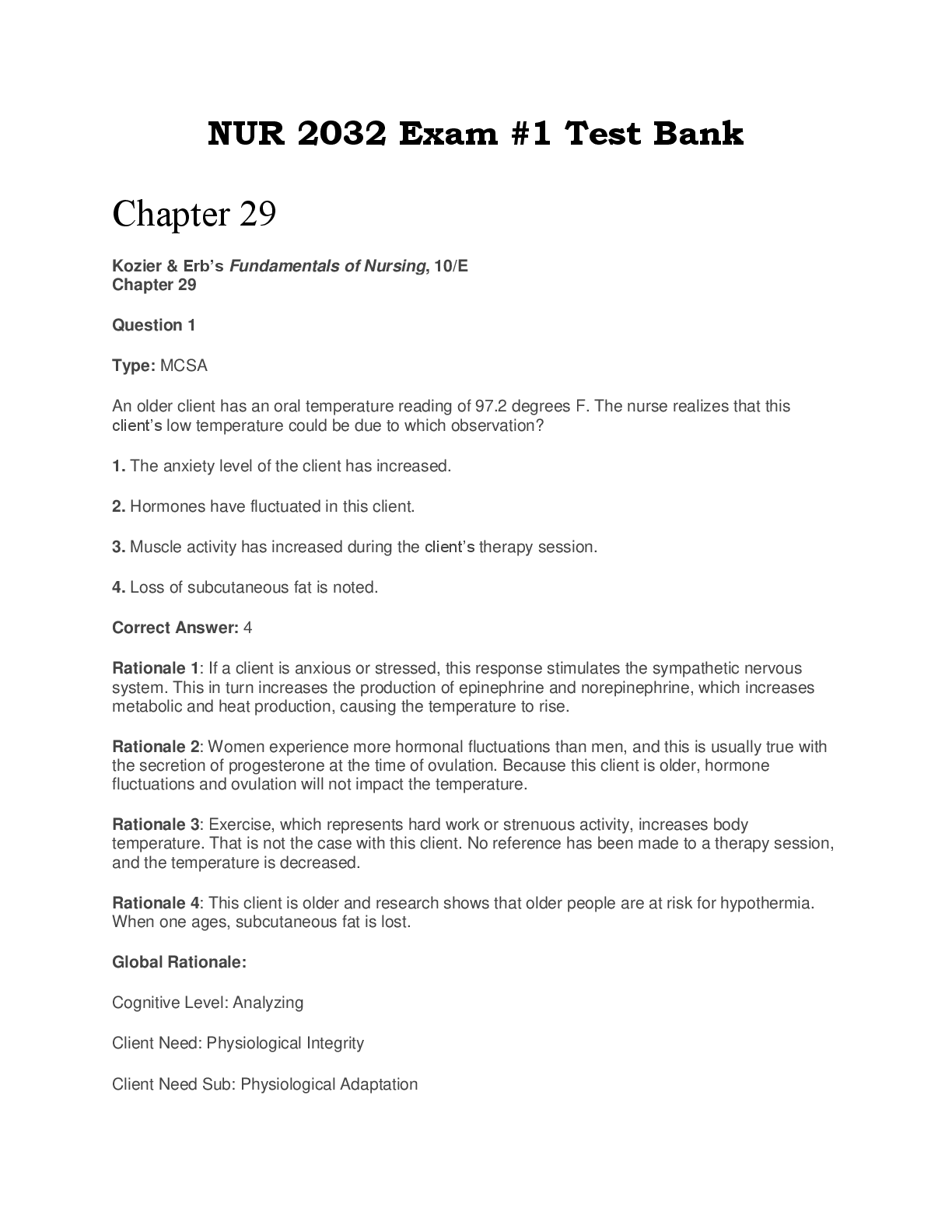




 (Diane Pacitti etc.png)