* We aren't endorsed by this school
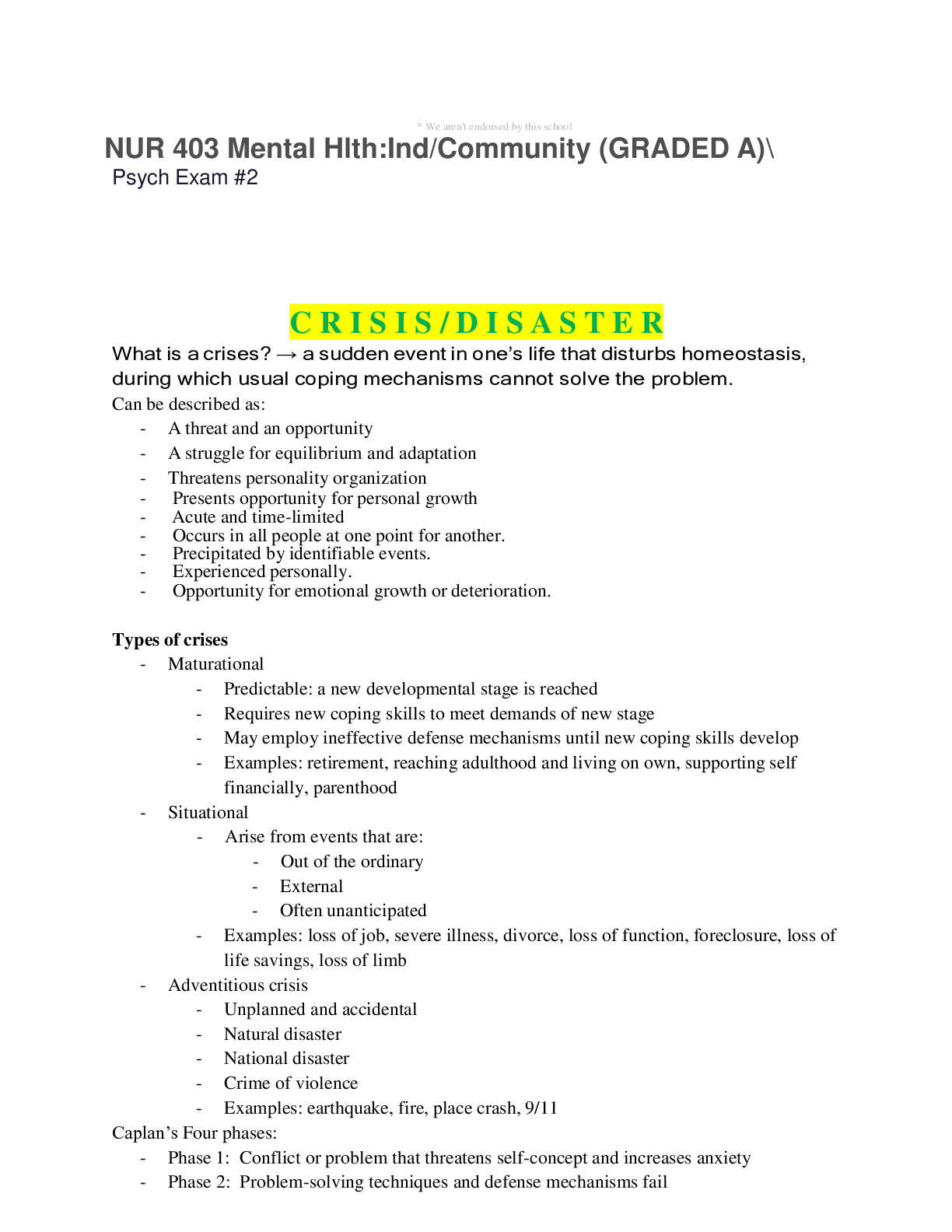
NUR 403 Mental Hlth:Ind/Community (GRADED A)\
Psych Exam #2
C R I S I S / D I S A S T E R
What is a crises? → a sudden event in one’s life that disturbs homeostasis, during wh
...
* We aren't endorsed by this school
NUR 403 Mental Hlth:Ind/Community (GRADED A)\
Psych Exam #2
C R I S I S / D I S A S T E R
What is a crises? → a sudden event in one’s life that disturbs homeostasis, during which usual coping mechanisms cannot solve the problem.
Can be described as:
- A threat and an opportunity
- A struggle for equilibrium and adaptation
- Threatens personality organization
- Presents opportunity for personal growth
- Acute and time-limited
- Occurs in all people at one point for another.
- Precipitated by identifiable events.
- Experienced personally.
- Opportunity for emotional growth or deterioration.
Types of crises
- Maturational
- Predictable: a new developmental stage is reached
- Requires new coping skills to meet demands of new stage
- May employ ineffective defense mechanisms until new coping skills develop
- Examples: retirement, reaching adulthood and living on own, supporting self financially, parenthood
- Situational
- Arise from events that are:
- Out of the ordinary
- External
- Often unanticipated
- Examples: loss of job, severe illness, divorce, loss of function, foreclosure, loss of life savings, loss of limb
- Adventitious crisis
- Unplanned and accidental
- Natural disaster
- National disaster
- Crime of violence
- Examples: earthquake, fire, place crash, 9/11 Caplan’s Four phases:
- Phase 1: Conflict or problem that threatens self-concept and increases anxiety
- Phase 2: Problem-solving techniques and defense mechanisms fail
- Phase 3: Trial-and-error attempts fail; anxiety can escalate
- Phase 4: If problem not solved and coping skills ineffective; “crisis”
Managing Crisis
- Assessment in Crisis Intervention
1. Safety First: assess for suicidal or homicidal ideations or gestures
2. Assess the issues that influence in an individual’s response to the event (perception of precipitating event, situational supports, severity of threat, resources, personal coping skills, environmental factors)
- Common Problems in the Nurse-Patient Relationship in a Crisis Situation
(See Varcarolis, Table 26-1; p. 503)
- When the Nurse “needs to be needed” and fosters dependence. May have difficulty terminating the nurse-patient relationship and see client’s moves toward independence as rejection.
- Nurse sets unrealistic goals for patient: start where patient is and set realistic goals.
- Nurse’s difficulty dealing suicide: focus on safety, and know patients in crisis are vulnerable and need support to fight ambivalence associated with suicide.
- Potential Nursing Diagnoses for Crisis Intervention
1. Type of Response
a. Anxiety
b. Risk for suicide
c. Social isolation
d. Ineffective Individual Coping
2. Related to: crisis intervention
3. As evidenced by: verbalization of inability to cope; inability to problem solve; expression of anxiety; disturbance in social or vocational functioning; panic attacks; suicidal feelings
4. Outcomes: demonstrates use of various coping behaviors or mobilizes resource
- When Coping is Ineffective: Interventions and Rationales
- Address fight/flight response and deep breathing to decrease ANS stimulation → understanding of physical response to stress and ways to control breathing and reduce stressful reactions, decreases anxiety
** Ineffective Individual coping → inability to form a valid appraisal of the stressors; inadequate choices of practical responses; and/or inability to use available resources
INTERVENTION RATIONALE
Assess for suicidal or homicidal thoughts or plans
Take initial steps to make the patient feel safe and less anxious
Listen carefully. (e.g., make eye contact, give frequent feedback to verify and convey understanding, summarize what patient says).
Crisis intervention calls for directive and creative approaches.
Initially the nurse may make phone calls to arrange babysitters, schedule a visiting nurse, find shelter, or contact a social worker
Identify needed social supports (with patient’s input) and mobilize the priority)
Identify needed coping skills (problem solving, relaxation, assertiveness, job training, newborn care, self-esteem building
Involve patient in identifying realistic, acceptable interventions
Plan regular follow up (e.g. phone calls, clinic visits, home visits) to assess patient’s progress Safety is always the first consideration
A person who feels safe and less anxious is able to more effectively problem solve solutions with the nurse
A person who believes someone is really listening is more likely to believe that someone cares about his or her situation and that help may be available
A person who is confused, frightened, or overwhelmed may be temporarily unable to perform usual tasks
A person’s need for shelter, help with care for children or elders, medical workup, emergency medical attention, hospitalization, food, safe housing, and self-help groups is determined
Increased coping skills and learning new ones can help with current crisis and help minimize future crisis
The person’s involvement in planning increases his or her sense of control, self- esteem, and adherence to plan
Plan is evaluated to see what works and what does not
- Identifying appropriate Outcomes for Patient in Crisis (See Varcarolis, Table 26-2)
- Includes new or refined coping, decision making skills, improved role performance, and manageable stress level
- Planning and implementation: #1 Goals: safety and reduction of anxiety
- Counseling: Primary Care; Secondary Care; Tertiary Care
- Primary care → promotes mental health and reduces mental illness to decrease the incidence of crisis
- Education on...
- Secondary care → establishes intervention to prevent prolonged anxiety from diminishing personal effectiveness and personality organization
- Services for identifying new cases and treatment
- Tertiary care → Provides support for those who have experienced a severe crisis and are now recovering from a disabling mental state
- Rehabilitation centers, sheltered workshops, day hospitals, outpatient clinics
- Social and community facilities that provide structured environments that can help prevent problem situations
- Critical Incident Stress Debriefing (CISD): tertiary strategy aimed at people who’ve experienced a crisis: Seven-phase group meeting
- Seven-phase group meeting:
1. Introductory
2. Fact
3. Thoughtful
4. Reaction
5. Symptom
6. Teaching
7. Reentry
- Evaluation: Nursing Outcome Classification (NOC): how will the nurse measure outcomes
- Disaster management:
- Preparedness, mitigation, response, recovery, evaluation
Safety/Suicide in Crisis
- Critical incident stress debriefing (CISD)--> an example of tertiary intervention directed toward a group that has experienced a crisis. CISD consists of a seven-phase group meeting that offers individuals the opportunity to share their thoughts and feelings in a safe and controlled environment. It is used to debrief staff on an inpatient unit following a patient suicide or an incident of violence, to debrief crisis hotline volunteers, to debrief
school- children and school personnel after multiple school shootings, and to debrief rescue and health care workers who have responded to a natural disaster or a terrorist attack (i.e. 9/11)
The phases of CISD are:
- Introductory phase: Meeting purpose is explained; an overview of the debriefing process is provided; confidentiality is assured; guidelines are explained; team members are identified; and questions are answered.
- Fact phase: Participants discuss the facts of the incident; participants introduce themselves, tell their involvement in the incident, and describe the event from their perspective.
- Thought phase: Participants discuss their first thoughts of the incident.
- Reaction phase: Participants talk about the worst thing about the incident—what they would like to forget, and what was most painful.
- Symptom phase: Participants describe their cognitive, physical, emotional, or behavioral experiences at the incident scene and describe any symptoms they felt following the initial experience.
- Teaching phase: The normality of the expressed symptoms is acknowledged and affirmed; anticipatory guidance is offered regarding future symptoms; group is involved in stress-management techniques.
- Reentry phase: Participants review material discussed, introduce new topics, ask questions, and discuss how they would like to bring closure to the debriefing. Debriefing team members answer questions, inform, and reassure; provide written material; provide information on referral sources; and summarize the debriefing with encouragement, support, and appreciation.
A N X I E T Y
What is anxiety? → A universal human experience and is the most basic of emotions. It can be defined as a feeling of apprehension, uneasiness, uncertainty, or dread resulting from a real or perceived threat. Fear is a reaction to a specific danger, whereas anxiety is a vague sense of dread related to an unspecified or unknown danger; however, the body physiologically reacts in similar ways to both anxiety and fear. Another important distinction between anxiety and fear is that anxiety affects us at a deeper level. It invades the central core of the personality and erodes feelings of self-esteem and personal worth.
Levels of anxiety
- Mild
- Occurs in the normal experience of everyday living and allows an individual to perceive reality in sharp focus. A person experiencing a mild level of anxiety sees,
hears, and grasps more information, and problem solving becomes more effective. Physical symptoms may include slight discomfort, restlessness, irritability, or mild tension-relieving behaviors (e.g., nail biting, foot or finger tapping, fidgeting).
- Moderate
- As anxiety increases, the perceptual field narrows, and some details are excluded from observation. The person experiencing moderate anxiety sees, hears, and grasps less information and may demonstrate selective inattention, in which only certain things in the environment are seen or heard unless they are pointed out.
The ability to think clearly is hampered, but learning and problem solving can still take place although not at an optimal level. Sympathetic nervous system symptoms begin to kick in. The individual may experience tension, pounding heart, increased pulse and respiratory rate, perspiration, and mild somatic sympoms (e.g., gastric discomfort, headache, urinary urgency). Voice tremors and shaking may be noticed. Mild or moderate anxiety levels can be constructive because anxiety may be a signal that something in the person’s life needs attention or is dangerous
- Severe anxiety
- The perceptual field of a person experiencing severe anxiety is greatly reduced. A person with severe anxiety may focus on one particular detail or many scattered details and have difficulty noticing what is going on in the environment, even when another points it out. Learning and problem solving are not possible at this level, and the person may be dazed and confused. Behavior is automatic and aimed at reducing or relieving anxiety. Somatic symptoms (e.g., headache, nausea, dizziness, insomnia) often increase; trembling and a pounding heart are common, and the person may experience hyperventilation and a sense of impending doom or dread
- Panic
- Panic is the most extreme level of anxiety and results in markedly disturbed behavior. Someone in a state of panic is unable to process what is going on in the environment and may lose touch with reality. The behavior that results may be manifested as pacing, running, shouting, screaming, or withdrawal.
Hallucinations, or false sensory perceptions (e.g., seeing people or objects not really there), may be experienced. Physical behavior may become erratic, uncoordinated, and impulsive. Automatic behaviors are used to reduce and relieve anxiety although such efforts may be ineffective. Acute panic may lead to exhaustion.
Antianxiety Medications (SSRIs; Benzodiazepines)
- Antianxiety med that is often used to treat the somatic and psychological symptoms of anxiety disorders. When moderate or severe anxiety is reduced, patients are better able to participate in treatment of their underlying problems. Benzodiazepines are most commonly used because they have a quick onset of action; however, due to the potential for dependence, these medications ideally should be used for short periods, only until other medications or treatments reduce symptoms. An important nursing intervention is to monitor for side effects of the benzodiazepines, including sedation, ataxia, and decreased cognitive function. Benzodiazepines are not recommended for patients with a known substance abuse problem and should not be given to women during pregnancy or breastfeeding.
- Antidepressant → Selective serotonin reuptake inhibitors (SSRIs) are considered the first line of defense in most anxiety and obsessive-compulsive related disorders.
These SSRIs include paroxetine (Paxil), fluoxetine (Prozac), escitalopram (Lexapro), fluvoxamine (Luvox), and sertraline (Zoloft). Some of these antidepressants exert more of an “activating” effect than others and may actually increase anxiety. Sertraline (Zoloft) and paroxetine (Paxil) seem to have a more calming effect than the other SSRIs.
Antidepressants have the secondary benefit of treating comorbid depressive disorders.
- Venlafaxine (Effexor) is a serotonin-norepinephrine reuptake inhibitor (SNRI) that is quite successful in the treatment of several anxiety disorders. Another SNRI, Duloxetine (Cymbalta), is effective in the treatment of generalized anxiety disorder.
- Monoamine oxidase inhibitors (MAOIs) are reserved for treatment-resistant conditions because of the risk of life-threatening hypertensive crisis if the patient does not follow dietary restrictions (patients cannot eat foods containing tyramine and must be given specific dietary instructions). The risk of hypertensive crisis also makes the use of MAOIs contraindicated in patients with comorbid substance abuse.
Contraindications to Use of Benzodiazepines
- Patients with a known substance abuse problem and should not be given to women during pregnancy or breastfeeding.
Assessing Anxiety (levels and symptoms)
- Ensure that a sound physical and neurological examination is performed to help determine whether the anxiety is primary or secondary to another psychiatric disorder, medical condition, or substance use
- Determine current level of anxiety (mild, moderate, severe, or panic).
- Assess for potential for self-harm and suicide; persons suffering from high levels of intractable anxiety may become desperate and attempt suicide.
- Perform a psychosocial assessment. Always ask the person, “What is going on in your life that may be contributing to your anxiety?” The patient may identify a problem (stressful marriage, recent loss, stressful job, or school situation) that should be addressed by counseling
Nursing Interventions For Each Stage of Anxiety
Agoraphobia (Sx and Rx)
- Agoraphobia is intense, excessive anxiety or fear about being in places or situations from which escape might be difficult or embarrassing or in which help might not be available. The feared places are avoided in an effort to control anxiety. Examples of situations that are commonly avoided by patients with agoraphobia are being alone outside; being alone at home; traveling in a car, bus, or airplane; being on a bridge; and riding in an elevator. These situations may be made more tolerable with the addition of a friend. Avoidance behaviors can be debilitating and life constricting. Consider the effect on a father whose agoraphobia renders him unable to leave home and prevents him from seeing his child’s high school graduation or the businesswoman whose avoidance of flying prevents her from attending distant business conferences.
Obsessive Compulsive Disorder (Sx and Rx)
- Obsessive-compulsive behavior exists along a continuum. Most sufferers may experience mildly obsessive-compulsive behavior such as nagging doubts as to whether a door is locked or the stove is turned off. These doubts require the person to go back to check the door or stove. Mild compul- sions about timeliness, orderliness, and reliability are valued traits in U.S. society.
- At the pathological end of the continuum is obsessive- compulsive disorder with symptoms that occur on a daily basis and may involve issues of sexuality, violence, contamination, illness, or death. Pathological obsessions or compulsions cause marked distress to individuals, who often feel humiliation and shame regarding these behaviors. The rituals are time-consuming and interfere with normal routines, social activities, and relationships with others. Severe obsessive- compulsive disorder occupies so much of the individual’s mental processes that the performance of cognitive tasks is impaired. English soccer player David Beckham has shared his struggle with obsessive-compulsive disorder. He has a compulsion to count his clothes and line his magazines up in a straight line.
- About a third of adult cases begin in childhood and can be present as early as age 3 (Bostic & Prince, 2010). Younger children are often preoccupied with turning off lights or locking doors and windows, while older children and adolescents tend to focus on contamination. Young people experience shame and helplessness as their rituals interfere with their ability to form relationships and attend school.
T R A U M A , S T R E S S O R - R E L A T E D D I S O R D E R S , A N D D I S S O C I A T I V E D I S O R D E R S
PTSD: (Sx and Rx)
- In children:
- Reduction in play
- Play that re-enacts the traumatic event
- Social withdrawal
- Negative emotions: fear, guilt, horror, sadness, shame, confusion
- I am a bad person
- Irritable, aggressive, self-destructive, poor sleep, poor concentration and hypervigilance
- In adults:
- Flashbacks
- Avoidance of stimuli associated with trauma: avoidance of people, places and activities
- Inability to recall aspects of the trauma
- Experience of persistent numbing of responses
- Persistent symptoms of increased arousal—hypervigilance and irritability
- Decreased interest in usual things
- Difficulty in interpersonal, social, or occupational relationships
- Increased arousal/hypervigilance
- Difficulty in falling or staying asleep
- Irritability and outbursts of anger
- Difficulty concentrating
- Duration more than 1 month
- Chronic: more than 3 months or more
- Delayed: onset of symptoms is at least 6 months after the stress.
Nursing Considerations
- Children
- Establish trust and safety in the therapeutic relationship.
- Use developmentally appropriate language to explore feelings. Teach relaxation techniques before trauma exploration to restore a sense of control over thoughts and feelings.
- Help the child to identify and cope with feelings through the use of art and play to promote expression.
- Involve the parents or appropriate caretakers in 1:1s unless they are the cause of the trauma.
- Educate the child and parents about the grief process and response to the trauma.
- Assist parents in resolving their own emotional distress about the trauma.
- Coordinate with social work for protections as indicated
- Adults
- Stage Model (as seen in adolescents)
- Psychoeducation
- Psychopharmacology
- SSRI :fluoxetine (Prozac); paroxetine (Paxil); sertraline (Zoloft)
- Serotonin norepinephrine reuptake inhibitor (SNRI): venlafaxine (Effexor)
- to decrease anxiety and depressive symptoms
Dissociative Identity Disorder (Sx and Rx)
- Occur after significant adverse experiences/ traumas, and individuals respond to stress with a severe interruption of consciousness. Dissociation is an unconscious defense mechanism that protects the individual against overwhelming anxiety through an emotional separation; however, this separation results in disturbances in memory, consciousness, self- identity, and perception.
- Symptoms of Dissociation
- Positive symptoms include flashbacks and these are unwanted additions to mental activity.
- Negative symptoms include memory problems or ability to sense or control different parts of the body.
- May be protective in childhood. Child able to be attached to his/her abuser
- Thoughts may not intrude into consciousness until later in adulthood.
Nursing Considerations
- Milieu therapy: be ready to work with any of the alters and the change in affect that can occur.
- Health teaching
- Psychobiological interventions: medications for depression and anxiety
- Safe protected environment
- Identify the identity of the patient and orientation to time, place and person.
- Allow patient to go at own pace while memories are uncovered.
- Teach stress reduction methods.
- Provide support when painful experiences are revealed.
- No specific medication for Dissociative disorders
- Symptoms of hyperarousal and intrusive symptoms and depression are treated
Dissociative Disorders
- Depersonalization DIsorder
- Alteration in perception of self
- Disturbing experiences of
- Feeling a sense of deadness of the body
- Seeing oneself from a distance
- Perceiving limbs to be larger or smaller than normal
- Feeling detached and outside of one’s mental processes or body.
- Reality testing remains intact
- Dissociative Amnesia
- Inability to recall important personal information
- Generalized amnesia: about his/her lifetime.
- Localized amnesia: certain period of time.
- Selective amnesia: Some things are remembered, some things are forgotten.
- Dissociative Fugue
- Sudden unexpected travel away from the customary locale. This is precipitated by a traumatic event.
- Inability to recall one's identity and some or all of the past
- During fugue state tend to live simple, quiet lives
- When remember former identity, become amnesic for time spent in fugue state
- Dissociative Identity Disorder
- Presence of two or more distinct personality states . Used to be called “multiple personality disorder.”
- Primary personality (host) usually not aware of alters.
- Alters may be different sexes; different dominant hands, different voices
- Alternate personality (alters) or subpersonalities take control of behavior
- Alters often aware of each other: childlike one; an aggressive one
- Each alter thinks and behaves as a separate individual
- Host does not recognize the alters
- Inability to recall important information too extensive to be explained by ordinary forgetfulness.
- Host does not recognize the alters
- Inability to recall important information too extensive to be explained by ordinary forgetfulness
Dissociative Disorders
- Patient may refer to self as “we” versus “I”
- Handwriting may change
- Mannerisms may be different in different alters
- Tone of voice may be different in different alters
- Eyeglasses or not in different alters
- Defense mechanisms: Repression and dissociation
S O M A T I C S Y M P T O M D I S O R D E R
Somatic Symptom Disorder
- Excessive distressing symptoms and exaggerated or maladaptive response or associated health concerns without physical findings or medical diagnosis.
- Suffering is authentic
- High level of functional impairment
- Women predominate: seek out medical care, in tune with body
Meaning of Symptoms
- Fatigue
- Pain
- Back Pain
- Headaches
- Insomnia
- Shortness of breath
- Dizziness
- Appraise body symptoms as severe and life-threatening
Implications for Intervention
- Help patient get needs met without resorting to somatization.
- Help patient express FEELINGS, versus converting feelings into physical symptoms.
- Good communication; acceptance instead of stigmatizing the patient.
- Promote self-care activities
- Increase sense of independence
- Set up a helping nurse-patient relationship
- Determine if the patient’s signs and symptoms are conscious or unconscious.
- If you confront they will become angry and defensive.
- Self-assessment: these patients may make us angry.
B I P O L A R & R E L A T E D D I S O R D E R S
Diagnostic criteria: BP I and II
- BP I → mania
- Distinct period of time in which the person has a persistently elevated, expansive or irritable mood and abnormally and persistently increased goal-directed activity or energy, lasting at least 1 week and present most of the day, nearly every day.
- During this time, shows 3 or more of the following symptoms:
- Inflated self-esteem/grandiosity
- Decreased need for sleep (rested after 3 hours)
- More talking more than usual or pressure to keep talking
- Flight of ideas or subjective experience that thoughts are racing
- Distractibility
- Increased goal-directed activities (socially, at work, sexually) or psychomotor agitation
- Excessive involvement in pleasurable activities that have a noted risk for painful consequences (buying sprees/ sexual encounters; bad business deals).
- Mood is sufficiently severe to:
- cause marked impairment in social or occupational functioning
- necessitate hospitalization to prevent harm to self or others
- include psychotic features.
- BP II → hypomania
- A distinct period of abnormally and persistently elevated, expansive, or irritable mood and abnormally and persistently increased activity or energy, lasting at least 4 consecutive days and present most of the day, nearly every day.
- During this period of mood disturbance and increased energy and activity, 3 or more of the following symptoms (4 if the mood is only irritable)
- Increase in goal-directed activity
- Excessive involvement in activities that have a high potential for painful consequences (unrestrained buying sprees, sexual indiscretions, foolish business deals)
- The episode is not severe enough to cause marked impairment in social or occupational functioning or to require hospitalization
Mood Stabilizers: Nursing considerations for clients taking Lithium
- Lithium:
- Mood stabilizer
- First-line agent
- Takes 7 to 14 days to reach therapeutic levels in blood
- Therapeutic blood level
- 0.8 to 1.4 mEq/L (1.2?)
- Maintenance blood level 0.4 to 1.3 mEq/L
- Initial treatment of acute mania until Lithium takes effect
- Antipsychotics
- Slow speech
- Inhibit aggression
- Decrease psychomotor activity
- Antipsychotic or benzodiazepine to prevent:
- Exhaustion
- Coronary collapse
- Death
- Expected Side Effects
- Blood level: <0.4 to 1.0 mEq/L
- Signs
- Fine hand tremor
- Polyuria
- Mild thirst
- Mild nausea
- General discomfort
- Weight gain
- Early Signs of Toxicity
- •Blood level: 1.5 mEq/L
- Signs
- Nausea
- Vomiting
- Diarrhea
- Thirst
- Polyuria
- Slurred speech
- Muscle weakness
- Advanced Signs of Toxicity
- Blood level: 1.5 to 2.0 mEq/L
- Signs
- Coarse hand tremor
- Persistent gastrointestinal upset
- Mental confusion
- Muscle hyper-irritability
- Incoordination
- Severe Toxicity
- •Blood level: 2.0 to 2.5 mEq/L
- Signs
- Ataxia
- Blurred vision
- Clonic movements
- Large output of dilute urine
- Seizures
- Stupor
- Severe hypotension
- Coma
- Death
- Blood level: >2.5 mEq/L
- Signs
- Confusion
- Incontinence of urine or feces
- Coma
- Cardiac arrhythmias
- Peripheral circulatory collapse
- Abdominal pain
- Proteinuria
- Oliguria
- Death
- Major Long Term Risks
- Patients who take Lithium have the potential to develop:
- Hypothyroidism
- Impairment of kidneys’ ability to concentrate urine
- Blood work to test thyroid and renal functioning is done prior to and during treatment with lithium
- Contraindications
- Cardiovascular disease
- Brain damage
- Renal disease
- Thyroid disease
- Myasthenia gravis
- Pregnancy
- Breastfeeding mothers
- Children younger than 12 years
- Client and Family Teaching for Lithium Therapy
- Effects of treatment
- Need to monitor lithium blood levels
- Side effects and toxic effects
- Effects of food and over-the-counter medications
- When to call the physician
Nursing Interventions in mania
- Acute →
- Communication: clear communication; consistency between staff;
- Structure in a safe milieu set limits; patient may need restriction from others if he/she cannot control behavior
- Physiological safety: run after them with food/fluids; finger foods
- Self-care needs: may not shower; nurse needs to follow up with patient’s hygiene and tell him/her to take care of elimination needs; wash clothes
-
-
Psychoeducation for Bipolar Disorder
- In the continuum phase
- Lasts for 4 to 9 months. Although the overall outcome of this phase is relapse prevention, many other outcomes must be accomplished to achieve relapse prevention. These outcomes include the following:
- Psychoeducational classes for patient and family related to:
- Knowledge of disease process
- Knowledge of medication
- Consequences of substance addictions for predicting future relapse
- Knowledge of early signs and symptoms of relapse
- Support groups or therapy (cognitive-behavioral, interpersonal)
- Communication and problem-solving skills training
Best approaches for someone with bipolar disorder
- Use firm, calm approach
- Use short and concise explanations
- Remain neutral: avoid power struggles
- Be consistent in approach and expectations
- Firmly redirect energy into more appropriate areas
Serotonin Syndrome (Signs and Symptoms)
- Serotonin syndrome → One rare and life-threatening event associated with SSRIs is serotonin syndrome. This syndrome is thought to be related to over-activation of the central serotonin receptors caused by either too high a dose or interaction with other drugs.
- Symptoms include abdominal pain, diarrhea, sweating, fever, tachycardia, elevated blood pressure, altered mental state (delirium), myoclonus (muscle spasms), increased motor
activity, irritability, hostility, and mood change. Severe manifestations can induce hyperpyrexia (excessively high fever), cardiovascular shock, or death.
D E P R E S S I V E D I S O R D E R S
Antidepressant Medications
MAOI Diet
AVOID FOODS WITH TYRAMINE AND VASOPRESSORS
SSRIs/SNRIs and adverse events
- SSRIs →
- Serotonin receptors
- Indications: depression and anxiety
- Side effects/adverse reactions: lower level of anticholinergic side effects; but positive for agitation, sleep disturbance, tremor, sexual dysfunction; sweating, nausea, headaches
ECT: what occurs and nursing implications
- Procedure: controlled environment like a PACU; sodium brevital and succinylcholine
- Advantages: for 20-30% who do not respond to medications; when positive response in past to ECT
- Potential adverse reactions; headache post procedure; short term memory loss; long term memory loss; safer in elderly than TCAs.
Assertiveness training for depression
- Type of therapeutic group
- Can help to increase self-esteem and improve interpersonal relationships
Therapeutic communication to use with someone who is depressed
- Maintain therapeutic milieu: encourage short term activities that increase self-esteem
[Show More]