Week 3 – Psychiatric Disorders and Screening Discussions (INITIAL RESPONSE)
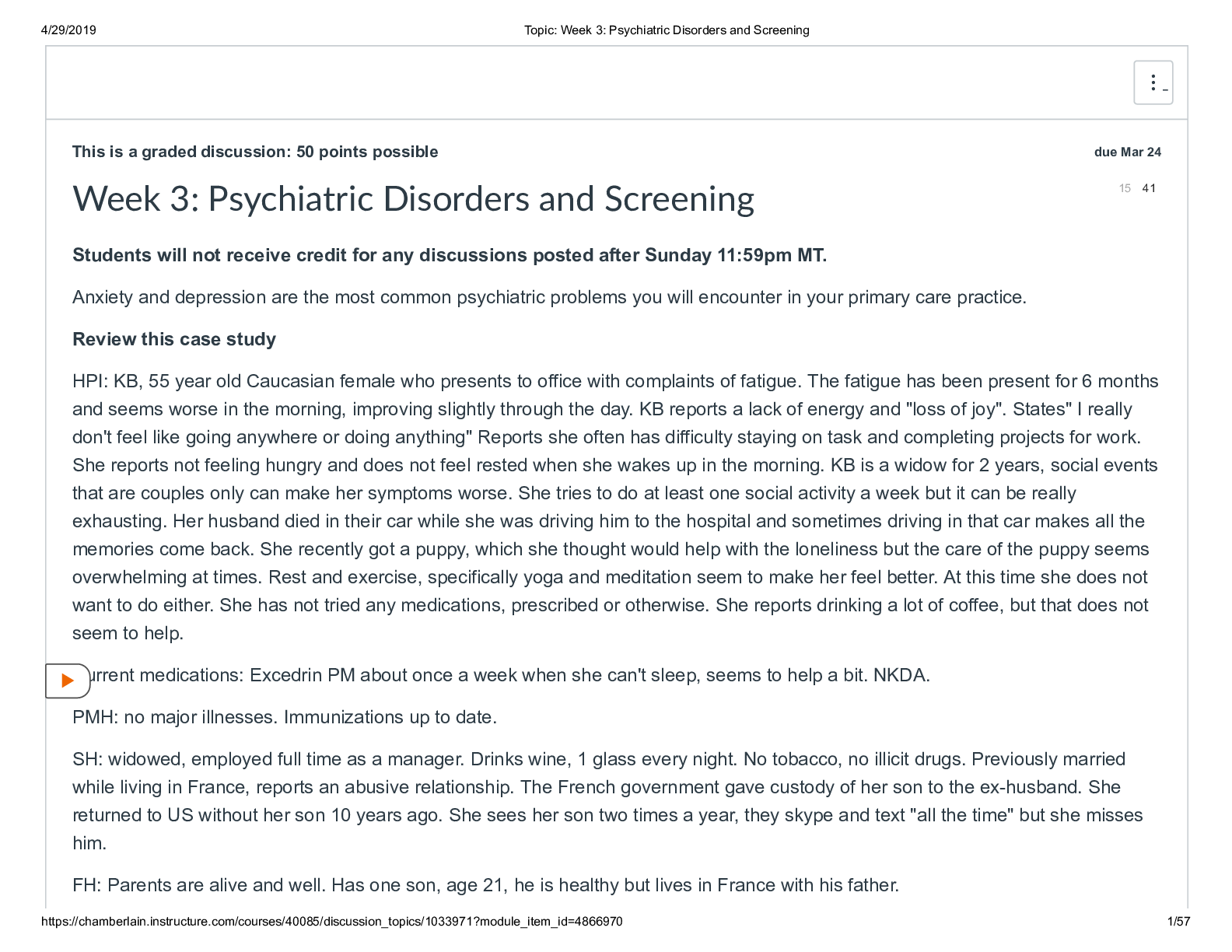
Research screening tools for depression and anxiety.
Choose one screening tool for depression and one screening tool for anxiety that you
f
...
Week 3 – Psychiatric Disorders and Screening Discussions (INITIAL RESPONSE)
Research screening tools for depression and anxiety.
Choose one screening tool for depression and one screening tool for anxiety that you
feel are appropriate to screen KB.
Explain why you chose that particular tool for KB.
Score KB based on the information provided (not all data may be provided). Include
what questions could be scored, and your chosen score. Assume that any question
topics not mentioned are not a concern at this time.
The screening tool chosen for depression is the Patient Health Questionnaire-9 (PHQ-9). It is
estimated that 14% of patients in the primary care setting have depression; and it is frequently
not diagnosed because of the lack of utilization of standardized screening tools (Hirschtritt &
Kroenke, 2017). According to Hirschtritt and Kroenke (2017), when standardized screening tools
are not utilized, primary care providers only recognize depression in an estimated 47% of
patients. The PHQ-9 is a self-report questionnaire based on symptoms experienced over the past
2 weeks that comprises of 9 items, which are then added together to result a score ranging from 0
through 27 (Hirschtritt & Kroenke, 2017). According to Hirschtritt & Kroenke (2017), a total
score ≥10 has an estimated specificity of 85.3% for major depressive disorder. There are several
benefits to the PHQ-9 screening tool which include: self-report format, quick scoring and
interpretation, available in multiple languages, and can be administered remotely such as in cases
where telehealth is utilized (Hirschtritt & Kroenke, 2017). I chose the PHQ-9 screening tool for
depression because it is geared towards the general adult population, and is frequently utilized in
the primary care setting. I find this screening tool very effective and have used it many times
thus far in my clinical rotations, as well as in the emergency department where I currently work.
PHQ-9:
Over the last 2 weeks, how often have you been bothered by any of the following problems? (0 =
not at all, 1 = several days, 2 = more than half the days, 3 = nearly every day)
1. Little interest or pleasure in doing things = 3
2. Feeling down, depressed, or hopeless = 3
3. Trouble falling or staying asleep, or sleeping too much = 1
4. Feeling tired or having little energy = 3
5. Poor appetite or overeating = 3
6. Feeling bad about yourself or you are a failure or have let yourself or your family down = 2
7. Trouble concentrating on things, such as reading the newspaper or watching television = 2
8. Moving or speaking so slowly that other people could have noticed? Or the opposite—being
so fidgety or restless that you have been moving around a lot more than usual = Not
Known
9. Thoughts that you would be better off dead or of hurting yourself in some way = Not Known
Total score = 17 (Hirs
[Show More]