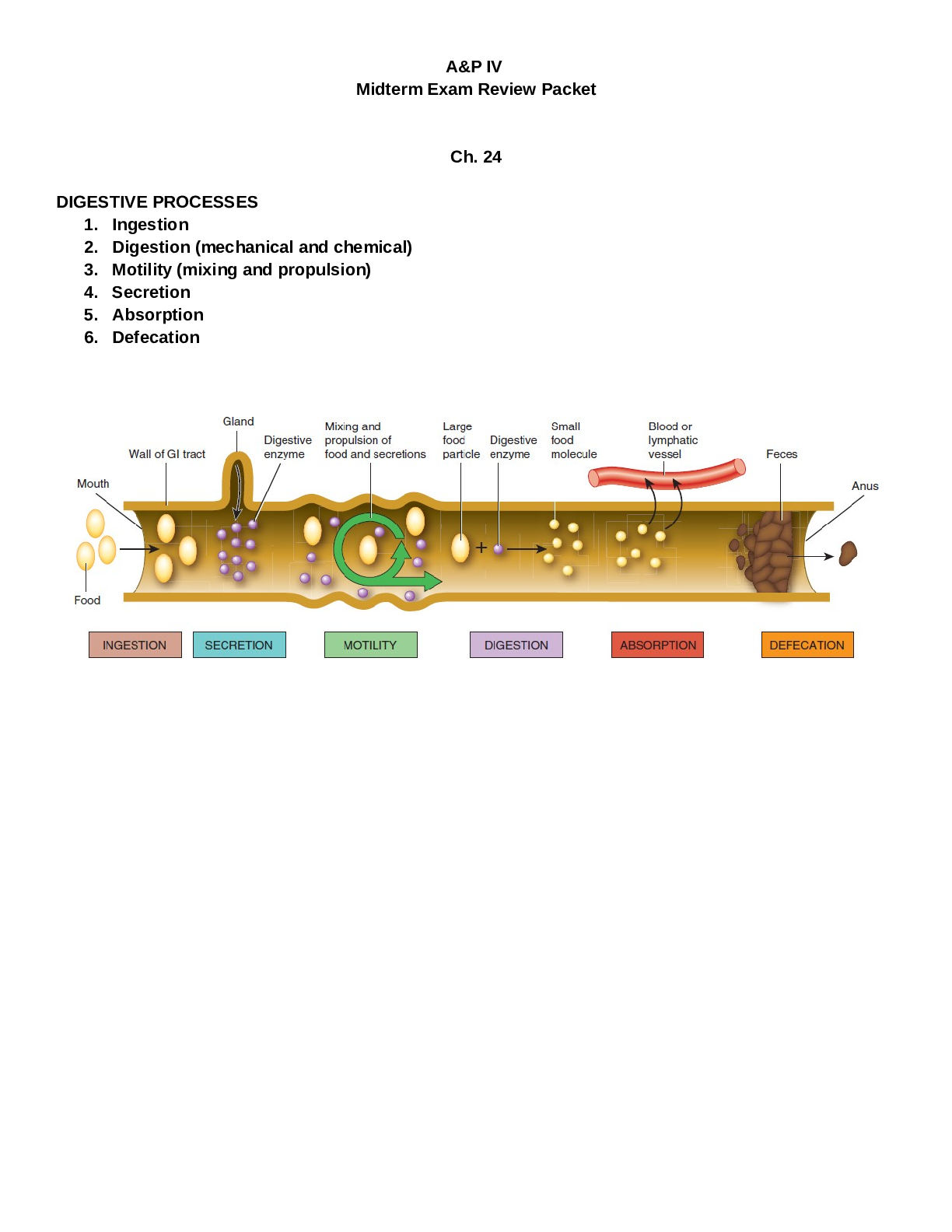
DIGESTIVE PROCESSES
1. Ingestion
2. Digestion (mechanical and chemical)
3. Motility (mixing and propulsion)
4. Secretion
5. Absorption
6. Defecation
GI TRACT AND ACCESSORY DIGESTIVE STRUCTURES
BE ABLE TO IDENTIFY
...
DIGESTIVE PROCESSES
1. Ingestion
2. Digestion (mechanical and chemical)
3. Motility (mixing and propulsion)
4. Secretion
5. Absorption
6. Defecation
GI TRACT AND ACCESSORY DIGESTIVE STRUCTURES
BE ABLE TO IDENTIFY EACH ORGAN ON THE IMAGE ABOVE.
GI TRACT INNERVATION
Autonomic NS
o Parasympathetic NV (enhances digestion)
o Sympathetic NV (inhibits or slows down digestion)
Enteric Nervous System
o Submucosal plexus
o Myenteric plexus
Be able to identify all parts of the GI tract
What are the histological significances of the GI tract?
The GI tract consist of 4 layers:
Mucosa- Divides into 3 layers
Epithelium – Surface Epithelium
Lamina Propria – Connective Tissue
Muscularis Mucosae – Smooth Muscle
Submucosa- Areolar Connective Tissue
Muscularis- In all GI tract organs except the stomach
Serosa
ENZYMES originating in the oral cavity
What are the functions of the oral cavity?
Salivary glands
Parotid glands (under the cheek bones)
Submandibular glands (under the mandible)
Sublingual glands (under the tongue)
All secrete SALIVA, which contains:
o Mostly water
o Ions
o Buffers
o Lysosyme
o Salivary amylase
Salivary Amylase (made by the salivary glands)
- Break down carbohydrates
- Converts Polysaccharides to monosaccharides, maltose, maltotriose and alpha-dextrins
- Deactivated by stomach acid
Lingual Lipase (made by the lingual glands of the tongue)
- From lingual glands of the tongue
- Break down lipids
- Activated by HCl of stomach
- Converts triglycerides to fatty acids and monoglycerides
- What are the components of saliva?
Among these polynucleotides, what is digested in the oral cavity? (proteins, lipids, nucleic acids,
carbohydrates)
THE SIGNIFICANT CELLS OF THE STOMACH AND THEIR SECRETIONS (GASTRIC JUICE)
Parietal Cells
- Secrete HCl
- makes the chyme acidic
- kills bacteria
- denaturing (unfolding) proteins
- activates pepsin along with lingual lipase.
- Secrete intrinsic factor, which allows for absorption of vitamin B12
Chief Cells
- The major stomach cells
- Secrete pepsinogen, which is activated (by stomach acid) and becomes pepsin, a peptidase
- Pepsin breaks down proteins
- Secrete gastric lipase
- breaks down triglycerides into monoglycerides and fatty acids
G Cells
- Secrete Gastrin (hormone): contracts cardiac sphincter; loosens pyloric sphincter; promotes stomach
motility; promotes secretion of pepsinogen from chief cells and HCl from parietal cells
Mucous Cells
- THEY SECRETE MUCOUS
- Mucous forms a protective barrier against acidic chyme
What is the function of stomach acid?
Define gastric secretion. What are the components of gastric secretion?
THE SIGNIFICANT CELLS OF THE SMALL INTESTINE AND THEIR SECRETIONS
Paneth Cells
- Secrete lysozome
The Enteroendocrine Cells
- S Cells
- Secrete secretin in response to acidic chyme, promoting release of HCO3- rich pancreatic
juice; secondarily, secretin slows down secretion of gastric juice.
- K Cells
- Secrete GIP (glucose-dependent insulinotropic peptide)
- slows down secretion of gastric juice
- stimulates insulin secretion
- CCK Cells
- Secrete cholecystokinin in response to amino acid and fatty acid
- CCK stimulates digestive enzyme-rich pancreatic juice
- relaxes the sphincter of Oddi
- slows gastric emptying
- promotes a feeling of satiety
- causes contraction of the gallbladder
- CCK and Secretin enhance each other
Brunner’s Glands
- Secrete alkaline rich mucus to counter acidic chyme
- Located in the duodenum
- Why is it important for the Brunner’s gland to secrete alkaline fluid?
Describe the cells that line the GI tract. (Hint: in each region, there are different cells)
What kind of muscle tissue is found in the GI tract?
The Brush-border
- Brush-border enzymes are inserted into the plasma membranes of the microvilli in the small intestine
Alpha-dextrinase
- Alpha-dextrins to glucose
Maltase
- Maltose to glucose
Lactase
- Lactose to glucose and galactose
Sucrase
- Sucrose to glucose and fructose
Enterokinase
- Converts trypsinogen to trypsin
Aminopeptidase
- Further breaks down amino acids and peptides
Dipeptidase
- Dipeptides to amino acids
Phosphatases & Nucleosidases
- Nucleotides to nitrogenous bases
- What is the importance of villi?
PANCREATIC JUICE
Pancreatic Amylase
- Breaks down carbohydrates
- Converts polysaccharides to a-dextrose, maltose and maltotriose
Pancreatic Lipase
- Breaks down lip
[Show More]