Two other study suggestions:
1. Be able to describe in detail the course outcomes found in the syllabus
2. Answer the question interspersed throughout the readings. If you can answer
those, you will more likely be ab
...
Two other study suggestions:
1. Be able to describe in detail the course outcomes found in the syllabus
2. Answer the question interspersed throughout the readings. If you can answer
those, you will more likely be able to answer the final’s questions.
Gastrointestinal
Know anatomy and roles of
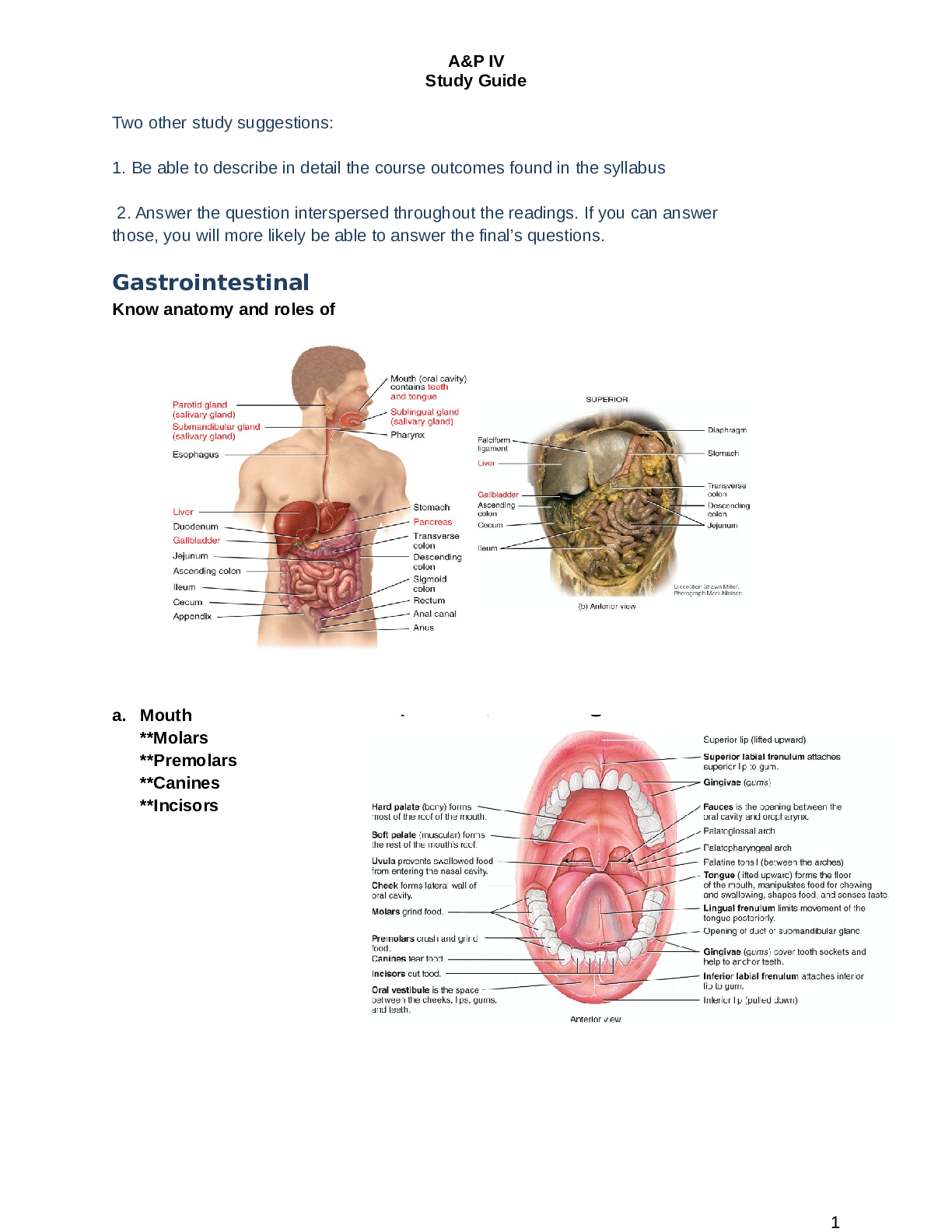
a. Mouth
**Molars
**Premolars
**Canines
**Incisors
1
A&P IV
Study Guide
The mouth is formed by the cheeks, hard and soft palates, and tongue
Salivary glands lie outside the mouth and empty their contents into ducts which deliver
saliva into the oral cavity.
o Oral Cavity 3 pairs:
1.Parotid
2.Submandibular
3.Sublingual
➢ Mechanical digestion
Chewing mixes food with saliva and forms a bolus which can be easily swallowed
➢ Chemical digestion
Salivary amylase converts polysaccharides to disaccharides
b. Pharynx
The pharynx is a funnel shaped tube that extends from the internal nares to the esophagus
posteriorly and to the larynx anteriorly
The pharynx is composed of skeletal muscle and lined with mucous membrane
c. Esophagus
The esophagus is a collapsible, muscular tube that lies posterior to the trachea and
connects the pharynx to the stomach
2
A&P IV
Study Guide
d. Deglutition
d. Stomach
3
A&P IV
Study Guide
The stomach is a J-shaped enlargement of the GI tract
Functions:
1.Mixes saliva, food, and gastric juice to form chyme
2.Serves as a reservoir for food before release into the small intestine
3.Secretes gastric juice which contains
HCl
Pepsin
Intrinsic Factor
Gastric Lipase
4.Secretes gastrin(Hormone) into the blood
Secretion and Regulation of HCI in the Stomach
4
A&P IV
Study Guide
e. Liver
The liver is composed of
o hepatocytes
o bile canaliculi, and hepatic sinusoids
➢ The liver synthesizes bile, which is important in the digestion and absorption (emulsification)
of fats and cholesterol in the small intestine
The liver maintains normal blood glucose levels.
⇨ Functions of the Liver and Gallbladder
Carbohydrate, lipid, and protein metabolism
Processing of drugs and hormones
Bilirubin excretion
Bile salt synthesis
Storage
Phagocytosis
5
A&P IV
Study Guide
Vitamin D activation
f. Gallbladder
⇨ The gallbladder stores bile until it is needed
g. Pancreas
⇨ Lies posterior to the stomach
⇨ Produces enzymes that digest
Carbohydrates
Proteins
Fats
nucleic acids
⇨ Produces
sodium bicarbonate which buffers stomach acid
Empties its contents into the duodenum h. Small Intestine
Most of the digestion and absorption occur in the small intestine
1.Segmentations mix chime with digestive juices and bring food into contact with
mucosa for absorption; peristalsis propels chime through small intestine
2.Completes digestion of carbohydrates, proteins, lipids;
begins and completes digestion of nucleic acids
3.Absorbs about 90% of nutrients and water that pass through digestive system
Circular folds increase the surface area for digestion and absorption in
the small intestine
Mechanical Digestion in the SI
Segmentation Localized contractions
Peristalsis Propulsive contractions Chemical Digestion in the SI
Digestion of:
➢ Carbohydrates ➢ Proteins ➢ Lipids ➢ Nucleic Acids
i. Duodenum
the first and shortest segment of the small intestine. It recei
[Show More]