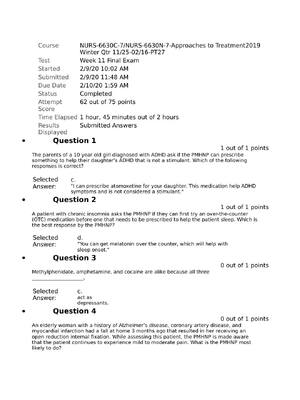
Question 1
1 out of 1 points
The parents of a 10 year old girl diagnosed with ADHD ask if the PMHNP can prescribe
something to help their daughter’s ADHD that is not a stimulant. Which of the following
responses is c
...
Question 1
1 out of 1 points
The parents of a 10 year old girl diagnosed with ADHD ask if the PMHNP can prescribe
something to help their daughter’s ADHD that is not a stimulant. Which of the following
responses is correct?
Selected
Answer:
c.
"I can prescribe atomoxetine for your daughter. This medication help ADHD
symptoms and is not considered a stimulant."
Question 2
1 out of 1 points
A patient with chronic insomnia asks the PMHNP if they can first try an over-the-counter
(OTC) medication before one that needs to be prescribed to help the patient sleep. Which is
the best response by the PMHNP?
Selected
Answer:
d.
“You can get melatonin over the counter, which will help with
sleep onset.”
Question 3
0 out of 1 points
Methylphenidate, amphetamine, and cocaine are alike because all three
_____________________.
Selected
Answer:
c.
act as
depressants.
Question 4
0 out of 1 points
An elderly woman with a history of Alzheimer’s disease, coronary artery disease, and
myocardial infarction had a fall at home 3 months ago that resulted in her receiving an
open reduction internal fixation. While assessing this patient, the PMHNP is made aware
that the patient continues to experience mild to moderate pain. What is the PMHNP most
likely to do?
Selected
Answer:
b.
Order an X-ray because it is possible that she
dislocated her hip.
Question 5
1 out of 1 points
The PMHNP is caring for a patient who openly admitted to drinking a quart of vodka daily.
Prior to prescribing this patient disulfiram (Antabuse), it is important for the PMHNP to:
Selected
Answer:
c.
Evaluate the patient’s willingness to abstain
from alcohol
Question 6
0 out of 1 points
Insomnia is caused by excessive nighttime arousal. The PMHNP is likely to prescribe which
of the following to treat insomnia?
Selected
Answer:
d.
A negative allosteric modulator of GABA-A
receptors
Question 7
1 out of 1 points
The nursing staff asks the PMHNP for additional education regarding the treatment of
agitation in dementia patients. Which of the following is correct?
Selected
Answer:
b.
The nurse should attempt to determine how the patient's environment
may be impacting the patient's mood.
Question 8
1 out of 1 points
The PMHNP is evaluating a 30-year-old female patient who states that she notices pain and
a drastic change in mood before the start of her menstrual cycle. The patient states that
she has tried diet and lifestyle changes but nothing has worked. What will the PMHNP most
likely do?
Selected
Answer:
d.
Prescribe desvenlafaxine (Pristiq), 50
mg daily
Question 9
1 out of 1 points
The PMHNP is caring for a patient who reports excessive arousal at nighttime. What could
the PMHNP use for a time-limited duration to shift the patient’s brain from a hyperactive
state to a sleep state?
Selected
Answer:
b.
Benzodiazepi
nes
Question 10
1 out of 1 points
Which of these characteristics does NOT meet the criteria for probably Alzheimer's
dementia?
Selected
Answer:
b.
Sudden
onset
Question 11
0 out of 1 points
A patient with a new diagnosis of diabetic peripheral neuropathy is switched from sertraline
(ZOLOFT) to duloxetine (CYMBALTA). The patient asks why they are switching treatment.
What is the best response?
Selected
Answer:
c.
Sertraline increases norepinephrine and serotonin. You need a medication
that only increases serotonin.
Question 12
1 out of 1 points
Daniel is a 33 year old patient with ADHD and multiple comorbidities: mood disorder,
alcohol abuse, ADHD, and nicotine dependence. Which comorbidity should be treated first?
Selected
Answer:
c.
Alcohol abuse
disorder
Question 13
1 out of 1 points
Parents of a 12-year-old boy want to consider attention deficit hyperactivity disorder
(ADHD) medication for their son. Which medication would the PMHNP start?
Selected
Answer:
a.
All of these could potentially treat their son’s
symptoms.
Question 14
0 out of 1 points
Which of the following is considered as a disruptive/impulse control behavior?
Selected
Answer:
a.
Skin
picking
Question 15
1 out of 1 points
The PMHNP is performing a quality assurance peer review of the chart of another PMHNP.
Upon review, the PMHNP reviews the chart of an older adult patient in long-term care
facility who has chronic insomnia. The chart indicates that the patient has been receiving
hypnotics on a nightly basis. What does the PMHNP find problematic about this
documentation?
Selected
Answer:
a.
Hypnotics have prolonged half-lives that can cause drug accumulation
in the elderly.
Question 16
1 out of 1 points
The PMHNP understands that slow-dose extended release stimulants are most appropriate
for which patient with ADHD?
Selected
Answer:
d.
8-year-old
patient
Question 17
1 out of 1 points
Mr. Peterson is meeting with the PMHNP to discuss healthier dietary habits. With a BMI of
33, Mr. Peterson is obese and needs to modify his food intake. “Sometimes I think I’m
addicted to food the way some people are addicted to drugs,” he says. Which statement
best describes the neurobiological parallels between food and drug addiction?
Selected
Answer:
c.
There is decreased activation of the
prefrontal cortex.
Question 18
0 out of 1 points
Which of the following substances has the highest probability of becoming dependent after
a single use?
Selected
Answer:
a.
Heroi
n
Question 19
1 out of 1 points
A patient recovering from shingles presents with tenderness and sensitivity to the upper
back. He states it is bothersome to put a shirt on most days. This patient has end stage
renal disease (ESRD) and is scheduled to have hemodialysis tomorrow but states that he
does not know how he can lie in a recliner for 3 hours feeling this uncomfortable. What will
be the PMHNP’s priority?
[Show More]






.png)
.png)