Problem 1. Unlinking cash and in-kind welfare benefits
a) generally increases the moral hazard of welfare.
b) can help to solve the problem of “welfare lock.”
c) creates an additional benefit to receiving welfare.
d)
...
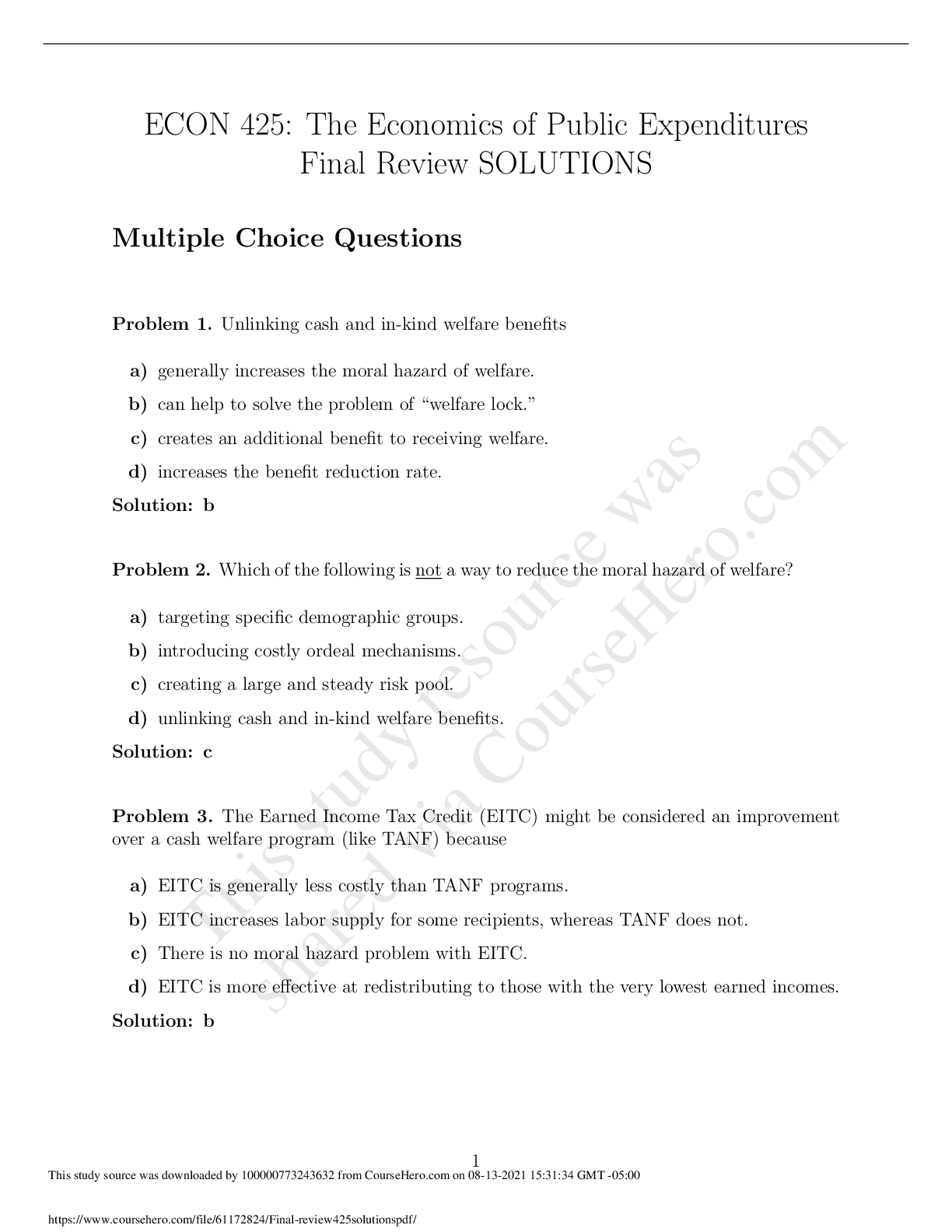
Problem 1. Unlinking cash and in-kind welfare benefits
a) generally increases the moral hazard of welfare.
b) can help to solve the problem of “welfare lock.”
c) creates an additional benefit to receiving welfare.
d) increases the benefit reduction rate.
Problem 2. Which of the following is not a way to reduce the moral hazard of welfare?
a) targeting specific demographic groups.
b) introducing costly ordeal mechanisms.
c) creating a large and steady risk pool.
d) unlinking cash and in-kind welfare benefits.
Problem 3. The Earned Income Tax Credit (EITC) might be considered an improvement
over a cash welfare program (like TANF) because
a) EITC is generally less costly than TANF programs.
b) EITC increases labor supply for some recipients, whereas TANF does not.
c) There is no moral hazard problem with EITC.
d) EITC is more e↵ective at redistributing to those with the very lowest earned incomes.
Problem 4. With a progressive tax system
a) the average tax rate is decreasing with income.
b) the marginal tax rate is decreasing with income.
c) the marginal tax rate is lower than the average tax rate.
d) the marginal tax rate is higher than the average tax rate.
Problem 5. The Ramsey rule for optimal commodity taxation implies that
a) a few items are taxed at a very high rate, while others are not taxed at all.
b) items with elastic demand are taxed at a higher rate.
c) items with inelastic demand are taxed at a higher rate.
d) all items are taxed at the same e↵ective rate.
Problem 6. Suppose that labor supply is relatively inelastic. Which of the following is
true?
a) The La↵er curve will reach a peak at a relatively low tax rate.
b) The La↵er curve will reach a peak at a relatively high tax rate.
c) Labor supply elasticity has no e↵ect on the La↵er curve.
d) Labor supply elasticity has an ambiguous e↵ect on the La↵er curve
[Show More]