PHIL 1000 Ancient_Greek_Philosophers_Final_Milestone_Sophia_Course - Study Guide (QUESTIONS ONLY) – Strayer University
1
When Socrates is asked about suicide in the Phaedo, he replies that .
the body is eternal
...
PHIL 1000 Ancient_Greek_Philosophers_Final_Milestone_Sophia_Course - Study Guide (QUESTIONS ONLY) – Strayer University
1
When Socrates is asked about suicide in the Phaedo, he replies that .
the body is eternal and cannot die
philosophers must always be prepared for death
it is man’s choice to live or to die
our bodies belong to the gods RATIONALE
In the Phaedo, Socrates contends that suicide is immoral. He argues that the bodies of men belong to the gods, and that only the gods can choose to end a life.
CONCEPT
The Phaedo: The Death of Socrates 2
Water is a condition for staying alive.
Apply conceptual analysis to this statement and choose the answer that correctly describes the relationship.
neither necessary nor sufficient
both necessary and sufficient
necessary, not sufficient
sufficient, not necessary
RATIONALE
Water is a logical requirement for staying alive, therefore it is a necessary condition. However, water is not a logical guarantee for staying alive, so it is not a sufficient condition.
CONCEPT
Plato: An academic approach to concepts 3
Which of the following statements about the atomistic worldview is FALSE?
Everything in the universe exists as a single atom, or a collection of atoms.
The worldview of philosophical atomists, with some revisions, has been adopted by contemporary science.
Philosophical atoms of different shapes and consistencies are the fundamental components of reality.
The philosophical worldview of the early Greek atomists had great influence on philosophical, scientific, and religious thinking, but only for a brief period of time.
RATIONALE
The philosophical worldview of the early Greek atomists has continued to have an impact throughout history. Atomism has been adopted and modified by contemporary science, and has had a lasting influence on religion and theology.
CONCEPT
The Atomistic Worldview 4
Which of the following statements about the Crito is FALSE?
The Social Contract made it unethical for Socrates to escape his punishment.
Athens performed its end of the Social Contract; Socrates was required to do the same.
Following the advice of experts is more ethical than appealing the majority.
Socrates argued that civil disobedience was an obligation for intellectuals and philosophers.
RATIONALE
In the Crito, Socrates argues against the concept of civil disobedience. In an imagined dialogue between him and Athens, Socrates says "But he who has experience of the manner in which we order justice and administer the state, and still remains, has entered into an implied contract that he will do as we command him." In other words, a person who has benefited from the protection and privileges provided by a state, and who has not sought to change its laws or leave its jurisdiction, must accept its judgement. This is an early expression of the concept of the Social Contract.
CONCEPT
The Crito: The Duties of the Social Contract 5
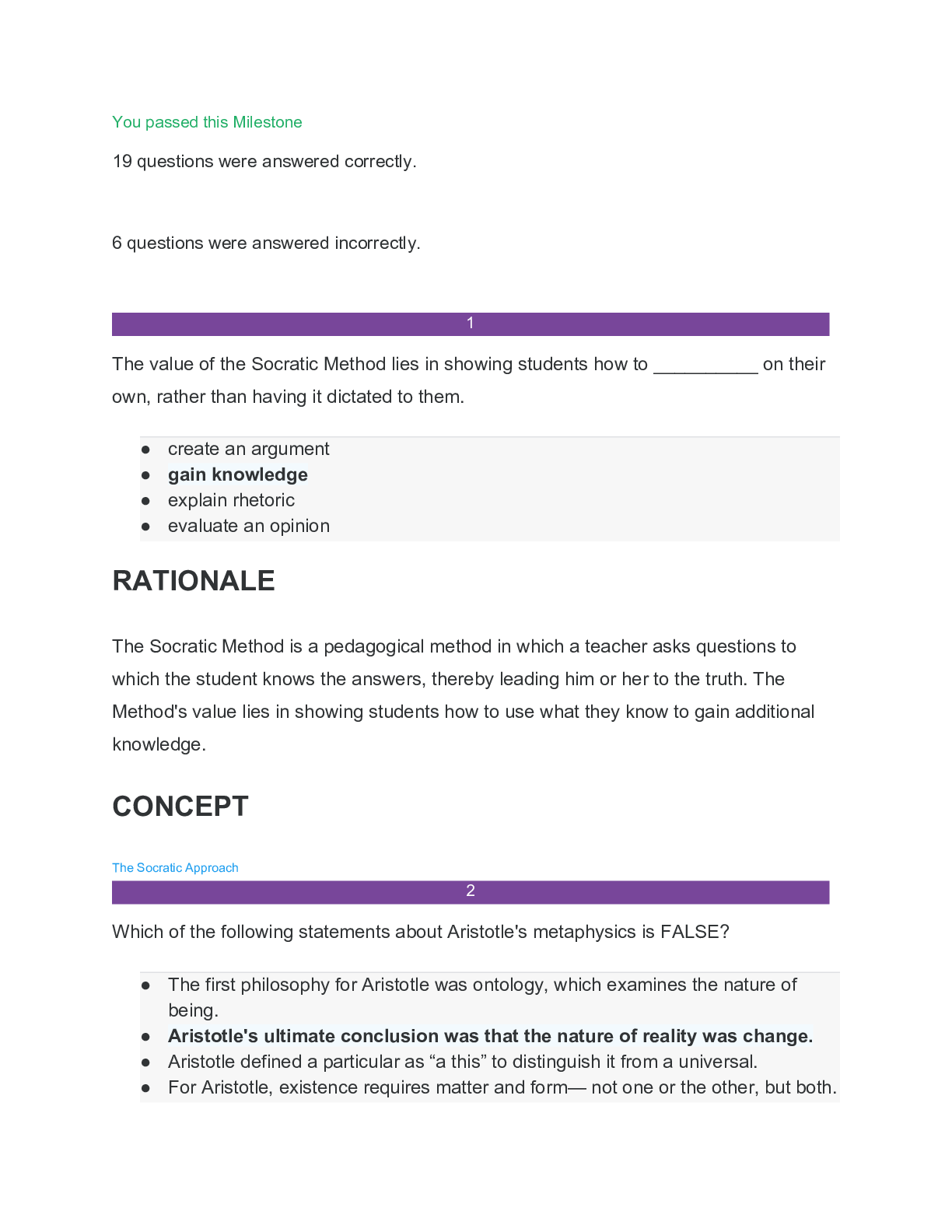
The philosophical value of the Socratic Method is described in all of the following statements, EXCEPT:
Students answer questions to which they know the answers, and are led by the teacher to new truths.
The emphasis is on finding truth, not on “winning” an argument.
The Socratic Method guides students to understanding rather than requiring them to memorize facts.
Students learn from interacting with each other, and the teacher facilitates this process. RATIONALE
The Socratic Method does not facilitate learning through students' interaction with one another. Rather, it is an exchange between student and teacher, in which the teacher uses the student's knowledge to guide him or her to truth.
CONCEPT
The Socratic Approach 6
Perhaps the most important way in which Socrates changed the course of Western philosophy was by focusing on .
cosmology
natural philosophy
martyrdom
moral philosophy RATIONALE
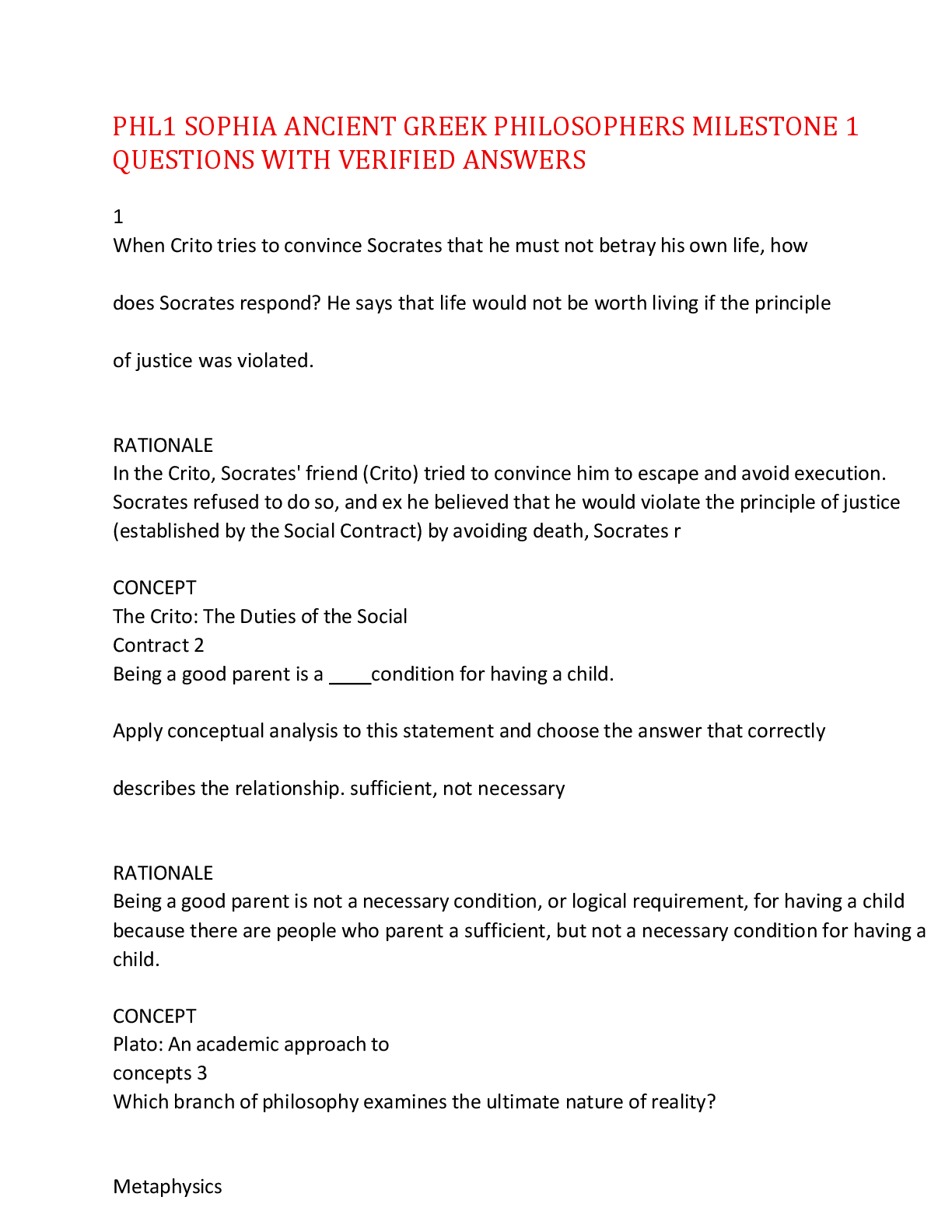
Ethics and morality were the primary focus of Socrates's philosophical inquiry. He is considered to have been the first "moral philosopher," who was deeply interested in how to determine right and wrong.
CONCEPT
Socrates: The Father of Western Philosophy 7
Which of the following statements about Aristotle’s metaphysics is FALSE?
Examining the nature of being, and knowing what kinds of things exist, is a sensible beginning point for philosophical inquiry.
In order for a statement to be true, one must state that an object exists, what the object is, and the state in which it exists.
Humans have the natural capacity to know many things without divine revelation or empirical evidence.
The distinction between form and matter is purely conceptual— one does not, and cannot, exist without the other.
RATIONALE
Aristotle would agree with all of these statements except the suggestion that we can have knowledge without empirical evidence. To Aristotle, all knowledge is grounded in human experience and flows from empirical evidence.
CONCEPT
Aristotle on What There Is 8
Kendra believes that women have a right to choose to have an abortion. Select the statement that is consistent with Kendra's belief.
“I voted for this presidential candidate because she supports a woman's right to have an abortion.”
"The man should have an equal say in whether or not a woman ends her pregnancy.”
“Some women use abortion as a form of birth control, which is wrong.”
“Every woman should be a mother; it is our function and purpose as human beings.” RATIONALE
To live philosophically, a person must examine his or her beliefs to ground them in knowledge, and then act according to those beliefs. By voting for a presidential candidate who supports a woman's right to have an abortion, Kendra displays a consistent philosophical worldview.
CONCEPT
Philosophical Analysis as a Way of Life 9
What kind of a thing is an orchid? It is a type of flower. What distinguishes an orchid from other flowers? The female and male parts of an orchid are fused together.
According to Aristotle, answering both of these questions reveals the of an orchid.
ontology
organization
genus
essence RATIONALE
According to Aristotle, we can discover and describe essences by identifying a genus and a differentia. The genus (in this example, a flower) tells us what kind of thing an orchid is. The differentia tells us what sets an orchid apart from other things of the same kind.
CONCEPT
Aristotle on What There Is 10
Which of the following is the most important tenet of Stoicism?
To resist playing a role
To understand that reality is either good or bad
To let go of what we cannot control
To feed our desires RATIONALE
Stoicism is a philosophy that encourages us to focus only on what we can control (e.g., our desires, emotions, judgments, and reactions). We should not be upset by things that are beyond our control. Stoicism encourages us to reduce desire and to view reality as neither good nor bad.
CONCEPT
Stoicism: The Ethics of Dispassion 11
Recall the similarities and differences between Plato and Aristotle's philosophical approaches.
Select the statement that would most likely have been made by Plato, rather than by Aristotle.
“I teach by example and I live by what I teach, no matter the consequences.”
“My ideas have served as a starting point for both philosophy and the physical sciences.”
“In order to find truth, we must first identify what makes a thing what it is, its essence.
“My approach is scientific and empirical; we learn about truth from observation and discovery.”
RATIONALE
Plato proposed the existence of essences in his doctrine of the Forms. As a result, it is more likely that he would have made this statement. As a rationalist philosopher, Plato believed that knowledge does not rely on human senses alone, and can be accessed through the existence of essences. The statements which involve science and empiricism are reflective of Aristotle's views. The statement about teaching and living by example is reflective of Socrates' philosophy.
CONCEPT
Aristotle: The Dissection of Reality 12
Which of the following statements about the metaphysical tenets of Plato’s Doctrine of the Forms is FALSE?
The Forms exist in an intellectual realm that is fixed and never-ending.
There is a cause and effect relationship between Forms and their earthly counterparts.
Perfection in the Forms does not exist in Platonic Heaven.
Forms must exist in order for knowledge to be possible. RATIONALE
All of the statements about aspects of Plato's metaphysics are true, except for the suggestion that perfect Forms do not exist in Platonic Heaven. This statement describes Aristotle's metaphysics, not Plato's. Platonic Heaven is where Plato believed Forms, or perfect metaphysical entities, exist.
CONCEPT
Plato Forms: The Foundations of Being 13
“As a physicist, I see all elements as either connected by love or separated by conflict.” Which ancient philosopher would most likely have made this statement?
Pythagoras
Empedocles
Anaxagoras
Xenophanes RATIONALE
Empedocles was a Pre-Socratic philosopher and physicist who believed that everything in the
cosmos was made up of six metaphysical entities. He believed that, rather than beginning and
ending, everything in the universe resulted from the continuous mixing and separation of these entities. Although Empedocles's ideas were informed by the Pythagorean doctrine of reincarnation, Pythagoras is not the correct answer because he was not a physicist.
CONCEPT
Cosmology and the First Philosophers 14
Heraclitus developed , which stated that all things change over time.
the Philosophical Atom
the Paradoxes of Zeno
Parmenidean Theory
the Doctrine of Flux RATIONALE
Heraclitus developed the Doctrine of Flux, and defined flux as "continuous change." The doctrine maintains that everything is impermanent and in a constant state of change.
CONCEPT
Heraclitus and the Doctrine of Impermanence 15
In the Apology, Socrates states that a good person does what he knows to be right despite
.
negative personal consequences
risking fame and fortune
the laws of man
the wisdom of the gods RATIONALE
The Apology is Plato's transcription of the defense Socrates presented at his trial on charges of "denying the gods" and "corrupting the youth of Athens." In it, Socrates asserts that he
does not fear death, because he has lived as he believed was right. To Socrates, it is more important to live rightly than to avoid death and other negative personal consequences.
CONCEPT
The Apology: A Defense of Philosophy 16
Nancy is a cashier at a grocery store. A boy from her school, who she knows is underage, attempts to buy beer. Nancy hesitates before completing the transaction.
According to Aristotle’s ethics, which question should Nancy ask herself?
Why is this action right, and why is it wrong?
How can I reach a compromise?
What kind of person should I be?
Are there possible consequences of this action that could harm me? RATIONALE
Aristotelian ethics are primarily concerned with character. As a result, Nancy should ask herself “What kind of person should I be?” rather than “How should I act?”
According to Aristotelian ethics, actions are evaluated based on how they inform your character. Therefore, Nancy must determine what kind of person she wants to be and what virtues she wants to cultivate, and then act accordingly.
CONCEPT
Applying Aristotle's Ethics 17
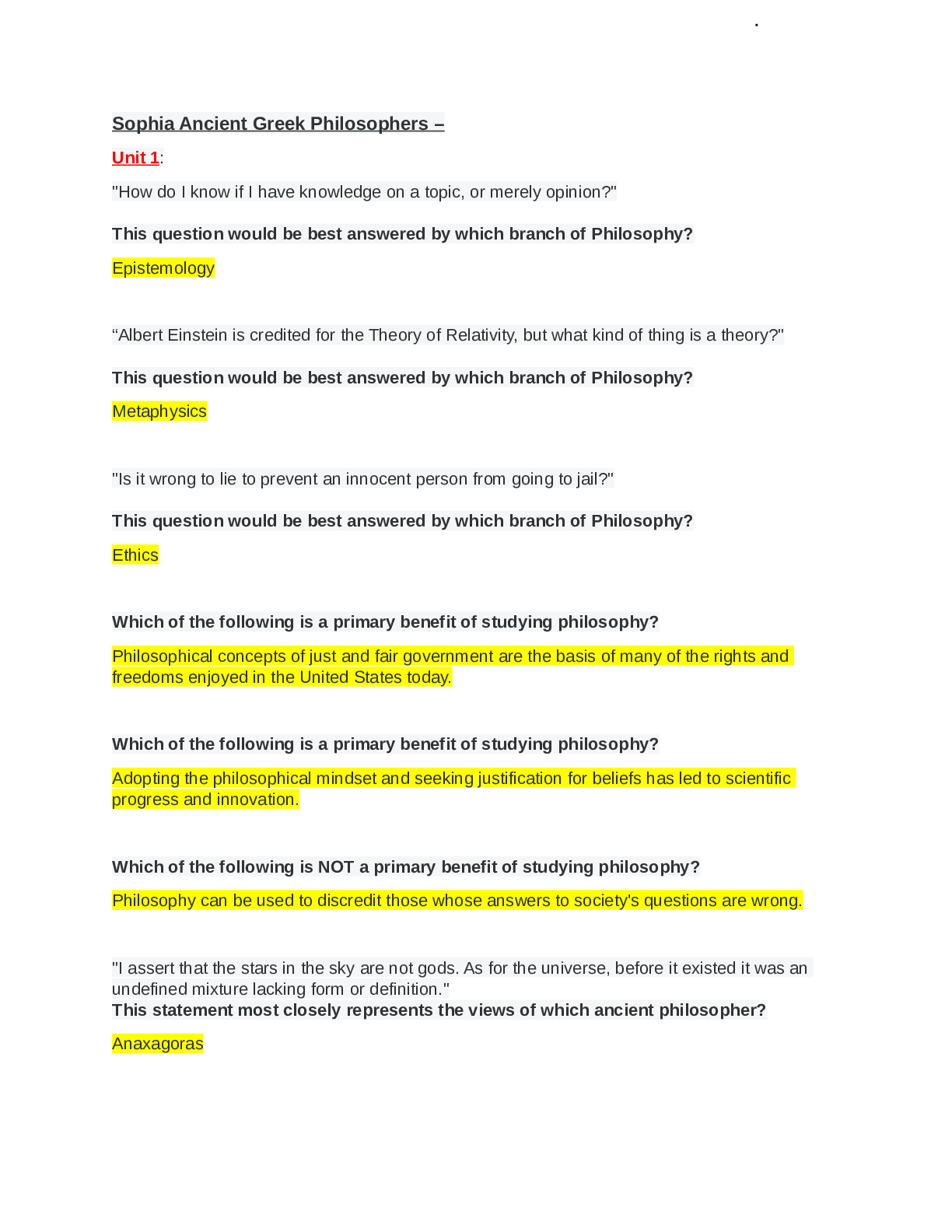
Which branch of philosophy examines the basis and nature of knowledge?
Ethics
Epistemology
Cosmology
Metaphysics
RATIONALE
Epistemology is the branch of philosophy in which concepts of knowledge are analyzed and defended. Metaphysics is concerned with discovering and describing the ultimate nature of reality. Cosmology is the study of the universe in its totality, and ethics considers concepts of value (e.g., right and wrong).
CONCEPT
What is Philosophy?
18
According to Plato’s doctrine of the Forms, is Leonardo da Vinci's painting, the Mona Lisa, beauty?
No, because not everyone agrees that it represents that which is beautiful.
No, because it only participates in the Form of Beauty.
Yes, if each individual applies his or her concept of beauty to the painting.
Yes, if beauty represents all that is good in Platonic Heaven. RATIONALE
Plato's doctrine of the Forms states that the essences of all things, including beauty, exist in Platonic Heaven. Worldly objects are what they are because they participate in their corresponding Form. The Mona Lisa is a beautiful painting because it participates, or imitates, the Form of Beauty. It is not, in itself, beauty.
CONCEPT
Applying Plato's Metaphysics 19
In the passage below, Socrates imagines a dialogue between himself and Athens, personified as the laws:
“Then the laws will say: ‘Consider, Socrates, if we are speaking truly that in your present attempt you are going to do us an injury. For, having brought you into the world, and nurtured and educated you, and given you and every other citizen a share in every good which we had to give, we further proclaim to any Athenian by the liberty which we allow him, that if he does not like us when he has become of age and has seen the ways of the city, and made our acquaintance, he may go where he pleases and take his goods with him. None of us laws will forbid him or interfere with him. Anyone who does not like us and the city, and who wants to emigrate to a colony or to any other city, may go where he likes, retaining his property. But he who has experience of the manner in which we order justice and
administer the state, and still remains, has entered into an implied contract that he will do as we command him.’”
Reconstruct the argument from this text and choose the sentence that accurately states the main premise of Socrates’ argument.
By neither leaving Athens nor attempting to change its laws, Socrates consented to the terms of a Social Contract with Athens.
An unjust act is obvious, just as a just act is obvious, but unless we know the true essence of justice, we cannot judge others.
Socrates believes that taking advantage of opportunities to save his life would be giving in to his enemies, and approving his own destruction.
Our senses do not provide us with truth, so the soul must attain truth without the distraction and deception caused by bodily experiences.
RATIONALE
In this selection from the Crito, "the laws" remind Socrates that Athens has provided him many benefits, including sustenance, education, and liberty, including the freedom to leave Athens with all of his worldly property if chose to do so. However, anyone (including Socrates) who "still remains . . . has entered into an implied contract . . .” to obey the laws and judgements of the state. The main premise of Socrates' argument, therefore, is that since he neither left Athens nor attempted to change its laws, he has consented to the terms of a Social Contract with the state.
CONCEPT
The Apology — Socrates' Arguments 20
When Alan joins the military, he discovers that the philosophy of Stoicism is popular with his fellow soldiers.
All of the following describe reasons why Stoicism is a good fit for the military, EXCEPT:
It is important for soldiers to do their jobs with skill and dispassion.
Stoicism emphasizes personal control of emotions and actions.
Soldiers must remain impassive to what is outside their control.
Courage in battle is measured by the efficiency of one's actions. RATIONALE
All of these statements indicate why Stoicism is a good fit for the military except for the suggestion that it improves courage in battle because it makes soldiers more efficient.
Stoicism can make soldiers less fearful of outcomes beyond their control, thus enhancing their courage. However, the principles of Stoicism do not create a relationship between courage and efficiency.
CONCEPT
Stoicism: The Ethics of Dispassion 21
According to Aristotle’s ethics, virtues should be pursued by .
finding a rational mean between two extremes
defining what is true
determining the purest form of action
thinking abstractly RATIONALE
Aristotle's Doctrine of the Mean states that virtue must be cultivated as a rational mean between extremes. For example, the virtue of courage is found between the vices of cowardice and foolhardiness.
CONCEPT
Aristotle's Highest Good 22
Choose the statement that describes a central theme of Parmenidean metaphysics.
The world is composed of linked opposites.
The universe consists of one, unchanging entity.
The opinions of mortals are universally reliable.
Mortal and divine knowledge can be joined. RATIONALE
Parmenidean metaphysics includes the concept of "substance monism" — the belief that all reality is one object. This object is called the “what-is.” The "what-is" is eternal and unchanging. None of the other statements represent Parmenidean metaphysics.
CONCEPT
Parmenides and the Doctrine of Permanence 23
In Plato's view, justified true beliefs must be related to his metaphysical notion of
, which he called the Forms.
truth
knowledge
wisdom
essence RATIONALE
Plato's Forms are also referred to as "essences." An essence is that which makes an object what it truly is. Essences provide the basis for knowledge (i.e., justified true belief). For example, we can know what "goodness" truly is because a real thing that is the essence of goodness, called the Form of Goodness, exists.
CONCEPT
Plato's Forms: The Objects of Knowledge 24
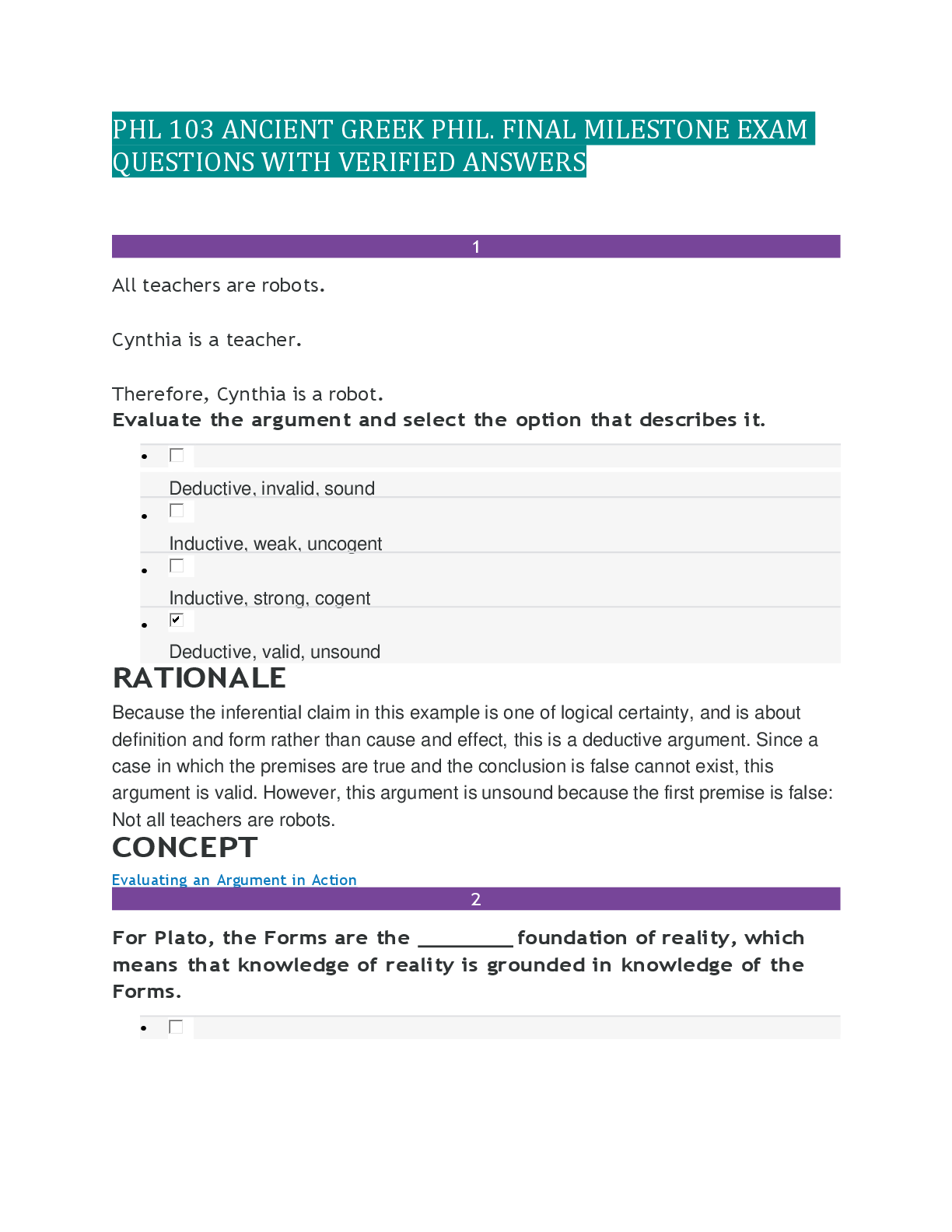
All teachers are robots.
Cynthia is a teacher.
Therefore, Cynthia is a robot.
Evaluate the argument and select the option that describes it.
Inductive, weak, uncogent
Deductive, invalid, sound
Deductive, valid, unsound
Inductive, strong, cogent RATIONALE
Because the inferential claim in this example is one of logical certainty, and is about definition and form rather than cause and effect, this is a deductive argument. Since a case in which the premises are true and the conclusion is false cannot exist, this argument is valid.
However, this argument is unsound because the first premise is false: Not all teachers are robots.
CONCEPT
Evaluating an Argument in Action 25
Select the statement upon which Plato and Aristotle would disagree.
Essences exist and are genuine entities.
Truth is important above all else.
Essences exist independently of the world.
Reasoning and logic are key to finding truth. RATIONALE
1
According to Plato's doctrine of Forms, what makes a rose a rose is that it .
imitates the genuine Form of Rose
serves the purpose of a rose
changes the Form of Rose
reveals what is true about all roses RATIONALE
According to Plato, Forms are the exemplars of their worldy correlates. Worldly objects imitate the more genuine, more real Forms of those objects. As a result of this process, wordly objects are grounded in truth.
CONCEPT
Applying Plato's Metaphysics 2
Select the statement that would most likely have been made by Aristotle.
“The world is unchanging and eternal, which conflicts with the illusion that life is neither.”
“We must begin with the world we encounter every day, rather than with the abstraction of metaphysics.”
“What is true is always true, independent of wisdom, language, or knowledge.”
“New things do not come into existence; rather, things change their organization.” RATIONALE
The statement that "We must begin with the world we encounter every day" reflects Aristotle's philosophical approach. To Aristotle, all knowledge is grounded in human experience, and flows from empirical evidence. The statements which involve change are reflective of Parmenides and the Atomists. The statement about truth existing independent of wisdom, language, or knowledge is reflective of Plato's philosophy.
CONCEPT
Aristotle: The Dissection of Reality 3
Select the statement upon which Plato and Aristotle would disagree.
Essences exist independently of the world.
Truth is important above all else.
-
-
-
-
-
-
-
-
-
-
-
-
-
-
-
-
-
-
-
-
-
-
-
-
-
-
-
-
-
-
-
-
-
Worldly objects imitate the more real, genuine Forms of objects. RATIONALE
The statement that "There is no knowledge because everything is in a state of transition and nothing is true" is the opposite of Plato's metaphysical beliefs. His Doctrine of the Forms argues that all worldly objects are related to their essences (i.e., Forms), which are real,
unchanging, perfect entities that exist in an intellectual realm called Platonic Heaven. The Forms provide the basis for all knowledge.
CONCEPT
Plato Forms: The Foundations of Being 19
Kenny is a chef who is trying to determine how carefully he should focus on details while doing his job. He wants to avoid being too detail-oriented because it would be inefficient for him to do so. However, if he doesn't pay enough attention to details, the quality of the food he prepares will be inconsistent.
According to Aristotle’s ethics, this is an example of the .
Doctrine of the Forms
Ethics of Virtue
Doctrine of the Mean
Function Argument RATIONALE
Aristotle's Doctrine of the Mean states that virtue must be cultivated as a rational mean between extremes. Kenny's efforts to find the correct level of detail-focus to succeed in his job illustrates this doctrine.
CONCEPT
Aristotle's Highest Good 20
Which of the following statements about the atomistic worldview is FALSE?
Philosophical atoms of different shapes and consistencies are the fundamental components of reality.
The worldview of philosophical atomists, with some revisions, has been adopted by contemporary science.
The philosophical worldview of the early Greek atomists had great influence on philosophical, scientific, and religious thinking, but only for a brief period of time.
Everything in the universe exists as a single atom, or a collection of atoms. RATIONALE
The philosophical worldview of the early Greek atomists has continued to have an impact throughout history. Atomism has been adopted and modified by contemporary science, and has had a lasting influence on religion and theology.
CONCEPT
The Atomistic Worldview 21
Which of the following statements about Aristotle’s metaphysics is FALSE?
Examining the nature of being, and knowing what kinds of things exist, is a sensible beginning point for philosophical inquiry.
Humans have the natural capacity to know many things without divine revelation or empirical evidence.
In order for a statement to be true, one must state that an object exists, what the object is, and the state in which it exists.
The distinction between form and matter is purely conceptual— one does not, and cannot, exist without the other.
RATIONALE
Aristotle would agree with all of these statements except the suggestion that we can have knowledge without empirical evidence. To Aristotle, all knowledge is grounded in human experience and flows from empirical evidence.
CONCEPT
Aristotle on What There Is 22
Lisa is considering whether it is morally permissible to eat meat. Which branch of philosophy can help her answer this question?
Ethics
Cosmology
Epistemology
Metaphysics RATIONALE
Ethics is the branch of philosophy in which concepts of value (e.g., right and wrong are
considered). In epistemology, concepts of knowledge are analyzed and defended. Metaphysics is concerned with discovering and describing the ultimate nature of reality, and cosmology is the study of the universe in its totality.
CONCEPT
What is Philosophy?
23
In the Apology, what does Socrates do when he is found guilty and sentenced to death?
He agrees that his actions were immoral and that the decision of the judges is just.
He is willing to face death rather than violate the principles of his moral philosophy.
He tries to convince the jury to accept his defense.
He asks Plato to record his life. RATIONALE
The Apology is Plato's transcription of the defense Socrates presented at his trial on charges of "denying the gods" and "corrupting the youth of Athens." When found guilty and sentenced to death, Socrates accepts his sentence. He argues that it is more important to live rightly, which he believes he has done, than to avoid death by compromising one's moral philosophy.
CONCEPT
The Apology: A Defense of Philosophy 24
Being a good parent is a condition for having a child.
Apply conceptual analysis to this statement and choose the answer that correctly describes the relationship.
sufficient, not necessary
both necessary and sufficient
neither necessary nor sufficient
necessary, not sufficient RATIONALE
Being a good parent is not a necessary condition, or logical requirement, for having a child because there are people who have children who aren't good parents. In order to be a parent, a person must have a child. That makes being a good parent a sufficient, but not a necessary condition for having a child.
CONCEPT
Plato: An academic approach to concepts 25
In Plato's view, justified true beliefs must be related to his metaphysical notion of
, which he called the Forms.
knowledge
truth
wisdom
essence RATIONALE
Which branch of philosophy examines the ultimate nature of reality?
Epistemology
Metaphysics
Natural philosophy
Cosmology
For Plato, the Forms are the foundation of reality, which means that knowledge of reality is grounded in knowledge of the Forms.
ethical
natural
metaphysical
logical
For Plato and his Doctrine of Forms, a person can determine whether an act is courageous if he or she can .
accurately describe the Form of Courage
clearly understand the value of courage
imagine an unambiguously courageous action
explain what courage means in the real world
The value of the Socratic Method lies in showing students how to on their own, rather than having it dictated to them.
gain knowledge
evaluate an opinion
explain rhetoric
create an argument
Roland is a compassionate person. He sometimes gives money that he needs for himself to strangers who beg on the street.
According to Aristotle’s ethics, Roland should do which of the following in order to cultivate the virtue of compassion?
Stop giving away his money so that he can focus on taking care of himself.
Find middle ground between being too compassionate and not compassionate enough.
Find other ways to help people besides giving his money away.
Spend time with compassionate people in order to learn the essence of compassion. While I have lived in my home, my rent has increased every year.
My salary has remained the same for three years.
Next year, I will probably be in a better financial situation. Evaluate the argument and select the option that describes it.
Inductive, strong, cogent
Inductive, weak, uncogent
Deductive, invalid, unsound
Deductive, valid, sound
Read the following statement by Socrates:
“In questions of just and unjust, fair and foul, good and evil, which are the subjects of our present consultation, ought we to follow the opinion of the many and to fear them; or the opinion of the one man who has understanding?”
Extract Socrates' argument from this text and choose the sentence that accurately reflects it.
He who has experienced the administration of justice will do as the majority commands him to do.
Any man who cares about ethics and wisdom has an obligation to listen to himself over others.
Absolute justice can only be achieved when the state agrees with the opinion of the masses.
Non-experts have opinions, but the man who is an expert in a field has true knowledge. Karen believes that she has a responsibility to protect the environment.
Choose the statement that is consistent with Karen's belief.
"I only drive my car to work when it is raining or too cold outside.”
“I serve meat to my family only on holidays and special occasions.”
“I have eliminated all plastic from my day-to-day life.”
“I go to the farmer’s market if I have time to do so on the weekends.”
“I view the world as a mathematical entity of perfect harmony.”
Which ancient philosopher would most likely have made this statement?
Xenophanes
Anaxagoras
Pythagoras
Protagoras
Water is a condition for staying alive.
Apply conceptual analysis to this statement and choose the answer that correctly describes the relationship.
neither necessary nor sufficient
sufficient, not necessary
both necessary and sufficient
necessary, not sufficient
[Show More]
 – Strayer University.png)

 – Strayer University.png)