BIO 100 Exam 3 Study Guide - Santa Barbara City college
Bio 100 - Exam 3 Study Guide
Species of Classification
Order of Life
• Domain
• Kingdom
• Phylum
• Class
• Order
• Family
• Genus
• Species
King
...
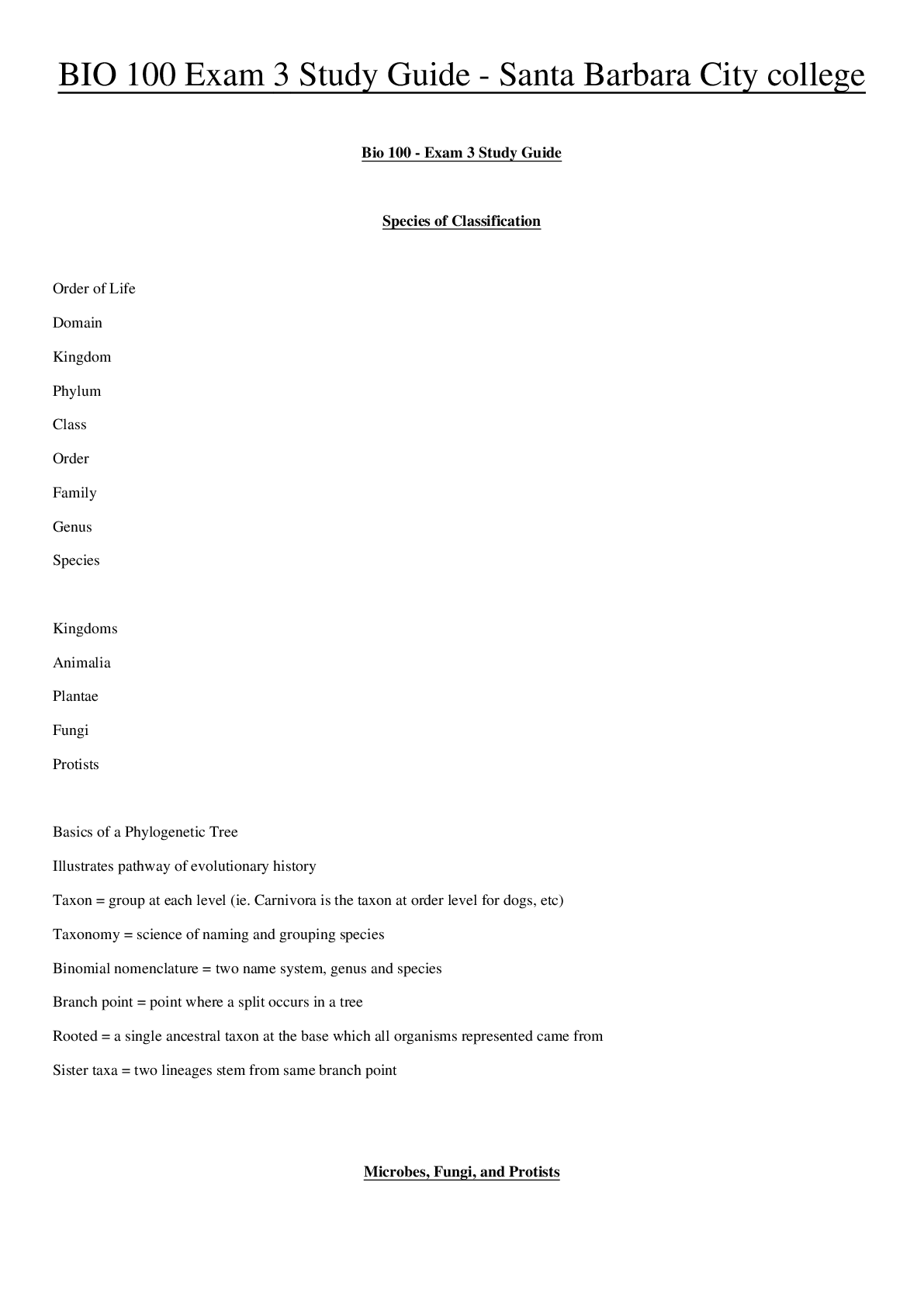
BIO 100 Exam 3 Study Guide - Santa Barbara City college
Bio 100 - Exam 3 Study Guide
Species of Classification
Order of Life
• Domain
• Kingdom
• Phylum
• Class
• Order
• Family
• Genus
• Species
Kingdoms
• Animalia
• Plantae
• Fungi
• Protists
Basics of a Phylogenetic Tree
• Illustrates pathway of evolutionary history
• Taxon = group at each level (ie. Carnivora is the taxon at order level for dogs, etc)
• Taxonomy = science of naming and grouping species
• Binomial nomenclature = two name system, genus and species
• Branch point = point where a split occurs in a tree
• Rooted = a single ancestral taxon at the base which all organisms represented came from
• Sister taxa = two lineages stem from same branch point
Microbes, Fungi, and Protists
Prokaryote differences from Eukaryote
• Prokaryotes = unicellular organisms that lack organelles surrounded by membranes
• Recycle nutrients (carbon & nitrogen) and help drive evolution of new ecosystems
• Cell wall = protective layer giving prokaryotic cells shape and rigidity
• Bacteria divided into 2 groups = gram-positive and gram-negative based on reaction to Gram staining
• Extremophiles = found in extreme environments (ocean depths, hot springs)
Different ways Prokaryotes get energy and carbon
• Prokaryotes involved in nutrient cycles such as the nitrogen and carbon cycles, decomposing dead organisms
• Use different sources of energy to assemble macromolecules from smaller ones
• Phototrophs obtain energy from sunlight
• Chemotrophs obtain energy from chemical compounds
Endosymbiosis
• Endosymbiotic Theory - eukaryotes are product of one prokaryotic cell engulfing another, one living with another, & evolving together overtime
• Symbiosis (interaction between two diff. organisms) in which one of the organisms lives inside the other
How Fungi Feed
• Fungi are heterotrophs
• Use complex organic compounds as source of carbon
• Digestion precedes ingestion
-
-
-
-
-
-
-
-
-
-
-
Parasites
Life cycle of a trematode parasite in a salt marsh
• Snail
• Infects the snail, consumes reproductive organs and uses snails’ energy to reproduce, making snail a virtual zombie,
• Eventually burst out of snail, into water to infect next host
• California Killi Fish
• Encyst fish’s brain and manipulates behavior
• Causes them to dart to surface and flash belly, make more likely to be eaten by predatory bird
• Bird
• Final host for the adult parasite
• Adult trematodesProduce eggs and larvae that reach outside environment through bird excreta
• Eggs and larvae are the trematode stages infective to snails
Relationship between parasite diversity & overall species diversity
• Overall species diversity will increase with parasite diversity
Channel Islands
Restoration of the Channel Islands ecosystem
• Introduction of non-native, exotic plants and animals have caused loss of rare species
Why did Bald Eagles decline?
• DDT - insecticide used globally and produced in Southern California
• Chemical interfered with physiology of egg production resulting in eggs being laid that had thin egg shells
• Once laid, adult bird would crush eggs when attempting to incubate
What took place of Bald eagles & why was it a problem for foxes
• Golden eagles moved out from mainland to take over empty niche
• Bald eagles feed primarily on marine species, while Golden eagles feed on terrestrial species
• Supported by the feral pigs, or ate endemic species of mammals like Channel Island foxes
Other impacts on foxes and other species
• Invasive plants
• Grazing and rooting damaged native vegetation
• Destroyed shrubs that foxes would use for cove
• Pigs and sheep
• Grazed vegetation, destroyed roots, ate acorns decreasing oak production
[Show More]