Question 1
A 45-year-old woman with acute leukemia is going to begin chemotherapy with vincristine. The
nurse is aware that vincristine must always be administered
A.
at a rapid infusion rate.
B.
at a slow infusion
...
Question 1
A 45-year-old woman with acute leukemia is going to begin chemotherapy with vincristine. The
nurse is aware that vincristine must always be administered
A.
at a rapid infusion rate.
B.
at a slow infusion rate.
C.
through a central line.
D.
through an IV line primed with vincristine.
1 points
Question 2
A 62-year-old patient taking tamoxifen exhibits increased bone and tumor pain along with a local
disease flare. The nurse interprets this as an indication of which of the following?
A.
A hypersensitivity reaction
B.
Cardiomyopathy
C.
Nephrotoxic effects of tamoxifen
D.
The tumor responding to treatment
1 points
Question 3
A middle-aged patient has received a diagnosis of GI stromal tumor following an extensive
diagnostic workup. Imatinib has been recommended as a component of the patient's drug regimen.
What patient education should the nurse provide to this patient?
A.
“If you experience significant nausea after taking a dose, stop taking the drug and schedule an
appointment at the clinic.”
B.
“Try to keep your PICC line dressing as dry as possible at all times.”
C.
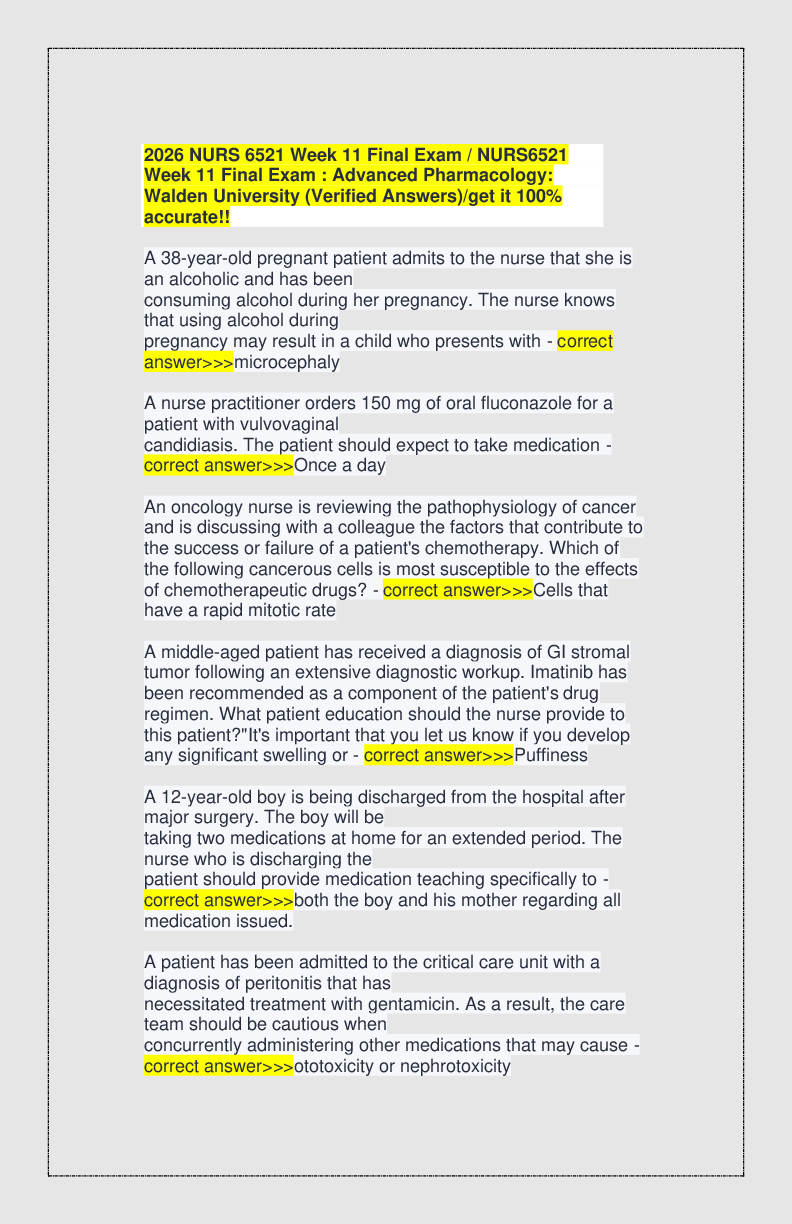
“It's important that you let us know if you develop any significant swelling or puffiness.”
D.
“You'll likely experience a lot of dry mouth while you're taking this drug, so it's helpful to chew
ice chips.”
1 points
Question 4
A nurse has completed a medication reconciliation of a patient who has been admitted following
a motor vehicle accident. Among the many drugs that the patient has received in the previous year
is rituximab. The nurse would be justified in suspecting the patient may have received treatment
for which of the following diseases?
A.
Malignant melanoma
B.
Non-Hodgkin's lymphoma
C.
Nonsmall cell lung cancer
D.
Renal cell carcinoma
1 points
Question 5
A nurse has been assigned to a 55-year-old woman who has a malignant brain tumor. The patient
is receiving her first dose of carmustine. It will be critical for the nurse to observe for which of the
following?
A.
Inability to drink fluids for 6 hours
B.
Nausea and vomiting
C.
Reddish urine
D.
Respiratory difficulty
1 points
Question 6
A nurse is caring for a 64-year-old female patient who is receiving IV heparin and reports bleeding
from her gums. The nurse checks the patient's laboratory test results and finds that shehas a very
high aPTT. The nurse anticipates that which of the following drugs may be ordered?
A.
Alteplase
B.
Coumadin
C.
Ticlopidine
D.
Protamine sulfate
1 points
Question 7
An older adult woman has been diagnosed with acute lymphoblastic leukemia (ALL) and her care
team has identified potential benefits of imatinib. Which of the following characteristics ofthis
patient's current health status may preclude the use of imatinib?
A.
The patient has type 2 diabetes mellitus that is controlled using diet and oral antihyperglycemics.
B.
The patient had a total knee arthroplasty several months earlier.
C.
The patient has chronic heart failure resulting in significant peripheral edema.
D.
The patient experienced a mild ischemic stroke several years ago and had transient ischemicattacks
last year.
1 points
Question 8
An oncology nurse is reviewing the pathophysiology of cancer and is discussing with a colleague
the factors that contribute to the success or failure of a patient's chemotherapy. Which of the
following cancerous cells is most susceptible to the effects of chemotherapeutic drugs?
A.
Cells that lack a blood supply
B.
Cells that lack contact inhibition
C.
Cells with a long generation time
D.
Cells that have a rapid mitotic rate
1 points
Question 9
Mr. Lepp is a 63-year-old man who was diagnosed with colon cancer several weeks ago and who
is scheduled to begin chemotherapy. He reports to the nurse that he read about the need for
erythropoietin in an online forum for cancer patients and wants to explore the use of epoetin alfa
with his oncologist. Which of the following facts should underlie the nurse's response to Mr.
Lepp?
A.
Treatment with epoetin alfa will likely begin 4 to 6 days before Mr. Lepp's first round of
chemotherapy and continue indefinitely.
B.
Mr. Lepp's oncologist should have begun treatment with epoetin alfa immediately after he was
diagnosed.
C.
The potential benefits of epoetin alfa must be weighed carefully against the potential
adverse effects in cancer patients.
D.
Epoetin alfa is normally contraindicated in patients who are receiving radiotherapy or
chemotherapy.
1 points
Question 10
A 28-year-old woman has completed rituximab therapy for an autoimmune disease. She tells the
nurse that she and her husband would like to start a family. The nurse will advise her to
A.
pursue fertility testing.
B.
discontinue birth control, but avoid breast-feeding after the child is born.
C.
continue using birth control for at least 12 months.
D.
stop using birth control for the next several weeks.
[Show More]


![Preview of NURS 6521N 55 Advanced Pharmacology 2020 FINAL EXAM [101 Questions+Answers]](https://scholarfriends.com/storage/NURS_6521N_55__Advanced_Pharmacology.png)
![Preview of Walden University NURS 6521N Final Exam Pharma 2020 (101 Questions+Answers) [Result| 96%]](https://scholarfriends.com/storage/Final_exam_Pharma_2020.png)

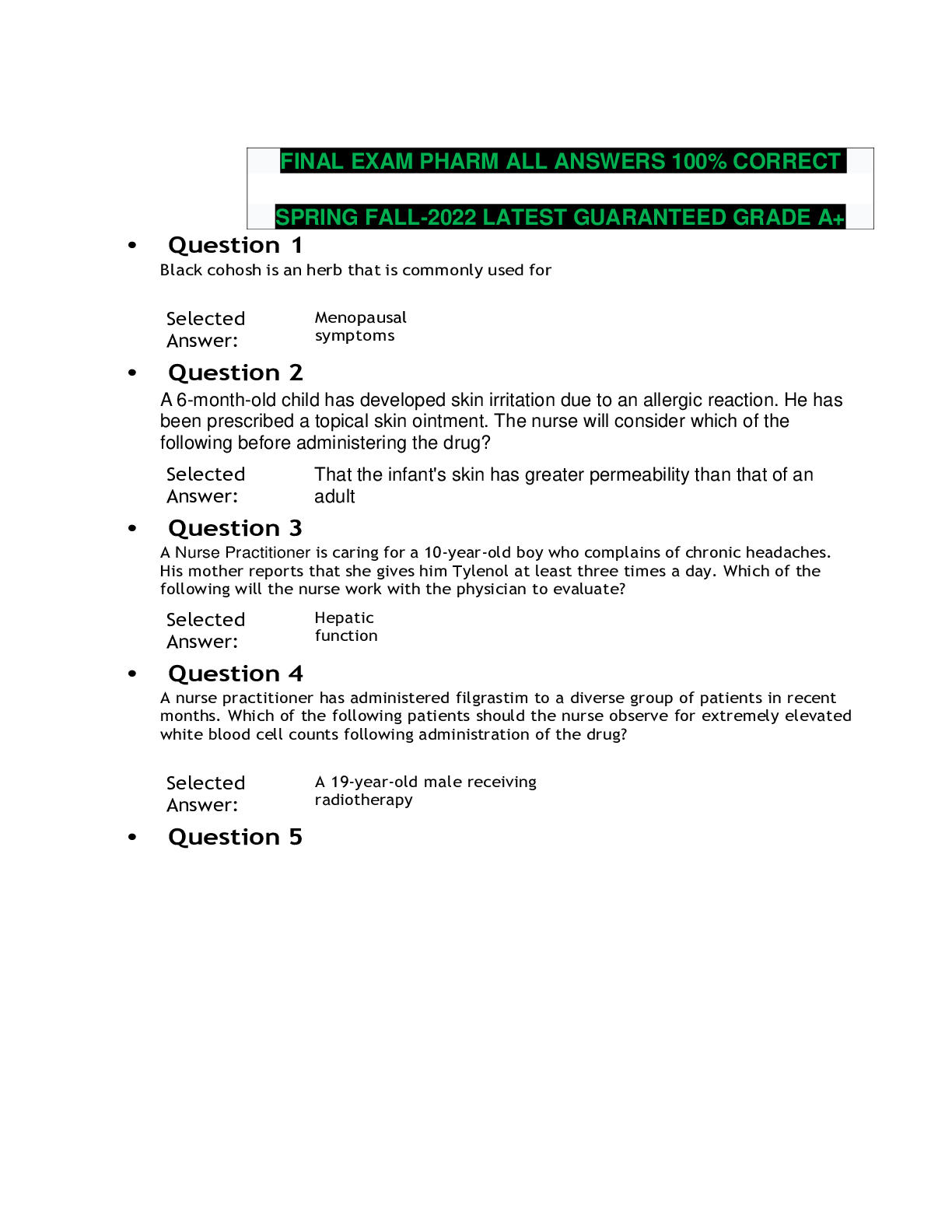






.png)
.png)


.png)

