BUS 100 Chapter 9-12
Chapter 9
37) Which of the following describes the concept of leadership?
A) the processes and behaviors used by someone to determine the optimal decision among several options
B) the processes a
...
BUS 100 Chapter 9-12
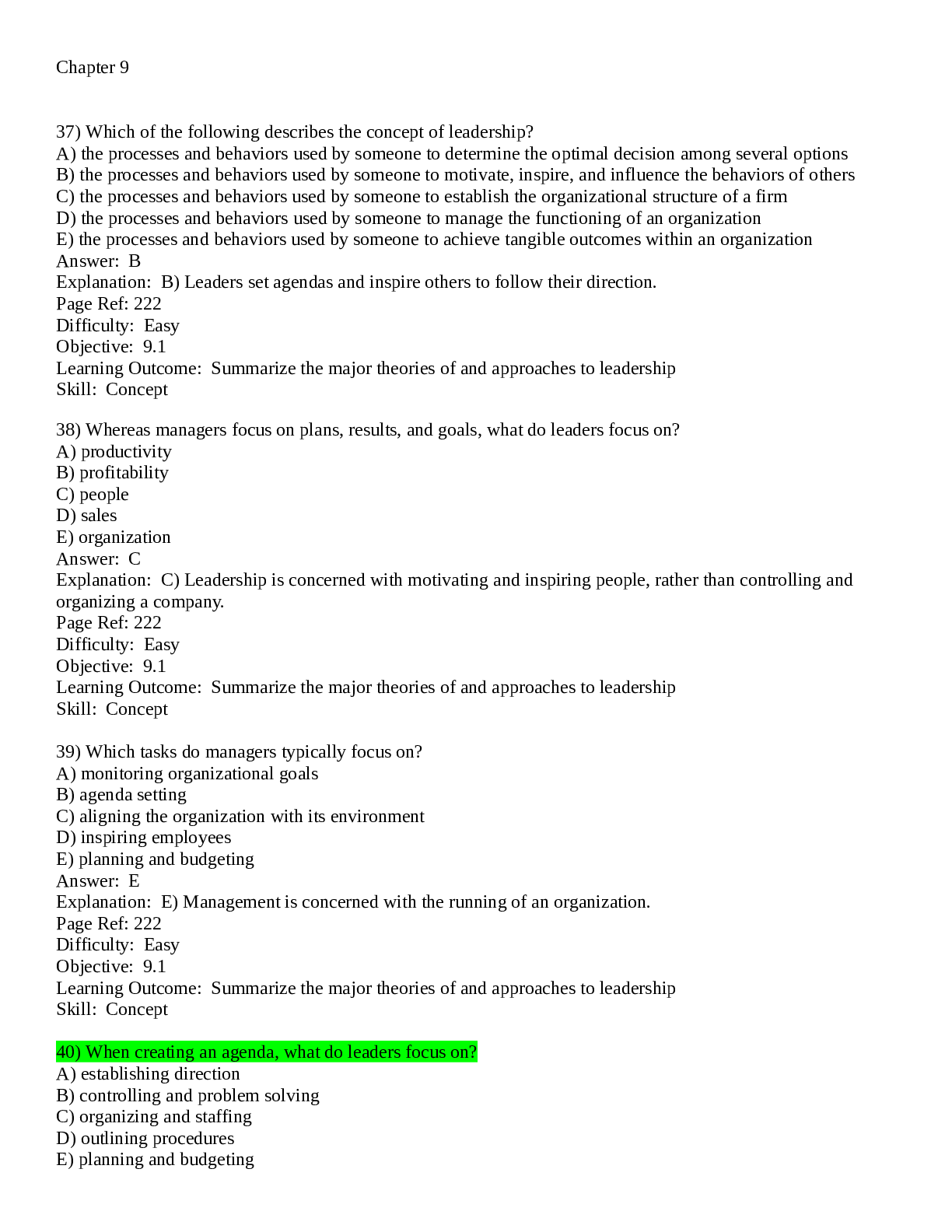
Chapter 9
37) Which of the following describes the concept of leadership?
A) the processes and behaviors used by someone to determine the optimal decision among several options
B) the processes and behaviors used by someone to motivate, inspire, and influence the behaviors of others
C) the processes and behaviors used by someone to establish the organizational structure of a firm
D) the processes and behaviors used by someone to manage the functioning of an organization
E) the processes and behaviors used by someone to achieve tangible outcomes within an organization
Answer: B
Explanation: B) Leaders set agendas and inspire others to follow their direction.
Page Ref: 222
Difficulty: Easy
Objective: 9.1
Learning Outcome: Summarize the major theories of and approaches to leadership
Skill: Concept
38) Whereas managers focus on plans, results, and goals, what do leaders focus on?
A) productivity
B) profitability
C) people
D) sales
E) organization
Answer: C
Explanation: C) Leadership is concerned with motivating and inspiring people, rather than controlling and
organizing a company.
Page Ref: 222
Difficulty: Easy
Objective: 9.1
Learning Outcome: Summarize the major theories of and approaches to leadership
Skill: Concept
39) Which tasks do managers typically focus on?
A) monitoring organizational goals
B) agenda setting
C) aligning the organization with its environment
D) inspiring employees
E) planning and budgeting
Answer: E
Explanation: E) Management is concerned with the running of an organization.
Page Ref: 222
Difficulty: Easy
Objective: 9.1
Learning Outcome: Summarize the major theories of and approaches to leadership
Skill: Concept
40) When creating an agenda, what do leaders focus on?
A) establishing direction
B) controlling and problem solving
C) organizing and staffing
D) outlining procedures
E) planning and budgeting
Answer: A
Explanation: A) This is the prime concern of a leader.
Page Ref: 222
Difficulty: Easy
Objective: 9.1
Learning Outcome: Summarize the major theories of and approaches to leadership
Skill: Concept
41) When developing the human resources for achieving an agenda, what do managers focus on?
A) establishing direction
B) controlling and problem solving
C) organizing and staffing
D) aligning people
E) motivating and inspiring
Answer: C
Explanation: C) This is the primary methodology for a manager to achieve his or her goals.
Page Ref: 222
Difficulty: Easy
Objective: 9.1
Learning Outcome: Summarize the major theories of and approaches to leadership
Skill: Concept
42) When developing the human resources necessary for achieving an agenda, what do leaders focus on?
A) establishing direction
B) controlling and problem solving
C) organizing and staffing
D) aligning people and goals
E) establishing workplace policies
Answer: D
Explanation: D) Aligning people to work together toward an agenda is one of the leadership responsibilities.
Page Ref: 222
Difficulty: Easy
Objective: 9.1
Learning Outcome: Summarize the major theories of and approaches to leadership
Skill: Concept
43) What area was the earliest research on leadership most concerned with?
A) leadership behaviors
B) leadership traits
C) leadership situations
D) leadership integrity
E) leadership roles
Answer: B
Explanation: B) The trait approach to leadership yielded various lists of attributes that successful leaders often
have.
Page Ref: 223
Difficulty: Easy
Objective: 9.2
Learning Outcome: Summarize the major theories of and approaches to leadership
Skill: Concept
44) What was a major problem with the trait approach to leadership?
A) The results were too innovative and thus were not taken seriously at the time.
B) The results were too inconsistent and thus not very practical.
C) The results were not very inspiring and thus ignored.
D) The results were found to be too pessimistic and thus were dismissed as useless.
E) The results were too worshipful of certain leaders and thus were dismissed as irrelevant.
Answer: B
Explanation: B) These early studies never really managed to agree with each other.
Page Ref: 223
Difficulty: Difficult
Objective: 9.2
Learning Outcome: Summarize the major theories of and approaches to leadership
Skill: Concept
45) Which of the following best describes task-focused leader behavior?
A) concentration on how tasks should be performed
B) concentration on which tasks should be performed
C) concentration on why tasks should be performed
D) concentration on who should perform which tasks
E) concentration on when tasks should be performed
Answer: A
Explanation: A) Task-focused leader behavior occurs when a leader focuses on how tasks should be performed
in order to meet certain goals and to achieve certain performance standards.
Page Ref: 224
Difficulty: Easy
Objective: 9.2
Learning Outcome: Summarize the major theories of and approaches to leadership
Skill: Concept
46) Which of the following best describes employee-focused leader behavior?
A) concentration on both the work quality and work quantity of employees
B) concentration on both the well-being and work quality of employees
C) concentration on both the satisfaction and work quantity of employees
D) concentration on both the satisfaction and the well-being of employees
E) concentration on both the work quantity and the well-being of employees
Answer: D
Explanation: D) Employee-focused leader behavior occurs when a leader focuses on the satisfaction,
motivation, and well-being of his or her employees.
Page Ref: 224
Difficulty: Easy
Objective: 9.2
Learning Outcome: Summarize the major theories of and approaches to leadership
Skill: Concept
47) Which of the following describes one of the primary concerns associated with charismatic leadership due to
severe devotion to a particular leader?
A) the potential lapse of ethical practices
B) the potential inability to replace leadership efficiently
C) the potential encouragement of micromanaging
D) the potential stagnation of corporate vision
E) the potential creation of bureaucracy
Answer: A
Explanation: A) Although many of these reflect hazards of charismatic leadership, overzealousness of
supporters has often lead to serious ethical lapses of judgment.
Page Ref: 226
Difficulty: Moderate
AACSB: Reflective thinking skills
Objective: 9.4
Learning Outcome: Summarize the major theories of and approaches to leadership
Skill: Concept
48) Bill Lopez spends most of his time performing normal, routine tasks. Which of the following types of
leadership is he primarily involved with?
A) charismatic leadership
B) transformational leadership
C) behavioral leadership
D) situational leadership
E) transactional leadership
Answer: E
Explanation: E) Transactional leadership is essentially the same as management in that it involves routine,
regimented activities.
Page Ref: 226
Difficulty: Easy
AACSB: Reflective thinking skills
Objective: 9.4
Learning Outcome: Summarize the major theories of and approaches to leadership
Skill: Application
49) Which of the following accurately describes a primary characteristic of charismatic leaders?
A) They tend to set high expectations for themselves and energize others.
B) They tend to set high expectations for themselves and establish high standards for others.
C) They tend to establish high standards for and energize others.
D) They tend to energize others and establish good, stable practices.
E) They tend to set high expectations for themselves and establish good, stable practices.
Answer: A
Explanation: A) High standards are practiced through example in charismatic leadership, more than insisting
that everyone follow them.
Page Ref: 226
Difficulty: Difficult
Objective: 9.4
Learning Outcome: Summarize the major theories of and approaches to leadership
Skill: Concept
50) Which of the following organizational aspects allows employees to perform capably without the direction of
a leader?
A) leadership neutralizers
B) leadership substitutes
C) leadership incentives
D) leadership guidelines
E) leadership obstructions
Answer: B
Explanation: B) Leadership substitutes are individual, task, and organizational characteristics that tend to
outweigh the need for a leader to initiate or direct employee performance.
Page Ref: 227
Difficulty: Easy
[Show More]


 answers.png)


.png)







.png)
.png)
.png)