Study Guide Mid Term Week 4
Pulmonary Review
Concepts Related to Anticholinergic Drugs & Treatment for Asthma: Fast-acting Medications:
- Tiotropium & ipratropium
- Anticholinergic drugs block acetylcholine bindi
...
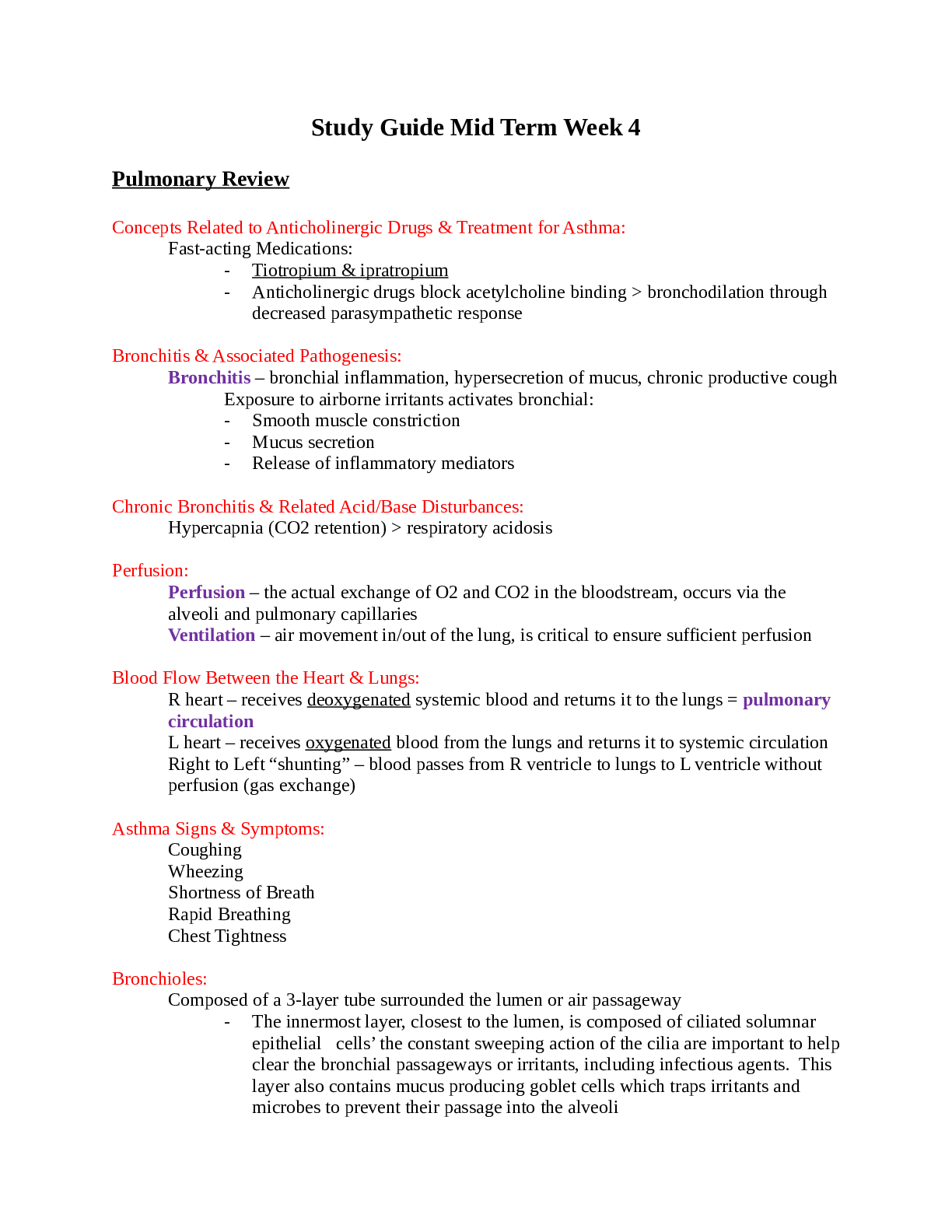
Study Guide Mid Term Week 4
Pulmonary Review
Concepts Related to Anticholinergic Drugs & Treatment for Asthma: Fast-acting Medications:
- Tiotropium & ipratropium
- Anticholinergic drugs block acetylcholine binding > bronchodilation through decreased parasympathetic response
Bronchitis & Associated Pathogenesis:
Bronchitis – bronchial inflammation, hypersecretion of mucus, chronic productive cough Exposure to airborne irritants activates bronchial:
- Smooth muscle constriction
- Mucus secretion
- Release of inflammatory mediators
Chronic Bronchitis & Related Acid/Base Disturbances: Hypercapnia (CO2 retention) > respiratory acidosis
Perfusion:
Perfusion – the actual exchange of O2 and CO2 in the bloodstream, occurs via the alveoli and pulmonary capillaries
Ventilation – air movement in/out of the lung, is critical to ensure sufficient perfusion
Blood Flow Between the Heart & Lungs:
R heart – receives deoxygenated systemic blood and returns it to the lungs = pulmonary circulation
L heart – receives oxygenated blood from the lungs and returns it to systemic circulation Right to Left “shunting” – blood passes from R ventricle to lungs to L ventricle without perfusion (gas exchange)
Asthma Signs & Symptoms: Coughing
Wheezing Shortness of Breath Rapid Breathing Chest Tightness
Bronchioles:
Composed of a 3-layer tube surrounded the lumen or air passageway
- The innermost layer, closest to the lumen, is composed of ciliated solumnar epithelial cells’ the constant sweeping action of the cilia are important to help clear the bronchial passageways or irritants, including infectious agents. This layer also contains mucus producing goblet cells which traps irritants and microbes to prevent their passage into the alveoli
- The middle layer, called the lamina propria, is embedded with connective tissue cells, as well as immune cells. These immune cells include a number of different kinds of WBCs, located here to help protect the airways
- The outermost layer is composed of smooth muscle cells, responsible for the ability of the airways to constrict and dilate
Alveolar Hyperinflation with Asthma:
Plugs of mucus and pus from the inflammatory process can block alveolar passageways which leads to air-trapping and alveolar hyperinflation
Cardiovascular Review
Concepts Related to Cardiac Output & Cardiac Contractility:
Cardiac Output – volume of blood ejected by each ventricle per minute CO = HR x SV (heart rate x stroke volume)
Cardiac Contractility – (inotropic state) – determined by Ca+2 availability and its interaction with actin-myosin
-Increased by sympathetic stimulation (fever, anxiety)
-Decreased by low ATP levels (ischemia, hypoxia, acidosis)
Preload/Afterload:
Preload – degree of myocardial fiber length stretch before contraction
- amount of blood entering ventricle during diastole
- increased by CHF, hypervolemia
- decreased by cardiac tamponade or hypovolemia (hemorrhage, dehydration) Afterload – amount of tension each ventricle must develop during systole to open SL valves and eject blood
- influenced by ventricle wall thickness, atrial pressure, ventricle chamber size
- increased by systemic hypertension, valve disease, or COPD
- decreased by hypotension or vasodilation (shock)
Systole/Diastole:
Diastole – the period of relaxation when blood fills the ventricles of the heart
Systole – ventricle contraction, propelling blood out of the ventricles into the body
Heart Valves (when they are open and closed; production of S1 & S2): 2 atrioventricular (AV) valves = tricuspid & bicuspid (mitral) 2 semilunar (SL) valves = pulmonary & aortic
- the valves open and close in response to myocardial contraction and pressure changes within the heart
- when the AV valves close = 1st heart sound (S1)
- when the SL valves close = 2nd heart sound (S2)
Stenosis of the Heart Valves and Effects:
Valvular Stenosis – valve orifice is constricted and narrowed, impeding the forward flow of blood and increasing the workload of the cardiac chamber proximal to the diseased valve
Aortic Stenosis – diminished blood flow from the L ventricle into the aorta Effects = angina, pulmonary edema, MI, heart failure
Mitral Stenosis – impairs blood flow from the L atrium to the L ventricle Effects = pulmonary edema, atypical chest pain, respiratory infections
Stoke Volume:
Volume of blood ejected per beat during systole
Preload, afterload & contractility all interact with one another to determine stroke volume and cardiac output
3 major factors determine force of contraction:
- changes in the stretching of ventricular myocardium caused by changes in preload
- alteration in the inotropic stimuli of the ventricles
- adequacy of the myocardial oxygen supply
Cor Pulmonale:
Also, known as Right Heart Failure
Inability of right ventricle (RV) to provide adequate blood flow into pulmonary circulation
Causes:
- pulmonary disease, RV MI, RV hypertrophy, pulmonary SLV or tricuspid valve damage secondary to L heart failure
Heart Failure & Physiologic Processes that Lead to Heart Failure Symptoms:
Heart Failure – cardiac dysfunction caused by inability of the heart to provide adequate cardiac output, resulting in inadequate tissue perfusion
Symptoms – dyspnea, fatigue, edema, pulmonary HTN, decreased urine output, orthopnea, cough with frothy sputum
Neurohumoral, inflammatory & metabolic processes:
- Catecholamine’s – sympathetic nervous system activation initially compensates for a decrease in cardiac output by increasing heart rate and peripheral vascular resistance
- RAAS (renin-angiotensin-aldosterone-system) – activation of RAAS causes not only increase in preload and afterload but also causes direct toxicity to the myocardium
- Aldosterone – causes salt and water retention by the kidney and contributes to dysrhythmias
- Arginine Vasopressin (antidiuretic hormone) – causes peripheral vasoconstriction and renal fluid retention
Parasympathetic stimulation – vasodilation and decreased HR
Sympathetic stimulation – vasoconstriction and increased HR
Hypertension:
Consistent elevation of systemic arterial blood pressure Systolic blood pressure (SBP) of 130 or greater Diastolic blood pressure (DBP) of 80 or greater
Risk Factors:
- Age, ethnicity, family history of HTN, tobacco use, sleep apnea, dietary factors
Calcium Binding & Troponin:
Troponin – holds tropomyosin in position to block myosin-binding sites on actin Ca+2 – binding to negatively charged troponin shifts tropomyosin to expose myosin binding sites
Hematology Review
Concepts Related to Hematopoiesis:
Hematopoiesis – the site of blood cell formation
- Begins in yolk sac at beginning of 3rd week gestation
- Shifts to fetal liver & spleen by week 8
- Shifts to bone marrow by 5th month
- To red marrow of all bones to make blood cells from birth – 5yrs
- Red marrow primarily located in ilium, vertebrae, cranium & jaw, sternum & ribs, humerus & femur after 20yrs
Hematopoietic Stem Cells (HSCs) proliferate (rapidly increase) and differentiate under the control of numerous growth factors and cytokines to form the 3 types of cells found in peripheral blood:
- RBCs
- WBCs
- Platelets
Risk Factors and Causes for Developing Any Type of Anemia:
Causes – impaired RBC production, excessive blood loss, increased RBC destruction Risk Factors:
- Diet lacking certain vitamins (low iron, vitamin B12, folate)
- Intestinal disorders (Chron’s, celiac disease)
- Menstruation
- Pregnancy
- Family History
Erythrocyte Function and Lifespan:
Erythrocyte – mature RBC that lacks a nucleus, ribosomes, and mitochondria Lifespan in circulation is approximately 100-120 days
Primarily responsible for tissue oxygenation
Erythropoietin:
Erythropoietin (EPO) – a growth factor that is made by the kidney and liver in response to tissue hypoxia
- Stimulated by androgens (testosterone)
Erythropoiesis – the formation of red blood cells
Iron-Deficiency Anemia:
Problem - Insufficient Iron (Fe) availability, small cells and low Hgb levels
Causes – inadequate dietary intake, chronic and or occult bleeding (hemorrhage, colitis, cirrhosis, GI ulcer), decrease ability to utilize Iron for heme synthesis)
Pathophysiology – insufficient Fe levels or inability for mitochondria to utilize Fe effectively leading to decrease Hgb synthesis leading to smaller, paler cells
Sickle Cell Anemia:
Problem – inherited disorder of erythrocytes (hemoglobinopathies) Causes – inherited autosomal recessive genetic disorder Pathophysiology – single amino acid change on beta-chain.
- Oxidative stress (hypoxia), anxiety, fever, cold, dehydration – decrease oxygen binding to Hgb and increases sickling tendencies
Thalassemia:
Problem – inherited disorder of erythrocytes (hemoglobinopathies) Causes – inherited autosomal recessive genetic disorder
Pathophysiology – single or multiple amino acid changes on alpha- and/or beta-chains
Pernicious Anemia Causes:
Problem – unusually large cells, but normal Hgb levels. Not enough “building blocks” (vitamins, folic acid or B12) to make DNA, so erythroblasts continue to enlarge instead of undergoing cell division (megaloblastic)
Causes – autoimmune reaction, gastritis, gastrectomy (loss of GI cells producing intrinsic factor (IF)
Pathophysiology – malabsorption of B12 due to lowered IF production/secretion
Hemolytic Anemia:
Problem – low cell number (cell size and Hgb level are normal)
Causes – Infection, transfusion reaction, hemolytic disease of newborn (Rh incompatibility), autoimmune reaction, drug induced
Pathophysiology – premature destruction of RBC due to enzymes/toxins produced by infectious agent, mediated by own immune system, or the effects of certain chemicals/drugs
Functions of Hemoglobin:
Oxygen-carrying protein in the RBC.
Hemoglobin-packed blood cells take up oxygen in the lungs and exchange it for carbon dioxide in the tissues
Development of Anemia due to Gastrectomy:
Can cause pernicious anemia d/t loss of GI cells producing intrinsic factor (IF)
Effects of Being Transfused with Incorrect Blood Type:
Donor cells act as if they are foreign invaders, and the patient’s immune system attacks them accordingly
Not only is the blood transfusion useless, but a potentially massive activation of the immune system and clotting system can cause shock, kidney failure, circulatory collapse, and death
Polycythemia Vera:
PV – a chronic neoplastic, nonmalignant condition characterized by overproduction of red blood cells and splenomegaly (enlarged liver)
Genitourinary/Renal Review
Anatomy & Physiology of the Kidney:
** Know: Renal Cortex Renal Medulla Renal Pyramids
- Removal of nitrogenous wastes (urea, creatinine, uric acid, ammonia)
- Water and electrolyte balance via aldosterone and ADH
- Regulation of blood pH via H+, HCO3 excretion or reabsorption
- Blood pressure regulation via aldosterone, renin system
- Hormone production (erythropoietin, renin, Vit D3 calcitriol)
Nephron – functional unit of the kidney – each kidney contains approx. 1 million
Nephron Damage:
When a nephron ages or is irreversibly damaged, the body is NOT able to replace it By age 80, approx. 40% of nephrons are non-functional
Tubular Reabsorption and Tubular Secretion:
Tubular Reabsorption – selective return of water and solutes (glucose, ions, amino acids, urea) FROM the filtrate of the nephron tubule system INTO the bloodstream of the peritubular capillaries
- 65% of salt and water and most organic substances are reabsorbed in the PCT
- Remainder of water and ions are reabsorbed throughout the tubule system Tubular Secretion – movement of material (urea, ammonia [NH3], Hydrogen [H+], potassium [K+], some Rx, misc. chemicals) FROM the bloodstream of the peritubular capillaries INTO the filtrate of the nephron tubule system
Calculi Blockage of Ureter:
Renal Calculi (Nephrolithiasis) Urinary Stones (Urolithiasis)
- Men are more than twice as likely as women to develop kidney stones
- Individuals that secrete high concentrations of calcium, magnesium, ammonium, phosphate, uric acid, or cysteine in the urine are at an increased risk
- The pH of the urine can increase the likelihood of stone formation
- Low pH increasing the risk of uric acid stones
- High pH increasing the risk of calcium phosphate tones
- Salts form crystals that are retained and grow into stones
- Crystallization is the process by which crystals grow from a small nucleus to larger stones in the presence of supersaturated urine
Benign Prostatic Hypertrophy:
Also, known as Benign Prostatic Hyperplasia (BPH)
- The enlargement of the prostate gland
- Problematic as prostatic tissue compresses the urethra, where it passes through the prostate, resulting in frequency of lower urinary tract symptoms
- Symptoms – urge to urinate often, delay in starting urination, urine retention
Prerenal, Intrarenal, and Postrenal Disease and What Causes Them: 3 Types of Acute Kidney Injury (AKI):
- Prerenal – caused by renal hypoperfusion due to hypotension, decrease CO, or decreased blood volume (most common cause of AKI)
- Intrarenal – caused by acute tubular necrosis (ATN), acute glomerulonephritis, and other glomerulopathies
- Postrenal – caused by urinary tract obstruction (BPH, calculi, inflammation, tumor)
Glomerulonephritis:
The glomerular capillaries trap blood-borne Ab & Ag-Ab complexes
- Begins with a triggering event (infection) and very commonl
- .
-
-
-
-
-
-
-
-
-
-
-
-
-
-
-
-
-
-
-
-
-
-
-
-
-
-
-
-
-
-
-
-
-
-
-
-
-
-
-
-
-
-
-
-
-
-
-
-
-
-
-
-
-
-
-
-
-
-
-
-
-
-
-
-
-
-
-
-
-
-
-
-
-
-
-
-
-
-
-
-
-
-
-
-
-
-
-
-
-
-
-
-
-
-
-
-
-
-
-
-
-
-
-
-
-
-
-
-
-
-
-
-
-
-
-
-
-
-
-
-
-
-
-
-
-
-
-
-
-
-
-
-
-
-
-
-
-
-
-
-
-
-
-
-
-
-
-
-
-
-
-
-
-
-
-
-
-
-
-
-
-
-
-
-
-
-
-
-
-
-
-
-
-
-
-
-
-
-
-
-
-
-
-
-
-
-
-
-
-
-
-
-
-
-
-
-
-
-
-
-
-
-
-
-
-
-
-
-
-
-
-
-
-
-
-
-
-
-
-
-
-
-
-
-
-
-
-
-
-
-
-
-
-
-
-
-
-
-
-
-
-
-
-
-
-
-
-
-
-
-
-
-
-
-
-
-
-
-
-
-
-
-
-
-
-
-
-
-
-
-
-
-
-
-
-
-
-
-
-
-
-
-
-
-
-
-
-
-
-
-
-
-
-
-
-
-
-
-
-
-
-
-
-
-
-
-
-
-
-
-
-
-
-
-
-
-
-
-
-
-
-
-
-
-
-
-
-
-
-
-
-
-
-
-
-
-
-
-
-
-
-
-
-
-
-
-
-
-
-
-
-
-
-
-
-
-
-
-
-
-
-
-
-
-
-
-
-
-
-
-
-
-
-
-
-
-
-
-
-
-
-
-
-
-
-
-
-
-
-
-
-
-
-
-
-
-
-
-
-
-
-
-
-
-
-
-
-
-
-
-
-
-
-
-
-
-
-
-
-
-
-
-
-
-
-
-
-
-
-
-
-
-
-
-
-
-
-
-
-
-
-
-
-
-
-
-
-
-
-
-
-
-
-
-
-
-
-
-
-
-
-
-
-
-
-
-
-
-
-
-
-
-
-
-
-
-
-
-
-
-
-
-
-
-
-
-
-
-
-
-
-
-
-
-
-
-
-
-
-
-
-
-
-
-
-
-
-
-
-
-
-
-
-
-
-
-
-
-
-
-
-
-
-
-
-
-
-
-
-
-
-
-
-
-
-
-
-
-
-
-
-
-
-
-
-
-
-
-
-
-
-
-
-
-
-
-
-
-
-
-
-
-
-
-
-
-
-
-
-
-
-
-
-
-
-
-
-
-
-
-
-
-
-
-
-
-
-
-
-
-
-
-
-
-
-
-
-
-
-
-
-
-
-
-
-
-
-
-
-
-
-
-
-
-
-
-
-
-
-
-
-
-
-
-
-
-
-
-
-
-
-
-
-
-
-
-
-
-
-
-
-
-
-
-
-
-
-
-
-
-
-
-
-
-
-
-
-
-
-
-
-
-
-
-
-
-
-
-
-
-
-
-
-
-
-
-
-
-
-
-
-
-
-
-
-
-
-
-
-
-
-
-
-
-
-
-
-
-
-
-
-
-
-
-
-
-
-
-
-
-
-
-
-
-
-
-
-
-
-
-
-
-
-
-
-
-
-
-
-
-
-
-
-
-
-
-
-
-
-
-
-
-
-
-
-
-
-
-
-
-
-
-
-
-
-
-
-
-
-
-
-
-
-
-
-
-
-
-
-
-
-
-
-
-
-
-
-
-
-
-
-
-
-
-
-
-
-
-
-
-
-
-
-
-
-
-
-
-
-
-
-
-
-
-
-
-
-
-
-
-
-
-
-
-
-
-
-
-
-
-
-
-
-
-
-
-
-
-
-
-
-
-
-
-
-
-
-
-
-
-
-
-
-
-
-
-
-
-
-
-
-
-
-
-
-
-
-
-
-
-
-
-
-
-
-
-
-
-
-
-
-
-
-
-
-
-
-
-
-
-
-
-
-
-
-
-
-
-
-
-
-
-
-
-
-
-
-
-
-
-
-
-
-
-
-
-
-
-
-
-
-
-
-
-
-
-
-
-
-
-
-
-
-
-
-
-
-
-
-
-
-
-
-
-
-
-
-
-
-
-
-
-
-
-
-
-
-
-
-
-
-
-
-
-
-
-
-
-
-
-
-
-
-
-
-
-
-
-
-
-
-
-
-
-
-
-
-
-
-
-
-
-
-
-
-
-
-
-
-
-
-
-
-
-
-
-
-
-
-
-
-
-
-
-
-
-
-
-
-
-
-
-
-
-
-
-
-
-
-
-
-
-
-
-
-
-
-
-
-
-
-
-
-
-
-
-
-
-
-
-
-
-
-
-
-
-
-
-
-
-
-
-
-
-
-
-
-
-
-
-
-
-
-
-
-
-
-
-
-
-
-
-
-
-
-
-
-
-
-
-
-
-
-
-
-
-
-
-
-
-
-
-
-
-
-
-
-
-
-
-
-
-
-
-
-
-
-
-
-
-
-
-
-
-
-
-
-
-
-
-
-
-
-
-
-
-
-
-
-
-
-
-
-
-
-
-
-
-
-
-
-
-
-
-
-
-
-
-
-
-
-
-
-
-
-
-
-
-
-
-
-
-
-
-
-
-
-
-
-
-
-
-
-
-
-
-
-
-
-
-
-
-
-
-
-
-
-
-
-
-
-
-
-
-
-
-
-
-
-
-
-
-
-
-
-
-
-
-
-
-
-
-
-
-
-
-
-
-
-
-
-
-
-
-
-
-
-
-
-
-
-
-
-
-
-
-
-
-
-
-
-
-
-
-
-
-
-
-
-
-
-
-
-
-
-
-
-
-
-
-
-
-
-
-
-
-
-
-
-
-
-
-
-
-
-
-
-
-
-
-
-
-
-
-
-
-
-
-
-
-
-
-
-
-
-
-
-
-
-
-
-
-
-
-
-
-
-
-
-
-
-
-
-
-
-
-
-
-
-
-
-
-
-
-
-
-
-
-
-
-
-
-
-
-
-
-
-
-
-
-
-
-
-
-
-
-
-
-
-
-
-
-
-
-
-
-
-
-
-
-
-
-
-
-
-
-
-
-
-
-
-
-
-
-
-
-
-
-
-
-
-
-
-
-
-
-
-
-
-
-
-
-
-
-
-
-
-
-
-
-
-
-
-
-
-
-
-
-
-
-
-
-
-
-
-
-
-
-
-
-
-
-
-
-
-
-
-
-
-
-
-
-
-
-
-
-
-
-
-
-
-
-
-
-
-
-
-
-
-
-
-
-
-
-
-
-
-
-
-
-
-
-
-
-
-
-
-
-
-
-
-
-
-
-
-
-
-
-
-
-
-
-
-
-
-
-
-
-
-
-
-
-
-
-
-
-
-
-
-
-
-
-
-
-
-
-
-
-
-
-
-
-
-
-
-
-
-
-
-
-
-
-
-
-
-
-
-
-
-
-
-
-
-
-
-
-
-
-
-
-
-
-
-
-
-
-
-
-
-
-
-
-
-
-
-
-
-
-
-
-
-
-
-
-
-
-
-
-
-
-
-
-
-
-
-
-
-
-
-
-
-
-
-
-
-
-
-
-
-
-
-
-
-
-
-
-
-
-
-
-
-
-
-
-
-
-
-
-
-
-
-
-
-
-
-
-
-
-
-
-
-
-
-
-
-
-
-
-
-
-
-
-
-
-
-
-
-
-
-
-
-
-
-
-
-
-
-
-
-
-
-
-
-
-
-
-
-
-
-
-
-
-
-
-
-
-
-
-
-
-
-
-
-
-
-
-
-
-
-
-
-
-
-
-
-
-
-
-
-
-
-
-
-
-
-
-
-
-
-
-
-
-
-
-
-
-
-
-
-
-
-
-
-
-
-
-
-
-
-
-
-
-
-
-
-
-
-
-
-
-
-
-
-
-
-
-
-
-
-
-
-
-
-
-
-
-
-
-
-
-
-
-
-
-
-
-
-
-
-
-
-
-
-
-
-
-
-
-
-
-
-
-
-
-
-
-
-
-
-
-
-
-
-
-
-
-
-
-
-
-
-
-
-
-
-
-
-
-
-
-
-
-
-
-
-
-
-
-
-
-
-
-
-
-
-
-
-
-
-
-
-
-
-
-
-
-
-
-
-
-
-
-
-
-
-
-
-
-
-
-
-
-
-
-
-
-
-
-
-
-
-
-
-
-
-
-
-
-
-
-
-
-
-
-
-
-
-
-
-
-
-
-
-
-
-
-
-
-
-
-
-
-
-
-
-
-
-
-
-
-
-
-
-
-
-
-
-
-
-
-
-
-
-
-
-
-
-
-
-
-
-
-
-
-
-
-
-
-
-
-
-
-
-
-
-
-
-
-
-
-
-
-
-
-
-
-
-
-
-
-
-
-
-
-
-
-
-
-
-
-
-
-
-
-
-
-
-
-
-
-
-
-
-
-
-
-
-
-
-
-
-
-
-
-
-
-
-
-
-
-
-
-
-
-
-
-
-
-
-
-
-
-
-
-
-
-
-
-
-
-
-
-
-
-
-
-
-
-
-
-
-
-
-
-
-
-
-
-
-
-
-
-
-
-
-
-
-
-
-
-
-
-
-
-
-
-
-
-
-
-
-
-
-
-
-
-
-
-
-
-
-
-
-
-
-
-
-
-
-
-
-
-
-
-
-
-
-
-
-
-
-
-
-
-
-
-
-
-
-
-
-
-
-
-
-
-
-
-
-
-
-
-
-
-
-
-
-
-
-
-
-
-
-
-
-
-
-
-
-
-
-
-
-
-
-
-
-
-
-
-
-
-
-
-
-
-
-
-
-
-
-
-
-
-
-
-
-
-
-
-
-
-
-
-
-
-
-
-
-
-
-
-
-
-
-
-
-
-
-
-
-
-
-
-
-
-
-
-
-
-
-
-
-
-
-
-
-
-
-
-
-
-
-
-
-
-
-
-
-
-
-
-
-
-
-
-
-
-
-
-
-
-
-
-
-
-
-
-
-
-
-
-
-
-
-
-
-
-
-
-
-
-
-
-
-
-
-
-
-
-
-
-
-
-
-
-
-
-
-
-
-
-
-
-
-
-
-
-
-
-
-
-
-
-
-
-
-
-
-
-
-
-
-
-
-
-
-
-
-
-
-
-
-
-
-
-
-
-
-
-
-
-
-
-
-
-
-
-
-
-
-
-
-
-
-
-
-
-
-
-
-
-
-
-
-
-
-
-
-
-
-
-
-
-
-
-
-
-
-
-
-
-
-
-
-
-
-
-
-
-
-
-
-
-
-
-
-
-
-
-
-
-
-
-
-
-
-
-
-
-
-
-
-
-
-
-
-
-
-
-
-
-
-
-
-
-
-
-
-
-
-
-
-
-
-
-
-
-
-
-
-
-
-
-
-
-
-
-
-
-
-
-
-
-
-
-
-
-
-
-
-
-
-
-
-
-
-
-
-
-
-
-
-
-
-
-
-
-
-
-
-
-
-
-
-
-
-
-
-
-
-
-
-
-
-
-
-
-
-
-
-
-
-
-
-
-
-
-
-
-
-
-
-
-
-
-
-
-
-
-
-
-
-
-
-
-
-
-
-
-
-
-
-
-
-
-
-
-
-
-
-
-
-
-
-
-
-
-
-
-
-
-
-
-
-
-
-
-
-
-
-
-
-
-
-
-
-
-
-
-
-
-
-
-
-
-
-
-
-
-
-
-
-
-
-
-
-
-
-
-
-
-
-
-
-
-
-
-
-
-
-
-
-
-
-
-
-
-
-
-
-
-
-
-
-
-
-
-
-
-
-
-
-
-
-
-
-
-
-
-
-
-
-
-
-
-
-
-
-
-
-
-
-
-
-
-
-
-
-
-
-
-
-
-
-
-
-
-
-
-
-
-
-
-
-
-
-
-
-
-
-
-
-
-
-
-
-
-
-
-
-
-
-
-
-
-
-
-
-
-
-
-
-
-
-
-
-
-
-
-
-
-
-
-
-
-
-
-
-
-
-
-
-
-
-
-
-
-
-
-
-
-
-
-
-
-
-
-
-
-
-
-
-
-
-
-
-
-
-
-
-
-
-
-
-
-
-
-
-
-
-
-
-
-
-
-
-
-
-
-
-
-
-
-
-
-
-
-
-
-
-
-
-
-
-
-
-
-
-
-
-
-
-
-
-
-
-
-
-
-
-
-
-
-
-
-
-
-
-
-
-
-
-
-
-
-
-
-
-
-
-
-
-
-
-
-
-
-
-
-
-
-
-
-
-
-
-
-
-
-
-
-
-
-
-
-
-
-
-
-
-
-
-
-
-
-
-
-
-
-
-
-
-
-
-
-
-
-
-
-
-
-
-
-
-
-
-
-
-
-
-
-
-
-
-
-
-
-
-
-
-
-
-
-
-
-
-
-
-
-
-
-
-
-
-
-
-
-
-
-
-
-
-
-
-
-
-
-
-
-
-
-
-
-
-
-
-
-
-
-
-
-
-
-
-
-
-
-
-
-
-
-
-
-
-
-
-
-
-
-
-
-
-
-
-
-
-
-
-
-
-
-
-
-
-
-
-
-
-
-
-
-
-
-
-
-
-
-
-
-
-
-
-
-
-
-
-
-
-
-
-
-
-
-
-
-
-
-
-
-
-
-
-
-
-
-
-
-
-
-
-
-
-
-
-
-
-
-
-
-
-
-
-
-
-
-
-
-
-
-
-
-
-
-
-
-
-
-
-
-
-
-
-
-
-
-
-
-
-
-
-
-
-
-
-
-
-
-
-
-
-
-
-
-
-
-
-
-
-
-
-
-
-
-
-
-
-
-
-
-
-
-
-
-
-
-
-
-
-
-
-
-
-
-
-
-
-
-
-
-
-
-
-
-
-
-
-
-
-
-
-
-
-
-
-
-
-
-
-
-
-
-
-
-
-
-
-
-
-
-
-
-
-
-
-
-
-
-
-
-
-
-
-
-
-
-
-
-
-
-
-
-
-
-
-
-
-
-
-
-
-
-
-
-
-
-
-
-
-
-
-
-
-
-
-
-
-
-
-
-
-
-
-
-
-
-
-
-
-
-
-
-
-
-
-
-
-
-
-
-
-
-
-
-
-
-
-
-
-
-
-
-
-
-
-
-
-
-
-
-
-
-
-
-
-
-
-
-
-
-
-
-
-
-
-
-
-
-
-
-
-
-
-
-
-
-
-
-
-
-
-
-
-
-
-
-
-
-
-
-
-
-
-
-
-
-
-
-
-
-
-
-
-
-
-
-
-
-
-
-
-
-
-
-
-
-
-
-
-
-
-
-
-
-
-
-
-
-
-
-
-
-
-
-
-
-
-
-
-
-
-
-
-
-
-
-
-
-
-
-
-
-
-
-
-
-
-
-
-
-
-
-
-
-
-
-
-
-
-
-
-
-
-
-
-
-
-
-
-
-
-
-
-
-
-
-
-
-
-
-
-
-
-
-
-
-
-
-
-
-
-
-
-
-
-
-
-
-
-
-
-
-
-
-
-
-
-
-
-
-
-
-
-
-
-
-
-
-
-
-
-
-
-
-
-
-
-
-
-
-
-
-
-
-
-
-
-
-
-
-
-
-
-
-
-
-
-
-
-
-
-
-
-
-
-
-
-
-
-
-
-
-
-
-
-
-
-
-
-
-
-
-
-
-
-
-
-
-
-
-
-
-
-
-
-
-
-
-
-
-
-
-
-
-
-
-
-
-
-
-
-
-
-
-
-
-
-
-
-
-
-
-
-
-
-
-
-
-
-
-
-
-
-
-
-
-
-
-
-
-
-
-
-
-
-
-
-
-
-
-
-
-
-
-
-
-
-
-
-
-
-
-
-
-
-
-
-
-
-
-
-
-
-
-
-
-
-
-
-
-
-
-
-
-
-
-
-
-
-
-
-
-
-
-
-
-
-
-
-
-
-
-
-
-
-
-
-
-
-
-
-
-
-
-
-
-
-
-
-
-
-
-
-
-
-
-
-
-
-
-
-
-
-
-
-
-
-
-
-
-
-
-
-
-
-
-
-
-
-
-
-
-
-
-
-
-
-
-
-
-
-
-
-
-
-
-
-
-
-
-
-
-
-
-
-
-
-
-
-
-
-
-
-
-
-
-
-
-
-
-
-
-
-
-
-
-
-
-
-
-
-
-
-
-
-
-
-
-
-
-
-
-
-
-
-
-
-
-
-
-
-
-
-
-
-
-
-
-
-
-
-
-
-
-
-
-
-
-
-
-
-
-
-
-
-
-
-
-
-
-
-
-
-
-
-
-
-
-
-
-
-
-
-
-
-
-
-
-
-
-
-
-
-
-
-
-
-
-
-
-
-
-
-
-
-
-
-
-
-
-
-
-
-
-
-
-
-
-
-
-
-
-
-
-
-
-
-
-
-
-
-
-
-
-
-
-
-
-
-
-
-
-
-
-
-
-
-
-
-
-
-
-
-
-
-
-
-
-
-
-
-
-
-
-
-
-
-
-
-
-
-
-
-
-
-
-
-
-
-
-
-
-
-
-
-
-
-
-
-
-
-
-
-
-
-
-
-
-
-
-
-
-
-
-
-
-
-
-
-
-
-
-
-
-
-
-
-
-
-
-
-
-
-
-
-
-
-
-
-
-
-
-
-
-
-
-
-
-
-
-
-
-
-
-
-
-
-
-
-
-
-
-
-
-
-
-
-
-
-
-
-
-
-
-
-
-
-
-
-
-
-
-
-
-
-
-
-
-
-
-
-
-
-
-
-
-
-
-
-
-
-
-
-
-
-
-
-
-
-
-
-
-
-
-
-
-
-
-
-
-
-
-
-
-
-
-
-
-
-
-
-
-
-
-
-
-
-
-
-
-
-
-
-
-
-
-
-
-
-
-
-
-
-
-
-
-
-
-
-
-
-
-
-
-
-
-
-
-
-
-
-
-
-
-
-
-
-
-
-
-
-
-
-
-
-
-
-
-
-
-
-
-
-
-
-
-
-
-
-
-
-
-
-
-
-
-
-
-
-
-
-
-
-
-
-
-
-
-
-
-
-
-
-
-
-
-
-
-
-
-
-
-
-
-
-
-
-
-
-
-
-
-
-
-
-
-
-
-
-
-
-
-
-
-
-
-
-
-
-
-
-
-
-
-
-
-
-
-
-
-
-
-
-
-
-
-
-
-
-
-
-
-
-
-
-
-
-
-
-
-
-
-
-
-
-
-
-
-
-
-
-
-
-
-
-
-
-
-
-
-
-
-
-
-
-
-
-
-
-
-
-
-
-
-
-
-
-
-
-
-
-
-
-
-
-
-
-
-
-
-
-
-
-
-
-
-
-
-
-
-
-
-
-
-
-
-
-
-
-
-
-
-
-
-
-
-
-
-
-
-
-
-
-
-
-
-
-
-
-
-
-
-
-
-
-
-
-
-
-
-
-
-
-
-
-
-
-
-
-
-
-
-
-
-
-
-
-
-
-
-
-
-
-
-
-
-
-
-
-
-
-
-
-
-
-
-
-
-
-
-
-
-
-
-
-
-
-
-
-
-
-
-
-
-
-
-
-
-
-
-
-
-
-
-
-
-
-
-
-
-
-
-
-
-
-
-
-
-
-
-
-
-
-
-
-
-
-
-
-
-
-
-
-
-
-
-
-
-
-
-
-
-
-
-
-
-
-
-
-
-
-
-
-
-
-
-
-
-
-
-
-
-
-
-
-
-
-
-
-
-
-
-
-
-
-
-
-
-
-
-
-
-
-
-
-
-
-
-
-
-
-
-
-
-
-
-
-
-
-
-
-
-
-
-
-
-
-
-
-
-
-
-
-
-
-
-
-
-
-
-
-
-
-
-
-
-
-
-
-
-
-
-
-
-
-
-
-
-
-
-
-
-
-
-
-
-
-
-
-
-
-
-
-
-
-
-
-
-
-
-
-
-
-
-
-
-
-
-
-
-
-
-
-
-
-
-
-
-
-
-
-
-
-
-
-
-
-
-
-
-
-
-
-
-
-
-
-
-
-
-
-
-
-
-
-
-
-
-
-
-
-
-
-
-
-
-
-
-
-
-
-
-
-
-
-
-
-
-
-
-
-
-
-
-
-
-
-
-
-
-
-
-
-
-
-
-
-
-
-
-
-
-
-
-
-
-
-
-
-
-
-
-
-
-
-
-
-
-
-
-
-
-
-
-
-
-
-
-
-
-
-
-
-
-
-
-
-
-
-
-
-
-
-
-
-
-
-
-
-
-
-
-
-
-
-
-
-
-
-
-
-
-
-
-
-
-
-
-
-
-
-
-
-
-
-
-
-
-
-
-
-
-
-
-
-
-
-
-
-
-
-
-
-
-
-
-
-
-
-
-
-
-
-
-
-
-
-
-
-
-
-
-
-
-
-
-
-
-
-
-
-
-
-
-
-
-
-
-
-
-
-
-
-
-
-
-
-
-
-
-
-
-
-
-
-
-
-
-
-
-
-
-
-
-
-
-
-
-
-
-
-
-
-
-
-
-
-
-
-
-
-
-
-
-
-
-
-
-
-
-
-
-
-
-
-
-
-
-
-
-
-
-
-
-
-
-
-
-
-
-
-
-
-
-
-
-
-
-
-
-
-
-
-
-
-
-
-
-
-
-
-
-
-
-
-
-
-
-
-
-
-
-
-
-
-
-
-
-
-
-
-
-
-
-
-
-
-
-
-
-
-
-
-
-
-
-
-
-
-
-
-
-
-
-
-
-
-
-
-
-
-
-
-
-
-
-
-
-
-
-
-
-
-
-
-
-
-
-
-
-
-
-
-
-
-
-
-
-
-
-
-
-
-
-
-
-
-
-
-
-
-
-
-
-
-
-
-
-
-
-
-
-
-
-
-
-
-
-
-
-
-
-
-
-
-
-
-
-
-
-
-
-
-
-
-
-
-
-
-
-
-
-
-
-
-
-
-
-
-
-
-
-
-
-
-
-
-
-
-
-
-
-
-
-
-
-
-
-
-
-
-
-
-
-
-
-
-
-
-
-
-
-
-
-
-
-
-
-
-
-
-
-
-
-
-
-
-
-
-
-
-
-
-
-
-
-
-
-
-
-
-
-
-
-
-
-
-
-
-
-
-
-
-
-
-
-
-
-
-
-
-
-
-
-
-
-
-
-
-
-
-
-
-
-
-
-
-
-
-
-
-
-
-
-
-
-
-
-
-
-
-
-
-
-
-
-
-
-
-
-
-
-
-
-
-
-
-
-
-
-
-
-
-
-
-
-
-
-
-
-
-
-
-
-
-
-
-
-
-
-
-
-
-
-
-
-
-
-
-
-
-
-
-
-
-
-
-
-
-
-
-
-
-
-
-
-
-
-
-
-
-
-
-
-
-
-
-
-
-
-
-
-
-
-
-
-
-
-
-
-
-
-
-
-
-
-
-
-
-
-
-
-
-
-
-
-
-
-
-
-
-
-
-
-
-
-
-
-
-
-
-
-
-
-
-
-
-
-
-
-
-
-
-
-
-
-
-
-
-
-
-
-
-
-
-
-
-
-
-
-
-
-
-
-
-
-
-
-
-
-
-
-
-
-
-
-
-
-
-
-
-
-
-
-
-
-
-
-
-
-
-
-
-
-
-
-
-
-
-
-
-
-
-
-
-
-
-
-
-
-
-
-
-
-
-
-
-
-
-
-
-
-
-
-
-
-
-
-
-
-
-
-
-
-
-
-
-
-
-
-
-
-
-
-
-
-
-
-
-
-
-
-
-
-
-
-
-
-
-
-
-
-
-
-
-
-
-
-
-
-
-
-
-
-
-
-
-
-
-
-
-
-
-
-
-
-
-
-
-
-
-
-
-
-
-
-
-
-
-
-
-
-
-
-
-
-
-
-
-
-
-
-
-
-
-
-
-
-
-
-
-
-
-
-
-
-
-
-
-
-
-
-
-
-
-
-
-
-
-
-
-
-
-
-
-
-
-
-
-
-
-
-
-
-
-
-
-
-
-
-
-
-
-
-
-
-
-
-
-
-
-
-
-
-
-
-
-
-
-
-
-
-
-
-
-
-
-
-
-
-
-
-
-
-
-
-
-
-
-
-
-
-
-
-
-
-
-
-
-
-
-
-
-
-
-
-
-
-
-
-
-
-
-
-
-
-
-
-
-
-
-
-
-
-
-
-
-
-
-
-
-
-
-
-
-
-
-
-
-
-
-
-
-
-
-
-
-
-
-
-
-
-
-
-
-
-
-
-
-
-
-
-
-
-
-
-
-
-
-
-
-
-
-
-
-
-
-
-
-
-
-
-
-
-
-
-
-
-
-
-
-
-
-
-
-
-
-
-
-
-
-
-
-
-
-
-
-
-
-
-
-
-
-
-
-
-
-
-
-
-
-
-
-
-
-
-
-
-
-
-
-
-
-
-
-
-
-
-
-
-
-
-
-
-
-
-
-
-
-
-
-
-
-
-
-
-
-
-
-
-
-
-
-
-
-
-
-
-
-
-
-
-
-
-
-
-
-
-
-
-
-
-
-
-
-
-
-
-
-
-
-
-
-
-
-
-
-
-
-
-
-
-
-
-
-
-
-
-
-
-
-
-
-
-
-
-
-
-
-
-
-
-
-
-
-
-
-
-
-
-
-
-
-
-
-
-
-
-
-
-
-
-
-
-
-
-
-
-
-
-
-
-
-
-
-
-
-
-
-
-
-
-
-
-
-
-
-
-
-
-
-
-
-
-
-
-
-
-
-
-
-
-
-
-
-
-
-
-
-
-
-
-
-
-
-
-
-
-
-
-
-
-
-
-
-
-
-
-
-
-
-
-
-
-
-
-
-
-
-
-
-
-
-
-
-
-
-
-
-
-
-
-
-
-
-
-
-
-
-
-
-
-
-
-
-
-
-
-
-
-
-
-
-
-
-
-
-
-
-
-
-
-
-
-
-
-
-
-
-
-
-
-
-
-
-
-
-
-
-
-
-
-
-
-
-
-
-
-
-
-
-
-
-
-
-
-
-
-
-
-
-
-
-
-
-
-
-
-
-
-
-
-
-
-
-
-
-
-
-
-
-
-
-
-
-
-
-
-
-
-
-
-
-
-
-
-
-
-
-
-
-
-
-
-
-
-
-
-
-
-
-
-
-
-
-
-
-
-
-
-
-
-
-
-
-
-
-
-
-
-
-
-
-
-
-
-
-
-
-
-
-
-
-
-
-
-
-
-
-
-
-
-
-
-
-
-
-
-
-
-
-
-
-
-
-
-
-
-
-
-
-
-
-
-
-
-
-
-
-
-
-
-
-
-
-
-
-
-
-
-
-
-
-
-
-
-
-
-
-
-
-
-
-
-
-
-
-
-
-
-
-
-
-
-
-
-
-
-
-
-
-
-
-
-
-
-
-
-
-
-
-
-
-
-
-
-
-
-
-
-
-
-
-
-
-
-
-
-
-
-
-
-
-
-
-
-
-
-
-
-
-
-
-
-
-
-
-
-
-
-
-
-
-
-
-
-
-
-
-
-
-
-
-
-
-
-
-
-
-
-
-
-
-
-
-
-
-
-
-
-
-
-
-
-
-
-
-
-
-
-
-
-
-
-
-
-
-
-
-
-
-
-
-
-
-
-
-
-
-
-
-
-
-
-
-
-
-
-
-
-
-
-
-
-
-
-
-
-
-
-
-
-
-
-
-
-
-
-
-
-
-
-
-
-
-
-
-
-
-
-
-
-
-
-
-
-
-
-
-
-
-
-
-
-
-
-
-
-
-
-
-
-
-
-
-
-
-
-
-
-
-
-
-
-
-
-
-
-
-
-
-
-
-
-
-
y develops as a Streptococcal infection.
- Ag-Ab (Antigen, Antibodies) complex formation & deposition in glomerulus
- Activation of compliment system & WBC infiltration
- Damage weakens the glomerular structure > glomerular injury/leakage
- Proteinuria and hematuria are two clinical indicators that this is occurring
- Results in decreased GFR, edema, increase creatinine, azotemia, oliguria
Conditions Associated with Renal Failure:
1. Congenital abnormalities in urinary tract development
- Renal agenesis – unilateral or bilateral failure of kidneys to develop in utero
- Hypospadias – urethral opening on underside of penis
- Vesicoureteral Reflux – abnormal ureter-bladder connection
- Wilms Tumor – embryonal kidney tumor associated with defective tumor suppressor genes
- Polycystic Kidney Disease (PKD) – mutant PKD genes > fluid accumulation in kidney tubules = “cysts” > compression of nephrons
2. The urinary tract is route of excretion for many toxins and contains highly mitotic cells > urinary system (kidney, bladder) cancers
3. The urinary tract is very sensitive to bacterial infections
- Descending Infection – high blood volume perfused via kidneys
- Ascending Infections – entry of pathogens via urethra
4. Glomerulonephritis
5. Renal tubule cells are highly sensitive to low oxygen levels or presence of toxins
> (acute) tubular necrosis
Treatment of Renal Failure:
No specific treatment for AKI, it requires individualized therapy and monitoring
- The primary goal of therapy is to maintain the individual’s life until renal function has recovered
- Management principles directly related to physiologic alterations generally include:
1. Correcting fluid & electrolyte disturbances
2. Managing blood pressure
3. Preventing and treating infections
4. Maintaining nutrition
5. Remembering that certain drugs or their metabolites are not excreted and can be toxic
Blood Hydrostatic Pressure:
The hydrostatic pressure within the capillary is the major force for moving water and solutes across the filtration membrane into Bowman’s capsule
- High hydrostatic pressure of the glomerular capillary beds facilitates filtration
Kidney Filtration:
The kidneys rely on constant blood flow (perfusion) to facilitate the process of filtration
- Blood from aorta >> renal artery >> afferent arteriole >>glomerulus >> efferent arteriole >> peritubular capillaries >> renal vein >> inferior vena cava
- 20% plasma is filtered and enters Bowman’s capsule = glomerular filtration rate (GFR)
- 80% plasma is not filtered and flows into efferent arterioles to peritubular capillaries and returns to circulation
Role of Angiotensin Converting Enzyme (ACE): Hormonal Regulation (RAAS):
- Angiotensin I is converted to Angiotensin II by ACE in the lungs > systemic vasoconstriction
- Angiotensin II > aldosterone release from adrenal cortex (aldosterone acts on nephron to increase Na+/H2O reabsorption and increase K+ excretion)
- Angiotensin II > thirst response in hypothalamus and ADH release from posterior pituitary gland (ADH acts on nephron to increase H2O reabsorption)
- Net Result = longer-term increased systemic BP
Immunity Review
Role of Macrophages:
Phagocytize (ingest) microorganisms and cellular debris; secrete chemicals that promote tissue healing; activate adaptive immunity
[Show More]