PHARM EXAM 3 GOUT
▪ Lab Values
o RFP, BUN, CR
Colchicine.
▪ Low dose is 1.2mg followed by 0.6mg one hour later or 1.8 milligrams total
▪ High dose is 1.2mg followed by 0.6mg every four to six hours; or 4.8mg tot
...
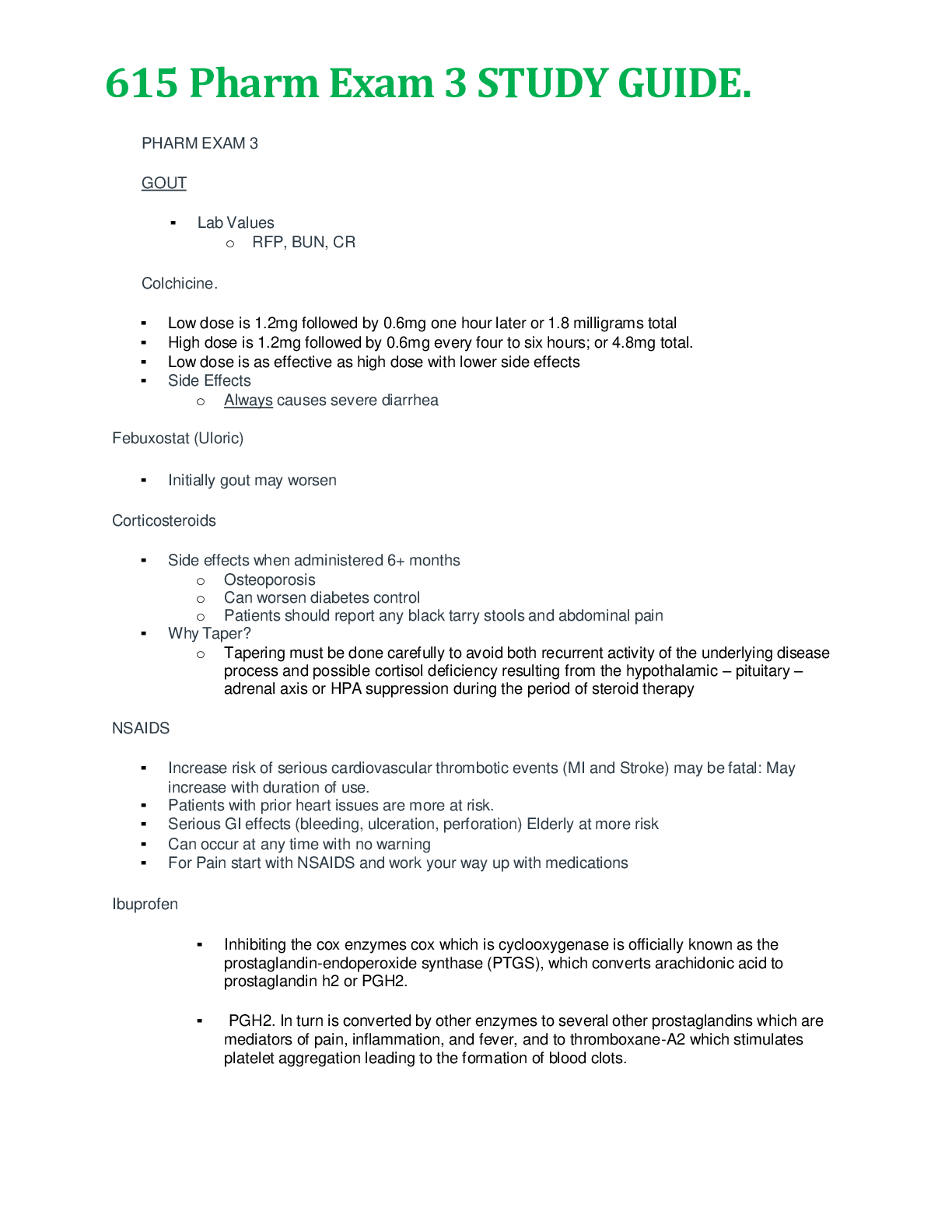
PHARM EXAM 3 GOUT
▪ Lab Values
o RFP, BUN, CR
Colchicine.
▪ Low dose is 1.2mg followed by 0.6mg one hour later or 1.8 milligrams total
▪ High dose is 1.2mg followed by 0.6mg every four to six hours; or 4.8mg total.
▪ Low dose is as effective as high dose with lower side effects
▪ Side Effects
o Always causes severe diarrhea Febuxostat (Uloric)
▪ Initially gout may worsen Corticosteroids
▪ Side effects when administered 6+ months
o Osteoporosis
o Can worsen diabetes control
o Patients should report any black tarry stools and abdominal pain
▪ Why Taper?
o Tapering must be done carefully to avoid both recurrent activity of the underlying disease process and possible cortisol deficiency resulting from the hypothalamic – pituitary – adrenal axis or HPA suppression during the period of steroid therapy
NSAIDS
▪ Increase risk of serious cardiovascular thrombotic events (MI and Stroke) may be fatal: May increase with duration of use.
▪ Patients with prior heart issues are more at risk.
▪ Serious GI effects (bleeding, ulceration, perforation) Elderly at more risk
▪ Can occur at any time with no warning
▪ For Pain start with NSAIDS and work your way up with medications Ibuprofen
▪ Inhibiting the cox enzymes cox which is cyclooxygenase is officially known as the
prostaglandin-endoperoxide synthase (PTGS), which converts arachidonic acid to prostaglandin h2 or PGH2.
▪ PGH2. In turn is converted by other enzymes to several other prostaglandins which are mediators of pain, inflammation, and fever, and to thromboxane-A2 which stimulates platelet aggregation leading to the formation of blood clots.
▪ Ibuprofen is a non-selective inhibitor of cyclooxygenase, its pharmacological effects are believed to be due to inhibition of cox-2 which decreases the synthesis of prostaglandins in mediating the inflammation pain, fever, and swelling.
▪ * Familiarize with COX pathways
▪ Reversibly inhibitor or cox pathway where aspirin is non-reversible Acetaminophen
▪ The main mechanism is the inhibition of cox.
▪ Highly selective cox-2.
▪ Does not significantly inhibit the production of pro clotting thromboxane’s. While it has analgesic and antipyretic properties compared to those of aspirin or other NSAIDs its peripheral anti-inflammatory activity is usually still limited by several factors.
1. High level of peroxides present and inflammatory lesions and in some circumstances even the peripheral anti-inflammatory activity comparable to NSAIDs can be observed.
▪ Acute overdoses of acetaminophen can cause potentially fatal liver damage.
▪ The maximum recommended dose is 4 grams in 24 hours.
Hypoglycemia
▪ Dizziness, confusion, diaphoresis, and tachycardia
Hyperglycemia
▪ Polyuria, polydipsia and weight loss.
Ketoacidosis.
▪ DKA or diabetic ketoacidosis you get a fruity breath odor, and rapid respirations.
▪ Neurologic symptoms including lethargy, focal sign, and obtundation can develop this can progress to coma in later stages.
Metformin
▪ Decrease hepatic glucose output by inhibiting gluconeogenesis.
▪ Increases insulin mediated glucose utilization in peripheral tissues such as the muscle and liver (particularly after meals)
▪ Antilipolytic effect that lowers serum phreatic concentrations thereby reducing substrate
availability for gluconeogenesis.
▪ Used in diabetics to decrease their cholesterol and triglyceride levels.
▪ Testing
▪ Cr and RFP
1. Metformin is not metabolized. It is cleared from the body via tubular secretion and excreted unchanged in the urine
-Gliptins
▪ Inhibitors Dipeptidyl peptidase-4 (DPP4), or dpp-4 inhibitors or gliptins, are a class of oral hypoglycemics that block DPP-4.
▪ Can be used to treat diabetes mellitus type II.
▪ Glucagon increases blood glucose levels and dpp-4 inhibitors reduced glucagonin blood glucose levels.
▪ MOA
▪ Increase incretin levels which inhibit glucagon release which in turn increases insulin secretion
▪ Decreases gastric emptying
▪ Decreases blood glucose levels.
GLP Agonists
▪ Glucagon-like peptide-1 receptor agonist (glp-1 receptor agonist or incretin mimetics)
▪ Agonists of the GLP-1 receptor.
▪ Used for treatment of type 2 diabetes.
▪ Advantages over older insulin secretagogues such as sulfonylureas or meglitinides
1. Lower risk of causing hypoglycemia.
▪ Bind to glucagon-like peptide-1 receptors slowing gastric emptying, increasing insulin secretion by pancreatic beta cells. Simultaneously the compound reduces the elevated glucagon secretion by inhibiting alpha cells of the pancreas
▪ GLP-1 is normally secreted by L cells of the gastrointestinal mucosa in response to a meal.
Exenatide
▪ Synthetic version of exendin-4 hormone found in the saliva of the Gilamonster. It displays biological properties similar to human glucagon-like peptide or GLP-1, a regulator of glucose metabolism and insulin secretion.
▪ Enhances glucose-dependent insulin secretion by the pancreatic beta-cell
▪ Suppresses inappropriately elevated glucagon secretion
▪ Slows gastric emptying, although the mechanism of action is still under study
▪ Administer 60 minutes before breakfast and dinner
. PTU
▪ Inhibits the enzyme thyroperoxidase, which normally acts in thyroid hormone synthesis by oxidizing the anion iodide (I) to iodine (I0)
▪ Does not inhibit the action of the sodium-dependent iodide transporter located on follicular cells'
basolateral membranes.
▪ Inhibition of this step requires competitive inhibitors, such as perchlorate and thiocyanate.
▪ Acts by inhibiting the enzyme 5-deiodinases which converts t4 to the active form
▪ Works both essentially in the thyroid as well as the target tissues
▪ These enzymes only work in conjugated tyrosine molecules of t3 and t4 a completely different enzyme family that is responsible for the deiodinase activity of iodinase single tyrosine molecules within the thyroid follicular cells.**
▪ Side effects
▪ Fatal granulocytopenia which usually the first sign is a fever and sore throat
▪ Vasculitis
▪ Temporary alopecia
▪ Rash
▪ Aplastic anemia
▪ Acute renal failure. Methimazole
▪ Treats toxic goiter in hyperthyroidism
▪ Teratogenic and can cause aplasia cutis is fetus (congenital focal absence of the skin on the scalp)
Levothyroxine
▪ Synthetic thyroid hormone that is chemically identical to levothyroxine T4 (naturally secreted by the follicular cells of the thyroid gland.
▪ It is used to treat thyroid hormone deficiency and occasionally to prevent the recurrence of thyroid
cancer.
▪ Chiral compound in the L form.
▪ Take on an empty stomach approximately half an hour before meals—as such thyroid replacement therapy is usually taken 30 minutes prior to eating in the morning
▪ Adverse effects (more in elderly)
▪ Tachycardia
▪ Angina
▪ Lab Values to Monitor
▪ Blood free thyroxine
▪ TSH
Alpha-glucosidase inhibitors
▪ Acarbose
▪ 50 and 100 milligram tablets and should be taken with the first bite of each meal.
▪ Begin with 50 milligrams TID
▪ Flatulence, diarrhea, and abdominal discomfort are dose-related and almost always resolve if the dose is decreased
▪ Few people tolerate more than 300mg daily
▪ Contraindicated in patients with inflammatory or IBS due to flatulence they can produce
Meglitinides.
▪ Close ATP-dependent potassium channels in the beta cell membrane by binding at specific receptor sites.
▪ Potassium channel blockade depolarizes the beta cell and leads to an opening of calcium
channels
TZD’s
▪ Side effect
▪ Water retention leading to edema
▪ Should be prescribed with both caution and patient warnings about the potential for water retention and weight gain, especially in patients with decreased ventricular function
Thyroid replacement hormone
▪ Too Much?
o Hyperthyroidism, tachycardia, insomnia and nervousness Onset of action, peak of action, and duration of action of each insulin preparation
• Rapid-acting insulins (Lispro, Asparte, and Glulisine)
o Onset is about five minutes
o Peak at one hour
o Duration of about four or five hours.
• Short acting or regular insulin
o Used around mealtime (Taken about 30 to 45 minutes before eating)
o Peaks in three to four hours
o Duration is four to 10 hours
• Intermediate acting (NPH) is mixed with protamine delaying absorption.
o Insulin looks cloudy and has to be mixed before injected.
o Onset is 1 to 1-1/2 and hours
o Peak of 4 to 10 hours
o Duration of 12 to 24 hours.
• Long acting (Glargine or Levemir(detemir))
o Onset 2 to 4 hours
o Duration 24 hours
o Little or no peak.
When changing from NPH to glargine insulin, how will you adjust the patient’s dose?
o Insulin glargine is a long-acting basal insulin analog given once daily to help control blood sugar levels of those with diabetes.
o Consists of microcrystals it slowly releases insulin giving a long duration of action of 18 to 26 hours with a peakless profile.
o Pharmacokinetic it resembles basal insulin secretion of a non-diabetic pancreatic beta cells.
o Initial dose of glargine is reduced by 20% to avoid hypoglycemia
Insulin Therapy
• Side Effects
o Hypoglycemia, with a potential of hypokalemia
What assessments should be made before prescribing any antihypertensive agent?
o RFT and LFT. The real function especially for ace inhibitors and ACE receptor blockers which work primarily in the kidneys.
ACE inhibitors
• MOA
o The renin-angiotensin system is systemically and locally driven. The systemic process is triggered by the kidneys’ response to decreased effective blood volume and begins with the secretion of insulin from the renal cortex. Once released, renin cleaves angiotensinogen to form angiotensin-I. This product in turn is catalyzed by angiotensin converting enzyme or ACE, formed primarily in the pulmonary vasculature and angiotensin-II. This potent vasoconstrictor effects tissues and systems throughout the body, research shows that these vasoconstrictor effects are attenuated by ACE inhibition.
• Drug of choice in diabetic patients with hypertension
o Reduce the adverse effects of diabetes on the kidneys.
o Slow the onset of diabetic nephropathy in patients with microalbuminuria and type 1 diabetes.
• Adverse effect
o Dry, Hacking cough and most time these patients are switched to an ACE receptor blocker
ARB’s
• ARB’s do not affect ACE activity but rather by blocking the AT II receptor.
• Similar actions to ACEI’s on vasoconstriction and aldosterone secretion
• No activity related to bradykinin.
• Don’t affect cardiac output.
Calcium channel blockers
• Four effects:
o (1) by acting on vascular smooth muscle they reduce contraction in arteries and causes an increase in arterial diameter a phenomenon called vasodilataters. Calcium channel blockers do not work on Venous smooth muscle
o (2) Acting on cardiac muscles or the myocardium they reduce the force of the contraction of the heart
o (3) Slowing down the conduction of electrical activity within the heart they slow down the heart rate
o (4) Blocking calcium signal on adrenal cortex cells they reduce aldosterone production which collaborates to lower blood pressure. Can help to eliminate symptoms of ischemic heart disease such as angina pectoris
o Dihydropyridines which includes nifedipine and nicardipine
▪ mainly affect arterial vascular smooth muscle and lower blood pressure by causing vasodilation.
▪ Adverse Effects
▪ Sometimes when they were used to treat angina the vasodilation and hypotension can lead to a reflex tachycardia which can be detrimental for patients with the ischemic symptoms because the resulting increase in myocardial oxygen demand.
▪ Can worsen proteinuria with patients with neuropathy which can increase edema and the hands and feet.
o The phenylalanine class of calcium channel blockers such as verapamil mainly affect the
cells of the heart and had negative inotropic and negative chronotropic effects
o The benzothiazepine class of calcium channel blockers like Diltiazem combined effects of the two other classes.
o Side Effects
▪ Reduction in BP may result in dizziness, headache, hypotension, and syncope.
▪ GI symptoms including; dry mouth, nausea, vomiting, reflux, and constipation.
-Statins
• Adverse Effects
o Rhabdomyolysis
o Increased risk of diabetes
o Increased liver enzymes in the blood due to liver damage.
o Other possible adverse effects include cognitive loss, neuropathy, pancreatic and other hepatic dysfunction, and sexual dysfunction.
• Patient education
o Report any muscle weakness or tenderness, and dark urine to physician immediately.
What lipid disorder(s) do fibric acid derivatives treat?
o Elevated Trg
o Used in combo with -statins
What lipid disorder(s) do bile acid sequestrants treat?
o Cholestyramine removes bile acids from the body by forming insoluble complexes with bile acids in the intestine which are then excreted in the feces.
o As a result of this loss of bile acids or plasma cholesterol is converted to bile acids in the liver to normalize levels.
o This conversion of cholesterol in a bile acid lowers plasma cholesterol levels.
What would you recommend to a patient who is experiencing flushing with niacin therapy?
o Niacin, also known as vitamin B3 or nicotinic acid, is an organic compound with the formula CA and is one of the 20 to 80 essential human nutrients.
o Pharmaceutical and supplemental niacin are primarily used to treat hypercholesterolemia and pellagra which is niacin deficiency.
o Main side effect is flushing which usually last for 15 to 30 minutes, although it can sometimes last up to two hours. It's sometimes accompanied by prickling or itching sensation in particular in areas covered by clothing.
o So that flushing can be blocked by taking 300 milligrams of aspirin a half an hour before taking niacin
Amlodipine
• Metabolized in the liver to inactive metabolites vs cyp3a4;
o No grapefruit juice inhibits the cyp3a4 increasing the amount of amlodipine in the bloodstream
• Used to treat high blood pressure and prevent chest pain; it can also be used for heart failure.
• It is a long-acting dihydropyridine CCB. By widening blood vessels, it lowers blood pressure.
• In angina, it increases blood flow to the heart muscle to relieve pain due to angina.
• Side effects
o Dose Related
▪ Peripheral edema
▪ Dizziness
▪ Palpitations
▪ Flushing
o Not dose Related
▪ Fatigue
▪ Nausea
▪ Somnolence
▪ Abdominal Pain
o Rare Side Effects
▪ Blood disorders
▪ Impotence
▪ Depression
▪ Insomina
▪ Tachycardia
▪ Gingival Enlargement
▪ Hepatitis
▪ Juandice
Amiodarone
• Side Effects
o Eyes
▪ corneal micro deposits
▪ andoptic neuropathy
▪ any visual problems using amiodarone definitely see the doctor or provider right away
o Skin
▪ Bluish-gray discoloration of the skin
▪ Photosensitivity
o Lung
▪ Interstitial lung disease
o You can see both hypo and hyperthyroidism and they should monitor their blood pressure daily.
• Thyroid Panel
o Induced abnormalities in thyroid function are common.
o Amiodarone is structurally similar to thyroxine which contributes to the effects of amiodarone on thyroid function
o Both under and over activity of the thyroid may occur on amiodarone treatment
o Treatment of free thyroxine alone may be unreliable in detecting these problems and TSH should therefore be checked every six months
Digoxin
• Purified cardio glycoside similar to digitoxin extracted from the foxglove plant digitalas lanata.
• Used in the treatment of various heart conditions
o atrial fibrillation, atrial flutter, and sometimes heart failure that cannot be controlled by other medication.
• Indications
o a fib and a flutter with that rapid ventricular response although beta blockers and CCB are a better first choice
• Digoxin may increase the risk of death though another meta-analysis reports no change in mortality.
• Digoxin has potentially serious interactions with verapamil, amiodarone, erythromycin, and
epinephrine as would be injected by a local with a local in the anesthetic.
• Digoxin level should be monitored while taking albuterol; need to monitor renal functions as it's excreted in the kidneys
Nitroglycerin
• Used for the treatment of angina, Acute MI, Severe HTN and coronary artery spasms
• In the short run Glyceryl Trinitrate can cause severe headaches necessitating algesic administration for relief of pain; severe hypotension; and in certain cases bradycardia
• The painful nature of these adverse effects has marked negative impact on patient compliance.
• Tolerance
• All organic nitrate regimens using frequent dosing of long acting nitrates (which is about three or more times daily) continuous delivery symptoms transdermal nitroglycerin patches, or continuous IV infusions of nitroglycerin or long- acting preparations, will result in partial or complete nitrate tolerance
• To avoid tolerance to long-term nitrate therapy regimens should be tailored to provide a 10 to 12- hour nitrate-free interval level when possible
Warfarin (Coumadin)
• Anticoagulant normally used in the prevention of thrombosis and thromboembolism.
• Decrease blood coagulation by inhibiting vitamin K epoxide reductase enzyme that recycles oxidized vitamin K to
its reduced form after it has participated in the carboxylation of several blood clot blood
coagulation protein. Mainly prothrombin and factor VII
• Onset of their effect requires about two to three days before remaining active-clotting factors that have time to naturally disappear in metabolism.
• Duration of a single dose of warfarin is 2 to 5 days.
• Reversal of warfarin’s effect by discontinuing its use or by administering vitamin K requires a similar period of time.
• Avoid vitamin K rich foods which include diets high in green leafy vegetables especially kale and spinach.
• Warfarin is contraindicated in pregnancy as it passes through the placental barrier and may
cause bleeding in the fetus.
• Warfarin use during pregnancy is commonly associated with spontaneous abortion, stillbirth, neonatal death, and preterm birth. There are also known teratogens in the incidence of birth defects of infants exposed to Warfarin
Congestive Heart Failure
o 1st line: ACE inhibitors and ACE receptor blockers
o Beta Blockers
o In people who are intolerant of ACE inhibitors or ARBs or who have significant kidney dysfunction the use of combined hydralazine and a long-acting nitrate such isosorbide nitrate is an effective alternative strategy.
o This regimen has been shown to reduce mortality and people with moderate heart failure it's especially beneficial in African Americans.
o In African Americans were symptomatic hydralazine and isosorbide nitrate can be added to an ACE inhibitor or ARB.
o In people with markedly reduced ejection fraction the use of an aldosterone antagonist in addition to beta blockers and ACE inhibitors can improve symptoms and reduce mortality.
o Second line drugs for congestive heart failure do not conform mortality benefit.
o Digitalis is one such drug- its narrow therapeutic window; high degree of toxicity, and the failure in multiple trials to show a mortality benefit has reduced its role included our clinical practice.
o Diuretics have been a mainstay of treatment for the treatment of fluid accumulation and includes diuretics classes such as loop diuretics, thiazide-like diuretics, and potassium-sparing diuretics although widely used evidence of their efficacy is safety limited with the effect exception of spironolactone antagonists.
Procainamide
o Anti-arrhythmic agents used for the medical treatment of cardiac arrhythmias classified as 1a.
o This drug is used for both supraventricular and ventricular arrhythmias.
o Has to be dosed frequently to maintain an adequate serum concentration. Because of its short half-life it must be dose every three to four hours.
o Procainamide induced anti-nuclear antibodies are formed after six months of treatment.
o There's a close line between the plasma concentration of the therapeutic atopic effect therefore a higher risk of toxicity.
o Side Effects (occur more when daily doses are increased)
o Ventricular dysrhythmias
o Bradycardia
o Hypotension
o Shock
o May also lead to drug induced fever and other allergic responses
o There is also a chance SLE can occur, which at the same time leads to polyarthralgia, myalgia, and pleurisy most of these side effects may occur due to the aestivatin of procainamide.
[Show More]