Drooping of the upper eyelid is termed: ptosis
2. 8-year-old c/o itching in the right ear & increased in pain when the pinna is pulled, or the
tragus is palpated. Exam reveals slight redness in the ear canal w/a clear
...
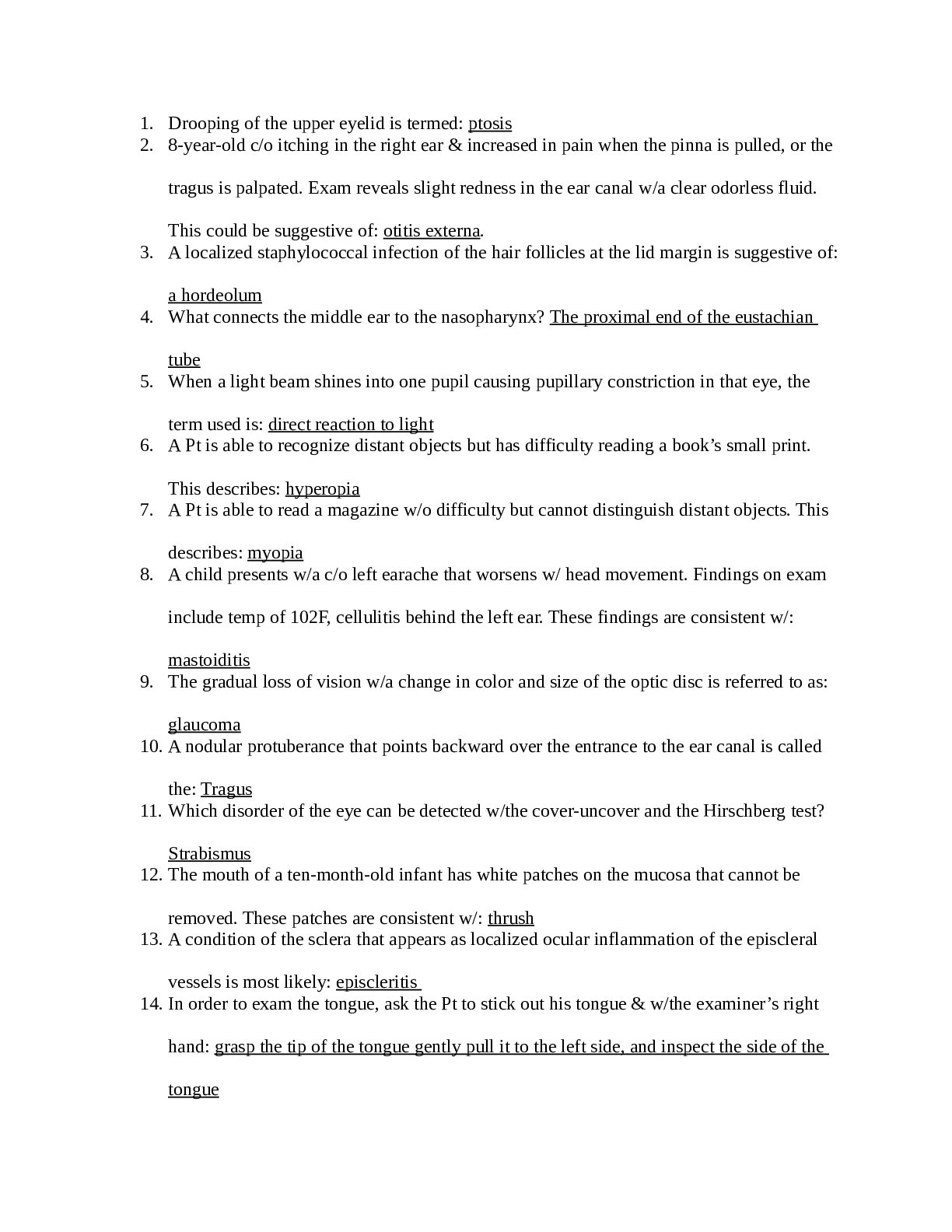
Drooping of the upper eyelid is termed: ptosis
2. 8-year-old c/o itching in the right ear & increased in pain when the pinna is pulled, or the
tragus is palpated. Exam reveals slight redness in the ear canal w/a clear odorless fluid.
This could be suggestive of: otitis externa.
3. A localized staphylococcal infection of the hair follicles at the lid margin is suggestive of:
a hordeolum
4. What connects the middle ear to the nasopharynx? The proximal end of the eustachian
tube
5. When a light beam shines into one pupil causing pupillary constriction in that eye, the
term used is: direct reaction to light
6. A Pt is able to recognize distant objects but has difficulty reading a book’s small print.
This describes: hyperopia
7. A Pt is able to read a magazine w/o difficulty but cannot distinguish distant objects. This
describes: myopia
8. A child presents w/a c/o left earache that worsens w/ head movement. Findings on exam
include temp of 102F, cellulitis behind the left ear. These findings are consistent w/:
mastoiditis
9. The gradual loss of vision w/a change in color and size of the optic disc is referred to as:
glaucoma
10. A nodular protuberance that points backward over the entrance to the ear canal is called
the: Tragus
11. Which disorder of the eye can be detected w/the cover-uncover and the Hirschberg test?
Strabismus
12. The mouth of a ten-month-old infant has white patches on the mucosa that cannot be
removed. These patches are consistent w/: thrush
13. A condition of the sclera that appears as localized ocular inflammation of the episcleral
vessels is most likely: episcleritis
14. In order to exam the tongue, ask the Pt to stick out his tongue & w/the examiner’s right
hand: grasp the tip of the tongue gently pull it to the left side, and inspect the side of the
tongue
15. Person’s eye gaze included both eyes moving in the same direction simultaneously:
conjugate gaze
16. 35-year-old Pt c/o vertigo accompanied by nausea and vomiting. Exam reveals bilateral
diplopia and an unsteady gait. These symptoms could be suggestive of: a neurological
condition
17. An example of a cause of conductive hearing loss in children would be: the presence of a
peanut in the ear for three weeks
18. Ophthalmoscopic exam of the retina reveals a normal arteriovenous crossing. This
appears as if the: vein crosses beneath the artery
19. 50-year-old Pt presents w/ c/o seeing double bilaterally. Exam reveals a vertical diplopia.
This maybe suggestive of a: palsy of cranial nerve III or IV
20. Ophthalmoscopic exam of the retina reveals AV tapering. This appears as if the: vein
“wind” down on either side of the artery
21. A condition that involves optic nerve damage and visual field changes is termed:
glaucoma
22. The most common cause of bacterial pharyngeal infection in children is: group A beta-
hemolytic streptococcus
23. Janeway lesions of the palms and soles appear as: small, nontender, erythematous
nodules
24. A softening of the skin at the angles of the mouth which maybe due to nutritional
deficiency is commonly referred to as: angular cheilitis
25. The maxillary sinuses: surround the nasal cavity
26. Sudden bilateral and painful visual loss is rare but can be associated w/: radiation
exposure
27. Eversion of the upper eyelid can be performed by placing the cotton applicator on the
upper lid above the level of the internal tarsal plates and then: gently push down w/the
stick and left the lashes up & flip the lid inside out
28. On Ophthalmoscopic exam of a 70-year-old, a thin grayish white arc is noted on the
lower end of the cornea. This appearance is referred to as a: corneal arcus
29. 50-year-old Pt c/o being unable to read the hymnal at church. This describes: presbyopia
30. The ossicles are located in the: middle ear
31. On physical exam, an abnormal Rinne test might indicate: impaired hearing ability
32. With transillumination of the frontal sinuses, a dim red glow is observed on the forehead.
This dim red glow would be indicative of: clear frontal sinuses
33. The nasolacrimal duct drains into the: inferior meatus
34. All of the following symptoms in a 10-month-old would be indicative of acute otitis
media (OM) except: increased mobility of the TM
35. In the normal ear, all of the following landmarks ca be visualized when using the
otoscope, except the: eustachian tube
36. When examining the conjunctiva and sclera, have the Pt look upward and then: depress
both lower lids w/your thumbs, exposing the sclera and conjunctiva
37. In Pts who have allergic rhinitis, the nasal mucosa appears: pale
38. Fordyce spots or granules are considered: normal sebaceous glands of the buccal mucosa
39. In order to visualize the opening of Stensen’s duct, examine the: buccal mucosa opposite
the second molar
40. 30-year-old Pt presents w/a moderated “aching” in his right eye. Findings reveal a small
and irregular shaped right pupil. The cornea appears cloudy w/a slight erythematous area
around the corneal limbus. There is no ocular discharge noted. These findings are
consistent w/: acute iritis
41. Miosis is a term used to described: constriction of the pupils
42. Most of the paranasal sinuses drain into: middle meatus
43. A condition in which the eyes are not properly aligned w/each other is termed: strabismus
44. Current indications for tympanostomy tube placement include all of the following except
which one? Persistent serous otitis media (SOM) that has not responded to a 3-6 weeks
course of medical treatment
45. A man w/a history of long term use of chewing tobacco presents, w/a mouth lesion that is
suspicious for malignancy. Oral assessment findings described: an ulcerated lesion w/
indurated margins on the lateral tongue
46. Children who pick their noses are at a higher risk for development of: epistaxis
47. A teenage c/o itching and burning of his eye. Examination reveals an erythematous eyelid
margin w/ crusting and a clear mucus discharge. These findings are consistent w/:
blepharitis
48. A Pt w/ diagnosed as being farsighted. The term for this condition is: hyperopia
49. Ptosis is defined as: drooping of the eyelid
50. Actinic cheilitis is a condition of the lower lip most commonly seen in: fair-skinned men
who work outdoors
51. 30-year-old Pt present w/ c/o seeing double in the right eye. Exam reveals diplopia in the
right eye when the left eye is closed. This maybe suggestive of: a problem in the cornea
52. On exam of the tympanic membrane, red bulging ear drum is detected. This is consistent
w/: acute otitis media
53. The ethmoidal sinuses: are located between the eyes
54. 45-year-old Pt c/o vertigo, tinnitus, and pressure in the right ear. These symptoms are
consistent w/: Meniere’s disease
55. When examining the eyes, both pupils appear small and have an irregular shape. They are
noted to accommodate but do not appear to react to light. This could be indicative of:
Argyll Robertson pupils
56. The lacrimal puncta are located: along the margin of the upper and lower eyelids
57. If there is an abnormal protrusion, what condition should be suspected if there is an
abnormal protrusion of the eye? Graves’ disease
58. Mydriasis is a term used to describe: dilation of the pupils
59. A toddler w/a suspected hearing loss would: likely communicate through gestures
60. 6-year-old child presents w/ sore throat, difficulty swallowing and a temp 102F. Findings
reveal lymphadenopathy and pharyngeal erythema. This is probably: pharyngitis
61. 60-year-old Pt presents with severe, deep left eye pain. Findings reveal dilated and fixed
left pupil and the cornea is cloudy. There is no ocular discharge noted. These findings are
most likely consistent w/: acute angle closure glaucoma
62. Where in the mouth would reddened areas, nodules, or ulcerations that are suspicious of
malignary be present? Tongue
63. Ophthalmoscopic examination of the fundus reveals small, rounded, slightly irregular red
spots embedded in the retina. These findings are consistent w/: deep retinal hemorrhages
64. On ophthalmoscopic exam of the older adult, there is an increased cup-to-disc ratio: This
findings is suggestive of: open angle glaucoma
65. Leukoplakia was noted during an exam of the mouth. This symptom may be:
precancerous
66. Ectropion is defined as: an outward turning of the lower eyelid
[Show More]





.png)
.png)