BIOL 251 Quiz 1
The function of the placental hormone human placental lactogen (hPL) is to .
•
A. prepare the breasts for lactation
•
B. nourish the placenta
•
C. regulate the menstrua
...
BIOL 251 Quiz 1
The function of the placental hormone human placental lactogen (hPL) is to .
•
A. prepare the breasts for lactation
•
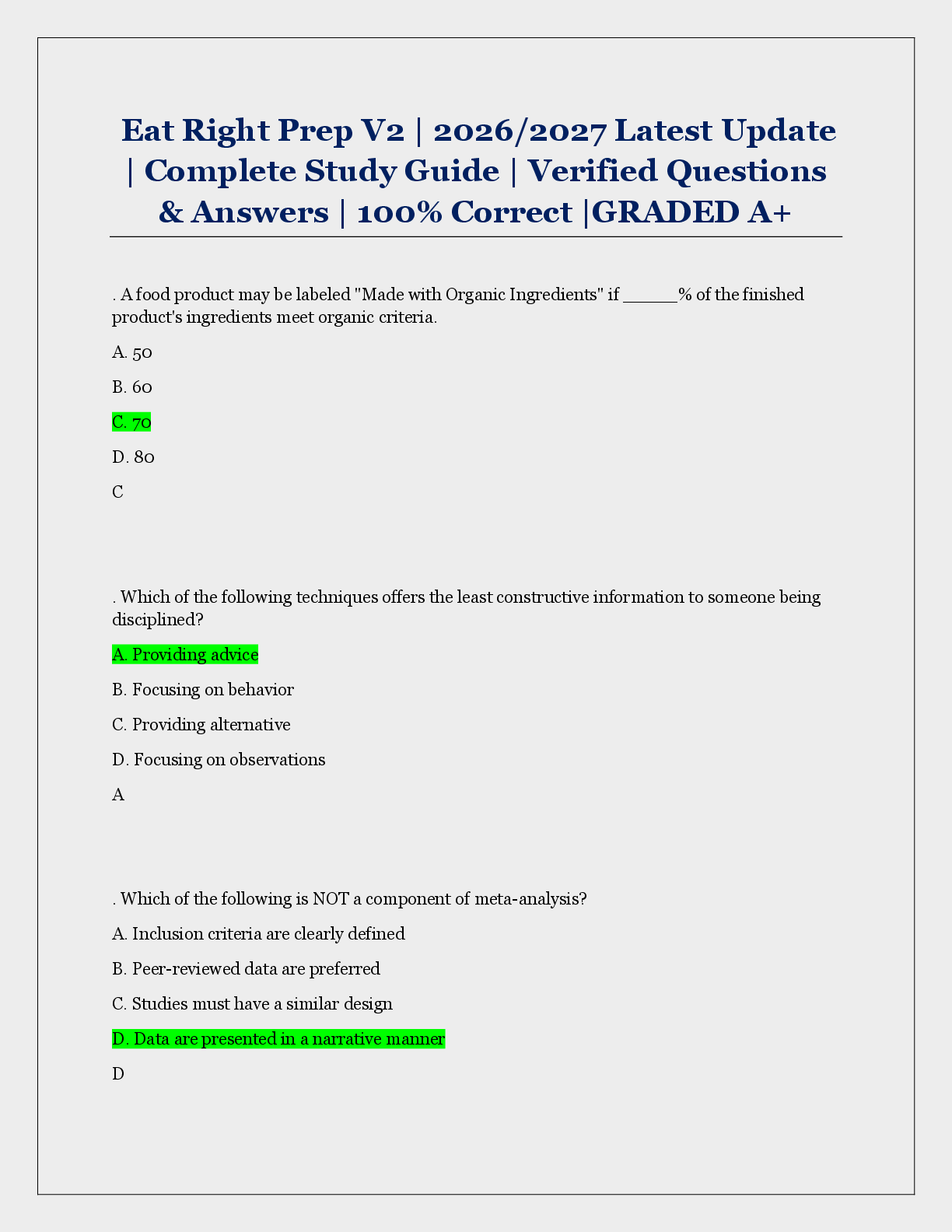
B. nourish the placenta
•
C. regulate the menstrual cycle
•
D. help the placenta to mature
•
E. All of the above are true.
Feedback:26. The function of the placental hormone human placental lactogen (hPL) is to prepare the breasts for lactation
Question 2 of 25
0.0 / 4.0 Points
Cushing’s disease is a disorder caused by .
A. abnormally high levels of cortisol
•
B. abnormally high levels of epinephrine
•
C. abnormally low levels of cortisol
•
D. abnormally low levels of aldosterone
•
E. abnormally high levels of aldosterone
Feedback:Cushing’s disease is a disorder caused by abnormally high levels of cortisol. Question 3 of 25
4.0 / 4.0 Points
Which of the following statements about insulin is true?
•
A. Insulin acts as a transport protein, carrying glucose across the cell membrane.
B. Insulin facilitates the movement of intracellular glucose transporters to the cell membrane.
•
C. Insulin stimulates the breakdown of stored glycogen into glucose.
•
D. Insulin stimulates the kidneys to reabsorb glucose into the bloodstream.
•
E. Two of the above are true statements.
Feedback:Good work; your answer is correct! Question 4 of 25
4.0 / 4.0 Points
The primary hormones produced by the ovaries are .
•
A. Estrogen
•
B. FSH and LH
•
C. Prolactin
•
D. Progesterone
•
E. Testosterone
Feedback:Good work; your answer is correct! Question 5 of 25
4.0 / 4.0 Points
The parathyroid glands are tiny, round structures usually found embedded in the posterior surface of the .
•
A. Pituitary gland
•
B. Hypothalamus
•
C. Pancreas
•
D. Thyroid gland
•
E. Adrenal glands
Feedback:Good work; your answer is correct! Question 6 of 25
4.0 / 4.0 Points
Stage one of GAS is called the alarm reaction. This is short-term stress, the fight-or-flight response, mediated by the hormones and from the adrenal medulla.
•
A. Epinephrine; norepinephrine
•
B. Aldosterone; angiotensin
•
C. Testosterone; estrogen
•
D. Insulin; glucagon
•
E. Cortisol; hydrocortisone
Feedback:Good work; your answer is correct! Question 7 of 25
4.0 / 4.0 Points
The hypothalamus is functionally and anatomically connected to the posterior pituitary lobe by a bridge of .
•
A. cartilage
•
B. nerve axons
•
C. blood vessels
D. muscle
•
E. bone
Feedback:Good work; your answer is correct! Question 8 of 25
4.0 / 4.0 Points
The hormones of the human body can be divided into which of the following major group(s)?
•
A. Sex hormones
•
B. CNS hormones
•
C. Hormones derived from amino acids
•
D. Hormones derived from lipids
E. C and D above are correct.
Feedback:Good work; your answer is correct! Question 9 of 25
4.0 / 4.0 Points
Which of the following can result from hyperparathyroidism?
•
A. increased bone deposition
•
B. fractures
•
C. convulsions
•
D. low blood calcium levels
•
E. All of the above are true.
Feedback:Good work; your answer is correct! Question 10 of 25
4.0 / 4.0 Points
The alpha cells of the pancreatic islets produce and secrete .
•
A. insulin
•
B. glucagon
•
C. epinephrine
•
D. alphagen
•
E. All of the above
Feedback:Good work; your answer is correct! Question 11 of 25
0.0 / 4.0 Points
How many hormones are produced by the posterior pituitary?
•
A. 2
•
B. 6
•
C. 3
•
D. 0
•
E. 1
Feedback:The hormones oxytocin and ADH are released from the posterior pituitary, but no hormones are produced there.
Question 12 of 25
4.0/ 4.0 Points
Which of the following statements about the thyroid gland is true?
•
B. The parathyroid glands are embedded within it.
•
C. It manufactures three hormones.
•
D. It is controlled by the anterior part of the pituitary gland.
•
E. All of the above are true.
Feedback:Good work; your answer is correct! Question 13 of 25
4.0 / 4.0 Points
What secretory cell type is found in the adrenal medulla?
•
A. follicle cells
•
C. oxyphil cells
•
D. neuroglial cells
•
E. beta cells
Feedback:Good work; your answer is correct! Question 14 of 25
4.0 / 4.0 Points
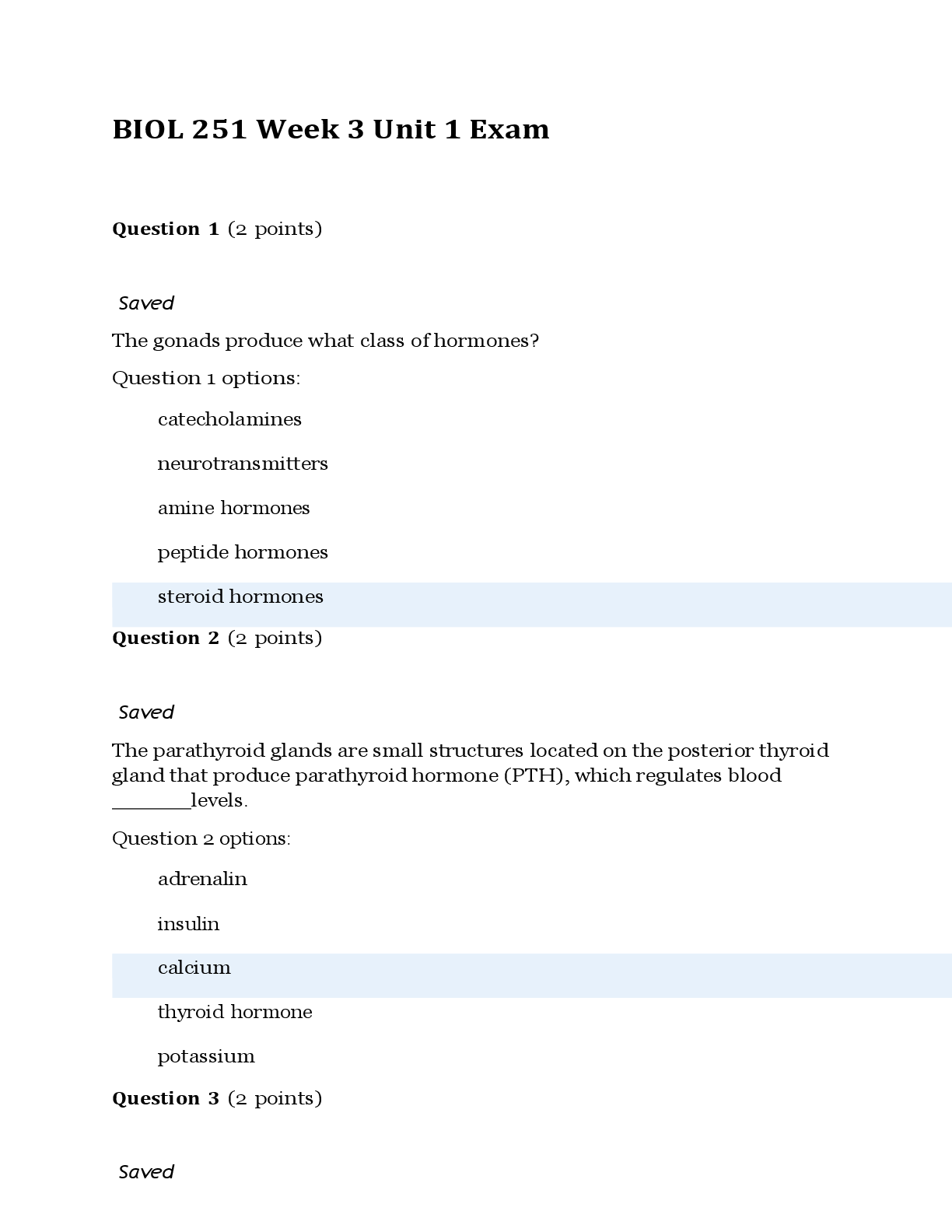
The parathyroid glands are small structures located on the posterior thyroid gland that produce parathyroid hormone (PTH), which regulates blood levels.
•
A. potassium
•
B. insulin
•
C. calcium
•
D. thyroid hormone
•
E. adrenalin
Feedback:Good work; your answer is correct! Question 15 of 25
4.0 / 4.0 Points
The signaling done by the endocrine system is accomplished by the use of chemicals called
.
•
A. electrical signals
•
B. transmitters
•
C. action potentials
•
D. electrons
•
E. hormones
Feedback:Good work; your answer is correct!
Part 2 of 6 - Part 2 8.0/ 8.0 Points
This is a review from BIOL250, OpenStax Anatomy and Physiology chapter 1
Question 16 of 25
4.0 / 4.0 Points
The smallest independently functioning unit of a living organism is a(an):
•
A. cell
•
B. atom
•
C. tissue
D. molecule
•
E. organ
Feedback:Good work; your answer is correct! Question 17 of 25
4.0 / 4.0 Points
Which of the following statements is(are) correct when discussing homeostasis?
•
A. Maintaining homeostasis requires that the body continuously monitor its internal conditions.
•
B. A sensor, also referred to a receptor, is a component of a feedback system that monitors a physiological value.
•
C. This value is then reported to the control center. The control center is the component in a feedback system that compares the value to the normal range.
D. If there is a condition that needs to be changed, an effector is the component in a feedback system that causes a change to reverse the situation and return the value to the normal range.
•
E. All of the above are correct/true.
Feedback:Good work; your answer is correct!
Part 3 of 6 - Part 3 4.0/ 8.0 Points
This is a review from BIOL250, OpenStax Anatomy and Physiology chapter 3
Question 18 of 25
0.0 / 4.0 Points
Which type of stem cell gives rise to red and white blood cells?
•
A. blood
•
B. endothelial
•
C. epithelial
D. hematopoietic
•
E. mesenchymal
Feedback:A hematopoietic stem cell can give rise to either red blood cells or white blood cells. Question 19 of 25
4.0 / 4.0 Points
What scientist is given credit for coming up with the concept of the cell?
•
A. Robert Hooke
•
B. Michelangelo
•
C. Galileo
•
D. Albert Einstein
E. Michael Curie
Feedback:Good work; your answer is correct!
Part 4 of 6 - Part 4 8.0/ 8.0 Points
This is a review from BIOL250, OpenStax Anatomy and Physiology chapter 6
Question 20 of 25
4.0 / 4.0 Points
Which type of joint is freely moveable, such as the elbow and knee?
•
A. Fibrous
•
B. Sutures
•
C. Synovial
•
D. Synarthrosis
E. Osteoarthrosis
Feedback:Good work; your answer is correct! Question 21 of 25
4.0 / 4.0 Points
What is the fibrocartilage padding in between the vertebrae called?
•
A. Costal Cartilage
•
B. Spinal Tendon
•
C. Thoracic Cartilage
•
D. Intervertebral Disc
•
E. Vertebral Gel Sac
Feedback:Good work; your answer is correct!
Part 5 of 6 - Part 5 8.0/ 8.0 Points
This is a review from BIOL250, OpenStax Anatomy and Physiology chapter 10
Question 22 of 25
4.0 / 4.0 Points
Which structures of cardiac muscle allows the cells to contract in waves so the heart can work as a pump?
•
A. Nucleus
•
B. Gap junction
•
C. Intercalated discs
•
D. Desmosome
•
E. Syncytium
Feedback:Good work; your answer is correct!
Question 23 of 25
4.0 / 4.0 Points
All of the following are functions of skeletal muscles except for which?
•
A. Produce heat
•
B. Maintain balance
•
C. Stop movement
•
D. Regulate blood pressure
•
E. Produce movement
Feedback:Good work; your answer is correct!
Part 6 of 6 - Part 6 8.0/ 8.0 Points
This is a review from BIOL250, OpenStax Anatomy and Physiology chapter 12
Question 24 of 25
4.0 / 4.0 Points
The two general types of cells found in the nervous system are and .
A. Neurons; nodes of Ranvier
•
B. Neurons; glial cells
•
C. Astrocytes; oligodendrocytes
•
D. Neurons; target cells
•
E. Glial cells; myelin cells
Feedback:Good work; your answer is correct! Question 25 of 25
4.0 / 4.0 Points
Voltage-gated sodium channels open upon reaching what state?
•
A. Overshoot
B. Repolarization
•
C. Resting potential
•
D. Threshold
Feedback:Correct. This can be found in the OpenStax Overview of Anatomy and Physiology section. Section 12.4.
[Show More]


 – Nevada State College.png)