QUIZ 1
The gonads produce what class of hormones?
•
A. steroid hormones
•
B. catecholamines
•
C. peptide hormones
•
D. amine hormones
•
E. neurotransmitters
Feedback: Good work; your
...
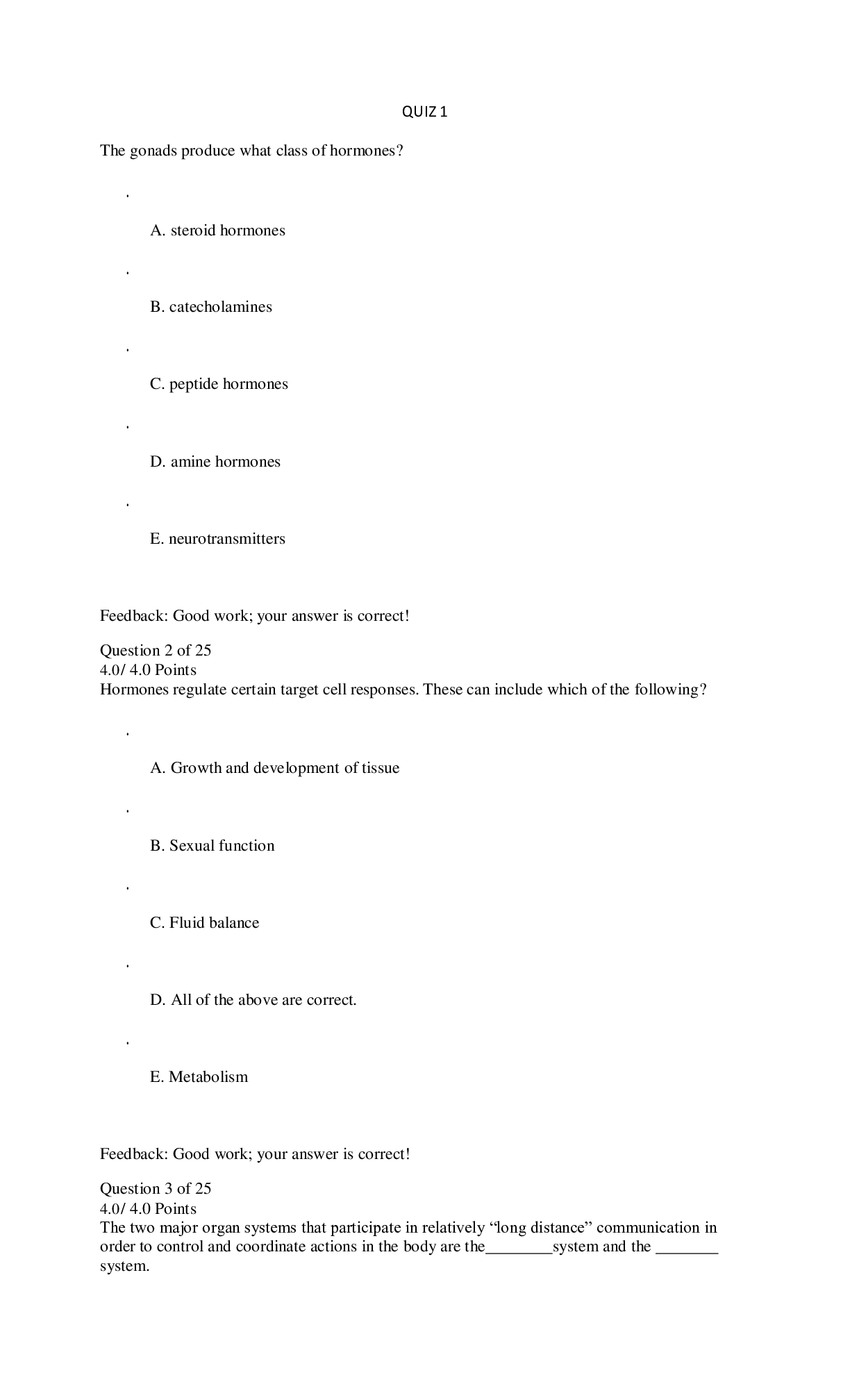
QUIZ 1
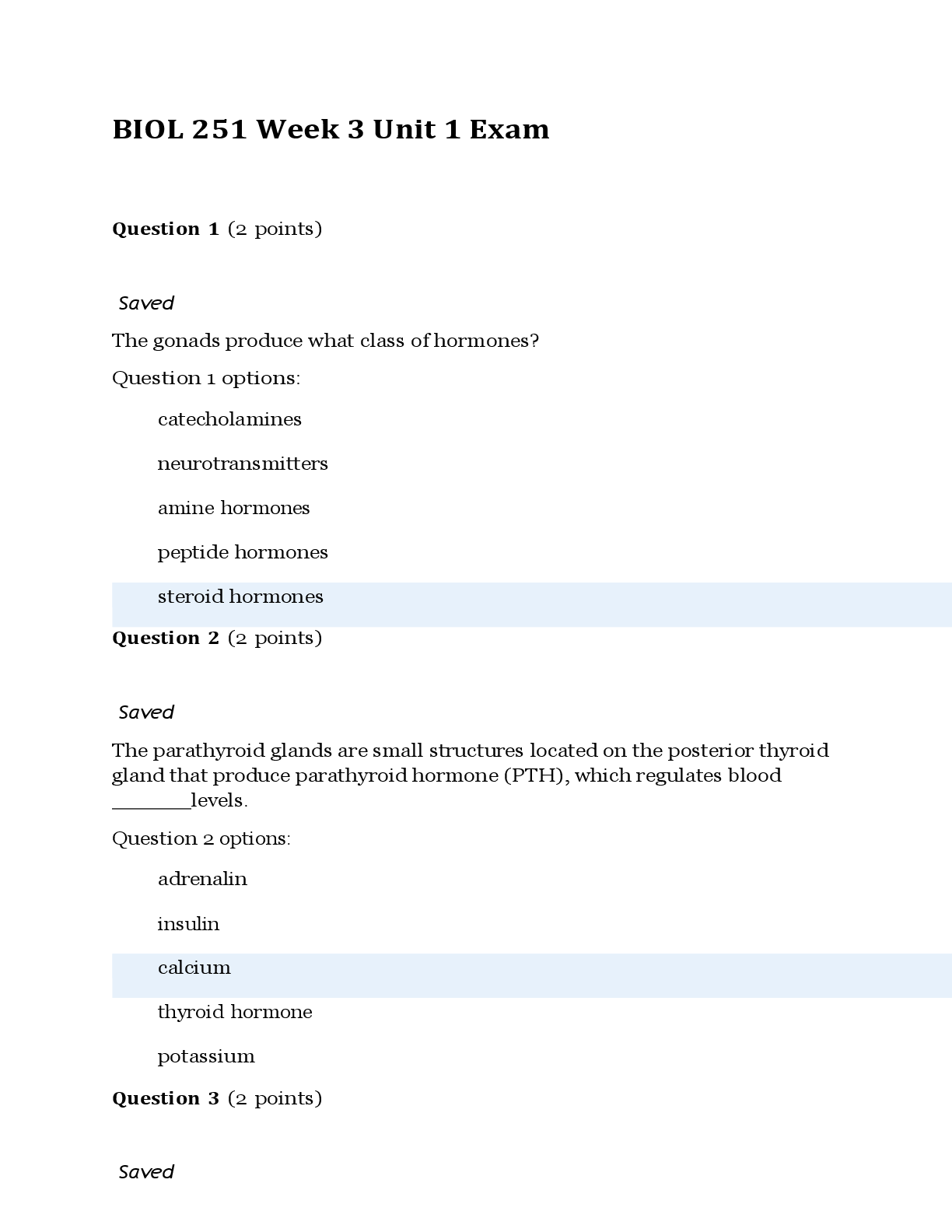
The gonads produce what class of hormones?
•
A. steroid hormones
•
B. catecholamines
•
C. peptide hormones
•
D. amine hormones
•
E. neurotransmitters
Feedback: Good work; your answer is correct! Question 2 of 25
4.0 / 4.0 Points
Hormones regulate certain target cell responses. These can include which of the following?
•
A. Growth and development of tissue
•
B. Sexual function
•
C. Fluid balance
•
D. All of the above are correct.
•
E. Metabolism
Feedback: Good work; your answer is correct! Question 3 of 25
4.0 / 4.0 Points
The two major organ systems that participate in relatively “long distance” communication in order to control and coordinate actions in the body are the system and the system.
A. Nervous; endocrine
•
B. Cardiovascular; endocrine
•
C. Skeletal; muscular
•
D. Muscular; nervous
•
E. Muscular; integumentary
Feedback: Good work; your answer is correct! Question 4 of 25
4.0 / 4.0 Points
Stage one of GAS is called the alarm reaction. This is short-term stress, the fight-or-flight response, mediated by the hormones and from the adrenal medulla.
•
A. Insulin; glucagon
•
B. Cortisol; hydrocortisone
•
C. Epinephrine; norepinephrine
•
D. Aldosterone; angiotensin
•
E. Testosterone; estrogen
Feedback: Good work; your answer is correct! Question 5 of 25
0.0 / 4.0 Points
The beta cells of the pancreatic islets produce and secrete .
•
A. insulin
B. glucagon
•
C. epinephrine
•
D. betagen
•
E. Both A and B
Feedback: Insulin is the hormone which controls the amount of glucose that enters each cell of the body.
Question 6 of 25
4.0 / 4.0 Points
The parathyroid glands are tiny, round structures usually found embedded in the posterior surface of the .
•
A. Adrenal glands
•
B. Hypothalamus
•
C. Thyroid gland
•
D. Pancreas
•
E. Pituitary gland
Feedback: Good work; your answer is correct! Question 7 of 25
4.0 / 4.0 Points
Which of the following is an anterior pituitary hormone?
•
A. Insulin
•
B. oxytocin
C. ADH
•
D. Cortisol
•
E. TSH
Feedback: Good work; your answer is correct! Question 8 of 25
0.0 / 4.0 Points
How many hormones are produced by the posterior pituitary?
•
A. 0
•
B. 2
•
C. 1
•
D. 3
•
E. 6
Feedback: The hormones oxytocin and ADH are released from the posterior pituitary, but no hormones are produced there.
Question 9 of 25
4.0 / 4.0 Points
The parathyroid glands are small structures located on the posterior thyroid gland that produce parathyroid hormone (PTH), which regulates blood levels.
•
A. thyroid hormone
•
B. calcium
•
C. adrenalin
D. potassium
•
E. insulin
Feedback: Good work; your answer is correct! Question 10 of 25
4.0 / 4.0 Points
The adrenal glands are wedges of glandular and neuroendocrine tissue adhering to the top of the
.
•
A. thyroid gland
•
B. hypothalamus
•
C. spleen
•
D. kidneys
•
E. liver
Feedback: Good work; your answer is correct! Question 11 of 25
0.0 / 4.0 Points
The function of the placental hormone human placental lactogen (hPL) is to .
•
A. prepare the breasts for lactation
•
B. nourish the placenta
•
C. regulate the menstrual cycle
•
D. help the placenta to mature
E. All of the above are true.
Feedback: 26. The function of the placental hormone human placental lactogen (hPL) is to prepare the breasts for lactation
Question 12 of 25
4.0 / 4.0 Points
The nervous system uses which of the following types of intercellular communication?
•
A. Electrical and chemical
•
B. Direct and chemical
•
C. Hormonal and chemical
•
D. Direct and hormonal
•
E. Electrical and hormonal
Feedback: Good work; your answer is correct! Question 13 of 25
4.0 / 4.0 Points
In contrast to the nervous system, the endocrine system uses only one method of communication:
signaling.
•
A. transmitter
•
B. “hard wired”
•
C. chemical
•
D. direct
•
E. electrical
Feedback: Good work; your answer is correct!
Question 14 of 25
0.0 / 4.0 Points
The female’s uterus secretes the following hormone:
•
A. Estrogen
•
B. FSH
•
C. None
•
D. Progesterone
•
E. hPL
Feedback: The uterus does not synthesize nor secrete any hormones. Question 15 of 25
4.0 / 4.0 Points
The signaling done by the endocrine system is accomplished by the use of chemicals called
.
•
A. action potentials
•
B. electrical signals
•
C. hormones
•
D. transmitters
•
E. electrons
Feedback: Good work; your answer is correct!
Part 2 of 6 - Part 2 4.0/ 8.0 Points
This is a review from BIOL250, OpenStax Anatomy and Physiology chapter 1
Question 16 of 25
0.0 / 4.0 Points
The ability of an organism to adjust to changes in either its internal or external environments is called .
•
A. movement
•
B. homeostasis
•
C. responsiveness
•
D. development
•
E. growth
Feedback: Responsiveness is the ability of an organism to adjust to changes in its internal and external environments.
Question 17 of 25
4.0 / 4.0 Points
A collection of similar tissues that performs a specific function is an .
•
A. specific tissue
•
B. organism
•
C. organ system
•
D. organ
•
E. organelle
Feedback: Good work; your answer is correct!
Part 3 of 6 - Part 3 8.0/ 8.0 Points
This is a review from BIOL250, OpenStax Anatomy and Physiology chapter 3
Question 18 of 25
4.0 / 4.0 Points
The cell membrane (also called the plasma membrane) contains which of the following molecules?
•
A. proteins
•
B. cholesterol
•
C. phospholipids
•
D. glycoproteins
•
E. All of the above
Feedback: Good work; your answer is correct! Question 19 of 25
4.0 / 4.0 Points
What scientist is given credit for coming up with the concept of the cell?
•
A. Michelangelo
•
B. Robert Hooke
•
C. Michael Curie
•
D. Galileo
•
E. Albert Einstein
Feedback: Good work; your answer is correct!
Part 4 of 6 - Part 4 8.0/ 8.0 Points
This is a review from BIOL250, OpenStax Anatomy and Physiology chapter 6
Question 20 of 25
4.0 / 4.0 Points
Which of the following is a critical result of bone recycling (remodeling)?
•
A. Carbon homeostasis
•
B. Sodium homeostasis
•
C. Calcium homeostasis
•
D. Nitrogen homeostasis
Feedback: Good work; your answer is correct! Question 21 of 25
4.0 / 4.0 Points
Where can osteocytes be found within compact bone?
•
A. Sinuses
•
B. Lacunae
•
C. Fibrous connective tissue
•
D. Cartilage
•
E. Foramen magnum
Feedback: Good work; your answer is correct!
Part 5 of 6 - Part 5 8.0/ 8.0 Points
This is a review from BIOL250, OpenStax Anatomy and Physiology chapter 10
Question 22 of 25
4.0 / 4.0 Points
Which of the following is not a type of muscle tissue?
•
A. Skeletal Muscle
B. Elastic Muscle
•
C. Cardiac Muscle
•
D. Smooth Muscle
•
E. All of the above are types of muscle tissue
Feedback: Good work; your answer is correct! Question 23 of 25
4.0 / 4.0 Points
Which type of contraction allows a muscle to produce tension without changing the angle of a skeletal joint or moving a load?
•
A. A packet of actin and myosin microfilaments
•
B. A motor neuron and the muscle fibers it innervates
•
C. The sarcomere and its associated sarcolemma
•
D. All of the muscle fibers in a specific muscle
•
E. A functional group of sarcomeres
Feedback: Good work; your answer is correct!
Part 6 of 6 - Part 6 8.0/ 8.0 Points
This is a review from BIOL250, OpenStax Anatomy and Physiology chapter 12
Question 24 of 25
4.0 / 4.0 Points
If a thermoreceptor is sensitive to temperature sensations, what would a chemoreceptor be sensitive to?
•
A. light
B. sound
•
C. molecules
•
D. vibration
•
E. Both C and D are correct.
Feedback: Good work; your answer is correct! Question 25 of 25
4.0 / 4.0 Points
The nervous system of our bodies is very, very complex. According to your author, how should we work our way through this in order to understand its structure?
•
A. Begin by learning about the individual cells of the nervous system.
•
B. Begin by learning the large divisions of the nervous system and work through to a more in-depth understanding.
•
C. Begin by learning about the chemistry of the nervous system.
•
D. Begin by first memorizing the names of every individual structure of the system.
Feedback: Good work; your answer is correct!
In contrast to the nervous system, the endocrine system uses only one method of communication:
signaling.
•
A. transmitter
•
B. “hard wired”
•
D. direct
•
E. electrical
Feedback: Good work; your answer is correct! Question 2 of 25
4.0 / 4.0 Points
Hormones produced and released from sex organs include which of the following?
•
A. estrogen and progesterone
•
B. testosterone
•
C. inhibin
•
D. FSH and LH
•
E. A, B, and C are all correct
Feedback: Good work; your answer is correct! Question 3 of 25
4.0 / 4.0 Points
The signaling done by the endocrine system is accomplished by the use of chemicals called
.
•
A. action potentials
•
B. electrical signals
•
C. hormones
•
E. electrons
Feedback: Good work; your answer is correct! Question 4 of 25
4.0 / 4.0 Points
The parathyroid glands are small structures located on the posterior thyroid gland that produce parathyroid hormone (PTH), which regulates blood levels.
•
A. thyroid hormone
•
B. calcium
•
C. adrenalin
•
D. potassium
•
E. insulin
Feedback: Good work; your answer is correct! Question 5 of 25
4.0 / 4.0 Points
The hormones of the human body can be divided into which of the following major group(s)?
•
A. Sex hormones
•
B. CNS hormones
•
C. Hormones derived from amino acids
•
D. Hormones derived from lipids
•
E. C and D above are correct.
Feedback: Good work; your answer is correct! Question 6 of 25
4.0 / 4.0 Points
Which of the following is an anterior pituitary hormone?
•
A. Insulin
•
B. oxytocin
•
C. ADH
•
D. Cortisol
•
E. TSH
Feedback: Good work; your answer is correct! Question 7 of 25
4.0 / 4.0 Points
Which of the following statements about the thyroid gland is true?
•
A. It is located anterior to the trachea and inferior to the larynx.
•
B. The parathyroid glands are embedded within it.
•
C. It manufactures three hormones.
•
D. It is controlled by the anterior part of the pituitary gland.
•
E. All of the above are true.
Feedback: Good work; your answer is correct!
Question 8 of 25
4.0 / 4.0 Points
Stage one of GAS is called the alarm reaction. This is short-term stress, the fight-or-flight response, mediated by the hormones and from the adrenal medulla.
•
A. Insulin; glucagon
•
B. Cortisol; hydrocortisone
•
C. Epinephrine; norepinephrine
•
D. Aldosterone; angiotensin
•
E. Testosterone; estrogen
Feedback: Good work; your answer is correct! Question 9 of 25
4.0 / 4.0 Points
Which general type of hormone can easily pass through the cell membrane and into the cytoplasm of the cell?
•
A. Protein hormones
•
B. CNS hormones
•
C. Water-soluble hormones
•
D. Lipid-soluble hormones
•
E. Pituitary hormones
Feedback: Good work; your answer is correct! Question 10 of 25
4.0 / 4.0 Points
The function of the placental hormone human placental lactogen (hPL) is to .
•
A. prepare the breasts for lactation
•
B. nourish the placenta
•
C. regulate the menstrual cycle
•
D. help the placenta to mature
•
E. All of the above are true.
Feedback: Good work; your answer is correct! Question 11 of 25
4.0 / 4.0 Points
How can the anterior part of the pituitary gland control the secretion of thyroid hormones?
•
A. Some thyroid hormones are actually produced in the pituitary gland.
• B. If there are not enough thyroid hormones available in the body, the anterior pituitary can release thyroid-stimulating hormone (TSH). TSH then stimulates the thyroid gland to release more thyroid hormone.
•
C. It cannot affect the secretion of thyroid hormones.
•
D. Growth hormone from the anterior pituitary gland can stimulate the secretion of thyroid hormones.
•
E. None of the above.
Feedback: Good work; your answer is correct! Question 12 of 25
4.0 / 4.0 Points
Which of the following can result from hyperparathyroidism?
•
A. increased bone deposition
B. fractures
•
C. convulsions
•
D. low blood calcium levels
•
E. All of the above are true.
Feedback: Good work; your answer is correct! Question 13 of 25
4.0 / 4.0 Points
The beta cells of the pancreatic islets produce and secrete .
•
A. insulin
•
B. glucagon
•
C. epinephrine
•
D. betagen
•
E. Both A and B
Feedback: Good work; your answer is correct! Question 14 of 25
4.0 / 4.0 Points
The two major organ systems that participate in relatively “long distance” communication in order to control and coordinate actions in the body are the system and the system.
•
A. Nervous; endocrine
•
B. Cardiovascular; endocrine
C. Skeletal; muscular
•
D. Muscular; nervous
•
E. Muscular; integumentary
Feedback: Good work; your answer is correct! Question 15 of 25
4.0 / 4.0 Points
The female’s uterus secretes the following hormone:
•
A. Estrogen
•
B. FSH
•
C. None
•
D. Progesterone
•
E. hPL
Feedback: Good work; your answer is correct!
Part 2 of 6 - Part 2 8.0/ 8.0 Points
This is a review from BIOL250, OpenStax Anatomy and Physiology chapter 1
Question 16 of 25
4.0 / 4.0 Points
Which of the following statements is(are) correct when discussing homeostasis?
•
A. Maintaining homeostasis requires that the body continuously monitor its internal conditions.
•
B. A sensor, also referred to a receptor, is a component of a feedback system that monitors a physiological value.
C. This value is then reported to the control center. The control center is the component in a feedback system that compares the value to the normal range.
• D. If there is a condition that needs to be changed, an effector is the component in a feedback system that causes a change to reverse the situation and return the value to the normal range.
•
E. All of the above are correct/true.
Feedback: Good work; your answer is correct! Question 17 of 25
4.0 / 4.0 Points
Every cell in an animal is separated from other cells and from the extracellular environment by a cell (plasma) membrane. Which of the following are found inside the cell membrane?
•
A. cilia
•
B. blood
•
C. cellular fluids
•
D. organelles
•
E. Both C and D are correct.
Feedback: Good work; your answer is correct!
Part 3 of 6 - Part 3 8.0/ 8.0 Points
This is a review from BIOL250, OpenStax Anatomy and Physiology chapter 3
Question 18 of 25
4.0 / 4.0 Points
How many bases found on a gene translate for any one amino acid?
•
A. One
•
B. Two
•
D. Four
•
E. Five
Feedback: Good work; your answer is correct! Question 19 of 25
4.0/ 4.0 Points
Human sex cells (sperm or egg) contain chromosomes. All other cells contain
chromosomes.
•
A. 25; 50
•
B. 23; 46
•
C. 30; 60
•
D. 22; 44
•
E. 24; 48
Feedback: Good work; your answer is correct!
Part 4 of 6 - Part 4 8.0/ 8.0 Points
This is a review from BIOL250, OpenStax Anatomy and Physiology chapter 6
Question 20 of 25
4.0 / 4.0 Points
What is the type of ossification (bone formation) that occurs between sheets of fibrous connective tissue?
•
A. Flat Bone Ossification
•
B. Intramembranous Ossification
•
D. Primary Ossification
•
E. Trabecular Ossification
Feedback: Good work; your answer is correct! Question 21 of 25
4.0 / 4.0 Points
Which type of joint is freely moveable, such as the elbow and knee?
•
A. Osteoarthrosis
•
B. Sutures
•
C. Synovial
•
D. Fibrous
•
E. Synarthrosis
Feedback: Good work; your answer is correct!
Part 5 of 6 - Part 5 8.0/ 8.0 Points
This is a review from BIOL250, OpenStax Anatomy and Physiology chapter 10
Question 22 of 25
4.0 / 4.0 Points
In muscular hypertrophy, what happens to muscle fibers?
•
A. Structural proteins are lost and cell diameter decreases
•
B. Structural proteins are added and cell diameter increases
•
C. New muscle cells are formed
•
D. Muscle mass decreases
•
E. Muscle fibers deteriorate from lack of use
Feedback: Good work; your answer is correct! Question 23 of 25
4.0 / 4.0 Points
A muscle-forming stem cell is called a what?
•
A. Myotube
•
B. Satellite cell
•
C. Mesodermal cell
•
D. Myoblast
•
E. Somite
Feedback: Good work; your answer is correct!
Part 6 of 6 - Part 6 8.0/ 8.0 Points
This is a review from BIOL250, OpenStax Anatomy and Physiology chapter 12
Question 24 of 25
4.0 / 4.0 Points
What neurotransmitter is released at the neuromuscular junction?
•
A. norepinephrine
•
B. serotonin
•
C. dopamine
•
D. acetylcholine
•
E. pre-synaptic
Question 25 of 25
4.0 / 4.0 Points
If a thermoreceptor is sensitive to temperature sensations, what would a chemoreceptor be sensitive to?
•
A. light
•
B. sound
•
C. molecules
•
D. vibration
•
E. Both C and D are correct.
Feedback: Good work; your answer is correct!
[Show More]


 – Nevada State College.png)