PN Pharmacology Review
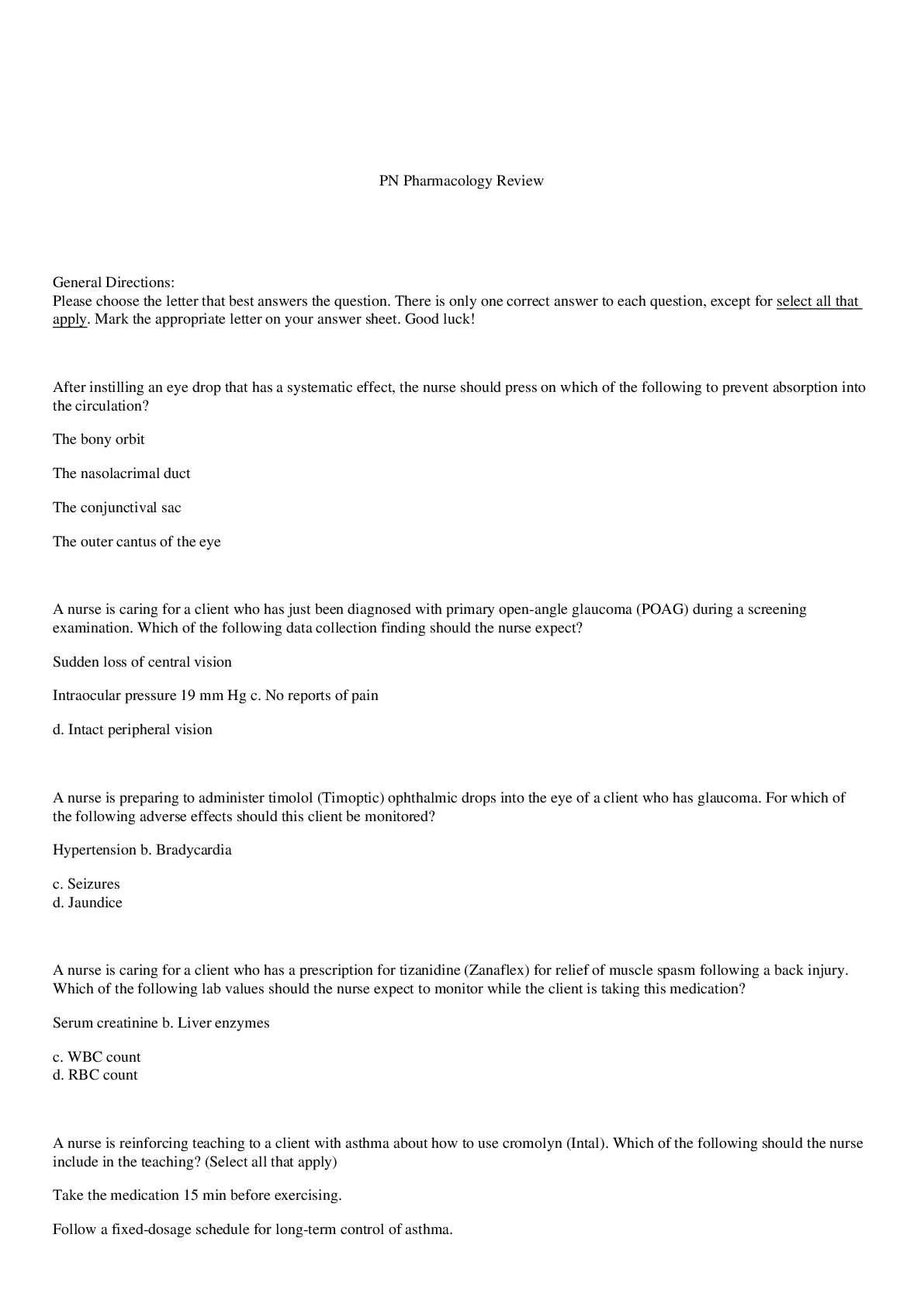
General Directions:
Please choose the letter that best answers the question. There is only one correct answer to each question,
except for select all that apply. Mark the appropriate letter on
...
PN Pharmacology Review
General Directions:
Please choose the letter that best answers the question. There is only one correct answer to each question,
except for select all that apply. Mark the appropriate letter on your answer sheet. Good luck!
1. After instilling an eye drop that has a systematic effect, the nurse should press on which of the
following to prevent absorption into the circulation?
a. The bony orbit
b. The nasolacrimal duct
c. The conjunctival sac
d. The outer cantus of the eye
2. A nurse is caring for a client who has just been diagnosed with primary open-angle glaucoma
(POAG) during a screening examination. Which of the following data collection finding should the
nurse expect?
a. Sudden loss of central vision
b. Intraocular pressure 19 mm Hg
c. No reports of pain
d. Intact peripheral vision
3. A nurse is preparing to administer timolol (Timoptic) ophthalmic drops into the eye of a client who
has glaucoma. For which of the following adverse effects should this client be monitored?
a. Hypertension
b. Bradycardia
c. Seizures
d. Jaundice
4. A nurse is caring for a client who has a prescription for tizanidine (Zanaflex) for relief of muscle
spasm following a back injury. Which of the following lab values should the nurse expect to
monitor while the client is taking this medication?
a. Serum creatinine
b. Liver enzymes
c. WBC count
d. RBC count
5. A nurse is reinforcing teaching to a client with asthma about how to use cromolyn (Intal). Which of
the following should the nurse include in the teaching? (Select all that apply)
a. Take the medication 15 min before exercising.
b. Follow a fixed-dosage schedule for long-term control of asthma.
c. Expect to lose weight while taking the medication.
d. Observe for adverse effects such as tremors, restlessness, and palpitations.
1/15
e. Do not crush or chew tablets.
6. A nurse is reinforcing teaching for a client with a prescription for a beclomethasone (QVAR)
inhaler to be used for the long-term management of asthma. Which of the following dietary
supplements should the client be sure to consume in sufficient amounts to prevent a deficiency
while taking the QVAR inhaler?
a. Iron and Protein
b. Calcium and Vitamin D
c. Vitamin B12 and folic acid
d. Vitamin E and K
7. A nurse is caring for a client who is prescribed oral prednisone (Deltasone) for the treatment of
chronic asthma. The nurse should plan to monitor the client for which of the following findings?
a. Weight loss
b. Infection
c. Hypoglycemia
d. Angina Pain
8. A nurse is caring for a client who states she has been taking phenylephrine (Neo-Synephrine) nasal
drops for the past 10 days for her upper respiratory symptoms. The nurse should plan to monitor
the client for which of the following findings?
a. Sedation
b. Nasal congestion
c. Productive cough
d. Constipation
9. A nurse is caring for a preschool-age child who may have taken an overdose of diphenhydramine
(Benadryl). To identify antihistamine toxicity, the nurse should plan to monitor the child for which
of the following?
a. Hallucinations
b. Bradycardia
c. Pinpoint pupils
d. Pallor
10. A nurse is reinforcing teaching for a client who has hypertension and is prescribed
hydrochlorothiazide (HydroDIURIL) twice daily. Which of the following instructions should the
nurse include in the client’s teaching?
a. “You should avoid foods high in potassium.”
b. “Take the second dose of the day by early afternoon.”
c. “Watch for ankle swelling that may appear late in the evening.”
d. “Limit your daily fluid intake to 11⁄2 L.”
2/15
11. A client has a new prescription for spironolactone (Aldactone). Which of the following laboratory
values should the nurse recognize as a reason to withhold the morning dose of the medication and
notify the provider?
a. Serum sodium 138 mEq/L
b. Serum potassium 5.2 mEq/L
c. Serum creatinine 1.2 mEq/L
d. Serum chloride 106 mEq/L
12. A nurse is caring for a client who is prescribed daily doses of both digoxin (Lanoxin) and
furosemide (Lasix). The client’s potassium level is 3.2 mEq/L. For which of the following
medication interaction is the client at risk?
a. Toxic levels of furosemide
b. Toxic levels of digoxin
c. Sub-therapeutic levels of furosemide
d. Sub-therapeutic levels of digoxin
13. Propranolol (Inderal) is contraindicated for a client who has which of the following conditions?
a. Asthma
b. Diabetes
c. Angina
d. Dementia
14. A nurse is reinforcing teaching for a client who has a prescription for verapamil (Calan). Which of
the following statements by the clients indicates a need for further teaching?
a. “I should increase the amount of fiber in my diet since the medication causes constipation.”
b. “I should eliminate grapefruit juice from my diet while taking verapamil.”
c. “I should decrease the amount of calcium in my diet while taking the medication.”
d. I should take the medication with food if it causes an upset stomach.”
15. A nurse is caring for a client with prescription for nifedipine (Procardia) to treat angina pectoris.
The nurse should plan to monitor the client for which of the following findings?
a. Weight loss
b. Reflex tachycardia
c. Grand mal seizures
d. Urinary Retention
16. A nurse is caring for a client on a medical unit who takes regular doses of propranolol (Inderal)
for hypertension. Before administering the client’s morning dose of propanolol, which of the
following should the nurse plan to monitor? (Select all that apply)
a. Urinary output
b. Pulse rate
c. Temperature
d. Blood pressure
e. Deep tendon reflexes
3/15
17. A nurse is reinforcing teaching for a client who is prescribed digoxin (Lanoxin). Which of the
following should the nurse instruct the client to report to the provider? (Select all that apply.)
a. Fatigue
b. Constipation
c. Anorexia
d. Rash
e. Diplopia
18. A nurse is caring for a client who is prescribed isosorbide mononitrate (Imdur) for chronic stable
angina. The nurse should plan to monitor the client for which of the following findings?
a. Bradycardia
b. Fever
c. Hypertension
d. Headache
19. A nurse is obtaining a medication history from a client who is to start a new prescription for
warfarin (Coumadin). Which of the following over-the-counter medications should the nurse
instruct the client to avoid?
a. Ranitidine (Zantac)
b. Docusate sodium (Colace)
c. Acetaminophen
d. Aspirin
20. A nurse is caring for a client who has angina pectoris and is prescribed a nitroglycerin patch
(Nitro-Dur) once daily. Which of the following are true regarding the administration of
transdermal nitroglycerin? (Select all that apply)
a. Apply the patch at the same time each morning
b. Leave the patch in place for 24 hr before replacing.
c. Put patch on a hairless area of skin.
d. Rotate the sites of administration with each application.
e. Cut patches in half to allow for smaller doses of prescribed medication.
21. A nurse is reinforcing teaching to a client who is prescribed lovastatin (Mevacor). Which of the
following should be included in the teaching?
a. Take the medication with the evening meal.
b. Change position slowly when rising from a chair.
c. Maintain a steady intake of green leafy vegetables.
d. Consume no more than 1L of fluid/day.
22. A nurse is reinforcing teaching for a client who is to begin taking a new prescription for niacin
(Niacor). The nurse should instruct the client to expect which of the following?
a. Facial flushing
b. Frontal headache
c. Blurred vision
d. Dry mouth
4/15
23. A nurse is caring for a client who takes a daily dose
[Show More]